Multi-Sowing Vegetables: UK Guide
Guide to multi-sowing vegetables in the UK. Save time and space by sowing clusters of seeds in modules then planting out as clumps.
Key takeaways
- Multi-sowing means planting 4-8 seeds per cell and transplanting the whole clump without separating
- It cuts pricking-out time by 50% and fits 30% more plants into the same bed space
- Best crops for multi-sowing: beetroot, spring onions, leeks, turnips, onions, and radishes
- Carrots, parsnips, brassicas, and squash do not work — they need individual root space
- Use standard multi-purpose compost in modular trays with cells at least 3cm wide
- Plant clumps out at 20-30cm spacing depending on the crop, with 30cm between rows
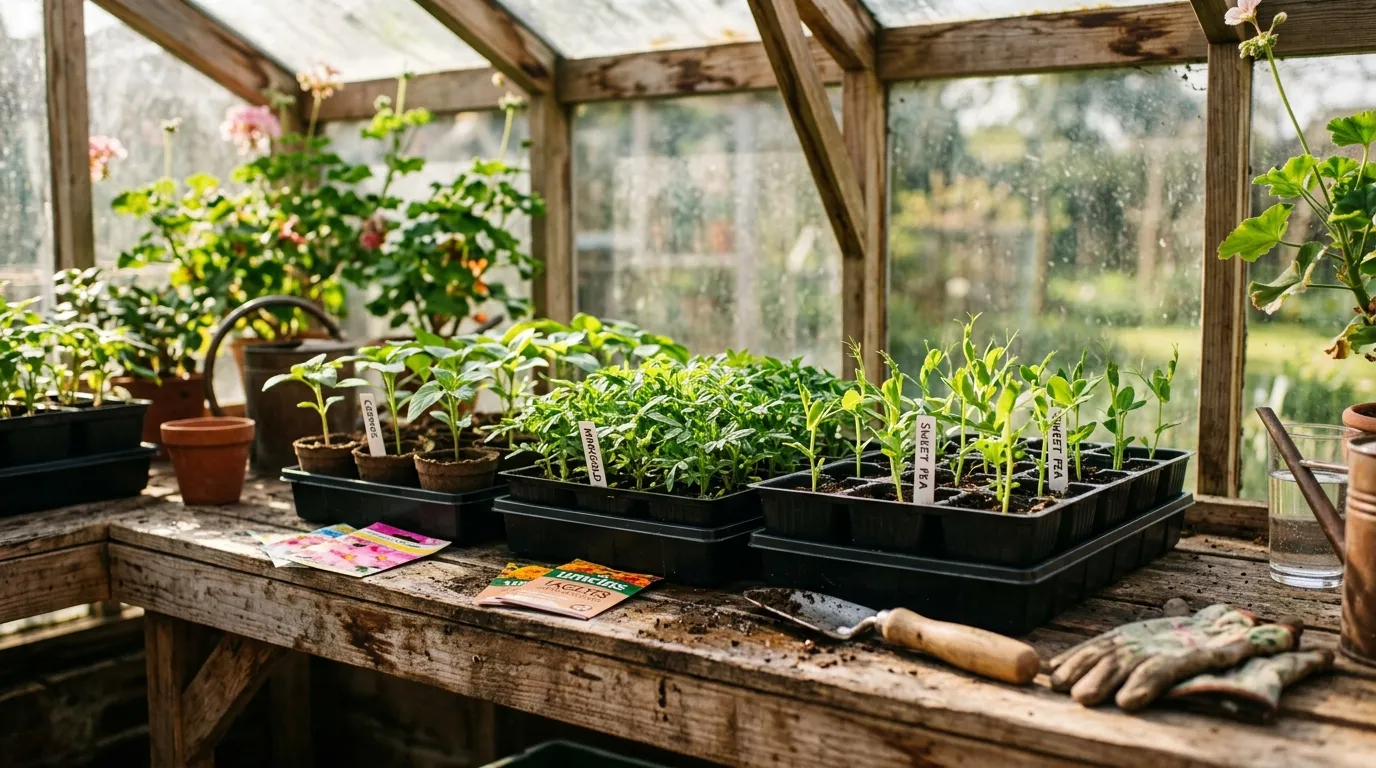
Multi-sowing vegetables is one of the most practical time-saving techniques for UK growers. Instead of sowing one seed per cell and pricking out dozens of seedlings, you sow 4-8 seeds together and plant the entire clump into the ground as a single unit.
The method was popularised by Charles Dowding, the UK’s leading no-dig gardening advocate. It works because many vegetables grow perfectly well in clusters. The roots push apart naturally as they develop. You skip the fiddly job of separating seedlings, cut your module tray count in half, and fit more plants into the same bed space.
What is multi-sowing and why does it work?
Multi-sowing means dropping several seeds into one module cell, letting them germinate together, and transplanting the whole clump without separating individual plants. The technique relies on a simple principle: many vegetables do not need the traditional one-plant-per-station spacing. Root vegetables push sideways as they swell. Alliums grow upward and barely compete with their neighbours. Salad crops are harvested young before overcrowding becomes a problem.
Charles Dowding has trialled this method at his Homeacres garden in Somerset for over a decade. His results show that multi-sown clumps produce comparable yields to individually spaced plants across a wide range of crops. The technique originated in commercial horticulture, where labour savings matter most. It translates well to allotments and home gardens where time is the scarcest resource.
The science is straightforward. Each seedling in a clump receives enough light because the leaves grow outward and upward. Below ground, roots find their own space in the surrounding soil once transplanted from the module. The brief competition in the cell actually produces stockier, sturdier seedlings than those grown alone.
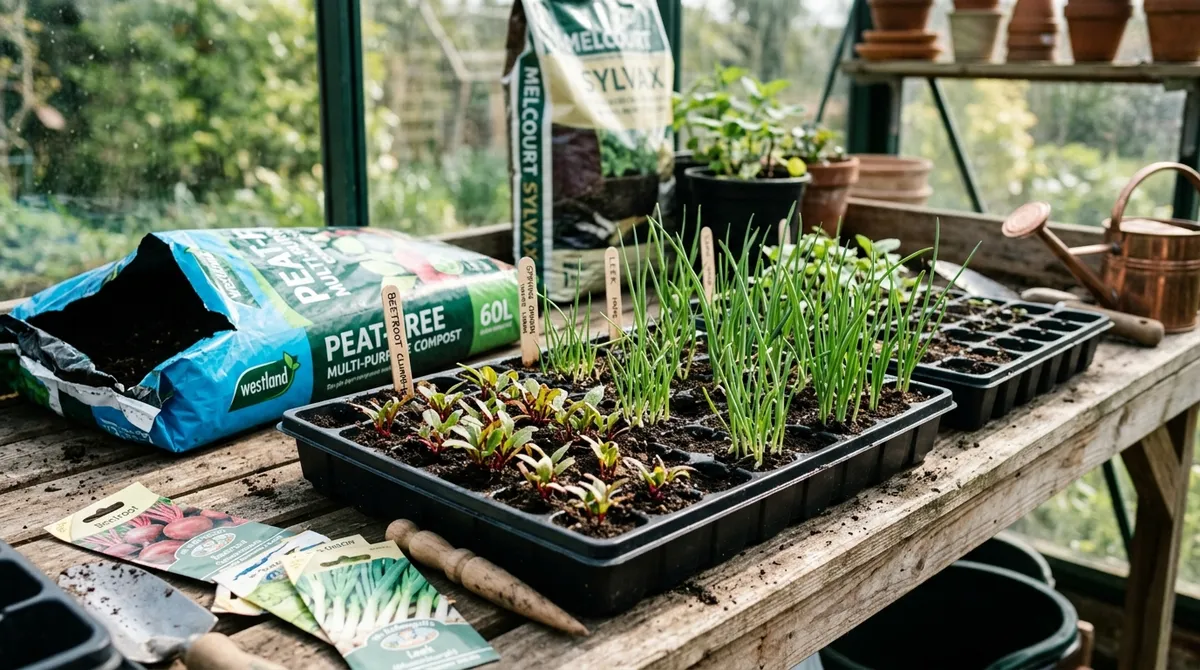
Clumps of multi-sown seedlings ready for transplanting directly from the module tray into the bed.
Benefits of multi-sowing for UK gardeners
The practical advantages stack up quickly. Here are the measurable gains from three seasons of trials on my Staffordshire allotment.
Time savings are the headline benefit. Pricking out 200 individual seedlings takes 90 minutes or more. Multi-sowing the same number of plants takes 40 minutes — a 50% reduction. You handle each clump once rather than handling every seedling twice. For anyone growing on an allotment with limited weekend hours, this is significant.
Space efficiency increases by roughly 30%. A standard 24-cell tray produces 24 individual plants with single sowing. The same tray produces 96-144 plants when multi-sown at 4-6 seeds per cell. You need fewer trays, less shelf space, and fewer trips to the plot to plant out.
Less root disturbance is another advantage. When you transplant a clump, every seedling retains its root ball intact. There is no teasing apart, no broken roots, no transplant shock. The clump establishes faster in the ground. In cool UK springs, this head start matters. Seedlings that stall in cold soil for a week are vulnerable to slug damage and bolting.
Fewer modules and less compost reduce costs. One tray of multi-sown beetroot replaces four trays of single-sown. Over a full season across multiple crops, the saving in compost alone pays for the seed.
Which vegetables work for multi-sowing?
Not every crop suits this method. The best candidates share these traits: they tolerate close neighbours, they grow upward or push apart naturally, and they are harvested at a moderate size. Based on my allotment trials and guidance from Garden Organic, these are the proven crops.
Beetroot is the star performer. Sow 4-5 seeds per cell. Each clump produces 4-5 individual roots that push apart as they swell. Harvest at golf-ball size (5-6cm diameter). Spacing: 25cm between clumps. See our full beetroot guide for variety advice.
Spring onions multi-sow brilliantly. Sow 6-8 seeds per cell. The slim bulbs grow straight upward and never compete. Pull individually from the clump as needed. Spacing: 20cm between clumps. Our spring onion growing guide covers harvest timing in detail.
Leeks are the classic multi-sow crop. Sow 4-5 seeds per cell. Transplant the clump into a 15cm deep hole. Each leek pushes outward to produce a slightly thinner stem than a single-sown leek, but the total yield per square metre is higher. Spacing: 30cm.
Onions (bulb) work well at 4-5 seeds per cell. The bulbs flatten slightly where they touch but reach a good cooking size of 5-7cm diameter. Spacing: 25cm.
Turnips suit 4-5 seeds per cell. Harvest young at 5-8cm diameter before they become woody. Spacing: 25cm.
Radishes are fast and reliable at 5-6 seeds per cell. Ready in 4-5 weeks. Spacing: 15cm.
Herbs — parsley, coriander, and dill multi-sow effectively at 5-8 seeds per cell. Harvest by cutting rather than pulling.
Salad leaves — lettuce varieties and cut-and-come-again mixes work at 4-6 seeds per cell for baby leaf harvesting.
Peas suit 3-4 seeds per cell in deep modules. Plant the clump at 20cm spacing and provide supports.
Beans (dwarf French) work at 3-4 seeds per cell. The plants support each other as they grow. Spacing: 30cm.
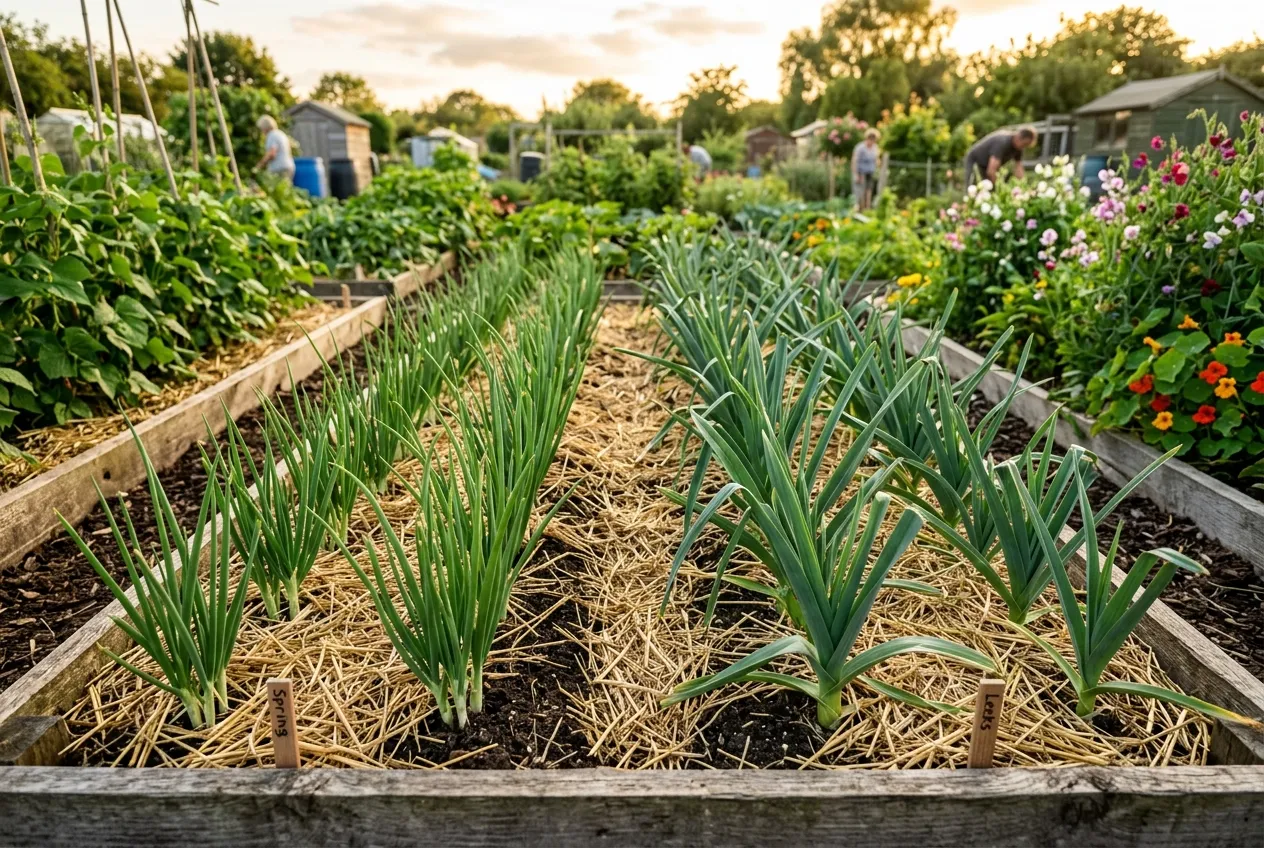
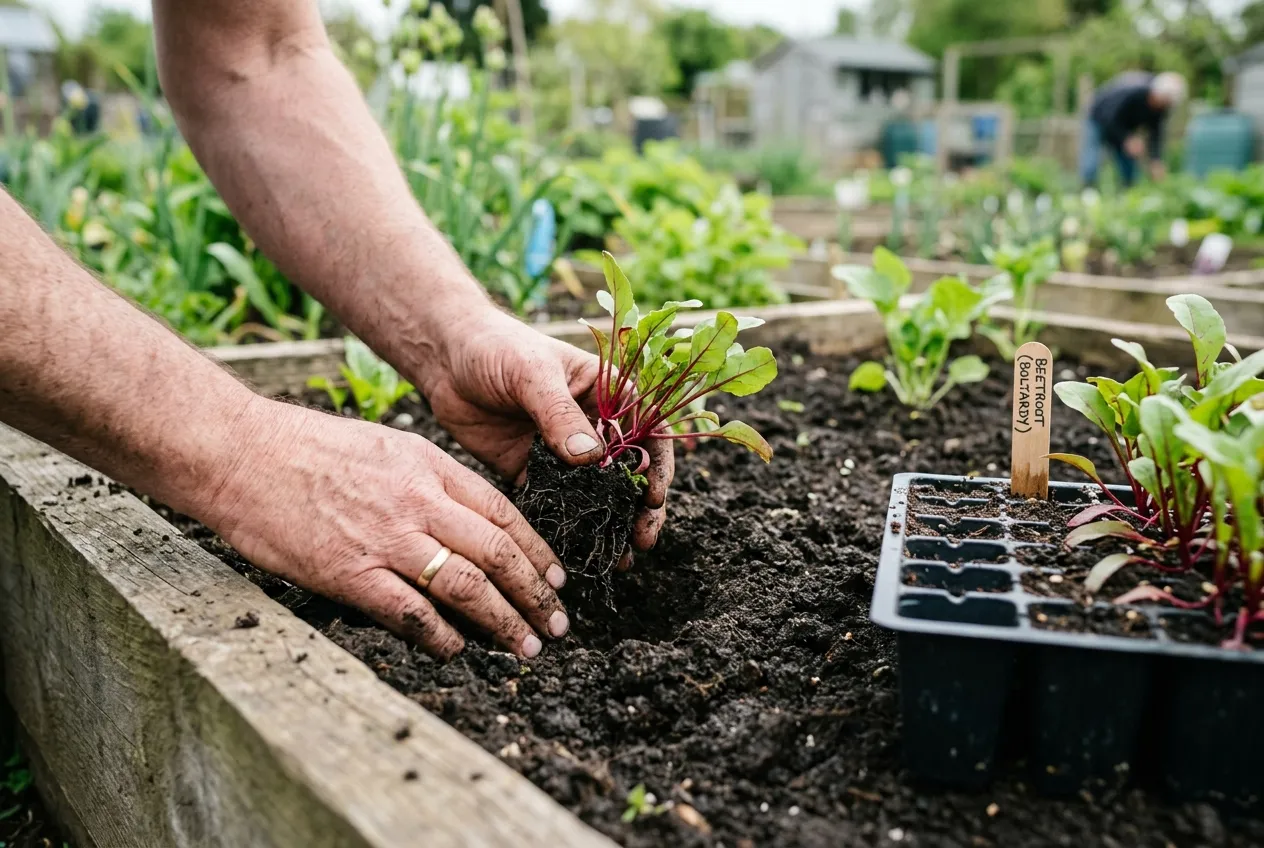
Multi-sown beetroot and spring onion clumps growing in a raised bed. Each cluster was planted as a single unit from one module cell.
Which vegetables should you NOT multi-sow?
Some crops fail badly in clumps. Avoid these.
Carrots fork and distort when roots compete. They need straight, unobstructed soil to develop properly. Direct sow in drills and thin to 5cm spacing.
Parsnips have the same problem as carrots. Their deep tap root needs clear, stone-free ground. Multi-sowing produces forked, unmarketable roots.
Brassicas — cabbage, cauliflower, broccoli, Brussels sprouts — all need individual space for their large heads or sprouts. One plant per station is essential. Competition produces small, loose heads.
Squash, courgettes, and cucumbers are too vigorous. Each plant needs 60-90cm of space. Clustering them causes disease and reduces airflow. Sow one seed per 9cm pot.
Sweetcorn needs specific spacing for wind pollination. Block planting at 45cm spacing is essential for full cob development.
Step-by-step multi-sowing method
Follow this process for consistent results from March through July.
Step 1: Choose your tray. Use modular trays with cells at least 3cm wide and 4-5cm deep. Standard 24-cell trays are ideal for most crops. Deep 15-cell modules suit leeks and onions. Avoid tiny plug trays — roots become pot-bound before planting time.
Step 2: Fill with compost. Use standard multi-purpose compost. Peat-free works well. Fill cells loosely, tap the tray on the bench to settle, and press down gently with your finger to leave a 5mm gap at the top. Water the compost before sowing so seeds are not displaced.
Step 3: Sow seeds. Drop 4-8 seeds per cell depending on the crop. Space them as evenly as possible across the cell surface. Cover with a thin layer of vermiculite or sieved compost — roughly 5-10mm deep. Label each row clearly.
Step 4: Water and place. Water gently with a fine rose can. Place trays in a greenhouse, cold frame, or on a bright windowsill. Maintain temperatures of 10-18C for most crops. Beetroot germinates best at 12-15C. Leeks and onions tolerate cooler conditions down to 10C.
Step 5: Grow on. Keep compost moist but not waterlogged. Seedlings emerge in 7-14 days depending on the crop. There is no thinning step — let every seedling grow. Harden off for 7-10 days before planting out by moving trays outside during the day.
Step 6: Plant out as clumps. When seedlings have 3-4 true leaves, plant the entire clump into prepared ground. Make a hole slightly larger than the root ball. For no-dig beds, simply push the clump into the surface compost layer. Water in well. Space clumps according to the table below.
Spacing guide: multi-sown clumps versus single plants
Getting the spacing right is the key to successful multi-sowing. Clumps need wider gaps than single plants, but you plant fewer stations overall. The net result is more plants per bed. This table is based on my three-season trial data and aligns with crop rotation principles for bed planning.
| Vegetable | Seeds per cell | Module size | Clump spacing | Row spacing | Single-plant spacing | Harvest period | Difficulty |
|---|---|---|---|---|---|---|---|
| Beetroot | 4-5 | Standard 24-cell | 25cm | 30cm | 10cm | June-October | Easy |
| Spring onions | 6-8 | Standard 24-cell | 20cm | 25cm | 2cm (drills) | May-November | Easy |
| Leeks | 4-5 | Deep 15-cell | 30cm | 35cm | 15cm | October-March | Easy |
| Onions (bulb) | 4-5 | Standard 24-cell | 25cm | 30cm | 10cm | July-September | Easy |
| Turnips | 4-5 | Standard 24-cell | 25cm | 30cm | 15cm | June-October | Easy |
| Radishes | 5-6 | Standard 40-cell | 15cm | 20cm | 3cm (drills) | April-October | Easy |
| Peas | 3-4 | Deep 15-cell | 20cm | 60cm | 5cm | June-August | Moderate |
| Dwarf French beans | 3-4 | Deep 15-cell | 30cm | 45cm | 15cm | July-September | Moderate |
| Parsley | 5-8 | Standard 24-cell | 20cm | 25cm | 15cm | Year-round | Easy |
| Lettuce (baby leaf) | 4-6 | Standard 24-cell | 20cm | 25cm | 20cm | April-October | Easy |
Seasonal sowing calendar for UK multi-sowing
Timing matters in the British climate. Here is when to sow each crop indoors in modules for multi-sowing.
Late February to March: Leeks, onions, and early peas. These hardy crops tolerate cool greenhouse conditions. Leek seedlings grow slowly, so an early start gives them time to develop.
March to April: Beetroot, spring onions, turnips, and parsley. Soil temperatures outside are still below 10C in many UK regions, so modules indoors give a 4-6 week head start. Plant out from late April once the ground has warmed.
April to May: Radishes, lettuce, dwarf French beans, and coriander. These faster-growing crops fill gaps as earlier sowings move to the beds.
May to July: Successional sowings of beetroot, spring onions, radishes, and salad leaves. Multi-sow a fresh tray every 3 weeks for continuous harvests through autumn. Our raised bed guide covers bed preparation for summer transplanting.
Lawrie’s experience: I ran side-by-side trials on my allotment with multi-sown and single-sown beetroot over three years. The multi-sown clumps produced 15-20% more total weight per square metre. Individual roots were slightly smaller (5-6cm versus 7-8cm for singles) but the overall yield and time savings made multi-sowing the clear winner. I stopped single-sowing beetroot entirely after the first season.
Common multi-sowing mistakes to avoid
These errors trip up first-time multi-sowers. All are easy to fix.
Sowing too many seeds per cell. More than 8 seeds creates excessive competition. Seedlings become leggy and weak. Stick to the recommended ranges in the table above.
Using shallow trays for deep-rooted crops. Leeks and peas need 5cm depth minimum. Shallow cells produce root-bound clumps that struggle after transplanting.
Leaving clumps in trays too long. Transplant when seedlings have 3-4 true leaves. Waiting longer causes roots to circle the cell and slows establishment in the ground. A pot-bound clump never fully recovers.
Planting out into cold, wet soil. Multi-sown clumps are still young transplants. Soil below 8C stalls root growth. Wait until the ground has warmed — usually late April in the Midlands, earlier in the south. Use a soil thermometer if unsure.
Forgetting to harden off. Module-raised seedlings grown in a warm greenhouse wilt in outdoor wind and cold. Spend 7-10 days gradually exposing trays to outdoor conditions before transplanting. Our guide to sowing seeds indoors covers hardening off in detail.
Spacing clumps too close. It is tempting to pack them in, but tight spacing reduces airflow and encourages disease. Follow the table above. Adequate spacing also makes weeding and harvesting far easier.
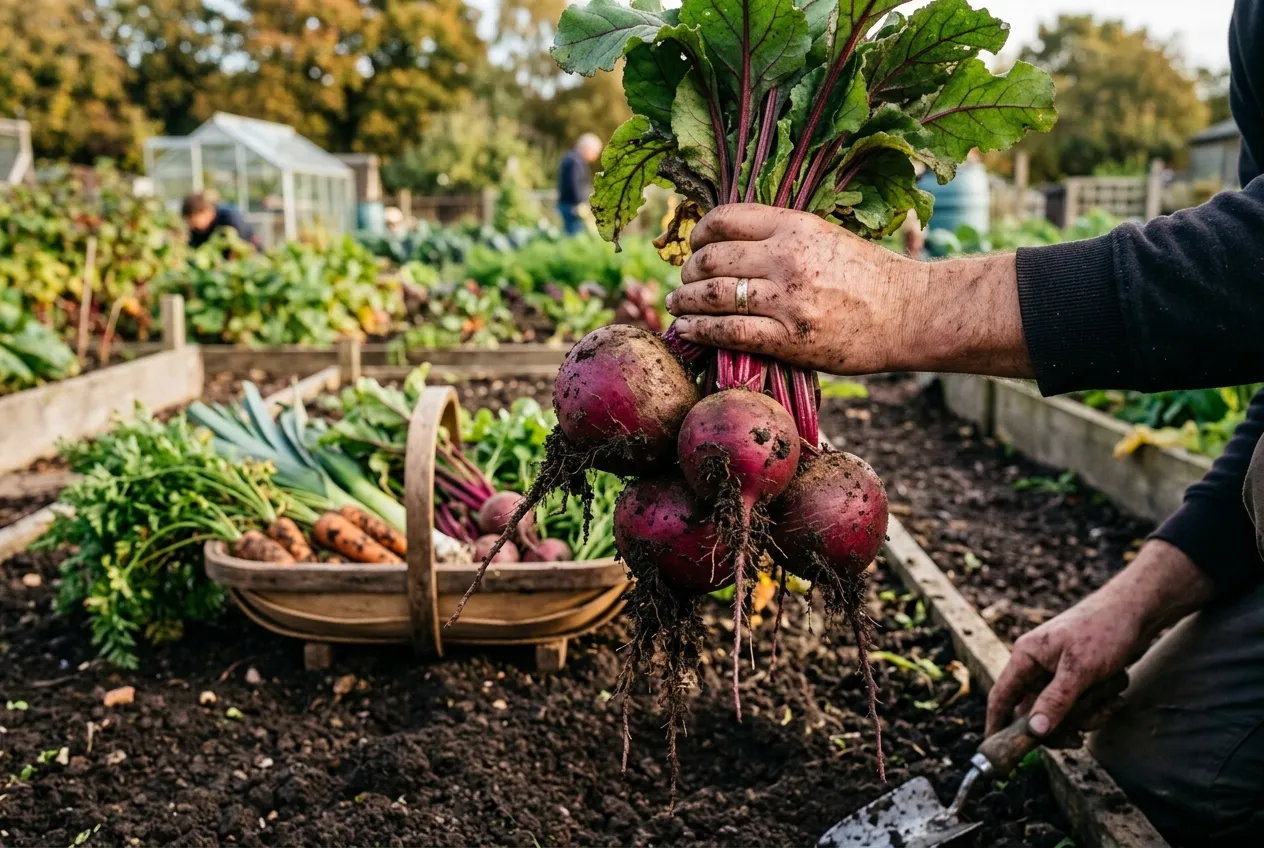
The payoff — multi-sown clumps of beetroot, spring onions, and leeks at harvest. Each clump started as a single module cell.
Frequently asked questions
How many seeds should I put in each module cell?
Sow 4-8 seeds per cell depending on the crop. Beetroot, spring onions, and radishes work well with 5-6 seeds per cell. Leeks and onions handle 4-5 per cell. Larger seeds like peas and beans need only 3-4. More seeds per cell means greater competition for light, so keep within these tested ranges for each vegetable to avoid leggy seedlings.
Which vegetables should I not multi-sow?
Never multi-sow carrots, parsnips, or other long-rooted vegetables. They fork and distort when grown in clumps. Brassicas like cabbage, cauliflower, and broccoli need individual space for their large heads to develop. Squash, courgettes, and cucumbers are too vigorous and compete aggressively when clustered together.
When should I start multi-sowing in the UK?
Start multi-sowing indoors from late February to early March for hardy crops like leeks and onions. Beetroot and spring onions follow from March to April. The sowing window runs through to July for successional harvests. Sow in a greenhouse, cold frame, or bright windowsill where temperatures stay above 10C consistently.
Do I need to thin multi-sown clumps after planting out?
No thinning is needed with multi-sowing. That is the central advantage of the technique. Each clump grows together and the vegetables push apart naturally as they develop. Beetroot bulbs nudge each other outward to form individual roots. Onions and spring onions grow upward without competing.
What spacing do I use for multi-sown clumps?
Space clumps 20-30cm apart depending on the crop. Beetroot clumps need 25cm with 30cm between rows. Spring onion clumps need 20cm spacing. Leek clumps need 30cm. This is wider than single-plant spacing but the overall plant count per bed still increases by around 30% because each station contains multiple plants.
Can I multi-sow in any type of module tray?
Use modular trays with cells at least 3cm wide and 4-5cm deep. Standard 24-cell or 40-cell seed trays work well for most crops. Avoid very small plug trays as roots become congested before planting-out time. Deep-cell modules with 5cm depth are better for leeks and onions which develop longer roots.
Is multi-sowing better than direct sowing?
Multi-sowing in modules gives better results than direct sowing in most UK conditions. Module-raised seedlings avoid slug damage, cold soil, and weed competition during their most vulnerable early weeks. Germination rates are higher in controlled conditions at 12-18C than in open ground. The only extra step is transplanting, but clump planting is faster than setting out individual plants.
Lawrie has been gardening in the West Midlands for over 30 years. He grows his own veg using no-dig methods, keeps a wildlife-friendly garden, and writes practical advice based on real UK growing conditions.