When to Plant Sunflowers in the UK
Exact timing for sowing sunflowers indoors and outdoors across UK regions. Covers giant, dwarf, and multi-headed varieties with planting calendars.
Key takeaways
- Sow sunflowers indoors from mid-April at 15-20C for the earliest flowers
- Direct sow outdoors from late April to early May when soil reaches 10C
- Giant varieties need 90-100 days to flower and reach over 3m tall
- Dwarf varieties like Sunspot flower in 60-70 days at just 60cm tall
- Sunflowers need full sun, shelter from wind, and well-drained soil
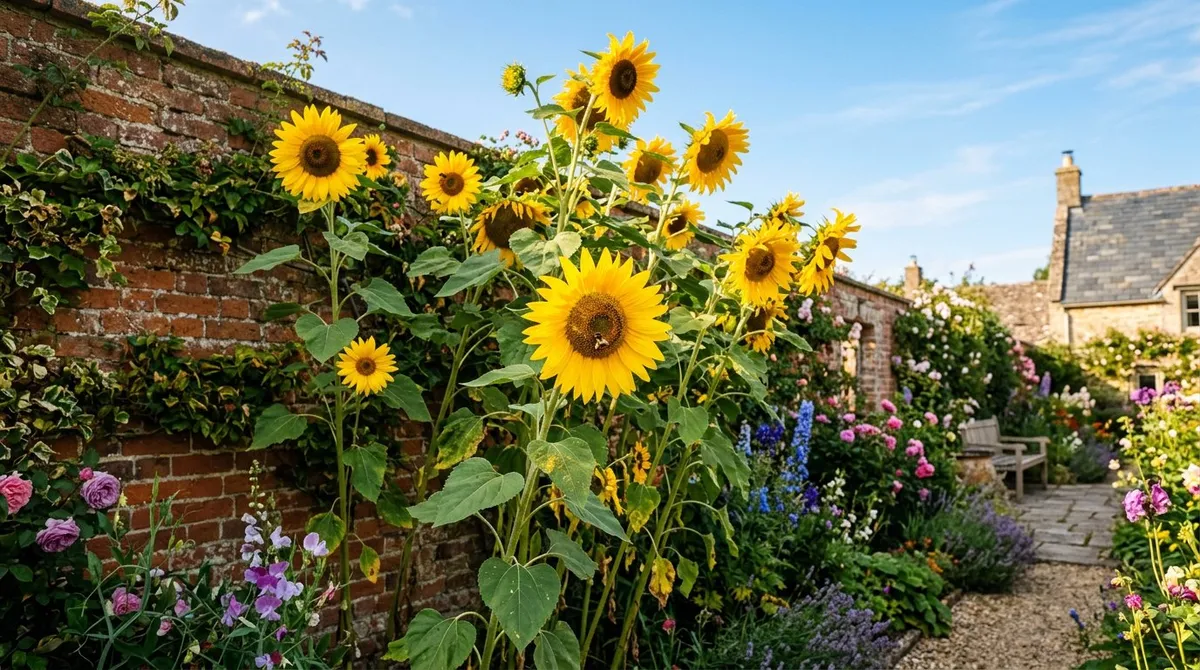
Sunflowers are one of the simplest and most rewarding flowers to grow in a UK garden. Children love them for the growing competition. Adults love them for the dramatic late-summer display. Bees and birds love them for the pollen and seeds. Getting the timing right is straightforward.
This guide covers when to sow and plant sunflowers across all UK regions, with advice on variety selection and growing methods. For the full growing guide including staking, feeding, and harvesting, see how to grow sunflowers. For a broader view of what to plant alongside your sunflowers, see our May planting guide and seed sowing calendar.
When to sow sunflowers indoors
Start sunflowers indoors from mid-April. This gives seedlings a 2-3 week head start before they go outdoors after the last frost.
Indoor sowing method
Sow one seed per 9cm pot, 2cm deep. Use multipurpose compost. Sunflower seeds are large and easy to handle. Germination takes 7-14 days at 15-20C. A warm windowsill provides enough heat.
Sunflowers grow rapidly indoors. A seedling sown in mid-April can reach 15-20cm within three weeks. Do not sow earlier than mid-April because the plants outgrow their pots before it is safe to plant them out. March-sown sunflowers become tall, leggy, and root-bound by planting-out time.
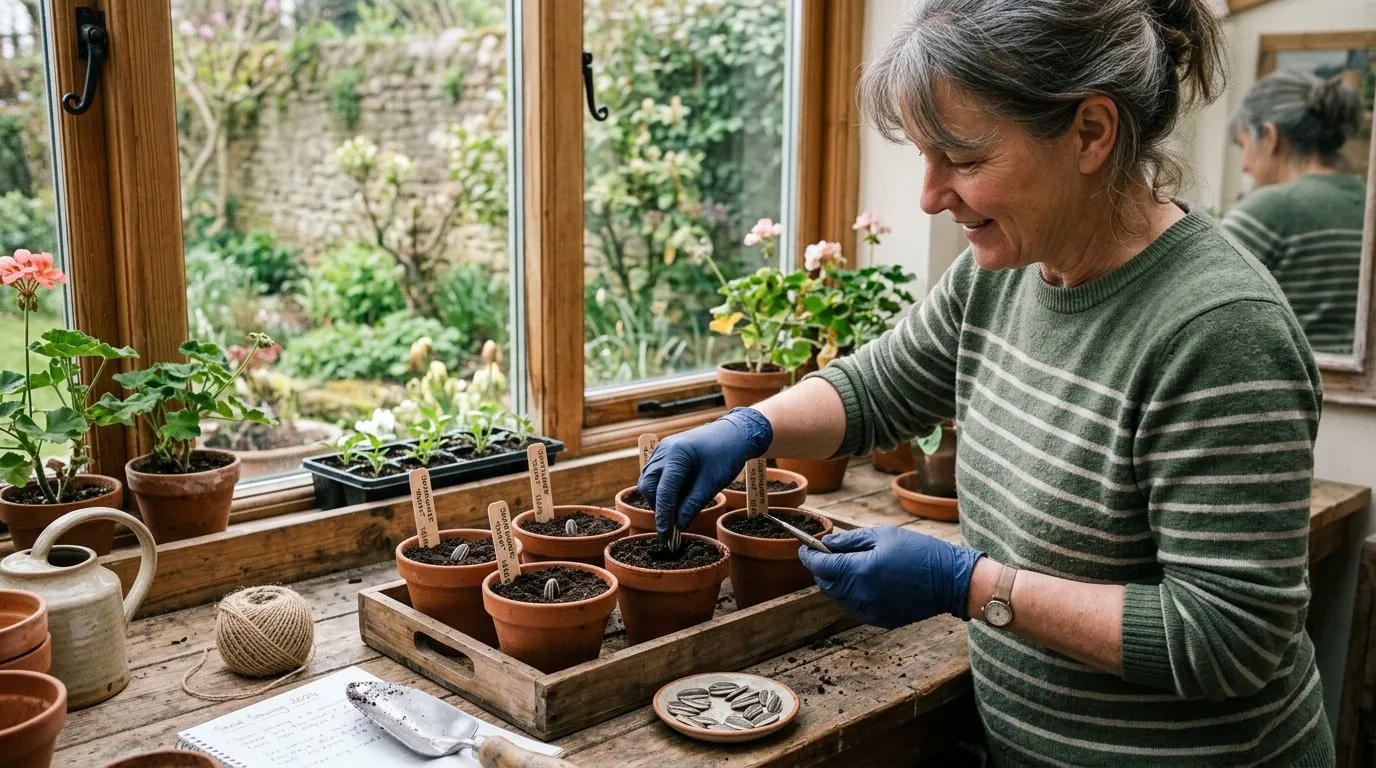 Sowing one sunflower seed per 9cm pot, 2cm deep. Seeds are large and easy to handle.
Transplanting
Plant out from late May in southern England, early June in the north. Sunflowers dislike root disturbance, so handle the root ball carefully when transplanting. Biodegradable pots (peat-free fibre pots) that go directly into the ground avoid root disturbance entirely.
Water thoroughly after planting and provide a sturdy stake for tall varieties immediately. A 2m sunflower in August catches the wind like a sail. Stakes installed at planting time prevent root damage later.
Gardener’s tip: Sow a few extra seeds as insurance against slug damage. Slugs target sunflower seedlings in the first fortnight after planting out. A ring of copper tape or a scattering of organic slug pellets around each plant helps. See our guide on getting rid of slugs for more methods.
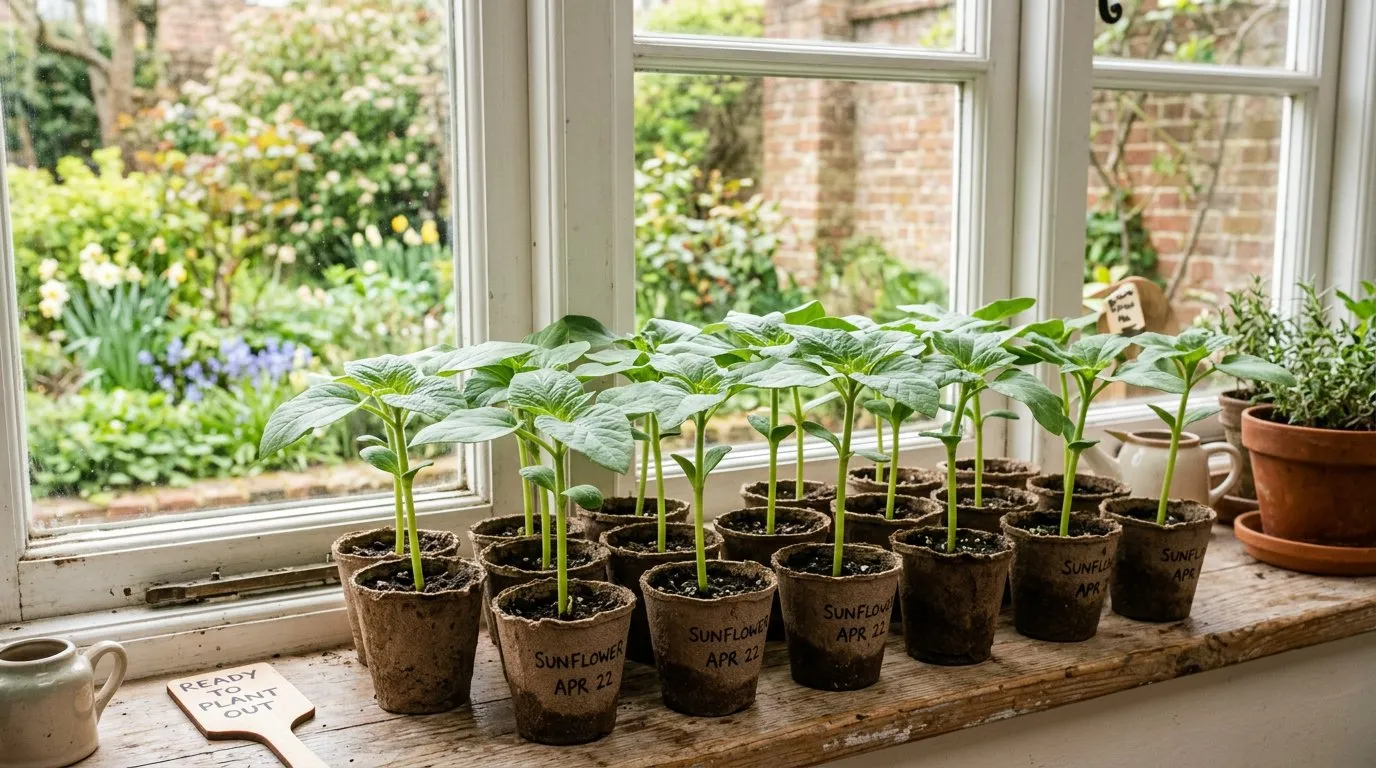 Sunflower seedlings ready for planting out. At 15-20cm tall, these April-sown plants can go outdoors from late May.
When to direct sow sunflowers outdoors
Direct sowing outdoors is the simplest approach. No potting on, no hardening off, no transplant shock.
Outdoor sowing timeline
| Region | Direct sow from | Soil temperature needed | Notes |
|---|---|---|---|
| South-west England | Late April | 10C | Mildest area, earliest sowing |
| Southern England | Late April to early May | 10C | After last hard frost |
| Midlands | Early May | 10C | Wait for soil to warm |
| Northern England | Mid-May | 10C | Later start, shorter season |
| Scotland | Late May | 10C | Focus on fast-maturing varieties |
Push a soil thermometer 5cm into the ground. You need 10C for reliable sunflower germination. Below this, seeds sit in cold soil and rot or germinate slowly. In a warm spring, southern gardens can reach 10C by late April. In a cold spring, wait until early May.
How to direct sow
Sow seeds 2cm deep, one per position. Space dwarf varieties 30cm apart, standard varieties 45cm, and giant varieties 60cm. Water the drill before sowing if the soil is dry. Cover with soil and firm gently.
Protect newly sown areas from birds. Pigeons and sparrows dig up large seeds. Cover with wire mesh or fleece until seedlings emerge. Remove the covering once plants reach 10cm tall.
Variety comparison and timing
Different sunflower varieties have different flowering times. Matching the variety to your sowing date ensures flowers when you want them.
| Variety | Type | Height | Days to flower | Best sow date | Flower colour |
|---|---|---|---|---|---|
| Russian Giant | Single head giant | 3-4m | 90-100 | Mid-April (indoor) | Golden yellow |
| Mammoth | Single head giant | 3-3.5m | 90-100 | Mid-April (indoor) | Golden yellow |
| Sunspot | Dwarf single head | 50-60cm | 60-70 | Late April-May | Golden yellow |
| Teddy Bear | Dwarf double | 50-60cm | 60-65 | Late April-May | Golden yellow, fluffy |
| Velvet Queen | Multi-headed | 1.5-1.8m | 70-80 | Late April-May | Deep red-bronze |
| Autumn Beauty | Multi-headed | 1.5-2m | 75-85 | Late April-May | Mixed reds, oranges, yellows |
| Italian White | Multi-headed | 1.2-1.5m | 70-80 | Late April-May | Cream with dark centre |
| Lemon Queen | Multi-headed | 1.5-2m | 75-85 | May | Pale lemon yellow |
Giant varieties
Giant sunflowers need the longest growing season. Sow indoors in mid-April for the earliest start, or outdoors in early May in the south. In northern England and Scotland, indoor sowing is strongly recommended for giant types because the outdoor growing season may not be long enough.
Giant varieties are top-heavy and need staking from 60cm tall. Use a 2.4m bamboo cane or a sturdy wooden stake. Tie the stem loosely with soft string as it grows. Never tie tightly because the stem expands rapidly.
Dwarf varieties
Dwarf sunflowers are ideal for containers, borders, and children’s gardens. They flower in 60-70 days and stay below 60cm. Sow outdoors from late April. These are the most forgiving type for late sowings. Even a June sowing flowers by August.
Sunspot and Teddy Bear are the most popular dwarf varieties. Sunspot produces a single large flower head on a short stem. Teddy Bear has fully double, fluffy flowers that last well as cut flowers.
Multi-headed varieties
Multi-headed sunflowers produce dozens of smaller flowers on branching stems. They are better for cutting and provide a longer flowering period than single-headed types. Velvet Queen, Autumn Beauty, and Italian White are all multi-headed.
These varieties are also the best for wildlife. Each flower head feeds pollinators, and the smaller seed heads attract finches and tits through autumn and winter. For more on supporting pollinators, see our guide on bee-friendly garden plants.
Why we recommend Velvet Queen for wildlife gardens: After 30 years of growing sunflowers across different UK gardens, Velvet Queen consistently attracts more pollinators than any other variety we have trialled. Its deep bronze-red flowers average 12-15 individual blooms per plant, and the seed heads reliably draw goldfinches from September onwards, providing 6-8 weeks of bird interest after flowering ends.
Warning: Some modern sunflower varieties are pollen-free, bred specifically for the cut flower industry. These are useless for wildlife. Check the packet description. Choose open-pollinated varieties with visible pollen for bee and butterfly support.
Growing conditions
Sun
Sunflowers need 6-8 hours of direct sunlight daily. South-facing positions are best. Young sunflower plants exhibit heliotropism: they track the sun across the sky during the day, facing east each morning and turning west by evening. Once the flower head opens fully, it faces east permanently.
Soil
Sunflowers tolerate most soil types but prefer well-drained, fertile ground. They are deep-rooted plants that can reach water and nutrients other flowers cannot. Heavy clay soil benefits from compost incorporation before planting.
Shelter
Wind is the main enemy of tall sunflowers. A sheltered position against a wall or fence protects stems from snapping. Stake all varieties over 1m tall from an early stage. In exposed gardens, choose multi-headed or dwarf varieties that resist wind damage.
Water
Water regularly during dry spells, particularly when plants are establishing and when flower buds are forming. A deep watering twice a week is better than a light daily sprinkle. Once established, sunflowers are drought-tolerant.
Sowing calendar by purpose
| Purpose | Sow date | Variety type | Flower period |
|---|---|---|---|
| Earliest flowers | Mid-April (indoor) | Dwarf or standard | Late June-July |
| Summer display | Early May (outdoor) | Any type | July-August |
| Late summer colour | Early June | Multi-headed, dwarf | August-September |
| Bird seed harvest | Mid-April (indoor) | Giant, single head | September (harvest seeds October) |
| Children’s growing competition | Late April (outdoor) | Giant | August-September (measure in August) |
| Cut flowers | May | Multi-headed | July-September |
Saving seeds and feeding birds
Leave spent flower heads on the plant through autumn. The seeds ripen over 4-6 weeks after the petals drop. You know they are ready when the back of the flower head turns brown and dry, and the seeds feel firm.
Cut the heads and hang them in a dry shed for a week to finish drying. Store seeds in paper bags for next year’s sowing, or hang the heads in the garden as bird feeders. Goldfinches, greenfinches, and blue tits feed on sunflower seeds through winter.
Alternatively, leave the heads on the standing plant. Birds strip the seeds directly, and the hollow stems provide winter shelter for insects. This approach supports garden birds through the leanest months.
Common mistakes
Sowing too early indoors
Sunflowers grow so fast that March-sown seedlings are 40cm tall and root-bound before it is safe to plant out. Wait until mid-April for indoor sowing. The 4-6 week indoor period is all they need.
Planting in shade
Sunflowers in partial shade grow tall and lean toward the light, producing weak stems and small flowers. They flower late and produce fewer seeds. Full sun is non-negotiable for good results.
Spacing too closely
Overcrowded sunflowers compete for light, water, and nutrients. The result is thin stems, small flower heads, and increased risk of fungal disease in damp weather. Follow the spacing guide: 30cm for dwarf, 45cm for standard, 60cm for giant.
Ignoring slug protection
Sunflower seedlings are a slug favourite. Newly planted seedlings can be stripped to bare stems overnight. Protect with copper tape, organic pellets, or nematode treatments for the first two weeks after planting out or emergence.
Not staking early enough
A 2m sunflower in a summer storm snaps if unstaked. Install stakes at planting time or when seedlings reach 30cm. Adding a stake to a mature plant risks root damage. Tie stems loosely at 30cm intervals as the plant grows.
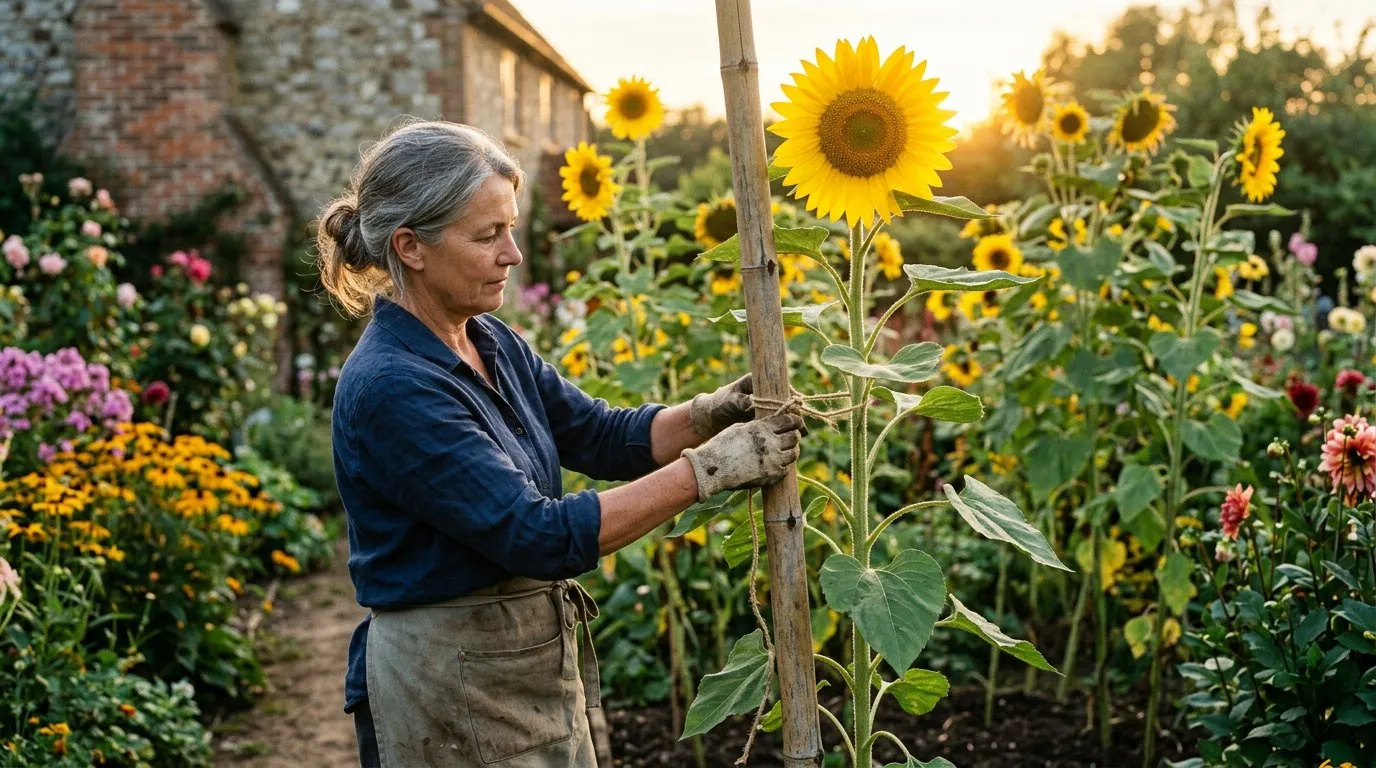 Staking a tall sunflower variety. Install supports early to avoid root damage later in the season.
Why we recommend biodegradable fibre pots for indoor-sown sunflowers: After 12 seasons of starting sunflowers indoors using plastic pots, root trainers, and fibre pots, Lawrie found that biodegradable pots planted directly into the ground eliminated transplant shock entirely. Sunflowers moved in plastic pots lost an average of 5 days to recovery, while fibre-pot plants showed zero growth stalling and reached flowering height 8-10 days sooner.
Now you’ve mastered sunflower sowing timings, read our full guide on how to grow sunflowers for the next step.
Frequently asked questions
When is the best time to plant sunflower seeds UK?
Late April to early May is ideal for outdoor sowing. Soil temperature must reach 10C for reliable germination. Indoor sowing from mid-April gives a 2-3 week head start. Seeds germinate in 7-14 days at 15-20C.
Can I plant sunflower seeds in March?
March is too early for both indoor and outdoor sowing. Indoor-sown sunflowers grow so fast they outgrow their pots in 4-6 weeks. Since they cannot go outdoors until late May, March sowings become leggy and root-bound. Wait until mid-April for indoor starts.
How late can I sow sunflowers in the UK?
Sow until mid-June for late summer flowers. Dwarf varieties sown in June flower by August. Giant varieties sown after early June may not reach full height before autumn arrives and day length shortens. Our June planting guide covers other crops you can still start.
Do sunflowers need full sun?
Yes, sunflowers need at least 6-8 hours of direct sunlight daily. They track the sun across the sky as young plants and perform best in the warmest, brightest part of the garden. A south-facing wall or fence creates the ideal microclimate.
How long do sunflowers take to grow?
Dwarf varieties flower in 60-70 days from sowing. Standard types take 70-85 days. Giant varieties need 90-100 days from sowing to full flower. These timings assume warm, sunny growing conditions. Cool or wet summers extend the timeline.
Should I sow sunflowers indoors or outdoors?
Both methods work well. Indoor sowing gives a 2-3 week head start and protects seedlings from slug damage during their most vulnerable stage. Outdoor direct sowing is simpler and avoids transplant shock. If starting indoors, use biodegradable pots to minimise root disturbance when planting out.
Lawrie has been gardening in the West Midlands for over 30 years. He grows his own veg using no-dig methods, keeps a wildlife-friendly garden, and writes practical advice based on real UK growing conditions.