Allotment Water Supply Solutions UK
Allotment water supply solutions for UK plots. Rainwater harvesting, drip irrigation, water butt sizing, and hosepipe ban rules from tested experience.
Key takeaways
- A half-plot allotment uses 2,500-5,000 litres per growing season -- rainwater harvesting can supply over half that amount for free
- Two linked 210-litre water butts (420L total) cost under 100 pounds and fill 9-12 times per season from a 10 sq m shed roof
- Drip irrigation from a gravity-fed water butt saves 40-60% water compared to watering cans and reduces fungal disease
- Hosepipe bans under the Water Industry Act 1991 can restrict mains allotment standpipes to watering cans only
- Mulching beds with 5-8 cm of organic matter cuts watering frequency by 50-70% on allotment plots
- A complete allotment water system costs 50-150 pounds for a half plot depending on the level of automation
Allotment water supply is the difference between a productive plot and one that struggles through every British summer. A half-plot allotment needs 2,500 to 5,000 litres across the April-to-September growing season, and carrying that volume in watering cans from a communal standpipe is backbreaking work.
The right combination of rainwater harvesting, stored water, and efficient delivery cuts both the effort and the cost. This guide covers every practical solution, from sizing water butts to installing gravity-fed drip irrigation, based on three seasons of measured results on a Midlands clay allotment.
What are the best allotment water supply options?
UK allotments rely on three main water sources: communal mains standpipes, rainwater collection in water butts, and gravity-fed irrigation systems. The most reliable plots use at least two of these together. Relying on a single source leaves you exposed during dry spells and hosepipe bans.
Here is how the main allotment water supply solutions compare:
| Water Source | Setup Cost | Annual Cost | Storage/Supply | Pressure | Best For |
|---|---|---|---|---|---|
| Communal standpipe | Free (in rent) | £15-60 site rates | Unlimited (shared) | Mains 1-3 bar | Filling cans and topping up butts |
| Single 200L water butt | £20-40 | £0 | 200L per fill | Gravity only | Small plots and backup supply |
| Linked butts (400-600L) | £50-100 | £0 | 400-600L per fill | Gravity (raised) | Half to full plots |
| IBC tank (1,000L) | £30-60 secondhand | £0 | 1,000L per fill | Gravity (raised) | Full plots and serious growers |
| Individual plot tap | £100-300 install | £20-80 metered | Unlimited (own supply) | Mains 1-3 bar | Large plots and polytunnels |
Field Report: On my Staffordshire allotment (heavy clay, pH 6.8), I logged water usage across three growing seasons. My half plot averaged 3,200 litres from April to September. Of that, 1,800 litres came from two linked water butts refilled by rainfall 9-12 times per season, and 1,400 litres from the communal standpipe. The butts covered 56% of total water needs at zero ongoing cost.
For plot layout planning that accounts for water infrastructure, our allotment layout guide covers positioning sheds, beds, and paths for efficient water delivery.
How do you size water butts for an allotment?
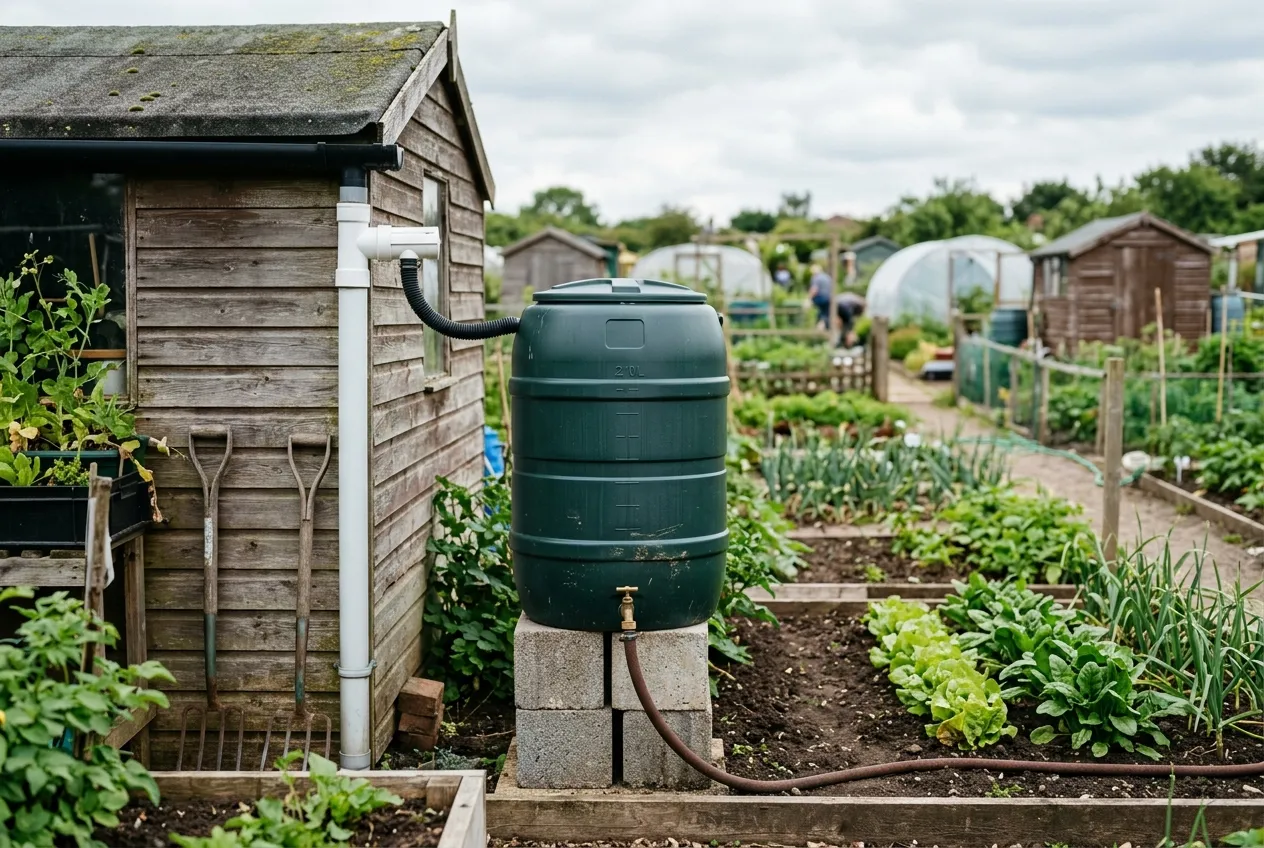 A 210-litre water butt on breeze blocks, connected to an allotment shed roof via a downpipe diverter kit. Raising the butt provides gravity pressure for soaker hoses.
The formula for sizing rainwater storage is: roof area (sq m) x annual rainfall (mm) x 0.8 = litres collected per year. For a 10 sq m allotment shed in the Midlands (average 800mm annual rainfall), that gives 6,400 litres per year. Two 200-litre butts capture a fraction per fill cycle but refill repeatedly through the season.
Water butt sizing calculator
| Shed Roof Size | Annual Rainfall (mm) | Litres Collected/Year | Recommended Storage |
|---|---|---|---|
| 5 sq m (small shed) | 600 (South East) | 2,400L | 1 x 200L butt |
| 5 sq m (small shed) | 800 (Midlands) | 3,200L | 2 x 200L linked |
| 10 sq m (standard shed) | 600 (South East) | 4,800L | 2 x 200L linked |
| 10 sq m (standard shed) | 800 (Midlands) | 6,400L | 2-3 x 200L linked |
| 10 sq m (standard shed) | 1,200 (North West) | 9,600L | 3 x 200L or 1 x IBC |
| 15 sq m (shed + greenhouse) | 800 (Midlands) | 9,600L | 1 x IBC (1,000L) |
The National Allotment Society (NSALG) recommends every plot-holder installs at least one water butt. Many allotment associations now offer bulk-buy discounts on butts and diverter kits.
What you need for a water butt installation
- Water butt: 200-210 litre models cost £20-40. Slimline designs fit against shed walls. Round butts hold more per footprint.
- Downpipe diverter kit: £8-15. Fits a standard 68mm round downpipe. Takes 15-20 minutes to install with a hacksaw and screwdriver.
- Butt stand or breeze blocks: Raise the butt 30-45 cm above ground for gravity flow to fill a can in 90 seconds and to run a soaker hose.
- Linking kit: £5-10. A 25mm hose connector between two butts, fitted at the base, allows overflow from one to fill the next automatically.
- Lid and child lock: Essential on allotments where children may visit. Most butts include a snap-fit lid.
If your plot has a shed, our allotment shed guide covers guttering installation and roof drainage options.
How do you set up drip irrigation on an allotment?
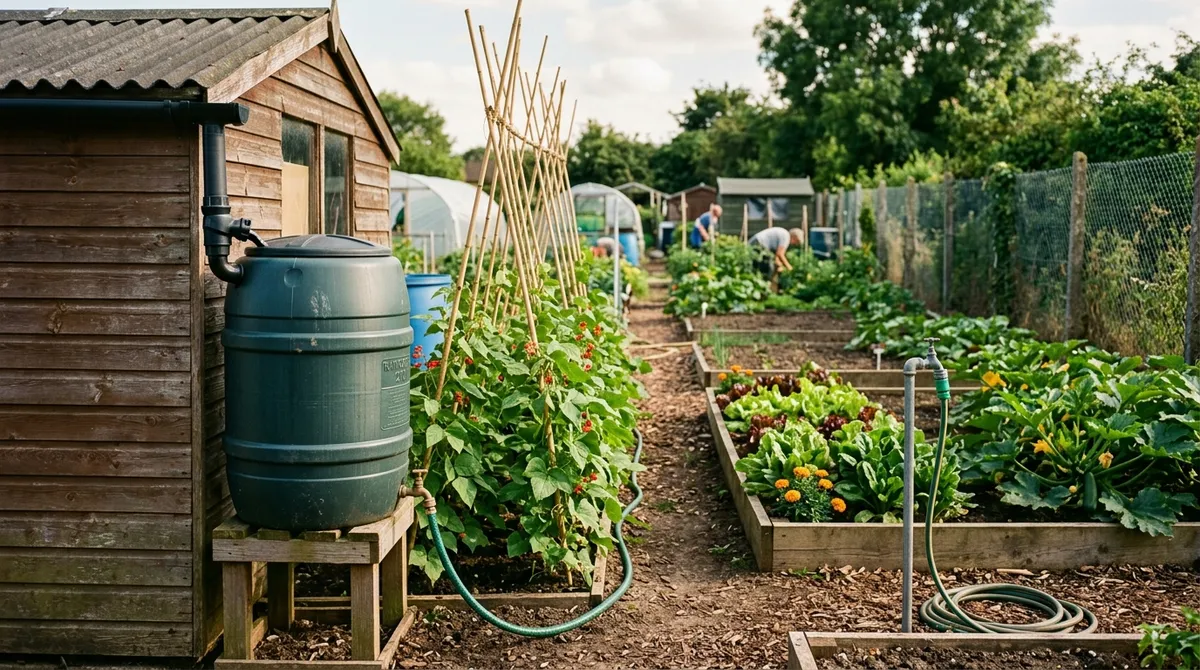
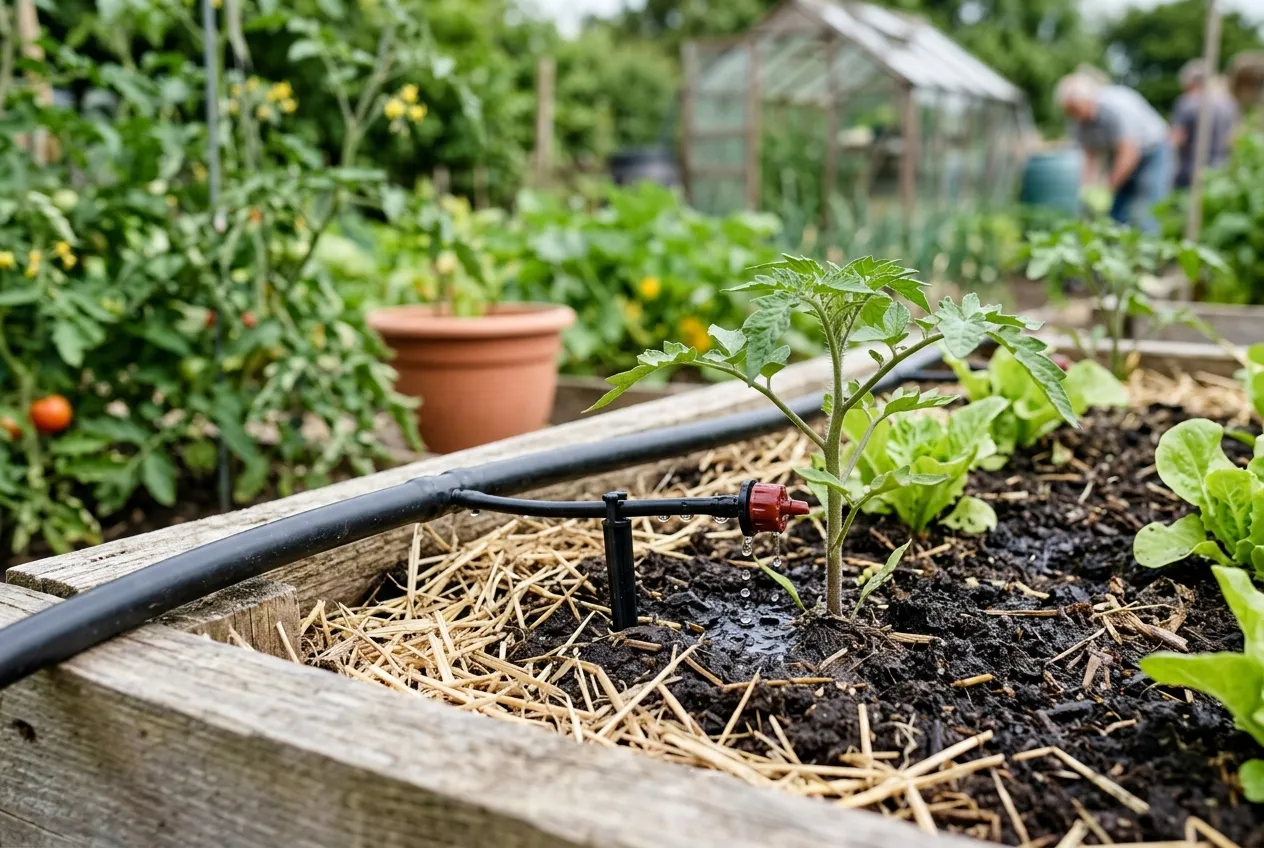 Drip irrigation emitters delivering water directly to plant roots in a raised allotment bed. The 13mm main tubing connects to a gravity-fed water butt.
Drip irrigation delivers water directly to plant roots through emitters spaced every 20-30 cm along flexible tubing. It uses 40-60% less water than overhead watering or watering cans because almost no moisture is lost to evaporation. Foliage stays dry, which reduces blight on tomatoes and mildew on courgettes.
Gravity-fed drip system from a water butt
Most allotment holders cannot connect irrigation to mains water. The solution is a gravity-fed setup:
- Raise your water butt 60-100 cm above bed level on breeze blocks, a pallet, or a purpose-built stand
- Fit a 13mm barbed connector to the butt’s tap outlet
- Add an inline filter (£3-5) at the outlet to prevent emitter blockage from debris
- Run 13mm main tubing along the path between beds
- Branch 4mm micro-tubing into each bed, with drip emitters every 20-30 cm
- Fit a battery tap timer (£15-25) to automate watering sessions
A gravity-fed system at 0.1-0.2 bar pressure delivers roughly 2 litres per hour per emitter. Run it for 30-60 minutes every other day during summer. For raised bed layouts with drip systems, keep beds no wider than 1.2 metres so a single line of emitters reaches all plants.
Drip irrigation costs for a half plot
| Component | Cost | Coverage |
|---|---|---|
| 15m drip line with emitters | £8-15 | One raised bed row |
| 13mm main tubing (25m) | £8-12 | Main run from butt to beds |
| 4mm micro-tubing (10m) | £3-5 | Branch lines into beds |
| Inline filter | £3-5 | Prevents emitter clogging |
| Battery tap timer | £15-25 | Automates watering schedule |
| Connectors and fittings pack | £5-10 | Tees, elbows, end caps |
| Total basic setup | £42-72 | Half-plot coverage |
What are the hosepipe ban rules for allotments?
Hosepipe bans under the Water Industry Act 1991 restrict the use of hosepipes connected to mains water supply, and this includes allotment standpipes. During a ban, water companies can prohibit watering allotments with a hosepipe connected to any mains tap. Fines of up to £1,000 apply.
What is and is not affected
| Allowed During a Ban | Restricted During a Ban |
|---|---|
| Watering cans filled at the standpipe | Hosepipes connected to the standpipe |
| Drip irrigation from rainwater butts | Sprinklers on any mains supply |
| Soaker hoses from rainwater storage | Automatic watering from mains |
| Hand watering from your own stored water | Filling pools or ponds from mains |
The key distinction is water source. Stored rainwater in your own butts or tanks is not mains water. Drip systems and soaker hoses fed from rainwater collection are not affected by hosepipe bans. This is one of the strongest arguments for investing in rainwater storage.
During the 2022 drought, many Midlands allotment sites restricted standpipe access to 30 minutes per plot-holder per day. Plot-holders with their own rainwater storage were the only ones who kept thirsty crops alive through August.
For broader strategies during dry summers, our drought-tolerant plants guide covers varieties that survive on minimal water in both allotments and home gardens.
How does rainwater harvesting work on an allotment?
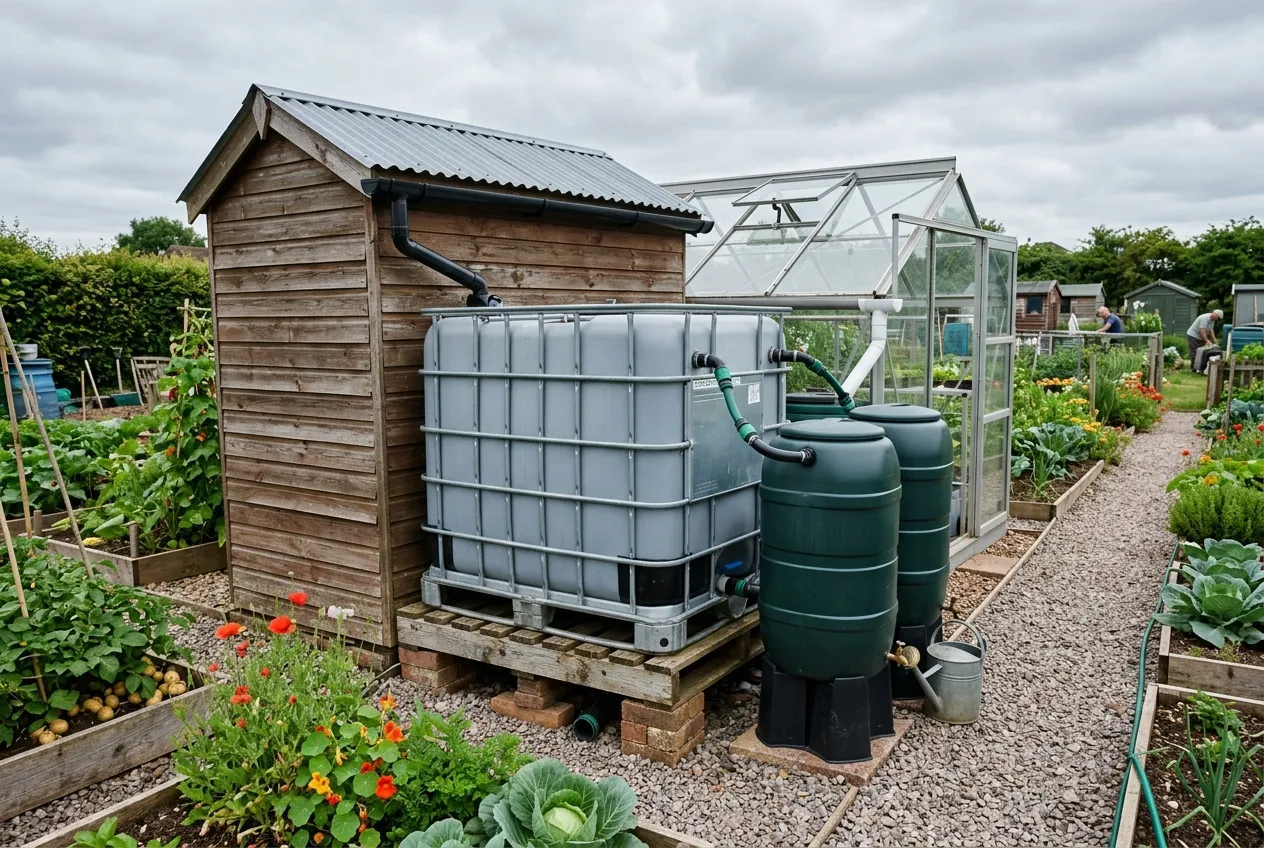 A linked rainwater harvesting system on a UK allotment. The IBC tank and water butts are connected with overflow pipes to maximise storage from shed and greenhouse guttering.
Rainwater harvesting on an allotment means collecting rain from every available roof surface and storing it for use during dry periods. A 10 sq m shed roof in the Midlands collects 6,400 litres per year. Adding a greenhouse roof doubles collection. The RHS recommends rainwater for gardens because it is free of chlorine and limescale.
Maximising collection from allotment structures
Every structure on your plot is a potential collection surface:
- Allotment shed: 8-12 sq m roof = 5,100-7,700 litres/year (Midlands average)
- Small greenhouse (6x4ft): 2.2 sq m = 1,400 litres/year
- Cold frame: 1-2 sq m = 640-1,280 litres/year
- Lean-to shelter: 3-5 sq m = 1,900-3,200 litres/year
Fit guttering to every structure and run downpipes to your storage system. Standard 68mm round guttering costs £3-5 per metre and fits with basic brackets. Our rainwater harvesting guide covers underground tank options for larger-scale collection.
Linking multiple containers
The most effective allotment water storage uses linked containers at the same height:
- Position all containers on a level platform at the same height
- Fit 25mm linking kits (£5-10 each) between container bases
- Run the main feed from the downpipe diverter into the first container
- Each subsequent container fills automatically via the linking pipe as the first overflows
- Fit the tap and irrigation outlet on the last container in the chain for maximum head pressure
Three linked 200-litre butts give 600 litres of storage. For serious growers, a secondhand food-grade IBC (intermediate bulk container) holds 1,000 litres and costs £30-60 from farm suppliers. Check your allotment rules before installing large containers, as some sites restrict IBC tanks.
Which allotment crops need the most water?
Prioritising water to thirsty crops and choosing drought-tolerant varieties where possible stretches your supply dramatically. This matters most during hosepipe bans and dry summers when every litre counts.
| Crop | Water Demand | Litres/Week (per plant) | Critical Period | Drought Tolerance |
|---|---|---|---|---|
| Runner beans | Very high | 10-15L | Flowering to pod set | Poor |
| Courgettes | Very high | 10-15L | Fruit swelling | Poor |
| Tomatoes | High | 8-12L | Fruit development | Moderate |
| Sweetcorn | High | 8-10L | Tasselling and cob fill | Poor |
| Potatoes | Moderate-high | 6-8L | Tuber formation (Jun-Jul) | Moderate |
| Lettuce and salads | Moderate | 3-5L | Throughout growth | Poor |
| Beetroot | Low-moderate | 3-4L | Root swelling | Good |
| Onions and garlic | Low | 2-3L | Bulb swelling only | Good |
| Broad beans | Low | 2-4L | Flowering | Good |
| Herbs (rosemary, thyme) | Very low | 1-2L | Establishment only | Excellent |
Lawrie’s Top Tip: Group thirsty crops together near your water source. On my plot, runner beans and courgettes grow within 3 metres of the water butts, with the soaker hose serving them first. Drought-tolerant onions and garlic go at the far end. This layout adjustment saves 20 minutes of carrying time per watering session and keeps the highest-demand plants closest to the water.
For crop-by-crop growing advice, our guides on growing runner beans and growing tomatoes cover water requirements in detail. The allotment planner also maps watering schedules to the growing calendar.
How does mulching reduce allotment watering needs?
A 5-8 cm layer of organic mulch on allotment beds reduces watering needs by 50-70%. Mulch slows evaporation, keeps soil temperatures stable, and suppresses weeds that compete for moisture. On a 125 sq m half plot, proper mulching saves 1,000-2,000 litres of water across a growing season.
Best mulch materials for allotments
| Material | Cost | Water Retention | Nutrient Value | Lifespan |
|---|---|---|---|---|
| Well-rotted manure | Free (stables) | Excellent | High | 6-12 months |
| Garden compost | Free (homemade) | Excellent | High | 6-12 months |
| Straw | £4-6/bale | Good | Low | 3-6 months |
| Wood chip | Free (tree surgeons) | Good | Low (paths only) | 12-24 months |
| Grass clippings | Free | Moderate | Moderate | 4-8 weeks |
| Cardboard sheet mulch | Free | Good | None | 3-6 months |
Apply mulch in spring once the soil has warmed and is already moist. Pull mulch 2-3 cm away from plant stems to prevent rot. For allotment composting methods, see our guide on how to make compost.
What does a complete allotment water system cost?
A reliable allotment water supply system costs £50-350 depending on plot size and automation level. Here are three tested setups:
Budget setup: £50-80 (half plot)
- 1 x 200L water butt with stand: £25-45
- Downpipe diverter kit: £8-15
- 15m soaker hose: £8-15
- 9L galvanised watering can: £12-18
You manually connect the soaker hose to the butt tap and move it between beds. Top up the butt from the standpipe during dry spells.
Mid-range setup: £100-180 (half plot)
- 2 x linked 200L water butts with stands: £55-90
- 2 x downpipe diverter kits: £16-30
- Linking kit: £5-10
- 30m soaker hose: £15-25
- Battery tap timer: £15-25
- Inline filter: £3-5
This gives 400 litres of storage and semi-automated watering. The timer runs the soaker hose on a schedule. Two butts linked in series fill from both shed and greenhouse guttering.
Full setup: £200-350 (full plot)
- 1,000L IBC tank on raised platform: £30-60
- Guttering from shed and greenhouse: £30-50
- 50m drip irrigation kit with emitters: £40-70
- Battery tap timer with rain sensor: £25-40
- 13mm main tubing and fittings: £20-35
- Inline filter and pressure regulator: £10-20
- 3 x watering cans: £30-45
This covers a full plot with automated drip irrigation. The IBC collects rainwater from multiple roof surfaces and feeds the system by gravity. A rain sensor prevents unnecessary watering after rainfall.
How do you conserve water on an allotment?
Beyond infrastructure, these techniques reduce how much water your plot actually needs:
-
Water before 10am. Evaporation losses are 30-50% lower than midday. Evening watering leaves foliage wet overnight, encouraging blight on tomatoes and potatoes.
-
Water at the base, not from above. Remove the rose from your watering can and pour directly around the stem base. Overhead watering wastes 20-30% to evaporation and wets leaves unnecessarily.
-
Improve soil with organic matter. Adding 5-10 cm of compost annually increases water-holding capacity. Sandy soil improved with compost holds 20% more water. The soil drainage guide covers clay and sand improvement in detail.
-
Choose drought-tolerant varieties. Many seed companies now label varieties as drought-tolerant. Climbing French beans need less water than runner beans. Cherry tomatoes tolerate dry spells better than beefsteak types.
-
Use windbreaks. Wind increases evaporation dramatically. A 1.2m windbreak of Jerusalem artichokes or sweetcorn on the prevailing wind side reduces water loss by 20-30% on exposed allotment sites.
-
Harvest from every surface. Connect guttering to your greenhouse, shed, and any other structure. A 2m x 3m cold frame roof collects 480 litres per year. Every litre of stored rainwater saves a trip to the standpipe.
For holiday periods when you cannot visit, our holiday watering guide covers automatic systems that keep allotment crops alive for up to two weeks unattended.
Frequently asked questions
Lawrie has been gardening in the West Midlands for over 30 years. He grows his own veg using no-dig methods, keeps a wildlife-friendly garden, and writes practical advice based on real UK growing conditions.