Autumn Gardening Jobs: Complete UK Checklist
Month-by-month autumn gardening checklist for UK gardens. Covers planting, bulbs, lawn care, pruning, composting, and wildlife tasks for Sep to November.
Key takeaways
- Autumn is the best planting season — warm soil and rain establish roots before winter dormancy
- Plant spring bulbs from September to November — daffodils and crocus first, tulips in November
- Scarify and aerate lawns in September for the best results of the year
- Collect fallen leaves for leaf mould — the best soil conditioner and completely free
- Cut back perennials selectively — leave seedheads on grasses and echinacea for winter interest and wildlife
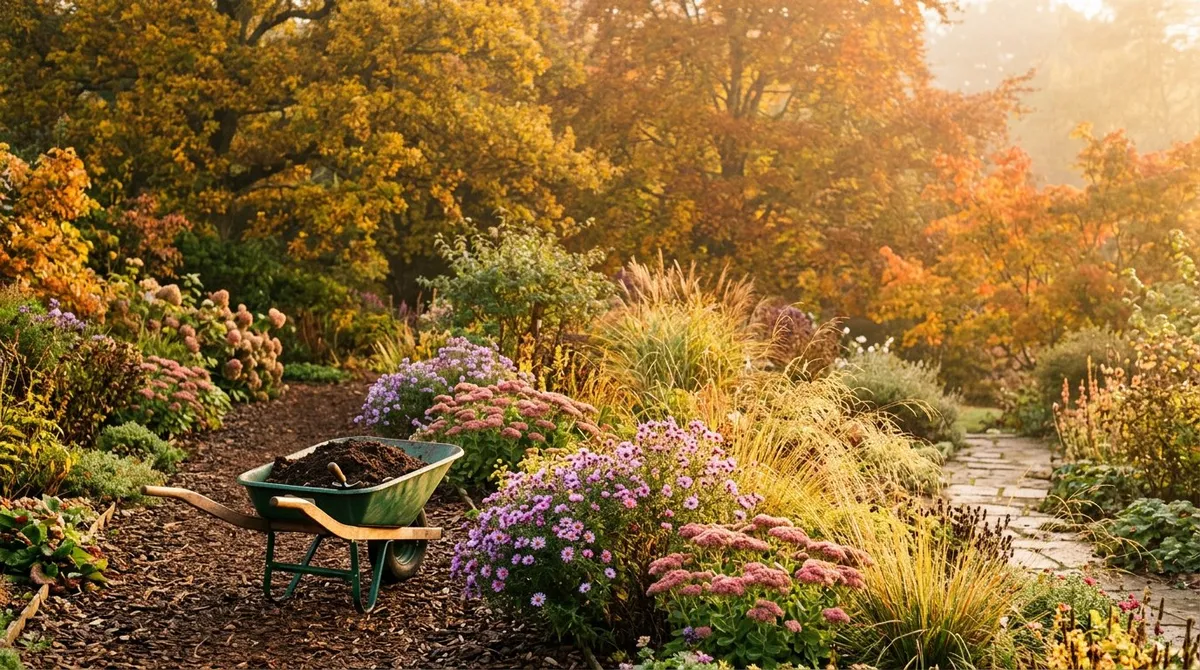
Autumn is the most productive planting season in the UK garden calendar. The soil is still warm from summer, rain returns reliably, and root growth continues even as top growth slows. A tree planted in October establishes better than the same tree planted in April.
This guide organises every autumn task by garden area and month. For the rest of the year, see our spring, summer, and winter gardening jobs guides. Work through each section systematically, or use the month-by-month checklist at the end. For specific planting guidance, see our monthly guides for September, October, and November. The RHS seasonal job finder is a useful companion reference.
Planting
Autumn planting is the single best investment of time in the gardening year.
Trees and shrubs
Plant container-grown trees and shrubs from September onwards. The combination of warm soil and autumn moisture encourages root establishment before winter. By spring, an autumn-planted shrub has a root system three months ahead of one planted in March.
Bare-root trees and shrubs become available from November. They are cheaper than container-grown plants (often half the price) and establish just as well. Plant immediately after delivery, or heel them into spare ground if planting is delayed.
Stake new trees with a short stake (one-third of the trunk height) angled into the prevailing wind. The trunk needs to flex to build strength. Tall stakes that hold the trunk rigid produce weak wood.
Hedging
Autumn is the ideal time to plant a new hedge. Bare-root hedging plants cost one to three pounds each and establish rapidly in warm autumn soil. Plant hawthorn, blackthorn, beech, hornbeam, or mixed native hedging at three plants per metre.
For faster results, see our guide to garden fence ideas for immediate boundary options while a hedge grows.
Perennials
Divide and replant overgrown perennials in September and October. Lift the clump with a fork, split into sections, and replant at the same depth. Water well after planting. Most perennials benefit from division every 3-4 years — the outer sections are the most vigorous.
Plant new perennials from September to October. Autumn-planted perennials produce larger plants and more flowers in their first summer than spring-planted ones.
Spring bulbs
Bulbs are the best-value planting in the garden. One hundred mixed daffodils cost around ten pounds and flower every spring for a decade.
| Bulb | Plant | Depth | Spacing |
|---|---|---|---|
| Daffodils | September-October | 15cm (3x bulb height) | 10-15cm |
| Crocus | September-October | 8cm | 5-8cm |
| Alliums | September-October | 15cm | 15-20cm |
| Hyacinths | September-October | 12cm | 10cm |
| Tulips | November only | 15-20cm | 10-12cm |
| Snowdrops | In the green (Feb-Mar) | 10cm | 10cm |
Plant tulips in November, not earlier. Early planting increases the risk of tulip fire, a fungal disease that destroys the bulbs. Deep planting (20cm) helps tulips perennialise rather than fading after one or two years.
Plant bulbs in drifts of a single variety for the strongest visual impact. Twenty-five of the same tulip in a cluster looks far better than twenty-five different varieties scattered randomly.
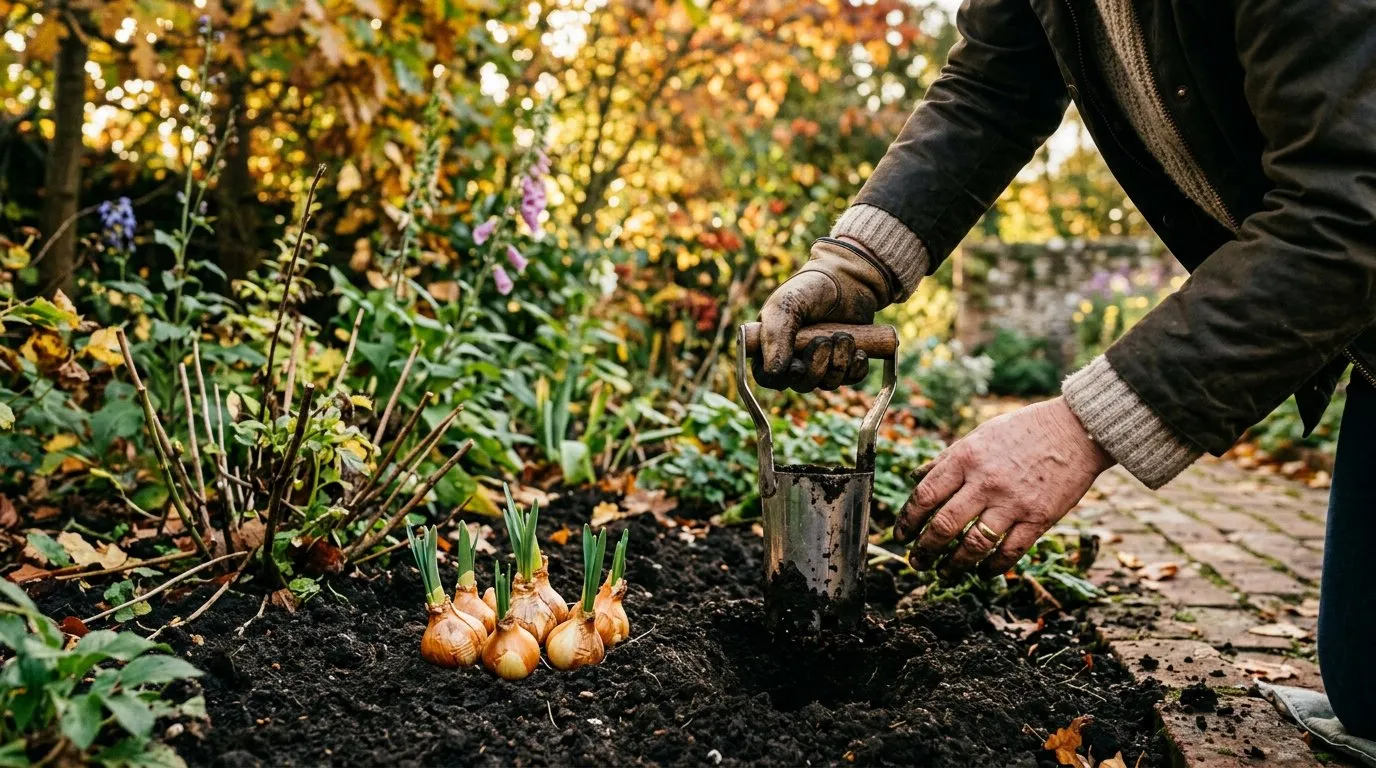 Planting spring bulbs in October. Set daffodils at three times their own depth, pointy end up.
Lawn care
Autumn lawn care produces the best results of the year. Warm soil and shorter days create ideal conditions for grass recovery.
Scarifying
September is the best month to scarify. Remove the layer of dead grass and moss that has built up over summer. Use a spring-tine rake on small lawns or a powered scarifier on larger areas. The lawn will look rough immediately after scarifying — it recovers within 3-4 weeks. For the full technique, see our guide on how to scarify and aerate your lawn.
Aerating
Aerate compacted areas after scarifying. Push a hollow-tine aerator or garden fork 10cm into the soil at 15cm intervals. On heavy clay, brush sharp sand into the holes to improve long-term drainage. If you have clay soil, our guide on improving clay soil covers the topic in detail.
Overseeding
Overseed bare patches and thinned areas in September. Scatter grass seed, rake lightly to work it into the surface, and water if no rain falls within 48 hours. Autumn seed germinates faster than spring seed because the soil is warmer. See our guide on how to grow grass from seed for the full process.
Autumn feeding
Apply an autumn lawn feed from September. Use a formulation high in potassium and low in nitrogen — the opposite of spring feed. Potassium toughens the grass for winter, while nitrogen would promote soft growth vulnerable to frost and disease.
Final mow
Give the last mow in late October or November, depending on your region. Raise the cutting height to 4cm for the final cut. Clear fallen leaves from the lawn regularly — a mat of leaves blocks light and encourages fungal diseases.
Borders and beds
Cutting back
Cut back perennials that have collapsed, turned brown, or look untidy. But be selective — leave seedheads standing on ornamental grasses, echinacea, sedum, and rudbeckia. They provide winter structure in the garden, food for seed-eating birds, and shelter for overwintering insects.
Mulching
Mulch borders in November after cutting back. Apply 5-8cm of well-rotted compost or bark chips around plants, keeping it clear of stems and crowns. Autumn mulch suppresses winter weeds, insulates roots from frost, and breaks down into the soil over winter. For more on mulching technique, see our mulching guide.
Tender plant protection
Lift dahlia tubers after the first frost blackens the foliage. Cut stems to 15cm, shake off excess soil, and store upside down for a week to drain moisture from the hollow stems. Pack in dry compost in a frost-free shed or garage.
Protect half-hardy plants like penstemons, agapanthus, and tree ferns with a thick layer of straw or fleece around the crown. Move tender container plants into a greenhouse, cold frame, or against a sheltered house wall.
Moving plants
September and October are ideal for moving established plants. The combination of warm soil and shortening days means less transplant stress. Water the plant thoroughly the day before moving. Lift with as large a root ball as possible. Replant immediately and water well.
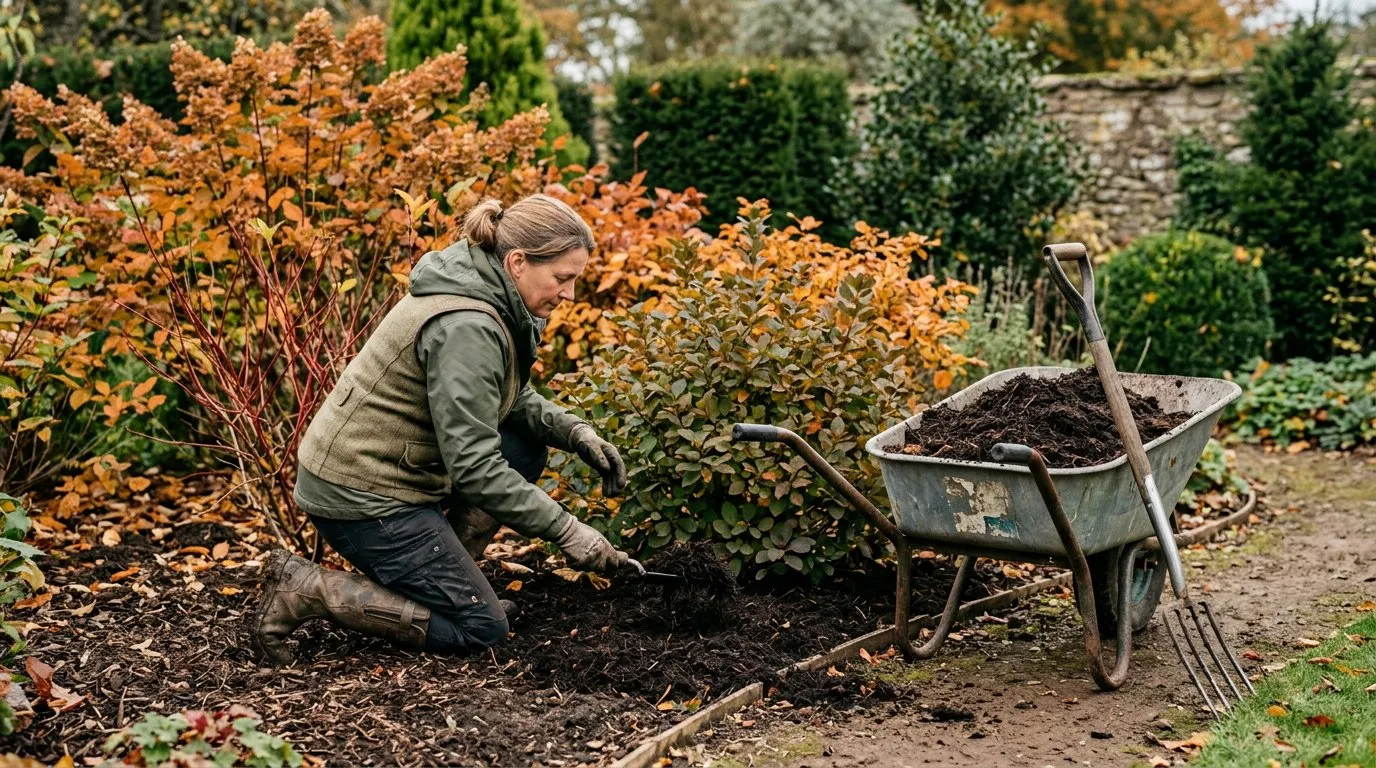 Autumn mulching. A 5-8cm layer of compost insulates roots, suppresses weeds, and feeds the soil over winter.
Fruit garden
Planting fruit trees
Bare-root fruit trees become available from November. They cost less than container-grown trees and establish just as well. Plant apple, pear, plum, and cherry trees before Christmas for the best root development over winter.
Pruning soft fruit
Prune summer-fruiting raspberries by cutting all the canes that fruited this year to ground level. Tie in the new green canes (which will fruit next year) to wires spaced 30cm apart.
Prune blackcurrants by removing one-third of the oldest (darkest) stems at ground level. This encourages new growth from the base, which carries the heaviest crops.
Storing the harvest
Store apples in single layers in a cool, dark place. Only store unblemished fruit — one rotten apple spoils its neighbours. Late varieties like Bramley and Russet keep well into winter.
Composting and leaf mould
Autumn generates the year’s largest volume of compostable material.
Leaf mould
Collect fallen leaves from lawns and paths. Do not leave them in thick layers on grass — they block light and encourage fungal disease. Make leaf mould by packing damp leaves into black bin bags, punching a dozen holes in each bag, and stacking in a shady corner. After 12-18 months, the leaves break down into a dark, crumbly soil conditioner that outperforms any bought product.
Compost heap maintenance
Turn the compost heap in October. Mixing the contents introduces air and speeds decomposition. If the heap is dry, water it as you turn. A well-maintained heap started in spring should produce usable compost by the following spring.
Add autumn garden waste — spent bedding plants, cut-back perennial stems, vegetable crop debris — to the compost. Avoid adding diseased material, perennial weed roots, or thick woody stems.
Wildlife
Preparing for hibernation
Hedgehogs begin hibernating from October onwards. Check bonfires before lighting — hedgehogs favour bonfire piles as hibernation sites. Build bonfires on the day of burning rather than days in advance.
Leave log piles undisturbed. Beetles, frogs, toads, and newts shelter in log piles through winter. Stack native hardwood logs in a shady, damp corner and leave them alone.
Bird feeding
Start putting out bird feeders from October. High-energy foods — sunflower hearts, peanuts, fat balls — help birds build reserves before winter. Clean feeders monthly to prevent disease. For more advice, see our guide on how to attract birds to your garden.
Leaving seedheads and cover
Resist the urge to tidy everything. Seedheads on echinacea, teasel, sunflowers, and grasses provide food for goldfinches and other seed-eating birds. Dense evergreen shrubs and hedges provide roosting cover on cold nights. A slightly messy garden supports far more wildlife than a pristine one.
Pond care
Netting against leaves
Stretch fine netting over the pond surface from September to prevent leaves falling in. Submerged leaves decompose, release gases, and create toxic conditions for fish and amphibians.
Cutting back marginal plants
Cut back marginal plants like iris, marsh marigold, and rushes to 10cm above water level. Remove dead foliage from water lilies. Leave some standing stems — hollow stems provide breathing tubes for overwintering insects.
Preparing for winter
Stop feeding fish when water temperature drops below 10C, usually in October. Their metabolism slows and undigested food pollutes the water. Switch off pond pumps only if the pond freezes regularly — moving water resists ice formation.
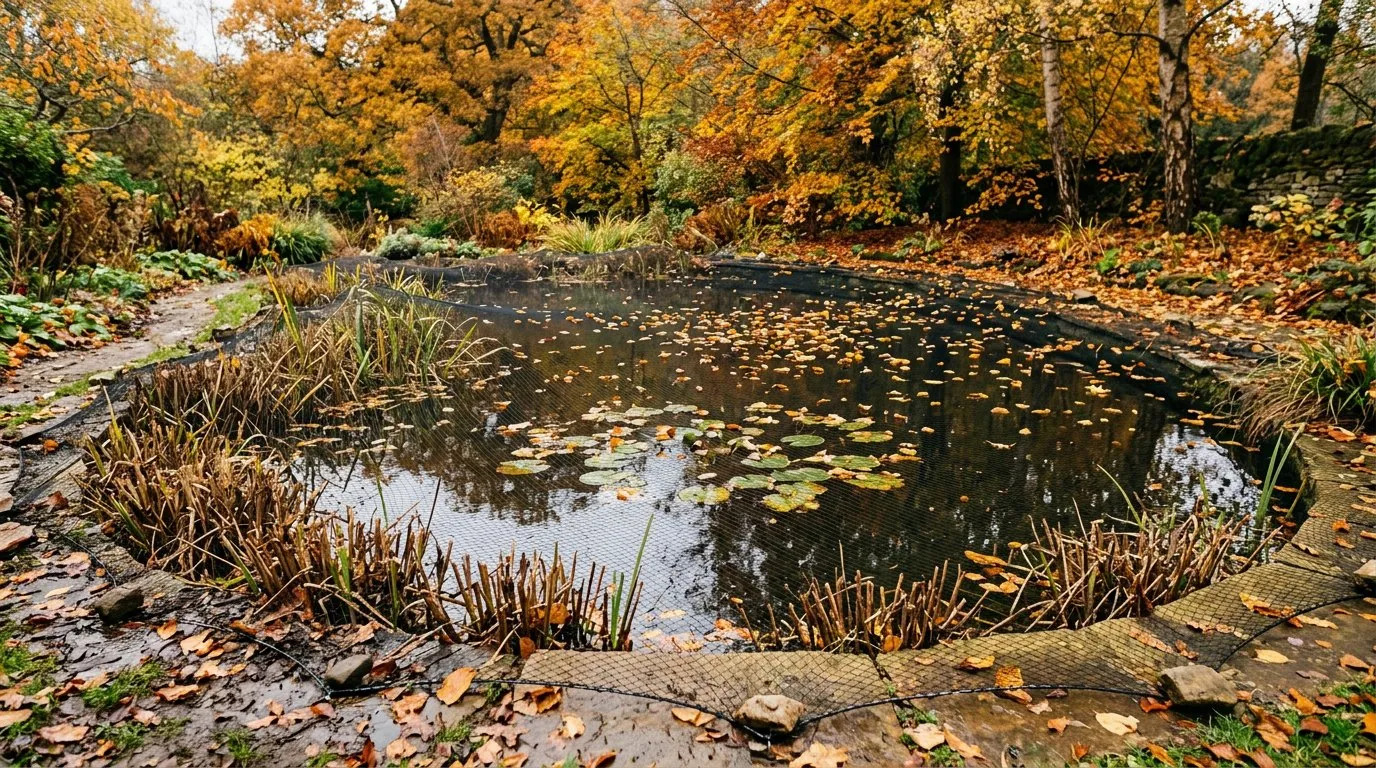 Netting the pond in autumn. Fine mesh prevents leaves decomposing in the water and harming fish.
Tools and infrastructure
Cleaning and storing tools
Clean all tools in November. Scrape soil from spades and forks, oil metal surfaces, and sharpen blades. Wipe secateur blades with an oily cloth. Properly maintained tools last decades.
Checking structures
Inspect fences, trellis, and pergolas before winter storms arrive. Fix loose panels, replace rotten posts, and tighten bolts on pergolas. A fence repaired in October costs a fraction of one blown down in January. Our guide to garden fence repair and maintenance covers all common fixes.
Preparing the greenhouse
Clean greenhouse glass inside and out in October. Check for cracked panes and seal gaps around the door and vents. Insulate with bubble wrap from November — fix it to the inside of the frame with clips. This raises the minimum temperature by 2-3C and reduces heating costs.
Month-by-month autumn checklist
| Task | September | October | November |
|---|---|---|---|
| Plant trees/shrubs | Container-grown | Container-grown | Bare-root begins |
| Plant bulbs | Daffodils, crocus, alliums | Continue | Tulips |
| Divide perennials | Yes | Early October | — |
| Cut back perennials | Selectively | Yes | Final clearance |
| Mulch borders | — | — | Yes |
| Lift dahlias | — | After first frost | After first frost |
| Scarify lawn | Yes (best month) | — | — |
| Aerate lawn | Yes | — | — |
| Overseed lawn | Yes | — | — |
| Autumn lawn feed | Yes | — | — |
| Last mow | — | Late October | Early November |
| Collect leaves | Start | Peak | Finish |
| Bird feeders | — | Set up | Maintain |
| Net pond | Yes | Maintain | Remove once leaves fall |
| Clean greenhouse | — | Yes | Insulate |
| Clean tools | — | — | Yes |
Why we recommend bare-root trees over container-grown in autumn: After 30 seasons of planting trees, bare-root specimens planted between November and February consistently outperform container-grown equivalents planted in autumn. In my experience, bare-root trees produce 20-30% more root growth in their first winter because the roots spread freely rather than following the spiral pattern of pot-bound specimens. They also cost half as much and establish faster, often catching up with container trees within two seasons.
Common mistakes
Planting tulips too early
Tulip fire, a fungal disease that produces brown lesions on leaves and flowers, is more prevalent when bulbs go in while the soil is warm. Plant tulips in November when soil temperatures have dropped below 10C.
Clearing everything away
A completely tidy autumn garden looks neat but removes food, shelter, and hibernation sites for wildlife. Leave seedheads, log piles, and leaf litter in borders. The garden can be tidied fully in early spring.
Ignoring lawn care
Autumn is actually the most productive time for lawn improvement. Scarifying, aerating, and overseeding in September produces better results than the same work in spring because warm soil accelerates grass recovery.
Not protecting tender plants
A single hard frost in October kills dahlias, cannas, and other tender plants if tubers are left in the ground. Lift and store them, or mulch heavily. The first sharp frost often arrives without warning.
Composting diseased material
Rose leaves with blackspot, blight-infected tomato stems, and clubroot-affected brassicas should go in the council green bin, not the garden compost. Most home compost heaps do not reach temperatures high enough to kill pathogens.
Now you have worked through your autumn jobs, read our guide on winter gardening jobs so the momentum carries you through to spring.
Frequently asked questions
What is the most important autumn gardening job?
Planting is the most important autumn task. Trees, shrubs, hedges, and perennials planted in September and October establish far better than spring-planted specimens. The warm, moist soil encourages root growth for months before winter dormancy. An autumn-planted tree starts spring with an established root system.
When should I plant spring bulbs?
Plant daffodils, crocus, and alliums from September to October while the soil is still warm. Plant tulips in November to reduce the risk of tulip fire disease. Plant all bulbs at three times their own depth with the pointed end facing up.
Should I cut back perennials in autumn?
Cut back perennials that look untidy or have collapsed. Leave ornamental grasses, echinacea, sedum, and rudbeckia standing through winter for structure, bird food, and insect shelter. Cut everything back in late February or early March before new growth appears.
When should I scarify the lawn?
September is the best month to scarify. The soil is warm, grass grows actively, and autumn rain helps recovery. Scarify first, then aerate compacted areas, overseed any bare patches, and apply autumn lawn feed. The lawn recovers fully within three to four weeks.
What should I do with fallen leaves?
Collect leaves from lawns and paths to prevent them smothering grass. Make leaf mould by packing damp leaves into black bin bags with holes punched in them. Store for 12-18 months. The result is a superb free soil conditioner. Small quantities of leaves can go directly onto the compost heap.
Can I still sow seeds in autumn?
Sow hardy annuals like cornflowers, nigella, and poppies in September for earlier flowering next year. Sow green manure crops on bare vegetable beds to protect and improve the soil over winter. Grass seed germinates well in September while soil temperatures remain above 10C.
Lawrie has been gardening in the West Midlands for over 30 years. He grows his own veg using no-dig methods, keeps a wildlife-friendly garden, and writes practical advice based on real UK growing conditions.