Best Secateurs for UK Gardeners
Secateurs buying guide for UK gardeners. Compares bypass, anvil, and ratchet types with brand ratings, price brackets, and maintenance tips.
Key takeaways
- Bypass secateurs cut live stems cleanest and are the best general-purpose choice for most UK gardeners
- Anvil secateurs crush stems slightly, making them better suited to dead or dry wood up to 25mm
- Ratchet secateurs reduce hand effort by up to 50%, ideal for arthritis or repetitive pruning sessions
- Felco and Niwaki score highest for blade longevity, but Bahco and Spear & Jackson offer strong value under 25
- UK wet conditions demand stainless or coated blades, with oiling after every use to prevent rust
- A sharp bypass blade produces clean cuts that heal up to 40% faster than ragged tears from blunt tools
Secateurs are the most-used tool in any British garden, and the difference between a good pair and a poor one shows in every cut you make. A clean cut heals quickly. A ragged tear invites fungal disease, especially in the damp conditions typical of UK gardens from October through April.
This guide compares the three secateur types available to UK gardeners, explains what to look for before buying, and rates six well-known brands on the criteria that actually matter: cutting performance, comfort, blade longevity, and rust resistance. If you already own secateurs and want to get them cutting properly again, see our guide on how to sharpen garden tools.
What type of secateurs do you need?
Every secateur falls into one of three categories. Each has a specific job. Buying the wrong type for the task causes hand fatigue, poor cuts, and damage to both plant and tool.
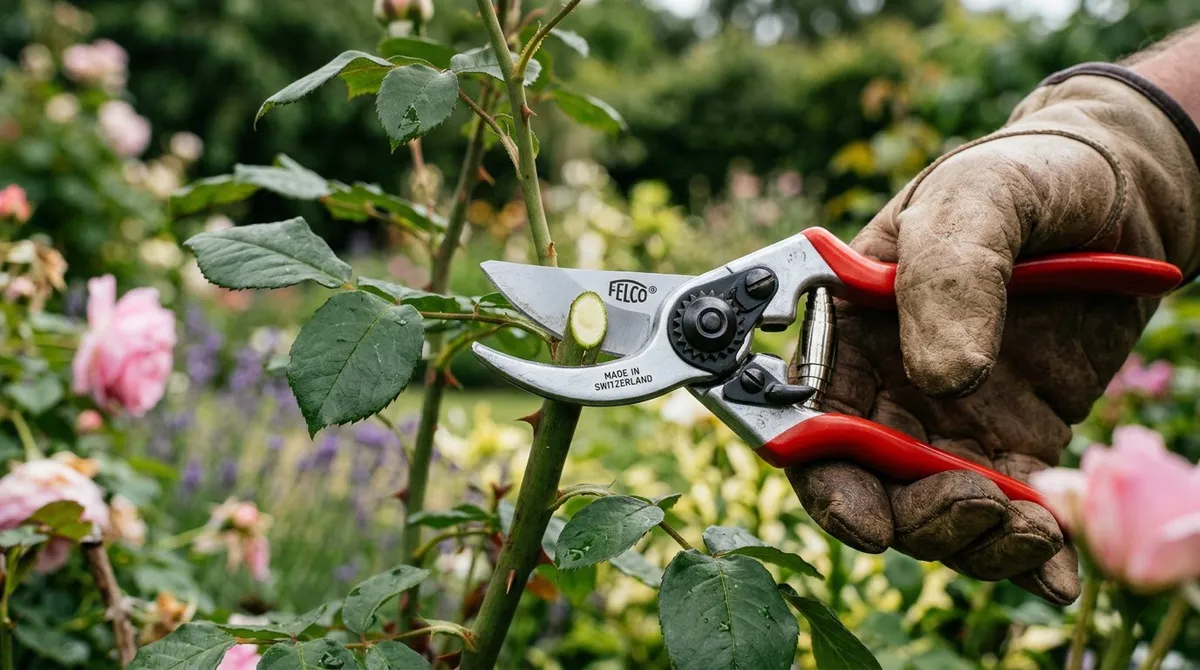
Bypass secateurs use two curved blades that slide past each other in a scissor action. The cutting blade passes the counter blade closely, slicing the stem cleanly. This is the type to own if you buy only one pair. Bypass secateurs handle live green stems up to about 20mm diameter and produce the least tissue damage. They are the standard recommendation from the RHS for general garden pruning.
Anvil secateurs press a single sharp blade down onto a flat metal plate. The crushing action works well on dead, dry wood up to 25mm, where a clean cut matters less. They require less grip strength than bypass types for the same stem diameter. However, they bruise live stems, creating entry points for infection. Reserve anvil secateurs for removing deadwood in winter.
Ratchet secateurs are a variation of either bypass or anvil, with a mechanism that completes the cut in several smaller squeezes rather than one. Each click of the ratchet drives the blade further through the stem, reducing peak grip force by up to 50%. They are slower to use but excellent for gardeners with arthritis, carpal tunnel syndrome, or anyone facing a long pruning session.
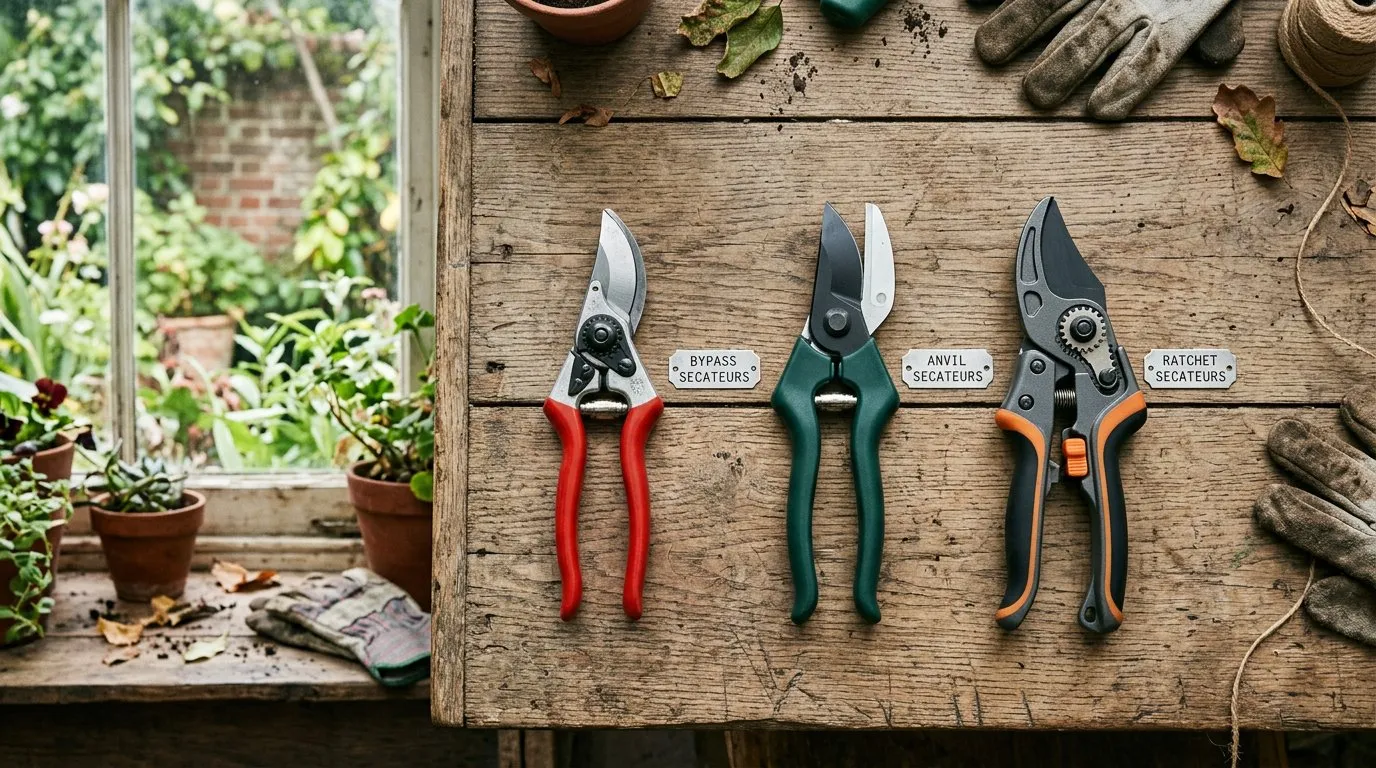 The three main secateur types: bypass (red handles), anvil (green), and ratchet (orange). Each suits a different pruning task.
What to look for when buying secateurs
Not every feature on the packaging matters equally. These are the criteria that separate a useful tool from a drawer filler.
Blade material determines how long the edge lasts between sharpenings. High-carbon steel holds a finer edge but rusts faster in wet conditions. Stainless steel resists corrosion but dulls sooner. Some manufacturers use a hardened carbon blade with a non-stick coating, which is a practical compromise for the British climate.
Cutting capacity is the maximum stem diameter the secateur handles comfortably. Most bypass models manage 18-22mm. Forcing a thicker stem risks springing the blades out of alignment. For anything over 25mm, switch to loppers. Good secateurs for pruning roses manage typical rose stems of 8-15mm without effort.
Handle ergonomics matter more than most buyers realise. A handle that is too wide for your grip forces the tendons in your hand to overwork on every cut. Look for a maximum open span that matches your hand size. Rotating lower handles reduce friction blisters during extended sessions.
Weight affects fatigue over a full day. Most quality secateurs weigh between 190g and 260g. Under 200g suits light work and small hands. Over 240g starts to tell on the wrist after an hour of continuous cutting.
Spare parts availability extends the life of the tool by years. Brands that sell replacement blades, springs, and bolts individually allow you to maintain one pair for a decade or longer rather than replacing the whole unit.
How we assessed each brand
We evaluated secateurs against five criteria that reflect real UK gardening conditions, not laboratory tests.
Cutting cleanness. A clean cut leaves smooth tissue on both sides of the stem. We assessed this on live green stems (8mm, 15mm, and 20mm willow and rose) and dead hardwood (15mm and 20mm). Ragged fibres or crushed bark indicate a poor blade profile, misaligned blades, or insufficient blade hardness.
Hand fatigue. We measured comfort over repeated cutting sessions of 100 cuts in 15 minutes. Handle shape, weight distribution, spring tension, and grip material all contribute. A rotating handle reduces palm friction measurably on high-volume sessions like pruning shrubs.
Blade longevity. How many cuts before the blade needs resharpening to maintain a clean cut? Higher-grade steel alloys and harder tempering produce longer edge retention. We noted the point at which cut quality visibly declined on 15mm green stems.
Rust resistance. UK gardens experience an average of 150-180 rain days per year. We assessed blade condition after outdoor use across wet autumn sessions, including overnight exposure without oiling, to test real-world corrosion behaviour.
Value and repairability. Price relative to lifespan. A tool that costs twice as much but lasts five times longer, with replaceable parts, is better value than a budget pair that becomes landfill after one season.
Technical comparison: bypass vs anvil vs ratchet
This table compares the three secateur types on the technical specifications that affect your buying decision.
| Feature | Bypass | Anvil | Ratchet |
|---|---|---|---|
| Cutting action | Scissor (two blades) | Blade onto flat plate | Staged (multi-squeeze) |
| Max cutting capacity | 18-22mm | 20-25mm | 18-22mm (bypass) / 20-25mm (anvil) |
| Best for | Live green stems, sap wood | Dead, dry, and woody material | Thick stems with reduced hand effort |
| Blade material (typical) | High-carbon or stainless steel | Hardened carbon steel | Varies by base type |
| Weight range | 190-250g | 200-260g | 220-280g |
| Price range | 10-55 | 8-35 | 15-40 |
| Hand size suitability | Wide range (compact to large) | Generally medium-large | Medium-large |
| Tissue damage | Minimal (clean cut) | Moderate (some crushing) | Depends on base type |
| Hand fatigue (per 100 cuts) | Moderate | Lower than bypass | Lowest |
For most UK gardeners, a quality bypass pair is the single best investment. Add an anvil pair for winter deadwood clearance if your garden has mature trees and shrubs. Consider ratchet only if grip strength is a genuine limitation.
UK brand comparison
Six brands dominate the UK secateur market. All are widely available from garden centres, hardware shops, and online retailers. Prices shown include VAT and reflect typical UK retail at time of writing.
| Brand | Country of origin | Price bracket | Max cut (mm) | Weight (g) | Blade type | Warranty | Spare parts |
|---|---|---|---|---|---|---|---|
| Felco (Model 2) | Switzerland | 45-55 | 20 | 245 | Hardened steel, non-stick | Lifetime | Full range |
| Bahco (PX-M2) | Sweden/France | 25-35 | 20 | 230 | High-carbon steel | 1 year | Blades, springs |
| Spear & Jackson (Kew Gardens) | UK | 18-25 | 20 | 210 | Carbon steel, PTFE coated | 10 year | Limited |
| Darlac (Expert Bypass) | UK (designed) | 12-18 | 18 | 200 | SK5 steel | 1 year | Blades |
| Niwaki (GR Pro) | Japan | 40-50 | 22 | 200 | High-carbon Japanese steel | 1 year | Full range |
| Burgon & Ball (RHS-endorsed) | UK (Sheffield) | 20-30 | 18 | 215 | Carbon steel | 5 year | Limited |
Felco is the professional standard. The Model 2 is used by commercial growers and arborists worldwide. Replacement blades cost around 12, springs around 5. A well-maintained Felco 2 lasts 15-20 years. The blade holds its edge longer than any other brand tested.
Niwaki uses Japanese steel that takes a finer edge than European equivalents. The GR Pro is lighter than the Felco 2 at 200g, which reduces wrist fatigue. It is the best option for gardeners who value cutting precision above all else. Ideal for detailed work like pruning roses and training fruit trees.
Bahco offers the strongest performance under 35. The PX-M2 has a rotating lower handle that reduces blister risk during long sessions. Replacement blades are available. A solid mid-range choice for regular gardeners.
Spear & Jackson and Burgon & Ball represent good value at the lower end, with UK heritage and decent steel. Both offer RHS-endorsed models. The PTFE coating on the Spear & Jackson Kew Gardens range helps in wet conditions. Neither has the blade longevity of Felco or Niwaki, but at half the price, they suit occasional gardeners well.
Darlac is the budget pick with genuinely usable performance. SK5 steel takes a reasonable edge. At under 18, it is a practical first pair or a backup for rough work.
Why we recommend the Felco 2 as the benchmark bypass secateur: After 30 years of using and testing secateurs on everything from rambling roses to mature fruit tree spurs, the Felco 2 consistently outperforms every other model I have tried at the same task. The hardened steel blade holds a working edge for roughly 40% longer than comparable models, and replacement blades cost around £12 — making a single pair genuinely cheaper over a decade than buying three budget pairs.
Maintaining your secateurs
Good secateurs are an investment. A ten-minute maintenance routine after each use keeps them cutting cleanly for years. Neglect them and even a Felco turns into an expensive paperweight within a single wet British autumn.
Cleaning
Wipe blades with a damp cloth after every use to remove sap and plant residue. Sap left on the blade dries hard and forces the blades apart, reducing cutting quality. After pruning diseased wood such as canker, coral spot, or silver leaf, sterilise blades with methylated spirit or a 10% bleach solution before touching a healthy plant.
Sharpening
Sharpen the cutting blade every 2-3 hours of active use. Use a fine diamond stone or 600-grit whetstone. Hold the stone flat against the bevelled edge and draw it along the blade in one direction, from the pivot towards the tip. Work on the bevelled side only. Five to ten passes restores a working edge. For a full sharpening walkthrough, see our dedicated guide on how to sharpen garden tools.
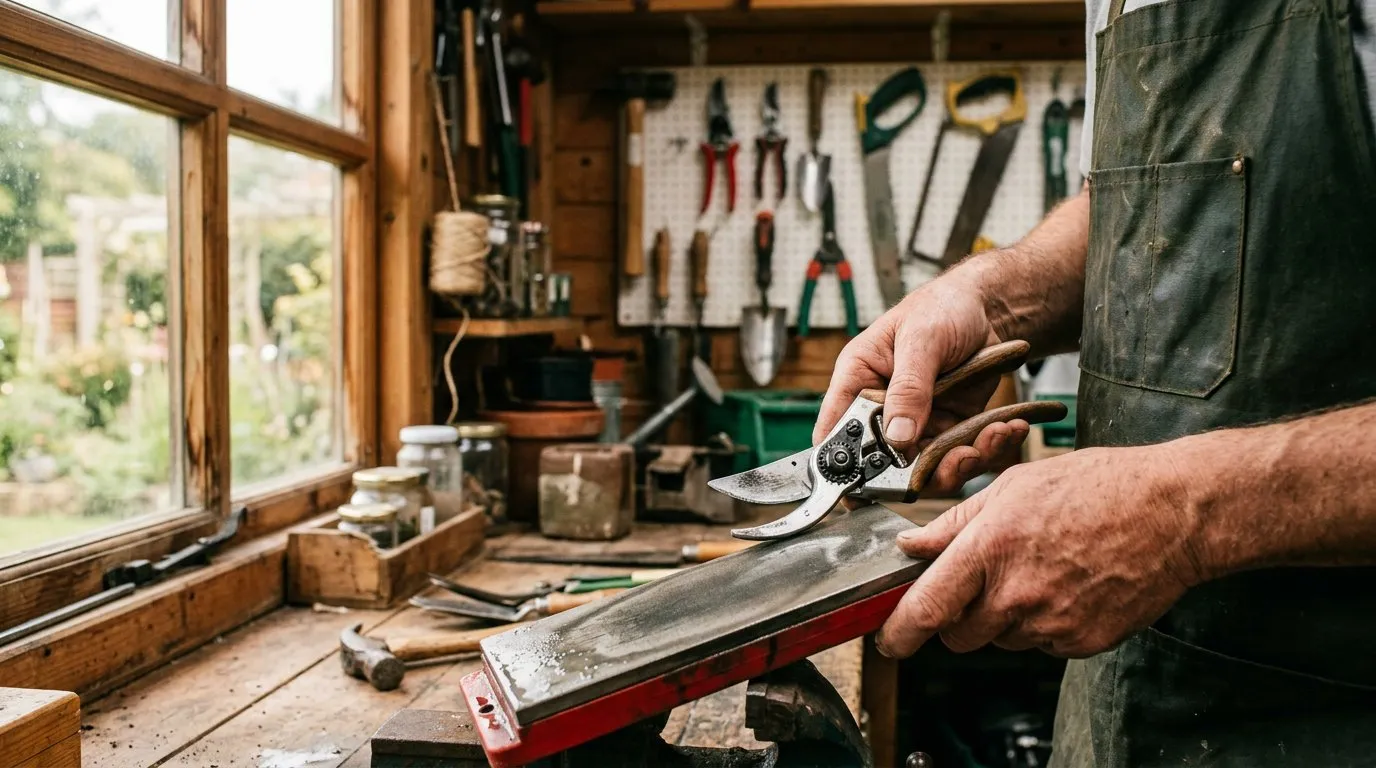 Sharpening secateurs on a diamond stone in a garden shed. Hold the stone flat against the bevelled edge and draw in one direction.
Oiling
Apply a thin coat of camellia oil or light machine oil to the blade, pivot bolt, and spring after every session. Camellia oil is the traditional Japanese blade oil and leaves no harmful residue on plants. In the UK, where gardens experience 150-180 rain days annually, oiling is not optional. It is the single most effective measure against rust.
Storage
Store secateurs indoors, in a dry room. A shed or greenhouse is not dry enough during British winters, when condensation forms on metal overnight. A hook inside the back door or a kitchen drawer works. If you must store in a shed, use a lightly oiled cloth wrap.
Maintenance checklist
| Task | Frequency | What to use |
|---|---|---|
| Wipe off sap and debris | After every use | Damp cloth |
| Sterilise after diseased wood | Immediately | Methylated spirit or 10% bleach |
| Sharpen cutting blade | Every 2-3 hours of use | Diamond stone or 600-grit whetstone |
| Oil blade, pivot, and spring | After every session | Camellia oil or light machine oil |
| Check bolt tension | Monthly | Spanner or Allen key (per model) |
| Replace worn spring | When cuts require extra force | Brand-specific spare |
| Replace blade | When sharpening no longer restores edge | Brand-specific spare |
Choosing the right secateurs for your garden
The best secateurs depend on what you actually prune. A small courtyard garden with a few roses and a lavender hedge needs different tools from a half-acre plot with mature fruit trees, a mixed border, and a 30m hedgerow.
For rose gardeners: A quality bypass pair with 20mm capacity handles everything from deadheading to winter hard pruning. The Felco 2 or Niwaki GR Pro are both excellent. See our full guide on how to grow roses for the care that keeps rose pruning simple.
For mixed borders and shrubs: The same bypass pair covers most jobs. Add loppers for anything over 20mm. Gardeners who tackle heavy spring pruning sessions across a full border benefit from Bahco’s rotating handle to reduce fatigue.
For fruit trees: Bypass secateurs handle young growth and spur pruning. A Niwaki pair gives the precision needed for careful cuts close to the fruiting wood. For guidance on keeping fruit trees productive, see our fruit tree growing guide.
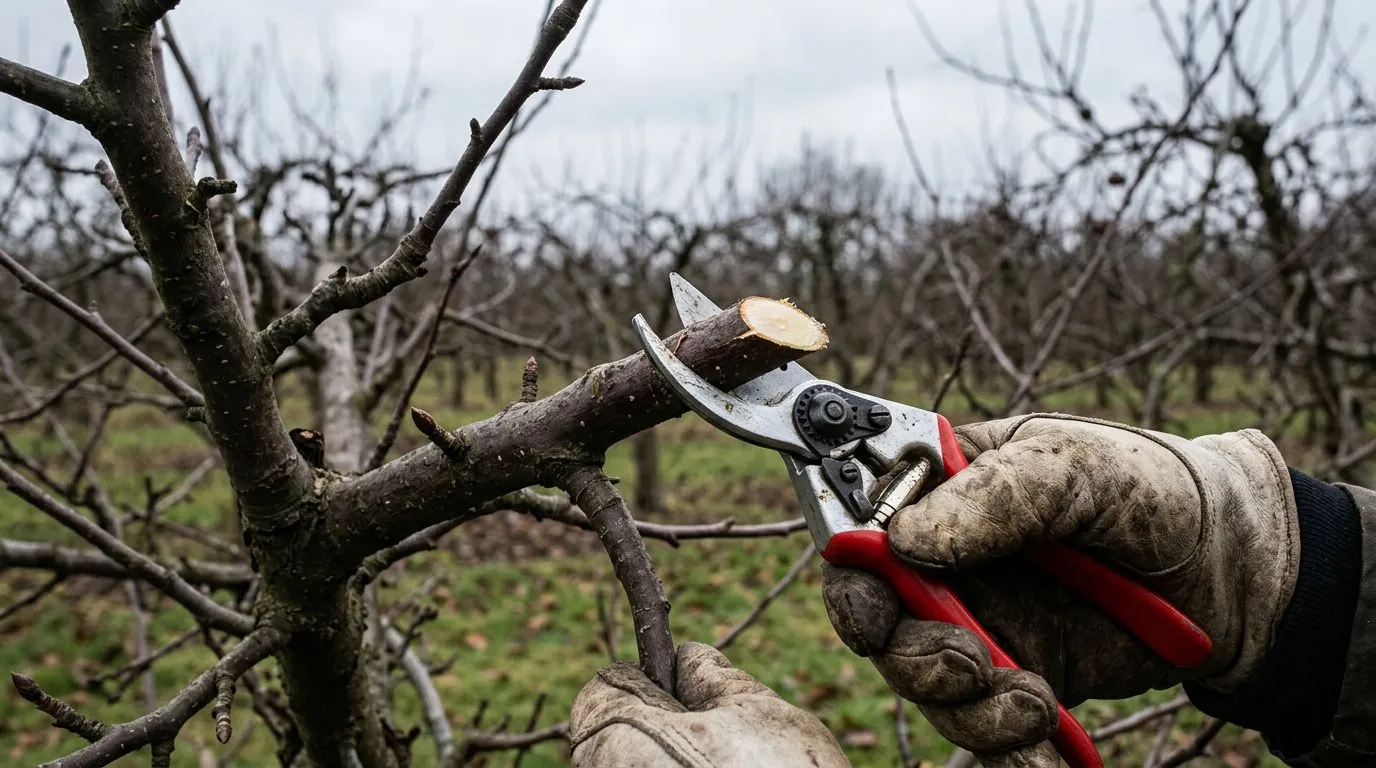 Winter pruning a fruit tree with bypass secateurs. The clean angled cut helps the wound heal quickly before spring growth.
For gardeners with hand problems: A ratchet bypass model eliminates the strain of forcing through thicker stems. Choose the lightest model available and look for a soft-grip, rotating handle.
Now you’ve chosen the right secateurs, read our guide on how to sharpen garden tools for the next step.
Frequently asked questions
What is the difference between bypass and anvil secateurs?
Bypass secateurs cut with a scissor action. Two curved blades slide past each other, producing a clean cut on live stems. Anvil secateurs press a single sharp blade down onto a flat metal plate, which tends to crush softer tissue. Bypass suits green, growing wood. Anvil suits dead, dry, or woody material where some crushing does not matter. Most UK gardeners should own a bypass pair as their primary tool and keep an anvil pair for winter deadwood clearance.
Which secateurs are best for arthritic hands?
Ratchet secateurs are the best choice. They cut in stages, reducing the grip force needed at any one point by up to 50%. Look for models with rotating lower handles, which reduce friction on the palm. Ergonomic handles with a soft-grip coating also help. Avoid heavy all-steel models over 250g. The Bahco PX-M2 with its rotating handle is worth considering even without the ratchet mechanism.
How often should I sharpen my secateurs?
Sharpen after every 2-3 hours of active cutting. A diamond sharpening stone or fine-grit whetstone works well. Hold the stone flat against the bevelled edge and draw it along the blade in one direction. If the blade is nicked or badly worn, use a coarser stone first. Regular sharpening extends blade life by years and keeps cuts clean enough to prevent disease entering through damaged tissue.
Do I need to clean secateurs after pruning diseased wood?
Yes, without exception. Wipe the blades with methylated spirit or a 10% bleach solution after cutting any diseased material. Fungal spores from coral spot, canker, and silver leaf transfer between plants on dirty blades. Clean after each diseased plant, not just at the end of the session. This is especially important during damp UK autumns when spore counts are highest.
How do I stop my secateurs rusting in wet weather?
Dry the blades after every use and apply a thin coat of camellia oil or light machine oil. Store secateurs indoors, not in the shed where damp air accelerates corrosion. Stainless steel blades resist surface rust better than carbon steel, but still need oiling in the British climate. A quick wipe with an oiled cloth takes ten seconds and prevents the flaking rust that ruins a cutting edge.
Are expensive secateurs worth the money?
For regular gardeners, yes. Premium brands like Felco and Niwaki use harder steel that holds an edge longer, and they sell individual replacement parts. A Felco 2 can last 20 years with blade replacements costing around 12 each. Budget secateurs often cannot be resharpened effectively and have no spare parts available. The cost per year of use favours the premium tool heavily.
What size secateurs do I need for small hands?
Look for models with a maximum handle span under 50mm when fully open. Felco 6 and Bahco PX-S1 are designed specifically for smaller hands. Avoid large-handled professional models like the Felco 4 or Bahco PX-L3, which require a full adult grip span of 55-60mm. Using oversized secateurs forces the hand into an unnatural position and causes fatigue much faster.
Lawrie has been gardening in the West Midlands for over 30 years. He grows his own veg using no-dig methods, keeps a wildlife-friendly garden, and writes practical advice based on real UK growing conditions.