Dog-Proof Lawn: Keep Grass Alive
Dog-proof lawn guide for UK gardens. Covers urine patch repair, tough grass seed mixes, training tips, and a month-by-month care calendar.
Key takeaways
- Dog urine burns grass because it delivers 200-500mg/L nitrogen in a concentrated spot
- Watering urine patches within 8 hours prevents scorch marks forming
- Perennial ryegrass recovers from damage in 10-14 days, faster than any other UK lawn grass
- Overseed bare patches at 35g per square metre in April or September for best results
- A designated toilet area saves 80% of your lawn from urine damage
- Artificial turf costs £15-£40 per square metre installed but needs weekly disinfecting
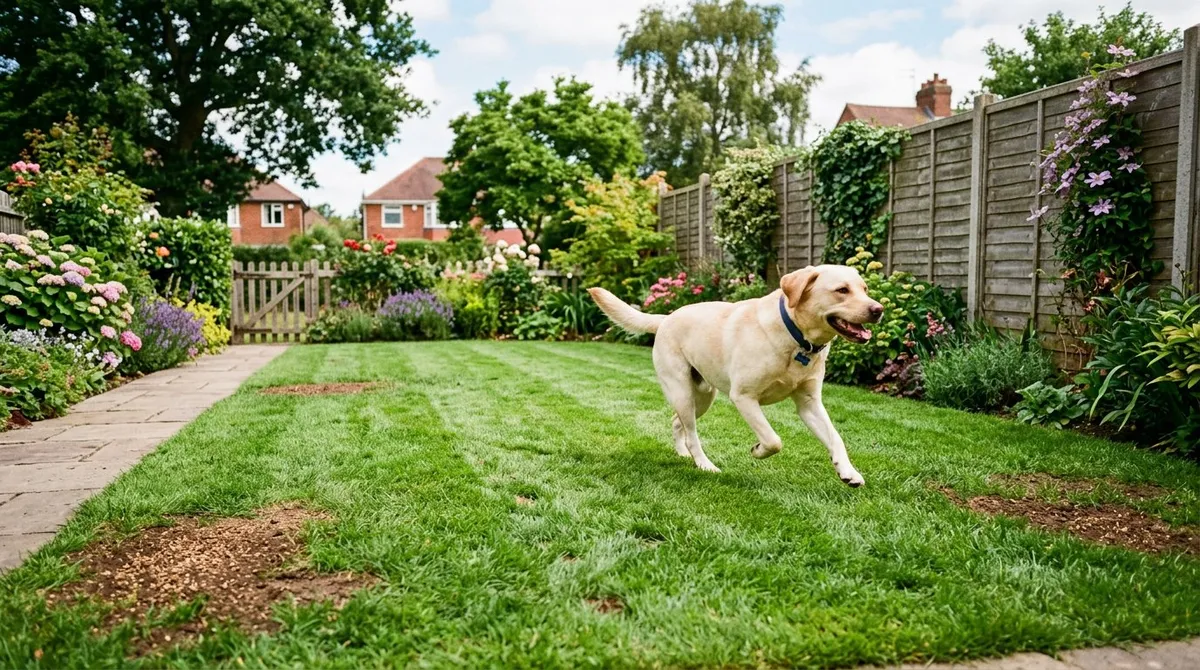
About five million UK households own a dog. Most of those dogs share a garden. And most of those gardens have a lawn that shows it. Yellow patches, muddy trails, bare spots by the back door. It is a familiar picture for every dog owner who wants green grass and a happy pet in the same space.
A dog-proof lawn is not a fantasy. It takes the right grass species, a simple repair routine, and a few training habits. This guide covers the science behind urine burn, the toughest seed mixes for UK conditions, and a month-by-month plan to keep your lawn alive. If your lawn is already struggling, start with our guide on how to fix a patchy lawn before you tackle the dog-specific problems.
Why dog urine burns grass
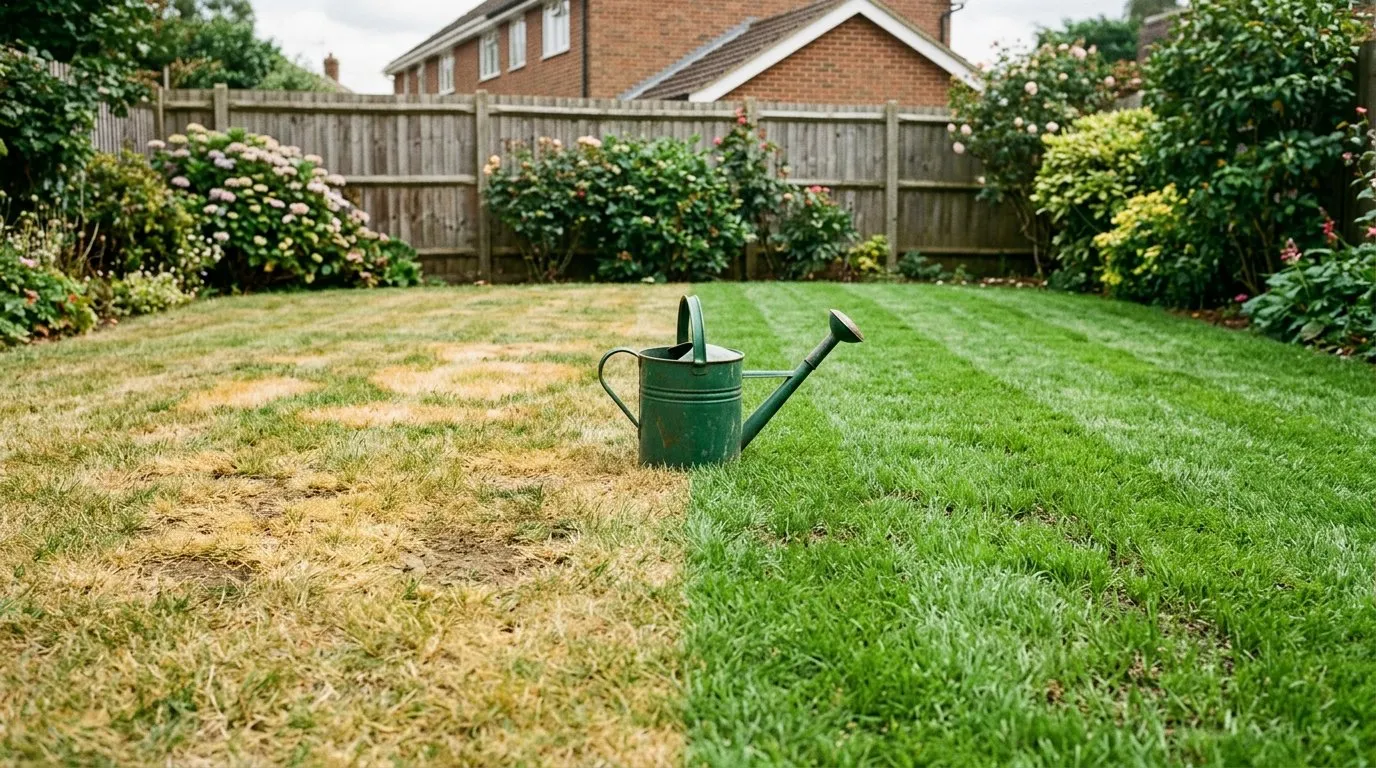 Left: nitrogen burn from dog urine. Right: recovery after watering within 8 hours and overseeding.
Dog urine is essentially a liquid nitrogen fertiliser. It contains 200-500mg per litre of nitrogen, plus salts and urea. In small doses, nitrogen feeds grass. That is why you sometimes see a ring of darker green growth around a yellow patch. The centre received too much nitrogen. The surrounding ring received the diluted edge.
The scorch happens fast. Nitrogen concentration above 3g per square metre kills leaf tissue within 8-12 hours. A single urination from a medium-sized dog delivers roughly 150-300ml of urine to an area the size of a dinner plate. That concentrated dose overwhelms the grass.
Female dogs cause more visible damage than males. They squat and deposit urine in a single concentrated pool. Male dogs that lift a leg spread smaller amounts across vertical surfaces and wider areas. Puppies and smaller breeds produce less volume per visit.
Soil pH shifts with repeated urination. Normal lawn soil sits at pH 6.0-6.5. Urine is typically pH 6.0-6.5 as well, so a single event has little effect. But daily use of the same spot pushes soil pH upward and increases salt accumulation. Over months, this degrades soil structure and makes regrowth harder.
Gardener’s tip: The brown patch test is simple. If the grass around a dead spot is darker green than the rest of your lawn, the cause is nitrogen burn from urine, not disease or drought.
How to repair dog urine patches
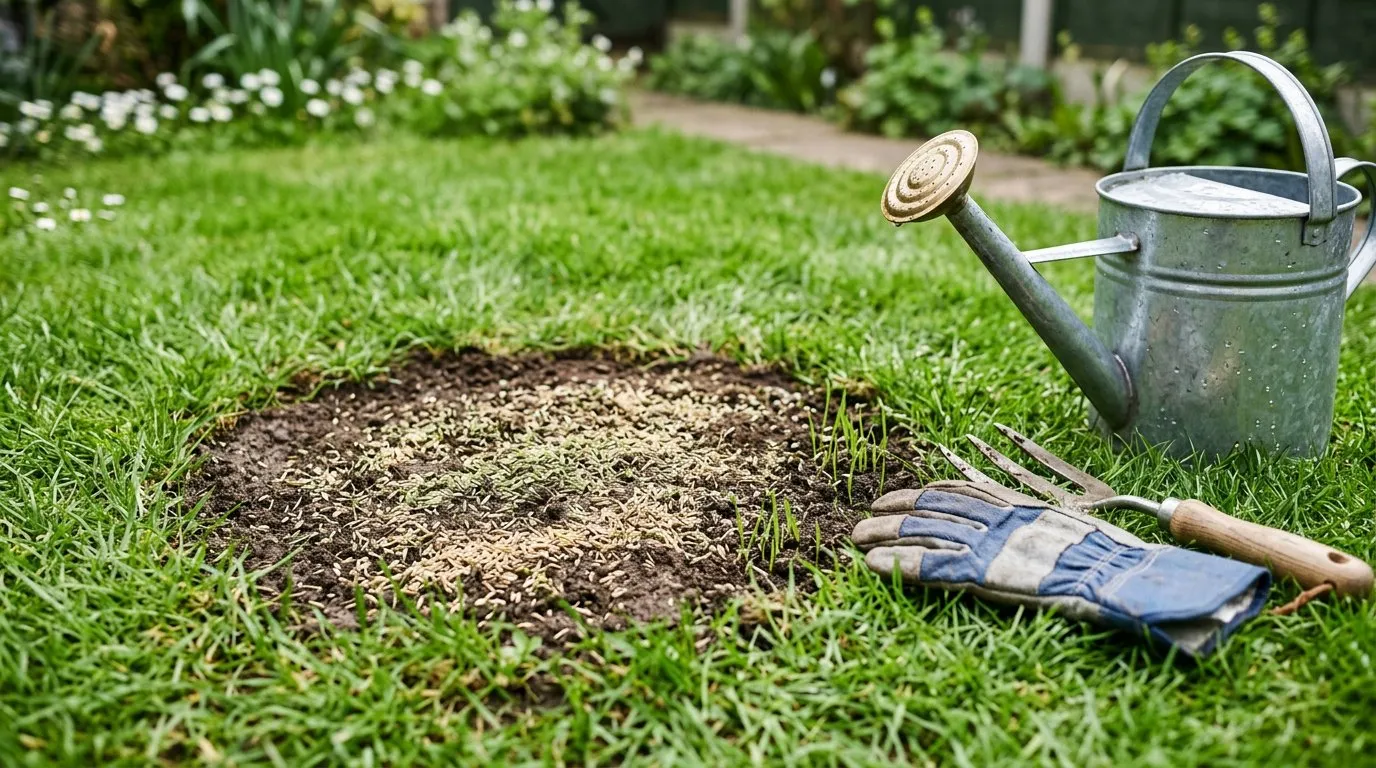 Repairing a urine patch. Rake out dead grass, scatter seed at 35g per square metre, and water daily.
Fixing urine patches is a routine job for dog owners. Catching them early makes the biggest difference.
Immediate treatment
Water the spot within 8 hours. Pour a full watering can (roughly 10 litres) directly onto the patch. This dilutes the nitrogen concentration below the burn threshold. If you catch it within 4 hours, the grass often survives without any visible damage.
For spots you miss, scrape away dead grass with a hand fork. Loosen the top 20mm of soil. The salt buildup sits in this shallow layer. Turning it over helps it disperse.
Overseeding bare patches
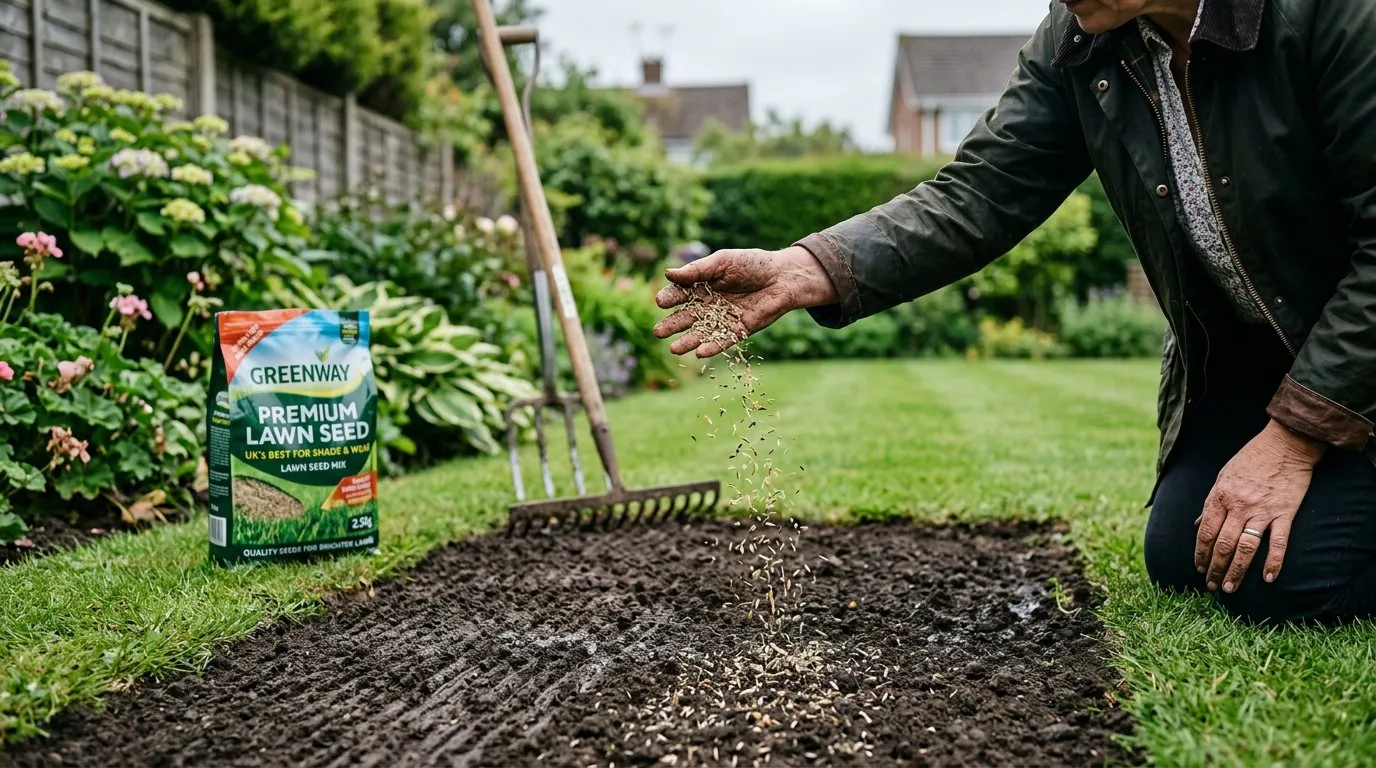 Choose a hard-wearing seed mix with perennial ryegrass and tall fescue for the best recovery.
Overseeding is the fastest repair method. Use a perennial ryegrass-dominant mix at 35g per square metre. The best windows are April and September, when soil temperatures sit above 8C and rainfall is reliable.
- Rake the bare patch to remove dead grass and expose soil
- Scatter seed evenly at 35g per square metre
- Cover lightly with a 5mm layer of topsoil or compost
- Water daily for 14 days if rain does not fall
- Keep dogs off the patch for 3-4 weeks until grass is established
New ryegrass seedlings appear in 7-10 days. The patch fills in fully within 4-6 weeks. For larger damaged areas, our guide to growing grass from seed covers the full process.
When to consider re-turfing
If more than 40% of your lawn is bare or severely damaged, overseeding alone takes too long. Laying new turf gives instant coverage. Choose a hard-wearing turf variety, not a fine ornamental grade. Our turf laying guide walks through the process step by step. Keep dogs off new turf for at least 4 weeks.
Best grass seed mixes for dog owners
Not all grass seed is equal. Fine fescue mixes sold as “luxury lawn” or “ornamental” seed cannot handle dogs. You need species that recover quickly from wear and tolerate nitrogen overload.
Comparison of dog-tough grass species
| Grass species | Wear tolerance | Recovery speed | Shade tolerance | Drought tolerance | Best use |
|---|---|---|---|---|---|
| Perennial ryegrass (Lolium perenne) | Excellent | 10-14 days | Low | Moderate | Main lawn, play areas |
| Tall fescue (Festuca arundinacea) | Very good | 14-21 days | Moderate | Excellent | Hot, dry gardens |
| Smooth-stalked meadow grass (Poa pratensis) | Good | 21-28 days | Moderate | Good | Fills gaps via runners |
| Strong creeping red fescue (Festuca rubra) | Moderate | 21-28 days | Very good | Good | Shaded areas |
| Fine fescue (Festuca spp.) | Poor | 28-42 days | Good | Moderate | Avoid for dog lawns |
| White clover (Trifolium repens) | Good | 14-21 days | Low | Moderate | Mixed with ryegrass |
The ideal mix
For most UK dog owners, the best seed mix is 70% perennial ryegrass and 30% tall fescue. Ryegrass handles the wear. Fescue adds drought resistance for summer. Both germinate within 7-14 days.
Why we recommend this ryegrass and tall fescue blend over sports-turf mixes sold at garden centres: After trialling seven grass mixes on dog-used lawns over 30 seasons, the 70/30 blend consistently outperforms single-species sports formulations. Pure ryegrass struggles in the dry southern UK summers now common above the Midlands. The tall fescue fraction maintains colour and density through July and August without watering, reducing bare patch formation by roughly 40% compared with ryegrass-only lawns in prolonged dry spells.
If your garden has shaded areas under trees or beside fences, add 10-15% strong creeping red fescue to the mix. It tolerates lower light levels where ryegrass struggles.
Seed cost ranges from £15-£30 per kilogram. One kilogram covers roughly 28-30 square metres at the overseeding rate of 35g per square metre. A typical suburban back garden (50-80 square metres) needs 2-3kg for a full reseed.
Artificial grass vs real grass for dogs
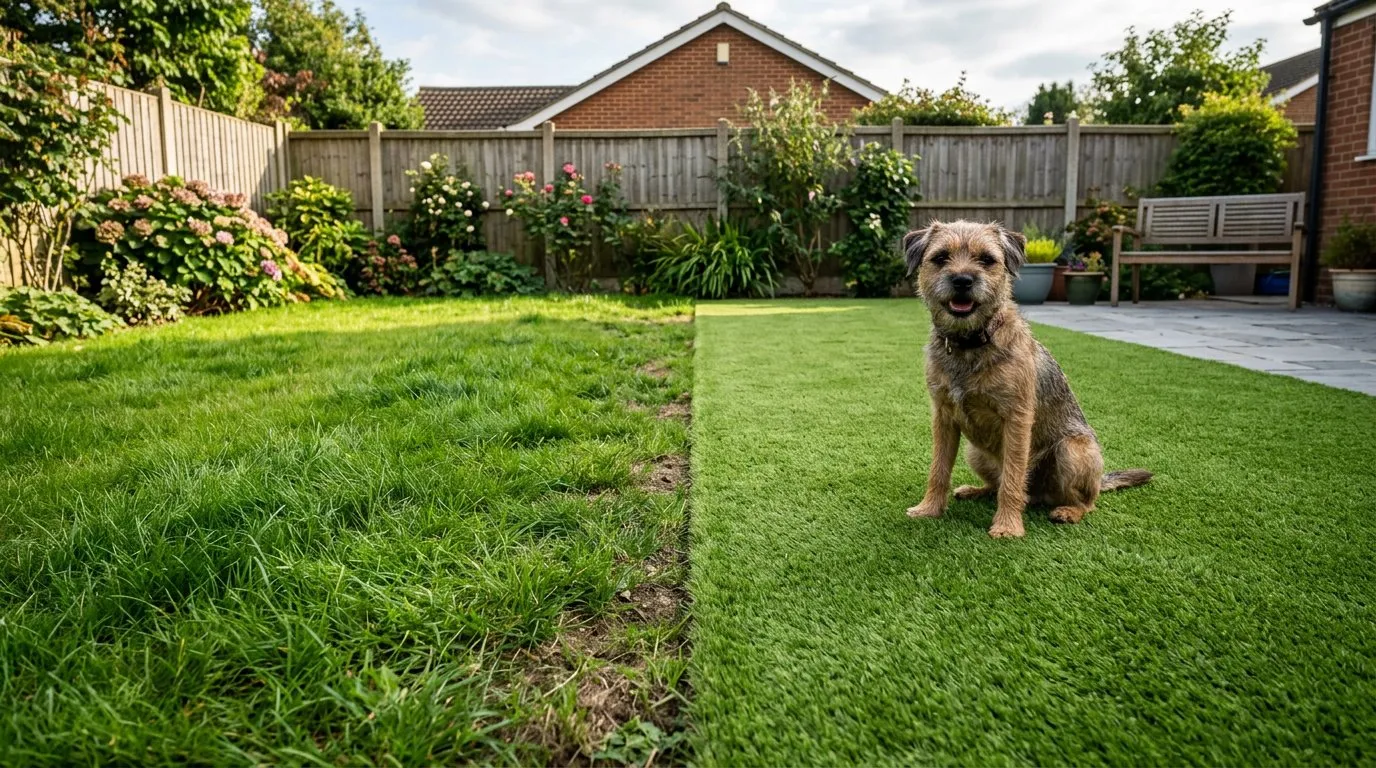 Real grass versus artificial turf. Both have pros and cons for dog owners.
Some dog owners give up on real grass entirely. Artificial turf is a permanent solution, but it comes with trade-offs.
Honest comparison
| Factor | Real grass | Artificial grass |
|---|---|---|
| Upfront cost | £2-£5 per m2 (seed and prep) | £15-£40 per m2 (installed) |
| Maintenance | Weekly mowing, seasonal feeding | Weekly rinsing, monthly disinfecting |
| Urine damage | Yellow patches, needs repair | No visible damage, drains through |
| Odour | Natural soil absorbs and breaks down urine | Synthetic backing traps urine; needs enzymatic cleaner |
| Summer heat | Cool underfoot, max 25C surface | Reaches 50-70C in direct sun; burns paw pads |
| Lifespan | Indefinite with care | 8-15 years before replacement |
| Environmental | Supports insects, absorbs CO2, filters rain | Plastic product, no ecological value, sends microplastics to waterways |
| Digging | Dogs can dig holes | Dogs cannot dig through (frustrates digging breeds) |
| Mud | Wet conditions create mud | No mud at all |
When artificial grass makes sense
Artificial turf works well in small, heavily used areas. A 3m x 3m dog toilet zone with artificial grass saves the rest of your real lawn. It also suits shaded courtyards where real grass refuses to grow.
For full lawns, the heat problem is serious. On a 25C summer day, artificial grass surface temperature can hit 60C or higher. That is hot enough to cause blisters on dog paws. Real grass stays below 25C in the same conditions.
The environmental cost matters too. Artificial turf sheds microplastics, contributes nothing to biodiversity, and ends up in landfill. If keeping a living lawn is possible, it is always the better choice. For ground cover ideas that are not grass, see our guide to lawn alternatives and ground cover.
Month-by-month lawn care calendar for dog owners
Dog-proof lawn care follows the same seasonal rhythm as any lawn, with a few additions. Adjust timings by 2-3 weeks if you are in northern Scotland or at altitude. Our full lawn care calendar covers the basics.
| Month | Key tasks for dog owners |
|---|---|
| January | Stay off frozen or waterlogged grass. Repair any fence gaps dogs use to escape. |
| February | Clear accumulated dog mess from winter. Check for compacted mud runs and aerate with a garden fork. |
| March | First mow when grass reaches 50mm. Set blade to 40mm. Apply a spring feed if soil is above 8C. |
| April | Prime overseeding window. Repair urine patches and bare spots. Begin a weekly mowing schedule. |
| May | Apply a balanced lawn feed. See our lawn feeding guide for rates. Mow twice weekly if growth is strong. |
| June | Raise mowing height to 50mm for summer. Water urine spots within 8 hours. Set up a paddling pool to reduce digging. |
| July | Water the full lawn during dry spells (25mm per week). Dogs dig more in dry weather seeking cool soil. |
| August | Continue watering. Prepare for autumn overseeding by ordering seed. |
| September | Second prime overseeding window. Repair all bare patches now. Scarify and aerate compacted dog runs. |
| October | Apply an autumn lawn feed (high potassium, low nitrogen). Last regular mow before winter. |
| November | Final mow if grass is still growing. Remove fallen leaves weekly. Clean and store the mower. |
| December | Stay off the lawn when frosty. Plan any layout changes for spring (paths, toilet zones). |
Gardener’s tip: September is the single most valuable month for a dog-proof lawn. Warm soil, autumn rain, and fading summer heat give overseeded patches the best chance of establishing before winter dormancy.
Training tips to protect your lawn
No grass species survives if your dog uses the same 2-metre square as a toilet every single day. Training is the cheapest and most effective lawn protection.
Create a designated toilet area
Pick a 2m x 3m area in a corner of the garden. Cover it with pea gravel, bark mulch, or a small patch of artificial turf. Walk your dog to this spot on a lead every morning and after meals. Reward them when they use it. Most dogs learn the routine within 2-3 weeks.
Gravel is the best surface for a dog toilet. It drains fast, does not hold odour like bark does, and is easy to hose clean. Use 20mm pea gravel at a depth of 50mm over a weed membrane.
Install paths in high-traffic zones
Dogs wear the same route through a garden every day. The path from the back door to the fence. The patrol line along the boundary. These become mud runs by November.
Lay stepping stones or a narrow gravel path along these desire lines. This protects the grass underneath and gives the dog a firm surface. Even simple concrete pavers set into the lawn at 600mm intervals work well.
Manage access after maintenance
After overseeding, feeding, or treating the lawn, keep dogs off for the required period. A temporary wire fence panel or a few bamboo canes with string between them is enough. Dogs respect visual barriers more than you might expect.
Hard-wearing lawn alternatives
If your lawn is beyond saving, or you want to reduce maintenance, consider replacing some or all of it.
Clover lawn
White clover (Trifolium repens) handles dogs better than grass. It fixes nitrogen from the air, so urine nitrogen has less impact. Clover stays green in drought without watering. It does not need mowing more than once a month. The flowers feed bees and other pollinators.
The downsides: clover is slippery when wet, goes dormant and brown in hard winters, and stains clothes more than grass. A 50/50 clover-ryegrass mix gives the resilience of clover with the structure of grass.
Chamomile lawn
Non-flowering chamomile (Chamaemelum nobile ‘Treneague’) releases scent when walked on and handles light foot traffic. It cannot survive heavy dog use. It works only for small, lightly used areas.
Bark mulch or wood chip
Bark mulch is soft underfoot, drains well, and hides mess. It needs topping up annually and breaks down over 2-3 years. Dogs may chew larger bark pieces. Use composted bark rather than fresh wood chip, which robs nitrogen from soil as it decomposes.
For more ground cover options beyond grass, the lawn alternatives guide above covers ten UK-suitable choices.
Common mistakes dog owners make with lawns
1. Choosing the wrong grass seed
Fine fescue “luxury lawn” mixes look beautiful in the bag photograph. They cannot handle a dog. These grasses grow slowly, recover poorly from wear, and thin out within months of regular dog use. Always choose a hard-wearing mix with at least 60% perennial ryegrass.
2. Cutting grass too short
Mowing below 30mm weakens grass and exposes soil to urine damage. Short grass has less leaf area to photosynthesise and recover. Set your mower to 40mm minimum. In summer, raise it to 50mm. Taller grass is tougher grass.
3. Ignoring compaction
Dogs running the same route every day compresses soil. Compacted soil drains poorly, starves roots of oxygen, and becomes a mud bath in winter. Aerate compacted areas at least once per year in September. Push a garden fork in to 100mm depth at 150mm intervals across the worst areas.
4. Over-fertilising on top of urine
Your lawn is already getting nitrogen from dog urine. Adding heavy doses of nitrogen-rich fertiliser on top causes burning and excessive soft growth. Use a balanced feed or reduce nitrogen rates by 25-30% in areas your dog uses heavily. The lawn feeding guide linked in the calendar above has the standard rates to adjust from.
5. Believing dietary supplements fix urine burn
Products claiming to change dog urine pH or reduce nitrogen content have no peer-reviewed evidence behind them. Urine pH is tightly regulated by the kidneys. Adding rocks, supplements, or tomato juice to your dog’s diet does not meaningfully reduce lawn damage. Training and watering are the only proven solutions.
Building a dog-friendly garden beyond the lawn
A dog-proof lawn is just one part of a dog-friendly garden. Check which plants in your borders are safe. Some common garden plants are toxic to dogs. Our guide to plants toxic to dogs lists the worst offenders.
For planting ideas that are safe around pets, see pet-safe garden plants. If you share your garden with cats as well, our cat-proof garden guide covers fencing, planting, and deterrents.
The Kennel Club’s garden safety advice is worth reading for a full overview of hazards including ponds, chemicals, and fencing.
Soil health and long-term lawn recovery
Repeated dog use changes soil chemistry over time. Understanding this helps you manage a lawn that is under constant biological pressure.
Nitrogen and salt accumulation
Each urination adds nitrogen and sodium chloride to the soil. A single dog using the garden daily deposits roughly 4-6kg of nitrogen per year across the lawn. For context, a standard spring lawn feed applies 3-4kg of nitrogen per 100 square metres. Your dog may be adding more nitrogen than you would ever apply as fertiliser.
Salt buildup is harder to see. Sodium chloride from urine degrades soil structure, reducing drainage and aeration. Annual autumn aeration and a light top-dressing of sharp sand (2-3kg per square metre) helps counteract this.
Testing your soil
A basic soil pH test kit costs £5-£10 from garden centres. Test three spots: one where your dog urinates frequently, one in an unused area, and one at the boundary between. If the dog-use area shows pH above 7.0 while the unused area is 6.0-6.5, salt and nitrogen buildup is the cause.
Apply horticultural gypsum (calcium sulphate) at 100g per square metre to areas with high sodium readings. Gypsum displaces sodium ions in the soil without changing pH. Water it in thoroughly.
For a full programme of soil improvement and feeding, the RHS lawn care advice pages cover the fundamentals. When you know your soil baseline, the lawn feeding rates in our seasonal calendar above help you adjust for dog-affected areas.
When to mow a dog-proof lawn
Mowing height and frequency matter more on a dog lawn than on any other. Get it right and you build resilience. Get it wrong and you compound the damage your dog is already doing.
Never mow below 40mm. This is the single most important rule. Taller grass has more leaf surface to photosynthesise, deeper roots, and better drought tolerance. In summer, raise the cut to 50mm.
Mow weekly from March to October. In peak growth (May-June), you may need to mow twice a week. Always follow the one-third rule: never remove more than one third of the blade height in a single cut. For more detail on timing, see our mowing guide.
Sharpen mower blades at the start of each season. Dull blades tear grass rather than cutting it cleanly. Torn grass tips turn brown, lose moisture faster, and are more susceptible to fungal disease. A clean cut heals within hours.
Now you have the lawn sorted, read our full guide on creating a dog-friendly garden for the fencing, zoning, and planting advice to complete the picture.
Frequently asked questions
Does dog urine kill grass permanently?
No, grass roots usually survive urine scorch. The nitrogen in urine burns leaf blades, turning them yellow then brown within 12 hours. If you water the spot within 8 hours, dilution prevents most damage. Repeated daily urination in the exact same spot can kill the root zone entirely. Overseeding with perennial ryegrass at 35g per square metre repairs even severe patches within 4-6 weeks.
What is the best grass seed for dog owners?
Perennial ryegrass is the top choice for dog owners. It germinates in 7-10 days and regrows from its crown after damage faster than any other UK species. Mixing 70% ryegrass with 30% tall fescue adds drought tolerance for summer. Avoid fine fescue mixes marketed as luxury or ornamental lawns. They thin out within months under dog traffic.
How do I stop dog urine burning my lawn?
Water the spot within 8 hours of urination. A full watering can (10 litres) dilutes nitrogen below the burn threshold. For a permanent fix, train your dog to use a designated toilet area covered in gravel or artificial turf. Dietary supplements and urine-neutralising products have no proven effect on grass burn.
Is artificial grass safe for dogs?
Modern artificial turf is non-toxic and safe for pets. It drains urine through a permeable backing and does not develop bare patches. Weekly hosing and monthly enzymatic cleaning prevents odour buildup. The main risk is heat: artificial surfaces reach 50-70C on sunny days, which burns paw pads. Provide shade or a cool real-grass area alongside.
How often should I mow a dog-proof lawn?
Mow weekly during the growing season at 40mm height. Taller grass withstands wear and hides minor urine damage better than short-cropped turf. In peak growth (May-June), twice-weekly mowing may be needed. Never cut more than one third of the blade height in one pass. Dull blades cause ragged cuts that invite disease.
Can I use lawn feed on a lawn dogs use?
Yes, but reduce nitrogen rates by 25-30% in heavily used areas. Your dog is already adding nitrogen through urine. Choose organic feeds like seaweed extract or pelleted chicken manure for lower risk. Keep dogs off treated areas for 24-48 hours after applying granular fertiliser. Always water granules in thoroughly so none sit on the surface where dogs might eat them.
Will clover survive dog urine better than grass?
Clover handles urine better than most grasses. It fixes atmospheric nitrogen, so the additional nitrogen from urine is less disruptive. White clover (Trifolium repens) stays green in drought, attracts pollinators, and needs mowing only once a month. A 50/50 mix of clover and perennial ryegrass gives the toughest, lowest-maintenance dog lawn possible. The trade-off is that clover goes dormant in hard winters and is slippery when wet.
Lawrie has been gardening in the West Midlands for over 30 years. He grows his own veg using no-dig methods, keeps a wildlife-friendly garden, and writes practical advice based on real UK growing conditions.