Gardening for Beginners: UK Guide
Gardening for beginners in the UK made practical. Soil types, essential tools, first plants to grow, and a month-by-month starter calendar.
Key takeaways
- Test your soil pH before buying plants — a five pound kit prevents fifty pounds of failed crops suited to the wrong conditions
- Start with six easy crops: lettuce, radishes, potatoes, courgettes, runner beans, and herbs like basil and parsley
- Last frost dates vary across the UK — mid-April in London, late April in the Midlands, mid-May in Scotland
- A basic tool kit of spade, fork, secateurs, trowel, and watering can costs under fifty pounds total
- Improve any soil type by adding 5-8 cm of homemade compost or well-rotted manure each autumn
- Sow one new crop every 2-3 weeks from March to August for continuous harvests through to November
Gardening for beginners starts with one fact most guides skip: your soil decides what thrives and what dies. Every plant in every UK garden centre has specific needs for drainage, pH, and nutrients that only certain soil types provide. Get the soil right and almost everything else follows.
This guide covers the five things every new UK gardener needs to understand: soil types, essential tools, the best first plants, basic growing techniques, and a month-by-month calendar that tells you exactly what to do and when. Whether you have a large back garden or a small patio with a few pots, the principles are identical.
What type of soil do you have?
UK soil type determines which plants succeed and which fail in your garden. The British Geological Survey maps four main soil types across the country, and each behaves differently when it comes to drainage, nutrient retention, and workability. Knowing your type saves money and frustration from the very first season.
Pick up a handful of moist garden soil and squeeze it. Clay holds its shape like modelling dough and feels sticky. Sandy soil crumbles apart and feels gritty. Chalk is pale, stony, and often shallow over bedrock. Loam — the one every gardener wants — holds together loosely without stickiness and crumbles when poked.
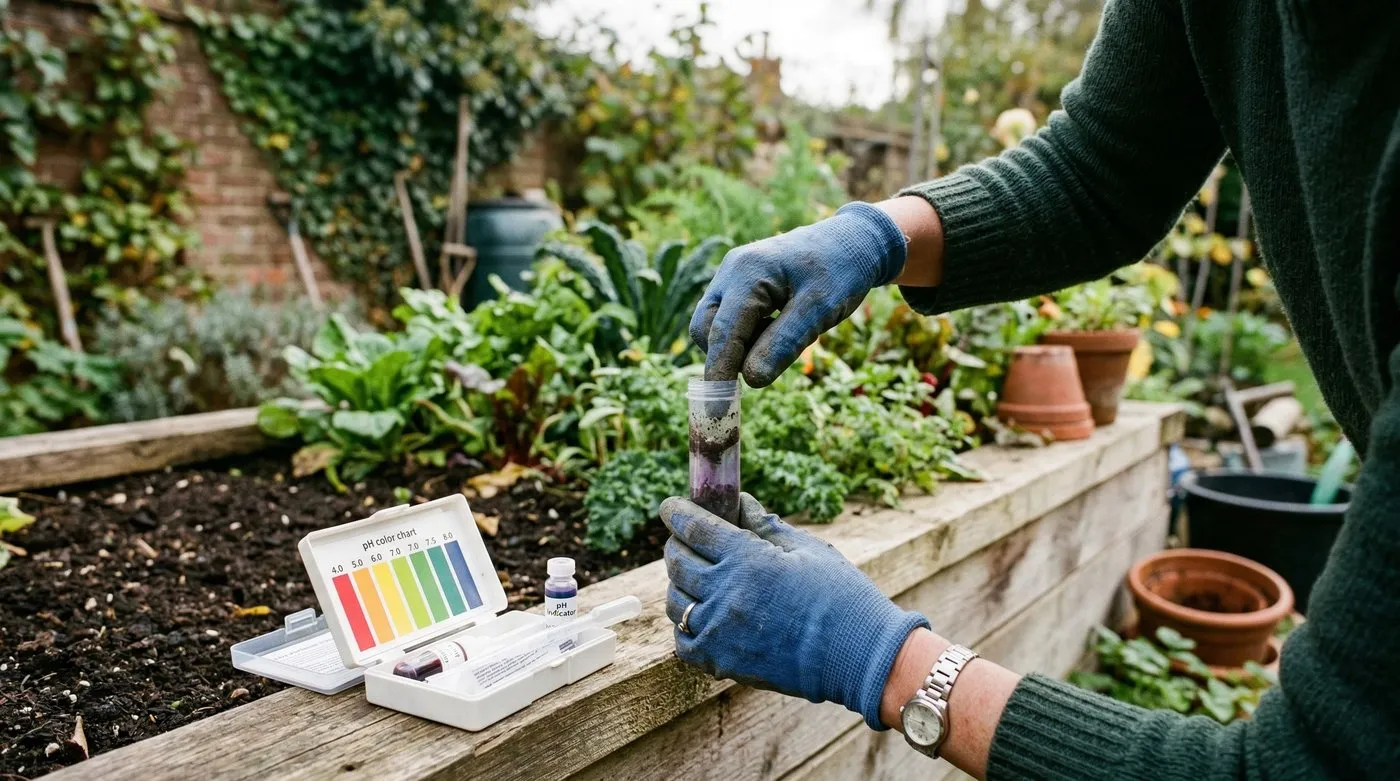 A five pound pH testing kit tells you exactly what your soil needs before you spend money on plants.
Most of southeast England sits on clay or chalky soil. The Midlands and northwest are predominantly clay. East Anglia and coastal areas tend toward sand. Scotland varies dramatically, with peaty acid soil in the Highlands and heavy clay in the central belt. For a detailed guide to testing and adjusting your soil, see our article on soil testing and pH adjustment.
| Soil type | pH range | Drainage | Nutrient retention | Workability | Best crops and plants |
|---|---|---|---|---|---|
| Clay | 6.0-7.5 | Poor, waterlogged in winter | High — holds nutrients well | Heavy, sticky when wet, hard when dry | Roses, asters, brassicas, beans, fruit trees |
| Sandy | 5.5-7.0 | Fast, dries out quickly | Low — nutrients wash through | Light, easy to dig year round | Carrots, parsnips, lavender, Mediterranean herbs |
| Chalk | 7.1-8.5 | Free-draining, often shallow | Medium — alkaline locks out iron | Stony, hard to dig deeply | Clematis, dianthus, spinach, brassicas, box hedging |
| Loam | 6.0-7.0 | Good, retains moisture without waterlogging | High — balanced nutrient profile | Easy to work in most conditions | Almost everything — the ideal garden soil |
Clay soil is the most common in UK gardens and the most frustrating for beginners. It bakes hard in summer and turns to mud in winter. The solution is always the same: add organic matter. Spreading 5-8 cm of homemade compost or well-rotted manure each autumn turns clay within two to three seasons.
Essential tools for your first year
A beginner needs five tools — not twenty. Garden centres sell hundreds of gadgets, most of which gather dust in the shed after their first use. Focus your budget on quality versions of the tools you will use every single week.
Buy the best spade and fork you can afford. These are the two tools that take the most punishment, and cheap versions bend, snap, or blister your hands within a season. Stainless steel blades with ash or fibreglass handles are the most durable combination.
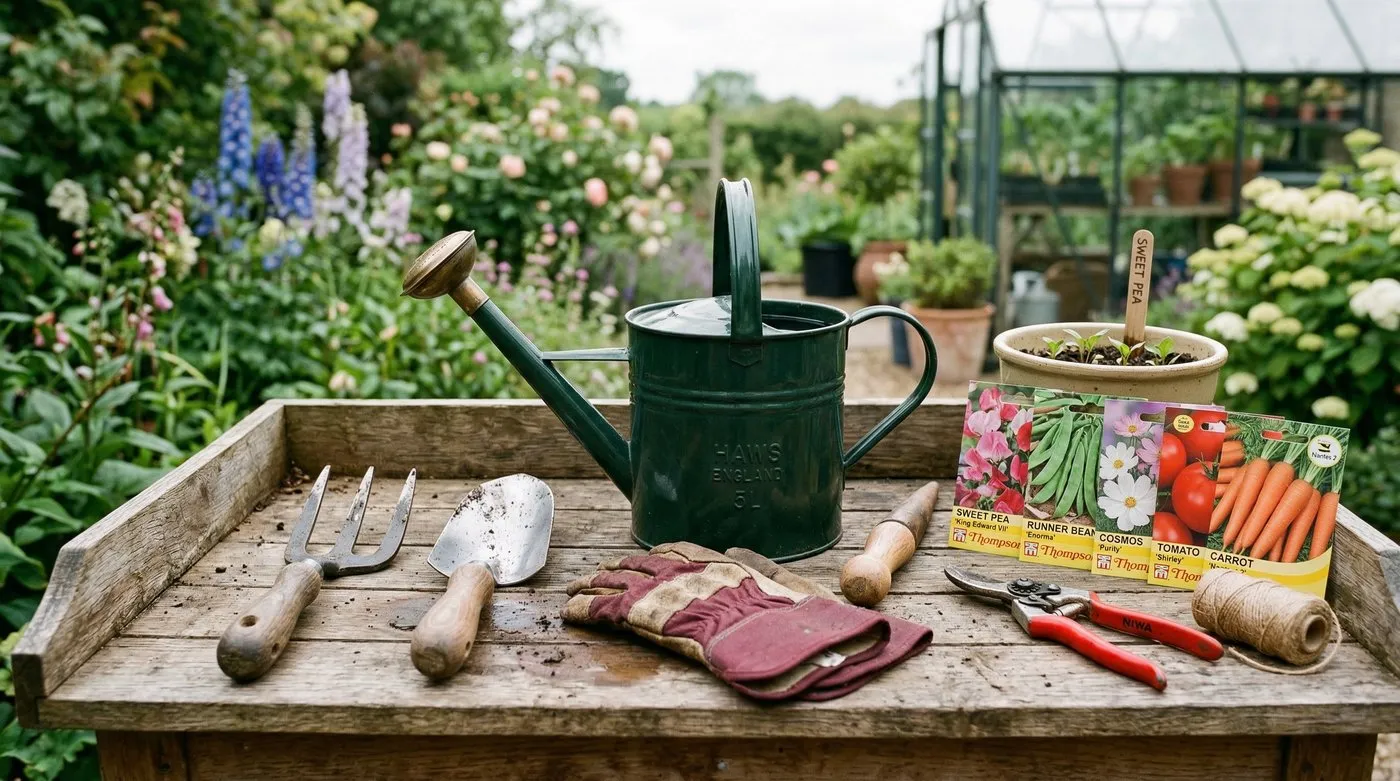 The five essential tools every beginner gardener needs cost under fifty pounds total.
| Tool | Essential or nice-to-have | Typical cost | What it does |
|---|---|---|---|
| Digging spade | Essential | 15-40 pounds | Digging beds, turning soil, edging lawns |
| Garden fork | Essential | 15-40 pounds | Loosening soil, incorporating compost, lifting root veg |
| Hand trowel | Essential | 5-15 pounds | Planting seedlings, weeding, container work |
| Secateurs | Essential | 8-25 pounds | Pruning, deadheading, cutting stems and light branches |
| Watering can (10L) | Essential | 5-12 pounds | Watering seedlings, containers, newly planted areas |
| Garden hoe | Nice-to-have | 10-20 pounds | Slicing weeds at soil level between rows |
| Wheelbarrow | Nice-to-have | 30-60 pounds | Moving compost, soil, and garden waste |
| Garden rake | Nice-to-have | 10-20 pounds | Levelling soil, preparing seed beds |
| Kneeling pad | Nice-to-have | 5-10 pounds | Protecting knees during weeding and planting |
| Garden gloves | Nice-to-have | 3-10 pounds | Hand protection for thorny plants and rough work |
The five essentials cost under fifty pounds total if you buy mid-range. Second-hand tools from car boot sales and online marketplaces are often better quality than budget new ones — older forged steel tools were built to last decades.
The best first plants to grow
Start with crops and plants that tolerate mistakes. Beginners kill plants. It is normal and part of learning. The trick is to start with species that survive inconsistent watering, imperfect soil, and slightly wrong timing.
Vegetables for beginners
Lettuce and salad leaves are the fastest reward in gardening. Sow a short row directly into soil or a container from March onwards and you are eating your own food within four to six weeks. Sow a new row every two to three weeks and the harvest runs from May to October. For a full guide, see growing tomatoes for beginners — tomatoes are only slightly harder than salad and hugely satisfying.
Potatoes are the perfect first-year crop because they break up compacted soil as they grow. Plant seed potatoes from late March, earth them up as shoots appear, and harvest early varieties in June. Courgettes and runner beans need warm soil, so wait until mid-May to plant them out. One courgette plant produces 15-20 fruits over the summer.
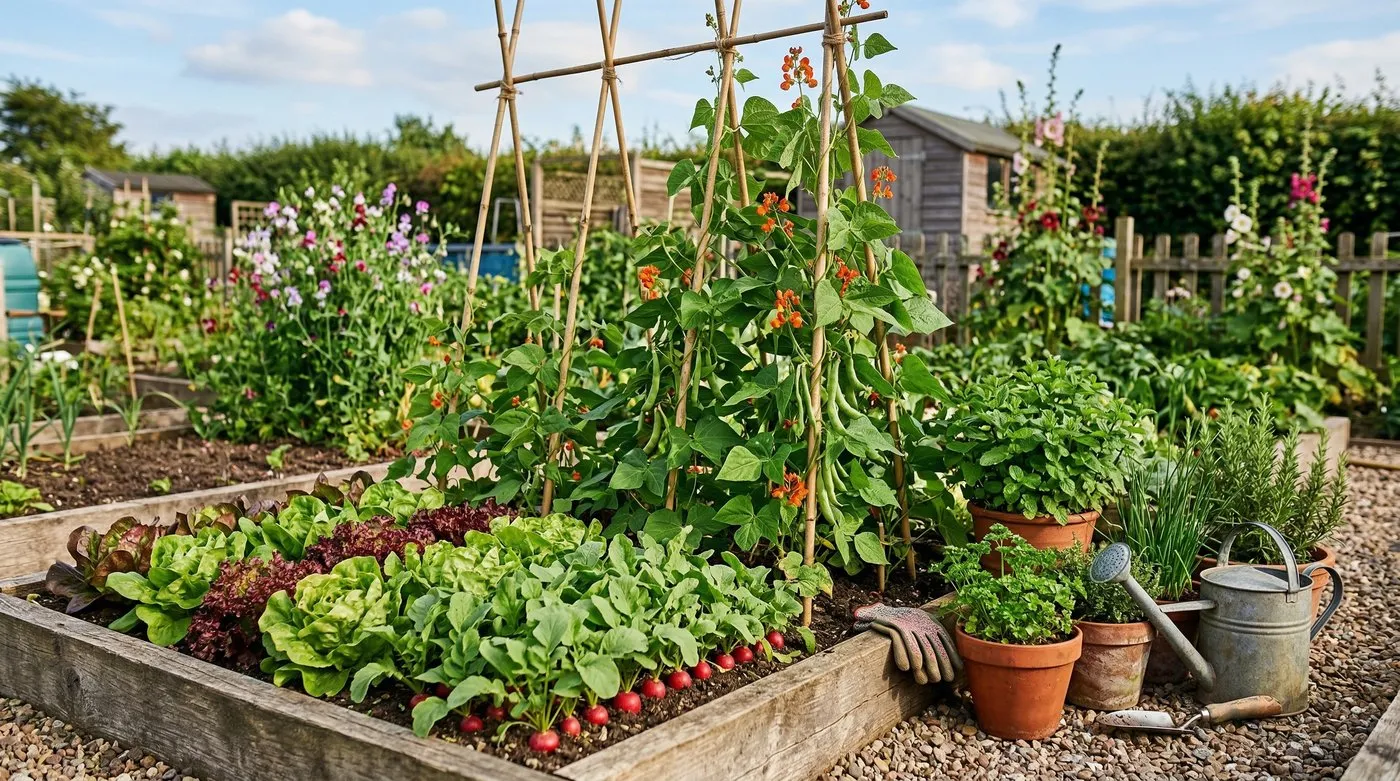 Lettuce, radishes, and runner beans are among the easiest first crops for beginner gardeners in the UK.
Herbs for beginners
A small herb garden is the quickest way to see daily results. Basil, parsley, chives, and mint all grow fast and get used in the kitchen immediately. Mint is virtually indestructible but spreads aggressively — always grow it in a pot, even if the pot sits inside a border.
Flowers for beginners
Sunflowers, marigolds, and nasturtiums germinate quickly, flower reliably, and tolerate poor soil. They also attract pollinators to your garden, which improves yields on any vegetables growing nearby. For a garden that looks after itself with minimal effort, see our guide to low-maintenance garden plants.
Understanding UK hardiness zones and frost dates
The last frost date is the most important date in a beginner’s calendar. It determines when tender plants can safely go outdoors without being killed overnight. Get this wrong and you lose weeks of growing time — or lose your plants entirely.
The UK sits mostly within RHS hardiness zones H4 and H5. H5 covers most of lowland England and Wales, where winter temperatures rarely drop below minus ten degrees Celsius. H4 covers colder inland areas and much of Scotland, where minus fifteen is possible.
| Region | Average last frost | Average first frost | Frost-free growing days |
|---|---|---|---|
| London and southeast | Mid-April | Late October | 190-200 |
| Midlands | Late April | Mid-October | 170-180 |
| Northwest England | Late April | Mid-October | 165-175 |
| Yorkshire | Late April | Mid-October | 165-180 |
| Southwest England | Early April | Early November | 200-215 |
| Wales | Late April | Mid-October | 165-180 |
| Scottish Lowlands | Early May | Early October | 150-160 |
| Scottish Highlands | Mid-May | Late September | 130-145 |
These are averages. Individual years vary by two to three weeks in either direction. The safest approach for beginners is to wait one week beyond the average last frost before planting tender crops outdoors. Sowing seeds indoors gives you a head start of four to six weeks on the outdoor growing season without any frost risk.
Basic growing techniques every beginner needs
Good technique turns average soil and ordinary plants into a productive garden. These four practices make the biggest difference in your first year.
Watering properly
Water deeply two to three times per week rather than a light sprinkle every day. Deep watering pushes roots downward, making plants drought-tolerant. A shallow daily sprinkle encourages surface roots that dry out fast. Water early in the morning. Evening watering leaves foliage damp overnight, encouraging fungal diseases like blight and mildew.
Feeding the soil
Plants take nutrients from the soil every time they grow. Without replenishment, the soil becomes exhausted. Add 5-8 cm of organic matter — homemade compost, well-rotted manure, or leaf mould — to beds each autumn. This single action improves every soil type. For lawns, a seasonal feeding schedule makes the biggest difference; see our lawn feeding guide for the full year-round plan.
Mulching
Spread a 5 cm layer of bark chips, compost, or straw around plants in spring. Mulch suppresses weeds, holds moisture in the soil, and regulates root temperature. It also breaks down slowly, feeding the soil organisms beneath. Keep mulch 5 cm away from plant stems to prevent rot.
Why we recommend homemade compost over bought-in alternatives: After 30 years of building and improving garden soils across every soil type in the UK, homemade compost consistently outperforms bagged products for long-term structure improvement. A three-bin system producing 300-400 litres per year costs nothing beyond initial setup — and gardens improved with homemade material retain their structure for three to four seasons, compared to one season with bagged compost.
Weeding little and often
Ten minutes of weeding three times a week keeps a garden under control. Thirty minutes once a month does not. Pull weeds before they flower and set seed. Annual weeds come out easily by hand. Perennial weeds like bindweed and couch grass need the entire root network removed — leaving a fragment means they regrow.
Beginner’s first-year planting checklist
This table gives beginners a clear month-by-month schedule for their first growing season. Follow it in order and you will have something to harvest from June right through to October, building confidence with each crop.
| Month | What to plant | Where | Difficulty |
|---|---|---|---|
| March | Lettuce, radishes, peas, broad beans | Direct sow outdoors | Easy |
| April | Potatoes, onion sets, spinach, beetroot | Direct sow or plant outdoors | Easy |
| April (indoors) | Tomatoes, courgettes, French beans | Sow in pots on a windowsill | Medium |
| May | Runner beans, sweetcorn, squash | Direct sow outdoors after last frost | Easy |
| May | Plant out tomatoes, courgettes | Move indoor-raised plants outside | Medium |
| June | Second sowing of lettuce, beetroot, carrots | Direct sow outdoors | Easy |
| June | Basil, coriander, dill | Sow in pots or direct outdoors | Easy |
| July | Spring cabbage, kale, autumn lettuce | Direct sow outdoors | Easy |
| August | Overwintering onion sets, spring onions | Plant outdoors | Easy |
| September | Garlic cloves, broad beans (overwintering) | Plant direct outdoors | Easy |
| October | Bare-root fruit bushes, tulip bulbs | Plant outdoors before ground freezes | Easy |
The key principle is succession sowing: planting small amounts of fast crops like lettuce and radish every two to three weeks rather than one large sowing. This spreads your harvest across months instead of giving you a glut followed by nothing.
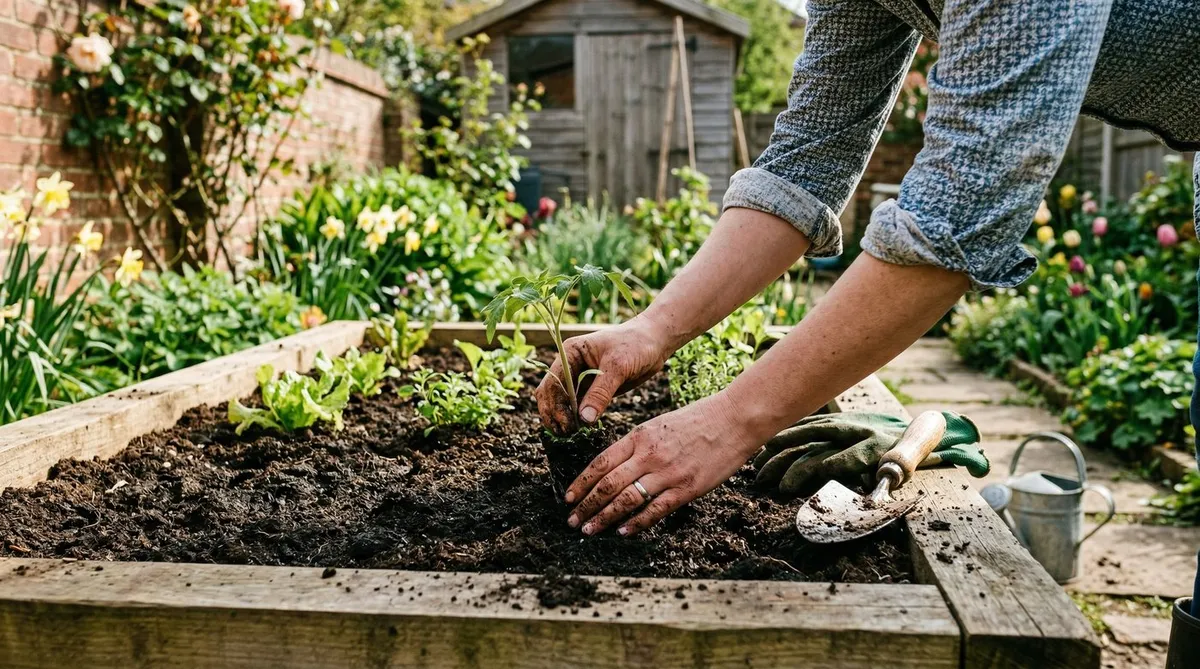
Raised beds are particularly useful for beginners because they warm up faster in spring, drain better in wet winters, and give you complete control over the soil quality from day one.
Improving your soil for the long term
Every successful garden is built on good soil, and every soil type in the UK can be improved with the same basic treatment. Adding organic matter is not a one-off fix — it is an annual habit that compounds over years.
Compost is the single most useful material a gardener can make. Kitchen scraps, garden waste, cardboard, and grass clippings all break down into dark, crumbly material that turns any soil. A simple three-bin system produces enough material to feed every bed in an average garden.
The Garden Organic website is an excellent free resource for organic growing methods, soil improvement, and pest control without chemicals. Their no-dig approach — where you add compost on top rather than digging it in — is increasingly popular and produces excellent results with less physical effort.
Well-rotted farmyard manure is the other major soil improver. Local stables and farms often give it away free. Stack it for at least six months before use — fresh manure burns plant roots and contains viable weed seeds. Spread 5-8 cm across beds in October or November and let winter rain and earthworms incorporate it.
Month-by-month starter calendar
Pin this to the inside of your shed door. It covers the essential jobs for each month across all areas of the garden, not just the vegetable patch.
| Month | Key jobs |
|---|---|
| January | Plan the year. Order seeds from catalogues. Clean and sharpen tools. |
| February | Chit seed potatoes. Prepare seed beds if soil is not frozen. Prune winter-flowering shrubs after they finish. |
| March | Sow hardy veg outdoors: lettuce, peas, broad beans, radish. Start mowing the lawn on a high setting. Apply a spring lawn feed. |
| April | Plant potatoes, onion sets, and beetroot. Sow tomatoes and courgettes indoors. Weed beds before annual weeds set seed. |
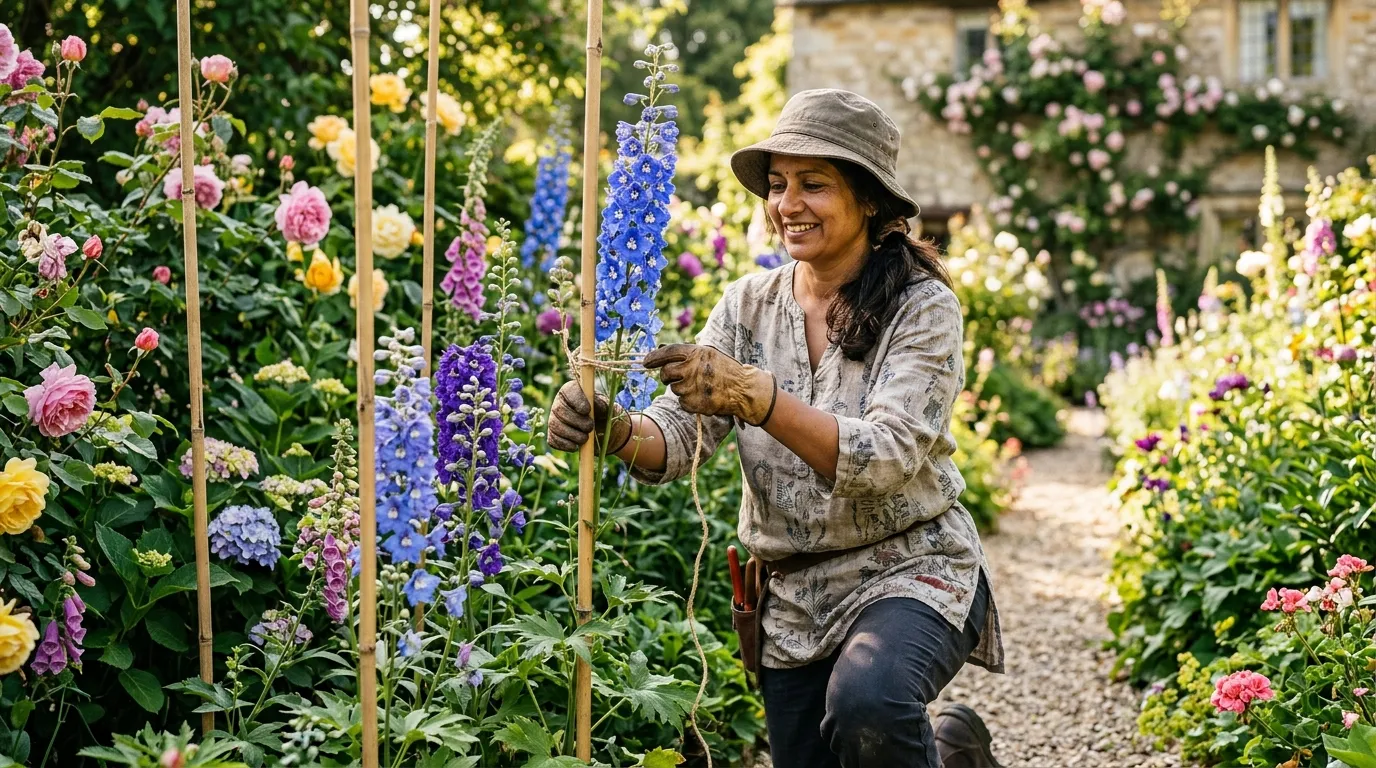
| May | Plant out tender crops after the last frost. Harden off indoor-raised seedlings. Stake tall perennials. Begin regular watering. |
| June | Sow second batches of salad and beetroot. Deadhead roses and bedding plants. Water containers daily in hot weather. |
| July | Harvest early potatoes, peas, beans, and salad. Summer-prune wisteria. Keep on top of watering and weeding. |
| August | Sow spring cabbage and overwintering onions. Take cuttings from lavender and rosemary. Order spring bulbs. |
| September | Plant garlic and overwintering broad beans. Divide perennials. Start collecting fallen leaves for leaf mould. |
| October | Plant tulips, daffodils, and bare-root trees. Spread compost or manure on empty beds. Clear spent vegetable plants. |
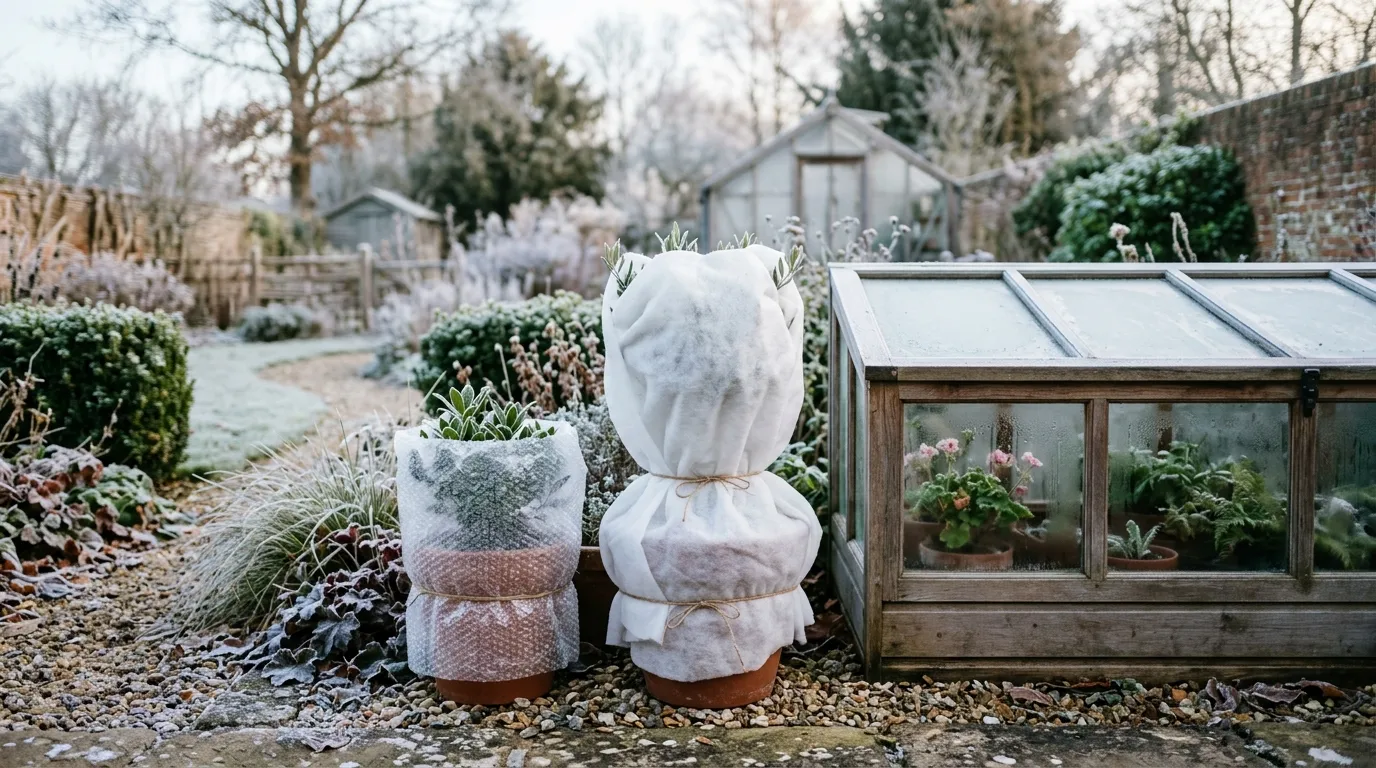
| November | Plant bare-root roses, hedging, and fruit bushes. Protect tender plants with fleece. Clean out the greenhouse. |
| December | Rest. Read seed catalogues. Check stored fruit and veg for rot. Plan improvements for next year. |
The timings above suit most of England and Wales. In Scotland and northern England, shift spring tasks forward by two to three weeks and bring autumn tasks back by the same margin.
Now you’ve mastered the basics, read our guide on raised bed gardening for beginners for the next step in building a productive UK garden.
Frequently asked questions
What is the easiest thing to grow for a beginner gardener?
Lettuce and radishes are the easiest crops for UK beginners. Both germinate in under a week, tolerate most soil types, and produce a harvest within four to six weeks of sowing. Sow short rows every fortnight from March to September for a continuous supply. Runner beans and courgettes are equally forgiving once the frost risk passes in mid-May.
When should I start gardening in the UK?
March is the earliest safe month for outdoor sowing. Hardy crops like peas, broad beans, and lettuce can go outdoors from mid-March in southern England. Wait until mid-April in the Midlands and late April in Scotland. Tender crops like tomatoes, courgettes, and French beans need indoor sowing from April and planting out after the last frost.
How do I know what type of soil I have?
Pick up a handful of moist soil and squeeze it. Clay holds its shape and feels sticky. Sandy soil crumbles apart immediately and feels gritty. Chalk soil is pale, stony, and free-draining. Loam holds together loosely without stickiness. A pH testing kit from a garden centre confirms whether your soil is acid, neutral, or alkaline.
Do I need a big garden to start gardening?
No, containers and raised beds produce worthwhile crops in any space. A single raised bed of 1.2m by 2.4m grows enough salad for two people all summer. Balconies, patios, and front gardens all work well for herbs, tomatoes, salad leaves, and bedding plants. Even a sunny windowsill produces a steady supply of fresh herbs.
How often should I water my garden?
Water deeply two to three times per week. Deep watering encourages roots to grow downward, making plants more drought-tolerant. A shallow daily sprinkle creates surface roots that dry out quickly. Water in the early morning to reduce evaporation and fungal disease. Newly planted seedlings and containers may need daily watering during hot spells in summer.
What tools does a beginner gardener need?
Five tools cover almost everything: spade, fork, trowel, secateurs, and a watering can. Buy the best quality you can afford in these five. Stainless steel blades with ash handles last decades. Everything else — hoes, rakes, wheelbarrows — is useful but not essential in your first year. Second-hand tools from car boot sales are often better quality than budget new ones.
How do I improve poor soil in my garden?
Add 5-8 cm of organic matter to beds each autumn. Homemade compost, well-rotted manure, or leaf mould all work. Spread it on the surface and let earthworms pull it down. This single action improves drainage in clay, water retention in sandy soil, and fertility across all soil types. Most gardens show visible improvement within one growing season.
Lawrie has been gardening in the West Midlands for over 30 years. He grows his own veg using no-dig methods, keeps a wildlife-friendly garden, and writes practical advice based on real UK growing conditions.