Greenhouse Ventilation and Humidity Control
How to ventilate a greenhouse and control humidity in UK conditions. Covers roof vents, louvre vents, automatic openers, and damping down techniques.
Key takeaways
- Total vent area should equal 15-20% of floor space for adequate air exchange
- Automatic vent openers activate at 15-20C using wax cylinders and need no electricity
- Ideal greenhouse humidity for most crops is 40-60% relative humidity
- Louvre vents at low level draw cool air in while hot air escapes through roof vents
- Damping down floors on hot mornings raises humidity by 15-25% and cools the air
- Poor ventilation above 30C causes heat stress, flower drop, and blossom end rot in tomatoes
Getting the air right inside a greenhouse is as important as getting the soil right outside. Temperature and humidity are the two invisible factors that decide whether crops thrive or fail. A greenhouse with poor ventilation traps heat above 40C on a sunny day, killing pollen, scorching leaves, and inviting disease.
This guide covers every ventilation method available to UK greenhouse gardeners. It explains how roof vents, louvre vents, doors, and fans work together to regulate temperature and humidity. It also covers automatic vent openers that take the guesswork out of daily vent management.
Why greenhouse ventilation matters
Ventilation controls three things inside a greenhouse: temperature, humidity, and air composition. All three affect plant health directly.
On a still, sunny day in April, a closed greenhouse reaches 35-40C within an hour of sunrise. Most vegetable crops suffer heat stress above 30C. Tomato pollen becomes non-viable above 35C, causing flower drop and reduced fruit set. Pepper and aubergine plants show similar sensitivity.
High humidity without airflow creates the perfect conditions for fungal disease and pest outbreaks. Powdery mildew, botrytis grey mould, and tomato blight all thrive in warm, stagnant, humid air. Our greenhouse pest control guide covers how ventilation affects pest pressure and biological control effectiveness. Good ventilation breaks the moisture film on leaves that fungi need to germinate.
Fresh air also brings carbon dioxide. Plants deplete CO2 inside a sealed greenhouse surprisingly fast during active photosynthesis. Opening vents replaces stale air and keeps growth rates high. The RHS recommends ventilating greenhouses daily during the growing season for this reason.
Finally, gentle air movement strengthens stems. Plants that grow in still air develop weaker cell walls. A light breeze through open vents produces sturdier, more resilient plants.
Roof vents: the most important ventilation
Roof vents are the single most effective ventilation feature. Hot air rises, so an opening at the ridge releases the hottest air first. Most aluminium greenhouses come with one or two hinged roof vents as standard.
The rule of thumb is that total vent area should equal 15-20% of the floor space. A 6x8ft greenhouse has roughly 4.5 square metres of floor. That means 0.7-0.9 square metres of open vent area is ideal. Most standard roof vents provide 0.15-0.2 square metres each, so two roof vents alone are not enough for a 6x8ft model.
Roof vents work best when paired with a low-level air inlet. This creates a chimney effect: cool air enters at the base, warms as it rises through the plant canopy, and exits through the roof. Without a low-level inlet, roof vents pull air in through gaps in the frame rather than drawing it smoothly through the growing space.
Gardener’s tip: Position the greenhouse so the ridge runs east-west. This puts the longest side facing south, maximising light, and allows you to place roof vents on the south-facing slope where heat builds fastest.
Louvre vents: the low-level partner
Louvre vents sit low on the greenhouse wall, typically between the base and the eaves. They consist of overlapping glass or aluminium blades that open and close like a venetian blind. Their job is to let cool air in at ground level.
The Vitavia 5-Blade Louvre Window at £59.99 fits most aluminium greenhouses and replaces a standard glass pane. It provides a controlled opening without removing a panel entirely.
Louvre vents offer a major advantage over simply leaving the door open: security and pest control. An open door lets in rabbits, foxes, cats, and large insects. A louvre vent allows airflow while keeping unwanted visitors out, especially when fitted with insect mesh.
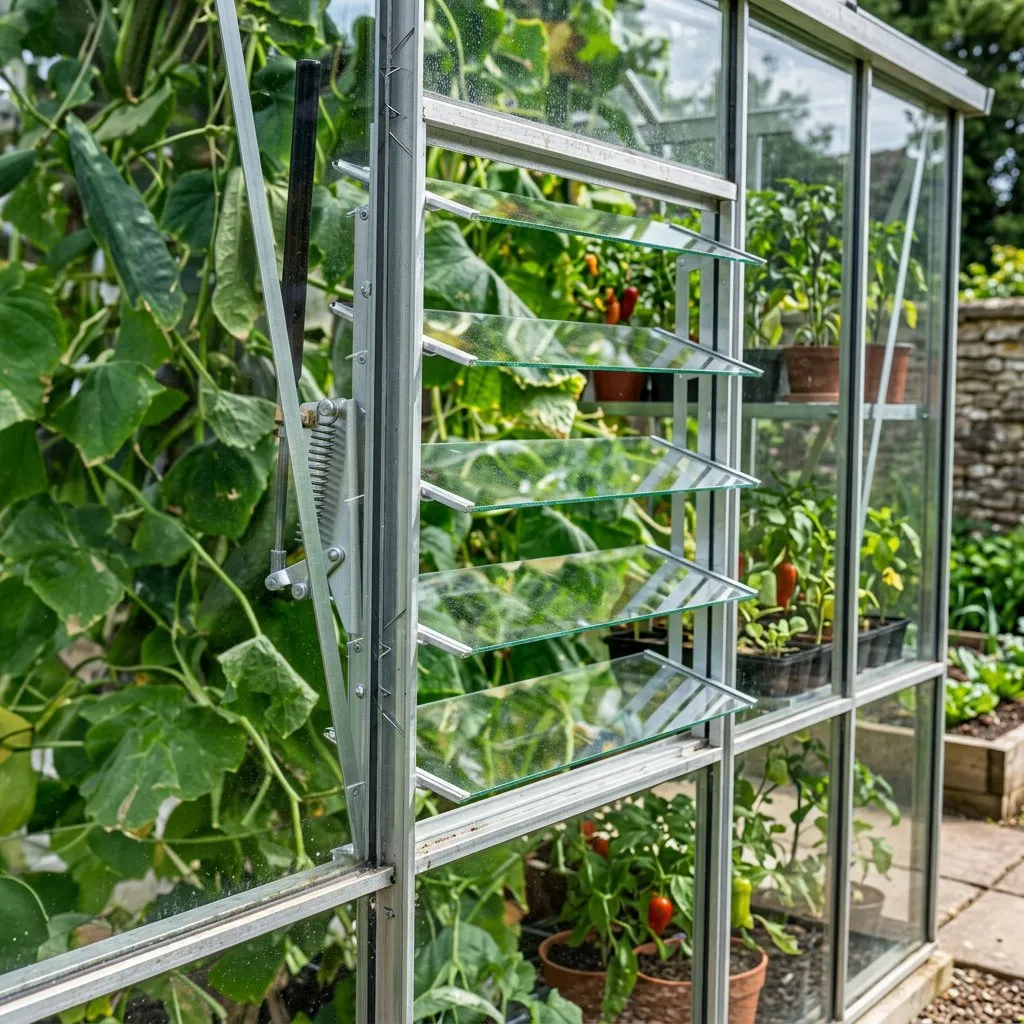 A louvre vent at low level draws cool air in while hot air escapes through the roof vents above.
Shop the Vitavia Louvre Vent at Greenhouse Stores →
For the best results, fit louvre vents on the opposite side of the greenhouse from your roof vents. This creates cross-ventilation that reaches every plant. Two louvre vents on a 6x8ft greenhouse, combined with two roof vents, provide excellent all-round air exchange.
Automatic vent openers: hands-free temperature control
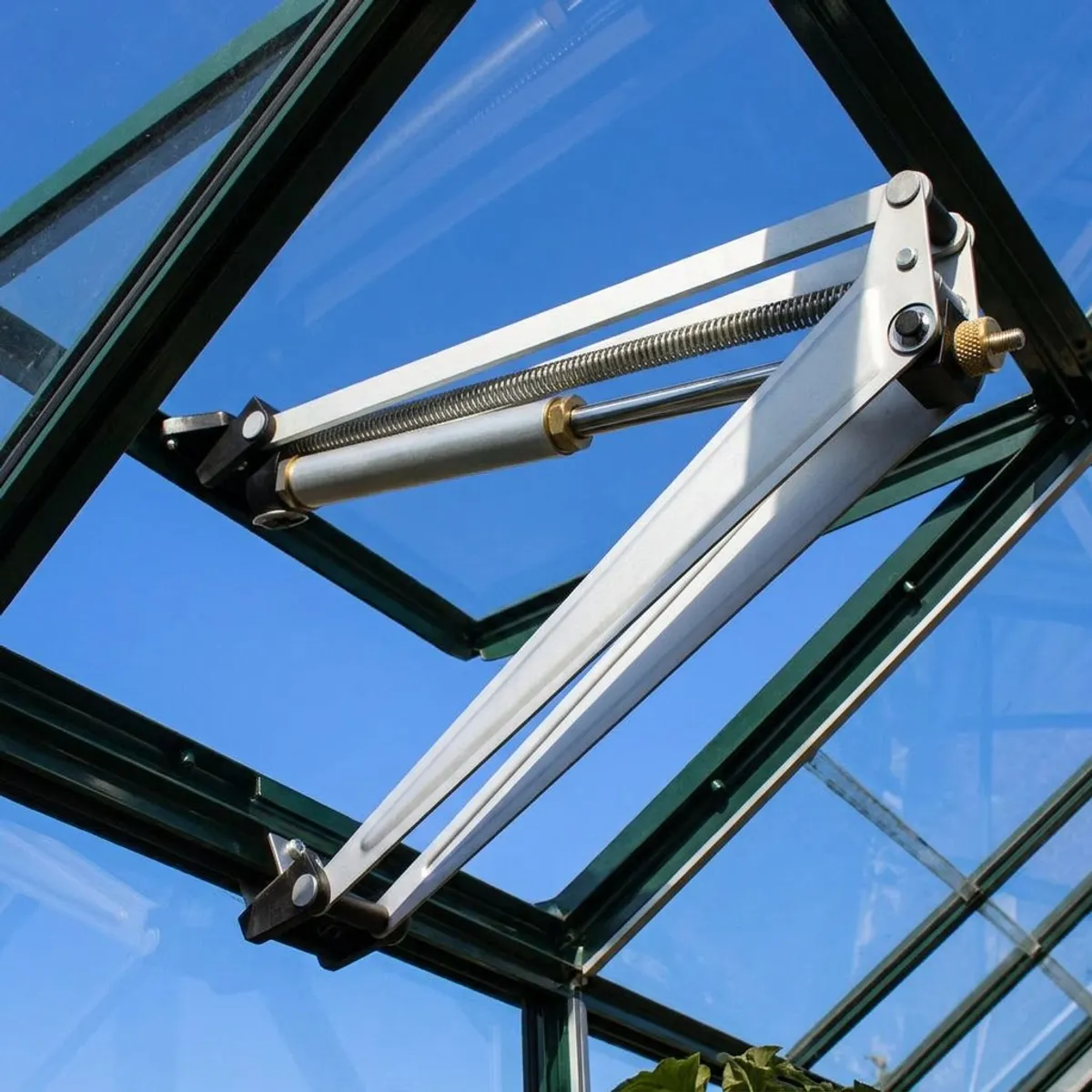
Most gardeners are not at home all day to open and close vents as the temperature changes. Automatic vent openers solve this problem. They use a wax-filled cylinder that expands when heated and contracts when cooled, pushing the vent open and pulling it shut without any electricity.
The Palram Canopia Automatic Roof Vent Opener at £55 fits most standard greenhouse roof vents. It activates between 16-25C and lifts up to 7kg. The Vitavia Automatic Louvre Opener at £49 does the same job for louvre windows, turning a manual louvre into a fully automatic vent.
For greenhouses with Elite-branded louvre vents, the Elite Automatic Louvre Opener at £59 is purpose-built for their louvre window range.
Wax cylinders have a finite lifespan. Replace them every 3-5 years, or sooner if the vent stops opening fully. The Elite Auto Vent Replacement Cylinder at £34 fits most standard openers and takes five minutes to swap.
| Ventilation method | Airflow type | Cost | Best for | Automation |
|---|---|---|---|---|
| Roof vent (manual) | Hot air exhaust | Included with greenhouse | Primary ventilation | Manual only |
| Roof vent + auto opener | Hot air exhaust | £49-£59 | Gardeners away during the day | Fully automatic |
| Louvre vent (manual) | Cool air intake | £50-£60 | Low-level cross-ventilation | Manual only |
| Louvre vent + auto opener | Cool air intake | £99-£120 (vent + opener) | Full automatic airflow | Fully automatic |
| Open door | Cool air intake | Free | Quick cooling in extreme heat | Manual only |
| Electric fan | Forced circulation | £25-£50 | Stagnant air and dense plantings | Manual or thermostat |
Why we recommend fitting automatic openers to both roof vents and louvre vents, not just roof vents alone: After 30 years of advising UK greenhouse growers, fitting openers at both levels consistently produces 8-10C lower peak temperatures compared to roof-only automation. In a monitored 6x8ft greenhouse during a July heatwave, combined roof and louvre automation kept peak temperature at 31C; the same greenhouse with roof-only automation reached 39C on the same day.
Door ventilation and when to use it
The greenhouse door is often overlooked as a ventilation tool. On the hottest summer days, opening the door wide provides a large volume of air exchange that vents alone cannot match.
Use door ventilation when temperatures exceed 30C and vents cannot keep up. This is common from June to August in most of the UK. A fully open door on a 6x8ft greenhouse provides around 1.5 square metres of opening, more than all the roof and louvre vents combined.
The trade-off is exposure. An open door lets in wind, pests, birds, and neighbourhood cats. Close the door before late afternoon to trap warmth for the evening. If you grow cucumbers, note that they dislike cold draughts, so direct airflow away from cucumber plants.
Gardener’s tip: Hang a bead curtain or strip curtain in the doorway for summer ventilation. It allows air through while deterring birds and butterflies that lay eggs on brassicas.
Humidity: the 40-60% sweet spot
Relative humidity measures the amount of moisture in the air. The ideal range for most greenhouse crops is 40-60%. Tomatoes and chilli peppers prefer 40-50%. Cucumbers and tropical plants perform best at 60-70%.
Humidity that is too low causes problems. Below 30%, spider mites reproduce rapidly. Dry air increases transpiration stress, causing leaf curl and blossom end rot in tomatoes. Pollen dries out and fails to stick, reducing fruit set.
Humidity that is too high is equally damaging. Above 80%, fungal spores germinate freely. Botrytis grey mould attacks flowers and fruit. Powdery mildew spreads across leaves. Damping off kills seedlings at soil level. Condensation drips onto plants and pooling water attracts fungus gnats.
A simple digital hygrometer (£8-£15) hung at plant height is the most useful monitoring tool. Check it morning and evening to learn how your greenhouse behaves across the day.
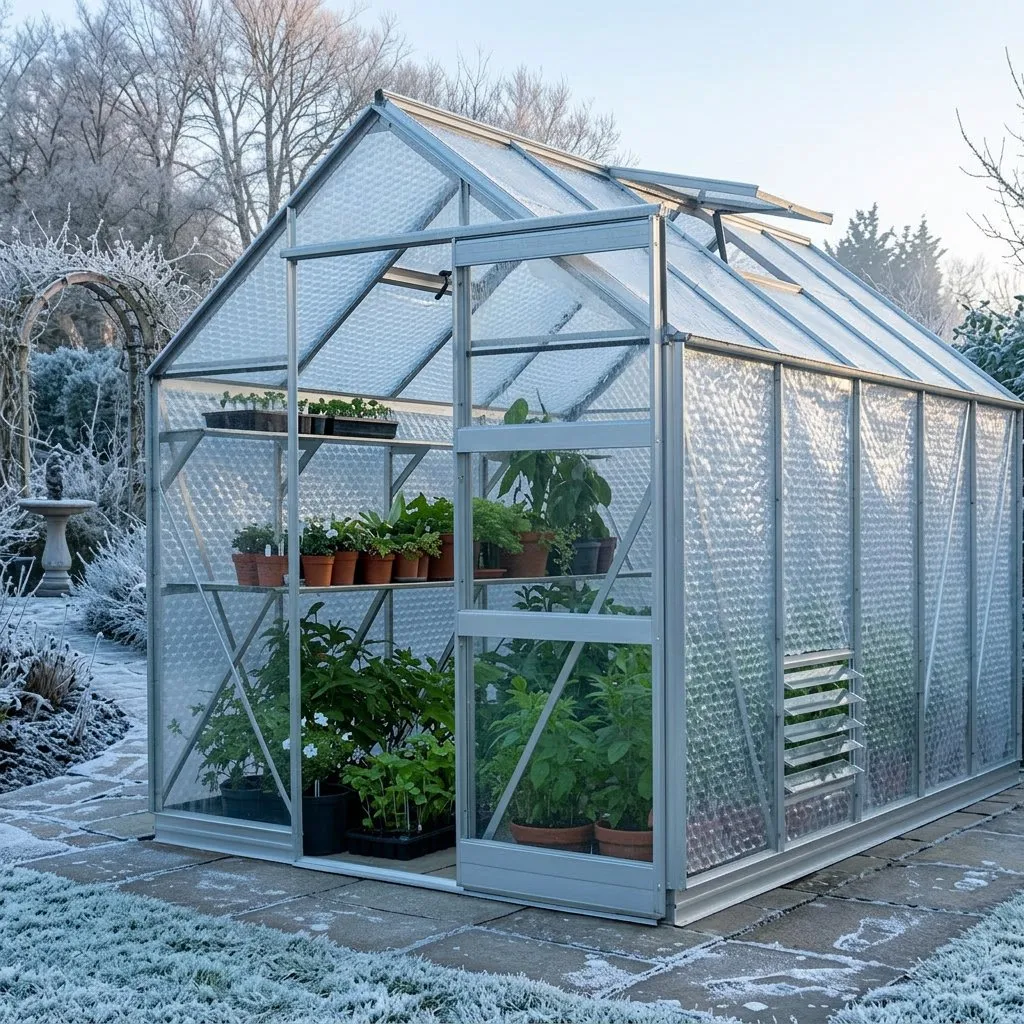 A well-ventilated greenhouse interior with balanced humidity. The Elite Thyme provides excellent airflow for healthy crops.
Shop the Elite Thyme 6x8 at Greenhouse Stores →
Damping down: raising humidity on hot days
Damping down means wetting the greenhouse floor, paths, and staging with water. As the water evaporates, it cools the air and raises humidity by 15-25%. This is especially useful in summer when ventilation alone can drop humidity below 30%.
Damp down first thing in the morning on days when temperatures are forecast above 25C. Use a watering can or hose to soak the floor thoroughly. The water evaporates through the morning, providing a cooling effect through the hottest hours. Repeat at midday if conditions are extreme.
Damping down provides three benefits:
- Cools the air by 3-5C through evaporative cooling
- Raises humidity into the ideal 40-60% range
- Discourages spider mites which thrive in hot, dry conditions
Avoid damping down in the late afternoon. Wet floors overnight raise humidity above 80%, creating conditions for botrytis and other fungal diseases. Morning damping gives the floor time to dry before the cooler evening.
For greenhouses on concrete or paving slab bases, damping down is straightforward. Gravel floors absorb and release moisture more slowly, providing a steadier humidity boost. Earth floors hold water longest but can become muddy and harbour fungal spores if kept permanently wet.
When to ventilate through the seasons
Ventilation is a year-round task, not just a summer activity. The approach changes with the seasons.
Spring (March-May): Open roof vents on sunny mornings when the internal temperature exceeds 20C. Close them by mid-afternoon to trap warmth for cool nights. Late frosts are still possible until mid-May, so avoid leaving vents open overnight. Automatic openers are particularly useful in spring when sunny mornings and cold afternoons alternate unpredictably.
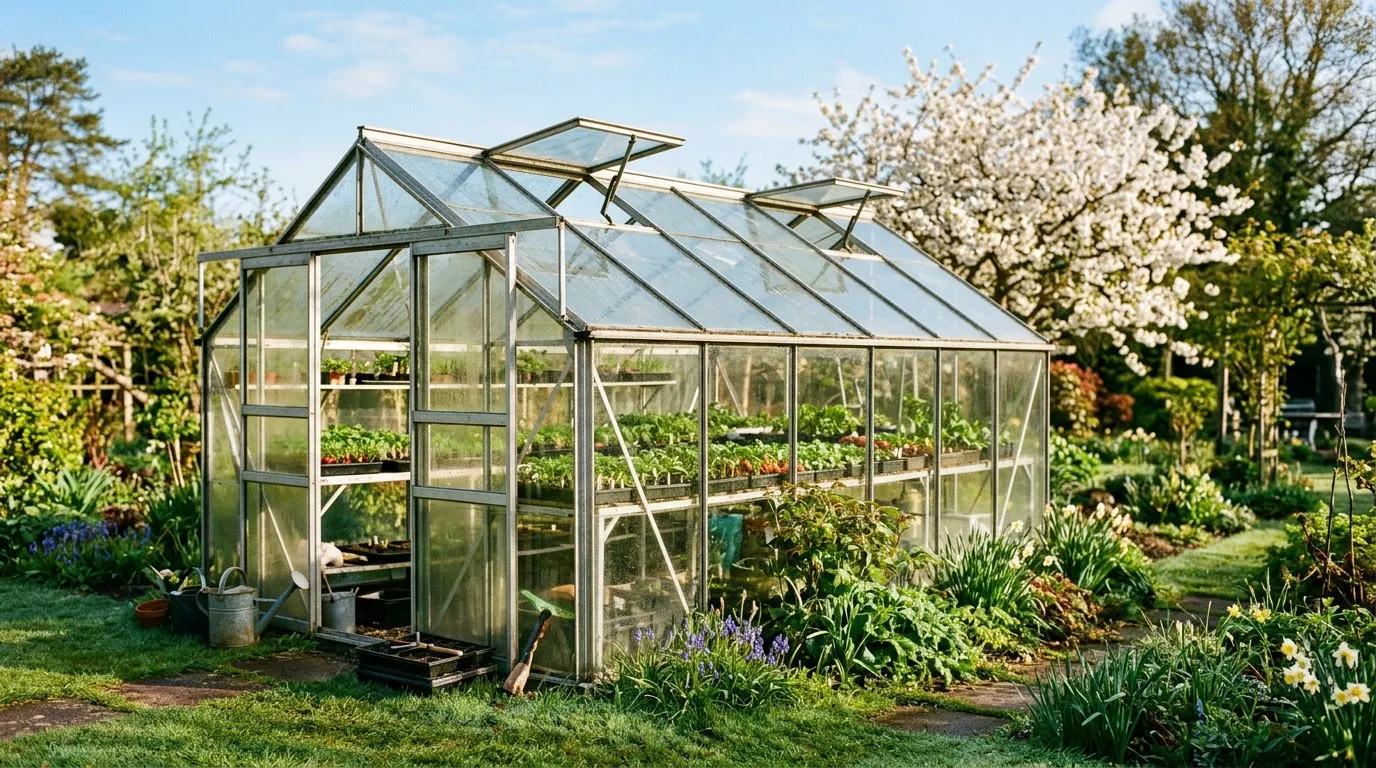 Roof vents propped open on a spring morning allow warm air to escape while seedlings grow inside.
Summer (June-August): Open everything. Roof vents, louvre vents, and the door should all be open from early morning. On days above 30C, damp down the floor. Leave roof vents slightly open overnight if night temperatures stay above 12C. This prevents condensation forming at dawn.
Autumn (September-November): Reduce ventilation gradually. Close louvre vents and the door by early October. Keep roof vents on automatic openers to catch warm autumn days without losing heat overnight. Clean and check all vent mechanisms before winter. Autumn is also a good time to set up water-efficient systems for the following season.
Winter (December-February): Ventilate briefly on mild, dry days to reduce condensation and prevent fungal disease. Open one roof vent for an hour around midday when the sun is strongest. Never ventilate when frost is forecast. Even in winter, a closed greenhouse builds moisture that needs releasing. If you are heating through winter, our greenhouse heating guide explains how to balance ventilation with heat retention.
Common ventilation mistakes
Relying on a single roof vent. One vent provides barely 0.15 square metres of opening. A 6x8ft greenhouse needs 0.7 square metres minimum. Add louvre vents and use the door in summer to reach adequate airflow.
Closing everything overnight in summer. Warm, humid air trapped overnight creates heavy condensation at dawn. This condensation dripping onto plants is a primary cause of botrytis. Leave at least one roof vent cracked open when night temperatures exceed 12C.
Damping down in the evening. Wet floors overnight raise humidity above 80%. Always damp down in the morning so the floor dries before the cooler evening hours.
Ignoring low-level ventilation. Roof vents alone create a one-way exit for hot air without a controlled inlet. Without low-level vents, air enters through random gaps in the frame, creating draughts that miss large areas of the greenhouse.
Forgetting to replace auto-opener cylinders. Wax cylinders lose effectiveness after 3-5 years. A sluggish opener that only half-opens the vent provides half the ventilation. Check openers each spring and replace worn cylinders promptly.
Now you’ve mastered ventilation and humidity control, read our greenhouse heating guide for the next step in managing your growing environment through the colder months.
Frequently asked questions
How much ventilation does a greenhouse need?
Total vent area should equal 15-20% of the floor space. A 6x8ft greenhouse needs at least 0.7 square metres of open vents. Combine roof vents with low-level louvre vents or an open door to create a chimney effect that pulls cool air in at the bottom and pushes hot air out at the top.
What humidity should a greenhouse be?
Aim for 40-60% relative humidity for most crops. Tomatoes, peppers, and aubergines prefer the lower end at 40-50%. Cucumbers and tropical plants thrive at 60-70%. Humidity above 80% encourages botrytis, powdery mildew, and damping off in seedlings.
Do automatic vent openers really work?
Yes, wax cylinder openers are reliable and need no electricity. The wax expands as temperature rises, pushing the vent open at 15-20C. They close again as the greenhouse cools. Most openers lift up to 7kg, enough for a standard aluminium roof vent. Replace the cylinder every 3-5 years.
When should I open my greenhouse vents?
Open roof vents when the internal temperature reaches 20-25C. This can happen as early as February on sunny mornings. Close vents before temperatures drop in the late afternoon. In summer, leave vents open overnight if night temperatures stay above 12C.
How do I reduce humidity in a greenhouse?
Improve air circulation by opening roof vents and a door or louvre at ground level. Water plants in the morning so foliage dries before evening. Space plants to allow air movement between them. Avoid splashing water on leaves when watering. A small fan improves airflow in stagnant areas.
What is damping down in a greenhouse?
Damping down means wetting the greenhouse floor and paths with water. As the water evaporates, it cools the air and raises humidity. Do this on hot mornings when temperatures exceed 25C. It is especially useful for crops like cucumbers that need 60-70% humidity.
Lawrie has been gardening in the West Midlands for over 30 years. He grows his own veg using no-dig methods, keeps a wildlife-friendly garden, and writes practical advice based on real UK growing conditions.