Hedge Planting Guide for the UK
Step-by-step UK hedge planting guide covering species selection, bare-root vs container plants, spacing, planting method, first-year care, and trimming.
Key takeaways
- Bare-root hedge plants cost 60-80% less than container-grown and establish faster when planted November to March
- Space most hedging species 30-45cm apart in a single row, or stagger in a double row at 40cm spacing for a thicker screen
- Cut all bare-root plants back by one-third at planting to force dense, bushy growth from the base
- Beech retains its copper-brown dead leaves through winter, giving semi-evergreen screening on a deciduous plant
- Yew is the longest-lived UK hedge species, with some hedges over 400 years old and still thriving
- Water newly planted hedges weekly from April to September in the first year — drought is the number one cause of failure
- Formal hedges need two trims per year (June and August); informal hedges need one trim after flowering
A well-planted hedge outlasts any fence. Where a panel fence lasts 10-15 years, a beech or yew hedge can stand for centuries. Hedges absorb noise, filter wind, support nesting birds, shelter pollinating insects, and look better with every passing year. A close-boarded fence does none of these things.
This guide covers the seven best hedging species for UK gardens, the advantages of bare-root over container planting, correct spacing for single and double rows, a step-by-step planting method, and first-year care that ensures strong establishment. Whether you need a formal clipped screen, a wildlife-rich boundary, or a low box edging, the method is the same. For trees that provide privacy without forming a hedge, see our guide to the best trees for privacy.
Choosing the right hedging species
The right species depends on your soil, aspect, budget, and how much trimming you are willing to do. Formal hedges (beech, yew, hornbeam, box, privet) are trimmed to a crisp profile once or twice per year. Informal hedges (hawthorn, mixed native) grow naturally, flowering and fruiting without heavy clipping. If you grow bee-friendly plants in your borders, a flowering native hedge completes the habitat.
Evergreen hedges (yew, laurel, box, privet) provide year-round screening. Deciduous hedges (beech, hornbeam, hawthorn) drop their leaves, but beech and hornbeam retain dead leaves through winter, giving partial screening from November to April.
Hedge species comparison table
| Species | Growth rate | Evergreen/Deciduous | Hedge height | Spacing | Soil | Trims/year |
|---|---|---|---|---|---|---|
| Beech (Fagus sylvatica) | 30-40cm/yr | Deciduous (retains leaves) | 1-5m | 30-45cm | Any well-drained | 2 |
| Yew (Taxus baccata) | 20-30cm/yr | Evergreen | 1-5m+ | 30-45cm | Any except waterlogged | 1 |
| Hornbeam (Carpinus betulus) | 30-40cm/yr | Deciduous (retains leaves) | 1-5m | 30-45cm | Any including wet clay | 2 |
| Privet (Ligustrum ovalifolium) | 30-50cm/yr | Semi-evergreen | 1-3m | 25-30cm | Any soil | 2-3 |
| Laurel (Prunus laurocerasus) | 40-60cm/yr | Evergreen | 1.5-5m | 45-60cm | Any except very dry chalk | 1-2 |
| Hawthorn (Crataegus monogyna) | 30-50cm/yr | Deciduous | 1-4m | 30-45cm | Any including poor clay | 1-2 |
| Box (Buxus sempervirens) | 10-15cm/yr | Evergreen | 30cm-1.5m | 15-25cm | Any well-drained | 2 |
Beech (Fagus sylvatica)
Beech is the most popular formal hedge in the UK, and for good reason. Fresh green leaves emerge in April, darken to deep green by summer, turn copper-gold in October, and then hold on the branches through winter. This marcescence gives beech a unique advantage: screening in every month of the year from a deciduous plant.
A beech hedge reaches any height from 1m to 5m. Most garden hedges are maintained at 1.5-2m. The leaf canopy is dense enough to block sightlines at just 45-60cm width. On well-drained soil, beech grows 30-40cm per year once established.
Beech thrives on chalk, sand, loam, and light clay. It does not tolerate waterlogged ground. On heavy, wet clay, choose hornbeam instead, which tolerates poor drainage far better. Copper beech (Fagus sylvatica f. purpurea) makes a striking alternative with deep purple leaves. Mixing green and copper beech plants in a ratio of 3:1 creates a mixed hedge with outstanding colour contrast.
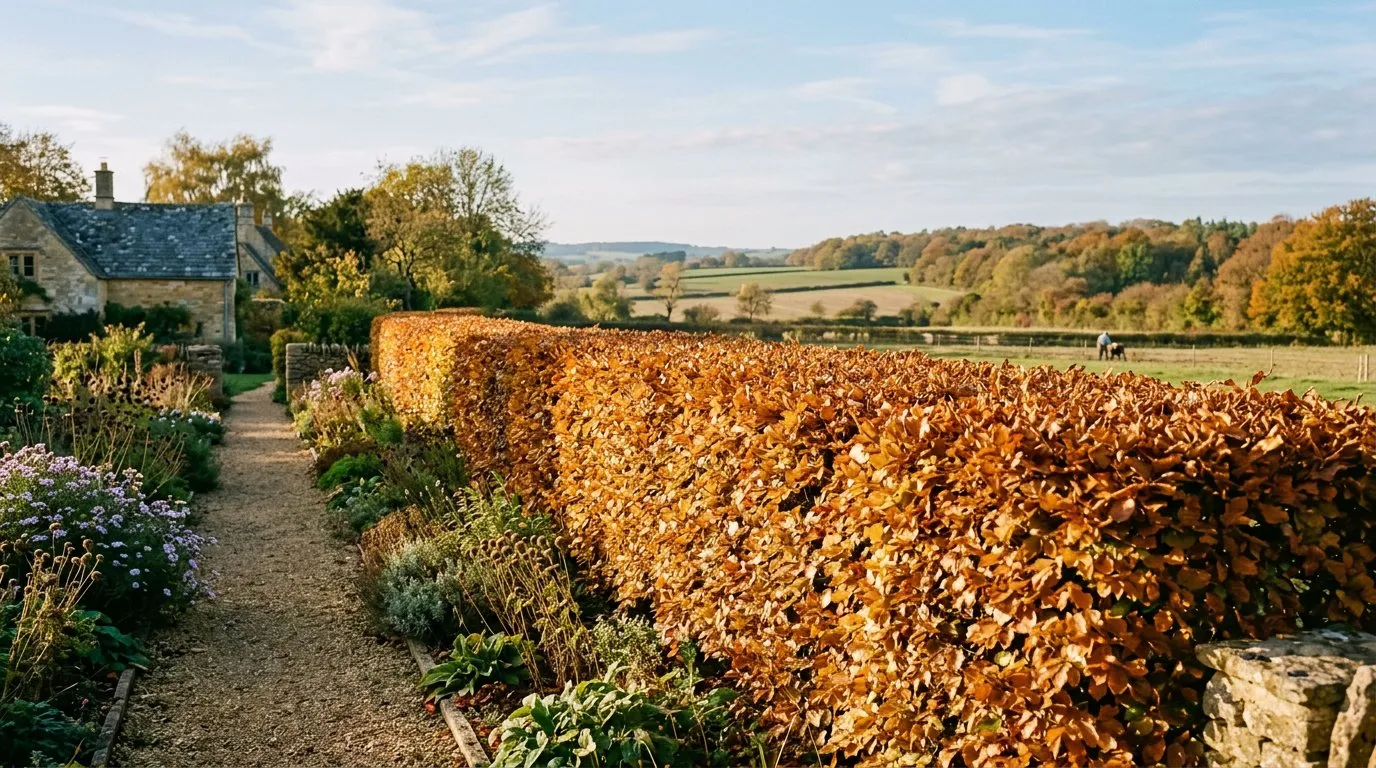
A mature beech hedge in full autumn colour, showing the dense copper foliage that provides year-round screening.
Yew (Taxus baccata)
Yew forms the finest, densest, longest-lived hedge of any British species. Some yew hedges in English country houses and churchyards are over 400 years old. It is the gold standard for formal evergreen hedging.
Growth is slow at 20-30cm per year, which means fewer trims. A single cut in late August keeps a yew hedge immaculate for the entire year. The dense, dark green foliage makes a perfect backdrop for herbaceous borders. No other hedge species creates such a clean, architectural line.
Yew grows on any soil except permanently waterlogged ground. It thrives on chalk, clay, sand, and acid soils. It tolerates deep shade better than any other hedging species, making it ideal for north-facing boundaries and beneath the canopy of large trees.
All parts of yew are toxic to livestock, horses, and most pets. The red berries are the least toxic part (the seed inside is poisonous). If you keep horses, cattle, or goats with access to the hedge, do not plant yew. For gardens with dogs, the risk is low as dogs rarely eat yew foliage, but be aware of the toxicity. Our guide to pet-safe garden plants covers safer alternatives.
Gardener’s tip: Yew regenerates from hard pruning better than almost any other conifer. If a neglected yew hedge has grown too wide, you can cut one side back hard to the trunk in April. It will reshoot from bare wood within two growing seasons. Do one side per year to maintain screening.
Hornbeam (Carpinus betulus)
Hornbeam is the best alternative to beech for heavy, wet, and clay soils. Like beech, it retains its dead leaves through winter, providing semi-evergreen screening. The leaves are slightly smaller and more corrugated than beech, with a lighter green colour.
Growth rate and trimming requirements match beech at 30-40cm per year and two cuts annually. Hornbeam tolerates shade, pollution, and exposed sites well. It forms a denser, more twiggy base than beech, which makes it better at blocking wind at ground level.
On well-drained soil, beech usually looks slightly better than hornbeam. On clay, damp, or heavy soil, hornbeam outperforms beech significantly. The Chelsea Physic Garden and many National Trust properties use hornbeam hedges on clay ground for exactly this reason.
If you garden on clay, our guide to improving clay soil covers broader techniques for working with heavy ground. A hornbeam hedge is one of the simplest wins for a clay garden boundary.
Privet (Ligustrum ovalifolium)
Privet is the classic suburban hedge. It grows fast at 30-50cm per year, forms a dense, semi-evergreen screen, and tolerates hard clipping without complaint. In mild winters it keeps most of its glossy leaves. In harsh winters it drops them but regrows rapidly in spring.
The main drawback is maintenance. Privet needs 2-3 cuts per year to stay tidy. Golden privet (Ligustrum ovalifolium ‘Aureum’) has bright yellow-green foliage and makes a cheerful alternative. Privet tolerates any soil, any aspect, pollution, and coastal salt.
Laurel (Prunus laurocerasus)
Cherry laurel is the fastest-growing evergreen hedge plant at 40-60cm per year. Large, glossy, dark green leaves give a bold appearance that blocks noise and wind effectively. Space plants at 45-60cm apart. Laurel tolerates shade, pollution, and most soils. It struggles only on very dry chalk or in waterlogged conditions.
Trim laurel with sharp secateurs, never a hedge trimmer. Electric trimmers slice through the large leaves, leaving brown, ragged edges that look unsightly for months. Cut each shoot individually, just above a leaf node. Portuguese laurel (Prunus lusitanica) is a more refined alternative with smaller leaves and red stems at 30-40cm growth per year.
Hawthorn (Crataegus monogyna)
Hawthorn is the native hedging backbone of the British countryside. It forms a dense, thorny barrier that keeps livestock in and intruders out. May blossom attracts pollinating insects, and red haws from September feed birds including fieldfares and redwings. Over 200 insect species use hawthorn, making it the single best hedging species for wildlife.
Growth is vigorous at 30-50cm per year. Hawthorn tolerates every soil type, including heavy clay, thin chalk, acidic peat, and waterlogged ground. It handles full exposure, salt spray, and altitude. There are hawthorn hedges on Scottish hillsides at 500m above sea level.
For a wildlife-rich mixed native hedge, combine hawthorn (60%) with blackthorn, hazel, field maple, dog rose, and holly. This mirrors a traditional countryside hedgerow and provides food and shelter across all seasons. See the Woodland Trust’s hedging guide for native mix ratios and regional advice.
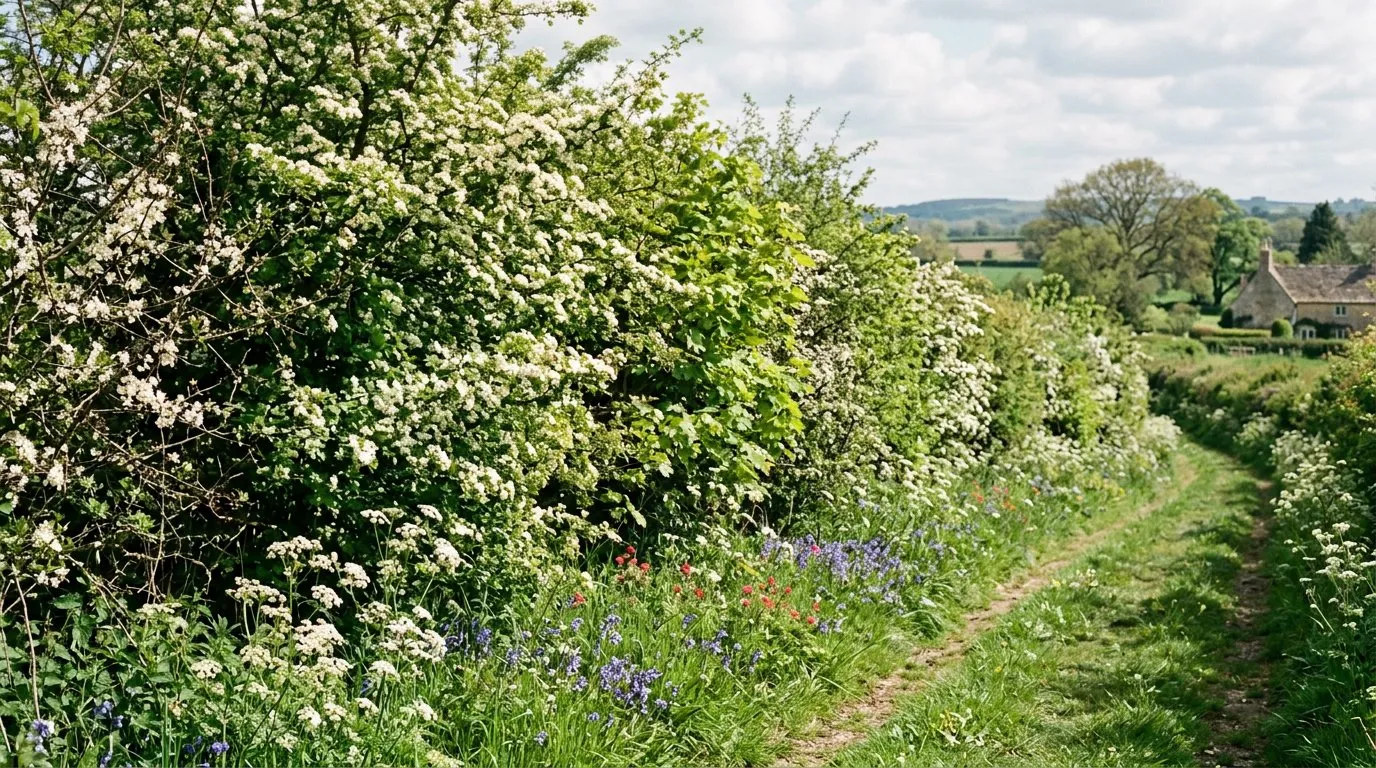
A young mixed native hedge in spring flower, combining hawthorn, blackthorn, and field maple along a rural garden boundary.
Hawthorn thorns can be a hazard beside paths used by children, but they also make the hedge virtually impenetrable. For front gardens, beech or yew gives a cleaner appearance.
Box (Buxus sempervirens)
Box is the traditional plant for low formal edging, knot gardens, and topiary. It clips to a precise, geometric shape and holds that shape longer between trims than any other species. Growth is very slow at 10-15cm per year, making it the lowest-maintenance hedging option.
Box suits hedges from 30cm to 1.5m tall. Most box edging is maintained at 30-60cm. The small, dark green, glossy leaves are densely packed along the stems. Two trims per year (May and August) keep box immaculate. It grows on any well-drained soil in sun or partial shade.
Box blight (Cylindrocladium buxicola) has devastated box hedging across the UK since the early 2000s. The fungal disease causes brown patches, leaf drop, and dieback. In areas where box blight is prevalent, consider these resistant alternatives:
- Ilex crenata (Japanese holly) has similar small, dark leaves and clips to the same neat shape. Growth rate is slightly faster than box.
- Euonymus japonicus ‘Green Spire’ forms a tight column of glossy green leaves. Excellent for low formal edging.
- Lonicera nitida clips well and grows faster than box, but needs more frequent trimming to stay tidy.
Bare-root vs container-grown hedging
Bare-root plants are dug from nursery fields during the dormant season (November to March) and sold without soil around the roots. They cost 60-80% less than container-grown equivalents. A 10m beech hedge needs roughly 30 plants at £1 per bare-root whip versus £8 per container plant. Bare-root plants also establish faster because roots grow directly into surrounding soil.
Container-grown plants are available year-round and give instant impact at a larger size (60-90cm vs 40-60cm). They suit summer planting and gardens where consistent watering is difficult.
For most new hedges, bare-root is the clear winner. Order in advance from a specialist nursery. Heel plants into moist soil if you cannot plant immediately.
Calculating plant numbers: At 30cm spacing, you need 3.3 plants per metre (33 for 10m). At 45cm spacing, 2.2 per metre (22 for 10m). A double staggered row at 40cm spacing needs 5 per metre. Laurel at 60cm spacing needs just 1.7 per metre. Always order 10% extra for replacements.
Step-by-step planting method
This method works for all bare-root hedge species. Plant between November and March.
Preparation
Mark out the hedge line with string stretched between two canes. Dig a trench 45cm wide and 30cm deep along the entire length. This is faster and gives better results than digging individual holes. Fork over the base of the trench to break up any compaction.
If the soil is poor, mix well-rotted garden compost or composted bark into the base of the trench. On heavy clay, add sharp grit to improve drainage. Do not add fresh manure, which burns roots.
Planting
- Soak bare-root plants in a bucket of water for 1-2 hours before planting. This rehydrates roots that may have dried during transit
- Trim any damaged, broken, or excessively long roots with sharp secateurs
- Place plants along the trench at the correct spacing. Use a marked cane as a guide for consistent gaps
- For a double staggered row, set two lines of plants 30cm apart with each plant offset from those in the opposite row
- Spread roots naturally in the trench. Do not coil or bend them to fit
- Backfill with the excavated soil, firming around each plant with your foot
- Ensure the soil mark on each stem sits at the final soil level. Planting too deep kills the stem base
- Water the entire row thoroughly with 5-10 litres per plant
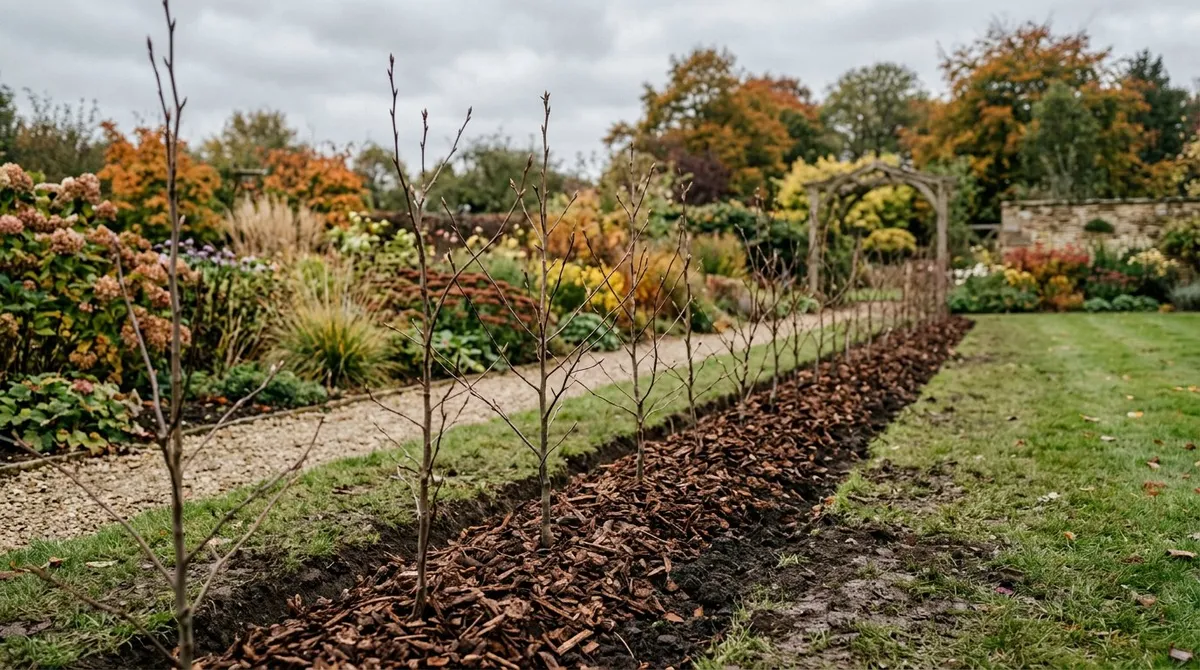
- Mulch along both sides with 5-8cm of bark chip or garden compost, keeping mulch 5cm from stems
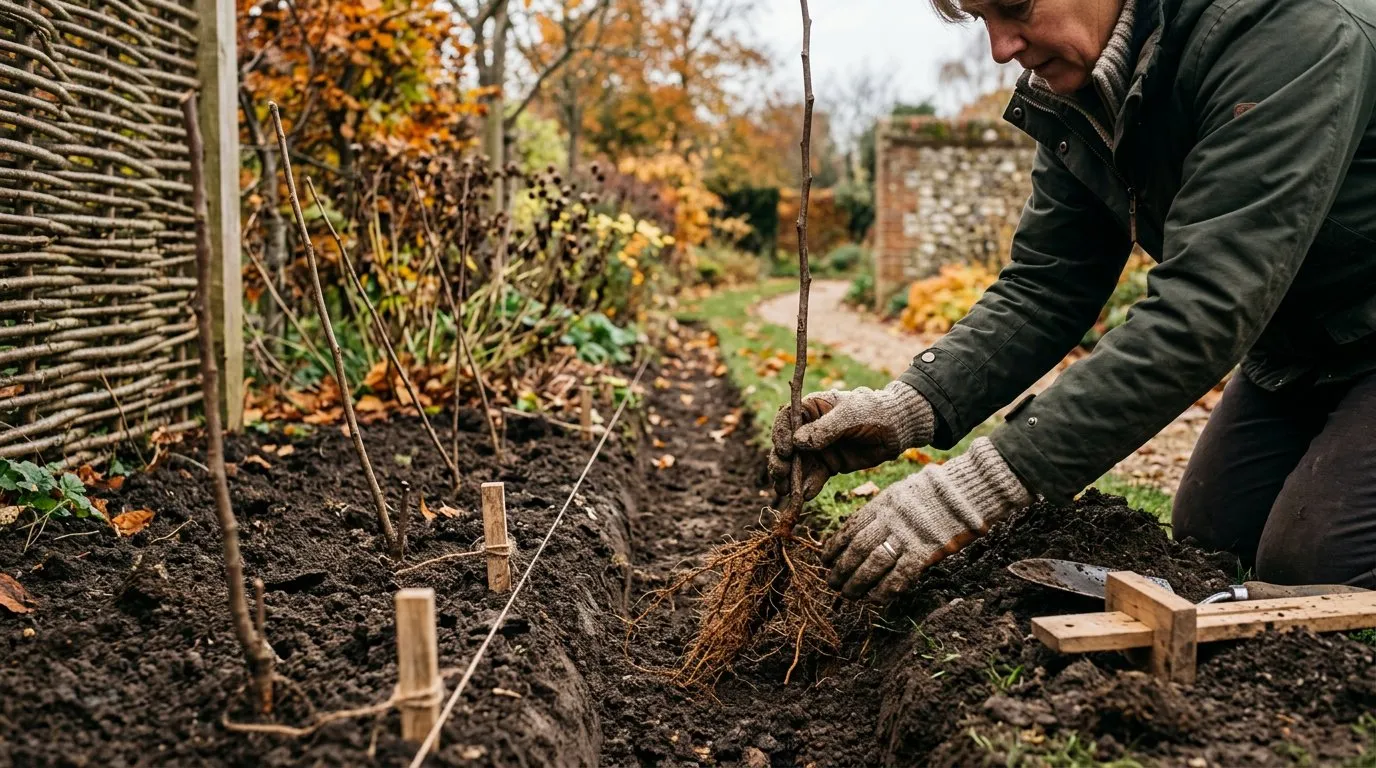
Bare-root hedge whips being placed into a prepared trench with a garden line marking the row for even spacing.
The critical first cut
This step is often skipped and it should never be. Cut all bare-root plants back by one-third immediately after planting. This feels brutal on newly planted whips, but it forces multiple shoots from the base rather than a single thin stem racing upward. A hedge that is not cut back at planting develops bare, leggy lower stems that never fill in.
The only exception is yew, which is naturally dense and bushy. Cut yew back by just the top 10-15cm.
First-year care
Water weekly from April to September. Drought is the number one cause of bare-root hedge failure. Each plant needs 2-3 litres per watering. A soaker hose laid along the base is the most efficient method.
Keep the base weed-free for the first two years. A 30cm mulched strip on each side prevents competition for water and nutrients. Do not trim in the first year except for the initial cut-back at planting. Let the hedge grow unchecked through its first full season.
Replace failures in the following November. Any plant that has not produced new growth by July is dead. Failure rates of 5-10% are normal.
Gardener’s tip: If rabbits are a problem, fit spiral tree guards around each plant for the first two years. Rabbits strip bark from young hedge plants, killing the stem. Clear plastic spirals cost a few pence each and prevent thousands of pounds of damage.
When and how to trim an established hedge
Under the Wildlife and Countryside Act 1981, it is an offence to damage or destroy the nest of any wild bird. Avoid trimming between March and August unless you have checked thoroughly for active nests.
Formal trimming schedule: First trim in June once spring growth has hardened. Second trim in late August as the final cut before winter. Yew needs only the August trim. Privet needs 2-3 cuts between May and September.
Shape matters. A hedge should be slightly wider at the base than the top. This tapered profile ensures lower branches receive sunlight and stay leafy. A hedge wider at the top shades its own base, which goes bare and thin. Use a string line for a level top.
Renovating an overgrown hedge: Cut one side back hard to the main stems in February. Leave the other side intact. The cut side reshoots by summer. Do the other side the following February. Yew, beech, hornbeam, and hawthorn all tolerate this. Never hard-prune Leylandii past the green growth; it does not regenerate from bare wood. For the jobs that keep your garden in shape this season, our autumn gardening guide covers trimming timing alongside other seasonal tasks.
Why we recommend bare-root beech for most UK gardens: After 30 years of planting hedges across clay, chalk, and loam, bare-root beech whips consistently outperform container-grown plants in first-year establishment. In our experience, a November-planted bare-root whip at 45cm reaches 90cm by the following autumn — roughly matching a container plant that costs five times more. The copper leaf retention through winter means you get year-round screening from year one.
Common hedging mistakes
Skipping the first cut-back produces a hedge with bare lower stems. This is the most common mistake and the hardest to fix. Cut back by one-third at planting, no exceptions.
Neglecting watering in the first summer kills more new hedges than any other factor. Bare-root plants need weekly watering from April to September until established.
Trimming too late (October onwards) leaves soft new growth vulnerable to frost. The last trim should be in August or early September.
Ignoring the base by letting grass and weeds grow right up to hedge stems. Maintain a clear, mulched strip for the first three years minimum.
Choosing Leylandii for a garden boundary. It grows 60-90cm per year and quickly reaches 15-20m if not trimmed twice annually. For gardens under 30m long, choose yew, laurel, or beech instead. For small garden design, proportionate plants make all the difference.
Now you’ve mastered hedge planting, read our guide on planting bee-friendly plants for the next step in creating a wildlife-rich boundary.
Frequently asked questions
When is the best time to plant a hedge in the UK?
Plant bare-root hedging between November and March while plants are dormant. This gives roots several months to establish before the demands of spring growth. The ideal window is November to December, when soil is still warm from summer. Container-grown hedging can go in at any time of year, but autumn and winter planting always produces the strongest establishment and fastest early growth.
How far apart should I space hedge plants?
Most species need 30-45cm spacing in a single row. For a thicker, denser hedge, plant a double staggered row with 40cm between plants and 30cm between the two rows. Laurel needs wider 60cm spacing due to its vigorous, spreading habit. Box edging is planted tightly at 15-25cm. Always order 10% extra plants to replace any that fail in the first year.
How long does it take for a hedge to grow?
Privet and laurel reach a usable 1.5m height in 3-4 years from bare-root plants. Beech and hornbeam take 4-6 years to the same height. Hawthorn fills in within 3-5 years. Yew is the slowest at 6-10 years to reach 1.5m, though it forms the densest hedge of all. Regular trimming encourages branching and actually accelerates the process of forming a solid, dense screen.
What is the cheapest way to plant a hedge?
Bare-root whips from a specialist nursery are the cheapest option. Beech and hawthorn cost 80p-£1.50 per plant. A 10m hedge at 30cm spacing needs 33 plants, costing roughly £25-50. Container-grown plants of the same species cost £5-15 each, making the same hedge £165-500. Plant bare-root whips yourself in winter and the total cost is minimal compared to fencing.
Do I need to cut back new hedge plants?
Yes. Cut bare-root plants back by one-third immediately after planting. This forces multiple shoots from the base and creates dense, bushy growth from the ground up. Without this cut, most hedges develop thin, leggy lower stems that remain bare for the life of the hedge. The only exception is yew, which needs minimal initial pruning because its growth habit is already compact and bushy.
Which hedge is best for privacy?
Cherry laurel gives the fastest evergreen screen at 40-60cm growth per year. A laurel hedge reaches 1.8m within 3-4 years of planting. Yew forms the densest, most impenetrable hedge but takes longer to establish. For a deciduous option, beech retains its coppery dead leaves through winter, providing year-round visual screening. A double-row beech hedge at 1.8m tall blocks sightlines effectively from the first year it reaches full height.
Can I plant a hedge next to a fence?
Yes. Plant at least 30-45cm from the fence to allow room for the hedge base and maintenance access. Plant on your side of the boundary. Under English common law, you can trim any part of a neighbour’s hedge that overhangs your property, but you must offer the cuttings back to them. A hedge planted tight against a fence will eventually push the fence over as it expands, so leave a clear gap.
What is the best low-maintenance hedge?
Yew needs just one trim per year (late August) and grows slowly enough to hold its shape between cuts. A mature yew hedge takes less than 30 minutes per 10m to trim once annually. Beech needs two trims but tolerates occasional neglect without becoming unmanageable. Avoid privet and Leylandii if low maintenance is a priority — both grow fast and look untidy within weeks of trimming.
Lawrie has been gardening in the West Midlands for over 30 years. He grows his own veg using no-dig methods, keeps a wildlife-friendly garden, and writes practical advice based on real UK growing conditions.