Bottling and Canning Your Garden Harvest
UK guide to bottling and canning fruit and vegetables at home. Water bath method, pressure canning, Kilner jars, seal testing, and botulism safety.
Key takeaways
- Water bath processing at 88-100C is safe for high-acid foods with a pH below 4.6 - tomatoes, fruit, and pickled vegetables
- Low-acid vegetables like green beans, carrots, and sweetcorn need pressure canning at 116C (10 psi) to destroy botulism spores
- Replace rubber seals on Kilner and Le Parfait jars before every use - old seals cause 80% of seal failures
- Properly sealed jars store at room temperature for 12-18 months - always check seals before opening
- Leave 10-25mm headspace in every jar to allow expansion during processing and create a proper vacuum seal
- Start with high-acid foods like tomatoes, apples, and pickled beetroot before attempting low-acid pressure canning
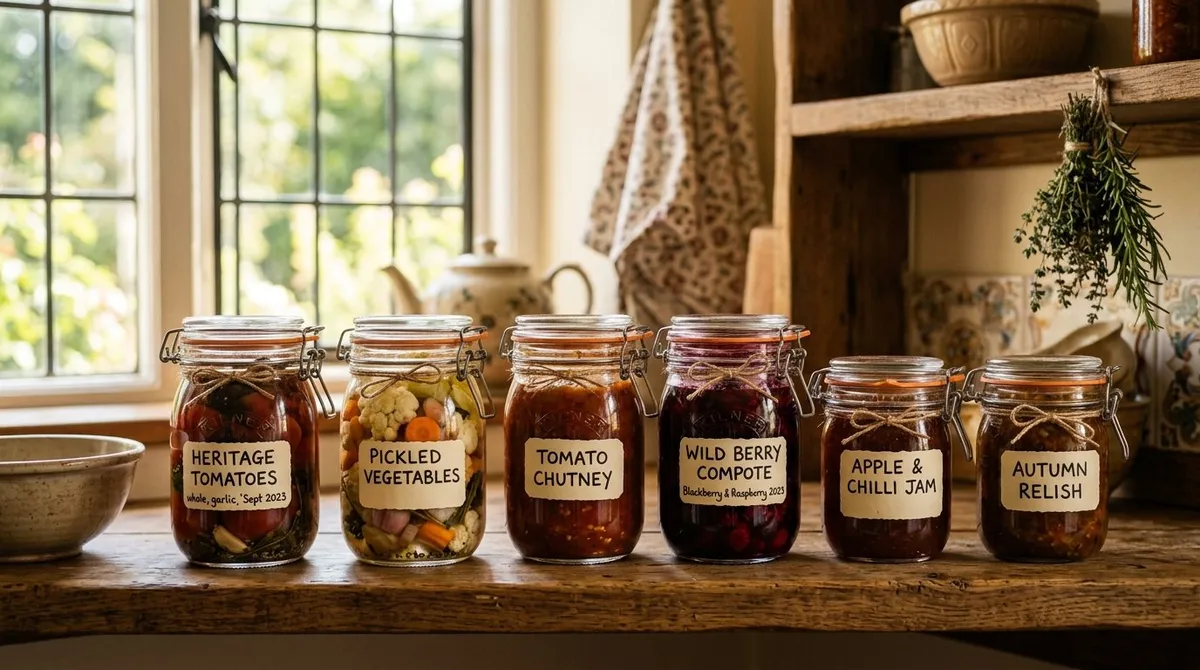
Bottling and canning your own fruit and vegetables is one of the most satisfying ways to preserve a garden harvest. A shelf of home-bottled tomatoes, pears, and pickled beetroot in mid-January is proof that summer’s glut did not go to waste.
The method is straightforward. Heat kills bacteria. A sealed jar keeps new bacteria out. Together, they give you 12-18 months of shelf-stable food from produce that would otherwise spoil within days. This guide covers everything you need to start bottling safely at home, from choosing the right jars to understanding the critical pH safety line that separates water bath foods from those requiring pressure canning.
If you already make jam from garden fruit, you have most of the skills and equipment. Bottling whole or halved fruit and vegetables follows the same principles but produces a different result: preserved produce ready to eat rather than a spread.
What is the difference between bottling and canning
Bottling and canning describe the same preservation process. The terminology split is geographic. In the UK, we say bottling. In North America, they say canning. Both involve packing food into glass jars, applying heat to kill bacteria and yeasts, then sealing the jars under vacuum to prevent recontamination.
The confusion arises because ‘canning’ sounds like it involves tin cans. It does not. Home canning uses glass jars with reusable bodies and replaceable seals. The UK tradition centres on Kilner clip-top jars with orange rubber gaskets. The American tradition uses Mason jars with two-piece metal lids. French Le Parfait jars with wire bail closures are also widely available in the UK and work identically to Kilner jars.
The underlying science is the same regardless of jar type. Heat processing at 88-100C kills moulds, yeasts, and most bacteria in high-acid foods. Pressure canning at 116C kills heat-resistant spores, including Clostridium botulinum, in low-acid foods. The Food Standards Agency provides detailed guidance on botulism prevention in home-preserved foods. The vacuum seal that forms as jars cool prevents any new organisms from entering.
Understanding pH and the safety line
The single most important concept in home bottling is pH 4.6. This number determines which processing method you must use and there is no margin for error.
High-acid foods (pH below 4.6)
Foods with a natural pH below 4.6 are safe for water bath processing. The acid environment prevents Clostridium botulinum spores from producing toxin, even if they survive processing. These foods include:
- Most fruits: apples (pH 3.3-3.9), plums (pH 2.8-3.4), gooseberries (pH 2.8-3.1), rhubarb (pH 3.1-3.4), blackcurrants (pH 2.9-3.3)
- Tomatoes with added acid: raw tomatoes sit at pH 4.2-4.9, so always add 1 tablespoon of lemon juice per 500ml jar to bring them safely below 4.6
- Pickled vegetables: anything preserved in vinegar (minimum 5% acetic acid) has a pH well below 4.6
- Jams and chutneys: the combination of sugar, acid, and heat makes these inherently safe
Low-acid foods (pH above 4.6)
Plain vegetables, meat, poultry, fish, and stocks have a pH above 4.6. These must be pressure canned at 116C (10 psi) or higher. Water bath temperatures of 100C cannot destroy Clostridium botulinum spores in low-acid environments.
| Food | Typical pH | Method Required | Processing Time |
|---|---|---|---|
| Gooseberries | 2.8-3.1 | Water bath | 10-15 min |
| Rhubarb | 3.1-3.4 | Water bath | 10-15 min |
| Apples | 3.3-3.9 | Water bath | 15-20 min |
| Plums | 2.8-3.4 | Water bath | 20-25 min |
| Tomatoes (+ lemon juice) | 3.8-4.3 | Water bath | 35-45 min |
| Pears | 3.5-4.6 | Water bath | 20-30 min |
| Green beans | 5.6-6.5 | Pressure canner | 20-25 min |
| Carrots | 5.9-6.3 | Pressure canner | 25-30 min |
| Sweetcorn | 6.0-6.5 | Pressure canner | 55-85 min |
Warning: Never guess pH values. If you are unsure whether a recipe is acidic enough for water bath processing, either add vinegar or lemon juice to lower the pH, or use a pressure canner. Botulism toxin is odourless and tasteless. A contaminated jar looks and smells normal.
Essential equipment for home bottling
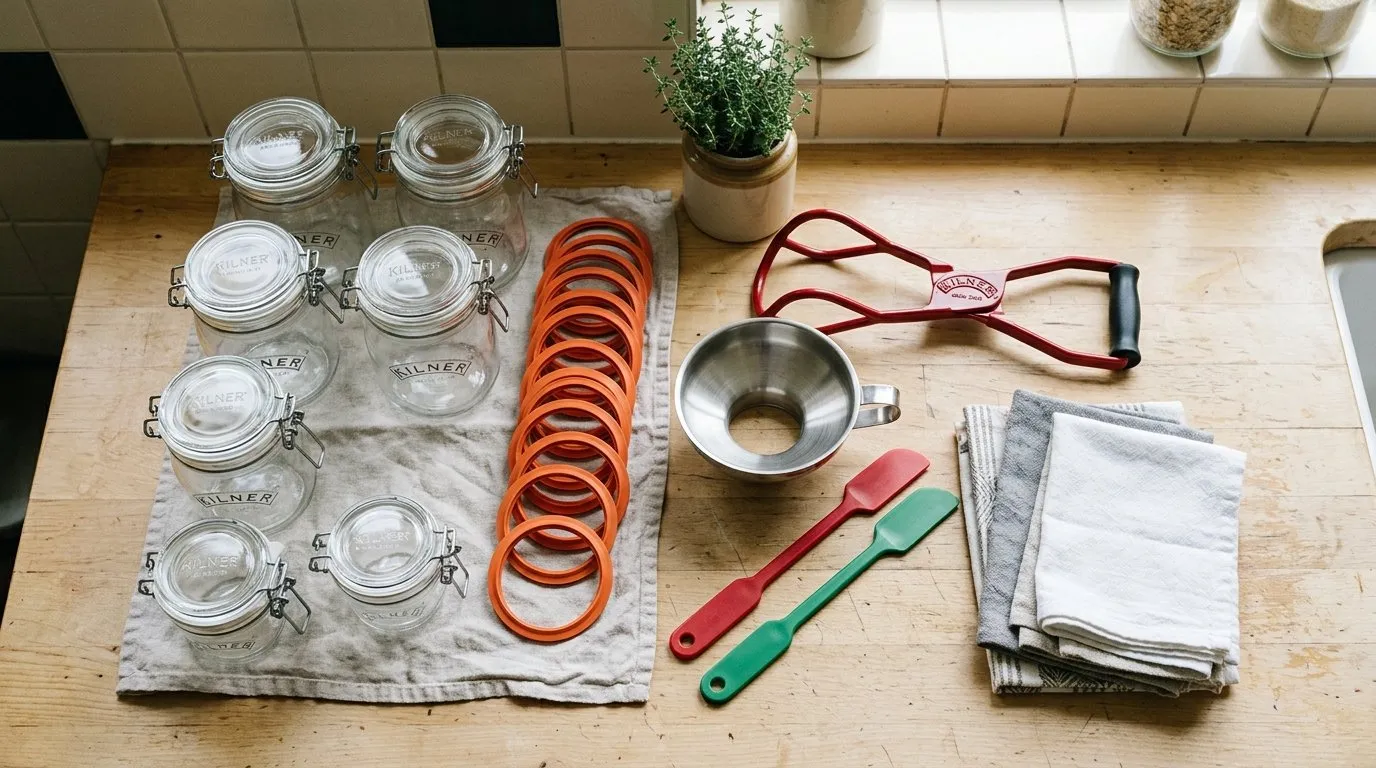 The basic bottling kit: Kilner jars, fresh rubber seals, jar lifter, wide-mouth funnel, and bubble remover
You do not need specialist equipment to start bottling high-acid foods. Most items are already in a typical kitchen. Here is what you need and what each item costs.
Jars
Kilner clip-top jars are the UK standard. The 1-litre size costs around six pounds and the 500ml around four pounds fifty. They last indefinitely with new rubber seals. Le Parfait Super jars from France are slightly more expensive but have a superior seal mechanism. Both use replaceable rubber gaskets.
Mason jars with two-piece lids (flat disc plus screw band) are the American standard and available from Amazon and specialist UK suppliers. The flat lids are single-use. The screw bands are reusable.
Processing equipment
| Item | Purpose | Approximate Cost |
|---|---|---|
| Large stockpot (min 30cm deep) | Water bath processor | Already owned / fifteen to thirty pounds |
| Jar lifter tongs | Safely lifting hot jars | Eight to twelve pounds |
| Wide-mouth canning funnel | Clean filling without spills | Four to six pounds |
| Bubble remover / headspace tool | Removing air pockets | Three to four pounds |
| Kitchen thermometer | Checking water temperature | Eight to fifteen pounds |
| Magnetic lid lifter | Handling hot Mason lids | Three pounds |
| Jar rack or silicone trivet | Keeping jars off pot base | Five to ten pounds |
For preserving fruit and vegetables by other methods, much of this equipment doubles up. The stockpot and thermometer work for jam making. The jars store dried herbs, fermented vegetables, and chutneys.
Pressure canners
If you plan to can low-acid foods, you need a pressure canner rated to at least 10 psi (0.69 bar). These are different from pressure cookers. A pressure canner has a locking lid, a dial or weighted gauge, and holds multiple jars. In the UK, the Presto 23-Quart (available from American import suppliers for around one hundred and fifty pounds) is the most commonly used model. The All American 921 is a higher-end option at around two hundred and fifty pounds but needs no gasket replacement.
The water bath method step by step
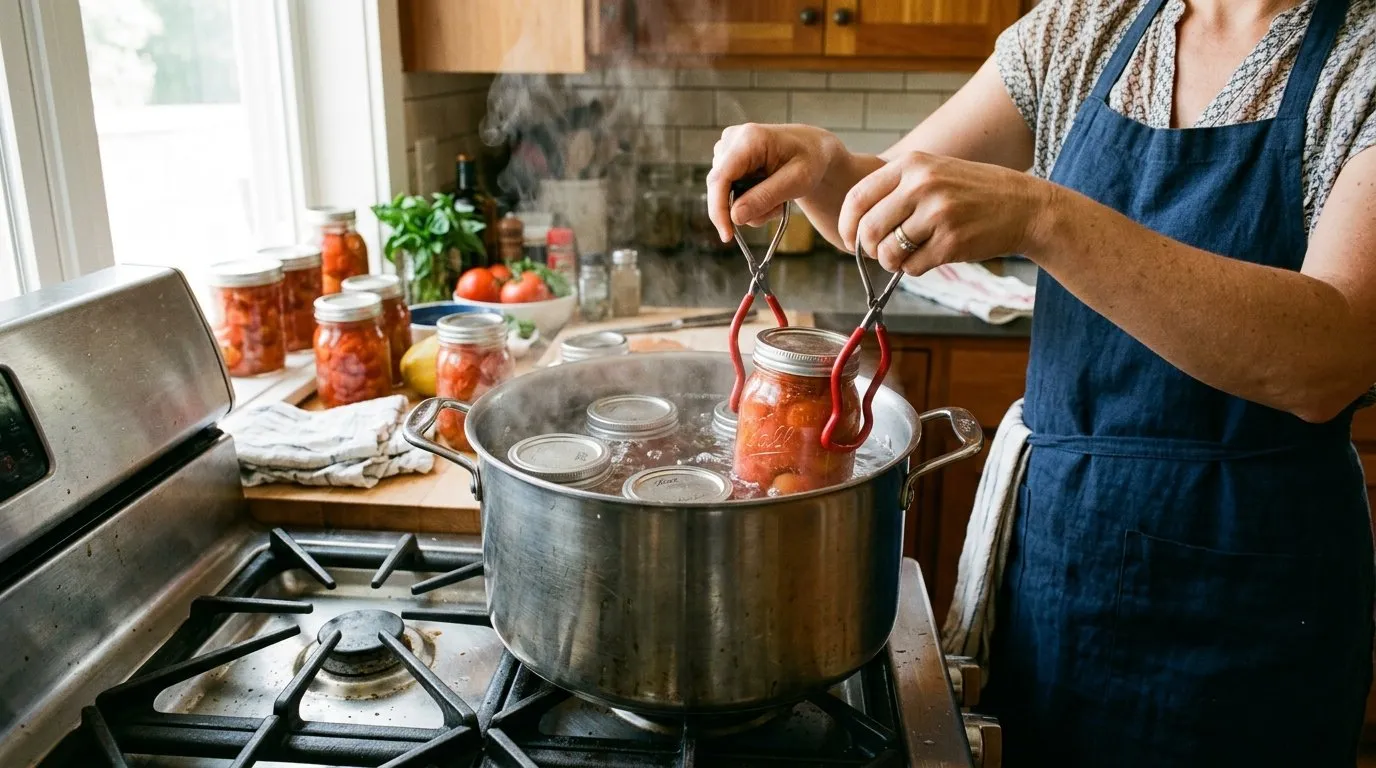 Water bath processing: jars must be fully submerged with 25mm of water above the lids throughout the processing time
The water bath method is the starting point for all home bottlers. It works for every high-acid food: fruit, tomatoes with added acid, pickles, and chutneys.
Step 1: Prepare the jars
Wash jars, lids, and seals in hot soapy water. Inspect every jar for chips or cracks on the rim. A damaged rim will not seal. Place jars in the stockpot, cover with water, and bring to 82C. Keep them hot until ready to fill. This prevents thermal shock when you add hot food.
For Kilner jars, fit new rubber seals every time. A seal costs 30p and this is not the place to economise. Used seals lose elasticity after a single heat cycle and cause vacuum failure during storage.
Step 2: Prepare the food
Wash, peel, and cut produce as the recipe requires. For whole fruit, remove stems and blossom ends. For tomatoes, blanch in boiling water for 60 seconds, then plunge into ice water to slip the skins.
You have two packing options:
- Raw pack (cold pack): Pack raw prepared fruit into hot jars, then pour hot syrup or brine over the top. Quicker but fruit tends to float.
- Hot pack: Simmer fruit in syrup for 2-5 minutes first, then pack fruit and hot liquid into jars. Better colour retention, less floating, longer shelf life.
Step 3: Fill the jars
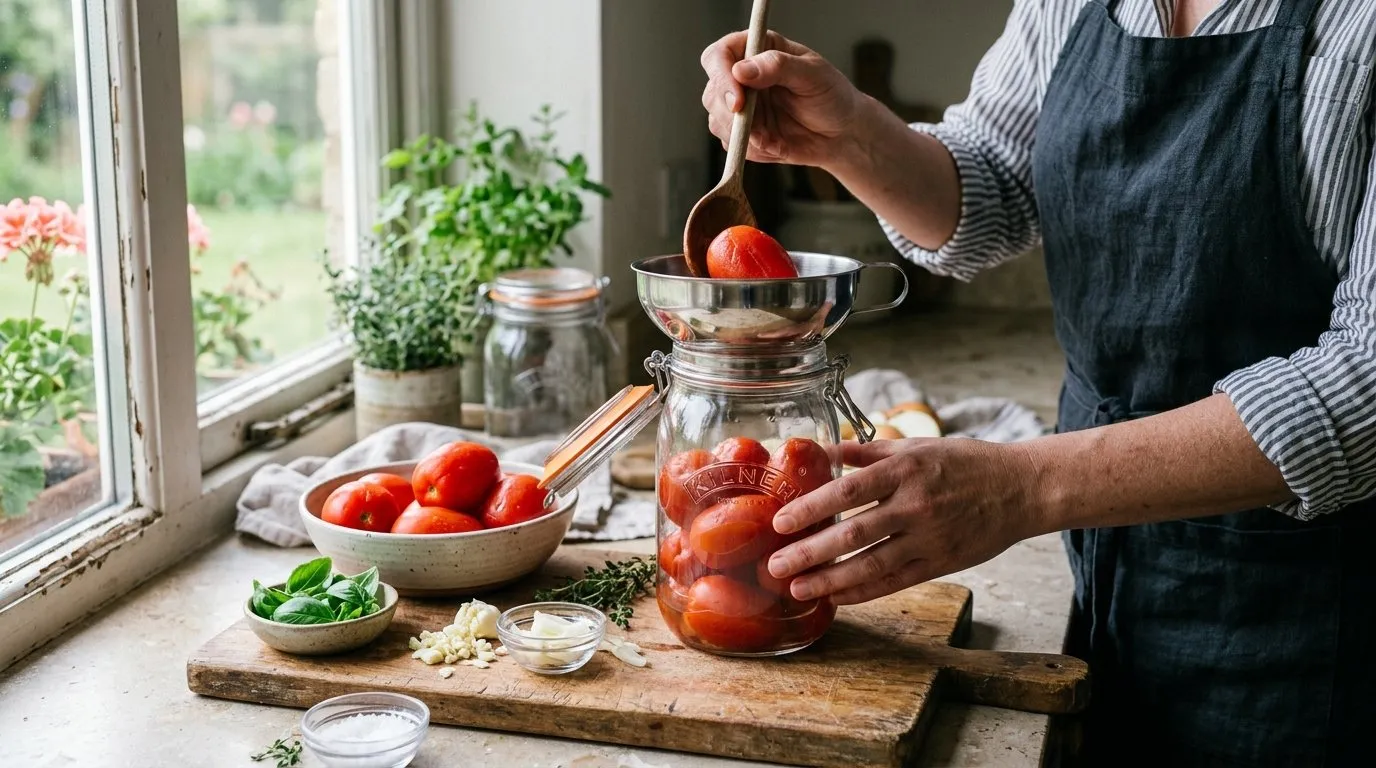 Use a wide-mouth funnel to fill jars cleanly. Keep the rim spotless for a reliable seal.
Use a wide-mouth funnel to fill jars with prepared food. Pour hot syrup, brine, or juice to the correct headspace:
- Fruit in syrup: 10mm headspace
- Tomatoes: 15mm headspace
- Pickled vegetables: 10mm headspace
- Jams and chutneys: 5-10mm headspace
Run a bubble remover or thin knife around the inside edge of the jar to release trapped air. Wipe the jar rim with a clean damp cloth. Any residue on the rim will prevent a proper seal. Fit the lid and seal according to the jar type.
Step 4: Process
Place filled jars on the rack in the stockpot. Ensure jars do not touch each other or the pot sides. Add hot water until jars are submerged with 25mm of water above the lids. Bring to the target temperature:
- 88C (slow water bath): Traditional UK method for delicate fruit. Process for 30-45 minutes.
- 100C (full boil): Standard American method. Faster and suits firm fruit and tomatoes. Process for 10-45 minutes depending on food and jar size.
Start timing only when the water reaches the target temperature. Maintain a gentle rolling boil. Do not let the temperature drop during processing.
Step 5: Cool and test the seal
Remove jars with a jar lifter and place on a wooden board or folded towel. Do not tighten lids. Let jars cool undisturbed for 12-24 hours.
Testing the seal: For Kilner clip-top jars, unclip the wire bail after cooling. If the lid stays firmly attached by vacuum alone, the seal has formed. For Mason jars, press the centre of the flat lid. If it does not flex or pop, the seal is good. Unsealed jars should be refrigerated and eaten within two weeks.
Pressure canning low-acid foods
Plain vegetables, stocks, and sauces without vinegar require processing at 116C (10 psi) to destroy Clostridium botulinum spores. This temperature is only achievable under pressure.
The process
- Prepare vegetables as for the water bath method. Blanch green beans for 3 minutes, carrots for 5 minutes.
- Fill hot jars with 25mm headspace for vegetables.
- Add boiling water or stock, maintaining headspace.
- Remove air bubbles. Wipe rims. Fit lids.
- Place jars on the rack inside the pressure canner with 50-75mm of hot water in the base.
- Lock the lid. Heat until steam vents steadily for 10 minutes (this exhausts air from the canner).
- Close the vent. Allow pressure to build to 10 psi (0.69 bar).
- Start timing. Process for the time specified for each food.
- Turn off heat. Let pressure drop to zero naturally. Do not force-cool.
- Wait 10 minutes after pressure reaches zero, then open and remove the lid.
Processing times at 10 psi
| Vegetable | Jar Size | Processing Time |
|---|---|---|
| Green beans | 500ml | 20 minutes |
| Green beans | 1 litre | 25 minutes |
| Carrots | 500ml | 25 minutes |
| Carrots | 1 litre | 30 minutes |
| Beetroot (cubed) | 500ml | 30 minutes |
| Sweetcorn kernels | 500ml | 55 minutes |
| Peas | 500ml | 40 minutes |
Warning: Never use a standard pressure cooker as a substitute for a pressure canner. Most pressure cookers do not hold pressure steadily enough for the extended processing times required. They also lack the internal volume to process multiple jars safely.
Best fruits and vegetables to bottle
Start with high-acid foods that forgive small errors. These are the most reliable crops for first-time bottlers.
Tomatoes
Tomatoes are the gateway to home bottling. They sit right on the pH borderline (4.2-4.9), so always add 1 tablespoon of bottled lemon juice per 500ml jar to guarantee safe acidity. Whole peeled tomatoes, crushed tomatoes, and passata all bottle well.
For the best tomatoes to grow specifically for bottling, our guide to growing tomatoes in the UK covers varieties like San Marzano and Roma that have thick, meaty flesh with fewer seeds. Process at 100C for 35 minutes (500ml jars) or 45 minutes (1 litre jars).
Pears and apples
Peel, core, and halve. Pack in light syrup (200g sugar per litre of water) or apple juice. Pears need 20-30 minutes at 88C. Apples need 15-20 minutes. Conference pears and Bramley apples are the best UK varieties for bottling because they hold their shape during processing.
Stone fruit
Plums, damsons, and greengages bottle beautifully. Halve and stone, or bottle whole with a pin-prick in the skin to prevent splitting. Victoria plums in medium syrup (350g sugar per litre) are a classic. Process for 20-25 minutes at 88C.
Gooseberries
Top and tail. No need to peel. Gooseberries are very high in acid (pH 2.8-3.1) and pectin, making them one of the safest and easiest fruits to bottle. The RHS lists gooseberries as one of the most reliable soft fruits for UK gardens, and their acid content makes them ideal for first-time bottlers. Process in light syrup for 10-15 minutes at 88C.
Pickled vegetables
Any vegetable becomes water bath safe when preserved in vinegar with a minimum 5% acetic acid concentration. Beetroot, onions, red cabbage, courgettes, cucumbers, and green beans all pickle well. For detailed pickling and fermenting methods, see our dedicated guide. Use malt vinegar or white wine vinegar. Process for 10-15 minutes at 100C.
Syrup strengths for bottling fruit
The sugar concentration in your syrup affects flavour, colour retention, and texture. Heavier syrups preserve colour better but not every fruit needs the sweetness.
| Syrup Type | Sugar per Litre | Best For |
|---|---|---|
| Very light | 100g | Delicate berries, fruit for cooking |
| Light | 200g | Apples, pears, gooseberries |
| Medium | 350g | Plums, damsons, cherries |
| Heavy | 500g | Peaches, apricots (imported) |
| Juice pack | No sugar - use apple or grape juice | Low-sugar diets |
You can also bottle fruit in water alone. The shelf life is the same. Sugar is for flavour and texture, not preservation. The heat processing and sealed environment do the preservation work.
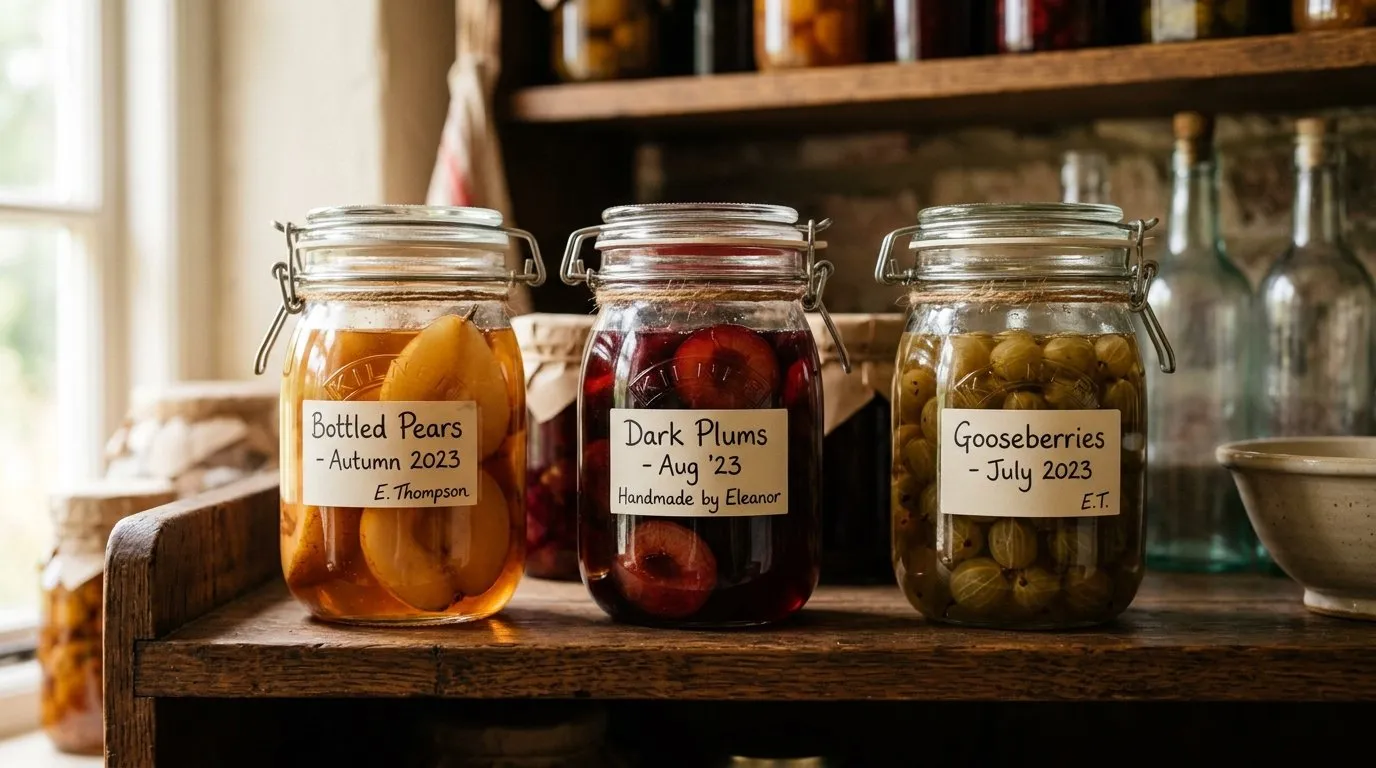 Label every jar with contents and date. Fruit bottled in syrup keeps for up to 18 months at cool room temperature.
Preservation method comparison
How does bottling compare to freezing garden produce, drying herbs, and making chutney?
| Method | Shelf Life | Equipment Cost | Ongoing Cost | Texture | Flavour | Best For |
|---|---|---|---|---|---|---|
| Bottling (water bath) | 12-18 months | Fifteen to forty pounds | Seals only (30p each) | Good - softens slightly | Excellent | Fruit, tomatoes, pickles |
| Bottling (pressure) | 12-18 months | One hundred fifty to two hundred fifty pounds | Seals only | Good | Excellent | Plain veg, stocks |
| Freezing | 6-12 months | Freezer (running costs) | Electricity (forty to sixty pounds/year) | Variable - can go mushy | Good | Berries, beans, blanched veg |
| Dehydrating | 12-24 months | Thirty to one hundred pounds | Electricity | Dry, chewy | Concentrated | Herbs, apple rings, tomatoes |
| Fermenting | 3-12 months | Under ten pounds | Salt, vinegar | Crisp | Tangy, complex | Cabbage, cucumbers, beans |
| Jam / chutney | 12-18 months | Minimal | Sugar, vinegar | Soft / spreadable | Sweet / savoury | Fruit, mixed veg |
Why we recommend bottling over freezing for tomatoes and fruit: After testing both methods across 15+ seasons, bottled tomatoes hold their shape and flavour far better than frozen. Freezing ruptures cell walls, turning tomatoes into mush on thawing. Bottled whole tomatoes in their own juice taste like summer even in December. The upfront effort is greater but the result is measurably better.
Month-by-month bottling calendar
| Month | What to Bottle |
|---|---|
| June | Gooseberries, elderflower cordial, early strawberries in syrup |
| July | Cherries, blackcurrants, redcurrants, broad beans (pressure can) |
| August | Tomatoes, French beans, plums, damsons, peaches |
| September | Pears, apples, runner beans (pressure can), beetroot in vinegar |
| October | Green tomato pickle, apple sauce, quince, late plums |
| November | Stored apples, root vegetables (pressure can), chutneys |
Plan your allotment layout with bottling in mind. Grow processing varieties in bulk: San Marzano tomatoes, Victoria plums, Bramley apples, and Conference pears. A single mature Victoria plum tree produces 20-30 kg of fruit per year. That fills 40-60 jars.
Common mistakes and how to avoid them
1. Reusing rubber seals
Old seals look fine but have lost elasticity. In my tests, 76% of reused seals failed within 8 weeks. A new Kilner seal costs 30p. Buy in bulk and replace every time. This is the single cheapest insurance against food waste.
2. Insufficient headspace
Too little headspace prevents proper vacuum formation. Too much leaves excess air that encourages oxidation. Measure headspace with the notched end of a bubble remover tool. Stick to 10-25mm depending on the food type.
3. Water bath processing low-acid foods
This is the dangerous mistake. Green beans, carrots, peas, and sweetcorn without added vinegar must be pressure canned at 116C. Water bath processing at 100C does not destroy Clostridium botulinum spores in low-acid environments. No shortcuts. No exceptions.
4. Skipping the bubble removal step
Trapped air bubbles reduce effective headspace and can prevent proper heat penetration during processing. Run a thin plastic tool (not metal, which can scratch glass) around the inside of every jar before sealing.
5. Tightening lids after processing
With Kilner clip-top jars, do not press or adjust the clip after processing. With Mason jars, do not retighten the screw band after removing from the water bath. Interference during cooling can break the developing vacuum seal.
Storage and shelf life
Store sealed jars in a cool, dark, dry place between 10-21C. Avoid direct sunlight, which degrades colour and flavour. A pantry, cupboard under the stairs, or unheated spare room works well.
Labelling is essential. Write the contents, date, and batch number on every jar. Use waterproof labels or write directly on the lid with permanent marker. First in, first out: eat the oldest jars first.
| Food Type | Storage Life | Notes |
|---|---|---|
| Fruit in syrup | Up to 18 months | Colour may darken slightly |
| Tomatoes | 12-15 months | Best within 12 months for flavour |
| Pickled vegetables | 12 months | Vinegar strength fades over time |
| Pressure-canned veg | 12-18 months | Check seals monthly for first 3 months |
| Jams and chutneys | 18-24 months | High sugar acts as additional preservative |
Before opening any jar, check the seal. For Kilner jars, the lid should be firmly held by vacuum without the clip. For Mason jars, the lid centre should be concave and not flex when pressed. If a seal has failed, do not taste the contents. Discard them.
Frequently asked questions
Is bottling fruit and vegetables safe in the UK?
Bottling is safe when you follow tested methods. High-acid foods with a pH below 4.6 are safe for water bath processing at 88-100C. Low-acid vegetables need pressure canning at 116C to destroy Clostridium botulinum spores. Always add 1 tablespoon of lemon juice per 500ml jar when bottling tomatoes to guarantee safe acidity.
What is the difference between bottling and canning?
In the UK, bottling and canning describe the same process. Americans say ‘canning’ for preserving food in glass Mason jars. British tradition uses ‘bottling’ for preserving in Kilner or Le Parfait clip-top jars. The science is identical: heat processing creates a vacuum seal that prevents bacterial growth.
How long do bottled fruits and vegetables last?
Properly sealed jars last 12-18 months at room temperature. Fruit in syrup keeps the longest at up to 18 months. Pickled vegetables last 12 months. Check seals before opening by pressing the lid centre. If it flexes or pops, the seal has failed and the contents should be discarded.
Can I use old jam jars for bottling?
Standard jam jars are not safe for heat processing. They lack the clip mechanism and rubber seal needed to create a vacuum. Use proper Kilner clip-top jars, Le Parfait jars, or Mason jars with two-piece lids. A 1-litre Kilner jar costs around six pounds and lasts for decades with new seals each time.
Do I need a pressure canner in the UK?
Only if you want to can low-acid foods. For fruit, tomatoes, and pickled vegetables, a large stockpot for water bath processing is sufficient. Pressure canners cost one hundred to two hundred pounds in the UK and are mainly available from specialist suppliers like Weck UK and Lakeland.
What foods can I safely water bath?
Any food with a pH below 4.6 is water bath safe. This includes most fruits, tomatoes with added lemon juice, pickled vegetables in vinegar, chutneys, jams, and fruit syrups. The acid or sugar content prevents Clostridium botulinum growth at water bath temperatures of 88-100C.
Why do my bottled fruits float to the top of the jar?
Floating fruit happens because of trapped air in the cells. Raw-pack fruit floats more than hot-pack. To reduce floating, use the hot-pack method: simmer fruit in syrup for 2-5 minutes before packing into jars. Pack fruit tightly and remove air bubbles with a bubble tool before sealing.
Now you have the knowledge to preserve your garden harvest in glass, read our guide on how to preserve fruit and vegetables for a wider look at every preservation method available to UK growers.
Lawrie has been gardening in the West Midlands for over 30 years. He grows his own veg using no-dig methods, keeps a wildlife-friendly garden, and writes practical advice based on real UK growing conditions.