How to Build a Garden Pond: UK Guide
Step-by-step guide to building a garden pond in the UK. Covers liner types, digging, pumps, filters, fish stocking, planting, and maintenance.
Key takeaways
- Butyl rubber (EPDM) is the best liner for most garden ponds, lasting 40-50 years
- A 2m x 3m lined pond costs 300-500 pounds including pump, filter, and plants
- Goldfish need a minimum depth of 60cm to survive UK winters without a heater
- Size your pump to turn over half the pond volume per hour for clear water
- Autumn is the best time to build — soil is workable and the pond matures over winter
- Five common mistakes account for most failed ponds — all are avoidable with planning
A garden pond turns any outdoor space. Moving water catches the light, attracts wildlife, and gives a garden a focal point that no border or lawn can match. Whether you want a formal raised pond with a fountain, an informal planted pool with goldfish, or a still water feature surrounded by flagstone, the build process follows the same core steps.
This guide covers general garden ponds: ornamental, fish-friendly, and decorative designs. If you are specifically interested in building a habitat for frogs, newts, and dragonflies, our separate guide to building a wildlife pond covers that in detail. The two types share some construction methods, but garden ponds differ in depth requirements, equipment, edging, and stocking.
Where to site a garden pond
The right location prevents problems that are expensive and difficult to fix later. Consider these factors before marking out your pond.
Sunlight is the most important factor. Position the pond where it receives 5-6 hours of direct sun per day. Too little sun and aquatic plants will not flower. Too much (full south-facing, unshaded all day) encourages excessive algae growth in summer. Dappled afternoon shade from a wall or fence is ideal in southern England.
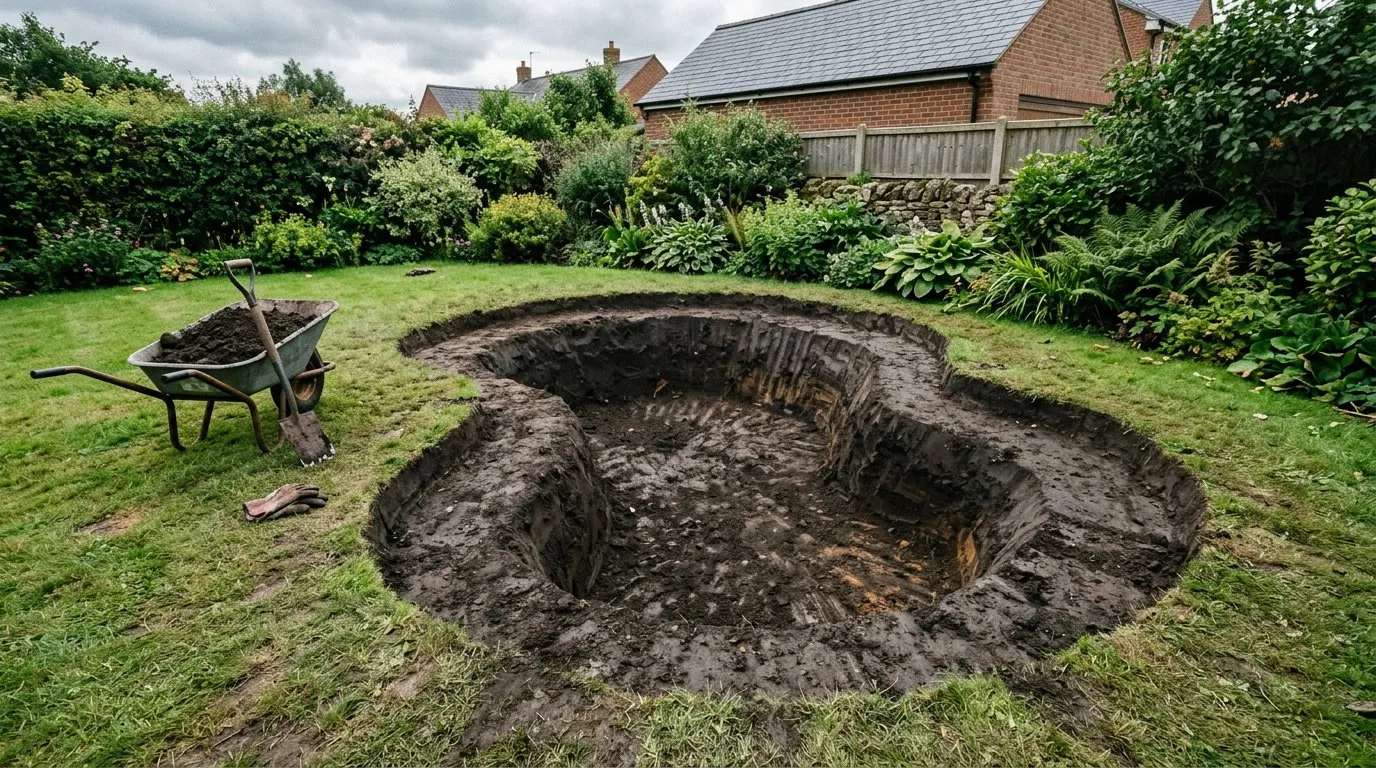 Dig the shallow marginal shelf first, then the deeper zone. Check levels across the excavation before laying the underlay.
Distance from trees matters more than most people realise. Overhanging trees drop leaves into the water from September to November. Decomposing leaves release tannins that turn water brown and nutrients that fuel blanket weed. Tree roots can also puncture liners over time. Keep the pond at least 3m from the nearest tree canopy edge.
Level ground is essential. Water finds its own level, and even a 3cm slope across a 2m pond means the liner shows on the high side. Check with a spirit level on a straight plank before digging. If your garden slopes, a raised or semi-raised pond avoids extensive groundwork.
Services and cables run beneath many gardens. Before digging deeper than 30cm, check for buried water pipes, gas lines, and electrical cables. Contact your utility providers or use a cable avoidance tool (CAT scanner) if you are unsure.
Visibility from the house adds daily enjoyment. A pond you can see from a kitchen window or a seating area gets appreciated far more than one hidden at the bottom of the garden. Consider garden lighting near the pond for evening interest.
Choosing between a liner and a preformed pond
This is the first big decision. Both approaches work, but they suit different situations.
Flexible liner
A flexible liner (butyl rubber, EPDM, or PVC) drapes into a hole you dig to any shape and depth you choose. You control the design completely. Liners suit irregular shapes, sloping banks, planting shelves, and deep fish zones.
Advantages: unlimited shape and size, adaptable depth profile, replaceable sections, long lifespan (40-50 years for butyl).
Disadvantages: requires careful installation, needs protective underlay, wrinkles are unavoidable in corners.
Preformed rigid pond
A preformed pond is a fibreglass or HDPE moulded shell. You dig a hole to match its shape, drop it in, backfill, and fill with water.
Advantages: fast installation (one afternoon), no wrinkles, built-in shelves, good for beginners.
Disadvantages: fixed sizes and shapes (typically small), often too steep-sided for natural planting, hard to integrate into informal gardens, shorter lifespan than butyl.
For any pond larger than 1.5m across, a flexible liner gives better results. Preformed ponds work well for small formal features, especially raised ponds on patios.
Liner types compared
Not all liners are equal. The material you choose affects lifespan, flexibility, cost, and ease of repair.
| Feature | Butyl rubber (EPDM) | PVC | Polythene | Preformed (HDPE/fibreglass) |
|---|---|---|---|---|
| Lifespan | 40-50 years | 10-15 years | 3-5 years | 15-25 years |
| Cost per sq metre | 8-12 pounds | 3-6 pounds | 1-2 pounds | 30-80 pounds (per unit) |
| Flexibility | Excellent | Good | Poor | None (fixed shape) |
| UV resistance | Excellent | Moderate | Poor | Good |
| Puncture resistance | Very good | Moderate | Poor | Good |
| Repairability | Patch kit available | Difficult | Not repairable | Not repairable |
| Best for | All garden ponds | Budget-conscious builds | Temporary ponds only | Small formal features |
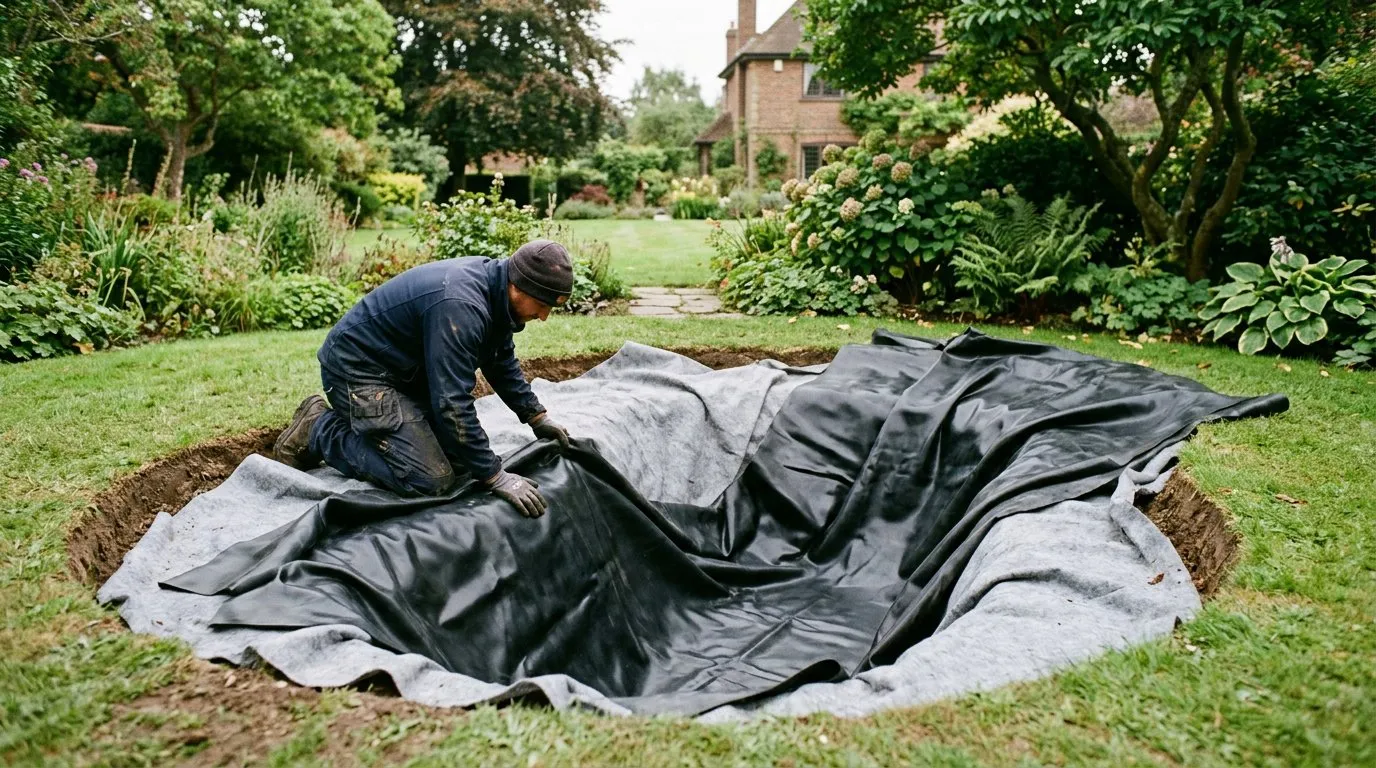 Lay the liner on a warm day when butyl is most flexible. Let the weight of water push it into the contours rather than stretching it.
Butyl rubber (EPDM) is the clear winner for most garden ponds. The upfront cost is roughly double that of PVC, but it lasts three to four times longer. Over 20 years, butyl costs less per year than any alternative. A 0.75mm thickness handles any domestic pond. Use 1.0mm for ponds with heavy rockwork or fish that dig into the substrate.
Calculating liner size
Measure the maximum length, width, and depth of your planned excavation. The formula is:
- Liner length = pond length + (2 x maximum depth) + 60cm overlap
- Liner width = pond width + (2 x maximum depth) + 60cm overlap
A 3m x 2m pond with 75cm depth needs a liner 5.1m x 4.1m. Always round up to the next available size. Liner offcuts cannot be spliced invisibly.
Underlay is not optional
A single sharp stone beneath the liner will work its way through over months, especially under the weight of water and foot traffic on the edges. Lay protective underlay across the entire excavation. Purpose-made geotextile underlay costs 2-3 pounds per square metre. Old carpet works in a pinch but degrades over time and can harbour chemicals. Sand (a 5cm layer) protects the base but does not stay on vertical sides.
How to build a garden pond step by step
This sequence works for any lined garden pond from 1m to 5m across. Allow a full weekend for a medium-sized pond (2m x 3m).
Tools and materials
- Butyl liner (calculated to size)
- Geotextile underlay
- Spade, half-moon edger, and wheelbarrow
- Spirit level and a 2m straight plank
- Hosepipe or rope for marking
- Pond pump and biological filter (sized to volume)
- Paving slabs, flagstone, or cobbles for edging
- Aquatic planting baskets, aquatic compost, and pea gravel
- Aquatic plants (oxygenators, marginals, water lilies)
Step 1: Mark the outline
Lay a hosepipe or rope on the ground in the shape you want. Walk around it. Check the shape from the house, from the seating area, and from the garden path. Adjust until it looks right from every angle. Formal ponds use geometric shapes (rectangles, circles). Informal ponds use flowing curves with no straight lines.
Step 2: Remove the turf
Cut along the marked line with a half-moon edger. Strip the turf and set it aside. Good turf can fill gaps elsewhere in the lawn.
Step 3: Dig the first shelf
Excavate the entire marked area to 25cm deep. This creates the first marginal shelf for shallow-water plants. Keep the edges vertical and the shelf base flat.
Step 4: Mark the deeper zone
Within the first shelf, mark a smaller shape set 30cm inward from the outer edge. This inner area becomes the deep zone.
Step 5: Dig the deep zone
Excavate the inner area to your target depth. For a fish pond, dig to at least 60cm, ideally 75-90cm. For a plant-only ornamental pond, 45-60cm is sufficient. Create a second shelf at 40cm depth if you want tiered planting.
Step 6: Check the levels
Place a straight plank across the excavation and set a spirit level on top. Check multiple directions. The rim must be level all the way around. Even 2cm of slope will expose the liner on the high side. Add or remove soil from the rim until it reads level everywhere.
Step 7: Remove debris
Pick out every stone, root, and sharp object from the base and sides. Run your hand across the surfaces. One overlooked flint can puncture a liner within months.
Step 8: Lay the underlay
Drape geotextile underlay across the entire excavation. Overlap pieces by 30cm. Press the material into corners and shelves. The underlay does not need to be taut. It just needs to sit between the soil and the liner everywhere.
Step 9: Install the liner
Unfold the liner loosely over the excavation on a warm day (above 15C). Butyl is far more flexible when warm. Let the liner drape into the hole under its own weight. Do not stretch or pull it.
Step 10: Fill with water
Begin filling with a garden hose. As the water level rises, the weight pushes the liner into the contours. Smooth out large creases by hand as the water rises. Small folds are inevitable in the corners and will be hidden by plants and gravel later.
Step 11: Trim and edge
Once full, leave the pond to settle for 24 hours. Then trim the liner, leaving 30cm of excess around the rim. Tuck the excess under edging material. Flagstone, natural stone, paving slabs, or timber sleepers all work. Overlap the edging over the water by 3-5cm to hide the liner.
Dig the shallow marginal shelf first, then the deeper zone. Check levels across the excavation before laying the underlay.
Edging options for garden ponds
The edging defines the pond’s character more than almost any other element. A well-edged pond looks intentional. Exposed liner looks amateur.
Flagstone and natural stone is the most popular choice for informal ponds. Lay flat stones overlapping the water by 5cm. Bed them on mortar for a permanent edge, or dry-lay them on compacted sand for a more natural look. Sandstone, slate, and York stone all work well.
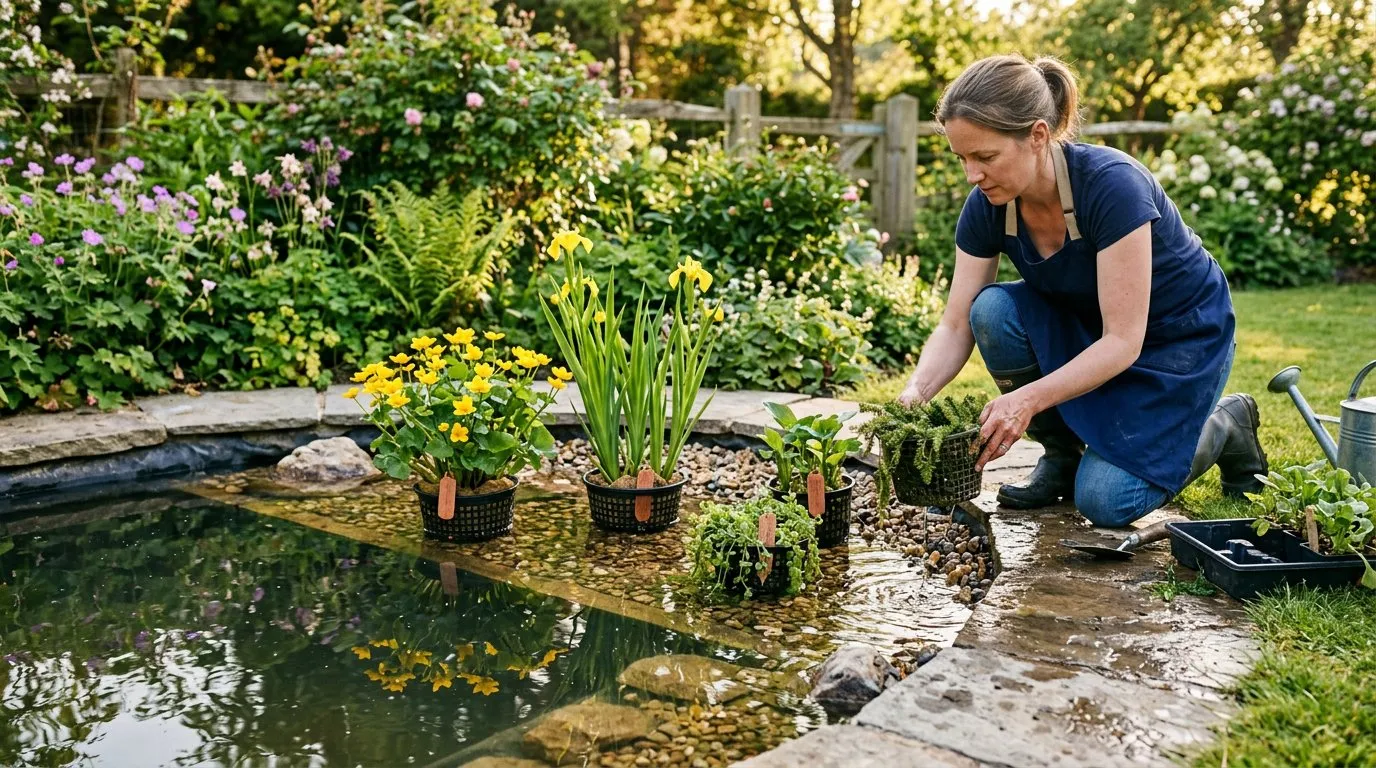 Plant marginals in aquatic baskets on the shelf. Top with pea gravel to stop the compost floating out.
Paving slabs suit formal rectangular ponds. Match them to your patio material for a unified design. Lay on a mortar bed with a 5cm overhang.
Timber sleepers create a raised or semi-raised edge. Use new, untreated oak or larch sleepers. Avoid pressure-treated softwood, as the chemicals can leach into the water and harm fish and plants. Secure sleepers with steel pins driven into the ground.
Pebble beach gives a natural, informal edge where one side of the pond slopes gradually from the water to dry land. Lay cobbles and pebbles over the liner on the slope. This also provides access for wildlife, hedgehogs, and birds that visit for drinking and bathing. If you want to attract birds to your garden, a shallow pebble beach at one side of the pond is highly effective.
Turf to the edge works for ponds set into a lawn. Roll the turf to the pond rim and overlap slightly. This creates a clean, natural finish but requires careful mowing and the grass edge will need trimming by hand.
Lay the liner on a warm day when butyl is most flexible. Let the weight of water push it into the contours rather than stretching it.
Pumps and filters for garden ponds
A wildlife pond can function without equipment. A garden pond with fish, a fountain, or any desire for clear water needs a pump and filter.
Sizing a pump
The pump moves water from the pond through the filter and back again. Size it to circulate half the total pond volume per hour. A 2,000-litre pond needs a pump rated at 1,000 litres per hour (LPH) minimum.
Calculate pond volume: length (m) x width (m) x average depth (m) x 1,000 = litres. A 3m x 2m pond with 0.6m average depth holds approximately 3,600 litres and needs a pump rated at 1,800 LPH.
Types of filter
Biological (box) filters sit at the pond edge, above water level. The pump pushes water up to the filter, which flows back to the pond by gravity. Biological media inside the filter house beneficial bacteria that break down ammonia from fish waste. These filters need 4-6 weeks to mature before stocking fish.
Pressurised filters can be buried at ground level or below the pond rim for a cleaner look. They work under pressure, so the outlet can be above or below the filter. They include a built-in UV clarifier in most models. More expensive than box filters but easier to hide.
UV clarifiers kill the single-celled algae that cause green water. Most modern filters include a UV unit. If yours does not, add an inline UV clarifier between the pump and filter. Replace the UV bulb every spring for full effectiveness.
Fountain or waterfall?
A fountain adds movement and sound. It also oxygenates the water, which benefits fish. Small solar-powered fountain pumps cost 15-25 pounds and need no wiring. For a reliable fountain that works in all weather, connect to the main pond pump.
A waterfall needs a pump rated higher than a still pond because the water must be lifted to the top of the cascade. Add 100 LPH for every 10cm of height. Waterfalls are excellent biological filters in themselves, as water running over rocks supports colonies of beneficial bacteria.
Planting a garden pond
Plants serve three purposes in a garden pond: they oxygenate the water, absorb nutrients that would otherwise feed algae, and provide visual interest. For a full guide to species selection, see our article on the best pond plants for UK gardens.
Oxygenating plants
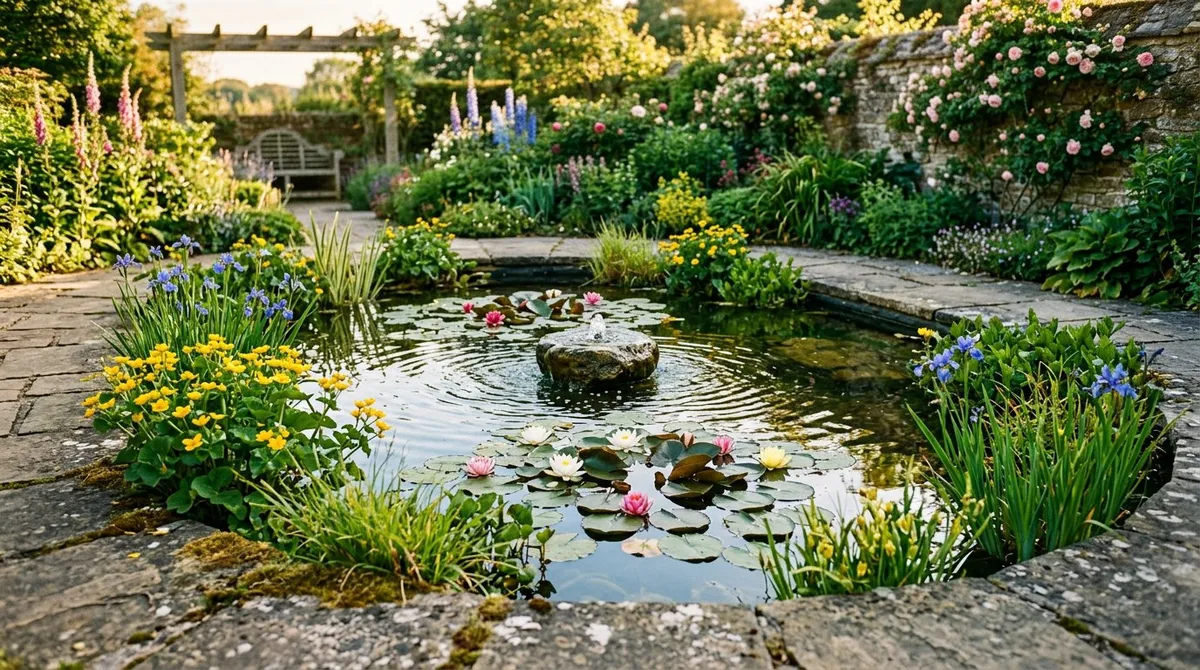
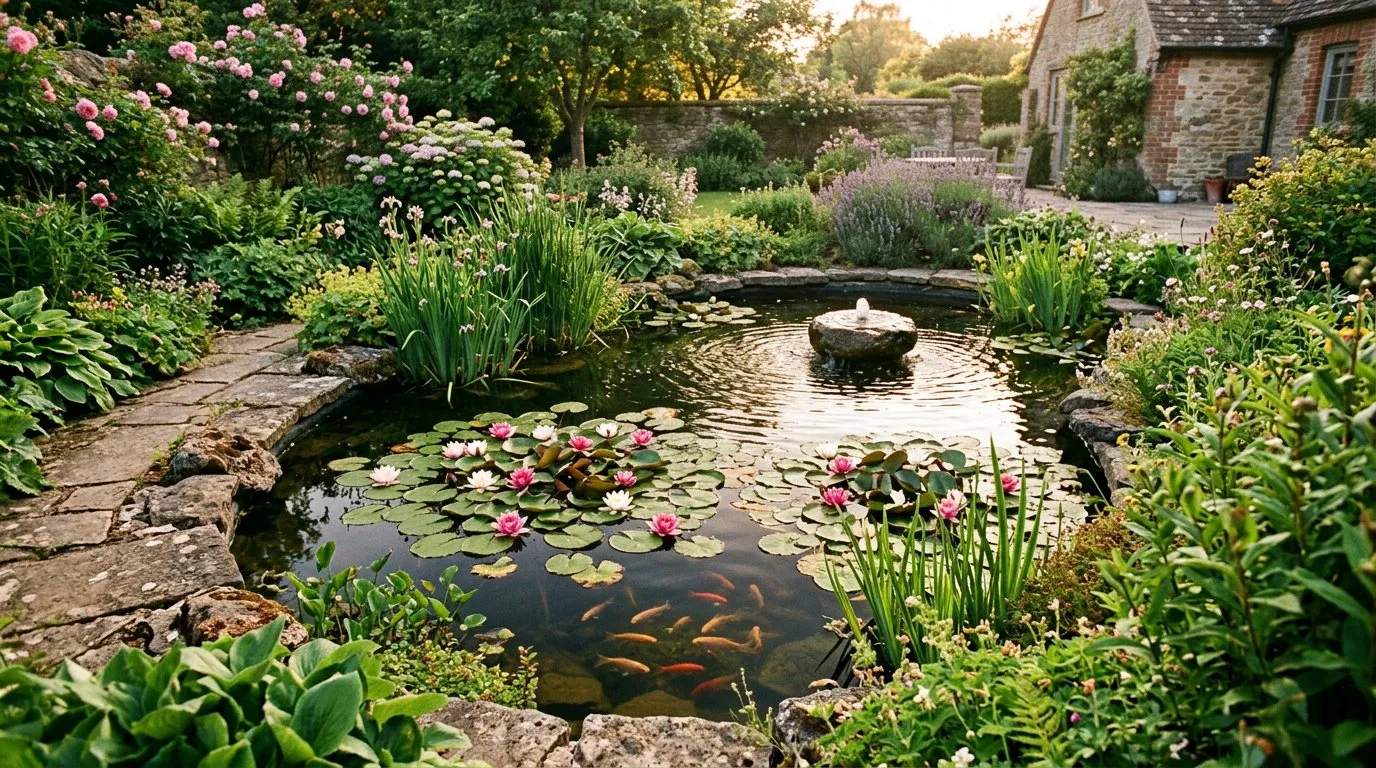 A finished pond with stone edging, established water lilies, and a gentle fountain. The marginal shelf planting softens the edges naturally.
Every pond needs submerged oxygenators. They produce dissolved oxygen during daylight hours and compete with algae for nutrients. Hornwort (Ceratophyllum demersum) is the single best choice for any UK pond. It floats freely, needs no planting, and stays green year-round. Drop weighted bunches into the deep zone from April onward.
Marginal plants
Marginals grow with their roots in shallow water (0-15cm deep) and their stems in the air. Plant them on the marginal shelf in aquatic baskets filled with aquatic compost and topped with pea gravel. Marsh marigold (Caltha palustris), water forget-me-not (Myosotis scorpioides), and water mint (Mentha aquatica) are all excellent native choices that flower from spring through summer.
Water lilies
Water lilies (Nymphaea) are the defining plant of a garden pond. Their floating leaves shade the surface, reduce algae, and provide cover for fish. Plant them in large aquatic baskets at the deep zone (45-90cm). For small ponds under 2m across, use miniature varieties like Nymphaea ‘Pygmaea Helvola’. For medium ponds, ‘Marliacea Chromatella’ (yellow) and ‘James Brydon’ (red) are reliable UK performers.
How many plants?
A general rule: cover one third to one half of the water surface with foliage. This provides enough shade to limit algae without blocking sunlight from oxygenators below. A 2m x 3m pond needs approximately 3-4 marginals, 2-3 bunches of oxygenator, and 1-2 water lilies.
Plant marginals in aquatic baskets on the shelf. Top with pea gravel to stop the compost floating out.
Stocking fish in a garden pond
Fish bring movement and personality to a pond. Goldfish are the best choice for most UK garden ponds. They are hardy, colourful, long-lived (10-25 years), and far less demanding than koi.
Goldfish vs koi
Koi need large, deep ponds (minimum 1,000 gallons / 4,500 litres), heavy-duty filtration, and produce far more waste than goldfish. A standard garden pond of 1,000-3,000 litres suits goldfish but is too small for koi. Koi also uproot plants and turn the water muddy. Stick with goldfish, shubunkins, or comets for garden ponds under 5,000 litres.
Stocking density
One goldfish per 200 litres is the safe maximum. A 1,000-litre pond supports five goldfish comfortably. A 2,000-litre pond holds ten. Overstocking is the single most common cause of poor water quality, algae blooms, and fish disease in garden ponds. Start with 3-4 fish and add more only after the filter has matured (6-8 weeks).
When to introduce fish
Wait at least two weeks after filling the pond and starting the filter before adding fish. This allows chlorine in tap water to dissipate and gives beneficial bacteria time to begin colonising the filter media. Float the fish bag on the pond surface for 20 minutes to equalise the temperature before releasing.
Do not add fish and expect a wildlife pond. Fish eat tadpoles, dragonfly larvae, and water beetle nymphs. If you want a pond that supports amphibians and invertebrates, keep it fish-free. Our guide to building a wildlife pond explains the differences in detail.
Winter fish care
Goldfish survive UK winters in ponds deeper than 60cm. They become dormant below 8C and stop feeding entirely below 4C. Stop feeding when water temperature drops below 8C in late autumn. Resume in spring when the temperature rises above 8C consistently.
Keep a section of the surface ice-free to allow toxic gases to escape. A floating pond heater (15-30 pounds) or a tennis ball on the surface prevents full freeze-over. Never smash ice on a fish pond. The pressure wave stresses and can kill fish.
Budget breakdown: what does a garden pond cost?
| Small pond (1m x 1.5m) | Medium pond (2m x 3m) | Large pond (3m x 5m+) | |
|---|---|---|---|
| Liner + underlay | 30-50 pounds | 60-120 pounds | 120-250 pounds |
| Pump + filter | 40-80 pounds | 80-200 pounds | 200-500 pounds |
| Edging materials | 20-50 pounds | 50-150 pounds | 150-400 pounds |
| Plants | 20-40 pounds | 40-80 pounds | 80-150 pounds |
| Fish (goldfish) | 10-20 pounds | 20-40 pounds | 30-60 pounds |
| Sundries (baskets, gravel, hose) | 15-30 pounds | 25-50 pounds | 40-80 pounds |
| Total | 135-270 pounds | 275-640 pounds | 620-1,440 pounds |
Preformed ponds reduce the liner cost but limit design. A preformed pond unit (200-500 litres) costs 50-120 pounds including built-in shelves. The pump, filter, edging, and planting costs remain the same regardless of liner type.
The biggest variable is edging. Natural stone and flagstone are the most expensive components in a large pond. Pebble beach edges and turf-to-water approaches cost very little.
Why we recommend butyl rubber over PVC for any pond intended to last: After 30 years of building and maintaining garden ponds, butyl rubber (EPDM) at 0.75mm consistently outlasts PVC by two to three times in UK conditions. We have removed PVC liners after 12 years that were brittle enough to crack by hand; butyl liners from the same period remained fully flexible. The upfront cost difference on a 2m x 3m pond is around 30-40 pounds — a fraction of the cost of a full drain-down and reline.
Seasonal maintenance calendar
A well-built garden pond needs regular but light maintenance. Neglect leads to problems that take far more effort to fix.
Spring (March to May)
- Reconnect the pump and filter if switched off over winter. Clean the filter media in pond water (never tap water, which kills beneficial bacteria).
- Replace the UV bulb. UV clarifiers lose effectiveness after 12 months even if the bulb still lights up.
- Begin feeding fish when water temperature consistently reaches 8C. Start with wheatgerm-based food, which is easier to digest in cool water.
- Plant new aquatic plants from late April onward.
- Check the liner for frost damage, particularly around the edges where ice pushes against stone.
Summer (June to August)
- Feed fish daily with a quality floating pellet. Remove uneaten food after 5 minutes to prevent water quality issues.
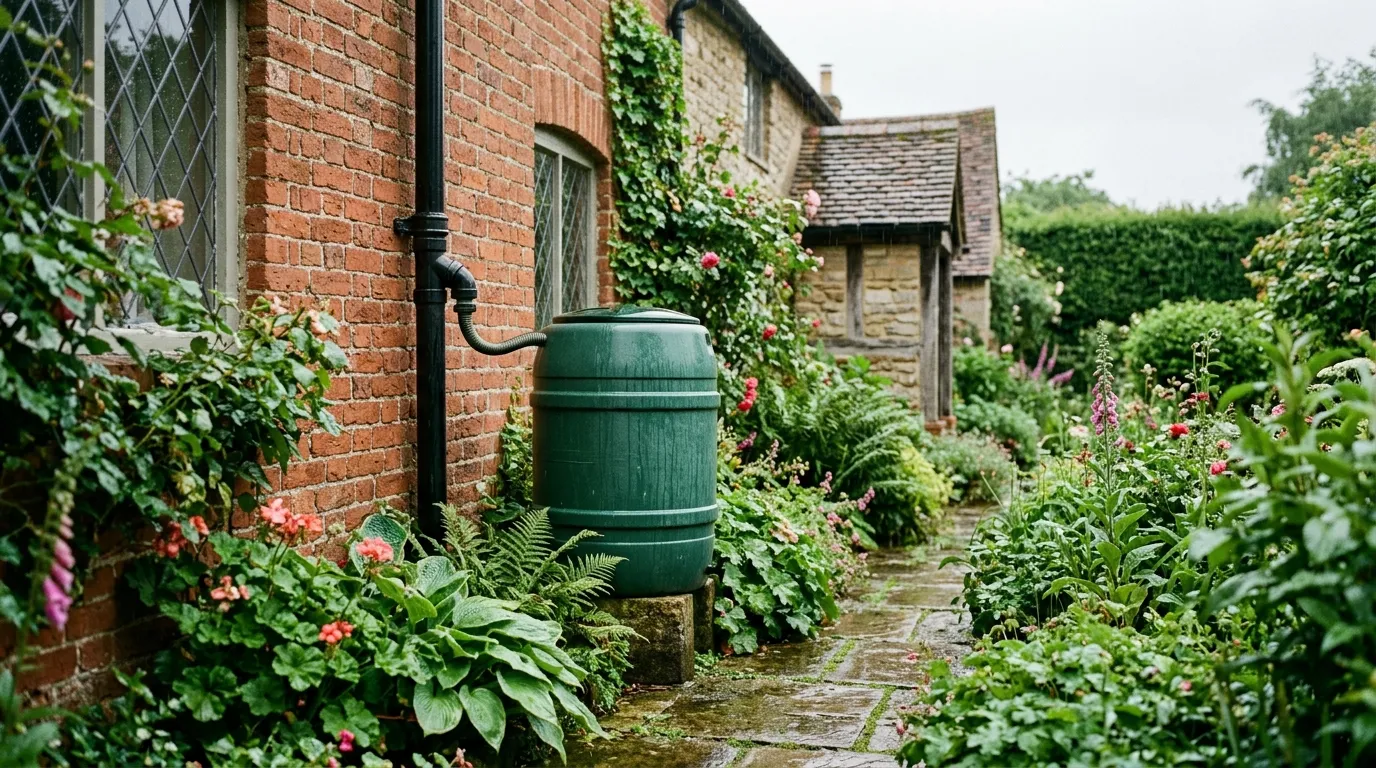
- Top up water levels in hot weather. Use rainwater from a butt where possible. Tap water adds chlorine and nutrients. Keeping a water butt nearby supports both the pond and a water-efficient garden overall.
- Thin blanket weed by twisting it onto a stick. Leave it on the bank overnight so invertebrates can crawl back to the water.
- Cut back vigorous marginals if they are shading more than half the surface.
- Check water clarity. Persistent green water suggests the UV bulb needs replacing or the filter is undersized.
Autumn (September to November)
- Net the pond to catch falling leaves. A fine-mesh net stretched over the surface prevents leaf litter from decomposing in the water. Remove the net once leaf fall ends.
- Reduce fish feeding as water temperature drops below 10C. Switch back to wheatgerm food.
- Cut back dead marginal plant stems to 10cm above water level. Leave some hollow stems standing for overwintering insects.
- Clean the filter one final time before winter. Rinse media in pond water only.
Winter (December to February)
- Stop feeding fish entirely once water temperature falls below 4C.
- Keep a section of the surface ice-free. Use a floating heater or place a pan of hot water on the ice to melt a hole. Never smash ice.
- Leave the pump running on a low setting if temperatures are mild. In prolonged hard frost (below -5C for more than a week), disconnect the pump to prevent it freezing and cracking.
- Do not clean the filter in winter. Beneficial bacteria are dormant and any disturbance sets the cycle back.
| Month | Key task | Time needed |
|---|---|---|
| March | Restart pump, replace UV bulb, start feeding | 1 hour |
| May | Plant new aquatic plants, check water quality | 30 minutes |
| July | Top up water, thin blanket weed, trim plants | 30 minutes |
| September | Net the pond, reduce feeding, clean filter | 1 hour |
| November | Remove net, switch to wheatgerm food | 15 minutes |
| January | Check ice, top up if needed, do not feed | 10 minutes |
Five common mistakes that ruin garden ponds
1. Building too small
A 500-litre pond is harder to maintain than a 2,000-litre one. Small volumes heat up fast, cool down fast, and have no buffer against water quality swings. Fish suffer most in small ponds. If you have the space, always go bigger than you think you need. You will never regret a larger pond, but many people wish they had built bigger.
2. Skipping the underlay
One sharp stone under the liner creates a slow leak that takes weeks to diagnose. By then, you have lost water, stressed the fish, and need to partially drain the pond to find and patch the hole. Five minutes laying geotextile underlay prevents this. Always use it, even on apparently smooth soil.
3. Wrong pump size
An undersized pump means sluggish filtration, green water, and unhealthy fish. An oversized pump wastes electricity and creates excessive current that stresses fish and disturbs plants. Calculate your pond volume accurately and match the pump to half that volume per hour.
4. Overstocking fish too soon
The biological filter needs 4-6 weeks to develop the bacteria colonies that process ammonia and nitrite. Adding too many fish before the filter matures causes “new pond syndrome”: ammonia spikes, fish gasping at the surface, and potentially fish loss. Add 2-3 fish initially, test water weekly, and add more only after ammonia and nitrite read zero.
5. Placing the pond under a tree
Falling leaves are the number one ongoing maintenance headache for pond owners. Decomposing leaves produce ammonia, turn water brown, and feed blanket weed. A pond surrounded by deciduous trees needs netting every autumn and frequent cleaning. Three metres from the nearest canopy edge is the minimum safe distance.
A finished pond with stone edging, established water lilies, and a gentle fountain. The marginal shelf planting softens the edges naturally.
Pond safety and children
Any open water is a drowning risk for young children. Ten centimetres of water is enough to be dangerous for a toddler. If small children have access to your garden, take precautions.
Rigid mesh cover fitted just below the water surface is invisible but supports a child’s weight. Purpose-made pond safety grids cost 30-60 pounds for a medium pond.
Raised ponds with walls 60cm or higher make it difficult for young children to fall in. They also bring the water closer to eye level, which makes fish and plants more visible.
Fencing around the pond with a self-closing, self-latching gate provides a physical barrier. This is the approach used by public gardens and is required by some insurers.
Delay building until children are old enough to understand the danger. A well-planted bog garden or a sealed water feature (where water flows over rocks into a hidden reservoir) gives you the sound and movement of water without the risk.
Now you’ve mastered building a garden pond, read our guide on building a wildlife pond for the next step in attracting frogs, newts, and dragonflies.
Frequently asked questions
How deep should a garden pond be?
At least 60cm for a pond with fish, 45cm for a plant-only ornamental pond. Deeper water maintains more stable temperatures year-round and prevents the pond freezing solid in harsh UK winters. If keeping goldfish, 75-90cm at the deepest point provides the best thermal stability and the fish will be more active and healthier across all seasons.
Do I need a pump and filter for a garden pond?
Yes, if you want clear water or plan to keep fish. A pump circulates the water through a biological filter that breaks down ammonia from fish waste into less harmful nitrate. Without filtration, a fish pond turns green within weeks. Plant-only ponds can work without equipment if densely planted with submerged oxygenators, but a small pump still improves water clarity. The RHS pond building guide provides additional advice on equipment selection.
Can goldfish survive winter in a UK garden pond?
Yes, goldfish thrive year-round in UK ponds deeper than 60cm. They enter a dormant state when water drops below 8C and stop feeding entirely below 4C. Stop adding food in late autumn and resume in spring when temperatures rise consistently. Keep a small area of the surface ice-free using a floating heater or by melting a hole with warm water. Never break ice with force.
How much does it cost to build a garden pond?
A small lined pond (1m x 1.5m) costs 100-300 pounds including liner, pump, and plants. A medium pond (2m x 3m) with a filter and edging costs 300-800 pounds. Larger formal ponds with stone edging, a waterfall, and fish cost 800-2,000 pounds or more. The liner and pump are the core expenses. Edging is the biggest variable cost. Reusing materials from the garden reduces the total significantly.
When is the best time to build a garden pond?
Autumn is the ideal season, typically September to November. The soil is moist and easier to dig after summer. The pond has three to four months to settle, develop beneficial bacteria, and allow tap water chlorine to fully dissipate before spring planting. Spring construction works well too, but avoid midsummer when the ground is hard and newly planted aquatic plants suffer in the heat.
What is the best pond liner to use?
Butyl rubber (EPDM) at 0.75mm thickness is the best liner for most garden ponds. It lasts 40-50 years, flexes into any shape, resists UV degradation, and can be repaired with patch kits if punctured. PVC liner costs less upfront but lasts only 10-15 years and becomes brittle in cold weather. Preformed rigid ponds suit small formal features but limit design flexibility.
How many fish can I put in a garden pond?
One goldfish per 200 litres of water is the safe stocking maximum. A 1,000-litre pond comfortably supports five goldfish. Overstocking leads to poor water quality, excess algae, and fish disease. Start with three or four fish, let the biological filter mature over six weeks, then test water parameters before adding more. Shubunkins, sarasa comets, and common goldfish are all suitable for UK garden ponds.
Do I need planning permission for a garden pond?
No, you do not need planning permission for a garden pond under normal circumstances. Ponds are classified as permitted development under UK planning law. Exceptions apply if you live in a listed building, a conservation area, or an AONB. Check with your local planning authority if you plan a pond with retaining walls above 1m or significant ground engineering. In all other cases, you can start digging without any permissions.
Lawrie has been gardening in the West Midlands for over 30 years. He grows his own veg using no-dig methods, keeps a wildlife-friendly garden, and writes practical advice based on real UK growing conditions.