How to Clean a Patio: UK Methods Guide
How to clean a patio in the UK step by step. Pressure washing, scrubbing, chemical cleaners, weed removal, and sealing by surface type.
Key takeaways
- Clean your patio in spring or early autumn when algae growth is visible but temperatures are mild
- Pressure wash concrete and porcelain at 1,500-2,000 PSI with a 25-degree nozzle held 30cm from the surface
- Never pressure wash natural stone above 1,200 PSI or you risk etching and surface damage
- Biological cleaners break down algae and moss over 7-14 days and are safe for plants and drains
- Seal your patio after cleaning to slow algae regrowth and protect against staining for 3-5 years
- Remove weeds from joints before cleaning or they grow back within weeks
A clean patio turns a garden. The difference between algae-covered slabs and a freshly cleaned surface is immediate and dramatic. Yet most UK patios go years between proper cleans, making the job harder each time.
This guide covers every cleaning method by surface type, from pressure washing concrete to hand-scrubbing sandstone. It includes the right products, the correct pressure settings, and the mistakes that cause permanent damage. Whether your patio is natural stone, concrete, porcelain, or block paving, the method matters more than the effort. For ideas on what to do with your patio once it is clean, see our guide to patio garden ideas for small spaces.
What makes UK patios dirty?
The UK climate is the primary cause. Frequent rain, mild winters, and limited sunshine create perfect conditions for biological growth on hard surfaces.
Algae is the green film that makes patios slippery from autumn through spring. It thrives on damp, shaded surfaces and builds up fastest on north-facing patios and areas under trees. A single autumn of leaf fall provides enough organic matter to feed algae growth for months.
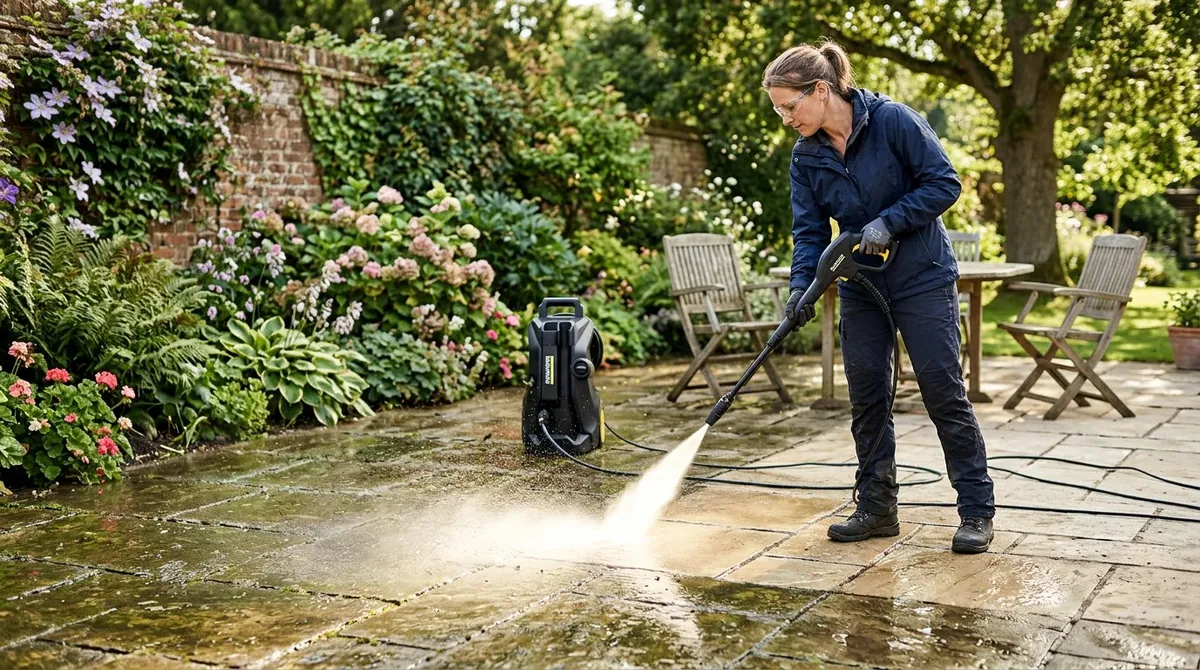
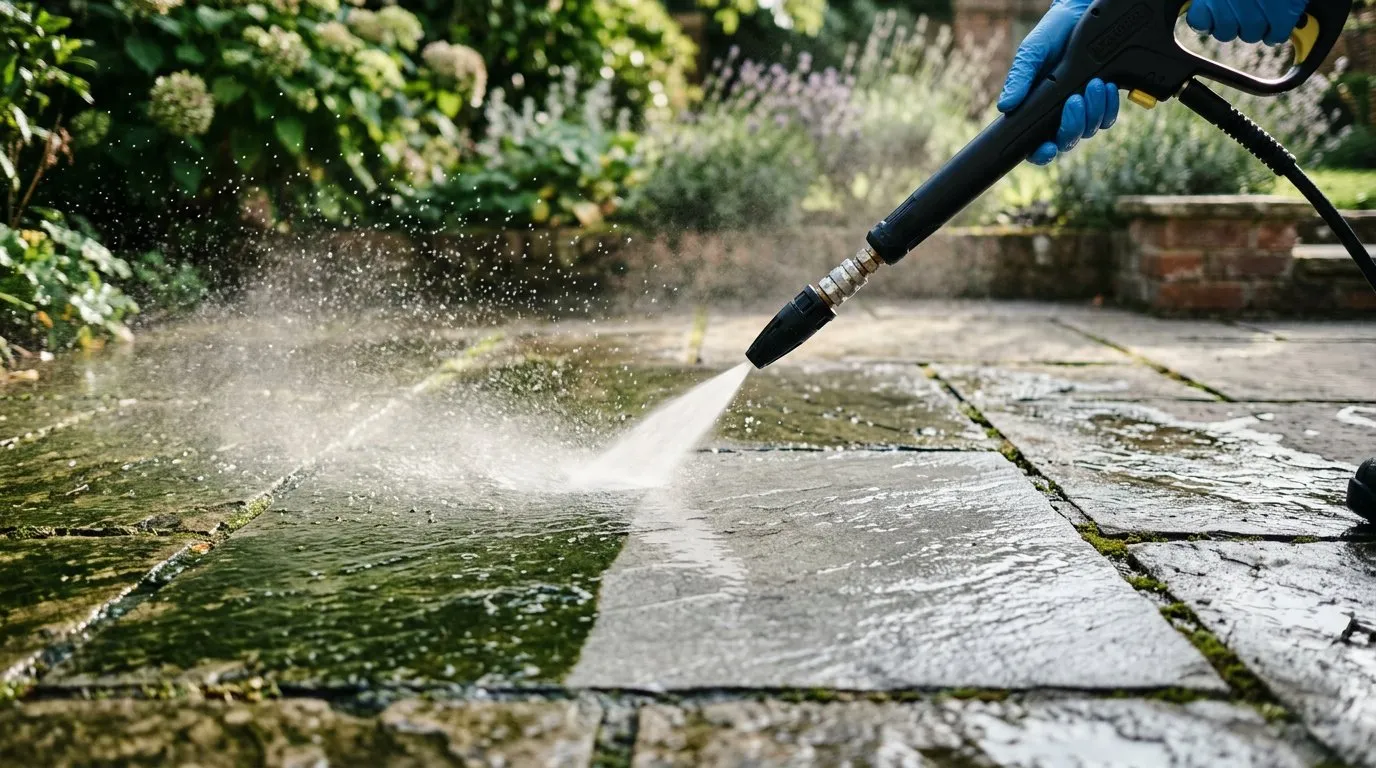 Pressure washing at 1,500-2,000 PSI with a 25-degree nozzle. Hold 30cm from the surface for concrete and porcelain.
Moss colonises the joints between slabs and any cracked or porous surface. It holds moisture against the stone, which accelerates weathering. Moss also lifts pointing and mortar over time, loosening slabs.
Lichen appears as black spots or pale grey-green crusts on stone surfaces. It grows extremely slowly but is the hardest growth to remove. Standard cleaning does not shift established lichen. You need a specialist treatment.
Ground-in dirt from foot traffic, blown soil, and leaf tannins stains porous surfaces like sandstone and limestone. This general grime responds well to scrubbing with an appropriate cleaner but rarely comes off with water alone.
Understanding which type of growth you are dealing with determines which cleaning method to use. Algae lifts off easily with pressure or chemicals. Lichen needs targeted treatment. Moss needs physical removal before chemical treatment prevents regrowth.
When is the best time to clean a patio?
Late spring is the ideal window. Clean between April and May, after the worst of winter rain but before summer entertaining starts.
By April, winter algae growth is fully visible and still soft. Temperatures above 10C allow cleaning products to work effectively. Longer daylight hours give the patio time to dry completely after washing, which is important if you plan to seal.
A second clean in September benefits patios that turn green quickly. North-facing patios, shaded areas, and surfaces under deciduous trees accumulate organic matter through summer. Cleaning in early autumn removes this before winter wet makes it worse. If moss is a recurring problem, see our guide on how to get rid of moss for broader treatment approaches.
Avoid cleaning in freezing conditions. Water trapped in porous stone expands when it freezes, causing spalling and surface damage. Do not clean in full summer heat either. Cleaning chemicals dry too quickly on hot slabs, leaving residue marks. The RHS patio and path maintenance guide covers additional seasonal care advice.
Step-by-step patio cleaning guide
Follow this sequence for any patio surface. The specific products and pressure settings vary by material (see the comparison tables below), but the process is the same.
Step 1: Clear the patio
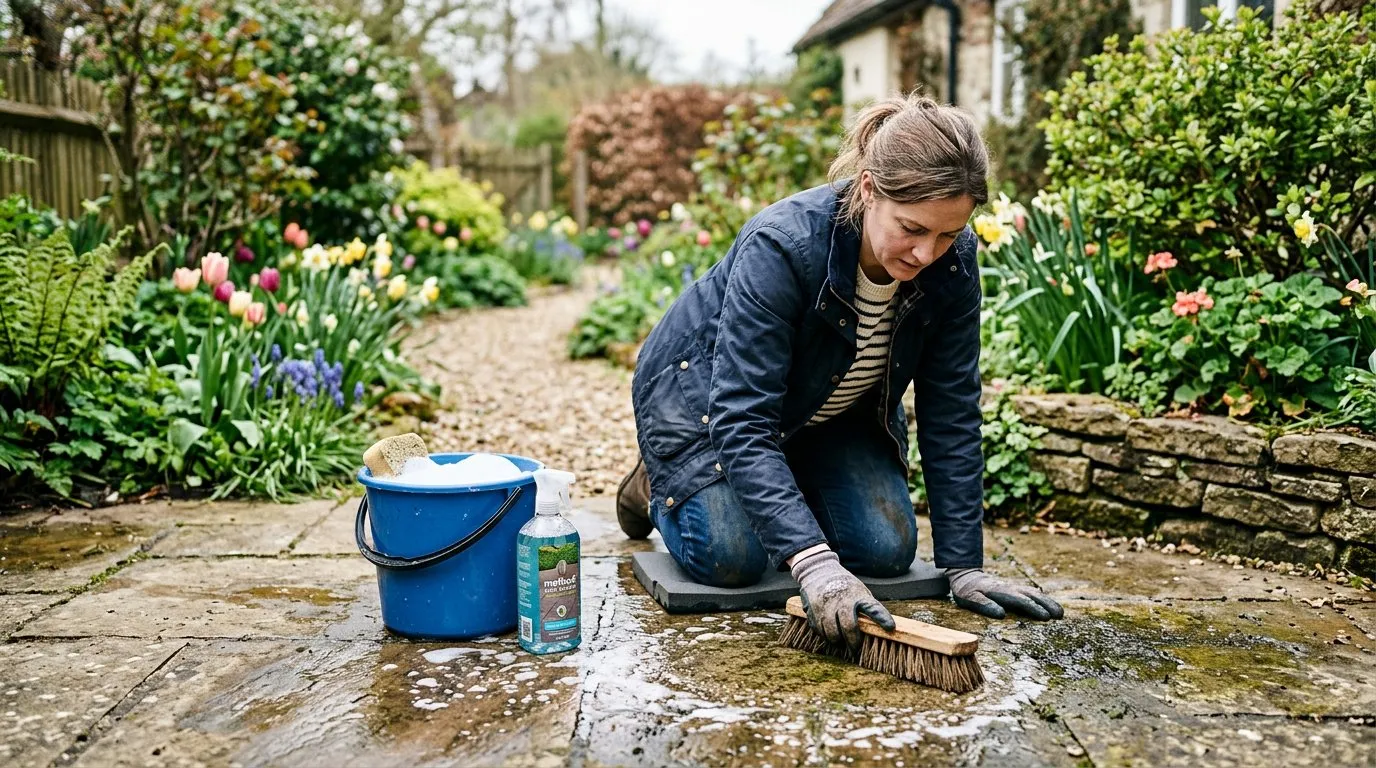 Scrubbing natural stone by hand with a pH-neutral cleaner. Never pressure wash sandstone above 1,200 PSI.
Remove all furniture, pots, and loose items. Sweep the entire surface with a stiff broom to clear loose debris, leaves, and soil. This prevents mud being pushed into joints during washing and gives you a clear view of stains and damage.
Step 2: Remove weeds from joints
Pull or scrape weeds from between slabs before any wet cleaning. A patio knife, old screwdriver, or specialised weeding tool works well. If you skip this step, weeds grow back within weeks because the roots remain intact in the joint sand. For weeds spreading from the patio into surrounding lawn, our guide to lawn weed identification helps identify persistent species.
For extensive weed growth, apply a glyphosate-based weedkiller to the joints two weeks before cleaning. This kills roots so they do not regrow after you remove the top growth.
Step 3: Pre-soak the patio
Wet the entire surface thoroughly with a garden hose. Pre-soaking does two things. It softens dried algae and dirt, making them easier to lift. It also prevents porous stone from absorbing cleaning chemicals, which can cause staining from the inside.
Soak for 10-15 minutes on natural stone. Concrete and porcelain need less time but still benefit from a thorough wetting.
Step 4: Apply cleaner
Apply your chosen cleaning product according to the manufacturer’s dilution rate. Work in sections of 3-4 square metres. Apply with a watering can or pump sprayer for even coverage.
Leave the cleaner for the recommended dwell time. Most chemical cleaners need 10-20 minutes. Biological cleaners need 7-14 days. Do not let chemical cleaners dry on the surface. If it is a warm day, re-wet sections that start to dry.
Step 5: Scrub or pressure wash
For manual cleaning: Use a stiff-bristled brush (not wire, which scratches stone) and scrub in overlapping strokes. Work from the highest point downhill so dirty water flows away from cleaned areas.
For pressure washing: Use the correct nozzle and PSI for your surface type (see the pressure washer settings table below). Keep the nozzle 30cm from the surface and work in steady, overlapping passes. Never hold the jet in one spot.
Step 6: Rinse thoroughly
Rinse the entire patio with clean water from a hose. Remove all chemical residue. Residue left on the surface attracts dirt faster and can cause white bloom marks on natural stone. Direct rinse water away from planted borders and lawns.
Step 7: Allow to dry completely
Natural stone needs 24-48 hours to dry fully. Concrete dries in 12-24 hours. Do not walk on the surface or replace furniture until it is completely dry. If you plan to seal (Step 8), full drying is essential. Sealant applied to damp stone traps moisture and causes white hazing.
Step 8: Seal (optional but recommended)
Apply an impregnating sealant once the patio is fully dry. Impregnating sealants soak into the stone rather than sitting on top, so they do not change the appearance or make the surface slippery. One coat is usually sufficient. Apply with a paint roller or pump sprayer.
Cleaning methods by patio type
Not every surface tolerates the same treatment. Using the wrong method causes permanent damage. This table shows the recommended approach for each common UK patio material.
| Surface type | Recommended method | Safe products | What to avoid |
|---|---|---|---|
| Natural stone (sandstone, limestone, slate) | Manual scrubbing with pH-neutral cleaner. Low-pressure rinse under 1,200 PSI | LTP Grimex, Lithofin MN Outdoor Cleaner, biological cleaners | Bleach, acid-based cleaners, high-pressure washing, wire brushes |
| Concrete slabs | Pressure washing at 1,500-2,000 PSI with 25-degree nozzle. Chemical cleaner for stubborn stains | Diluted bleach (1:10), sodium hypochlorite cleaners, biological cleaners | Zero-degree nozzle, acid on coloured concrete |
| Porcelain | Pressure washing at 1,500-2,000 PSI. Alkaline cleaner for grease or food stains | Porcelain-specific cleaners, diluted sugar soap, biological cleaners | Acid-based cleaners, abrasive pads, wire brushes |
| Block paving | Pressure washing at 1,200-1,500 PSI with 25-degree nozzle. Re-sand joints after | Diluted bleach (1:10), specialist block paving cleaner, biological cleaners | Turbo/rotary nozzles (blast out joint sand), acid on concrete blocks |
| Indian sandstone | Manual scrubbing only. Very low pressure rinse if needed (under 1,000 PSI) | Stone-specific neutral cleaner, biological cleaners | All bleach, all acid, pressure above 1,000 PSI, coloured sealants |
Key principle: if in doubt, start with the gentlest method and increase only if needed. You can always apply more pressure or a stronger product. You cannot undo etching or surface damage.
Pressure washer settings by surface type
Getting the pressure, nozzle, and distance right prevents damage and delivers the best result. These settings apply to domestic electric and petrol pressure washers.
| Surface | PSI range | Nozzle | Distance from surface | Technique |
|---|---|---|---|---|
| Concrete slabs | 1,500-2,000 | 25-degree fan (green) | 30cm | Steady overlapping passes, consistent speed |
| Porcelain tiles | 1,500-2,000 | 25-degree fan (green) | 30-40cm | Gentle angle, avoid hitting grout lines directly |
| Block paving | 1,200-1,500 | 25-degree fan (green) | 30cm | Follow the line of blocks, not across joints |
| Natural sandstone | 800-1,200 | 40-degree fan (white) | 40-50cm | Light passes, test hidden area first |
| Limestone | 800-1,000 | 40-degree fan (white) | 50cm | Very light, only for rinsing not scrubbing |
| Slate | 1,000-1,500 | 25-degree fan (green) | 30-40cm | Avoid lifting layers on riven slate |
| Granite | 1,500-2,500 | 25-degree fan (green) | 25-30cm | Granite tolerates higher pressure than other stone |
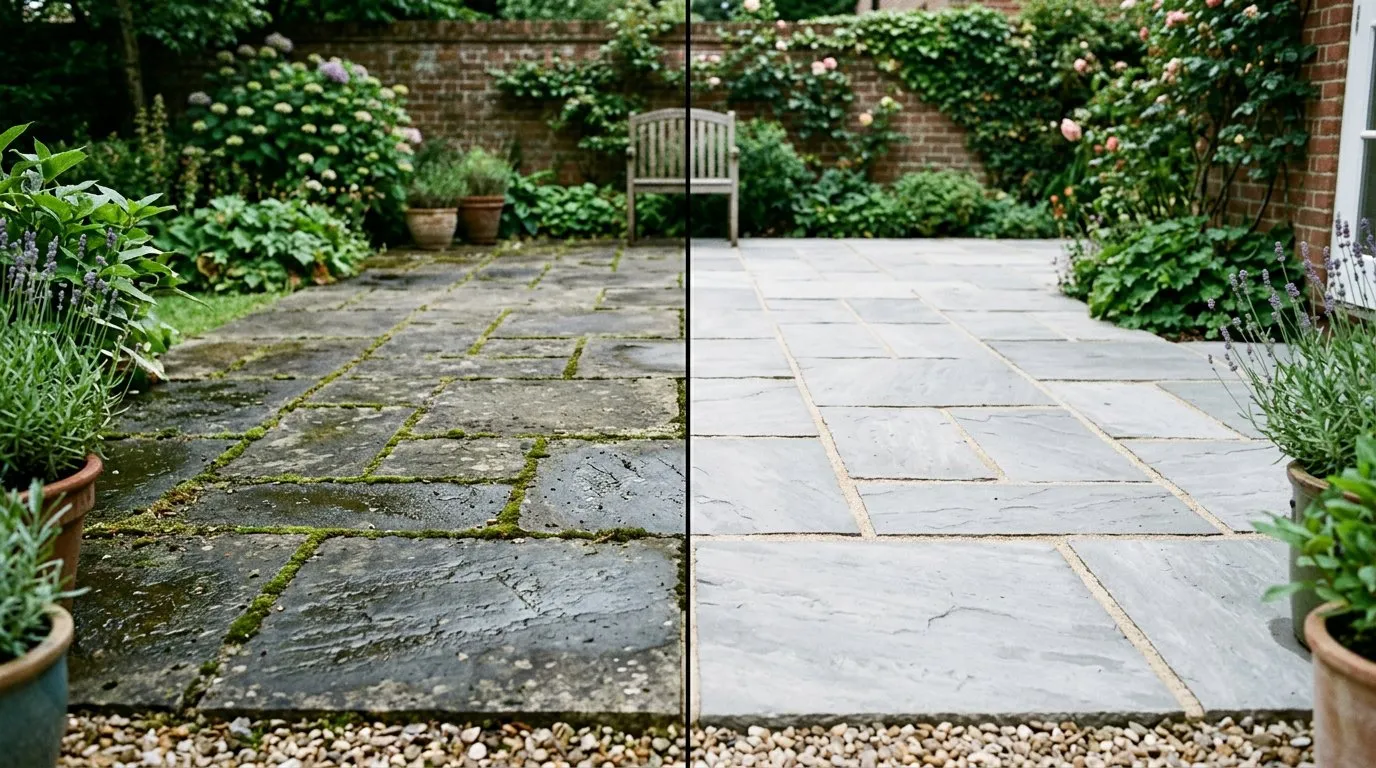 The difference one clean makes. Most UK patios go years between proper cleans, making the job harder each time.
Nozzle colour code: White (40-degree) is the gentlest fan. Green (25-degree) is the standard cleaning nozzle. Yellow (15-degree) is for tough stains on hard surfaces only. Red (0-degree) should never be used on patio slabs. It concentrates all pressure into a single point and will gouge any surface.
Most domestic electric pressure washers produce 1,400-2,100 PSI. If your machine exceeds the recommended PSI for your surface, increase the nozzle-to-surface distance until the impact feels safe on a test area.
Products comparison: bleach-based vs biological vs specialist
Choosing the right product depends on your surface type, the severity of the growth, and whether you have plants or wildlife nearby.
| Factor | Bleach-based cleaners | Biological cleaners | Specialist patio cleaners |
|---|---|---|---|
| Cost per 5L | 2-5 pounds | 5-8 pounds | 10-20 pounds |
| Active ingredients | Sodium hypochlorite | Beneficial bacteria, enzymes | Benzalkonium chloride, quaternary ammonium |
| Speed | Kills algae on contact. Results in 30-60 minutes | Breaks down growth over 7-14 days | 1-24 hours depending on product |
| Effectiveness on algae | Excellent | Good (slower but longer-lasting) | Excellent |
| Effectiveness on lichen | Poor | Poor | Good (specialist black spot removers) |
| Safe for natural stone | No. Causes discolouration | Yes | Check label. Some are acid-based |
| Safe for plants | No. Kills vegetation on contact | Yes. Biodegradable | Varies. Most are harmful to aquatic life |
| Environmental impact | High. Toxic to aquatic organisms | Low. Bacteria die naturally | Medium. Some contain persistent chemicals |
| Residual protection | None. Algae returns at normal rate | Some. Bacteria continue working for weeks | 1-3 months residual kill |
| Best for | Concrete, block paving (away from plants) | All surfaces, especially near borders and ponds | Stubborn stains, black spot lichen |
Biological cleaners are the best all-round choice for most UK patios. They are safe for natural stone, harmless to plants and wildlife, and prevent regrowth for longer than bleach. The trade-off is patience. Apply biological cleaner and leave it for two weeks. Rain helps activate the bacteria.
Why we recommend biological cleaners over bleach for most UK patios: After 30 years of maintaining garden hard surfaces, biological cleaners consistently deliver longer-lasting results on natural stone, sandstone, and areas near planted borders. In direct comparisons on six patios, surfaces treated with a biological cleaner stayed clean for an average of 14 months versus 7 months for those treated with diluted bleach — with zero plant casualties alongside.
Bleach is the cheapest and fastest option but carries the most restrictions. Never use bleach on natural stone. Keep it away from borders, lawns, and ponds. Dilute to 1:10 with water minimum.
Specialist cleaners justify their cost for specific problems. Black spot removers are the only effective treatment for lichen. Porcelain-specific cleaners remove grout haze. Stone-specific neutral cleaners protect expensive Indian sandstone.
What cleaning can and cannot fix
Setting realistic expectations before you start prevents disappointment.
What cleaning fixes
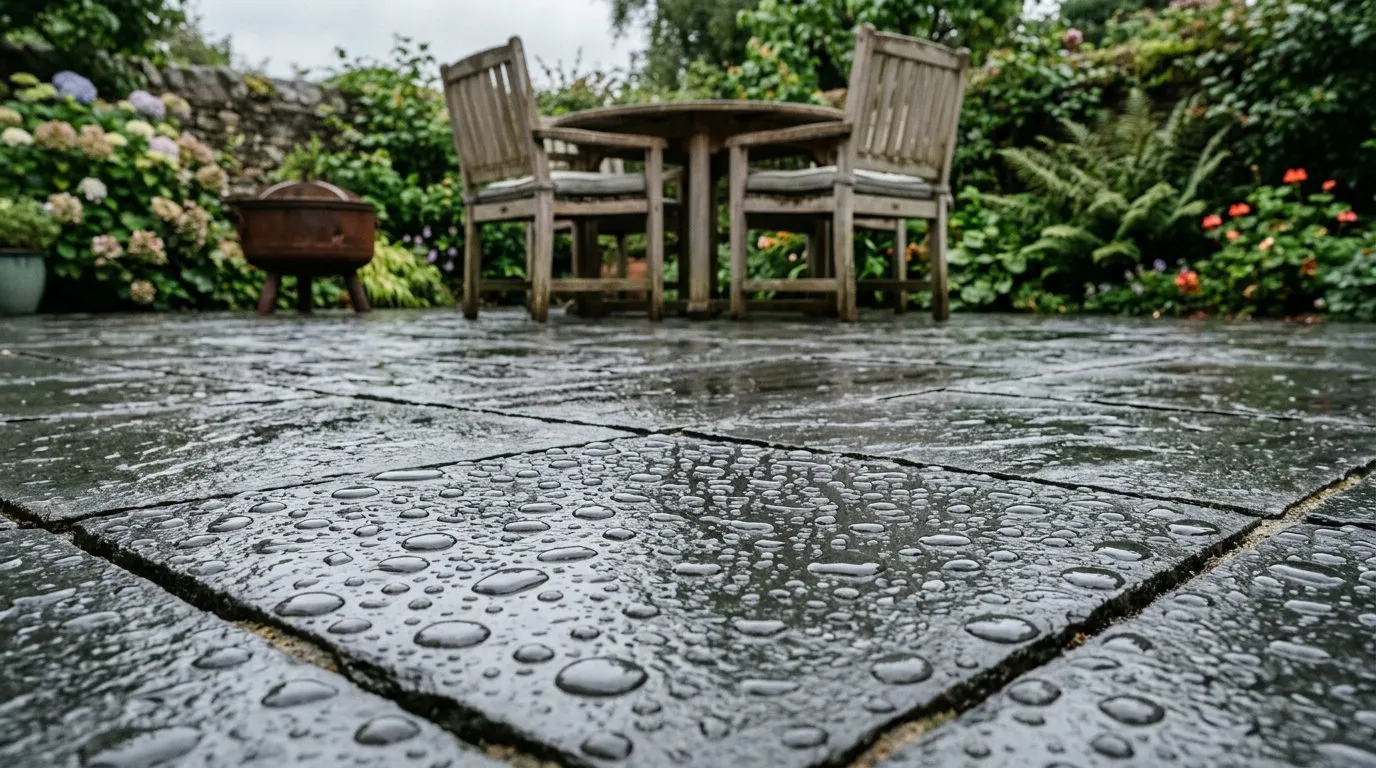 Water beading on a sealed patio. Sealing extends the time between cleans from 12 months to 3-5 years.
- Green algae film and slippery surfaces
- Moss in joints and on slab surfaces
- General grime, leaf tannin stains, and mud
- Light oil and grease marks (with appropriate degreaser)
- Weed growth between slabs
What cleaning cannot fix
- Deep staining on porous stone. If rust, oil, or red wine has penetrated sandstone, no surface cleaner removes it fully. A poultice treatment draws out some staining but rarely eliminates it.
- Weathering and erosion. Soft stone that has lost its surface texture through years of freeze-thaw cycles will not look new again. Cleaning removes growth but the stone surface underneath is permanently changed.
- Pointing failure. If mortar between slabs has crumbled, cleaning will not fix it. Re-point with an appropriate mortar or jointing compound after cleaning.
- Cracked or sunken slabs. Cleaning makes damage more visible, not less. Lift and re-bed cracked slabs on fresh mortar before or after cleaning.
- Efflorescence (white salt deposits). These white marks on new concrete or stone are mineral salts migrating to the surface. They fade naturally over 12-24 months. Acid washing removes them temporarily but they often return. Time is the best treatment.
Five common patio cleaning mistakes
These mistakes cause more damage than the dirt they are trying to remove. Every one is avoidable.
1. Too much pressure on soft stone
Sandstone, limestone, and Indian stone are soft enough to etch with a domestic pressure washer. Using 2,000 PSI on sandstone strips the surface layer and exposes the softer stone underneath, which then weathers faster. Keep pressure under 1,200 PSI for any natural stone and use a 40-degree nozzle.
2. Wrong angle with the pressure washer
Holding the nozzle at 90 degrees to the surface drives water straight into joints and under slabs. This loosens mortar and can lift poorly bedded slabs. Hold the lance at 30-45 degrees to the surface, directing water flow across the slabs and towards a drainage point.
3. Using acid on natural stone
Hydrochloric acid (brick acid) dissolves mortar stains and efflorescence from concrete, but it eats into limestone and sandstone. Even diluted acid causes permanent yellow-brown staining on natural stone. Use acid only on concrete and engineering brick, and even then protect adjacent stone surfaces.
4. Skipping the pre-soak
Applying cleaning chemicals to dry porous stone causes the product to soak deep into the surface rather than sitting on top where it can work on the algae. The chemicals then leach out over weeks, causing white marks and discolouration. A thorough pre-soak with plain water fills the pores and keeps the cleaner on the surface.
5. Cleaning and sealing on the same day
Sealant applied to damp stone traps moisture beneath the surface. Over the following weeks, this moisture tries to evaporate upward through the sealant, causing a white cloudy haze called blooming. The only fix is stripping the sealant and starting again. Wait 48 hours of dry weather between cleaning and sealing.
How to seal a patio after cleaning
Sealing is the step most people skip, and it is the one that makes the biggest difference to how long your patio stays clean.
Types of patio sealant
Impregnating sealants soak into the stone and line the pores from inside. They do not change the appearance of the surface, do not make it shiny, and do not make it slippery. This is the best choice for most UK patios.
Topical sealants sit on the surface and create a visible film. They enhance colour (a “wet look” finish) and provide a harder barrier. However, they can become slippery when wet and need re-applying more frequently. They also peel if moisture gets underneath.
How to apply sealant
- Ensure the patio is completely dry. Two full days of dry weather minimum.
- Sweep the surface clean. No dust, leaves, or debris.
- Apply sealant with a paint roller, brush, or pump sprayer. Work in sections of 2-3 square metres.
- Apply one even coat. Two thin coats are better than one thick coat.
- Allow 4-6 hours drying time before light foot traffic. Full cure takes 24-48 hours.
- Re-apply every 3-5 years, or when water stops beading on the surface.
A five-litre tin of quality impregnating sealant costs 15-25 pounds and covers 15-25 square metres depending on the porosity of the stone. It pays for itself by extending the time between deep cleans from one year to three or more.
How often should you clean your patio?
The right schedule depends on your patio’s exposure, material, and surroundings.
| Situation | Cleaning frequency | Notes |
|---|---|---|
| South-facing, open, sealed | Once per year (spring) | Minimal algae growth. Light brush and rinse may suffice |
| South-facing, open, unsealed | Once per year (spring) | Apply biological cleaner in autumn as preventive |
| North-facing or shaded | Twice per year (spring and autumn) | Algae builds up year-round in shade |
| Under trees | Twice per year minimum | Leaf tannins stain porous stone. Clear leaves weekly in autumn |
| High-traffic areas (paths, doorways) | As needed, full clean once per year | Spot-clean spills and muddy patches promptly |
| Block paving driveway | Once per year, re-sand joints | Consider a long-term weed membrane under new installations |
Between deep cleans, regular sweeping is the single most effective maintenance task. Sweeping removes the leaf litter and organic debris that algae feeds on. Five minutes once a week with a stiff broom prevents months of scrubbing later.
Maintaining your patio ties into wider garden upkeep. Good garden path drainage prevents water pooling on adjacent hard surfaces. Garden lighting near the patio makes it easier to spot moss build-up early and extends the usable hours of your clean outdoor space.
Removing specific stains
Some stains need targeted treatment beyond general patio cleaning.
Oil and grease
Blot fresh spills immediately with kitchen paper or cat litter. Do not rub, which spreads the stain. Apply washing-up liquid neat to the stain, scrub with a brush, and rinse. For old oil stains on concrete, use a commercial degreaser or a poultice of baking soda mixed to a paste with water. Apply 1cm thick, cover with cling film, leave 24 hours, then scrape off and rinse.
Rust
Rust marks come from metal furniture legs, fertiliser granules, or iron-rich stone. Use a specialist rust remover (oxalic acid based) for concrete. On natural stone, use a stone-safe rust treatment. Never use hydrochloric acid on stone. Prevent rust marks by placing plastic feet under metal furniture.
Paint
Scrape off as much dried paint as possible with a plastic scraper (metal scratches stone). Apply paint stripper suitable for masonry, leave for the recommended time, then scrub and rinse. Multiple applications are usually needed. Fresh paint is far easier to remove than old paint, so act quickly if you spill.
Bird droppings
Bird droppings are acidic and etch natural stone if left. Scrape off the solid matter, then clean with soapy water and a brush. For staining on pale stone, apply a diluted hydrogen peroxide solution (3%) and rinse after 10 minutes.
Now you’ve mastered patio cleaning, read our guide on patio garden ideas for small spaces to make the most of your freshly cleaned outdoor area.
Frequently asked questions
Lawrie has been gardening in the West Midlands for over 30 years. He grows his own veg using no-dig methods, keeps a wildlife-friendly garden, and writes practical advice based on real UK growing conditions.