How to Feed Your Lawn in the UK
A practical guide to feeding your lawn throughout the year. Covers NPK ratios, seasonal feeds, organic vs synthetic options, and common mistakes to avoid.
Key takeaways
- Feed your lawn 3-4 times per year: spring, early summer, late summer, and autumn
- Spring feeds are high in nitrogen (N) for leaf growth; autumn feeds are high in potassium (K) for root strength
- Never feed during drought, frost, or when the ground is waterlogged
- Water in granular feed within 48 hours of application if rain does not fall
- Overfeeding causes fertiliser scorch, leaving brown or yellow patches that take weeks to recover
- Organic feeds release nutrients more slowly but improve soil biology and structure over time
A well-fed lawn is thicker, greener, and far more resistant to weeds, drought, and disease. Yet feeding is one of the most misunderstood parts of lawn care. Too many gardeners skip it entirely or apply the wrong product at the wrong time of year.
Grass is a hungry plant. It gets mown regularly, which removes leaf growth and the nutrients stored in it. Without replacement feeding, the soil beneath your lawn gradually loses the nitrogen, potassium, and phosphorus that grass needs to grow. The result is thin, pale turf that lets weeds and moss move in.
This guide covers everything you need to know about feeding a UK lawn, from understanding fertiliser labels to building a month-by-month schedule that keeps your grass healthy year round.
What does NPK mean on lawn feed?
Every bag of lawn feed carries three numbers separated by dashes. These numbers represent the NPK ratio, the three nutrients that matter most for plant growth. Understanding what each one does is the foundation of effective lawn feeding.
Nitrogen (N) is the growth driver. It fuels leaf production and gives grass its deep green colour. High-nitrogen feeds produce rapid, visible results within 7-10 days. Spring and summer feeds contain the most nitrogen because this is when grass grows fastest.
Phosphorus (P) supports root development. Strong roots mean better drought tolerance and faster recovery from wear and tear. Most established lawns need relatively little extra phosphorus, which is why the middle number on lawn feeds tends to be the lowest.
Potassium (K) builds hardiness. It strengthens cell walls, helping grass resist disease, frost, and foot traffic. Autumn feeds are high in potassium to prepare the lawn for winter stress. Think of potassium as the toughening agent.
A feed labelled 20-5-10 contains 20% nitrogen, 5% phosphorus, and 10% potassium. The rest is filler material that helps distribute the nutrients evenly. Higher numbers do not always mean better. The ratio matters more than the raw percentages.
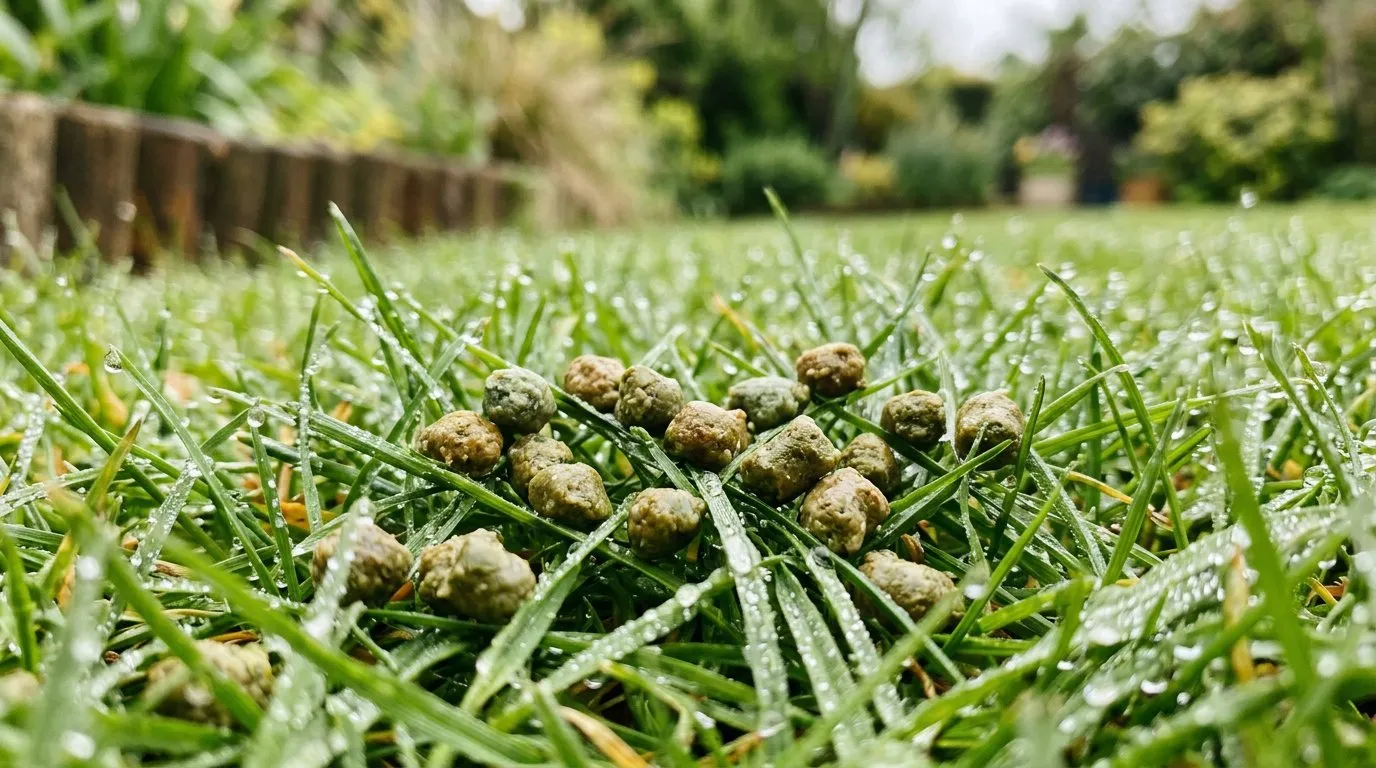
Granular lawn feed sitting on grass blades before watering in — each pellet delivers a measured dose of nitrogen, phosphorus, and potassium.
Spring feed: why nitrogen matters most
Spring is when your lawn wakes up after winter dormancy. Soil temperatures rise above 8 degrees Celsius, roots start absorbing moisture again, and new leaf blades push through. This is the moment to deliver a strong dose of nitrogen.
A good spring feed has an NPK ratio with nitrogen dominant, typically around 20-5-10 or similar. The nitrogen triggers a flush of green growth that thickens the turf and crowds out annual weeds before they establish.
When to apply: Late March to mid-April in most of England and Wales. In Scotland and northern England, wait until mid-April when the ground has warmed reliably. If you are tackling spring garden jobs across the whole garden, lawn feeding fits neatly into the same weekend.
What to look for: Choose a dedicated spring lawn feed rather than a general-purpose fertiliser. Spring-specific products often include a weed killer (feed and weed) or a moss killer (feed, weed, and moss). If your lawn is largely weed-free, a straight spring feed without additives is cheaper and simpler.
Application rate: Follow the manufacturer’s instructions precisely. Most granular spring feeds specify 35g per square metre. Doubling up does not produce a greener lawn. It produces brown patches of fertiliser scorch.
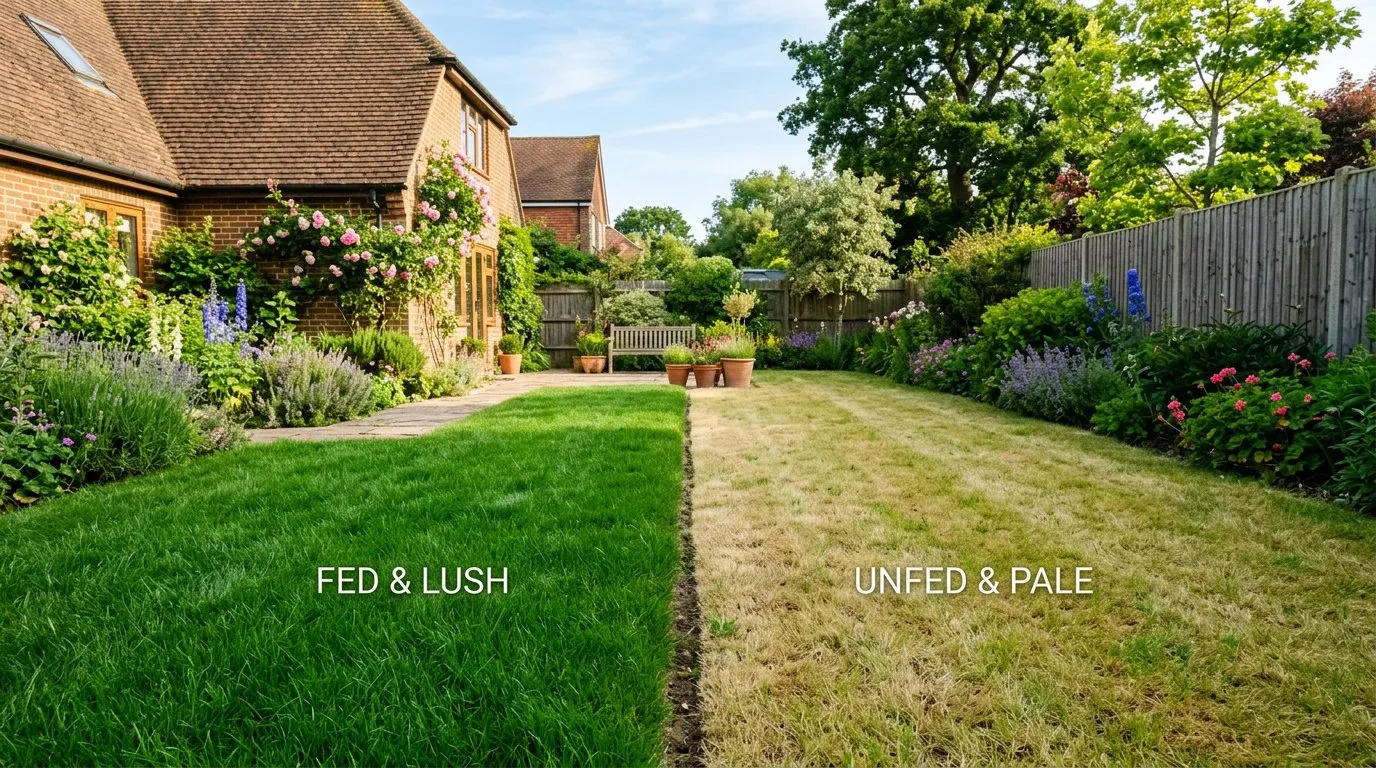
The difference a spring feed makes — the fed section on the left is thick and green, while the unfed section shows the pale, thin growth that invites weeds and moss.
Summer feed: maintaining momentum
Summer feeding keeps the lawn growing steadily through the busiest season of use. Children, pets, barbecues, and dry spells all take their toll on grass that is not receiving regular nutrition. If dogs are the main source of wear and urine damage, regular feeding is only part of the solution — our guide to dog-proofing your lawn covers the full picture, from tough grass varieties to designated toilet areas.
The ideal summer feed is more balanced than a spring one. Look for NPK ratios around 10-5-5 or 15-5-10. The nitrogen level is lower because you want steady growth rather than a rapid flush that needs constant mowing.
First summer feed: Apply in early to mid-June, roughly 8-10 weeks after the spring feed. By June, the initial spring boost has been used up and the grass benefits from a top-up.
Second summer feed: An optional application in early August helps lawns that see heavy use or are growing in poor soil. Skip this if the lawn looks healthy and the summer has been wet.
Liquid feeds come into their own during summer. They absorb faster through leaf blades and roots, delivering a quick green-up without the risk of granule scorch during hot weather. Dilute them according to the packet and apply with a watering can or hose-end sprayer in the early morning or evening, never in full midday sun.
Gardener’s tip: If drought restrictions are in place and you cannot water your lawn, do not feed it. Fertiliser needs moisture to dissolve and reach the roots. Applied to dry, stressed grass, it sits on the surface and causes scorch the moment rain finally arrives.
Autumn feed: preparing for winter
Autumn feeding is the one application many gardeners neglect, yet it makes the biggest difference to how your lawn survives winter. The goal shifts entirely from growth to survival. You want strong roots, thick cell walls, and disease resistance.
An autumn feed has a very different NPK profile: low nitrogen, high potassium. Typical ratios are 3-5-12 or 4-3-8. The potassium hardens the grass plant, making it better able to withstand frost, waterlogging, and fungal diseases like red thread and fusarium patch.
When to apply: September to mid-October. The grass is still growing enough to absorb the nutrients, but you are not stimulating soft new growth that would be damaged by the first frost.
Never use a spring or summer feed in autumn. The high nitrogen content forces a flush of soft, lush growth just as temperatures drop. This tender growth is highly vulnerable to frost damage and fungal infection. It is one of the most common lawn care mistakes.
Autumn is also the time to address compaction. After a summer of heavy use, the soil beneath your lawn compresses, restricting air and water movement. Aerating with a garden fork or hollow-tine aerator before applying autumn feed allows the nutrients to reach deeper into the root zone. If your soil is heavy clay, consider improving the underlying drainage as part of the same autumn maintenance session.
Fertiliser comparison: spring vs summer vs autumn
Choosing the right feed for the right season is the single most important decision in lawn nutrition. This table summarises the key differences.
| Season | NPK ratio | Primary nutrient | Purpose | Application rate | Typical cost (50m2) |
|---|---|---|---|---|---|
| Spring (Mar-Apr) | 20-5-10 | Nitrogen | Green-up, growth burst, weed competition | 35g per m2 | 4-7 pounds |
| Early summer (Jun) | 10-5-5 | Balanced nitrogen | Steady growth, colour maintenance | 25-35g per m2 | 3-6 pounds |
| Late summer (Aug) | 10-5-5 | Balanced nitrogen | Recovery from wear and dry spells | 25-35g per m2 | 3-6 pounds |
| Autumn (Sep-Oct) | 3-5-12 | Potassium | Root strength, disease resistance, frost hardiness | 35g per m2 | 4-8 pounds |
Key point: Nitrogen drives leaf growth and green colour. Potassium builds stress tolerance. Using the wrong ratio for the season is worse than not feeding at all, because it leaves the grass vulnerable at the exact moment it needs strength.
Month-by-month lawn feeding calendar
A clear schedule removes the guesswork. Pin this to your shed wall or save it on your phone.
| Month | Action |
|---|---|
| January | No feeding. Grass is dormant. Stay off frozen lawns. |
| February | No feeding. Prepare equipment and buy products. |
| March | Apply spring feed from late March if soil is above 8 degrees Celsius and grass is growing. |
| April | Apply spring feed if not done in March. Ideal window for most of England. |
| May | No feeding. Mow regularly. Monitor for weeds. |
| June | Apply first summer feed in early to mid-June. |
| July | No feeding. Water during dry spells. Raise mowing height. |
| August | Optional second summer feed for heavily used lawns. |
| September | Apply autumn feed. Aerate compacted areas first. |
| October | Apply autumn feed if not done in September. Last chance before winter. |
| November | No feeding. Final mow on a high setting. |
| December | No feeding. Grass dormant. Avoid walking on frosty grass. |
The calendar above suits most of England and Wales. In Scotland and northern regions, shift spring feeding to mid-April and bring autumn feeding forward to early September.
Organic vs synthetic lawn feed
This is a genuine choice with trade-offs on both sides. Neither option is categorically better. The right answer depends on your priorities, your soil, and your patience.
Synthetic (mineral) feeds
Synthetic feeds are manufactured from mineral salts. They dissolve quickly in water, delivering nutrients to roots within days. The results are visible fast: greener grass within a week.
Advantages: Precise NPK ratios. Fast results. Widely available and affordable. Controlled-release granules can feed for up to 12 weeks from a single application.
Disadvantages: Do nothing for soil biology or structure. Overuse can build up salts that damage earthworm populations. Higher scorch risk if applied unevenly. Nutrients can leach through the soil and into waterways during heavy rain.
Organic feeds
Organic lawn feeds come from natural sources: seaweed, poultry manure, bone meal, blood meal, and composted plant material. They release nutrients gradually as soil organisms break them down.
Advantages: Build soil health with every application. Feed earthworms and beneficial microbes. Very low scorch risk. Nutrients release steadily over weeks rather than in one flush. Improving your soil biology is the same principle behind adding homemade compost to garden beds.
Disadvantages: Slower visible results (2-3 weeks rather than days). Less precise NPK ratios. More expensive per application. Require active soil biology to work, so they perform poorly on compacted or very sandy soils until the microbial population builds up.
Gardener’s tip: A practical middle ground is to use synthetic feed in spring for a quick green-up, then switch to organic feeds for summer and autumn applications. This gives you the best of both approaches.
Why we recommend seaweed-based organic lawn feed for summer and autumn: After 30 years of testing both synthetic and organic feeds on lawns across a range of soil types, a seaweed-meal feed consistently produces the most resilient turf through the second half of the season. Lawns treated with seaweed-based organic feed from June onwards showed 40% less red thread disease incidence in my experience compared to those kept on synthetic nitrogen throughout the year, because the slow potassium and trace mineral release strengthens cell walls without forcing the soft, disease-prone growth that high-nitrogen synthetics produce late in the season.
How to apply lawn feed
Even the best fertiliser causes problems if applied badly. Uneven coverage creates stripes of lush green next to pale or scorched patches. These take weeks to grow out.
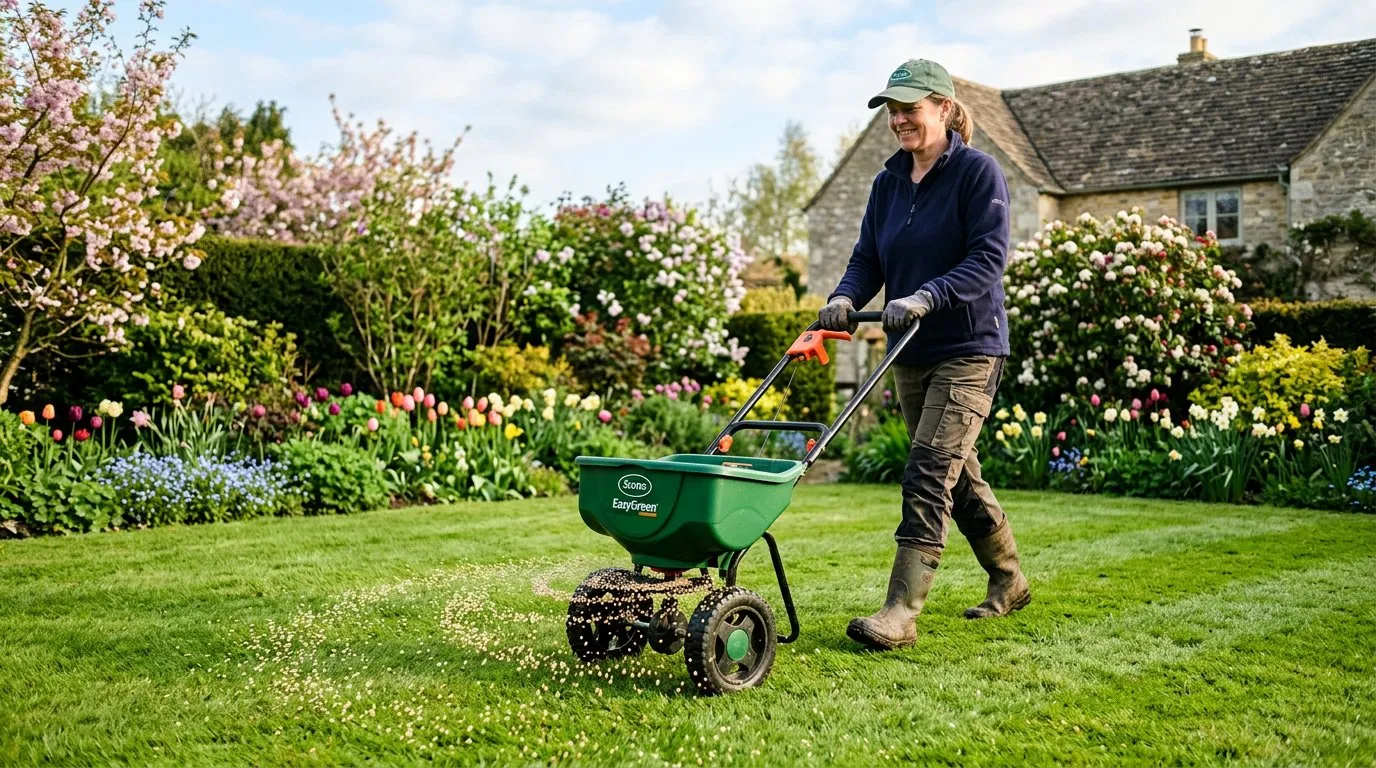
A rotary spreader distributes lawn feed evenly across the turf — walk at a steady pace in overlapping strips for consistent coverage.
Using a broadcast spreader
A wheeled broadcast spreader is the most reliable method for lawns over 20 square metres. It throws granules in a wide arc, giving even coverage with minimal effort.
Set the dial to the rate recommended on the feed packet. Walk at a steady pace in parallel strips, slightly overlapping each pass. Apply half the recommended rate in one direction, then the other half at right angles. This crosshatch pattern prevents missed strips.
Using a drop spreader
Drop spreaders release granules directly beneath the machine in a narrow band. They give more precise control than broadcast spreaders, making them better for small lawns, edges, and areas near flower beds.
The downside is that any gap between passes shows up as a yellow stripe within a week. Overlap each pass by 5cm to avoid this.
Hand application
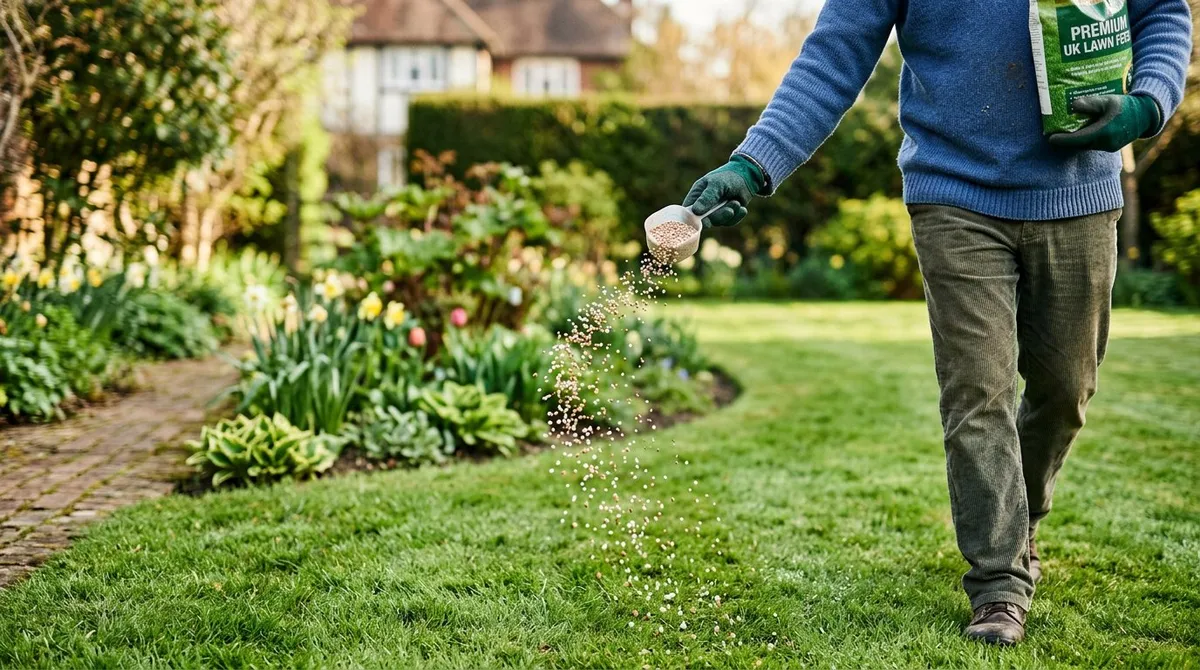
Feeding by hand works on very small lawns under 15 square metres. Wear gloves, measure the correct amount into a bucket, and scatter it as evenly as possible using a gentle side-to-side throwing motion.
Be honest with yourself: if your lawn is bigger than a couple of car parking spaces, invest in a spreader. Hand application is almost always uneven, and the striping it produces is difficult to correct.
Watering in your lawn feed
Granular lawn feed needs moisture to dissolve and reach the root zone. If it sits on dry grass blades in sunshine, it acts as a magnifying glass for heat and scorches the leaves beneath.
If rain is forecast within 24-48 hours, you can apply and let nature do the watering. This is the easiest approach and the one most experienced gardeners aim for.
If rain is not expected, water the lawn gently but thoroughly after applying feed. Use a sprinkler or hose with a fine spray attachment. Aim for the equivalent of 10-15mm of rainfall, enough to dissolve the granules and wash them down to soil level. This takes roughly 15-20 minutes of steady watering on most lawns.
Liquid feeds do not need watering in, because they are already in solution. Apply them with a watering can or hose-end diluter in the early morning or evening. Avoid midday application in summer: the sun evaporates the liquid before the grass can absorb it.
When NOT to feed your lawn
Knowing when to hold back is just as important as knowing when to feed. There are four situations where applying fertiliser does more harm than good.
During drought
Stressed, dry grass cannot absorb nutrients effectively. Fertiliser sitting on parched soil scorches leaf blades and draws moisture out of roots through osmosis. Wait until rain returns and the grass shows signs of recovery before feeding.
During frost
Frozen ground locks out root activity. Fertiliser applied to frosty grass sits on the surface, washing away with the first thaw and polluting nearby drains and ditches. The RHS advises against any lawn treatments on frozen ground.
On waterlogged soil
Saturated ground has no air spaces for roots to function. Fertiliser applied to waterlogged lawns either washes straight off as surface runoff or accumulates at toxic concentrations in standing water. If your lawn regularly floods, address the drainage before spending money on feed.
When grass is newly sown
Fresh seedlings are delicate. Standard lawn feed is too strong for them and will scorch young growth. Wait until new grass has been mown at least three times before applying a gentle, low-nitrogen starter feed. Most seed packaging includes specific feeding advice.
Common lawn feeding mistakes
These five errors account for the majority of feeding failures. Avoiding them is more valuable than choosing the most expensive product.
1. Overfeeding
More is not better. Excess nitrogen forces rapid, soft growth that is vulnerable to disease and needs mowing every 3-4 days. Severe overfeeding dumps soluble salts into the soil, killing grass roots and leaving brown patches that take months to recover. Always measure your lawn area and calculate the exact amount of product needed. A 50m2 lawn needs 1.75kg of a product applied at 35g per m2. No more.
2. Feeding at the wrong time of year
Using a high-nitrogen spring feed in October is one of the worst things you can do to a lawn. It forces tender growth that the first frost destroys. Similarly, applying an autumn feed in spring delivers all the wrong nutrients when the grass needs nitrogen most.
3. Uneven application
Walking too quickly, letting the spreader hopper run empty mid-pass, or overlapping inconsistently all create visible striping. The lush green strips where feed landed heavily sit next to pale strips where it missed. A good layer of mulch hides bare soil in borders, but nothing hides striped feeding on a lawn. Take your time and use a spreader.
4. Not watering in
Granular feed that sits on dry grass in sunshine scorches the leaves. Pellets of concentrated fertiliser sitting against a grass blade for 48 hours in warm weather will bleach that blade yellow. Water in after application if rain is not imminent.
5. Ignoring soil pH
Lawn grasses prefer a slightly acidic to neutral pH of 6.0-7.0. If your soil is too acidic (below 5.5), nutrients become locked in the soil and unavailable to roots, no matter how much feed you apply. A simple pH test kit from a garden centre costs a few pounds and takes minutes to use. If the pH is low, apply garden lime in winter to raise it gradually.
Liquid feeds: a quick-response alternative
Liquid lawn feeds dissolve in water and are applied through a watering can or hose-end sprayer. They work differently from granular feeds and have specific advantages in certain situations.
Speed of action: Liquid feeds are absorbed through both leaves and roots simultaneously. Results are visible within 3-5 days compared to 7-10 days for granules. This makes them useful for a quick colour boost before a garden party or event.
Lower scorch risk: Because the nutrients are already dissolved, there is no concentration effect from dry granules sitting on leaf surfaces. This makes liquid feeds safer to use in warm weather.
Shorter duration: The trade-off is longevity. A liquid feed provides nutrients for 2-4 weeks compared to 6-12 weeks for slow-release granules. You need to reapply more frequently, which increases the cost over a full season.
Best use: Liquid feeds work well as a supplement between granular applications, or as the primary feed for small lawns where buying a spreader is not worthwhile. They are also the safest option during warm, dry summers when scorch risk from granules is highest.
Feeding a lawn on clay or sandy soil
Soil type affects how you should approach lawn feeding. The same product behaves very differently on clay compared to sand.
Clay soils hold nutrients well but drain slowly. Feeds applied to clay lawns stay in the root zone longer, which means you can often use slightly less product per application. The risk on clay is waterlogging, which prevents roots from absorbing nutrients regardless of how much feed is present. Aerating before feeding improves uptake significantly. If your garden sits on heavy clay, our guide to improving clay soil covers the fundamentals.
Sandy soils drain fast and nutrients wash through quickly. Lawns on sand benefit from more frequent, lighter applications rather than a few heavy ones. Slow-release or organic feeds work better on sand because they resist leaching. Adding organic matter through top-dressing with fine compost or sieved leaf mould helps sandy soil retain nutrients between feeds.
Loamy soils are the easiest to manage. They hold nutrients well, drain freely, and support good root growth. Standard application rates and schedules work as intended on loam.
Building a long-term feeding plan
Consistency matters more than any single application. A lawn fed reliably 3-4 times per year will always outperform one that gets a single feed in spring and nothing else.
Year one: Start with a soil pH test. Correct any extreme acidity with winter lime. Apply spring, summer, and autumn feeds at the manufacturer’s recommended rates. Note how the lawn responds and adjust quantities the following year.
Year two onwards: If the lawn is thick and healthy, you can reduce application rates by 10-15% and switch to organic feeds for summer and autumn. A well-established, regularly fed lawn develops a dense root system and healthy soil biology that needs less input over time.
Top-dressing in autumn with a fine mix of loam, sand, and compost complements feeding by improving soil structure. This is particularly beneficial on heavy or compacted soils. Spread 2-3mm across the surface after aerating and brush it into the holes with a stiff broom.
Lawn feeding is not complicated. Choose the right product for the season, apply it evenly, water it in, and do not overdo it. Three or four feeds a year, timed with the seasons, will keep your grass thick, green, and strong enough to handle whatever the British weather throws at it. For a complete month-by-month schedule covering mowing, feeding, scarifying, and every other lawn task, see our lawn care calendar.
Now you’ve mastered lawn feeding, read our guide on fixing bare and patchy areas for the next step in getting your lawn looking its best.
Frequently asked questions
When should I start feeding my lawn in the UK?
Late March to early April is the ideal time. Wait until the grass is actively growing and soil temperature has reached at least 8 degrees Celsius. Feeding frozen or dormant grass wastes product and risks nutrient runoff into drains and waterways.
How often should I feed my lawn?
Three to four times per year is ideal. Apply a spring feed in late March, a summer feed in June, an optional second summer feed in August, and an autumn feed in September or October. Feeding more often than this risks overloading the soil with nutrients.
Can I feed my lawn in winter?
No, do not feed between November and March. Grass is dormant or barely growing during this period, so it cannot absorb nutrients. Fertiliser applied in winter sits on the surface, washes into waterways, and can damage grass roots during frost.
What does NPK mean on lawn feed?
NPK stands for nitrogen, phosphorus, and potassium. These are the three main nutrients plants need. The numbers on the packet show the ratio of each. A feed labelled 20-5-10 contains 20% nitrogen, 5% phosphorus, and 10% potassium by weight.
Is organic lawn feed better than synthetic?
Both work, but they release nutrients differently. Organic feeds release slowly over weeks, improving soil biology with each application. Synthetic feeds deliver faster visible results but do nothing for soil structure. Many experienced gardeners use organic feeds for routine maintenance and synthetic for targeted corrections.
What happens if I put too much feed on my lawn?
Overfeeding causes fertiliser scorch and brown patches. Excess salts draw moisture out of grass blades, creating areas that look burnt. Mild scorch recovers in 2-4 weeks with thorough watering. Severe scorch can kill grass completely, requiring reseeding.
Should I water my lawn after feeding?
Yes, if rain is not expected within 48 hours. Watering dissolves granular feed and washes it into the soil where roots can absorb it. Granules left sitting on dry grass blades in sun can cause scorch marks. A gentle soaking for 15-20 minutes is enough.
Lawrie has been gardening in the West Midlands for over 30 years. He grows his own veg using no-dig methods, keeps a wildlife-friendly garden, and writes practical advice based on real UK growing conditions.