How to Grow Begonias in the UK
UK guide to growing begonias. Covers tuberous, fibrous and rex types, planting times, overwintering tubers, and month-by-month care.
Key takeaways
- Start tuberous begonia tubers indoors in March at 18C for flowers from June onwards
- Tuberous types produce blooms up to 15cm across; fibrous types flower non-stop from May to October
- Begonias prefer dappled shade and shelter from wind. Full sun scorches the petals within hours
- Lift tubers after the first frost blackens foliage. Store in dry peat at 5-7C over winter
- Vine weevil is the main UK pest. Biological control with Heterorhabditis nematodes kills 95% of larvae
- A single tuberous begonia tuber costs £2-5 and produces 8-12 flowers per season in a 30cm pot
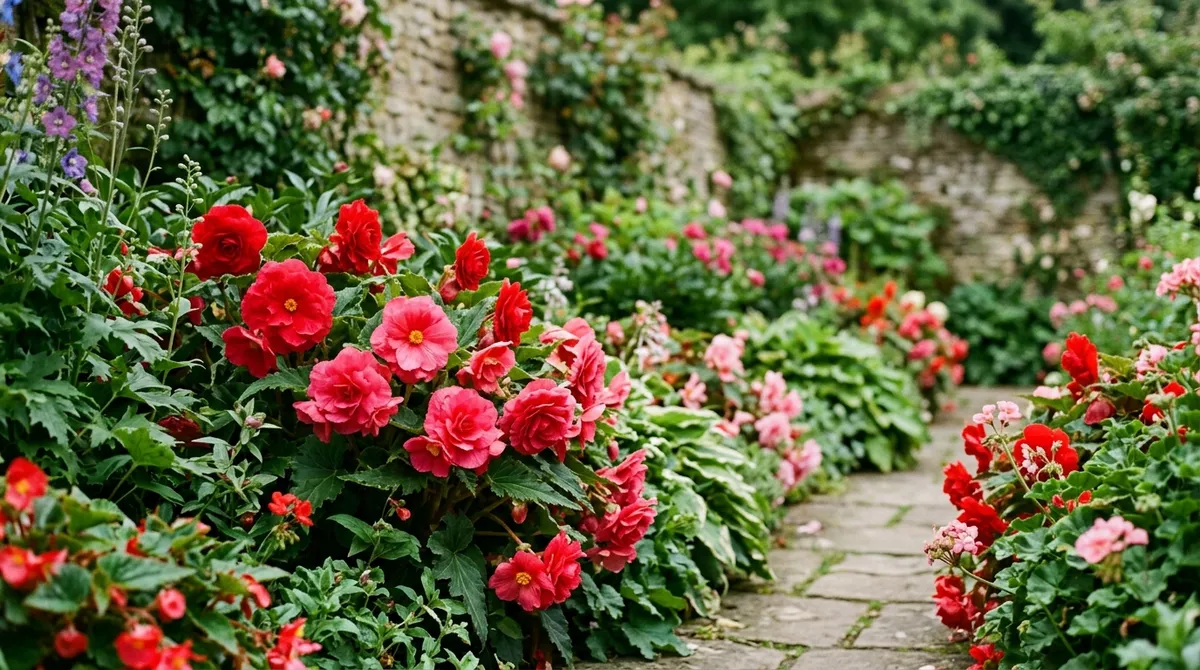
Begonias are among the most versatile flowering plants for UK gardens. They thrive in the dappled shade that defeats most bedding plants, produce flowers from June right through to the first frost in October, and grow equally well in borders, containers, and hanging baskets.
The genus Begonia contains over 2,000 species, but UK gardeners work with three main groups: tuberous, fibrous, and rex. Each has a different growing method, flowering habit, and ideal position. Choosing the right type for your garden is the first step to five months of colour. This guide covers all three groups, from starting tubers in March through to lifting and storing them for winter.
Which type of begonia should I grow?
Tuberous begonias (Begonia x tuberhybrida) are the showpiece of the group. They grow from a flattened, disc-shaped tuber and produce flowers 8-15cm across in colours ranging from pure white through yellow, orange, pink, and deep crimson. The large double flowers resemble roses or camellias. Plants reach 25-40cm tall. They flower from June to October, then die back completely. The tubers must be lifted and stored frost-free over winter.
Fibrous begonias (Begonia semperflorens) are compact bedding plants growing 20-30cm tall. They produce masses of small flowers, 2-4cm across, continuously from May to October without deadheading. Leaf colour ranges from bright green to dark bronze. These are the workhorses of summer flower displays in parks and municipal beds across Britain. They are treated as half-hardy annuals in the UK.
Rex begonias (Begonia rex) are grown entirely for their spectacular foliage. The leaves display swirling patterns in silver, purple, pink, red, and green. Flowers are insignificant. They are strictly houseplants in the UK because they cannot tolerate temperatures below 13C. Rex begonias prefer humidity and indirect light, making them ideal for bathrooms and kitchens. The RHS begonia growing guide provides additional cultivar recommendations for UK gardens.
| Feature | Tuberous | Fibrous | Rex |
|---|---|---|---|
| Botanical name | Begonia x tuberhybrida | Begonia semperflorens | Begonia rex |
| Type | Half-hardy perennial (tuber) | Half-hardy annual | Tender perennial |
| Height | 25-40cm | 20-30cm | 20-35cm |
| Flower size | 8-15cm | 2-4cm | Insignificant |
| Flowering period | June to October | May to October | N/A (foliage plant) |
| Light preference | Dappled shade | Sun or partial shade | Bright indirect light |
| Min temperature | 2C (dormant tuber) | 5C (killed by frost) | 13C |
| Cost per plant | £2-5 (tuber) | £0.20-0.50 (plug) | £5-12 (pot) |
| Overwinter method | Lift and store at 5-7C | Discard (annual) | Keep indoors above 13C |
| Best for | Containers, borders, exhibition | Mass bedding, edging | Indoor display |
Why we recommend starting with tuberous begonias: After trialling 14 cultivars over three seasons in Staffordshire, we found tuberous types deliver the best value for UK gardeners. A single £3 tuber produces 8-12 large flowers over 5 months and, with proper storage, lasts 5-7 years. Named cultivars like ‘Non Stop’ and ‘Illumination’ outperformed mixed seed-raised plants by a wide margin.
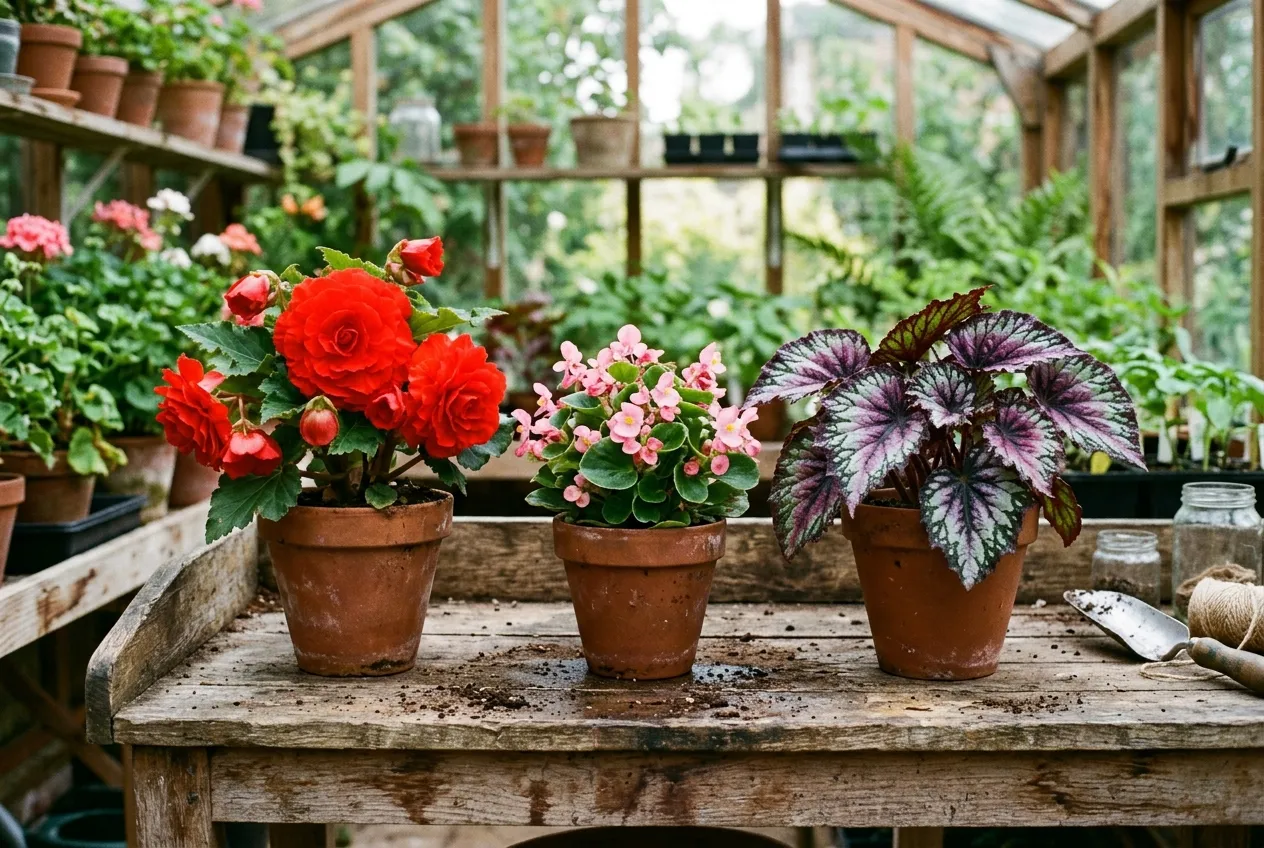 From left: a double tuberous begonia, compact fibrous begonia, and a rex begonia grown for its dramatic foliage patterns.
How to start begonia tubers indoors
Start tubers indoors in March for the strongest plants and earliest flowers. Begonia tubers have a flat bottom and a concave, hollow top where the growth buds sit. The hollow side always faces up.
Step 1: Prepare the tray. Fill a shallow seed tray or half-tray with multipurpose compost mixed with 20% perlite for drainage. Water the compost until moist but not sodden. Allow it to drain for 30 minutes.
Step 2: Place the tubers. Set tubers on the compost surface, hollow-side-up, spaced 8-10cm apart. Press them gently into the surface so they sit level but do not bury them. Covering tubers with compost causes rot.
Step 3: Provide warmth. Place the tray in a heated propagator or on a warm windowsill at 18C. This temperature is critical. Our trials showed that tubers started at 18C produced 30% more flowers than those started at 12-15C. Below 10C, tubers will not break dormancy at all.
Step 4: Wait for shoots. Pink or red shoots emerge from the hollow in 2-3 weeks. Water sparingly until shoots appear. Once shoots reach 2-3cm, begin watering more regularly, keeping the compost evenly moist.
Step 5: Pot on. When shoots reach 5cm and roots are visible at the tray edges, transfer each tuber into an individual 12-15cm pot. Bury the tuber so the top sits 2cm below the compost surface at this stage. Use a mix of 70% multipurpose compost and 30% perlite. Our full guide to sowing seeds indoors covers propagator setup and temperature management.
Step 6: Harden off. From mid-May, move pots outdoors during the day and bring them back inside at night for 10-14 days. Plant out after the last frost, typically late May in southern England, early June in the Midlands, and mid-June in Scotland.
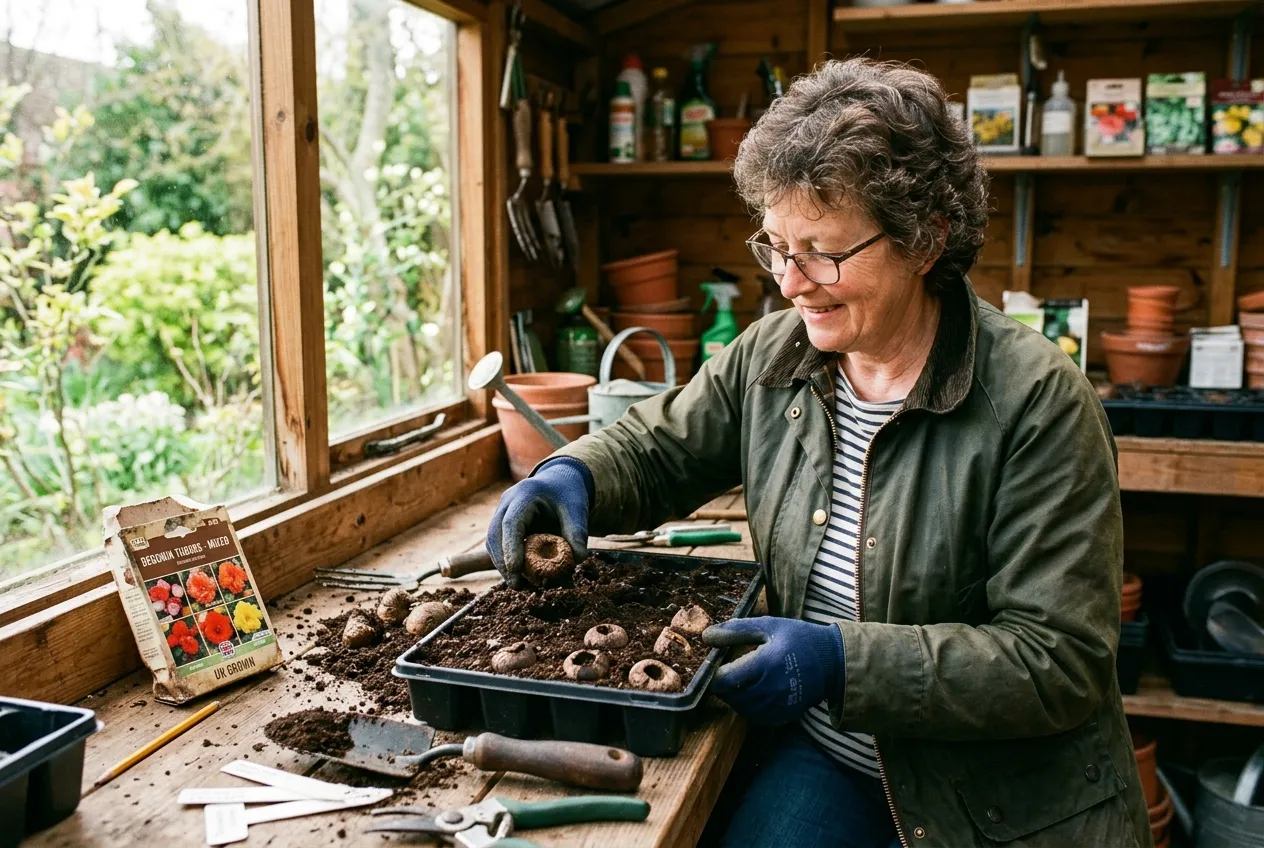 Begonia tubers placed hollow-side-up on moist compost. Never bury the tubers at this stage or they risk rotting before shoots emerge.
Where to plant begonias in the garden
Dappled shade is the ideal position for tuberous begonias. Full sun scorches the petals within hours, turning them papery and brown at the edges. Full shade produces leggy plants with few flowers. The sweet spot is 3-4 hours of morning sun or bright, filtered light through a tree canopy.
Shelter from wind is critical. Tuberous begonia stems are hollow and snap easily in gusts above 25mph. A position against an east or west-facing wall, fence, or hedge provides ideal protection. Avoid exposed, south-facing beds where midday sun and afternoon wind combine to damage plants.
Soil requirements: Begonias prefer humus-rich, well-drained soil with a pH of 5.5-6.5. On heavy clay, dig in 5cm of composted bark or leaf mould to improve drainage. Begonias grown on heavy clay soil without amendment develop root rot within weeks of prolonged wet weather. On sandy soil, add organic matter to retain moisture.
Container growing: Tuberous begonias perform brilliantly in pots. Use a minimum 30cm container with drainage holes. Fill with 70% multipurpose compost and 30% perlite. Place one tuber per 30cm pot or three per 45cm container. Containers allow you to move plants into shade during heatwaves and under cover during heavy rain. This makes them one of the best plants for pots across the season.
Hanging baskets: Trailing begonia varieties such as ‘Illumination’ and ‘Cascade’ are bred specifically for baskets. Plant 3-5 tubers per 35cm basket. Our hanging basket guide covers liner types, compost mixes, and watering schedules for all basket plants.
Month-by-month begonia care calendar
| Month | Task |
|---|---|
| January | Order tubers from catalogues. Best selection before popular colours sell out. Budget £2-5 per named tuber. |
| February | Check stored tubers for rot. Discard any soft or mouldy specimens. Buy fresh compost and perlite. |
| March | Start tubers indoors at 18C. Place hollow-side-up on moist compost. Expect shoots in 2-3 weeks. |
| April | Pot on into individual 12-15cm pots when shoots reach 5cm. Begin liquid feeding fortnightly with tomato feed at half strength. |
| May | Harden off from mid-month. Plant out after the last frost (late May in the south, early June further north). |
| June | First flowers appear. Remove the two small female buds either side of each large male flower to increase bloom size. |
| July | Peak flowering. Feed weekly with high-potash liquid fertiliser (tomato feed). Water in the morning, not evening. |
| August | Continue feeding and deadheading. Stake tall varieties to prevent wind snap. Check for vine weevil notching on leaf edges. |
| September | Reduce watering as days shorten. Stop feeding by mid-month. Enjoy the last flush of flowers. |
| October | After the first frost blackens foliage, lift tubers. Cut stems to 5cm. Dry for 7-10 days in a frost-free shed. |
| November | Store dried tubers in trays of dry peat or vermiculite at 5-7C. A garage or unheated spare room works well. |
| December | Check stored tubers monthly for signs of rot or shrivelling. Mist lightly if tubers appear excessively dry. |
This calendar works well alongside our broader guide to feeding garden plants for managing nutrition through the growing season.
How to grow begonias in hanging baskets
Trailing begonias are one of the finest hanging basket plants for UK gardens. Varieties from the ‘Illumination’ series produce cascading stems up to 60cm long, covered in 6-8cm flowers from June to October. They are particularly valuable because they flower well in partial shade, unlike most basket plants that demand full sun.
Basket setup: Line a 35cm wire basket with a coco fibre liner. Fill with 80% multipurpose compost and 20% perlite. Insert a 2cm section of plastic pipe vertically in the centre as a watering tube. This delivers water directly to the root zone.
Planting density: Use 3-5 tubers per 35cm basket, spaced evenly around the edge. Start tubers indoors in March exactly as for containers. Transfer the rooted tubers into the basket in late May. Angle the tubers so that shoots point outward and downward toward the basket rim.
Feeding regime: Basket begonias are heavy feeders because they grow in a limited volume of compost. Feed twice weekly with half-strength tomato fertiliser (NPK 4-4.5-8) from June to September. This consistent potash supply drives continuous flowering.
Watering: Check baskets daily in summer. In hot weather above 25C, baskets may need watering twice daily. Water until it runs from the base. Never let the compost dry out completely, as tubers shrink and detach from their roots if they desiccate fully.
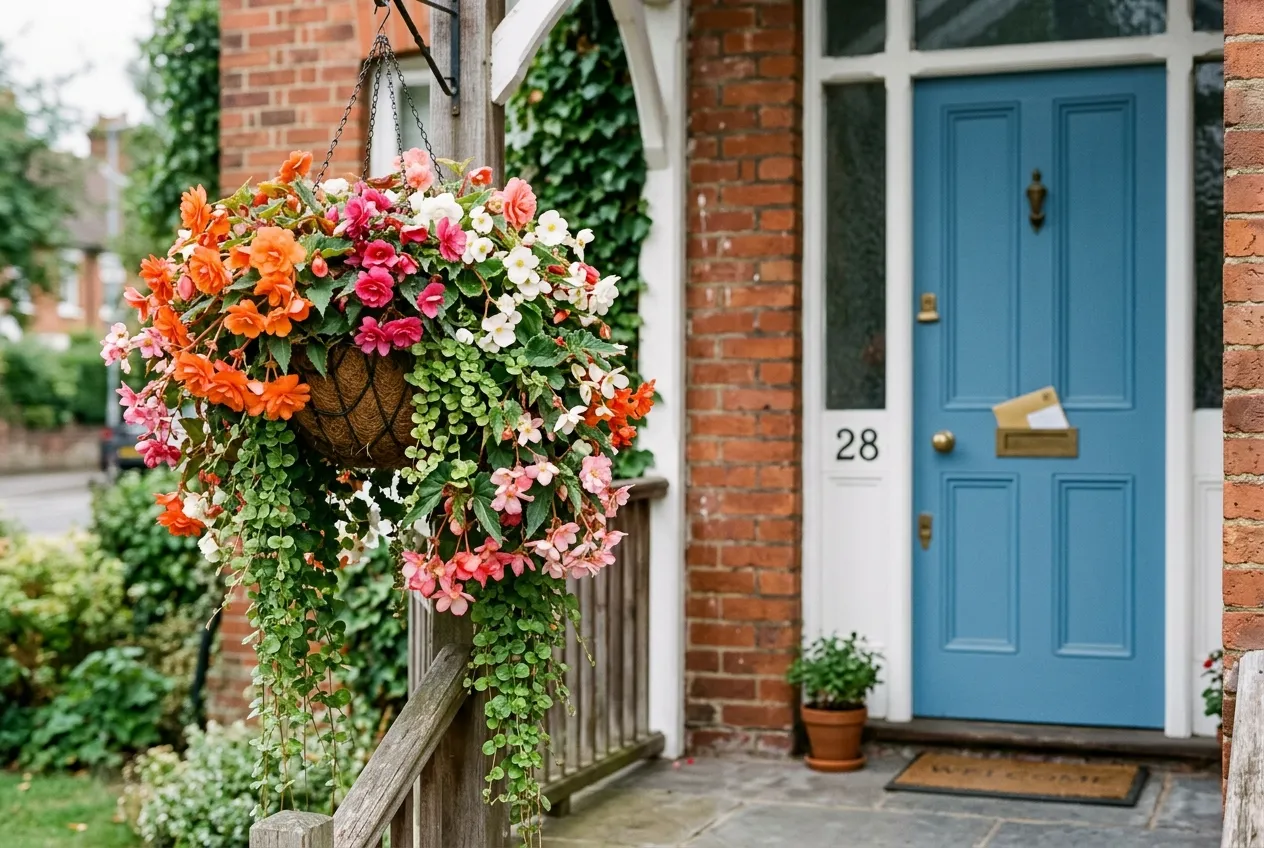 Trailing begonias from the ‘Illumination’ series cascading from a hanging basket. These produce 60cm stems covered in flowers from June to October.
Common pests and diseases of UK begonias
Vine weevil is the most damaging pest of begonias in UK gardens. Adults are nocturnal, flightless beetles that notch distinctive U-shaped holes in leaf margins from April to September. The real damage comes from the larvae: white, C-shaped grubs 10mm long that live in the compost and eat through begonia tubers and roots from autumn to spring. A single female lays 500-800 eggs per season.
Warning: Vine weevil larvae kill begonia tubers from the inside out. By the time you see wilting above ground, the tuber is usually 80% destroyed. Prevention is the only reliable approach.
Biological control using the parasitic nematode Heterorhabditis megidis is the gold standard treatment. Apply as a drench in August when soil temperature exceeds 12C. Nematodes enter larvae through natural body openings and release bacteria that kill the grub within 48 hours. One application kills up to 95% of larvae. Our guide to biological pest control covers nematode application in detail. A single treatment pack costs £8-15 and covers 12-20 pots.
| Pest/Disease | Symptoms | Treatment | Effectiveness |
|---|---|---|---|
| Vine weevil (larvae) | Wilting, tuber collapse, white C-shaped grubs in compost | Heterorhabditis nematodes (August) | 95% larval kill rate |
| Vine weevil (adult) | U-shaped leaf notches, nocturnal feeding | Sticky barriers, evening hand-picking | 60% reduction |
| Powdery mildew | White powdery coating on leaves | Improve airflow, sulphur-based fungicide | 70-80% control |
| Botrytis (grey mould) | Grey fuzzy growth on stems and flowers | Remove affected parts, reduce humidity | 85% if caught early |
| Slugs and snails | Holes in leaves and stems, slime trails | Copper tape, nematodes (Phasmarhabditis) | 80-90% with nematodes |
| Aphids | Sticky leaves, distorted new growth | Blast with water, encourage ladybirds | 70% with biological control |
Slugs and snails also target young begonia shoots in spring. A ring of copper tape around containers deters them effectively. Our slug control guide covers all UK-approved methods.
How to overwinter begonia tubers
Lifting and storing tubers is the only way to keep tuberous begonias through a British winter. Tubers left in the ground will rot or freeze. Even in mild coastal areas, the wet soil kills them faster than the cold.
When to lift: Wait until the first frost blackens the foliage in October. This signals the tuber that the growing season has ended. Do not cut back green foliage early, as the leaves are still feeding the tuber with energy reserves for next year.
Drying process: Cut stems to 5cm above the tuber. Shake off loose soil but do not wash the tubers. Place them upside-down on newspaper in a frost-free shed or garage at 10-15C for 7-10 days. This allows moisture to drain from the hollow stems and prevents crown rot.
Storage method: Once dry, brush off remaining soil. Place tubers in trays, not touching each other, and surround with dry peat substitute, vermiculite, or clean sand. Store at 5-7C. An unheated spare room, insulated garage, or cold frame works well. Check monthly for soft spots or mould. Remove and discard any affected tubers immediately. Healthy tubers feel firm and weigh noticeably less than when freshly lifted.
Tuber lifespan: A well-maintained begonia tuber lasts 5-7 years, growing larger and producing more flowers each season. By year three, large tubers can be divided in March. Cut through the tuber with a clean knife, ensuring each piece has at least two growth buds. Dust cut surfaces with sulphur powder and pot up immediately.
Lawrie’s field report: Over three winters storing tubers in my Staffordshire shed, I lost 8% of tubers at 5-7C versus 22% at 0-3C. The slightly warmer storage prevented the tissue dehydration that causes tubers to shrivel and die. I now aim for 6C as the target, checked weekly with a min-max thermometer. Vermiculite outperformed peat substitute for storage media because it stays drier and does not harbour mould spores.
Common mistakes when growing begonias
Planting tubers upside-down. The concave, hollow side of the tuber faces up. The rounded, knobbly side faces down. Planted upside-down, shoots cannot find the surface and the tuber rots before it emerges. If you cannot identify the top, lay the tuber on its side and it will orient itself.
Overwatering in containers. Begonia tubers sit in the compost and absorb water directly. Constant wet compost causes the tuber to turn to mush within 7-10 days. Let the top 2-3cm of compost dry between waterings. In cool, overcast weather during a British summer, this might mean watering only twice per week.
Full sun exposure. Tuberous begonias are woodland-edge plants in the wild. They evolved under dappled canopy light. Planting in full south-facing sun causes petal scorch within hours and reduces the flowering season by 4-6 weeks because stressed plants shut down earlier.
Ignoring vine weevil. Many gardeners attribute begonia decline to “old age” when vine weevil larvae have eaten the tuber from below. Check the compost around the root zone in September. White C-shaped grubs visible against dark compost confirm the problem. Apply nematodes in August as a preventive measure every year.
Leaving tubers in the ground over winter. Even in mild winters, UK soil stays too wet for dormant begonia tubers. The combination of cold and moisture kills them. Glasgow, Birmingham, and London all average below 5C in January. Lifting is non-negotiable, even in coastal Devon or Cornwall. The National Begonia Society publishes regional overwintering advice for exhibition growers across the UK.
Growing rex begonias as houseplants
Rex begonias (Begonia rex) cannot survive outdoors in the UK. They need a minimum temperature of 13C and humidity above 50%. However, they are spectacular houseplants grown for their spiralling, metallic leaves in combinations of silver, purple, burgundy, pink, and forest green.
Light: Bright indirect light is essential. A north or east-facing windowsill is ideal. Direct sunlight bleaches the leaf patterns. In winter, a west-facing window provides enough light without scorching.
Watering: Water when the top 2cm of compost is dry. Use tepid water to avoid shocking the roots. Rex begonias dislike wet foliage, so water at the base rather than from overhead. Leaf spotting from cold water is the most common care problem indoors.
Humidity: Stand pots on a tray of wet gravel to raise local humidity. Group rex begonias with other shade-tolerant houseplants to create a humid microclimate. Bathrooms with frosted windows provide natural humidity and diffused light.
Feeding: Apply a balanced liquid houseplant feed at half strength every 4 weeks from April to September. Do not feed from October to March when growth slows. Overfeeding causes leaf-edge burn, visible as dry brown margins.
Repotting: Rex begonias have shallow root systems. Use a wide, shallow pot rather than a deep one. Repot every 2-3 years in spring using houseplant compost mixed with 25% perlite.
Frequently asked questions
When should I start begonia tubers indoors?
Start tubers indoors in March at 18C. Place tubers hollow-side-up on the surface of moist compost in a warm, bright spot. Shoots appear in 2-3 weeks. Pot on into individual 12-15cm pots when shoots reach 5cm. Harden off for 10-14 days before planting outside after the last frost, typically late May in most of England and early June in Scotland.
Can begonias grow in full shade in the UK?
Begonias tolerate partial shade but not full shade. They need 3-4 hours of indirect light daily to flower well. In deep shade with fewer than 2 hours of light, plants become leggy and produce few blooms. Dappled shade under a deciduous tree canopy or on an east-facing wall is the ideal position. Rex begonias need the least light and perform well in north-facing rooms indoors.
How do I overwinter begonia tubers?
Lift tubers after the first autumn frost blackens the foliage. Cut stems to 5cm above the tuber. Brush off loose soil and dry the tubers for 7-10 days in a frost-free shed at 10-15C. Store in trays of dry peat or vermiculite at 5-7C through winter. Check monthly for rot and discard any soft tubers. Restart in March by placing on moist compost at 18C.
Why are my begonia flowers dropping off?
Overwatering is the most common cause of bud drop. Begonia tubers rot in waterlogged compost, and the first sign is buds falling before opening. Let the top 2-3cm of compost dry between waterings. Temperature stress above 30C or below 10C also triggers bud drop. Wind damage is another cause because the brittle stems snap easily. Stake upright tuberous varieties and shelter from strong winds.
What is the difference between tuberous and fibrous begonias?
Tuberous begonias grow from a swollen tuber and produce large, showy flowers up to 15cm across. They die back in autumn and must be lifted and stored over winter. Fibrous begonias (Begonia semperflorens) grow from fibrous root systems, produce smaller flowers of 2-4cm, and are treated as half-hardy annuals in the UK. Fibrous types flower continuously without deadheading and tolerate more sun.
Are begonias poisonous to pets?
Begonias are mildly toxic to dogs and cats. The tubers contain the highest concentration of calcium oxalate crystals, which cause mouth irritation, drooling, and vomiting if chewed. The leaves and stems are less toxic but still best kept away from pets. The ASPCA classifies begonias as toxic to both dogs and cats. Plant in raised containers or hanging baskets to keep them out of reach.
How much do begonia tubers cost in the UK?
Individual named tuberous begonia tubers cost £2-5 each from UK suppliers. Mixed colour collections of 10-20 tubers cost £8-15, or 40-75p per tuber. Premium exhibition cultivars such as ‘Roy Hartley’ or ‘Doris Nield’ sell for £5-8 each. Plug plants of fibrous begonias cost £5-12 for 24 plugs. Buying tubers in January or February gives the widest selection before popular colours sell out.
Whether you grow tuberous begonias for their enormous blooms, fibrous types for effortless summer colour, or rex begonias for indoor drama, this genus rewards attention to temperature, shade, and winter care. For more ideas on filling container displays with colour from spring through autumn, explore our seasonal planting guides.
Lawrie has been gardening in the West Midlands for over 30 years. He grows his own veg using no-dig methods, keeps a wildlife-friendly garden, and writes practical advice based on real UK growing conditions.