Grow Boysenberry and Loganberry in the UK
How to grow boysenberry and loganberry in UK gardens. Planting, training on wires, pruning, harvest, and how these hybrid berries differ from blackberry.
Key takeaways
- Boysenberries and loganberries are raspberry-blackberry hybrids, fully hardy to -15C across all UK regions
- Each plant yields 3-5kg of fruit per season once established, fruiting July to August
- Train canes on horizontal wires at 30cm intervals against a fence, wall, or post-and-wire framework
- Prune all fruited canes to ground level after harvest and tie in new growth for next year
- Loganberry LY654 is the thornless variety to choose; boysenberry canes are always thorned
- Both freeze well and make outstanding jam due to their high pectin and intense flavour
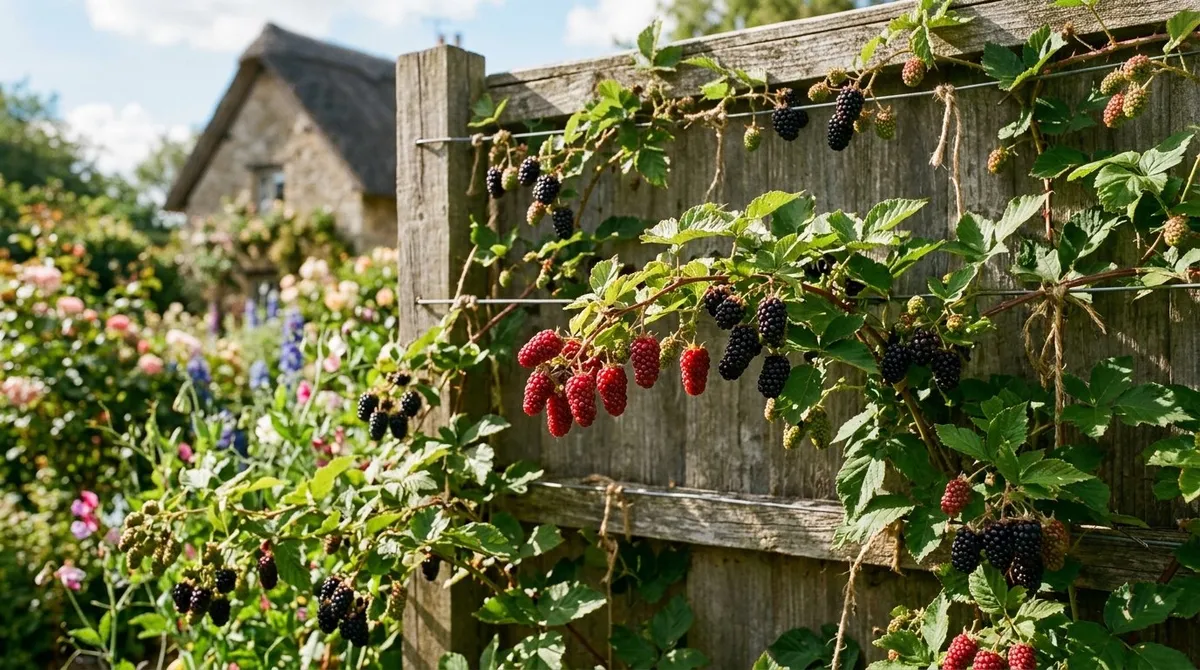
Boysenberries and loganberries are two of the most rewarding hybrid berries you can grow in a British garden. Both are crosses between raspberry and blackberry, combining the best qualities of each parent. The fruit is larger and more flavourful than either parent species alone. A single mature plant produces 3-5kg of berries per season, enough for eating fresh, freezing, and making jam.
These hybrid berries have been grown in UK gardens since the early 1900s. They thrive in our maritime climate and tolerate heavy clay soil, cool summers, and winter temperatures down to -15C. The plants need no special protection and fruit reliably from the Scottish Highlands to the south coast. Despite this, they remain far less common than blackberries or raspberries in British gardens. That is a missed opportunity. The fruit has a depth of flavour that neither parent can match.
This guide covers the practical differences between boysenberry and loganberry, site selection, planting, wire training, pruning, propagation, and harvest. Everything here comes from three years of growing both side by side in a Staffordshire garden on heavy clay.
What is the difference between boysenberry and loganberry?
Loganberry was the first deliberate raspberry-blackberry hybrid, created by Judge James Logan in Santa Cruz, California in 1881. The fruit is elongated, 3-4cm long, dark red when ripe, and firmer than a blackberry. Flavour is sharp and tangy with high acidity, making it outstanding for cooking and preserves.
Boysenberry appeared in the 1920s, bred by Rudolph Boysen from a complex cross of loganberry, raspberry, and blackberry. The fruit is rounder, larger (up to 5cm), and almost black when fully ripe. It is sweeter and softer than loganberry, with a musky, wine-like depth.
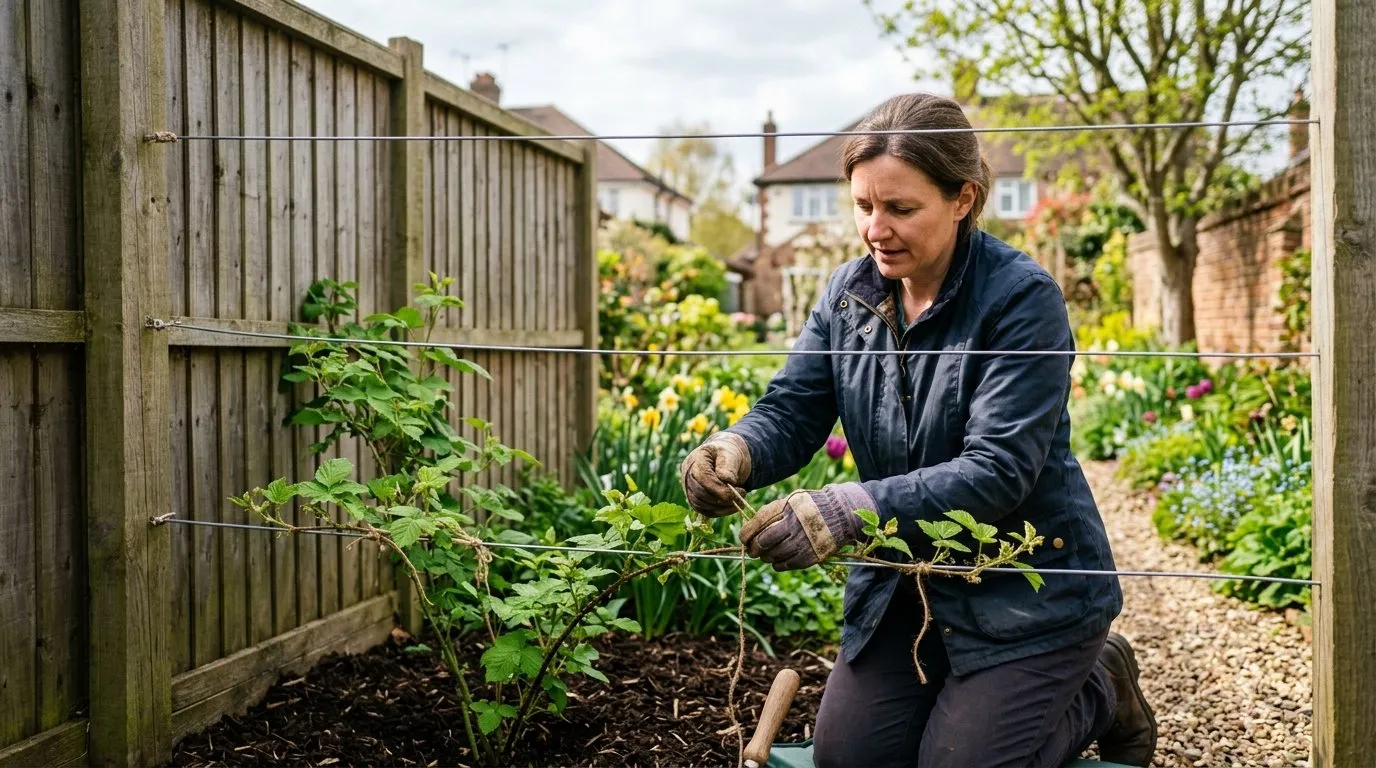 Boysenberry canes tied to horizontal training wires in spring. New growth reaches 2-3m by midsummer.
Both plants produce vigorous canes 2-3m long that fruit on the previous year’s wood. Training, pruning, and care are identical. The key difference is the fruit itself.
Hybrid berry comparison table
| Feature | Boysenberry | Loganberry | Tayberry | Blackberry |
|---|---|---|---|---|
| Fruit size | Large, up to 5cm | Medium-large, 3-4cm | Large, 4-5cm | Medium to large, 2-4cm |
| Fruit colour | Dark purple-black | Dark red | Deep red-purple | Black |
| Flavour | Sweet, musky, complex | Sharp, tangy, acidic | Sweet-sharp, aromatic | Sweet when fully ripe |
| Thorns | Always thorned | Thornless (LY654) or thorned | Thorned (Buckingham thornless available) | Thornless and thorned varieties |
| Vigour | Moderate, 2-3m canes | Moderate-vigorous, 2-3.5m canes | Vigorous, 2-3m canes | Very vigorous, 3-5m canes |
| Yield per plant | 3-4kg | 4-5kg | 3-5kg | 5-10kg |
| Harvest period | Mid-July to mid-August | Early July to mid-August | Early July to early August | August to October |
| Hardiness | -15C (H5) | -15C (H5) | -15C (H5) | -20C (H6) |
| Best use | Eating fresh, desserts | Jam, cooking, freezing | Jam, freezing, eating fresh | All purposes |
Field Report: Over three fruiting seasons (2023-2025) on a south-facing fence in Staffordshire on heavy Mercian Mudstone clay, loganberry LY654 averaged 4.2kg per plant against boysenberry’s 3.1kg. Loganberry canes grew 15-20cm longer and produced 8-12 laterals per cane compared to boysenberry’s 6-9. Boysenberry fruit averaged 7g per berry; loganberry averaged 5g. Both fruited from the second week of July, with loganberry finishing one week later than boysenberry.
Where should I plant hybrid berries?
Boysenberries and loganberries need a south-facing, west-facing, or east-facing fence, wall, or post-and-wire framework. The support must be at least 1.8m tall and 2-3m wide per plant. A sunny, sheltered position produces the sweetest fruit and heaviest crops.
Site requirements
- Sun: Minimum 4 hours direct sunlight per day. Full sun is ideal. South-facing walls and fences give the best results in northern England and Scotland.
- Soil: Any reasonable garden soil. Both tolerate heavy clay, sandy loam, and chalky ground. Avoid waterlogged sites. The RHS hybrid berry guide confirms they are unfussy about soil type.
- pH: 5.5-7.0. Most UK garden soils fall within this range.
- Drainage: Good drainage is essential. If water pools after rain, raise the planting area or improve drainage before planting.
- Shelter: Avoid fully exposed, windswept positions. Wind damages young canes and reduces pollinator visits during flowering.
A 3m stretch of fence accommodates one plant comfortably. If growing both types, space plants 2.5-3m apart along the same fence. This is identical to the spacing used for blackberries and other cane fruit.
How do I train boysenberry and loganberry on wires?
Wire training is essential. Without support, the canes flop onto the ground, fruit rots, and the plant becomes an unmanageable tangle. The training method is the same system used for blackberries and similar to training fruit trees on espalier wires.
Installing support wires
- Fix horizontal galvanised wires to the fence or wall at 30cm intervals
- Start the lowest wire at 60cm from ground level
- Add wires at 90cm, 120cm, 150cm, and 180cm
- Use vine eyes or screw-in eye hooks to hold the wires 5-8cm off the fence surface
- Tension each wire firmly so it does not sag under the weight of laden canes
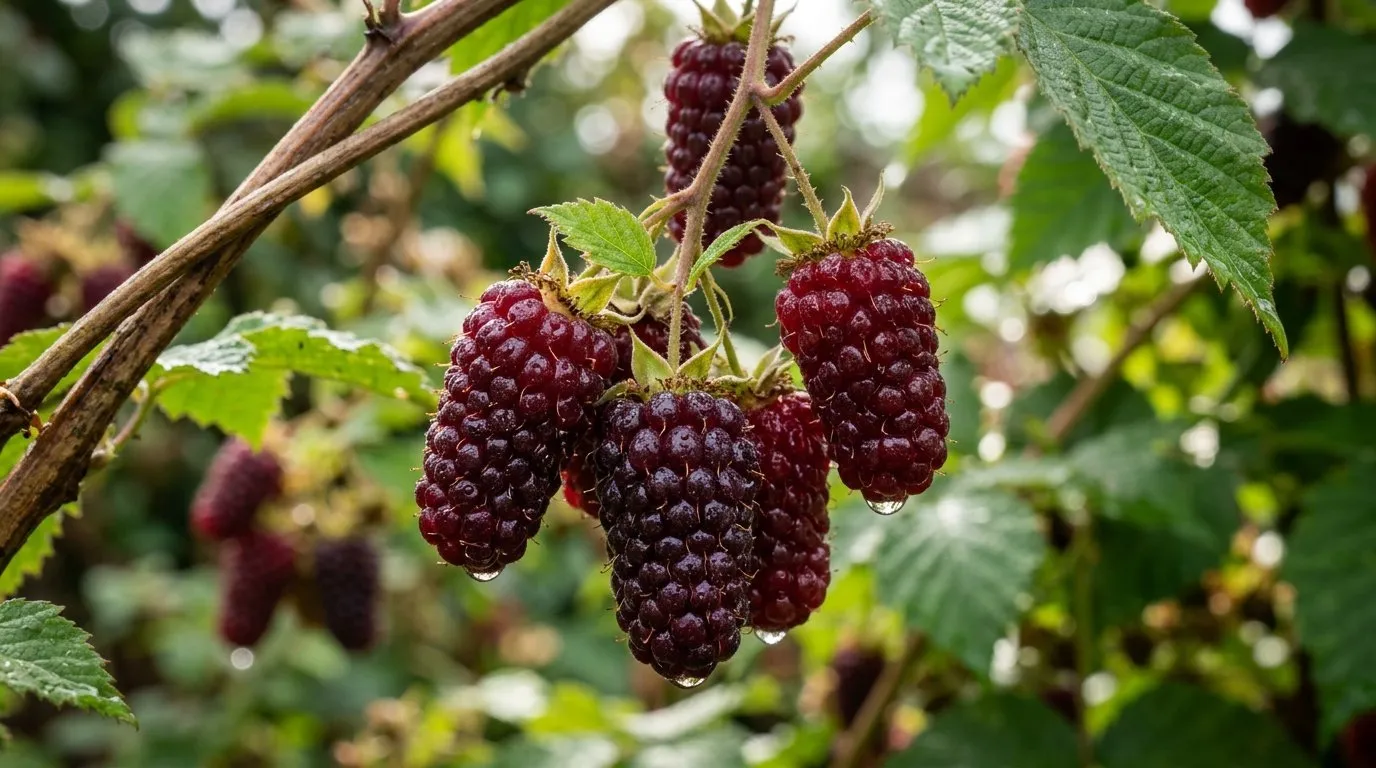 Ripe loganberries on the vine. The elongated dark red fruit is firmer than blackberry and sharper in flavour.
The one-way fan training system
This is the same system that works for blackberries. It separates fruiting canes from new growth, making pruning straightforward.
Year 1: After planting, new canes emerge from the base in spring. Tie them to the wires, fanning out to one side (left or right). No fruit is produced in the first year.
Year 2: The tied-in canes flower and fruit in July-August. At the same time, new canes grow from the base. Tie these new canes to the opposite side of the wires. After harvest, cut all fruited canes to ground level and remove them.
Year 3 onwards: The new canes (tied in last summer) now fruit. Fresh canes emerge from the base and go to the opposite side. Cut out fruited canes after harvest. Repeat every year.
Tying technique
Use soft garden twine or flexible rubber plant ties. Tie every 30-40cm along each cane. Space canes 10-15cm apart on the wires so sunlight and air reach all parts. Keep 5-8 strong canes per plant. Remove any thin, weak, or crossing shoots at the base.
Boysenberry canes have thorns, so wear thick gauntlets when tying in. Loganberry LY654 is thornless and far easier to handle. This is one of the strongest arguments for choosing the LY654 clone.
When do I prune hybrid berry canes?
Prune immediately after the last fruit is picked, typically late August or early September. This is the single most important maintenance task for both boysenberry and loganberry. The principle is simple: canes that have fruited will never fruit again.
Pruning method
- Cut every fruited cane to ground level using sharp secateurs or loppers
- Untie them from the wires and remove the old canes entirely
- The new canes (grown during summer) should already be tied to the opposite side
- If not yet tied in, fan them out now and secure to the wires
- Remove any weak, thin, or damaged new canes
- Keep 5-8 strong canes per plant for next year’s crop
Winter tidy-up
In February, check the tied-in canes. Remove any that have been damaged by winter storms. Shorten the tips of excessively long canes (over 3m) to a strong bud. This encourages side-shoot production, which is where the fruit forms.
Lawrie’s field note: In the first winter (2022-23), I lost two boysenberry canes to a late January ice storm that snapped them where they were tied too tightly to the wire. Loose ties with a figure-of-eight loop prevent this. Give each cane 1cm of movement against the wire.
Month-by-month care calendar
| Month | Task |
|---|---|
| January | Check ties are secure but not too tight. Order bare-root plants from nurseries. |
| February | Tip-prune any canes over 3m. Apply sulphate of potash at 35g per square metre around the base. |
| March | Apply a 5-8cm mulch of well-rotted compost or manure. Keep mulch 5cm from stems. |
| April | New side shoots appear on trained canes. Remove any weak growth. Watch for aphids on soft tips. |
| May | Flowers open. Ensure adequate water if the spring is dry. Do not spray insecticides during flowering. |
| June | Fruit sets and swells. Water deeply in dry spells: 10-15 litres per plant twice a week. |
| July | Harvest begins. Pick every 2-3 days as fruit ripens. Net against birds if needed. |
| August | Harvest continues. Prune out all fruited canes after the last pick. Tie in new canes. |
| September | Complete tying in of new canes if not finished. Clear fallen fruit and old foliage. |
| October | Tip-layer any canes needed for propagation. Plant new bare-root stock from month end. |
| November | Plant bare-root canes. This is the ideal planting month. Water in well. |
| December | Check supports and replace any rusted wires. Garden is dormant; no action needed on the plants. |
When are boysenberries and loganberries ready to pick?
Boysenberries are ready when the fruit turns dark purple-black and feels soft. A ripe boysenberry detaches from the plug with a gentle pull. If you have to tug, it is not ready. Ripe fruit is fragile and bruises within hours of picking.
Loganberries are ready when they turn dark red and slide off the plug. They hold their shape better than boysenberry after picking. Under-ripe loganberries are hard and extremely sour. Wait for the colour to deepen fully.
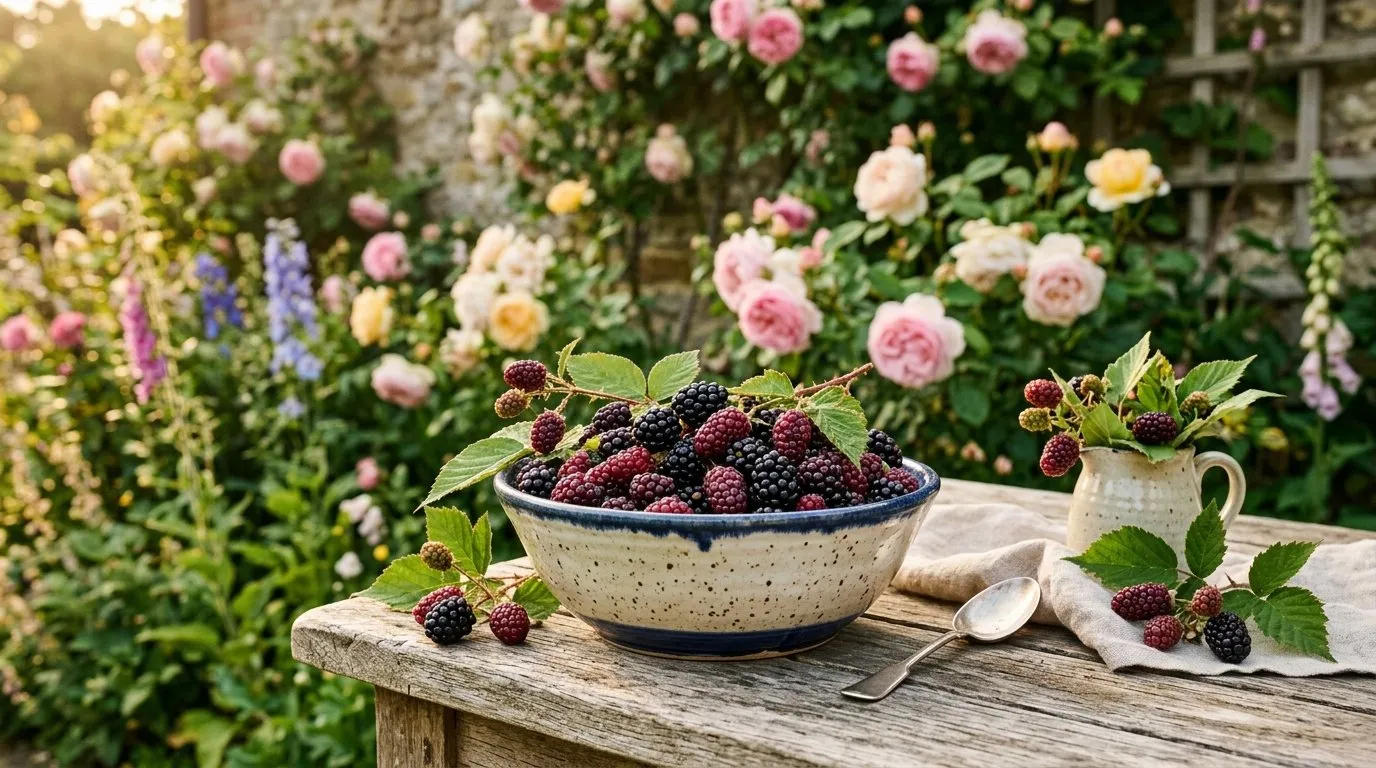 A mixed harvest of boysenberries (dark purple) and loganberries (dark red). Pick into shallow containers to avoid crushing.
Harvest tips
- Pick into shallow containers no more than two berries deep. Stacking crushes the bottom layer.
- Harvest every 2-3 days during the peak season (mid-July). The fruit ripens in waves over 3-4 weeks.
- Pick in the morning after the dew has dried. Wet fruit moulds faster.
- Eat fresh within 24 hours or refrigerate immediately. Both berries keep 2-3 days in the fridge.
- For longer storage, open-tray freeze on baking sheets then bag. Both varieties freeze well and make outstanding jam, crumbles, and sauces.
Expected yields
| Plant age | Boysenberry yield | Loganberry yield |
|---|---|---|
| Year 1 | No fruit | No fruit |
| Year 2 | 0.5-1kg | 1-1.5kg |
| Year 3 | 2-3kg | 3-4kg |
| Year 4+ | 3-4kg | 4-5kg |
Loganberry produces slightly more fruit per plant because it develops more fruiting laterals per cane. Boysenberry individual berries are heavier but fewer per cane.
How to propagate hybrid berries by tip layering
Both boysenberry and loganberry propagate easily by tip layering. This is the same method used for blackberries and requires no specialist equipment.
Method
- In late July or August, select a healthy new cane that has not fruited
- Bend the tip down to the ground without snapping it
- Bury the tip 10-15cm deep in a hole filled with garden compost
- Peg it in place with a bent wire or weigh it down with a stone
- Water the buried tip and keep the soil moist through autumn
- By the following March, the tip has rooted and produced a new shoot
- Cut the new plant from the parent cane and transplant it
Each parent plant can provide 2-3 tip-layered offspring per year without reducing its own vigour. This is the cheapest way to expand your planting or share with other gardeners.
Common problems and how to solve them
Pests
- Raspberry beetle: The main pest of all hybrid berries. Small brown beetles lay eggs in the flowers, and grubs feed inside the developing fruit. Picking and destroying affected fruit breaks the cycle. Spray with pyrethrum at dusk when flowers first open if the problem is severe.
- Aphids: Greenfly cluster on soft shoot tips in April and May. Pinch out affected tips or spray with soapy water. Encourage ladybirds and lacewings as natural predators.
- Birds: Blackbirds and thrushes take ripe fruit. Net the plants from first colour change using 2cm mesh draped over the support framework.
Diseases
- Cane spot (Elsinoe veneta): Purple spots on canes in late spring. Remove and burn affected canes. Improve air circulation by spacing canes further apart on the wires.
- Botrytis (grey mould): Fuzzy grey mould on fruit in wet summers. Pick fruit promptly and remove any mouldy berries immediately. Good air circulation and avoiding overhead watering reduce the risk.
- Spur blight (Didymella applanata): Dark patches around buds in late summer. Thin canes to 5-8 per plant to improve airflow. Remove affected canes in autumn.
Cultural problems
- Poor fruit set: Usually caused by frost damage to flowers or lack of pollinators. Cover plants with fleece during late frosts in April and May. Avoid spraying during flowering.
- Small, dry fruit: Drought stress during June and July when fruit is swelling. Water deeply and mulch to retain moisture.
- Cane dieback: Waterlogged soil or root disease. Improve drainage. Avoid planting where hybrid berries or raspberries grew previously.
Growing hybrid berries in containers
Both boysenberry and loganberry grow in large pots, though yields are reduced. This works well if you lack open ground. For general container advice, see our guide to growing fruit in pots and containers.
Container requirements
- Pot size: Minimum 45cm diameter and 40cm deep
- Compost: John Innes No. 3 (loam-based for weight and stability)
- Support: Attach a small trellis or obelisk inside the pot
- Watering: Daily in summer; twice daily in hot spells
- Feeding: Fortnightly with tomato fertiliser from flowering to final harvest
- Expected yield: 1-2kg per plant, roughly half the yield of plants in open ground
Loganberry LY654 is the better choice for containers because its thornless canes are easier to manage in a confined space. Repot every 3-4 years with fresh compost to maintain vigour. Container-grown plants are also easier to protect from frost and birds.
Best varieties for UK gardens
Loganberry
- LY654 (thornless): The standard choice for UK gardens. Thornless canes, heavy crops, vigorous growth. Available from most specialist fruit nurseries. This is the variety to buy unless you specifically want the original thorned form.
- Original thorned loganberry: More vigorous than LY654 with slightly higher yields, but the thorns make training and picking painful. Only worth growing if you have a large space and do not mind the scratches.
Boysenberry
- Standard boysenberry: Only one variety is commonly sold in the UK. Always thorned. Large, sweet, dark fruit. Slightly less vigorous than loganberry, which makes it easier to manage in smaller gardens.
Other hybrid berries worth considering
- Tayberry: A raspberry-blackberry cross bred in Scotland. Large, aromatic fruit. Thorned, though the Buckingham Tayberry is a thornless sport. Earlier fruiting than loganberry.
- Tummelberry: A tayberry seedling bred for cold Scottish conditions. Smaller fruit but extremely hardy. Good for exposed northern gardens.
- Sunberry: A smaller-fruited hybrid with good disease resistance. Less commonly sold but worth growing if you find it.
For UK gardeners with limited space, growing hybrid berries alongside blueberries and gooseberries provides soft fruit from June through to September with minimal effort.
Frequently asked questions
What is the difference between a boysenberry and a loganberry?
Boysenberry is larger, sweeter, and darker than loganberry. Loganberry was bred in 1881 from raspberry and blackberry. Boysenberry followed in the 1920s with more complex parentage. Loganberry fruit is elongated and dark red with a sharp, tangy flavour suited to cooking. Boysenberry fruit is rounder, almost black when ripe, and sweet enough to eat fresh. Both grow on 2-3m canes needing wire support.
Are boysenberries and loganberries easy to grow in the UK?
Yes, both are straightforward soft fruits for any UK garden. They tolerate heavy clay, partial shade, and winter cold to -15C. The main requirement is a fence or wall for wire support. Annual pruning after harvest is the only significant task. Disease problems are rare in UK conditions.
When should I plant boysenberry and loganberry?
Plant bare-root canes from November to March. November is ideal because winter rain keeps roots moist during establishment. Container-grown plants go in at any time, though autumn and winter give the best results. Space plants 2.5-3m apart along the support.
Do boysenberries and loganberries need full sun?
Full sun gives the sweetest fruit and heaviest crops. Both tolerate partial shade with at least four hours of direct sun per day. West-facing and east-facing positions still produce a worthwhile harvest. Avoid planting beneath dense tree canopies.
Can I grow boysenberry and loganberry in pots?
Yes, in containers at least 45cm across and 40cm deep. Use John Innes No. 3 compost. Provide a trellis for the canes. Water daily in summer and feed fortnightly with tomato fertiliser. Expect 1-2kg per plant rather than 3-5kg from plants in open ground.
How long do boysenberry and loganberry plants live?
Both produce fruit for 15-20 years from a single planting. Yields peak from the third season. Replace plants when cane vigour declines, usually after 15 years. Tip-layer new plants from existing stock for free replacements.
Where can I buy boysenberry and loganberry plants in the UK?
Specialist fruit nurseries stock both from October to March. Ken Muir, Pomona Fruits, and Blackmoor Nurseries are reliable suppliers. Loganberry LY654 (thornless) is widely available. Boysenberry is less common but stocked by most specialists. Expect to pay 8-12 pounds per bare-root plant.
Lawrie has been gardening in the West Midlands for over 30 years. He grows his own veg using no-dig methods, keeps a wildlife-friendly garden, and writes practical advice based on real UK growing conditions.