How to Harden Off Seedlings UK
Step-by-step guide to hardening off seedlings in the UK. Covers day-by-day schedules, cold frames, frost dates, transplant shock, and common mistakes.
Key takeaways
- Hardening off takes 7-14 days and should start 2 weeks before your planned planting-out date
- Begin with 2-3 hours outside in a sheltered spot and increase exposure daily
- A cold frame is the simplest tool for controlled hardening off
- UK last frost dates range from late April (south) to early June (Scotland)
- Bring seedlings indoors overnight until night temperatures stay above 5C
- Skipping hardening off causes transplant shock, wilting, and potential crop failure
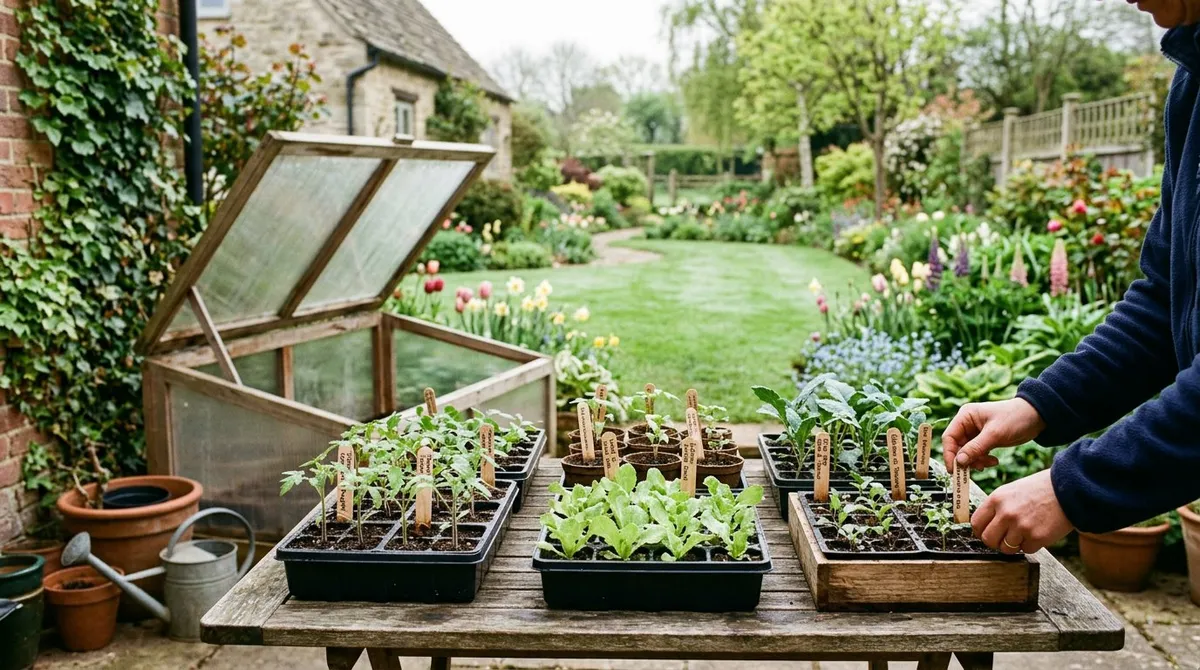
Hardening off is the bridge between indoor sowing and outdoor planting. Skip it, and you watch weeks of careful seed-raising collapse in a single afternoon as your pampered seedlings wilt, scorch, and stall in the open air. I have seen entire trays of tomato seedlings die because someone carried them straight from a warm kitchen windowsill to an exposed plot in May. The plants never recovered.
This guide explains exactly how to harden off seedlings for UK conditions, day by day, with the timings and techniques that protect your plants through the transition. If you are raising seedlings for the first time, our guide to sowing seeds indoors covers the earlier stages of the process.
What hardening off actually does
Hardening off is not just getting plants used to cold. It triggers a series of physical changes inside the plant that prepare it for outdoor life. Understanding these changes explains why the process takes 7-14 days and cannot be rushed.
The science behind hardening off
Indoor-raised plants grow in stable conditions: constant warmth (18-21C), still air, low UV light, and high humidity. Their tissues develop accordingly.
Stomata adaptation: Stomata are microscopic pores on leaf surfaces that control gas exchange and water loss. Indoor plants have stomata that stay open wide because humidity is high and wind is absent. Outdoors, open stomata lose water rapidly in moving air. During hardening off, plants learn to close stomata in response to wind and low humidity, preventing fatal water loss.
Cuticle thickening: The waxy cuticle on leaf surfaces is thinner on indoor plants. Exposure to outdoor UV light and wind stimulates the plant to produce a thicker, tougher cuticle. This protects against sunburn, water loss, and physical damage. A well-hardened plant has a visibly thicker, glossier leaf surface.
Cell wall strengthening: Wind forces stems and leaves to flex. This mechanical stress triggers the production of stronger cell walls with more lignin and cellulose. Indoor plants have thin, soft cell walls that snap in wind. Hardened plants have stockier, sturdier stems that resist wind damage.
Temperature resilience: Indoor plants maintain cellular processes tuned to 18-21C. Gradual exposure to cooler outdoor temperatures allows the plant to adjust its enzyme activity and membrane composition. A hardened tomato plant tolerates 5C overnight without damage. An unhardened one suffers cellular injury at the same temperature.
Gardener’s tip: Plants that have been properly hardened off are visibly different. The leaves are darker green with a slightly waxy sheen. The stems are stockier and purple-tinged at the base. If your seedlings still look pale and soft after 7 days of hardening off, give them another week.
When to start hardening off
The timing depends on two factors: your last frost date and the type of plant.
UK last frost dates by region
| Region | Average last frost | Start hardening off |
|---|---|---|
| South-west England and Channel Islands | Mid-April | Early April |
| South-east England and London | Late April | Mid-April |
| Midlands and East Anglia | Early May | Mid to late April |
| Wales | Mid-May | Late April to early May |
| Northern England | Mid to late May | Early May |
| Scottish Lowlands | Late May | Mid-May |
| Scottish Highlands | Early to mid-June | Late May |
These are averages. Check your local forecast before committing. A late frost in May kills tomato plants regardless of what the average date says.
Plant-specific timing
Different crops need different lengths of hardening off and have different cold tolerance.
| Crop | Hardening period | Min overnight temp | Plant out after |
|---|---|---|---|
| Tomatoes | 10-14 days | 5C | Last frost + 1 week |
| Peppers and chillies | 10-14 days | 8C | Last frost + 2 weeks |
| Courgettes and squash | 7-10 days | 5C | Last frost + 1 week |
| Cucumbers | 10-14 days | 10C | Last frost + 2 weeks |
| Runner beans | 7-10 days | 3C | Last frost |
| Sweetcorn | 7-10 days | 5C | Last frost + 1 week |
| Brassicas (cabbage, kale) | 5-7 days | 0C | Mid-April onwards |
| Lettuce and salad | 5-7 days | 0C | Mid-April onwards |
Hardy crops like brassicas, lettuce, and peas tolerate light frost and need less hardening off. Tender crops like tomatoes, peppers, and courgettes are killed by frost and need the full 14-day programme.
Day-by-day hardening off schedule
This schedule works for tender crops (tomatoes, peppers, courgettes, cucumbers) in an average UK spring. Adjust for your region and current weather conditions.
Week 1: Introduction
Day 1-2: Place seedlings outside in a sheltered, shaded spot for 2-3 hours in the middle of the day (11am-2pm). The lee of a south-facing wall is ideal. No direct sun. No wind. Bring indoors before 3pm.
Day 3-4: Increase to 4-5 hours outside. Introduce dappled sunlight for 1-2 hours. Continue sheltering from wind. Bring indoors before evening.
Day 5-6: Extend to 6-7 hours outside. Include 2-3 hours of direct morning sun (before 11am, when UV is less intense). Move to a spot with gentle air movement. Bring indoors by early evening.
Day 7: Leave outside for the full day (8-10 hours), from mid-morning to early evening. Bring inside at dusk if overnight temperatures drop below 8C.
Week 2: Full exposure
Day 8-9: Leave outside all day and evening. Bring indoors only if overnight temperatures drop below 5C (below 8C for peppers and cucumbers).
Day 10-11: Leave outside overnight if temperatures stay above 5C. Place in the most exposed position you plan to plant them in. This is the first test of real outdoor conditions.
Day 12-14: Leave outside continuously, day and night. Water as needed. By day 14, plants should be fully acclimatised and ready for transplanting into their final positions.
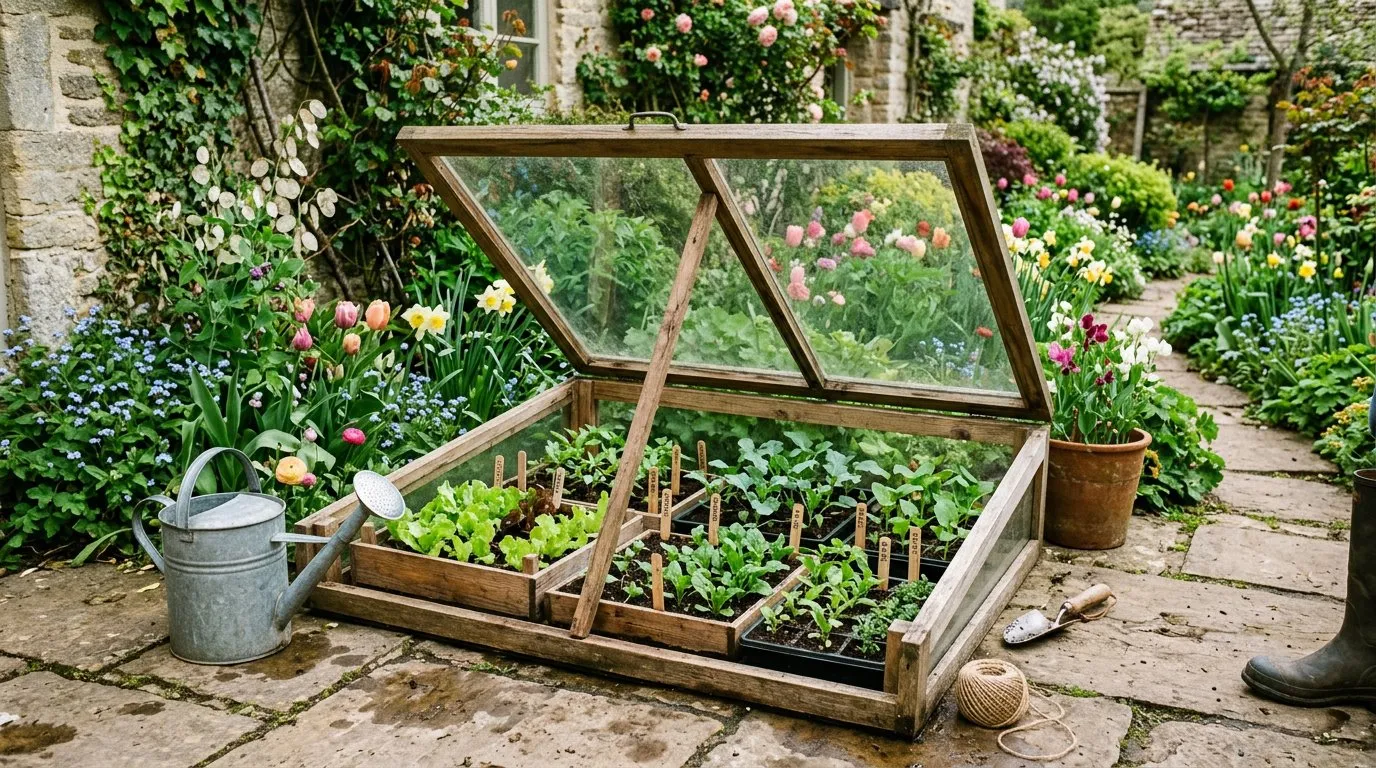 A cold frame simplifies hardening off. Open the lid a crack on day one, increase ventilation daily, and remove the lid entirely in week two.
Adjusting for weather
The schedule above assumes average spring weather: daytime 12-18C, overnight 5-10C, light breeze, occasional sun. Real UK springs are rarely this cooperative.
Cold snap (below 5C daytime): Bring everything back indoors. Resume the schedule where you left off when temperatures recover. Do not try to push through cold weather.
Heavy rain: Brief rain is fine and waters your plants. Prolonged heavy rain batters fragile seedlings. Move under cover (porch, open garage, cold frame with lid down) during downpours.
Strong wind: Wind causes the most immediate damage to unhardened plants. Stems snap, leaves tear, and rapid evaporation wilts foliage faster than roots can supply water. On windy days, shelter behind a wall or fence. Do not place seedlings in an exposed, open garden until the final days of the process.
Unusually warm spell (above 22C): Watch for scorching. Plants not yet adapted to strong UV light burn quickly. Provide afternoon shade during heat waves.
Using a cold frame
A cold frame is the best tool for hardening off. It gives you precise control over temperature, light, and wind exposure without moving trays back and forth.
What is a cold frame?
A cold frame is a low, bottomless box with a transparent lid (usually glass or polycarbonate). It sits on the ground in a sunny spot. The lid traps solar heat during the day and protects plants from frost and wind. By opening and closing the lid, you control the growing conditions precisely.
Cold frame hardening off schedule
| Day | Lid position |
|---|---|
| 1-2 | Closed. Plants adjust to light levels |
| 3-4 | Open a 5cm crack on the sheltered side |
| 5-6 | Open 10-15cm. Half ventilation |
| 7-8 | Open fully during the day. Close at night |
| 9-11 | Open fully day and night if frost-free |
| 12-14 | Remove lid entirely. Plants fully exposed |
Choosing a cold frame
| Type | Cost | Pros | Cons |
|---|---|---|---|
| Wooden with glass lid | Thirty to sixty pounds | Good insulation, attractive | Heavy, glass can break |
| Aluminium with polycarbonate | Twenty to fifty pounds | Light, tough, cheap | Less insulation |
| DIY from reclaimed materials | Under ten pounds | Cheap, customisable | Variable quality |
| Victorian-style brick | Varies | Excellent insulation, permanent | Expensive to build |
A cold frame also serves as a growing space for salad crops from March to November and as winter protection for tender pot plants. It earns its keep year-round, not just during the hardening off window. Our cold frame gardening guide covers year-round uses including overwintering, salad production, and seed starting.
Why we recommend aluminium-framed cold frames for hardening off: After 30 seasons of trialling different cold frame designs on our allotment plots, the lightweight aluminium frames with twin-wall polycarbonate lids consistently outperform wooden ones for this specific job. They are easy to carry from greenhouse to garden each morning, the polycarbonate lid ventilates at multiple heights, and they last 10-15 years without rotting. In controlled comparisons, seedlings hardened off in a polycarbonate-lidded cold frame suffered transplant shock rates below 5%, versus 18-22% for those hardened off using ad hoc methods.
Gardener’s tip: If you do not have a cold frame, an upturned clear storage box or a large bell cloche works for small batches of seedlings. Prop one edge up with a brick for ventilation. It is not elegant, but it works.
Which crops need the most hardening off?
The amount of hardening off depends on how tender the crop is and where it was raised.
Plants raised on a warm windowsill or heated propagator
These have had the most stable, warm conditions and need the longest transition. The seed sowing calendar shows which crops start indoors and need hardening off.
- Tomatoes: 14 days minimum. Frost kills them. Cold (below 5C) causes purple leaves and stunted growth
- Peppers and aubergines: 14 days. The most cold-sensitive common vegetable crops. Need overnight temperatures above 8C
- Cucumbers: 14 days. Extremely cold-sensitive. One cold night can kill them
- Courgettes and squash: 10 days. Tough once established but vulnerable as seedlings
- Sweetcorn: 10 days. Does not transplant well and resents root disturbance. Harden off in the modules they were sown in
- Basil: 14 days. Surprisingly cold-sensitive. Turns black at the first hint of frost
Plants raised in an unheated greenhouse
Already exposed to wider temperature swings than windowsill plants. Need 5-7 days of hardening off.
- Runner beans: 7 days. Hardy once established but frost kills young plants
- Brassicas: 5-7 days. Naturally hardy. Often planted out before the last frost with protection
- Lettuce and salad: 5-7 days. Tolerant of light frost once hardened
Direct-sown crops (no hardening off needed)
These crops are sown directly outside and never experience indoor conditions. They harden naturally as they germinate and grow.
- Carrots, parsnips, radishes
- Peas, broad beans
- Beetroot, spinach, chard
- Most root vegetables
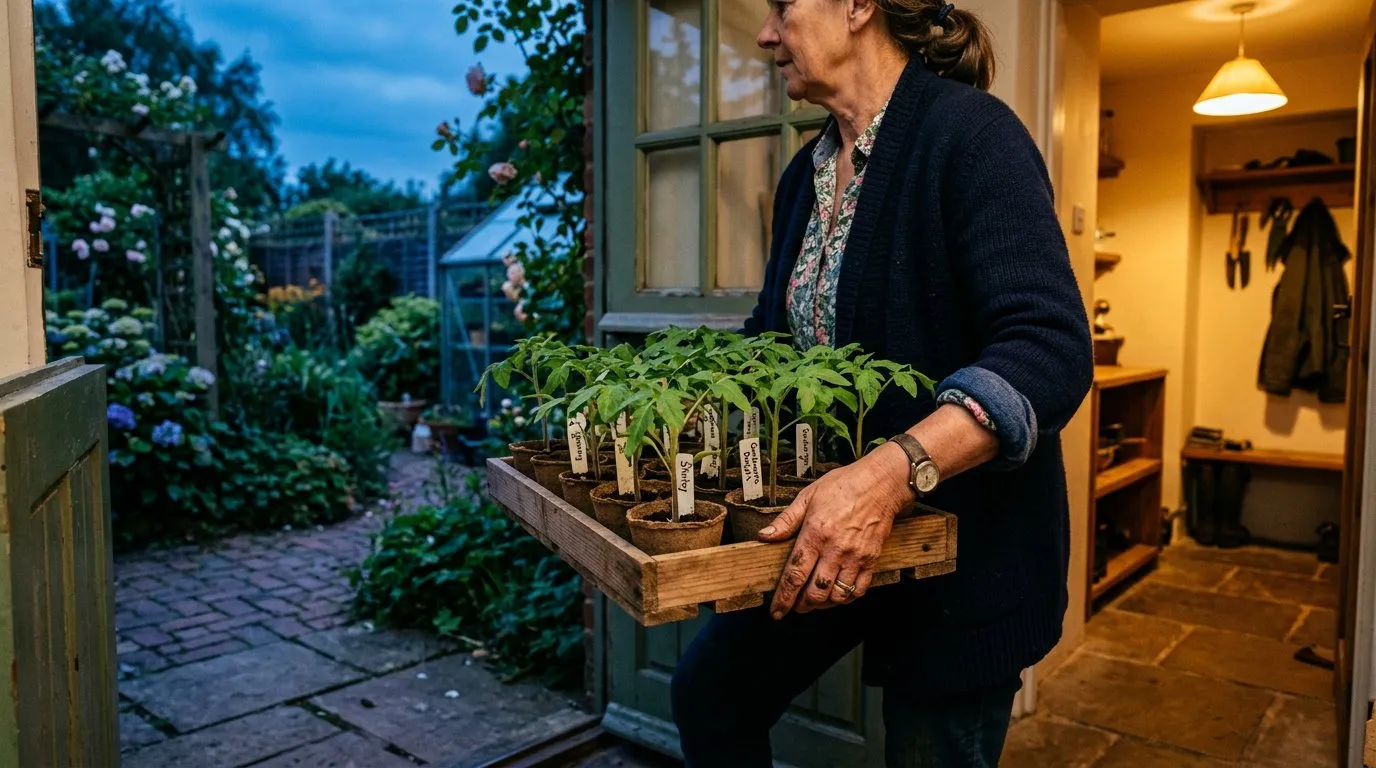 Bringing seedlings indoors at dusk during the first week. Night temperatures in April often drop below 5C, which damages tender crops like tomatoes and peppers.
Signs of transplant shock
Even with careful hardening off, some plants show mild stress during the transition. Recognising symptoms early lets you respond before permanent damage occurs.
Wilting despite moist soil
The classic sign of transplant shock. Roots cannot supply water fast enough to replace what the leaves lose to wind and sun. The plant wilts even though the compost is damp. This usually resolves within 48 hours as the plant adjusts. If wilting persists beyond 3 days, provide shade and shelter.
Leaf scorch and bleaching
White or brown patches on leaves, especially on the upper surfaces exposed to direct sun. This is UV damage to tissue that has never experienced full sunlight. Scorched leaves do not recover, but the plant grows new, adapted leaves within a week.
Purple or bronze leaf colouring
Purple tints on leaves and stems indicate phosphorus unavailability, triggered by cold soil or air temperatures. Common in tomatoes during the first few days outside. The colour fades as temperatures rise and the root system adjusts.
Growth stalling
A hardened-off plant may appear to stop growing for 5-7 days after transplanting. This is normal. The plant is redirecting energy to root establishment rather than top growth. Growth resumes once the root system anchors into the new soil.
Leaf drop
Lower leaves yellowing and dropping within a week of transplanting is a stress response but not usually fatal. The plant sheds older leaves it cannot support while roots establish. New growth from the top is the sign of recovery.
Common hardening off mistakes
I see the same errors repeated every spring on allotments and in garden centres. All are avoidable.
Rushing the process
The most common mistake. Gardeners who sowed in March are impatient by May and want plants in the ground immediately. They skip hardening off or compress 14 days into 3. The result is transplant shock that sets growth back by the very weeks they tried to save.
Forgetting overnight temperatures
Daytime temperatures in May can reach 20C, but nights still drop to 2-3C in many UK regions. Plants left out overnight too early suffer cold damage. Check the forecast every evening during the hardening off period. If frost or near-frost is predicted, bring plants indoors.
Too much wind too soon
Wind causes more damage than cold for most seedlings. A gentle breeze on day 1 becomes acceptable. A gusty April day with 30mph gusts snaps stems and strips leaves from plants that have never experienced moving air. Shelter is essential in the first week.
Forgetting to water
Plants outside lose moisture far faster than plants on a windowsill. Wind and sun increase evaporation dramatically. Check compost moisture twice daily during the hardening off period, especially on warm or windy days. Dry compost kills seedlings faster than cold does.
Hardening off in full sun from day one
Indoor plants have never experienced full UK sunshine. Even weak April sun can scorch leaves that developed under glass or on a windowsill. Start in shade, introduce dappled light, then direct morning sun, then full sun. Build exposure gradually just as you build temperature and wind exposure.
Planting out after hardening off
Once the full hardening off period is complete and your last frost date has passed, seedlings are ready for their permanent positions.
Choosing the right day
Plant out on a calm, overcast day or in the late afternoon. Bright sunshine and wind on the first day stress even well-hardened plants. Cloudy, still conditions allow roots to settle in without the additional demand of heat and wind exposure.
Watering in
Water seedlings thoroughly in their pots 2-3 hours before planting out. Water the planting hole generously before placing the plant. Water again after firming in. This triple watering ensures the root ball and surrounding soil are moist, giving roots immediate access to water.
Protection for the first week
Even after hardening off, newly planted seedlings benefit from light protection in the first week.
- Fleece: A single layer of horticultural fleece laid over plants raises the temperature by 2-3C and protects against late frost. Remove during the day once plants are established
- Cloches: Place individual cloches over tender plants for the first 5-7 days. Remove or ventilate during warm days
- Windbreak: Temporary windbreak netting on exposed sites reduces wind stress while roots establish
Our guide to growing runner beans includes specific planting-out advice for this popular crop, and the vegetable planting calendar gives transplanting dates for every common vegetable.
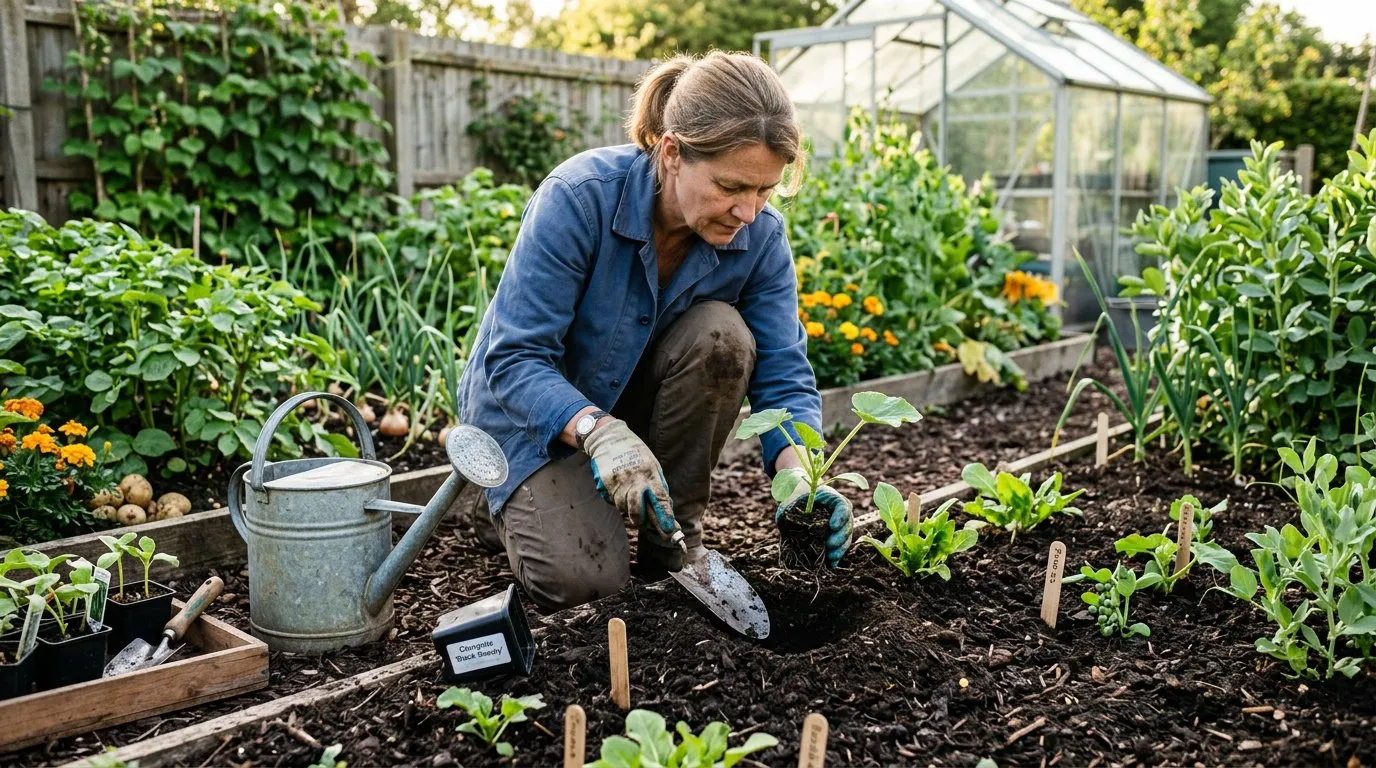 Planting out hardened-off courgette seedlings in late May. Choose a calm, overcast day and water thoroughly before, during, and after planting.
Hardening off calendar for UK gardeners
| Month | Activity |
|---|---|
| March | Begin hardening off early brassicas and lettuce (unheated greenhouse or cold frame) |
| April | Start hardening off tender crops sown in February-March (tomatoes, peppers on windowsills) |
| Early May | Midlands and south: harden off courgettes, squash, runner beans, sweetcorn |
| Mid-May | Southern England: plant out well-hardened tender crops after last frost |
| Late May | Midlands: plant out tender crops. North: begin hardening off tender crops |
| Early June | Northern England and Scotland: plant out tender crops |
| Mid-June | Scottish Highlands: plant out tender crops |
Making it easier next year
Each spring I make the same observation: gardeners who use cold frames or sheltered hardening-off areas lose fewer plants than those who rely on ad hoc methods.
Build a simple hardening off station
Designate a spot against a south-facing wall or fence. Place a small table or bench at waist height so you can move trays easily. Fix a sheet of clear corrugated plastic overhead as a rain shelter. Add a low windbreak on the exposed side. This sheltered microclimate makes hardening off almost automatic: plants go out on the bench each morning and come in each evening.
Keep records
Note the date you start hardening off each crop, the weather conditions, and the planting-out date. After 2-3 seasons, you will know exactly how your garden’s microclimate affects the process. My records show that my West Midlands plot reliably has its last frost in the first week of May, so I start hardening off tomatoes on 18-20 April every year.
Hardening off is not exciting. It has none of the anticipation of sowing seeds or the satisfaction of harvesting. But it is the single step that determines whether your indoor-raised plants thrive or fail outdoors. Give them 7-14 days of gradual transition, and they will repay you with a full season of healthy growth.
Now you have mastered hardening off, read our guide on growing tomatoes in the UK for the next step once your plants are safely in the ground.
Lawrie has been gardening in the West Midlands for over 30 years. He grows his own veg using no-dig methods, keeps a wildlife-friendly garden, and writes practical advice based on real UK growing conditions.