How to Lay Turf: Step by Step Guide
A practical step-by-step guide to laying turf in the UK. Covers soil preparation, laying technique, watering, aftercare, costs, and the best time of year.
Key takeaways
- Autumn (September to November) is the best time to lay turf in the UK, followed by spring (March to April)
- Prepare the soil by digging to 15cm depth, removing stones and weeds, then levelling and firming
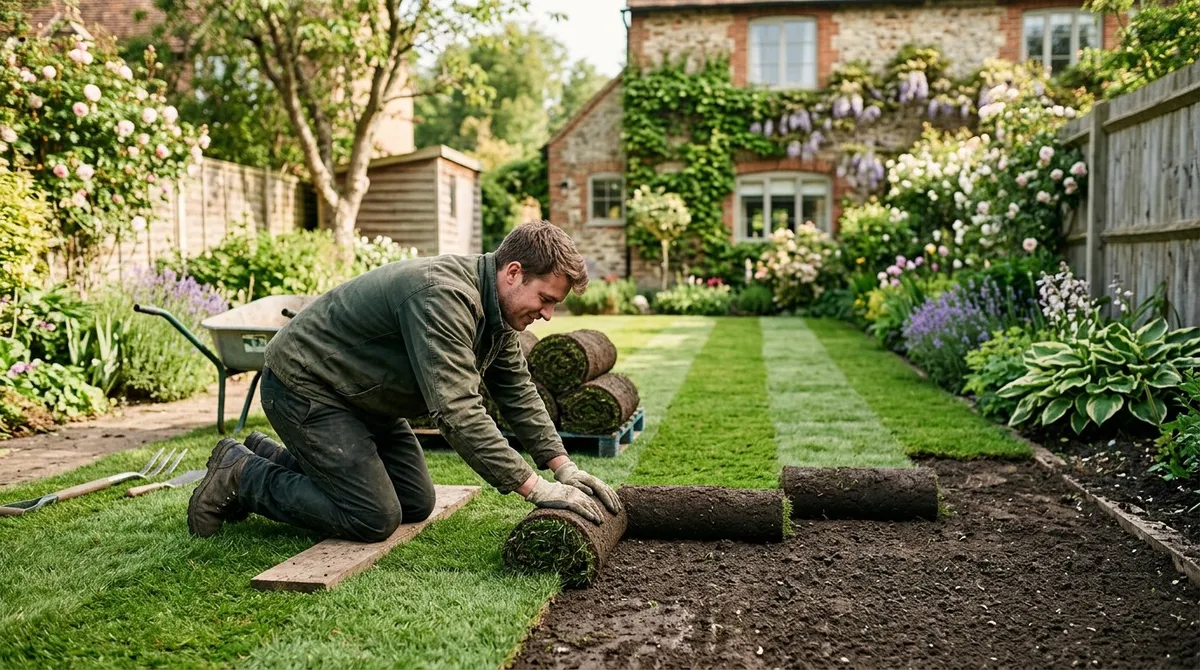
- Lay turf in a brick bond pattern with tight joints and stagger each row by half a roll
- Water new turf daily for the first 14 days and every other day for weeks 3 and 4
- Wait until grass reaches 5cm tall before the first mow, typically 3 to 4 weeks after laying
- Order 5% more turf than the measured area to allow for cutting and waste at edges
A new lawn is one of the fastest transformations in gardening. Bare soil becomes green, usable ground in a single day. Turf gives you what seed cannot: an instant result with full coverage, no patchy germination, and far fewer weeds in the critical first months.
The process is straightforward, but the details matter. Poor soil preparation is the reason most turfed lawns fail within a year. Rushing the levelling, skipping the firming, or forgetting to water through the first fortnight leads to a lawn that lifts, browns, or develops bumps. This guide covers every step from measuring your site to the first mow, with specific timings and quantities for UK conditions.
When is the best time to lay turf?
Timing affects how quickly turf roots and how much watering it needs. The UK climate gives you two good windows and one to avoid.
Autumn (September to November) is the ideal period. Soil retains warmth from summer, rainfall increases naturally, and the grass has a full winter and spring to establish before the next dry spell. Turf laid in October often needs no supplementary watering at all.
Spring (March to April) is the second-best window. Soil is warming, daylight is increasing, and there is usually enough rain to support establishment. The risk is a dry May or June before roots have fully formed. Budget for regular watering if spring turns dry early.
Summer (June to August) is the worst time. High temperatures stress freshly laid turf, and water demand is relentless. A missed watering day in July can kill new turf within 48 hours. If you must lay in summer, water twice daily and accept higher costs.
Gardener’s tip: Check the 10-day weather forecast before ordering turf. Ideally, you want mild, overcast weather with some rain in the days after laying. Avoid laying before a heatwave.
Measuring your lawn area and ordering turf
Accurate measurement prevents waste and shortfall. Both cost you time and money.
How to measure
Break the area into rectangles and triangles. Measure each section in metres using a tape measure, then calculate the area. For rectangles, multiply length by width. For triangles, multiply base by height and divide by two. Add all sections together for the total.
For curved lawns, measure the smallest rectangle that would contain the curve, then subtract roughly 20% for the curved edges. This gives a close-enough figure without complex geometry.
How much extra to order
Order 5% more turf than your measured area. This covers trimming at edges, around beds, paths, and any damaged rolls. For lawns with many curves or obstacles, increase the surplus to 8-10%.
A standard turf roll in the UK measures roughly 1m x 0.4m, covering 0.4m2. Some suppliers sell larger rolls of 1m x 1m for professional landscapers. Check roll size when comparing prices, as some quote per roll rather than per square metre.
Choosing the right turf type
Not all turf is the same. Choosing the right variety for your conditions saves problems later.
| Turf type | Best for | Shade tolerance | Wear tolerance | Cost per m2 | Notes |
|---|---|---|---|---|---|
| Standard lawn turf | General gardens | Moderate | Good | 1.50 to 2.50 | Most common, suits most UK gardens |
| Premium ryegrass blend | Family lawns, high traffic | Moderate | Excellent | 2.50 to 4.00 | Recovers quickly from wear |
| Fine fescue lawn | Ornamental lawns | Good | Low | 3.00 to 5.00 | Tight, fine-leaved finish |
| Shade-tolerant turf | Under trees, north-facing | Excellent | Moderate | 3.50 to 6.00 | Contains shade-adapted species |
| Hard-wearing utility | Play areas, paths | Low | Excellent | 2.00 to 3.50 | Coarser appearance, very durable |
| Wildflower turf | Wildlife gardens | Varies | Low | 6.00 to 12.00 | Pre-grown with native wildflowers |
Standard lawn turf suits 80% of UK gardens. It contains a mix of perennial ryegrass and fescue that handles sun, moderate shade, and regular foot traffic. Only choose a specialist variety if you have a specific problem to solve, such as heavy shade or a bowling-green finish.
How to prepare the soil for turf
Soil preparation determines whether your lawn succeeds or fails. This step takes the most time but repays every minute invested.
1. Clear the site
Remove all existing vegetation. If there is old grass, strip it off with a sharp spade or hire a turf cutter for large areas. Dig out perennial weeds including dandelions, docks, and bindweed. Every weed root left behind will push through the new turf.
For sites overrun with weeds, consider treating with glyphosate 2 to 3 weeks before preparation. This kills roots that hand-weeding misses. Wait until the weeds have fully died back before digging.
2. Dig and break up the soil
Dig the entire area to a depth of 15cm using a garden fork or rotavator. This breaks up compaction and allows roots to penetrate. On heavy clay, work in generous amounts of sharp sand or grit to improve drainage. On very sandy soil, add organic matter to improve moisture retention.
If your soil is heavy clay, this step is especially important. Clay compacts easily and holds water in winter. Working in 5cm of sharp sand and 5cm of compost before laying gives roots a much better start.
3. Level the surface
Rake the dug soil to a smooth, even surface. Break up lumps larger than a golf ball. Remove all stones, roots, and debris from the top 5cm. Use a long spirit level or a straight plank to check levels across the area.
The finished surface should sit roughly 2.5cm below any adjacent paths, patios, or edging. This allows for the turf thickness and ensures the finished lawn sits flush with its surroundings.
4. Firm the soil
Walk slowly across the entire area, placing your feet side by side in small overlapping steps. This is called “heeling in” and firms the soil evenly without over-compacting it. After firming, rake lightly to remove footprints and re-level any bumps.
The soil should feel firm underfoot but not rock-hard. If you sink in more than 1cm, the soil is too soft. If you cannot push a finger in 2cm, it is too compacted. Getting this balance right prevents the lawn developing humps and hollows later.
5. Apply a pre-turf fertiliser
Scatter a granular pre-turf fertiliser across the prepared surface at the rate stated on the packet, typically 35-70g per square metre. Rake it lightly into the top 2cm of soil. This provides phosphorus for root development and a balanced feed to support establishment.
Do not use a general lawn feed here. Pre-turf fertilisers are high in phosphorus, which drives root growth. Standard lawn feeds are high in nitrogen, which pushes leaf growth at the expense of rooting.
Why we recommend a premium ryegrass blend for family lawns: After 30 years of laying and maintaining turf across a range of UK gardens, perennial ryegrass blends consistently outperform standard lawn turf in gardens that see regular foot traffic. In my experience, a quality ryegrass blend recovers from a worn patch in 3-4 weeks compared to 8-10 weeks for cheaper standard turf. Choose a blend with at least 80% perennial ryegrass by seed weight if children or pets will use the lawn regularly.
How to lay turf: step by step
With the soil prepared, laying turf is a methodical process. Work in a logical order and avoid walking on freshly laid rolls.
Step 1: Start with a straight edge
Begin along the longest straight edge, such as a path, fence line, or boundary. Unroll the first strip of turf along this edge, pressing it firmly against the soil. Do not stretch or overlap the turf. It should lie flat without wrinkles or air pockets.
Step 2: Lay in a brick bond pattern
Start the second row with a half-roll to create a brick bond pattern, like brickwork in a wall. This prevents continuous lines across the lawn where joints would otherwise align. Cut the half-roll with a sharp knife or old bread knife.
Butt each roll tightly against its neighbour. Push edges together firmly so there are no visible gaps. Even a 5mm gap dries out quickly and leaves a brown line that takes weeks to fill in.
Step 3: Work forwards, stand on boards
Always work forwards off the prepared soil, laying turf in front of you. When you need to stand on freshly laid turf, place a plank across it to spread your weight. Never walk directly on new turf, as this creates dips and pushes the rolls out of alignment.
Step 4: Trim edges and curves
Use a sharp half-moon edging iron or a long-bladed knife to cut turf around beds, paths, and curves. Always use full rolls in prominent positions and place offcuts in the middle of the lawn where they are less visible. Never put a small piece at an edge, as it dries out and shrinks.
Step 5: Roll or firm the surface
After laying, use a garden roller or the back of a rake to press the turf into firm contact with the soil. This removes air pockets and ensures the roots can reach the prepared surface beneath. Go over the entire area at least once, working in straight lines.
Gardener’s tip: If you do not own a roller, walk over the entire lawn on planks. This achieves the same result without buying or hiring equipment.
Watering new turf: the critical first weeks
Watering is the most important aftercare task. Get it wrong and the turf dies before it roots.
The first 14 days
Water every day for the first two weeks. Each session should soak the turf and the soil beneath to a depth of at least 10cm. Lift a corner to check: the underside of the turf should be damp, and the soil below should be moist to your finger depth.
Water in the early morning if possible. This gives the grass all day to absorb moisture before evening. Avoid watering in the heat of midday, as much of it evaporates before reaching the roots.
How much water? A new lawn needs roughly 10 litres per square metre per day in dry conditions. For a 50m2 lawn, that is 500 litres daily. A standard hose delivers about 15 litres per minute, so you need 30 to 35 minutes of watering to cover the full area.
Weeks 3 and 4
Reduce watering to every other day. The turf should be rooting by now. Test by gently pulling up a corner. If you feel resistance, roots are growing into the soil.
After 4 weeks
Water only during dry spells. Established turf in the UK rarely needs regular watering outside prolonged summer droughts. Over-watering at this stage encourages shallow rooting, which weakens the lawn long-term.
When to mow new turf for the first time
The first mow is a landmark moment, but cutting too early damages the developing roots.
Wait until the grass reaches 5cm tall before the first cut. This typically takes 3 to 4 weeks in autumn and 2 to 3 weeks in spring. Set the mower to its highest setting and remove no more than one-third of the grass height. Use a sharp-bladed mower rather than a rotary, as rotary mowers can pull at turf that has not fully rooted.
For the second and third cuts, gradually lower the blade by one setting each time. By the sixth cut, you should be mowing at your preferred height, typically 2.5 to 4cm for a family lawn.
Do not use a heavy cylinder mower for the first three cuts. Its weight can press the turf into the soil unevenly. A lightweight rotary or hover mower is gentler on new grass.
Month-by-month establishment calendar
This calendar shows what to do after laying turf, assuming an autumn lay date. Adjust timing by 2 to 3 weeks for spring laying.
| Month | Task | Detail |
|---|---|---|
| Month 1 (laying month) | Water daily, no foot traffic | Soak to 10cm depth daily for 14 days, then every other day. No walking on the lawn |
| Month 2 | First mow, light use only | Mow at highest setting when grass is 5cm tall. No heavy use or garden furniture |
| Month 3 | Regular mowing begins | Gradually lower cutting height. Light foot traffic is now acceptable |
| Month 4 | Apply autumn or spring feed | Use a seasonal lawn feed appropriate to the time of year. Water in if no rain |
| Month 5 | Normal lawn use | The lawn is fully rooted. Resume all normal activities including children’s play |
| Month 6 | Assess and repair | Fill any gaps with seed. Address any drainage issues. Begin regular maintenance schedule |
Turf vs seed: which is better?
Both methods produce a good lawn. The right choice depends on budget, timeframe, and conditions.
| Factor | Turf | Seed |
|---|---|---|
| Time to usable lawn | 4 to 6 weeks | 8 to 14 weeks |
| Cost per m2 | 1.50 to 6.00 | 0.20 to 0.80 |
| Weed risk in first year | Low | High |
| Best season | Autumn, spring, or mild winter | April to September |
| Slope suitability | Excellent (stays in place) | Poor (washes away on slopes) |
| Shade tolerance | Choose shade variety | More shade-tolerant species available |
| Instant result | Yes | No |
| Skill level needed | Moderate | Low |
Choose turf when you want a usable lawn quickly, the site is on a slope, or you need to minimise weed competition. Choose seed when budget is tight, you have a very large area, or you want access to specialist grass varieties not available as turf.
For most UK gardens under 100m2, turf is the better option. The price difference per square metre is significant, but the time saving, weed suppression, and immediate result justify the cost for smaller lawns.
Common mistakes when laying turf
These are the errors that cause turfing projects to fail. Avoid all of them.
Not preparing the soil properly. This is the number one cause of failed lawns. Laying turf on compacted, stony, or unlevelled soil produces a bumpy, poorly draining lawn that deteriorates within months. Spend more time on preparation than on laying.
Leaving gaps between rolls. Even small gaps dry out and turn brown. They also allow weeds to establish in the joint. Push rolls tightly together, applying gentle pressure from the sides.
Laying turf on old grass. The buried grass rots, creating a soggy, uneven layer. New roots cannot penetrate decomposing turf. Always strip old grass first and prepare the bare soil underneath.
Waiting too long after delivery. Turf is a living product. Rolled turf generates heat inside the roll and begins to yellow within 24 hours in warm weather. Lay turf on the day it arrives. If you cannot lay it all, unroll the remaining strips on a hard surface and water them.
Forgetting to water. New turf has no root system. It relies entirely on surface watering until roots form, which takes 2 to 3 weeks. Missing even one day of watering in dry conditions can cause irreversible damage.
Walking on new turf. Foot traffic pushes the turf into the soft soil, creating dips. It also separates the turf from the soil, breaking the contact that roots need. Use planks if you must cross a newly laid lawn.
Cutting too early or too short. The first mow should wait until the grass is 5cm tall. Cutting shorter than 4cm on the first pass tears at turf that has not fully rooted, pulling it away from the soil.
Aftercare schedule for new turf
A newly laid lawn needs active care for 6 months. After that, it joins your regular spring gardening and seasonal maintenance routine.
Weeks 1 to 2
Water daily. No foot traffic at all. Keep children, pets, and garden furniture off the turf. Watch for edges curling up, which signals insufficient watering. Press curled edges back down and soak thoroughly.
Weeks 3 to 4
Reduce watering to every other day. The turf should be gripping the soil. Give the first mow when grass is 5cm tall, at the highest blade setting. Remove no more than one-third of the height.
Months 2 to 3
Mow weekly, gradually lowering the blade. Light foot traffic is now safe. Apply a liquid lawn feed if growth looks slow or the colour is pale.
Months 4 to 6
The lawn is establishing fully. Apply a seasonal granular feed. Address any remaining bare patches by overseeding. Begin regular weed management if needed.
Beyond 6 months
Treat as an established lawn. Annual aeration, scarification, feeding, and overseeding keep it in top condition. Adding mulch to surrounding borders helps prevent soil from washing onto the lawn edges during heavy rain.
Dealing with problem areas
Some sites need extra attention during turfing. Plan for these before you start laying.
Slopes
Lay turf across the slope, not up and down it. This prevents the rolls sliding downhill. On steep slopes (steeper than 1 in 3), peg each roll in place with wooden pegs until the roots establish. Use two pegs per roll, one at each end.
Shaded areas
Under trees and beside fences, choose shade-tolerant turf containing fine fescues. Standard ryegrass blends struggle in less than 4 hours of direct sunlight. Accept that shaded turf grows more slowly, needs less mowing, and should be cut 1cm higher than the rest of the lawn.
New-build gardens
Builder’s rubble, compacted subsoil, and poor drainage are common on new-build sites. Expect to remove rubble from the top 20cm, rotavate the subsoil thoroughly, and add 50mm of quality topsoil before laying. Budget an extra 5 to 10 pounds per square metre for topsoil.
Around existing trees
Leave a 10cm gap between turf and tree trunks. Turf pressed against bark traps moisture and can cause rot. Keep this gap clear with a half-moon edging iron once the lawn is established.
Laying turf in spring: specific advice
Spring laying works well but demands more attention than autumn. Soil temperatures in March sit around 6 to 8C, rising to 10 to 12C by April. Roots grow more slowly in cool soil, so establishment takes 6 to 8 weeks rather than autumn’s 4 to 6 weeks.
The key risk is a dry spring. April and May can bring extended dry periods, and a new lawn with shallow roots is vulnerable. Budget for daily watering through any dry spell and consider connecting a sprinkler to a timer for consistency.
Spring-laid turf benefits from a pre-turf fertiliser rich in phosphorus. This compensates for the slower root growth by making nutrients immediately available at the soil surface.
What does turf cost for a typical UK garden?
Understanding the full cost helps you budget accurately. Turf is only part of the bill.
| Item | Cost for 50m2 garden |
|---|---|
| Standard lawn turf (52.5m2 with 5% extra) | 79 to 131 pounds |
| Premium ryegrass turf (52.5m2) | 131 to 210 pounds |
| Topsoil (if needed, 2.5 tonnes) | 80 to 150 pounds |
| Pre-turf fertiliser | 8 to 15 pounds |
| Turf cutter hire (half day) | 50 to 80 pounds |
| Garden roller hire (weekend) | 20 to 30 pounds |
| Total (standard turf, with topsoil) | 237 to 406 pounds |
| Total (standard turf, without topsoil) | 107 to 176 pounds |
Professional turfing services charge 15 to 25 pounds per square metre for supply and laying, including soil preparation. A 50m2 garden laid by professionals typically costs 750 to 1,250 pounds. The DIY approach saves roughly 50 to 60% of this cost.
Final thoughts
Laying turf is a project that rewards careful preparation. The hours spent digging, levelling, and firming the soil pay back in a lawn that roots quickly, drains well, and looks good from day one. Rush the preparation and you spend years dealing with bumps, dips, and poor drainage.
The key steps bear repeating: dig to 15cm, remove every stone and weed root, level the surface, firm it evenly, lay in a brick bond pattern, and water religiously for the first two weeks. Follow this sequence and your new lawn will be fully established within 6 weeks.
For related projects, see our guides on spring gardening jobs, improving clay soil, and using mulch to maintain the borders around your new lawn. The RHS guide to laying turf covers additional detail on grass species selection and regional timing.
Now you’ve mastered laying turf, read our guide on improving clay soil for the next step in getting your lawn and borders into the best possible condition.
Lawrie has been gardening in the West Midlands for over 30 years. He grows his own veg using no-dig methods, keeps a wildlife-friendly garden, and writes practical advice based on real UK growing conditions.