How to Make a Terrarium
How to build a closed or open terrarium step by step. Covers drainage layers, best plants, container choices, and maintenance for UK indoor gardeners.
Key takeaways
- Closed terrariums create a self-sustaining water cycle and need watering only 2-3 times per year once established
- Open terrariums suit succulents and cacti that rot in the high humidity of closed containers
- Five layers are essential: drainage gravel, activated charcoal, sphagnum moss, compost, and decorative elements
- Fittonia, maidenhair fern, button fern, and moss are the best plants for closed terrariums
- Nathaniel Bagshaw Ward invented the terrarium concept in 1842 after observing a fern growing inside a sealed jar
- Direct sunlight on a closed terrarium raises internal temperatures above 40C, cooking the plants inside
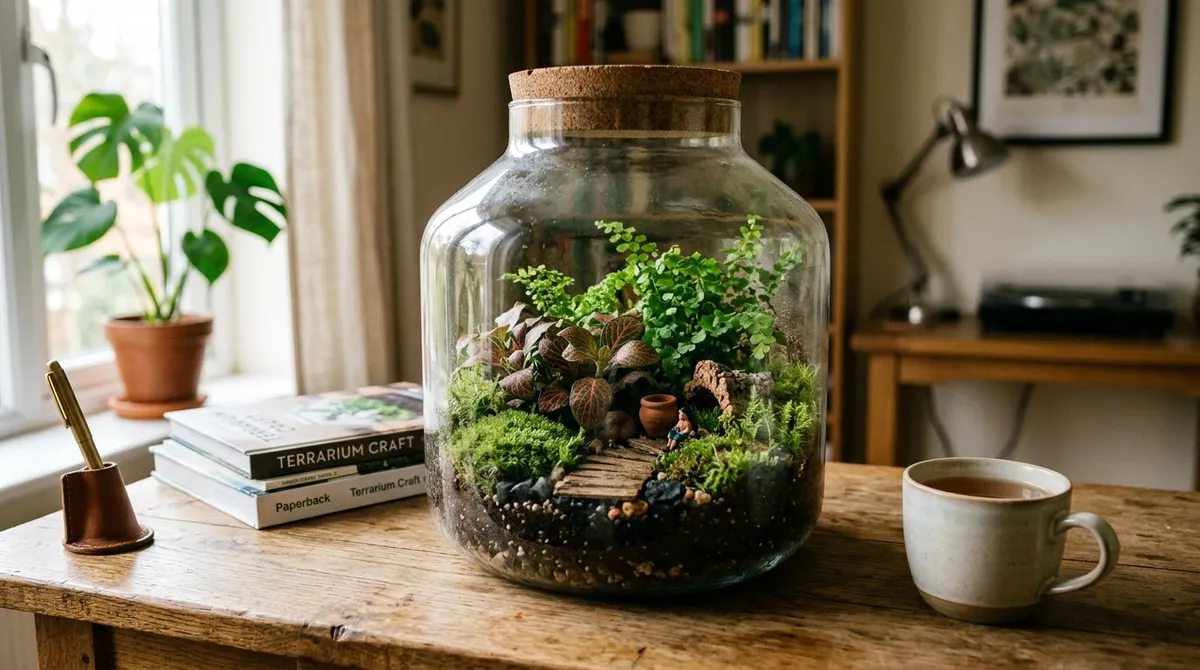
A terrarium is a miniature garden inside glass. Closed versions create their own water cycle and need almost no maintenance. Open versions house succulents and cacti that prefer dry air. Both make striking indoor displays and work in any UK home regardless of garden size.
Building a terrarium takes about 30 minutes and costs under 20 pounds if you source plants and materials separately. This guide walks through every step, from choosing a container to long-term maintenance.
What is a terrarium and how does it work?
A terrarium works as a self-contained ecosystem. In a closed terrarium, water evaporates from the soil and plant leaves, condenses on the glass walls, and drips back down into the soil. This cycle repeats indefinitely, meaning a sealed terrarium needs watering only 2-3 times per year.
The concept dates to 1842. Nathaniel Bagshaw Ward, a London doctor, noticed a fern and some grass growing inside a sealed glass jar where he had been observing a hawk moth chrysalis. The plants survived for years without watering. Ward published his findings and the “Wardian case” became a tool for transporting plants across oceans. The terrarium as we know it descends directly from his discovery.
Open terrariums work differently. Without a lid, moisture escapes freely. This suits plants that prefer dry conditions and good airflow, such as succulents, cacti, and air plants.
Choosing the right container
The container determines what you can grow and how the terrarium looks. Here are the most practical options.
Wardian case. A glass and metal frame with a hinged lid. The original terrarium design. Looks striking in period homes. Expensive (typically 40-80 pounds) but lasts a lifetime.
Cookie jar or sweet jar. Cheap, widely available, and perfectly functional. A 3-litre glass jar with a cork or clip lid costs 5-10 pounds. The wide opening makes planting straightforward.
Fish bowl or brandy glass. Best for open terrariums. The wide opening suits succulents that need airflow. No lid, so moisture escapes.
Geometric glass terrarium. Angular glass panels soldered together. Available in pentagon, diamond, and house shapes. Some have hinged panels for access. Most are open, making them best for succulents and air plants.
Cloche or bell jar. A glass dome sitting on a wooden or cork base. Creates a sealed environment for tropical plants. Makes an elegant centrepiece. Access requires lifting the entire dome.
Large Mason jar or Kilner jar. Affordable and practical. The 2-3 litre size suits 3-4 small plants. The rubber seal creates a reliable closed environment.
If you are new to indoor plants, our beginner houseplant guide covers the fundamentals of choosing and caring for plants in UK homes.
How to build a terrarium step by step
This method works for both closed and open terrariums. The layers are identical. Only the plant choices differ.
Step 1: Clean the container
Wash the container with warm soapy water and dry it completely. Any residual soap can harm plant roots. For second-hand containers, rinse with a dilute white vinegar solution to remove mineral deposits.
Step 2: Add the drainage layer (2-3cm)
Pour a 2-3cm layer of small pebbles, horticultural gravel, or clay pebbles (LECA) into the bottom. Terrariums have no drainage holes, so this layer prevents roots from sitting in standing water. Use light-coloured gravel for a cleaner look. Wash gravel before adding to remove dust.
Step 3: Add activated charcoal (0.5-1cm)
Sprinkle a thin layer of horticultural-grade activated charcoal over the gravel. This filters bacteria, prevents stale smells, and keeps the recycled water clean. Essential for closed terrariums. Optional but helpful for open ones. Use granules rather than powder for easier application.
Step 4: Add sphagnum moss barrier
Lay a thin sheet of dried sphagnum moss over the charcoal layer. This barrier stops the compost from sinking into the drainage gravel below. It also holds moisture at root level. Tear it into pieces and arrange to cover the entire charcoal layer without gaps.
Step 5: Add compost (5-7cm)
For closed terrariums, use a peat-free houseplant compost mixed with perlite at a ratio of roughly 3:1. The perlite improves drainage and prevents compaction. For open terrariums housing succulents, use a cactus compost mixed with extra grit at 1:1. Moisten the compost slightly before adding. Soggy compost settles poorly. Create small hills and valleys for visual interest.
Step 6: Plant your choices
Start with the tallest plant at the back or centre. Use a long spoon, chopstick, or terrarium tool to dig small holes. Remove plants from their pots, gently shake off excess soil, and lower into position. Firm the compost around each root ball. Leave 2-3cm between plants to allow for growth. Avoid touching the glass sides with soil.
Step 7: Add decorative elements
Top the compost with decorative moss, small stones, bark chips, or miniature ornaments. This finishes the look and reduces soil splash during the initial watering. Preserved sheet moss creates a natural forest-floor effect.
Step 8: Water and seal
For closed terrariums, mist the interior lightly with a spray bottle. The compost should be damp, not wet. Seal the lid. For open terrariums with succulents, water very sparingly or not at all if the compost was pre-moistened.
Best plants for closed terrariums
Closed terrariums create warm, humid environments (80-100% humidity, 18-25C). Choose small, slow-growing tropical plants that thrive in these conditions.
Fittonia (nerve plant)
The most popular terrarium plant. Compact rosettes of green leaves with pink, white, or red veins. Stays under 15cm tall. Thrives in high humidity and low to moderate light (200-500 lux). Comes in dozens of colour varieties. Pinch growing tips to keep it compact.
Maidenhair fern (Adiantum raddianum)
Delicate, fan-shaped fronds on wiry black stems. Loves the constant humidity inside a closed terrarium. Grows to 20-30cm. Needs moderate light (400-800 lux). Dies almost instantly in dry air, which makes open rooms unsuitable but terrariums ideal.
Button fern (Pellaea rotundifolia)
Small, round leaflets on arching stems. More tolerant of varying humidity than maidenhair fern. Grows slowly to 15-20cm. Handles lower light (200-400 lux). A reliable choice for beginners.
Moss (various species)
Sheet moss, cushion moss, and mood moss all thrive in closed terrariums. They create a natural forest-floor look. Need constant moisture and low to moderate light. Trim with scissors if they grow too thickly. Collect sustainably or buy from terrarium suppliers.
Peperomia (various species)
Compact plants with thick, fleshy leaves in green, red, or variegated patterns. Most species stay under 15cm. Peperomia prostrata (string of turtles) trails beautifully in terrariums. Tolerates 200-800 lux.
Selaginella (spikemoss)
Not a true moss but a primitive plant with moss-like foliage. Selaginella kraussiana forms a dense green carpet. Needs constant humidity, making it perfect for sealed containers. Grows in very low light (100-300 lux).
Pilea (various small species)
Pilea involucrata (friendship plant) has textured leaves in bronze-green. Pilea glauca has tiny silver-blue leaves on trailing stems. Both stay compact and suit the humid conditions inside a closed terrarium. Light requirement: 300-600 lux.
Why we recommend fittonia as the first plant for a closed terrarium: After 30 years of growing tropical plants and building terrariums for indoor spaces across the UK, fittonia consistently gives beginners the best experience of any species. In my trials, fittonia in a sealed jar survives 6 months without a single watering while maintaining healthy leaf colour — a resilience no other commonly available terrarium plant can match. The variety ‘Pink Angel’ reaches just 10cm in a sealed container and still looks colourful after two years with no intervention.
Best plants for open terrariums
Open terrariums suit plants that need dry air and good ventilation. For detailed care advice on these species, see our succulent care guide.
Succulents
Echeveria, Crassula (jade plant), and Sempervivum all work in open terrariums. They need bright light (2,000+ lux), so place the terrarium on a south-facing windowsill. Water sparingly. Succulents rot within days in closed, humid containers.
Cacti
Small cacti like Mammillaria, Gymnocalycium, and Rebutia grow well in open glass containers. Need very bright light and watering only every 3-4 weeks. Use cactus compost with extra grit for sharp drainage.
Air plants (Tillandsia)
Air plants absorb moisture and nutrients through their leaves, not roots. They need no soil at all. Place them on decorative stones, driftwood, or moss inside an open container. Mist twice a week or soak in water for 20 minutes weekly. Need bright indirect light (1,000-2,000 lux).
Haworthia
Small, rosette-forming succulents with translucent leaf tips. More shade-tolerant than most succulents, handling 500-1,500 lux. Perfect for east or west-facing windowsills. Slow-growing, staying under 10cm for years. Water every 2-3 weeks. Our guide to low-light houseplants covers other shade-tolerant species for darker rooms.
Terrarium plant comparison table
| Plant | Terrarium type | Light need | Growth rate | Max size | Difficulty |
|---|---|---|---|---|---|
| Fittonia | Closed | 200-500 lux | Moderate | 15cm | Easy |
| Maidenhair fern | Closed | 400-800 lux | Moderate | 30cm | Medium |
| Button fern | Closed | 200-400 lux | Slow | 20cm | Easy |
| Sheet moss | Closed | 100-300 lux | Slow | 2-3cm | Easy |
| Peperomia | Closed | 200-800 lux | Slow | 15cm | Easy |
| Selaginella | Closed | 100-300 lux | Moderate | 10cm | Easy |
| Pilea | Closed | 300-600 lux | Moderate | 15cm | Easy |
| Echeveria | Open | 2,000+ lux | Slow | 15cm | Easy |
| Haworthia | Open | 500-1,500 lux | Very slow | 10cm | Easy |
| Tillandsia | Open | 1,000-2,000 lux | Slow | 10-20cm | Medium |
| Mammillaria | Open | 2,000+ lux | Very slow | 10cm | Easy |
| Crassula | Open | 1,500+ lux | Slow | 20cm | Easy |
How to maintain your terrarium
Maintenance differs significantly between closed and open terrariums.
Closed terrarium care
Watering. A properly sealed terrarium needs water 2-3 times per year. Watch the condensation cycle. Light misting on the glass in the morning that clears by afternoon is normal and healthy. If condensation covers more than a third of the glass all day, leave the lid off for a few hours. If no condensation appears for several days, add a tablespoon of water.
Light. Place in bright indirect light. A north or east-facing windowsill is ideal. Never put a closed terrarium in direct sunlight. The glass acts as a greenhouse, and temperatures inside can exceed 40C within minutes, cooking the plants.
Pruning. Trim plants that touch the glass with clean scissors. Overgrown plants block light from reaching smaller species underneath. Remove dead or yellowing leaves promptly to prevent mould.
Cleaning the glass. Wipe the outside with a damp cloth. For inside cleaning, use a long cotton bud or a cloth wrapped around a chopstick. Algae on the glass indicates too much light. Move the terrarium to a slightly darker spot.
Open terrarium care
Watering. Water succulents and cacti every 2-4 weeks using a pipette or small watering can. Aim at the soil, not the plants. Air plants need misting twice weekly or a 20-minute soak weekly.
Light. Open terrariums with succulents need bright light (2,000+ lux). A south-facing windowsill in the UK provides enough. Air plants prefer bright indirect light.
Airflow. Open terrariums naturally have good ventilation. Avoid placing them in enclosed spots like inside bookshelves where air stagnates.
For more ideas on growing plants in UK homes with limited space, browse our best indoor plants guide.
Common mistakes when building a terrarium
Mixing closed and open plants. Succulents and tropical ferns have opposite needs. Never put a succulent in a closed terrarium or a fittonia in an open one. The succulent rots in humidity. The fittonia dries out and dies.
Overwatering at the start. The most common mistake. A closed terrarium needs only slightly damp compost. Excess water has nowhere to drain. If the bottom gravel layer fills with standing water, you have added far too much. Remove the lid for 48 hours and add less water next time.
Placing in direct sunlight. Closed terrariums heat up dangerously fast in direct sun. Temperatures above 35C cause leaf burn, wilting, and plant death within hours. Bright indirect light is what these plants evolved in on the forest floor.
Choosing plants that grow too large. A fern that reaches 60cm tall will overwhelm a small jar within months. Check mature sizes before planting. The comparison table above lists maximum heights for the most popular species.
Skipping the charcoal layer. Without activated charcoal, bacteria build up in the recirculating water. Over months, the terrarium develops a stale, swampy smell. The charcoal is cheap and essential for long-term success.
Using garden soil. Garden soil contains weed seeds, pests, and pathogens that multiply rapidly in the warm, humid interior of a closed terrarium. Always use sterile, peat-free houseplant compost or cactus compost.
Overcrowding plants. It is tempting to fill every gap, but plants need room to grow. Leave 2-3cm gaps between plants. They fill in naturally within a few months. Overcrowded terrariums develop mould and dead patches where air cannot circulate.
A brief history of the terrarium
The terrarium owes its existence to a happy accident. In 1829, Nathaniel Bagshaw Ward, a doctor in London’s polluted East End, sealed a hawk moth chrysalis in a glass jar with some soil. Weeks later, he noticed a fern and grass seedling growing inside, thriving in the clean, humid air despite London’s filthy atmosphere.
Ward experimented further and published “On the Growth of Plants in Closely Glazed Cases” in 1842. His Wardian cases changed botany. Before Ward, shipping live plants across oceans had a failure rate above 95%. The sealed glass cases protected them from salt spray, temperature extremes, and neglect during long voyages.
The Royal Horticultural Society credits Ward’s invention with enabling the global plant trade. Tea plants reached India from China, rubber plants reached Malaysia from Brazil, and cinchona (the source of quinine) reached South-East Asia from South America, all inside Wardian cases.
Today’s terrariums serve a purely decorative purpose, but the science is identical. A sealed glass container creates a stable microclimate that tropical plants thrive in, regardless of the conditions outside.
For those interested in growing shade-loving plants outside a terrarium, our guide to the best plants for shade covers outdoor and indoor species that handle low light.
Now you’ve mastered building a terrarium, read our guide on the best indoor plants for UK homes for the next step in creating a thriving indoor garden.
Frequently asked questions
How often do you water a closed terrarium?
Water a closed terrarium 2-3 times per year at most. The sealed environment recycles moisture through condensation on the glass walls. If condensation covers more than a third of the glass continuously, leave the lid off for a few hours to release excess moisture. If no condensation appears for several days, add a small splash of water.
Can you use any glass container for a terrarium?
Any clear glass container works for a terrarium. Cookie jars, fish bowls, large Mason jars, wine carafes, and Wardian cases all function well. The container must be transparent to allow light through. Tinted or coloured glass reduces light too much for plants to photosynthesise at a usable rate.
Why is my terrarium going mouldy?
Mould grows in terrariums that are too wet or poorly ventilated. Remove the lid for 24 hours to dry the air inside. Pick out visible mould with tweezers or a cotton bud. Reduce watering and remove dead leaves promptly. White mould on soil often disappears on its own as the ecosystem finds its balance over 2-3 weeks.
Do terrariums need sunlight?
Terrariums need bright indirect light but never direct sunlight. A north or east-facing windowsill is ideal. Direct sun on a closed terrarium raises internal temperatures above 40C within minutes. The glass amplifies heat in the same way a car windscreen does. Place the terrarium where it receives natural light without sun hitting the glass directly.
Can you put succulents in a closed terrarium?
Succulents die in closed terrariums within weeks. They evolved in dry, arid climates and rot quickly in the 80-100% humidity of a sealed container. Always use an open terrarium for succulents, cacti, and air plants. Reserve closed containers for tropical species like fittonia, ferns, and moss.
How long do terrariums last?
A well-built closed terrarium can last for years or even decades. The oldest known example, created by David Latimer in 1960, has been sealed since 1972 and is still growing. Open terrariums last 1-3 years before plants outgrow the container and need replanting or dividing.
What is the charcoal layer for in a terrarium?
Activated charcoal filters bacteria and toxins from the water as it recycles through the system. It prevents the build-up of harmful gases and odours that develop in stagnant, enclosed environments. Use horticultural-grade activated charcoal, not barbecue charcoal, which contains lighter-fluid additives that are toxic to plants.
Lawrie has been gardening in the West Midlands for over 30 years. He grows his own veg using no-dig methods, keeps a wildlife-friendly garden, and writes practical advice based on real UK growing conditions.