How to Overwinter Plants in the UK
Learn how to overwinter plants in the UK with fleece, cold frames, and greenhouses. Covers dahlias, fuchsias, pelargoniums, and tender perennials.
Key takeaways
- Wrap tender plants in double-layered horticultural fleece before the first frost, typically late October in most UK regions
- Lift dahlia tubers after the first blackening frost — dry for a week, then store in barely damp compost at 5 degrees Celsius
- Cold frames keep pelargoniums and fuchsias alive through winter without any heating costs
- A frost-free greenhouse heated to just 2 to 5 degrees Celsius overwinters citrus, olive trees, and tender perennials
- Move borderline-hardy plants like agapanthus against south-facing walls and mulch the crown with 10 cm of bark
- Indoor windowsills above 10 degrees Celsius suit tender houseplants and rooted cuttings taken in late summer
Overwintering plants in the UK is the difference between losing tender favourites to frost and seeing them return stronger each spring. Every winter, UK gardeners lose plants worth hundreds of pounds because they acted too late or used the wrong method.
This guide covers every practical overwintering technique, from wrapping pots in fleece to storing dahlia tubers in the garage. For broader seasonal tasks, see our winter gardening jobs checklist and autumn gardening guide.
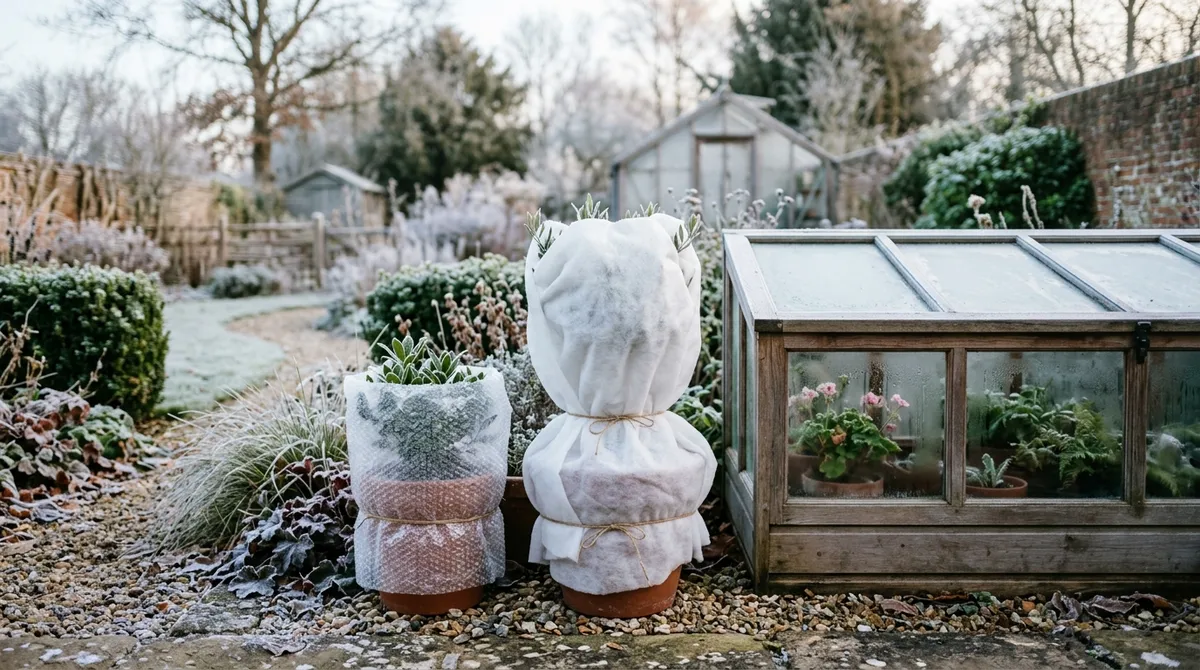
Fleece-wrapped pots and a cold frame provide layered protection for tender plants through a UK winter.
What does overwintering mean for UK gardeners?
Overwintering means protecting plants that cannot survive outdoor UK winter temperatures without help. The Royal Horticultural Society uses hardiness ratings from H1 to H7 to classify plant cold tolerance.
Plants rated H1 to H3 need active overwintering in the UK. These include tropical houseplants, tender perennials, half-hardy bedding, and Mediterranean species. Plants rated H4 and above generally survive British winters unaided, though exposed or northern gardens may need to protect H4 plants too.
UK winter temperatures vary hugely by region. London averages minus 2 degrees Celsius as a winter minimum. The Scottish Highlands regularly hit minus 10 degrees. Coastal gardens in Cornwall rarely drop below zero. Your local microclimate matters more than national averages.
| RHS Rating | Minimum Temp | UK Survival | Examples | Action Needed |
|---|---|---|---|---|
| H1 (tender) | Above 15°C | Indoors only | Tropical houseplants | Bring inside year-round |
| H2 (tender) | 1 to 5°C | Heated greenhouse | Pelargoniums, tender fuchsias | Frost-free storage |
| H3 (half-hardy) | -5 to 1°C | Sheltered + fleece | Agapanthus, olive trees | Wrap or move under cover |
| H4 (hardy) | -10 to -5°C | Most UK gardens | Hardy fuchsias, penstemons | Mulch crown in cold areas |
| H5 to H7 | Below -10°C | All UK gardens | Roses, hostas, apple trees | No protection needed |
When should you start overwintering plants?
Start preparing in late September and act by mid to late October. The UK’s first air frosts typically arrive in late October in southern England and mid-October further north. Ground frost arrives earlier.
The three-week rule works well. Three weeks before your area’s average first frost date, start moving pots, wrapping plants, and lifting tender bulbs. Waiting until you see frost damage means you have already lost tissue.
Key dates for most UK regions:
- Southern England: First frost late October to early November. Start overwintering by 10 October.
- Midlands and Wales: First frost mid to late October. Start by 1 October.
- Northern England and Scotland: First frost early to mid-October. Start by late September.
For monthly planting guidance through winter, check our guides for what to plant in November and what to plant in December.
How to overwinter plants with horticultural fleece
Horticultural fleece is the cheapest and most effective first line of defence. A single layer of 30 gsm fleece provides 2 to 3 degrees of frost protection. Double layering gives 4 to 5 degrees.
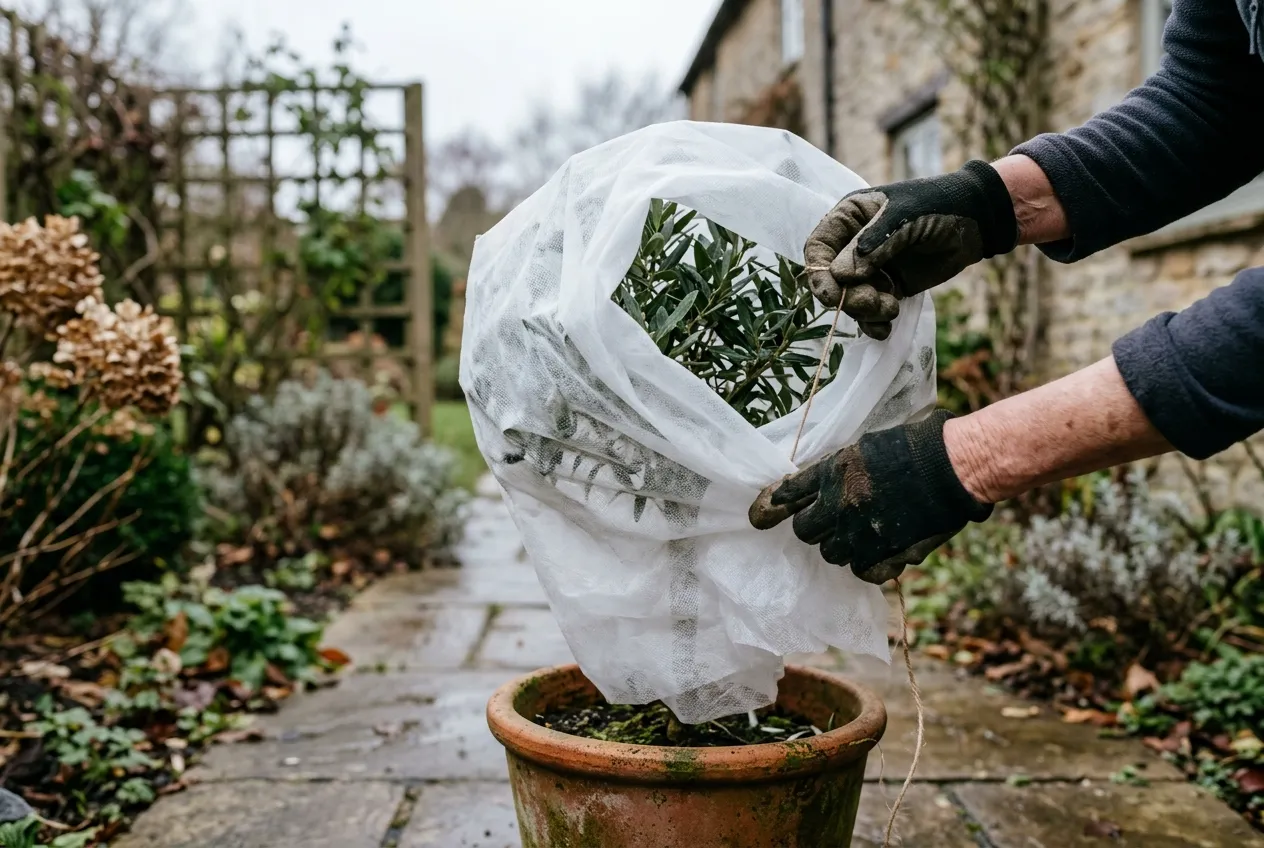
Double-wrapping fleece around the pot and crown gives up to 5 degrees of frost protection for under five pounds.
Which plants to fleece
Wrap borderline-hardy plants (H3 to H4) that stay outdoors. Good candidates include:
- Agapanthus in pots or ground — wrap the pot and mulch the crown
- Olive trees — fleece the canopy and wrap the pot with bubble wrap
- Tree ferns — stuff the crown with straw, wrap the trunk in fleece
- Cordylines — gather leaves upward, tie loosely, wrap the bundle
- Hardy bananas (Musa basjoo) — cut back, pile straw around the stump, cover with fleece
How to wrap properly
Loose wrapping works best. Tight wrapping traps moisture against stems and causes fungal rot — the real killer in UK winters, not frost alone.
- Water the plant well the day before wrapping. Dry root balls freeze faster.
- Push three bamboo canes into the pot or soil around the plant.
- Drape two layers of 30 gsm fleece over the canes to create an air gap.
- Secure with garden twine. Leave the base open for drainage.
- On mild, dry days above 8 degrees, remove the fleece to allow air circulation.
Fleece degrades in UV light. Replace it each autumn. A roll of 30 gsm fleece (1.5 m wide, 8 m long) costs under five pounds from any garden centre.
How to use a cold frame for overwintering
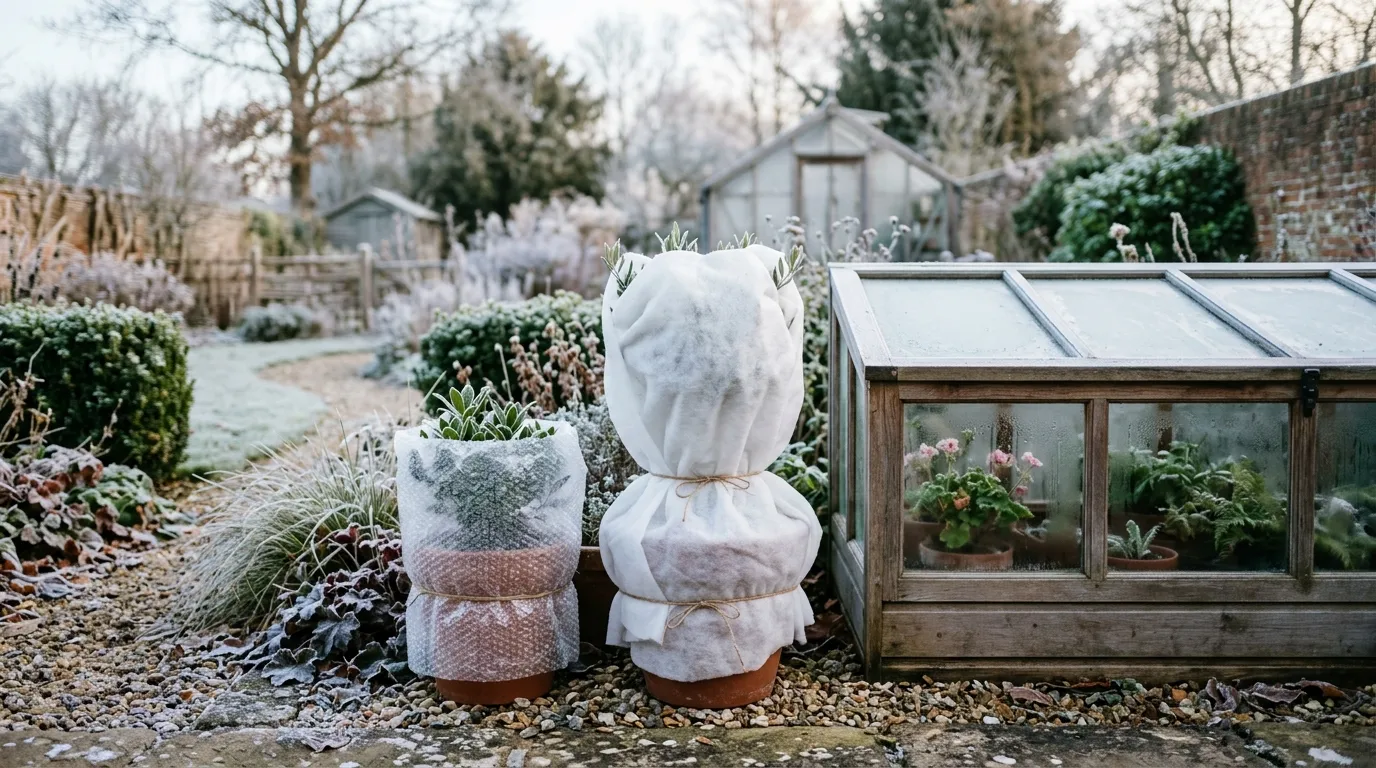
A cold frame is the most underrated overwintering tool in British gardening. It provides 4 to 8 degrees of frost protection without any heating cost and ventilates itself on mild days if you prop the lid.
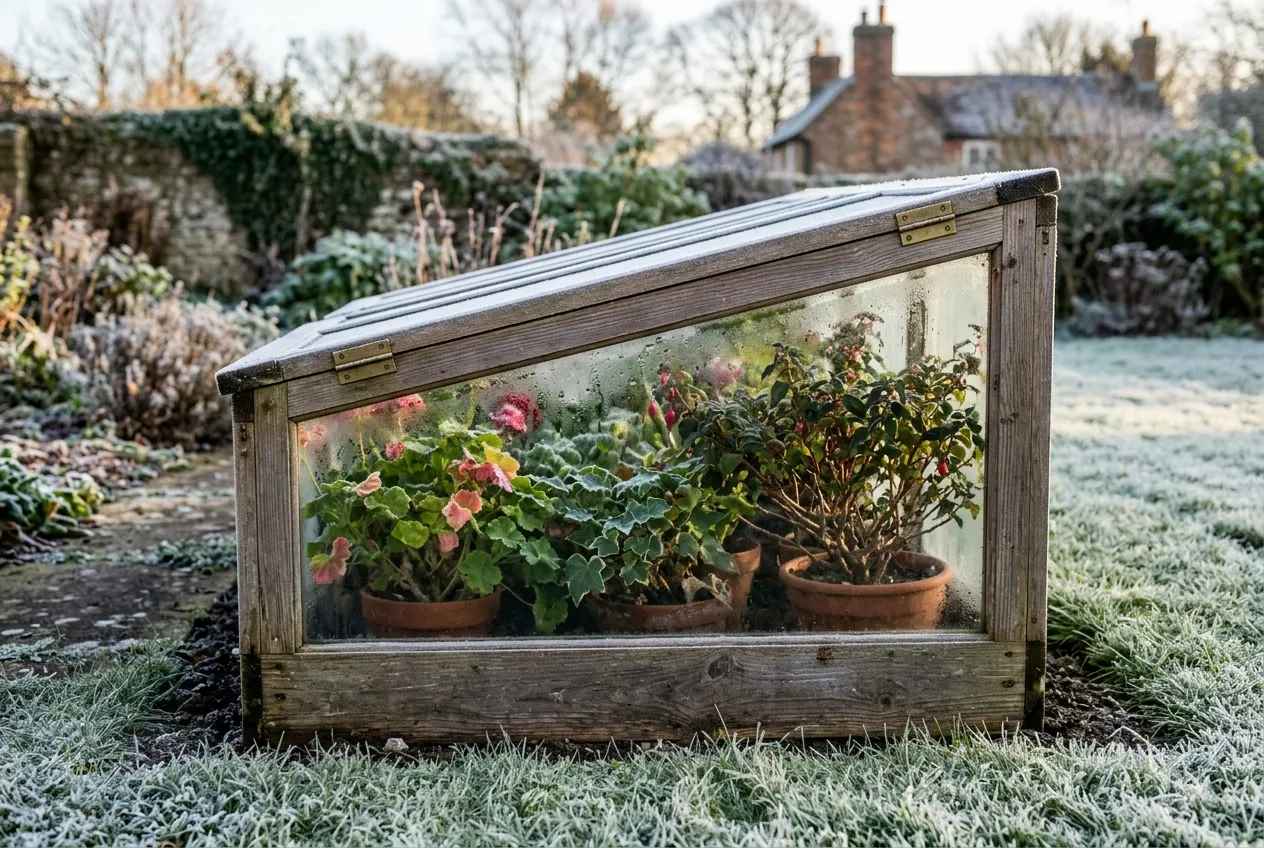
A simple cold frame keeps pelargoniums and fuchsias alive through winter with no heating bills.
Best plants for cold frame overwintering
- Pelargoniums — cut back to 10 cm, remove leaves, water monthly
- Tender fuchsias — cut to 15 cm, allow to go dormant, keep barely moist
- Rooted cuttings — late-summer cuttings of tender perennials overwinter well in frames
- Alpine plants — they handle cold but hate wet; the frame keeps rain off
- Autumn-sown hardy annuals — sweet peas, cornflowers, and larkspur in modules
Cold frame management through winter
Open the lid fully on any frost-free day above 5 degrees Celsius. Closed cold frames build condensation, which causes botrytis (grey mould). Ventilation matters more than warmth.
On nights forecast below minus 5 degrees, lay old carpet or bubble wrap over the frame lid for extra insulation. Remove it each morning.
Position the cold frame against a south-facing wall for maximum winter sun. Raise it 10 cm off bare soil on bricks to improve drainage underneath. For more on cold frame growing, see our cold frame gardening guide.
How to overwinter plants in a greenhouse
A greenhouse extends what you can grow and overwinter dramatically. Even an unheated greenhouse provides 2 to 4 degrees of frost protection. With a small heater, you can keep it frost-free all winter for under 50 pounds in electricity.
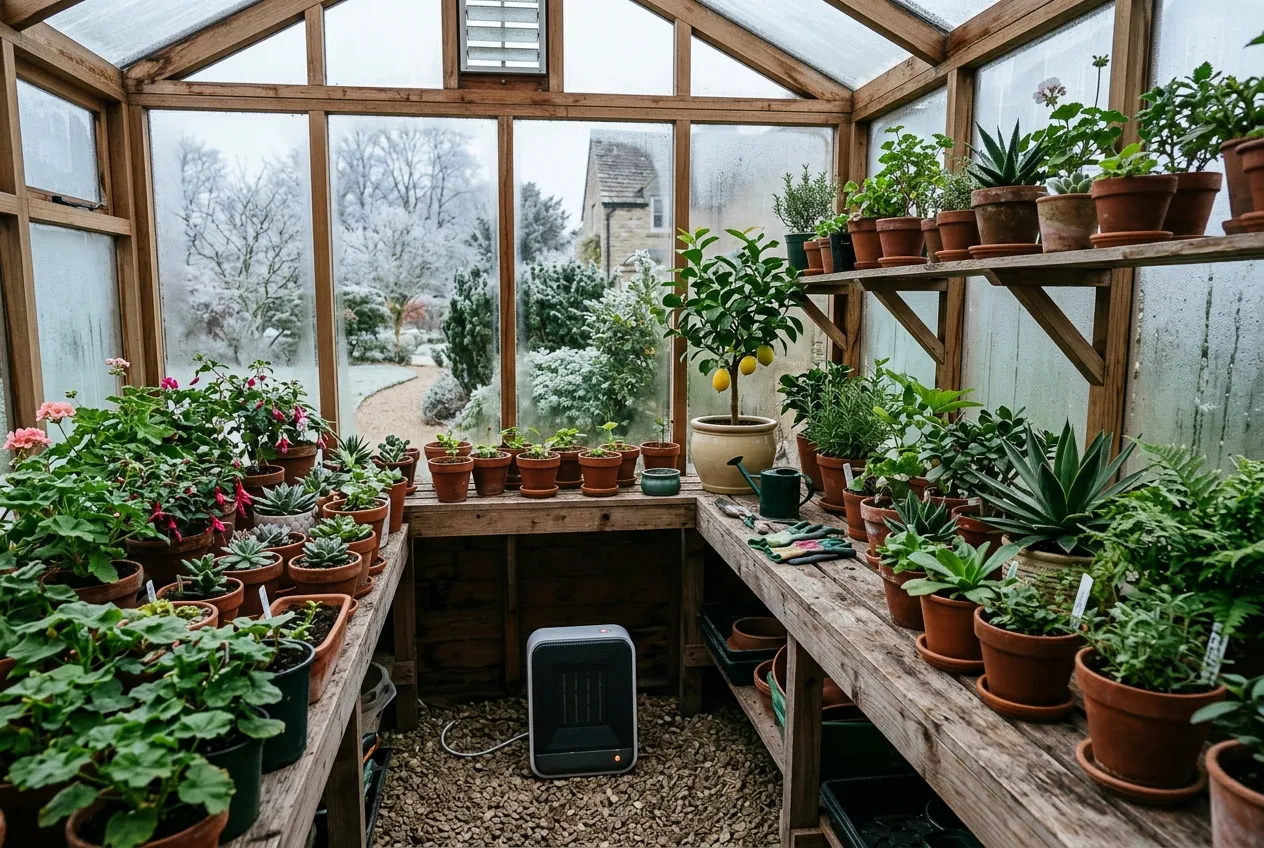
A thermostat-controlled heater set to 2 degrees Celsius protects a full greenhouse of tender plants for under 50 pounds per winter.
Greenhouse insulation
Insulate with bubble wrap before October. This alone can halve your heating costs. Fix the bubble wrap to the glazing bars with clips — not tape, which damages frames. Leave roof vents uncovered so you can still ventilate on mild days.
For a full guide on insulating greenhouse glass, see our greenhouse insulation guide.
Greenhouse heating options
| Heater Type | Cost to Buy | Running Cost (winter) | Pros | Cons |
|---|---|---|---|---|
| Electric fan heater + thermostat | £30-50 | £30-60 | Precise control, no fumes | Needs mains power |
| Paraffin heater | £25-40 | £20-40 | No electricity needed | Produces moisture, needs ventilation |
| Tubular heater (electric) | £20-35 | £25-50 | Low profile, even heat | Slow to warm large spaces |
| Heat mats (propagation) | £15-30 | £10-20 | Targeted heat for trays | Only warms roots, not air |
Set the thermostat to 2 degrees Celsius for frost-free overwinter storage. Raising it to 5 degrees keeps tender species like citrus and brugmansia happier but doubles the electricity bill.
What to overwinter in a greenhouse
- Citrus trees — bring inside before first frost, keep above 5 degrees, water sparingly
- Tender salvias — cut back to 15 cm, keep frost-free, reduce watering
- Pelargoniums — store on staging, minimal water, good ventilation
- Overwintered plug plants — rooted cuttings of diascia, osteospermum, and verbena
- Dahlia tubers in trays — store on lower staging, check monthly for rot
For greenhouse ventilation advice through winter, read our greenhouse ventilation and humidity guide.
How to overwinter dahlias in the UK
Dahlias are the plant most commonly lost to poor overwintering. They are rated H3 — their tubers rot in cold, wet soil but survive frost if kept dry.
To lift or not to lift
Lift dahlias in most UK gardens. The exception is well-drained sandy soil in mild areas (Devon, Cornwall, coastal Wales). Heavy clay soil, which holds water around tubers, kills more dahlias than frost.
How to lift and store dahlia tubers
- Wait for the first frost to blacken the foliage. Cut stems to 15 cm.
- Dig around the clump carefully. Lift the entire root ball.
- Shake off loose soil. Rinse with a hose if soil is claggy clay.
- Turn upside down for a week to drain water from hollow stems.
- Trim off any damaged or rotten sections. Dust cuts with sulphur powder.
- Store in trays of barely damp vermiculite, compost, or sand at 5 degrees Celsius.
- Check monthly. Remove any tubers showing soft rot immediately.
A frost-free garage, shed, or unheated spare room works well. Avoid anywhere that drops below zero or stays above 10 degrees — both cause problems. For growing dahlias from the start, see our dahlia growing guide.
How to overwinter cannas and other tender bulbs
Several popular summer bulbs need lifting and storing alongside dahlias.
| Bulb/Tuber | Lift After | Storage Temp | Storage Medium | Replant |
|---|---|---|---|---|
| Dahlia tubers | First frost | 5°C | Damp vermiculite | April-May |
| Canna rhizomes | First frost | 7-10°C | Damp compost | April |
| Gladioli corms | October | 5-10°C | Paper bags, dry | March-April |
| Begonia tubers | First frost | 5-7°C | Dry compost | March |
| Eucomis bulbs | November | 5°C | Dry sand | April |
Cannas are the trickiest. Their rhizomes must not dry out completely — store them in barely moist compost in a frost-free place. Check fortnightly and mist lightly if the compost feels bone dry.
Gladioli are the easiest. Lift corms, peel off the old shrivelled corm from below the new one, dry for two weeks, and store in labelled paper bags in a cool room. They take up almost no space.
How to overwinter plants indoors
Indoor overwintering suits small collections of tender plants, rooted cuttings, and houseplants that spent summer outdoors.
Best indoor overwintering spots
- Cool spare bedroom (8-12 degrees) — ideal for dormant pelargoniums and fuchsias
- Bright windowsill (above 10 degrees) — suits citrus, tender herbs, and rooted cuttings
- Unheated porch or conservatory — good for hardy-ish plants that need rain protection
- Heated utility room — too warm and dark for most plants; only for short-term emergency storage
The acclimatisation rule
Move plants indoors gradually. A sudden shift from 10 degrees outdoors to 20 degrees in a centrally heated room causes leaf drop and stress. Bring plants into an unheated room first for a week, then move to their final indoor position. The reverse applies in spring — harden off seedlings before moving them back outdoors.
Reduce watering by at least half. Most overwinter losses indoors happen from overwatering, not cold. Dormant plants in cool rooms need water only when the top 3 cm of compost is completely dry.
Which plants survive UK winters without protection?
Knowing what you do not need to protect saves time and worry. Plants rated H5 and above are fully hardy across the UK, including the Scottish Highlands.
Fully hardy plants (H5-H7) that need no overwintering:
- All UK native trees and shrubs (oak, birch, hawthorn, hazel)
- Hardy perennials: hostas, hardy geraniums, asters, sedums, echinacea
- Hardy bulbs: daffodils, snowdrops, crocus, alliums, bluebells
- Hardy roses — see our rose growing guide
- Hardy fuchsias (e.g. ‘Riccartonii’, ‘Mrs Popple’)
- Most ornamental grasses — see our ornamental grasses guide
Borderline plants (H4) that need protection only in cold regions:
- Penstemons — mulch the crown in northern gardens
- Japanese anemones — fine in most gardens, mulch on exposed sites
- Hardy agapanthus (e.g. ‘Headbourne Hybrids’) — protect pots, ground-planted usually fine
Month-by-month overwintering calendar
| Month | Key Tasks |
|---|---|
| September | Take cuttings of tender perennials as insurance. Buy fleece and bubble wrap. |
| October | Lift dahlias, cannas, gladioli after first frost. Wrap borderline plants. Move citrus indoors. |
| November | Insulate greenhouse with bubble wrap. Set up heater. Close cold frame on frosty nights. |
| December | Check stored tubers monthly. Ventilate greenhouse on mild days. Water sparingly. |
| January | Coldest month — monitor heater and insulation. Remove any rotting stored bulbs. |
| February | Order new summer bulbs. Start checking dahlias for early growth. |
| March | Move pelargoniums to brighter position. Increase watering slightly. |
| April | Begin hardening off overwintered plants. Pot on dahlia tubers showing shoots. |
For a broader view of what to do each month, see our spring gardening jobs guide and the greenhouse growing calendar.
Common overwintering mistakes
Wrapping too late. By the time you see frost damage, cells have already burst. Wrap before the first forecast frost, not after.
Overwatering in storage. Dormant plants barely transpire. A monthly check and light misting is enough. Soggy compost breeds rot faster than any frost.
Forgetting to ventilate. A sealed greenhouse or cold frame on a mild winter day reaches 20 degrees Celsius by noon. This forces plants out of dormancy early, then the next frost kills the soft new growth. Ventilate every day the temperature rises above 5 degrees.
Using the wrong wrapping material. Plastic sheeting and bin bags trap moisture and cause stem rot. Always use breathable fleece for direct plant contact. Save bubble wrap for insulating greenhouse glass and the outside of pots.
Not taking insurance cuttings. Take cuttings of tender plants in August and September. Root them in a cold frame or on a windowsill. If the parent plant dies over winter, the cutting carries the genetics through. It costs nothing and takes five minutes per plant. For techniques, see our plant propagation guide.
Frequently asked questions
When should I start overwintering plants in the UK?
Start in late October before the first hard frost. In southern England, the first frost typically arrives in late October or early November. In Scotland and northern England, start by mid-October. Monitor local forecasts and have fleece ready from the first week of October.
Can I leave dahlias in the ground over winter?
In mild, well-drained gardens in southern England, dahlias sometimes survive in the ground under a thick mulch. In most UK gardens — especially those with heavy clay or in northern regions — lifting tubers is safer. Wet soil kills more dahlias than frost does.
What temperature kills tender plants in the UK?
Most tender plants (RHS H1 to H3) die below minus 5 degrees Celsius. Half-hardy plants rated H3 tolerate down to minus 5 degrees briefly. Truly tender plants rated H1 and H2 suffer damage below zero. Check the RHS hardiness rating before deciding on protection.
Is horticultural fleece better than bubble wrap for overwintering?
Fleece is better for most outdoor plants because it breathes. Bubble wrap traps moisture and causes rot on stems and foliage. Use bubble wrap to insulate greenhouse glass and the inside of cold frames, but wrap plants themselves in fleece.
Do I need to heat a greenhouse to overwinter plants?
Not always. An unheated greenhouse provides 2 to 4 degrees of frost protection. For truly tender plants like citrus and pelargoniums, a thermostat-controlled heater set to 2 degrees Celsius prevents the worst damage while keeping electricity costs below 50 pounds per winter.
How do I overwinter pelargoniums in the UK?
Cut pelargoniums back to 10 cm in October. Remove all leaves. Store in a frost-free greenhouse, cold frame, or cool indoor room above 5 degrees Celsius. Water sparingly — once a month at most. They look dead by January but regrow strongly in March.
Which plants need overwintering in the UK?
Plants rated RHS H1 to H3 need overwintering. Common examples include dahlias, cannas, gladioli, pelargoniums, fuchsias (tender types), agapanthus, olive trees, citrus trees, banana plants, and tender salvias. Hardy plants rated H5 and above survive UK winters without help.
Lawrie has been gardening in the West Midlands for over 30 years. He grows his own veg using no-dig methods, keeps a wildlife-friendly garden, and writes practical advice based on real UK growing conditions.