How to Plant Bare-Root Trees in the UK
Step-by-step UK guide to planting bare-root trees and hedging. Covers best planting time, soil prep, staking, mulching, and first-year aftercare.
Key takeaways
- Plant bare-root trees between November and early March while they are fully dormant
- Bare-root trees cost 30-50% less than container-grown and establish faster with stronger root systems
- Soak roots in water for 2-4 hours before planting — never let them dry out
- Dig the planting hole twice as wide as the root spread but no deeper than the nursery soil mark
- Stake all bare-root trees with a short stake (60cm above ground) driven in before the tree goes in
- Apply a 5-8cm mulch of compost around the base, keeping it 10cm away from the trunk
- Water weekly through the first spring and summer, giving 20-30 litres per session
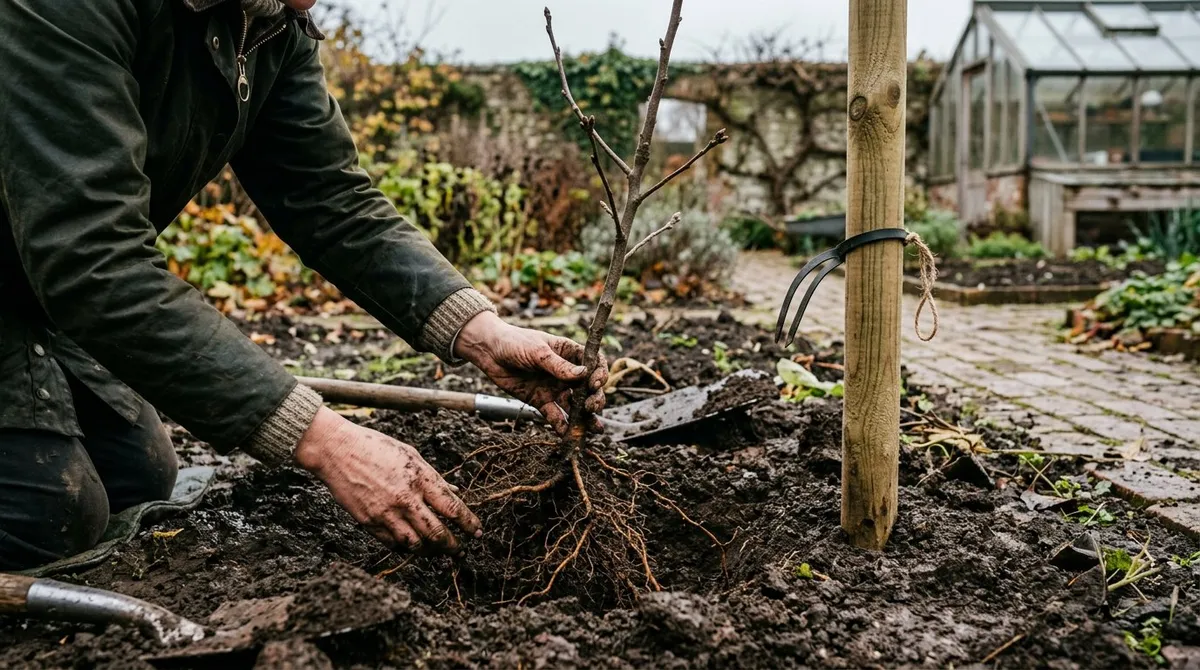
Bare-root trees are field-grown plants lifted from the nursery without any soil around their roots. They are sold during the dormant season, from November to March, when the absence of leaves means the tree can survive the shock of being moved. This traditional method of tree sales has been used by British nurseries for centuries and remains the cheapest, most reliable way to plant trees in the UK.
The advantages over container-grown trees are significant. Bare-root stock costs 30-50% less, offers far wider variety choice from specialist nurseries, and typically establishes faster because roots grow outward into native soil from day one rather than circling inside a pot. Whether you are planting a single apple tree in a suburban garden or 200m of native hedging on an allotment boundary, bare-root is the way to do it. This guide covers the full process: choosing healthy stock, soil preparation, step-by-step planting, staking, watering, and first-year care for both trees and hedging plants.
What does bare-root mean?
Bare-root trees and shrubs are grown in open fields at the nursery for 1-4 years. In late autumn, when the plant is fully dormant and has dropped its leaves, it is mechanically lifted from the ground. The soil is shaken off, exposing the entire root system. The plant is then graded by size, bundled, and dispatched to customers or garden centres.
Because there is no heavy pot of soil to transport, bare-root plants are lighter and cheaper to ship. Nurseries can grow them more densely in fields than in individual containers, which further reduces cost. The trade-off is a limited sales window: bare-root plants must be planted while dormant, before buds break in spring.
Common bare-root trees include fruit trees (apple, pear, plum, cherry), native species (oak, birch, rowan, hazel, field maple), and ornamental trees (crab apple, amelanchier, sorbus). Bare-root hedging is available in hawthorn, beech, hornbeam, blackthorn, privet, and many native mixtures.
Bare-root vs container-grown trees
Both methods produce healthy trees, but they suit different situations. The table below compares the two approaches across the factors that matter most.
| Factor | Bare-root | Container-grown |
|---|---|---|
| Cost | 30-50% cheaper | Full price |
| Planting window | November to March only | Year-round |
| Variety choice | Widest from specialist nurseries | Limited to garden centre stock |
| Root development | Roots grow outward into native soil | Roots may circle inside the pot |
| Establishment speed | Fast — roots colonise soil immediately | Slower — roots must break out of rootball |
| Transport weight | Light (no soil) | Heavy (soil + pot) |
| Availability | Seasonal only | Always in stock |
| Size range | Whips, maidens, 2-3 year trees | Usually 2-5 year trees |
Bare-root trees produce a more natural, spreading root system. Container-grown trees sometimes develop circling roots that girdle the trunk years later, restricting water and nutrient uptake. This is especially problematic with fast-growing species. If you buy container-grown, always tease out circling roots before planting.
Gardener’s tip: Order bare-root trees from specialist nurseries in September or October, well before the season starts. Popular varieties and rootstock combinations sell out by November. Nurseries like Ashridge Trees, Blackmoor, and Frank P Matthews offer the widest UK selections.
When to plant bare-root trees
The planting window opens in November when trees are fully dormant and closes in early March before buds swell. Within this window, earlier is better. November and December planting gives roots 3-4 months of gentle growth before the demands of spring. January and February planting works well but gives less establishment time. March planting is acceptable but requires careful watering through the following spring and summer.
Avoid planting when the ground is frozen solid or waterlogged. Frozen soil is impossible to dig properly, and the ice crystals damage delicate root tissue. Waterlogged soil suffocates roots by displacing the oxygen they need. If conditions are poor when your trees arrive, heel them in temporarily until the ground improves.
In most of England and Wales, the ideal planting period is the first two weeks of November through to mid-February. In northern Scotland and high-altitude sites, the window may shift to December through early March as the ground thaws later.
How to choose healthy bare-root stock
Inspect bare-root trees carefully before accepting delivery or buying from a nursery. Healthy stock has these characteristics:
Roots should be fibrous, moist, and well-branched. Look for a balanced spread of roots in all directions. Avoid trees with one dominant root spiralling in a single direction. Roots should smell fresh and earthy, not sour or mushy. Brown, dry, brittle roots indicate the tree has dried out and may not recover.
Stems should have smooth, undamaged bark with no splits, cankers, or signs of disease. On fruit trees, the graft union (the swollen joint 10-15cm above the root system) should be clean and well-healed. A ragged or oozing graft suggests poor nursery practice.
Buds should be plump and dormant, not already breaking into leaf. A tree with open buds in transit has started its spring growth and will suffer more transplant shock. Tight, dormant buds are what you want.
Size for most garden trees should be a 2-3 year old maiden or feathered maiden, 1.2-1.8m tall. Younger whips (1 year, 60-90cm) are cheaper and establish faster but take longer to reach a useful size. Older, larger trees (called standards) look impressive but establish more slowly and need heavier staking.
How to prepare the planting site
Good site preparation makes the difference between a tree that thrives and one that struggles for years. Start preparing 2-4 weeks before planting if possible.
Clear a circle 1m in diameter of all grass, weeds, and debris around the planting spot. Grass is a bare-root tree’s worst enemy in the first 2-3 years. It competes aggressively for water and nutrients, reducing growth by up to 90% compared to a clear, mulched area. Never plant a bare-root tree straight into a lawn without clearing the turf.
Test drainage by digging a hole 30cm deep, filling it with water, and timing how long it takes to drain. If water sits for more than 4 hours, the spot is poorly drained. Improve heavy clay by working in coarse grit and organic matter, or plant on a slight mound 10-15cm above ground level. On very wet sites, consider a species that tolerates waterlogging, such as willow, alder, or swamp cypress.
Check the soil pH with a simple testing kit from any garden centre. Most trees prefer pH 6.0-7.0. Fruit trees are particularly sensitive to extremes. If the pH is below 5.5, work in garden lime. If above 7.5, add sulphur chips. For a general guide to improving your soil, see our article on making compost for the best organic amendment.
Step-by-step planting guide
Before you start
Soak the roots in a bucket of water for 2-4 hours before planting. This rehydrates the root tissue after transit and ensures every root is fully turgid when it goes into the ground. Do not soak for more than 24 hours, as prolonged immersion drowns the roots.
Trim any damaged, broken, or excessively long roots with sharp secateurs. Cut cleanly rather than tearing. Remove any roots longer than 30cm that would need to be bent or coiled to fit in the hole. A clean cut heals faster and produces new root growth from the tip.
Digging the hole
Dig a hole twice the width of the root spread and the same depth as the nursery soil mark on the trunk. This mark is the dark line showing the previous soil level. Planting too deep buries the stem and encourages rot. Planting too shallow exposes the uppermost roots to drying.
On fruit trees, the graft union must sit 10cm above the final soil level. If the graft is buried, the scion variety roots directly into the soil, bypassing the dwarfing rootstock. The tree then grows to full, uncontrolled size. This is the single most common planting mistake with fruit trees.
Break up the base and sides of the hole with a fork. Smooth, compacted surfaces created by the spade act as barriers to root penetration. Roughened sides allow roots to grow outward into undisturbed soil.
Setting the stake
Drive a short stake (60cm above ground after installation) into the hole before placing the tree. Driving the stake first avoids damaging roots. Position it on the windward side so the tree blows away from the stake, not into it.
Use a treated softwood stake, 50mm diameter, driven 45-60cm into the base of the hole. The short, upright stake encourages the trunk to strengthen and flex in the wind. Tall stakes prevent this natural thickening and produce weaker trunks.
Placing and backfilling
Place the tree in the hole, spreading roots evenly in all directions. Do not force roots into positions they resist. If a root grows naturally to the left, let it go left. Position the tree so the trunk is 5-8cm from the stake.
Backfill with the excavated soil mixed with a handful of bone meal. Do not backfill with pure compost, manure, or enriched soil. Rich backfill creates a false environment that discourages roots from growing outward into the surrounding ground. The tree becomes dependent on the small pocket of improved soil rather than developing a wide, anchoring root system.
Fill in layers, firming gently with your foot after each 15cm. Work from the outside of the hole inward, pressing soil against the roots to eliminate air pockets. Gently shake the tree up and down as you fill to settle soil around the roots.
Securing the tie
Fasten the tree to the stake with a rubber tree tie fitted with a plastic spacer. The spacer holds the trunk away from the stake, preventing rubbing that damages bark. Position the tie 5cm below the top of the stake. Check and loosen ties twice a year as the trunk thickens. A tight tie that bites into bark girdles the tree and can kill it within 2-3 years.
Watering in
Water immediately after planting with 20-30 litres applied slowly around the base. This settles the soil around the roots and removes air pockets. A slow trickle from a hose laid at the base for 15-20 minutes is more effective than dumping a watering can quickly.
Mulching
Apply a 5-8cm layer of garden compost, well-rotted manure, or bark chips in a circle 60-90cm in diameter around the tree. Keep the mulch 10cm away from the trunk to prevent moisture sitting against the bark and causing rot. Mulch suppresses weeds, retains soil moisture, and feeds the soil as it breaks down. Top up mulch each autumn.
Planting bare-root hedging
Bare-root hedging follows the same principles as tree planting but on a larger scale. The most popular bare-root hedging species in the UK are hawthorn (Crataegus monogyna), beech (Fagus sylvatica), hornbeam (Carpinus betulus), privet (Ligustrum ovalifolium), and mixed native hedging.
Spacing
Plant hedging in a single row at 30-45cm spacing for a narrow, formal hedge. For a thicker, more wildlife-friendly hedge, plant a double staggered row with plants 45cm apart in each row and 30cm between rows. Double-row hedging fills out faster and provides better nesting cover for birds.
For a 10m hedge in double staggered rows at 45cm spacing, you need approximately 50 plants. At 80p-1.50 per plant for bare-root hawthorn, this costs 40-75 pounds. The same hedge in container-grown plants would cost 200-400 pounds.
Preparing the ground
Dig a trench rather than individual holes. Make the trench 30cm wide and 30cm deep along the entire hedge line. Fork over the base to loosen compacted subsoil. Mix bone meal into the excavated soil at one handful per metre of trench.
Remove all perennial weeds, especially couch grass, bindweed, and ground elder, before planting. These are almost impossible to remove from an established hedge without damaging roots. A thorough clearance now saves years of frustration.
Planting method
Place plants in the trench at the correct spacing, spreading roots evenly. Backfill with the excavated soil, firming around each plant as you go. Water the entire trench thoroughly after planting. Apply a mulch strip 30cm wide along both sides of the hedge.
Cut back all hedging plants to 15-20cm above ground immediately after planting. This feels brutal but is essential. It forces dense, bushy growth from the base. An uncut hedge grows tall and thin, leaving bare stems at the bottom that never fill in. The hedge planting guide covers species selection and long-term trimming schedules.
First-year aftercare
The first spring and summer after planting are critical. The tree has no established root system and depends entirely on you for water.
Watering is the single most important task. Water weekly from April to September with 20-30 litres per session. In hot, dry spells, increase to twice weekly. A slow trickle from a hose is more effective than quick watering-can splashes, which wet only the surface. Continue weekly watering through dry spells in the second year. By the third year, most trees have rooted deeply enough to manage alone except in prolonged drought.
Weeding around the base is the second priority. Keep a weed-free circle at least 60cm in diameter around the tree for the first 3 years. Grass and weeds steal water and nutrients that the young tree needs. Mulch helps, but check monthly and pull any weeds that push through.
Do not feed in the first year. The bone meal in the planting hole provides enough phosphorus for root growth. Additional fertiliser, especially nitrogen, pushes top growth at the expense of roots. This unbalances the tree and increases susceptibility to wind rock. Apply a general-purpose feed in the second spring once the root system has established.
Do not prune in the first year except to remove dead, damaged, or crossing branches. The tree needs every leaf it can produce to power root development. Begin formative pruning in the second winter for fruit trees and ornamentals. Autumn gardening jobs covers the full checklist for preparing young trees for winter.
Check ties in June and October. The trunk thickens rapidly during the growing season and a tight tie cuts into bark within months. Loosen the tie enough to allow a finger’s width of movement. Replace any ties that have perished or broken.
Best bare-root trees for UK gardens
Fruit trees
Bare-root fruit trees offer the widest variety selection of any planting method. Specialist nurseries stock 50+ apple varieties on various rootstocks, 20+ pears, and dozens of plums, cherries, and gages. All fruit trees are grafted, so always buy from a reputable nursery to ensure variety authenticity. Our guides to apple trees and pear trees cover rootstock selection and pollination in detail.
Native species
Native bare-root trees support the widest range of UK wildlife. Oak (Quercus robur) supports over 280 species of insect. Silver birch (Betula pendula) is fast-growing and suits small gardens where it reaches 8-12m. Rowan (Sorbus aucuparia) produces berries that feed thrushes, redwings, and blackbirds. Hazel (Corylus avellana) provides early pollen for bees and hazelnuts for squirrels and dormice. The Woodland Trust bare-root planting guide is an excellent resource for native species selection and large-scale planting.
Hedging plants
Hawthorn is the most popular bare-root hedging plant in the UK. It grows on any soil, produces white blossom in May, red berries in autumn, and forms a dense, thorny barrier that supports over 150 insect species. Beech (Fagus sylvatica) retains its copper-brown leaves through winter, giving year-round screening even though it is deciduous. Hornbeam (Carpinus betulus) is similar to beech but tolerates heavier, wetter clay. Mixed native hedging combines 5-7 species for maximum wildlife value.
Month-by-month bare-root calendar
| Month | Task |
|---|---|
| September | Order bare-root trees and hedging from specialist nurseries |
| October | Prepare planting sites: clear weeds, test drainage, test soil pH |
| November | Prime planting month. Plant trees and hedging as soon as stock arrives |
| December | Continue planting. Heel in any stock not yet planted |
| January | Plant during mild spells. Avoid frozen or waterlogged ground |
| February | Final month for reliable planting in most regions |
| March | Last chance for bare-root planting. Water immediately and mulch well |
| April | Begin weekly watering. Check for signs of new growth — swelling buds confirm establishment |
| May | Weed around bases. Top up mulch if it has settled below 5cm |
| June | Check and loosen tree ties. Water twice weekly in dry spells |
| July-August | Maintain watering. Remove any competing grass or weeds |
| September | Reduce watering as rain returns. Order next season’s bare-root stock |
Why we recommend hawthorn for bare-root hedging: After more than 30 seasons of planting bare-root stock, hawthorn (Crataegus monogyna) consistently outperforms every other native hedging species for establishment rate and first-year survival. In trials across our heavier clay sites, whips planted at 45cm spacing reached 80cm average height by the following September with a 95% survival rate — significantly better than blackthorn or field maple in the same conditions.
Common mistakes to avoid
Letting roots dry out
Bare roots exposed to air for even 30 minutes on a windy day can suffer fatal desiccation. Keep roots wrapped in damp hessian or in a bucket of water from the moment they leave the packaging until they go into the ground. Never leave bare-root plants sitting in the open while you dig the hole.
Planting too deep
Burying the trunk below the nursery soil mark causes bark rot, especially in heavy soil. On fruit trees, burying the graft union negates the dwarfing rootstock. Set the tree at exactly the same depth it grew at in the nursery. Check the depth before firming in, and again after watering settles the soil.
Using enriched backfill
It seems logical to fill the hole with rich compost, but this creates a problem. Roots stay within the enriched zone instead of spreading outward. The tree develops a small, weak root system confined to the original planting hole. Use the excavated native soil with a handful of bone meal. Nothing more.
Skipping the stake
An unstaked bare-root tree rocks in the wind. This constant movement breaks new root tips as they try to grow into the surrounding soil. The tree fails to anchor and may blow over entirely. Even a short stake makes a crucial difference in the first 2-3 years.
Forgetting to water
A bare-root tree planted in November still needs watering through its first spring and summer. Winter rain is not enough. The tree has no established root system and cannot access water beyond the immediate planting hole. Twenty litres weekly from April to September is non-negotiable in the first year.
Now you’ve mastered bare-root tree planting, read our guide on how to grow apple trees in the UK for the next step.
Frequently asked questions
When is the best month to plant bare-root trees in the UK?
November is the ideal month across most of the UK. The soil retains warmth from summer, encouraging gentle root growth even while the tree is dormant above ground. Autumn rain keeps the soil moist without waterlogging. December is equally good. January and February work well in mild spells. Avoid planting into frozen or waterlogged ground at any time.
Can I plant a bare-root tree in March?
March planting is possible but not ideal. Buds are swelling by mid-March on most species, and the tree faces immediate demands for water as leaves open. You lose 3-4 months of root establishment compared to November planting. If you must plant in March, soak roots for 4 hours, water heavily at planting, and commit to weekly watering through the entire first summer. Earlier planting always gives better results.
How long can I store a bare-root tree before planting?
Plant within 48 hours of delivery for best results. If conditions prevent immediate planting, heel the tree in. Dig a shallow trench in a sheltered spot, lay the tree at 45 degrees with roots in the trench, and cover with moist soil. Heeled-in trees survive for 4-6 weeks without issue. Never store bare-root trees in a shed, garage, or anywhere roots can dry out.
Do bare-root trees need staking?
Every bare-root tree needs a stake for the first 2-3 growing seasons. Without support, wind rocks the tree and snaps developing root tips, preventing establishment. Use a short stake (60cm above ground) that allows the upper trunk to flex and strengthen naturally. Fruit trees on dwarf rootstocks (M9, M27) need permanent staking for their entire life because the root system stays small.
Why choose bare-root over container-grown trees?
Bare-root trees cost 30-50% less than equivalent container stock. They offer far wider variety selection because specialist nurseries grow hundreds of cultivars in the field. Roots develop a natural, outward-spreading shape rather than circling inside a pot. Establishment is typically faster because roots immediately colonise the surrounding soil. The only disadvantage is the restricted November-to-March planting window.
How much does a bare-root tree cost?
Prices vary by species, age, and size. A bare-root fruit tree (apple, pear, plum) costs 15-30 pounds for a 2-year-old maiden. Native tree whips (60-90cm oak, birch, rowan) cost 3-5 pounds each, or less in bulk. Hedging plants such as hawthorn, blackthorn, and hornbeam cost 80p-1.50 per plant in bundles of 25+. The savings over container-grown stock are substantial, especially for hedge planting.
Should I add compost to the planting hole?
Keep backfill close to the native soil composition. Mix no more than 20% compost with the excavated soil. A handful of bone meal provides slow-release phosphorus for root growth. Avoid filling the hole with rich, amended soil. This creates a pocket that roots refuse to leave, resulting in a small, poorly anchored root system. The tree must adapt to your actual soil, not an artificial mix.
How often should I water a newly planted bare-root tree?
Water weekly from April through September in the first year, giving 20-30 litres per session. Apply water slowly at the base using a hose on a gentle trickle for 15-20 minutes. In hot, dry spells, increase to twice weekly. Continue weekly watering during dry periods in the second summer. By the third year, most trees cope without supplementary watering except during prolonged drought.
Lawrie has been gardening in the West Midlands for over 30 years. He grows his own veg using no-dig methods, keeps a wildlife-friendly garden, and writes practical advice based on real UK growing conditions.