How to Propagate Houseplants
How to propagate houseplants from cuttings, division, and offsets. Covers water and soil methods with success rates for 10 popular species.
Key takeaways
- Propagate houseplants between April and July when growth is strongest and rooting is fastest
- Stem cuttings in water root in 2-3 weeks for easy species like pothos, tradescantia, and philodendron
- Division of mature clumps gives near 100% success rates and produces full-sized plants immediately
- Always cut below a node — the bump on the stem where leaves emerge — as roots form from nodes
- Rooting hormone is optional but increases success rates by 20-30% for difficult species
- One healthy spider plant can produce 10-20 baby plants in a single growing season
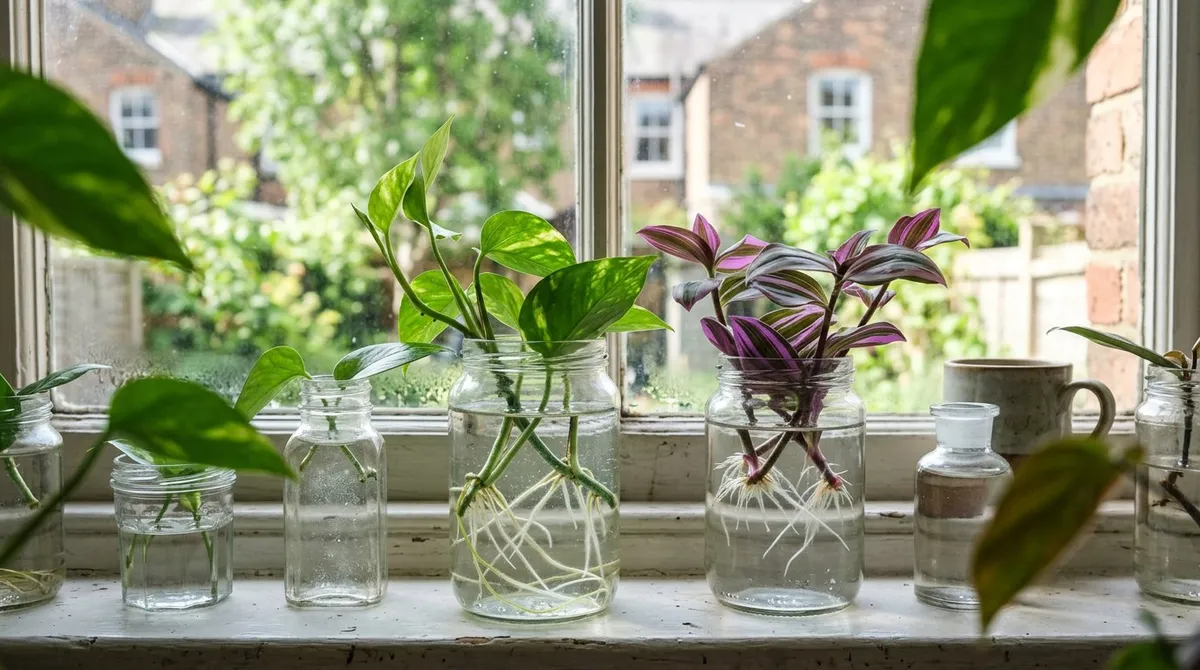
A single pothos cutting costs nothing and roots in a glass of water on the windowsill. A spider plant hanging in the kitchen produces a dozen babies every summer, each one a complete new plant waiting to be potted up. Propagation turns one houseplant into many, and it is one of the most satisfying skills an indoor gardener can learn.
The techniques are straightforward. Once you understand where to cut, what conditions cuttings need, and which method suits each species, success rates climb above 80% for most common houseplants. This guide covers every propagation method that works indoors, with specific timings for UK growing conditions.
When is the best time to propagate houseplants
Timing matters more than technique for most propagation methods. Get the season right and cuttings root quickly. Get it wrong and they sit in water or compost for weeks before rotting.
April to July is the prime propagation window. Houseplants are in active growth, producing the soft, vigorous stems that root fastest. Longer daylight hours and warmer temperatures in UK homes (typically 18-24C) create ideal conditions for root formation.
August and September still work for most methods. Growth is slowing but temperatures remain warm enough for roots to form. Cuttings taken in late summer may be slower to establish.
October to March is the worst time to propagate. Most houseplants are dormant or semi-dormant. Short days mean less energy for root production. Cuttings are 2-3 times more likely to rot in cool, damp conditions. The exception is division of very overgrown plants, which can be done year-round if necessary.
Temperature affects rooting speed directly. Cuttings root fastest at 20-25C. Below 15C, root growth slows dramatically. UK homes heated to 18-21C in winter can work, but keeping cuttings on a windowsill where nighttime temperatures drop to 10-12C will almost certainly fail.
How to propagate houseplants from stem cuttings
Stem cuttings are the most versatile propagation method for houseplants. The technique works for trailing plants, upright tropical species, and many woody-stemmed varieties.
Step 1: Select healthy growth. Choose a stem that is actively growing, free from pests and disease, and has at least 2-3 leaves. Avoid leggy, weak stems or old woody growth.
Step 2: Make the cut. Cut 10-15cm below a node using clean, sharp secateurs or scissors. The node is the bump on the stem where leaves emerge. Roots form from nodes, so cutting below one is essential. A cutting without a node will not produce roots.
Step 3: Remove lower leaves. Strip the leaves from the bottom half of the cutting. Any leaves submerged in water or buried in compost will rot and introduce disease. Leave 2-3 leaves at the top to power photosynthesis.
Step 4: Apply rooting hormone (optional). Dip the cut end in hormone rooting powder. Tap off excess. This step is optional for easy species but improves success rates for harder ones. See our guide to plant propagation methods for more on rooting hormones.
Step 5: Root in water or compost. Place the cutting in a clean glass of water with the node submerged, or push it 3-4cm into moist propagation compost. Both methods work. The pros and cons of each are covered below.
Step 6: Provide warmth and light. Place the cutting in bright indirect light at 20-25C. Avoid direct sun, which dries out the cutting before roots can form. A warm windowsill out of direct afternoon sun is ideal in most UK homes.
Step 7: Wait and watch. Roots typically appear within 2-4 weeks. In water, you can see them forming. In compost, give the cutting a gentle tug after 3 weeks. Resistance means roots have formed.
Pothos and tradescantia stem cuttings rooting in water. Roots appear at the nodes within 2-3 weeks.
Water propagation vs soil propagation
Both methods work for most houseplants. Each has advantages depending on the species and your experience level.
Water propagation is the best method for beginners. You can see roots forming, judge progress easily, and catch problems like rot early. Place the cutting in a clean glass or jar filled with room-temperature water. Keep the node submerged but all leaves above the waterline. Change the water every 3-4 days to keep it oxygenated and prevent bacterial growth.
The downside of water roots is that they are different from soil roots. Water roots are thinner, more brittle, and adapted to absorbing oxygen directly from water. When you transfer a water-rooted cutting to compost, it must grow new soil-adapted roots. This transition can stress the plant. Transfer cuttings when roots are 3-5cm long. Longer water roots are harder to adapt.
Soil propagation skips the transition problem entirely. Roots that form in compost are immediately adapted to their growing medium. The cutting establishes faster and suffers no transplant shock.
Use a mix of 50% perlite and 50% peat-free multipurpose compost. This provides moisture retention with excellent drainage and aeration. Insert the cutting 3-4cm deep, firm gently, and water lightly. Cover with a clear plastic bag or place in a propagator to maintain humidity around the leaves while roots form.
The downside of soil propagation is that you cannot see the roots. You must rely on new leaf growth or a gentle tug test to confirm success. There is also a higher risk of the cutting rotting if the compost is too wet.
| Factor | Water Propagation | Soil Propagation |
|---|---|---|
| Difficulty | Easiest for beginners | Slightly more skill needed |
| Root visibility | Roots fully visible | Roots hidden in compost |
| Transition stress | Must adapt to soil later | No transition needed |
| Root quality | Thinner, more brittle | Stronger, soil-adapted |
| Rot risk | Lower (visible early) | Higher if compost too wet |
| Best for | Pothos, philodendron, tradescantia | Rubber plant, fiddle leaf fig, hoya |
How to propagate by leaf cuttings
Some houseplants grow entirely new plants from a single leaf. This is remarkable biology. A leaf placed on damp compost sends out roots, then produces a miniature plantlet at its base.
Succulents are the classic leaf propagation candidates. Twist a healthy leaf cleanly from the stem. Do not cut it. The base of the leaf must remain intact for roots to form. Lay the leaf on the surface of dry cactus compost. Do not bury it or water it. After 3-5 days, the cut end calluses over. Mist very lightly every few days. Roots and a tiny rosette appear at the base within 4-8 weeks. See our guide to succulent care for compost requirements.
African violets propagate from leaf cuttings inserted into compost. Cut a healthy leaf with 3-4cm of stem attached. Push the stem into moist vermiculite or perlite at a 45-degree angle. Cover with a clear bag to maintain humidity. New plantlets emerge at the base in 6-10 weeks.
Begonias with large leaves can be propagated by cutting the leaf into sections, each containing a main vein. Lay the sections vein-side down on moist compost. Pin them flat with bent wire if they curl. New plants grow from each vein intersection within 6-8 weeks.
Snake plant (Sansevieria) leaves can be cut into 7-10cm sections and inserted upright into moist, gritty compost. Mark the bottom of each section before cutting so you insert it the right way up. Roots and new shoots emerge in 4-8 weeks. Note that variegated snake plants lose their variegation when propagated from leaf cuttings. Only division preserves the pattern.
How to propagate by division
Division is the simplest and most reliable propagation method. It works for any houseplant that grows as a clump of multiple stems rising from the soil. Success rates are essentially 100% because each division already has its own root system.
Step 1: Water the plant. Thoroughly water the day before dividing. Moist roots separate more easily and suffer less damage.
Step 2: Remove from pot. Turn the pot on its side and slide the root ball out. For large plants, you may need to cut the pot away.
Step 3: Separate the clumps. Gently pull the root ball apart into 2-4 sections. Each section must have at least 3-4 stems and a healthy portion of roots. For tightly bound roots, use a clean knife to cut through the root ball. Do not worry about cutting some roots. Plants recover quickly from division when done in spring.
Step 4: Pot each division. Plant each section into its own pot using fresh compost appropriate for the species. The pot should be proportionate to the root mass. A small division does not need a large pot.
Step 5: Water and settle. Water each division lightly. Place in bright indirect light for a week. New growth confirms successful establishment.
Plants that divide easily include peace lily, calathea, Boston fern, asparagus fern, Chinese money plant, and most clumping beginner houseplants. Divide every 2-3 years when the parent plant outgrows its pot.
A peace lily divided into three sections. Each piece has stems, leaves, and its own root system.
How to propagate from offsets and pups
Some houseplants produce miniature copies of themselves at their base or on runners. These offsets (also called pups) are genetically identical to the parent plant and come with their own developing root system.
Spider plant babies form on long, arching runners. Each baby develops aerial roots while still attached to the mother plant. Cut the runner and pot the baby into moist compost. Or leave it attached and pin it into a small pot of compost next to the parent. Once rooted, cut the runner. This is layering and gives near 100% success rates.
Aloe vera offsets emerge around the base of the parent plant. Wait until the offset is at least 7-10cm tall and has 3-4 leaves of its own. Unpot the parent plant and carefully separate the offset with a clean knife, keeping as many roots as possible attached. Pot into gritty cactus compost and let it dry for 2-3 days before watering.
Bromeliad pups form at the base of the mother plant after flowering. The parent plant slowly dies after producing pups. Wait until each pup is at least one-third the size of the parent before separating. Cut with a clean knife and pot individually.
Chinese money plant (Pilea peperomioides) produces soil-level offsets and stem offsets. Soil-level pups can be separated when they reach 5-7cm tall. Use a clean knife to sever the connecting root. Pot into standard compost and water sparingly until established.
Haworthia and echeveria produce offsets around their base. Separate during repotting in spring. Each offset with roots can go straight into its own small pot of gritty compost.
How to propagate by layering indoors
Layering is the lowest-risk propagation method. The stem stays attached to the parent plant while it develops roots, drawing water and nutrients the entire time. Once rooted, you simply cut it free. Success rates are 80-95%.
Simple layering works for trailing and climbing houseplants. Pin a section of stem onto the surface of a pot of moist compost placed beside the parent plant. Use a bent paper clip or small stone to hold the stem in contact with the compost. Make a small nick on the underside of the stem where it touches the compost to encourage root formation. Keep the compost moist. Roots form in 4-8 weeks. Cut the new plant free once it is growing independently.
Air layering suits woody-stemmed houseplants that are too tall or leggy. Make a 3cm upward cut into the stem, one-third of the way through. Wedge the cut open with a sliver of toothpick. Wrap the wound with a ball of damp sphagnum moss. Cover the moss with cling film and secure with tape at both ends. Roots grow into the moss over 6-12 weeks. Once visible through the wrap, cut the stem below the new roots and pot the rooted section.
Air layering works well for rubber plants, fiddle leaf figs, dracaenas, and monstera. It is the best method for reducing the height of a leggy plant while simultaneously producing a new one. Our guide to garden propagation techniques covers outdoor layering in more detail.
Equipment for propagating houseplants
You do not need expensive equipment. Most houseplant propagation requires items already in the house.
Clean secateurs or sharp scissors. The most important tool. A clean, sharp cut minimises damage and reduces the risk of infection. Wipe blades with rubbing alcohol or boiling water between plants.
Clean glass jars or containers. For water propagation. Any glass jar works. Clear glass lets you monitor root development. Avoid metal containers as mineral ions can interfere with root growth.
Propagation compost. A 50:50 mix of perlite and peat-free multipurpose compost. This drains freely, holds enough moisture, and provides the aeration that new roots need. Ready-made seed and cutting compost also works.
Rooting hormone powder. Optional but useful for harder-to-root species. Costs around three pounds from garden centres. The powder form is easier to apply than gel or liquid. Dip the cut end, tap off excess, and insert into compost.
Small pots (7-9cm). Individual cuttings need small pots. Rooting into a large pot means excess wet compost around tiny new roots. Graduate to larger pots once the plant is established.
Clear plastic bags or a propagator. Covering cuttings with a clear bag maintains the high humidity that prevents leaf wilting before roots form. Remove the bag for 30 minutes daily to prevent mould. A heated propagator set to 20-22C speeds rooting significantly but is not essential. Learning to save seeds is another way to multiply your plant collection cheaply.
Houseplant propagation comparison table
| Plant | Best Method | Difficulty | Time to Root | Success Rate | Best Season |
|---|---|---|---|---|---|
| Pothos | Stem cutting (water) | Very easy | 2-3 weeks | 90-95% | April to July |
| Spider plant | Offset/runner | Very easy | 1-2 weeks | 95-100% | Spring to summer |
| Tradescantia | Stem cutting (water) | Very easy | 1-2 weeks | 90-95% | April to July |
| Monstera | Stem cutting (soil) | Easy | 3-4 weeks | 80-90% | May to July |
| Snake plant | Division or leaf cutting | Easy | 4-8 weeks (leaf) | 85-95% (division) | April to June |
| Peace lily | Division | Easy | Immediate | 95-100% | March to May |
| Rubber plant | Air layering | Moderate | 6-10 weeks | 70-80% | May to July |
| Fiddle leaf fig | Air layering | Moderate | 8-12 weeks | 60-75% | May to July |
| Philodendron | Stem cutting (water) | Easy | 2-3 weeks | 85-90% | April to July |
| Succulent (echeveria) | Leaf cutting | Easy | 4-8 weeks | 70-80% | April to August |
| African violet | Leaf cutting | Moderate | 6-10 weeks | 65-75% | April to June |
| Hoya | Stem cutting (soil) | Moderate | 4-8 weeks | 60-75% | May to July |
| Chinese money plant | Offset | Very easy | 2-3 weeks | 90-95% | Spring to summer |
| Aloe vera | Offset | Easy | 2-4 weeks | 85-90% | April to July |
Why we recommend a 50:50 perlite and peat-free compost mix for soil propagation: After 30 years of propagating plants indoors and out, this mix consistently delivers better rooting results than standard multipurpose compost used alone. Across trials with pothos, monstera, and philodendron cuttings, the perlite blend produced visible root development 5-7 days earlier on average and reduced rot losses by roughly 30% compared with compost used straight from the bag.
Common propagation mistakes and how to avoid them
Most propagation failures come down to a handful of repeated errors. Avoiding these gives you the best chance of success.
Cutting in the wrong place. Roots form from nodes. A cutting made between nodes, in the middle of a bare stem section, will not produce roots. Always cut just below a node. If you are unsure where the nodes are, look for the bumps or rings on the stem where leaves attach.
Leaving too many leaves on the cutting. A cutting with five large leaves loses moisture through its leaves faster than the rootless stem can replace it. The cutting wilts and dies before roots form. Remove all but 2-3 leaves. For large-leaved plants like monstera, cut individual leaves in half horizontally to reduce water loss.
Using dirty tools. Pathogens on unsterilised blades infect the cut surface immediately. Bacterial or fungal infection kills the cutting within days. Wipe blades with rubbing alcohol between plants. Clean the glass or jar used for water propagation.
Forgetting to change the water. Stagnant water in a propagation jar becomes a breeding ground for bacteria. The water turns cloudy, smells unpleasant, and the cutting rots from the base up. Change water every 3-4 days. Use room-temperature tap water.
Too much direct sunlight. Cuttings without roots cannot replace water lost through their leaves. Direct sun speeds water loss and overheats the cutting. Place cuttings in bright indirect light. A north or east-facing windowsill is ideal during summer propagation.
Compost too wet. Waterlogged propagation compost suffocates new roots and encourages rot. The compost should be moist but not dripping. If you squeeze a handful and water runs out, it is too wet. Add more perlite to improve drainage.
Transferring water roots too late. Cuttings left in water for months develop long, tangled water roots that struggle to adapt to compost. Transfer to soil when roots are 3-5cm long. Pot into moist compost and keep consistently damp for the first 2 weeks to ease the transition.
Propagating from unhealthy plants. A cutting taken from a pest-infested, diseased, or severely stressed plant carries those problems into the new pot. Always propagate from healthy, vigorous parent material.
Left: healthy white roots forming on a pothos cutting. Right: a rotted cutting with brown, mushy base caused by stagnant water.
How to care for newly rooted cuttings
Young plants from cuttings need slightly different care than established houseplants. Their root systems are small and fragile.
Pot size. Start in a small 7-9cm pot. New roots need to grow into the compost surrounding them. A large pot means a large volume of wet compost that tiny roots cannot access, leading to rot.
Watering. Keep compost lightly moist for the first 2-3 weeks after potting. Do not let it dry out completely. Once the plant is established and producing new leaves, transition to the normal watering routine for that species.
Light. Bright indirect light. No direct sun for at least 2-3 weeks after potting. Gradually introduce more light as the plant establishes.
Feeding. Wait 4-6 weeks before applying any fertiliser. The fresh compost provides enough nutrients. Adding feed to tiny new roots risks chemical burn.
Humidity. Young plants benefit from higher humidity. Group propagated plants together or place on a tray of wet pebbles. Misting is acceptable for newly potted cuttings (unlike succulents) but stop once the plant is established.
Patience. New cuttings sometimes look dormant for weeks after potting. Growth is happening below the surface as the root system develops. Do not overwater out of anxiety. Do not move the plant around. Leave it in position and let it establish at its own pace. You can read our guide to low-light houseplants if your propagation spot is away from bright windows.
Now you’ve mastered propagating houseplants, read our guide on how to repot houseplants for the next step.
Frequently asked questions
What is the easiest houseplant to propagate?
Pothos is the easiest houseplant to propagate. Cut a stem below a node, place it in water, and roots appear within 2-3 weeks. Spider plants are equally easy because they produce ready-made plantlets on runners that already have aerial roots. Tradescantia roots so readily that a single stem placed in water can produce a full plant within a month.
Can you propagate houseplants in winter?
You can, but success rates drop significantly in the UK. Most houseplants are dormant or growing slowly between November and February. Indoor temperatures near windows can fall below 15C at night. Cuttings take 2-3 times longer to root and are more prone to rotting in cool, damp conditions. Wait until April for the best results.
Why are my cuttings rotting in water?
Rotting cuttings are usually caused by stagnant water or submerged leaves. Leaves below the waterline decay rapidly and introduce bacteria that attack the stem. Change the water every 3-4 days. Remove all leaves from the submerged portion. Use a clean glass or jar each time. If rot persists, try rooting in moist perlite instead, which provides better aeration around the cut end.
Do I need rooting hormone for houseplant cuttings?
Rooting hormone is not essential for easy species. Pothos, tradescantia, spider plants, and philodendrons root readily without it. For harder-to-root species like rubber plants, fiddle leaf figs, and hoyas, hormone powder increases success rates by 20-30%. Buy it from any garden centre for around three pounds. The powder form is easiest to apply.
How long do houseplant cuttings take to root?
Most stem cuttings root in 2-4 weeks in water or moist compost during the growing season. Easy species like pothos and tradescantia can show roots within 10 days. Harder species like rubber plants take 4-8 weeks. Succulent leaf cuttings are slowest at 4-8 weeks before visible roots appear. Air layering takes 6-12 weeks.
Should I propagate in water or soil?
Water propagation lets you see roots forming and is best for beginners. Soil propagation produces stronger roots that do not need a transition period. For most tropical houseplants, either method works well. Succulents and cacti should always be propagated in dry, gritty compost because their stems rot in water. The Royal Horticultural Society recommends compost for most species.
Can I propagate a houseplant from a single leaf?
Only certain species propagate from single leaves. Succulents like echeveria and sedum grow new plants from individual leaves placed on damp compost. African violets and begonias also root from leaf cuttings. Snake plant leaves can be cut into sections and rooted in gritty compost. Most other houseplants need a stem section with at least one node to produce roots. Without a node, no roots will form.
Lawrie has been gardening in the West Midlands for over 30 years. He grows his own veg using no-dig methods, keeps a wildlife-friendly garden, and writes practical advice based on real UK growing conditions.