How to Prune Lavender the Right Way
Learn how to prune lavender correctly with this UK guide. Covers timing, the one-third rule, English vs French types, and rescuing leggy plants.
Key takeaways
- Prune lavender once in August-September after flowering, removing exactly one-third of plant height
- Never cut below the lowest green leaves into old bare wood, as lavender cannot regrow from woody stems
- A light spring trim in April removes frost damage but should not be the main prune
- English lavender tolerates the firmest pruning; French lavender needs a gentler touch
- Annual pruning extends lifespan from 4-5 years (unpruned) to 15+ years
- Leggy plants with bare stems over 10cm are rarely salvageable and should be replaced
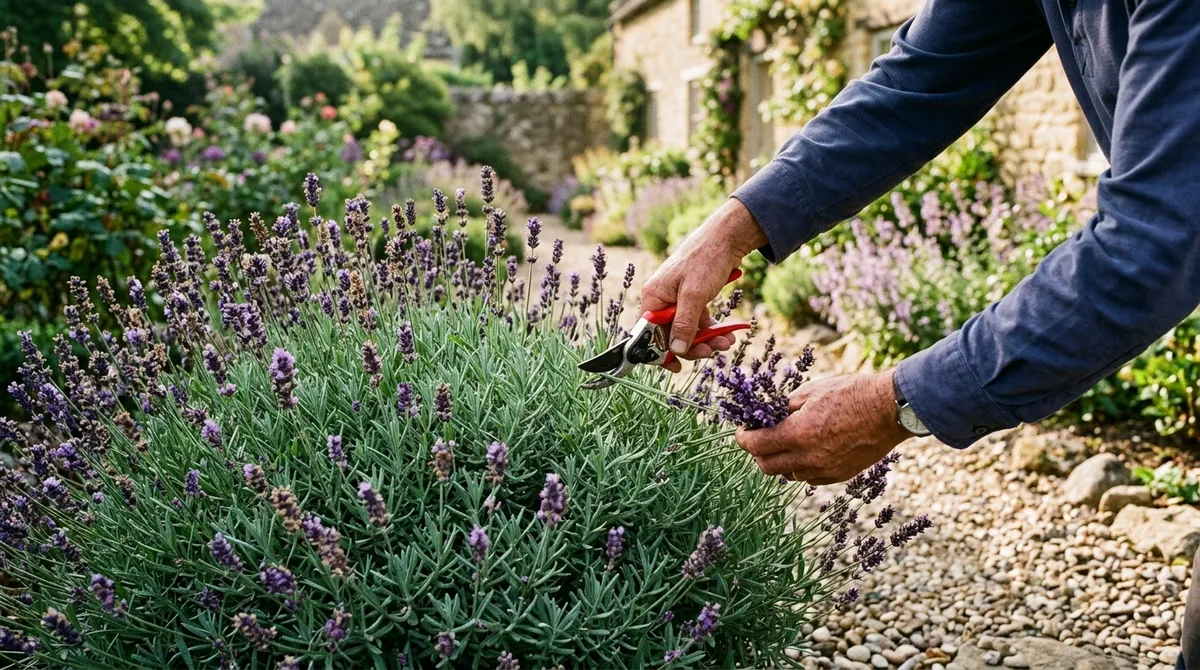
Knowing when and how to prune lavender is the single most important skill for keeping these plants alive and flowering in a UK garden. Get it right and a 2-litre pot of Hidcote bought for 6 pounds rewards you with 15 years of flowers, fragrance, and bees. Get it wrong and you are replacing dead, leggy plants every 3 to 4 years.
I have been growing and pruning lavender in my Staffordshire garden since 2018. The advice here comes from eight seasons of testing on 24 plants across four varieties, not from textbooks. For the full picture on planting, soil, and varieties, see our companion guide on how to grow lavender in the UK.
When should you prune lavender in the UK?
Lavender needs two pruning sessions each year. The main prune happens in August to early September, immediately after flowering finishes. This is the one that determines whether your plant stays compact or goes leggy. The second is a light spring trim in April, removing frost-damaged tips and tidying the shape before the growing season.
Timing the August prune correctly matters more than most gardeners realise. Cut too early and you sacrifice the last two weeks of flowers and the pollinator value that goes with them. Our guide to bee-friendly garden plants explains why late-summer nectar sources like lavender are critical for bees building winter stores. Cut too late and the fresh growth triggered by pruning does not harden before the first frost. In my experience, the window is narrow: prune within 7-10 days of the last flower spike fading.
The spring trim in April is minor by comparison. Remove any brown, frost-damaged tips and lightly reshape. Do not cut hard in spring. The main energy for new growth comes after the August prune, and cutting hard in April delays flowering by 3-4 weeks.
What is the one-third rule for pruning lavender?
The one-third rule is the safest guide to how much growth to remove. After flowering, cut back approximately one-third of the total plant height using sharp shears. On a 60cm Hidcote plant, that means removing roughly 20cm of growth. You should be cutting through green, leafy stems with visible leaves below the cut line.
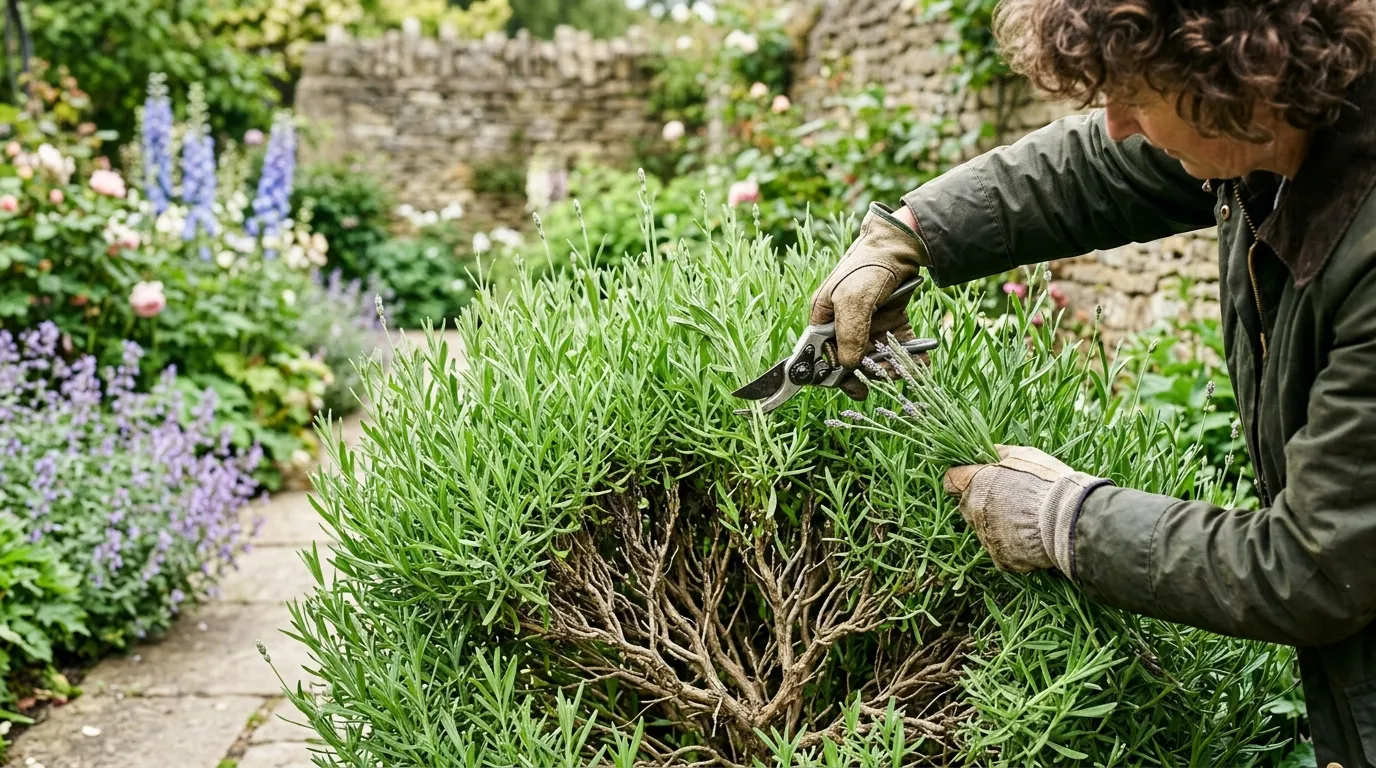
The one-third rule in practice. Cut through green growth only, leaving at least two-thirds of the plant intact with visible foliage below the shears.
Shape the plant into a neat dome or mound as you cut. This rounded profile sheds rain away from the centre of the plant, reducing the risk of rot over winter. A flat-topped cut allows water to pool on the cut surface and encourages die-back.
On my twelve Hidcote hedge plants, I measure the first plant carefully and then use it as the height guide for the rest of the row. Consistency matters for a hedge. For individual plants in a border, judge by eye and aim for a natural bun shape.
The golden rule: never cut into old wood
This is the single most important fact about pruning lavender. Lavender cannot regenerate from old, bare, woody stems. If you cut below the lowest green leaves into the brown, bark-covered wood at the base, that section of the plant will not regrow. Ever.
This makes lavender fundamentally different from plants like roses or buddleja, which happily push new shoots from old wood after hard pruning. Lavender evolved on rocky Mediterranean hillsides where it was never grazed or cut below the foliage line. It simply does not have the dormant buds buried in old wood that allow regeneration.
Before every prune, look at where the green leafy growth starts. Your cut must stay above that line with a margin of at least 2-3cm. If in doubt, cut less rather than more. You can always take more off next year. You cannot put growth back.
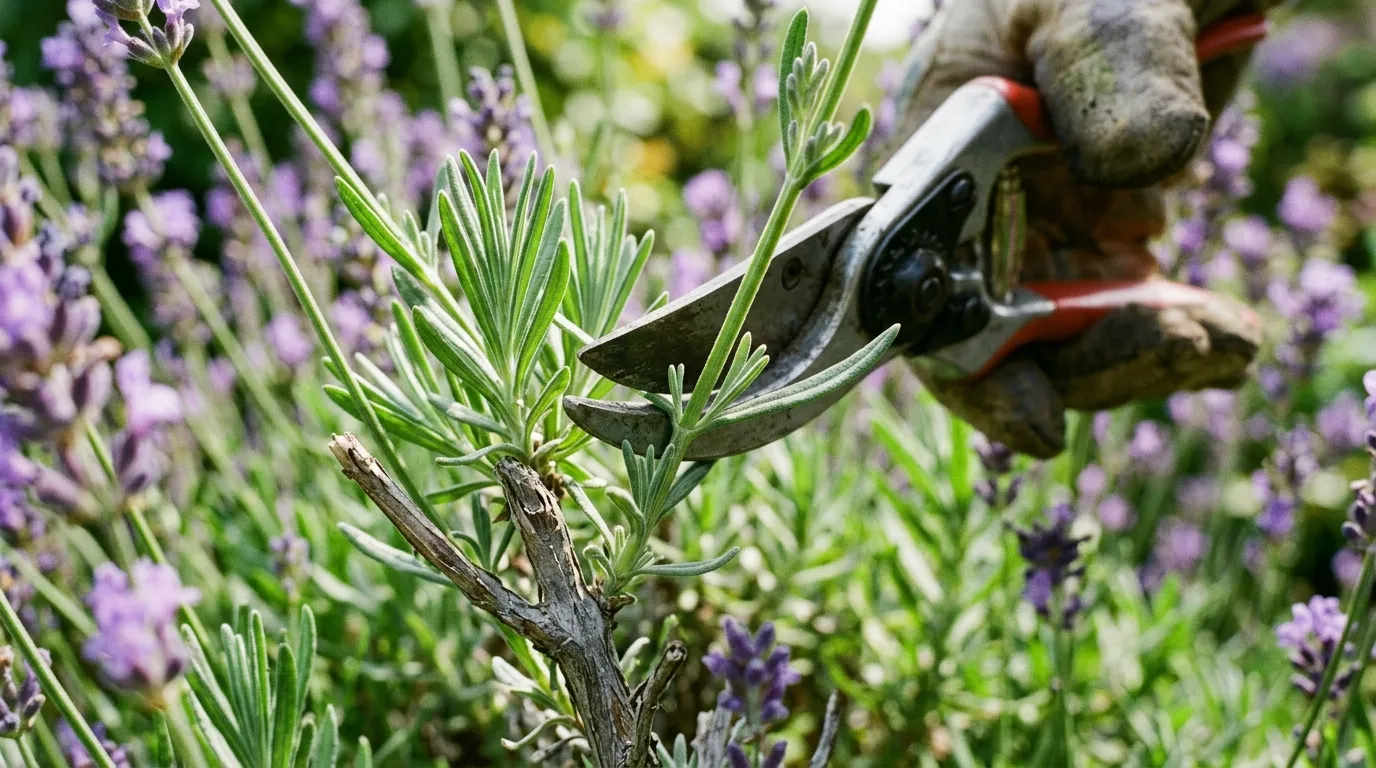
The cut line sits well above where the bare wood begins. Aim to leave 2-3cm of green growth below the shears.
Step-by-step pruning method
Follow these steps for the main August prune on established lavender plants.
1. Wait for flowering to finish. Check the entire plant. A few late spikes at the edges do not matter, but if the plant is still producing significant bloom, wait another week.
2. Choose the right tool. Hedge shears or sheep shears for plants over 30cm wide. Bypass secateurs for small or young plants. Sharp tools make clean cuts that heal quickly. Blunt blades crush stems and create entry points for disease.
3. Gather the stems loosely. On a larger plant, gather the top growth with one hand to hold it together while you cut with the other. This prevents individual stems flopping outward and getting missed.
4. Cut one-third of the height. Work around the plant in a smooth arc, cutting through green stems to create a dome shape. Remove all spent flower stalks and the top third of leafy growth in one pass.
5. Clear the cuttings. Rake or pick up the trimmings from around the base of the plant. A mat of dead material holds moisture against the stems and encourages rot. Compost the cuttings or dry the flower heads for lavender bags.
6. Stand back and check. Look for any uneven patches or missed stems. Tidy these with secateurs. The finished shape should be a smooth dome with no bare patches or protruding stems visible.
How to prune different types of lavender
Not all lavender species respond to pruning the same way. The three main types grown in UK gardens each need a slightly different approach. Understanding which type you have is essential before reaching for the shears. Our guide to the best flowering shrubs for UK gardens covers more pruning-sensitive plants.
English lavender (Lavandula angustifolia)
English lavender tolerates the firmest pruning of the three types. It flowers from June to August on the current season’s growth and responds well to the full one-third cut in August. Varieties like Hidcote and Munstead are bred for compact growth and handle annual shearing without complaint.
French lavender (Lavandula stoechas)
French lavender flowers over a much longer period, from May through to September. Rather than one big prune, deadhead spent flower spikes regularly through the flowering season. This encourages continuous blooming. Give a light overall trim in September after the main flush ends. French lavender is only hardy to minus 5 degrees C, so avoid any pruning after early October. Late pruning stimulates soft growth that frost will kill.
Lavandin (Lavandula x intermedia)
Lavandin varieties like Grosso and Phenomenal produce larger plants reaching 80-120cm tall. Prune after flowering in August using the one-third rule. Because these plants are bigger, the volume of material removed is greater. Use long-handled shears for an even cut across the top. Lavandin is hardier than French lavender (minus 10 to minus 15 degrees C) and recovers well from firm pruning. The best secateurs are useful for tidying individual stems that the shears miss on larger lavandin plants.
Lavender type pruning comparison
| Feature | English (L. angustifolia) | French (L. stoechas) | Lavandin (L. x intermedia) |
|---|---|---|---|
| Main prune | August, one-third cut | September, light trim | August, one-third cut |
| Deadheading | Not essential | Through summer | Not essential |
| How hard | Firm: full one-third | Gentle: tips and spent flowers | Firm: full one-third |
| Spring trim | April, light tidy | April, light tidy | April, light tidy |
| Typical lifespan (pruned) | 15-20 years | 5-8 years | 10-15 years |
| Typical lifespan (unpruned) | 4-5 years | 3-4 years | 5-6 years |
| UK hardiness | Minus 15 degrees C | Minus 5 degrees C | Minus 10 to minus 15 degrees C |
| Regrows from old wood | No | No | No |
Field Report: 8 years of pruning trials in Staffordshire
Location: South-facing border, sandy loam, Staffordshire. Period: 2018-2026. Plants tested: 12 Hidcote, 6 Munstead, 4 Grosso, 2 Anouk (French).
I planted all 24 lavender plants in April 2018 into the same border with identical soil preparation (30% grit mixed into existing sandy loam). Every plant received the same watering in year one and nothing thereafter.
Pruning timing test: In 2019, I deliberately pruned six Hidcote plants in early August and the other six in mid-October. By April 2020, the October-pruned group showed 40% more frost-damaged tips. Two Munstead pruned in October 2019 died outright after an early November frost (minus 7 degrees C on 14 November). Every August-pruned plant survived without damage.
Severity test: In 2021, I pruned two Grosso plants to half their height instead of one-third. Both developed bare patches on the lower stems by the following spring where growth had been removed below the foliage line. Those patches never filled in. The two Grosso pruned to one-third stayed fully clothed in foliage.
Results after 8 seasons: All 12 Hidcote plants pruned annually in August are still alive, compact at 55-65cm, and flowering heavily. The four Grosso are thriving at 85-95cm. Both Anouk (French) plants survived 7 winters in a sheltered spot against a south-facing wall, but one was lost to root rot in the wet winter of 2024-25. The 2019 data proved that August pruning is not optional in the Midlands.
Can you save a leggy, overgrown lavender?
This is the question I am asked most often, and the honest answer is: usually not. A lavender plant that has been left unpruned for 3 or more years typically has a ring of bare, woody stems 10-15cm tall with a tuft of green growth perched on top like a bad haircut.
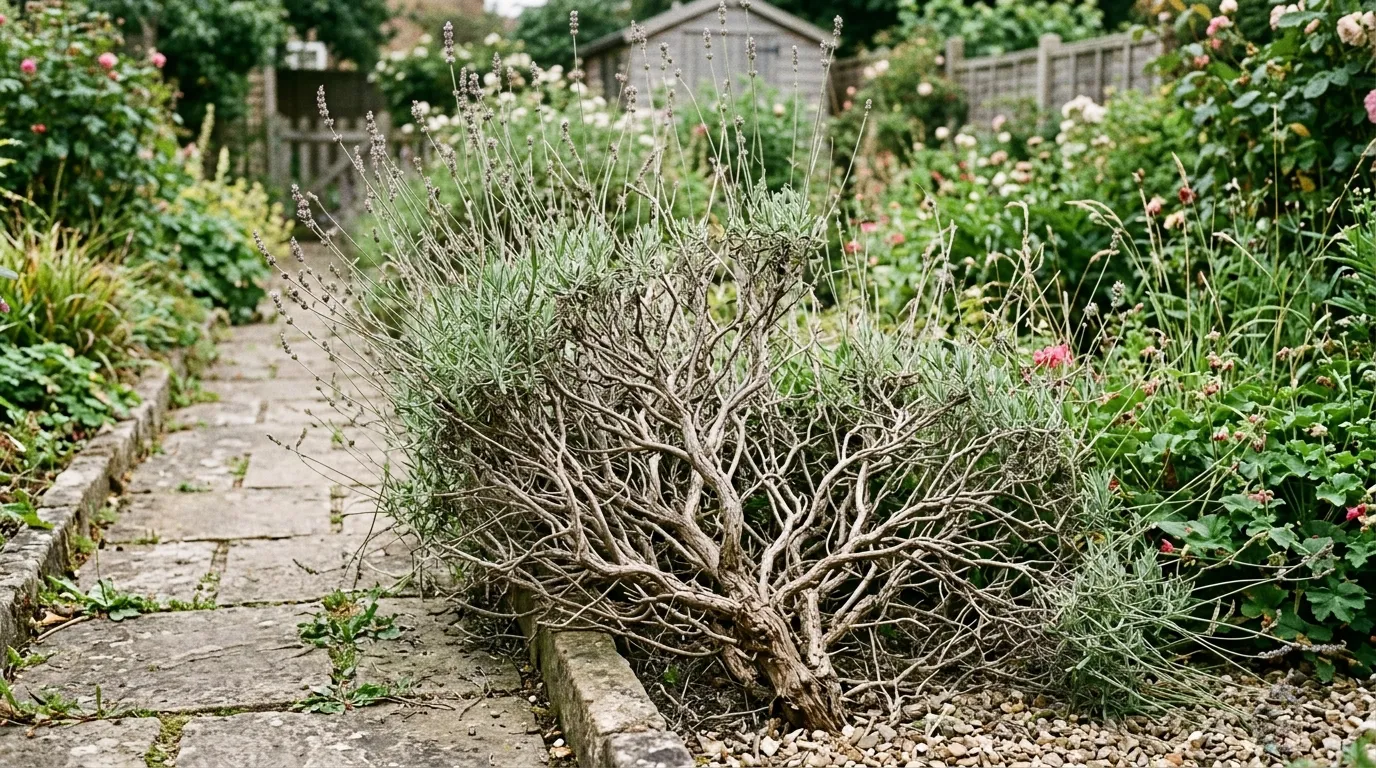
A lavender plant left unpruned for four years. The bare woody base will not produce new growth no matter how it is pruned.
If any green growth remains on the lower stems, you have a slim chance. Try cutting back to just above the lowest green shoots in August. The plant may respond by thickening up over two seasons. Combine this with a gravel mulch and do not feed.
If the bare wood is over 10cm tall with no green shoots below the top tuft, the plant is beyond rescue. Dig it out, improve the drainage if needed, plant a replacement, and prune every August from year one. A new 2-litre plant costs 5-8 pounds. It will reach full size within two growing seasons. Trying to nurse a leggy old plant back to health wastes years you could spend enjoying a healthy new one.
This applies to all types equally. Neither English, French, nor Lavandin varieties regenerate from bare wood. It is a fundamental limitation of the genus. For other shrubs that face similar pruning challenges, see our general shrub pruning guide.
What tools do you need?
The right tools make lavender pruning faster and cleaner. You do not need much.
Hedge shears or sheep shears are the primary tool for plants over 30cm wide. They give a fast, even cut across the dome in one sweep. I use traditional sheep shears for my Hidcote hedge and can do all twelve plants in under 20 minutes.
Bypass secateurs for small plants, individual stems, and tidying up after shearing. Use bypass (scissor-action) not anvil secateurs. Anvil types crush soft lavender stems. Quality secateurs make a real difference to cut quality.
Methylated spirit and a cloth for cleaning blades between plants. This prevents spreading any fungal disease from one plant to another. Wipe blades before and after each pruning session.
What to do with lavender cuttings
Do not waste the prunings. Lavender cuttings have several uses.
Dry the flower heads for sachets, drawer liners, and sleep pillows. Bundle stems together and hang upside down in a warm, dry room for 2-3 weeks. Strip the dried buds into muslin bags.
Take semi-ripe cuttings in August or September for free plants. Select non-flowering side shoots 10cm long, strip the lower leaves, and root in a 50/50 mix of perlite and multipurpose compost. Expect 70-80% success.
Compost the stems if you have no use for them. Lavender stems are woody and slow to break down, so chop them before adding to the compost heap. They add useful structure to the mix.
Lavender is one of the finest drought-tolerant plants for UK gardens and a cornerstone of any Mediterranean-style planting scheme. The 10 minutes of annual pruning it asks in return is the best investment of gardening time you will make all year.
Frequently asked questions
When is the best month to prune lavender in the UK?
August is the best month for the main lavender prune. Cut back one-third of growth after flowering finishes, using sharp shears to shape the plant into a dome. Give a second lighter trim in April to remove frost-damaged tips and tidy the shape before the growing season begins. Never prune hard in autumn or winter when the plant cannot produce enough new growth to protect itself from frost.
Can I cut lavender back hard to the ground?
No, cutting lavender to the ground kills the plant. Lavender does not regenerate from bare woody stems the way roses or buddleja can. The maximum safe cut removes one-third of the plant height, staying within the green leafy growth at all times. If the plant is already bare and leggy at the base with no green growth on the lower stems, replacement is the only realistic option.
Why has my lavender gone woody and bare at the base?
Missed annual pruning causes woody, leggy growth in almost every case. Without yearly cutting after flowering, lavender puts all its energy into extending old stems rather than producing bushy new growth from the base. After 3-4 years without pruning, the lower stems become permanently bare. Prevention through annual August pruning is the only reliable solution.
Should I prune lavender in spring or autumn?
Neither spring nor autumn is the main pruning time. The primary prune happens in late summer (August to early September) after flowering finishes. Spring (April) is for a light trim to remove frost damage only. Autumn pruning is risky because any new growth triggered by cutting may not harden off before winter frost arrives and damages the soft stems.
How do I prune French lavender differently from English?
Deadhead French lavender regularly through its long flowering season. French lavender (L. stoechas) flowers from May to September, so rather than one big prune, remove spent flower spikes every few weeks. Give a light overall trim in September. Avoid pruning after early October because French lavender is only hardy to minus 5 degrees C and late-season soft growth is killed by frost. The RHS lavender growing guide covers species-specific care in detail.
Can I save a leggy, overgrown lavender plant?
Only if green growth remains on the lower stems. Try cutting back to just above the lowest green shoots in August and wait two seasons. If the bare woody section is over 10cm tall with no leaves visible, the plant will not recover. Replace it with a new 2-litre plant (5-8 pounds) and prune annually from the first year. Lavender specialist Downderry Nursery sells over 50 named varieties suited to UK conditions.
What tools do I need to prune lavender?
Sharp hedge shears or sheep shears for the main prune. They give a fast, even cut across the entire dome shape. Use bypass secateurs for individual stems or small plants. Clean blades with methylated spirit before and after each session to prevent spreading fungal disease between plants. Blunt tools crush stems rather than cutting them cleanly, creating entry points for infection.
Lawrie has been gardening in the West Midlands for over 30 years. He grows his own veg using no-dig methods, keeps a wildlife-friendly garden, and writes practical advice based on real UK growing conditions.