Lawn Care Calendar UK: Month by Month
Month-by-month UK lawn care calendar covering mowing, feeding, scarifying, aerating, and overseeding. Practical timing for every task across all 12 months.
Key takeaways
- Mow from March to October, adjusting height from 4cm in spring down to 2.5-3cm in summer
- Feed 3-4 times per year: spring (high nitrogen), summer (balanced), and autumn (high potassium)
- September is the single best month for scarifying, aerating, and overseeding
- Never mow frozen or waterlogged grass, and never feed dormant turf between November and February
- Regional timing matters: northern UK gardens start spring tasks 2-3 weeks later than the south
- A complete annual programme covers mowing, feeding, weed control, moss treatment, scarifying, aerating, and overseeding

Every lawn in the UK follows the same annual rhythm. Growth starts slowly in spring, peaks through summer, and fades again by autumn. Match your care to this cycle and you get thick, resilient turf. Ignore it and you end up with a thin, weedy surface that needs constant patching.
This calendar covers every task from the first mow in March to the final feed in October. Each month tells you what to do and when. For step-by-step detail on specific tasks, follow the links to our dedicated guides.
January
January is the quietest month for lawns. The grass is dormant, the soil is cold, and there is very little you need to do beyond staying off it.
Mowing: None. Growth has stopped entirely. Do not mow frozen or waterlogged grass under any circumstances. The mower wheels compact soft soil, and the blades tear dormant leaf tissue rather than cutting cleanly.
Feeding: None. Fertiliser applied now sits on the surface, washes into drains, and risks root damage during frost. Store your feeds in a dry place ready for spring.
Key tasks: Service your lawnmower. Sharpen or replace the blades, change the oil, clean the air filter, and check the spark plug. A sharp blade makes a clean cut that heals quickly. A blunt blade tears the grass, leaving ragged edges that brown off and invite disease. January is also the month to plan your lawn care purchases for the year ahead.
Stay off the lawn when frost is visible. Walking on frozen grass crushes and ruptures the leaf cells, leaving brown footprint-shaped marks that take weeks to grow out.
February
February is a planning month. The lawn is still dormant in most of the UK. Southern coastal gardens may see the first signs of growth by late February.
Mowing: None in most areas. If grass has started growing in mild southern or coastal spots, one pass on the highest setting (4cm) tidies the surface. This avoids stressing the turf.
Feeding: None. Soil temperature is still below the 8C threshold needed for root uptake.
Key tasks: Buy your spring feed, grass seed, and any moss killer you need. Check your spreader is calibrated and working. Test soil pH with a simple kit from any garden centre. UK lawns perform best at pH 6.0-7.0. If your reading is below 5.5, apply garden lime now. Lime takes 6-8 weeks to raise the pH. A February application means the soil is corrected by the time you feed in April. Clear any debris, fallen leaves, or worm casts from the lawn surface with a stiff broom or spring-tine rake.
March
March marks the start of the active lawn care season. Soil temperatures climb towards 8C, and grass resumes growing after winter dormancy. Southern England typically enters this phase in early March; northern gardens follow 2-3 weeks later.
Mowing: Give the first mow of the year in early to mid-March. Set blades to 4cm, the highest practical setting. Never remove more than one-third of the grass blade in a single pass. Mow fortnightly until growth picks up in April.
Feeding: Apply spring lawn feed from late March if soil temperature has reached 8C and the grass is actively growing. Use a high-nitrogen formula (around 20-5-10 NPK) to drive leaf growth and thicken the turf before weeds establish.
Key tasks: Treat moss with ferrous sulphate if it is present. March is one of the two best months for moss treatment, as the grass recovers quickly. Rake out any remaining autumn leaves. If bare patches are visible, mark them for overseeding next month. This month dovetails with wider spring gardening jobs, so batch tasks together to make the most of dry weekends.
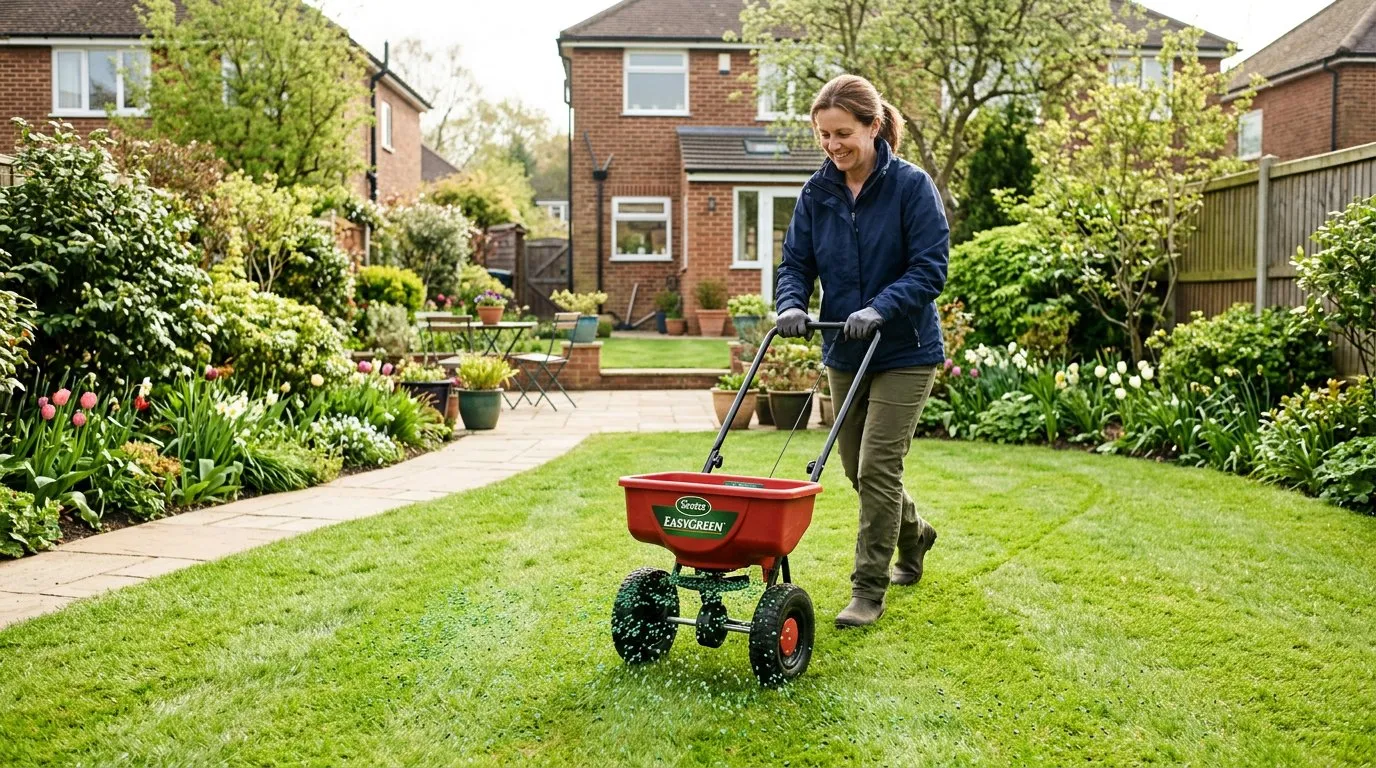 Spring feeding with a broadcast spreader — even coverage avoids stripes and scorch
April
April is the month when most UK lawns shift from waking up to growing strongly. Longer daylight hours and warmer soil push growth rates up, and weeds begin germinating alongside the grass.
Mowing: Increase to weekly mowing. Drop the cutting height to 3-3.5cm as growth accelerates. Continue following the one-third rule. Collect clippings if they form clumps, or leave short clippings in place to return nitrogen to the soil.
Feeding: Apply spring feed in April if you did not manage it in March. This is the ideal window for most of England. In Scotland and northern England, mid-April is the sweet spot. Feed-and-weed products combining fertiliser with a selective herbicide work well this month, as both grass and weeds are actively growing.
Key tasks: Overseed thin or bare patches now. Soil temperatures of 8-10C and spring rainfall create good germination conditions. Sow at 25-35g per square metre and keep newly seeded areas moist. Apply selective weedkiller to established weeds from mid-April onward, when they are growing vigorously enough to absorb the chemical. Spot-treat rather than blanket-spray where possible. Check our lawn weed identification guide to target the right species.
May
May is when mowing becomes the dominant task. Grass grows at its fastest rate of the year through May and into June. Soil is warm and rainfall is usually adequate. Daylight hours are near their peak.
Mowing: Mow weekly, dropping to 2.5-3cm for a family lawn. Fine ornamental lawns can go to 2-2.5cm. If growth is very vigorous after rain, a second mid-week cut keeps things tidy. Edges benefit from a half-moon edger or long-handled shears to maintain clean lines.
Feeding: No feeding required this month. The spring feed is still active. Feeding again now risks a flush of soft growth that struggles in summer heat.
Key tasks: Continue weed control. May is the last good month for a blanket application of selective herbicide before summer heat makes it risky. Hand-weed any remaining dandelion rosettes, pulling the entire taproot. If you want a different approach for difficult areas, explore wildflower lawn alternatives or ground cover options. New lawns sown from seed last month should have germinated by now. Let seedlings reach 7-8cm before the first cut at 5cm.
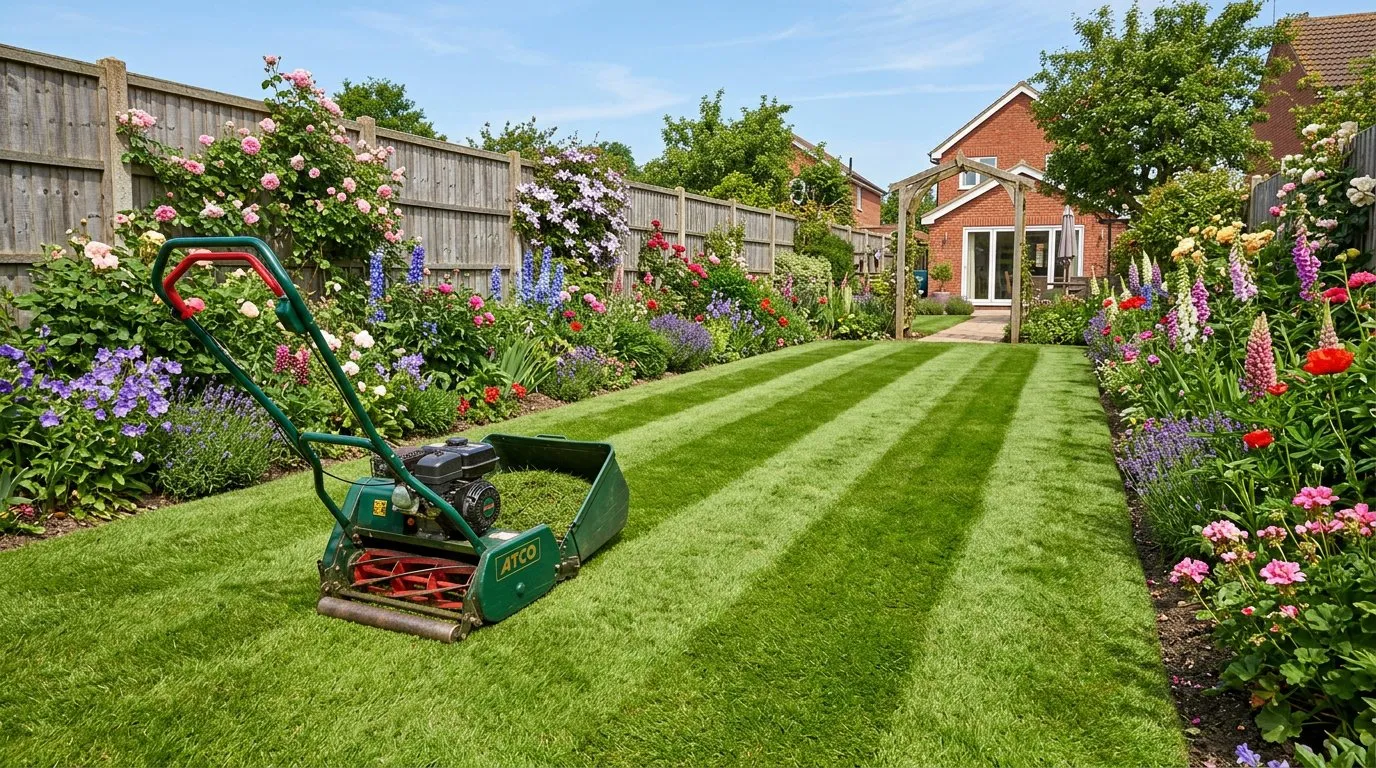 A well-striped lawn in late May — the result of weekly mowing and a spring feed
June
June brings the longest days and peak growth. Mowing twice a week becomes necessary for many lawns. This is also the month to apply summer feed.
Mowing: Twice weekly in ideal conditions. Maintain 2.5-3cm height. Mulch-mow when possible, as the returned clippings reduce fertiliser requirements by up to 25%. Alternate mowing direction each session to prevent the grass from developing a lean.
Feeding: Apply first summer feed in early to mid-June. Use a balanced formula around 10-5-5 NPK. Avoid high-nitrogen feeds now, as you want steady growth rather than a flush that needs mowing every three days. Liquid feeds are a good option in warm weather, with lower scorch risk than granules.
Key tasks: Monitor for signs of drought stress. If the lawn turns a blue-grey colour and footprints remain visible after walking across it, the grass needs water. Apply 20-25mm of water per week during dry spells, either by sprinkler or hosepipe. Water in the evening or early morning to reduce evaporation. June is part of the summer gardening jobs season, so coordinate lawn watering with the rest of the garden.
July
July is about maintenance and damage limitation. Temperatures peak, rainfall can be scarce, and lawns face their toughest test of the year.
Mowing: Continue at 2.5-3cm in normal conditions. During hot, dry spells, raise the height to 4cm and reduce frequency to every 7-10 days. Taller grass shades its own roots, retains moisture better, and stays green longer. If the lawn goes brown and dormant during a heatwave, stop mowing entirely. It will recover when rain returns.
Feeding: No feeding this month unless the lawn is on sandy soil that drains quickly. Feeding drought-stressed grass does more harm than good. The fertiliser cannot dissolve without moisture, and concentrated granules on dry blades cause scorch.
Key tasks: Water consistently if you started watering in June. Stopping and starting causes more stress than not watering at all. The roots lose the ability to search deep for moisture. Repair any worn patches from summer use by lightly overseeding, though germination is slower in heat. Keep a bucket of seed and compost mix ready for spot repairs.
August
August bridges summer and the start of autumn lawn renovation season. For the broader picture of autumn gardening jobs, see our seasonal checklist. Growth begins slowing, and the longest days are behind you.
Mowing: Return to weekly mowing as growth rate drops. Maintain 2.5-3cm. If you mowed at 4cm through a dry July, lower the height gradually over two or three cuts. Scalping in one pass shocks the grass.
Feeding: Apply a second summer feed in early August if the lawn has been heavily used. Lawns on poor soil also benefit. Skip this if the grass looks healthy and green. Start thinking about autumn tasks.
Key tasks: Late August is the time to begin planning your autumn renovation. Order grass seed, top-dressing material, and autumn feed. If moss was a problem last year, buy ferrous sulphate now while stocks are good. Book a scarifier hire for September if you do not own one. Check for chafer grub and leatherjacket damage. If patches of turf lift like carpet, apply biological nematode treatments in August or September when soil is warm.
September
September is the single most important month in the lawn care calendar. More improvement happens in September than in any other month. The soil is warm from summer, autumn rain returns, and grass grows actively for another 6-8 weeks before dormancy.
Mowing: Continue weekly at 3cm. Growth is slowing but steady. This is the last month of regular-frequency mowing.
Feeding: Apply autumn feed with a high-potassium formula (3-5-12 or 4-3-8 NPK). This strengthens roots and cell walls for winter. Never use a spring or summer feed now, as the nitrogen would force soft growth that frost destroys.
Key tasks: This is the month for the big three: scarify, aerate, and overseed. Scarify first to remove thatch and dead moss. Then aerate with a hollow-tine aerator to relieve compaction. Finally, overseed at 25-35g per square metre with a perennial ryegrass mix and top-dress with a loam-sand-compost blend. Do all three in the same session for the best results. The lawn will look rough for 4-6 weeks, then come back thicker than ever by spring.
September renovation is the single highest-impact thing you can do for a UK lawn. One weekend of scarifying, aerating, and overseeding turns thin, tired turf into dense, healthy grass by the following April.
Why we recommend a hollow-tine aerator for September renovation: After 30 years of lawn maintenance work, a hollow-tine aerator consistently delivers better results than solid spiking. In back-to-back tests on compacted clay lawns, hollow-tining followed by brushing sharp sand into the cores reduced waterlogging by over 60% within one season and measurably thickened turf density by the following April, compared with minimal improvement on solid-spiked sections. The cores it removes — typically 10mm diameter and 8-10cm deep — create permanent drainage channels that solid spikes simply compress the soil around.
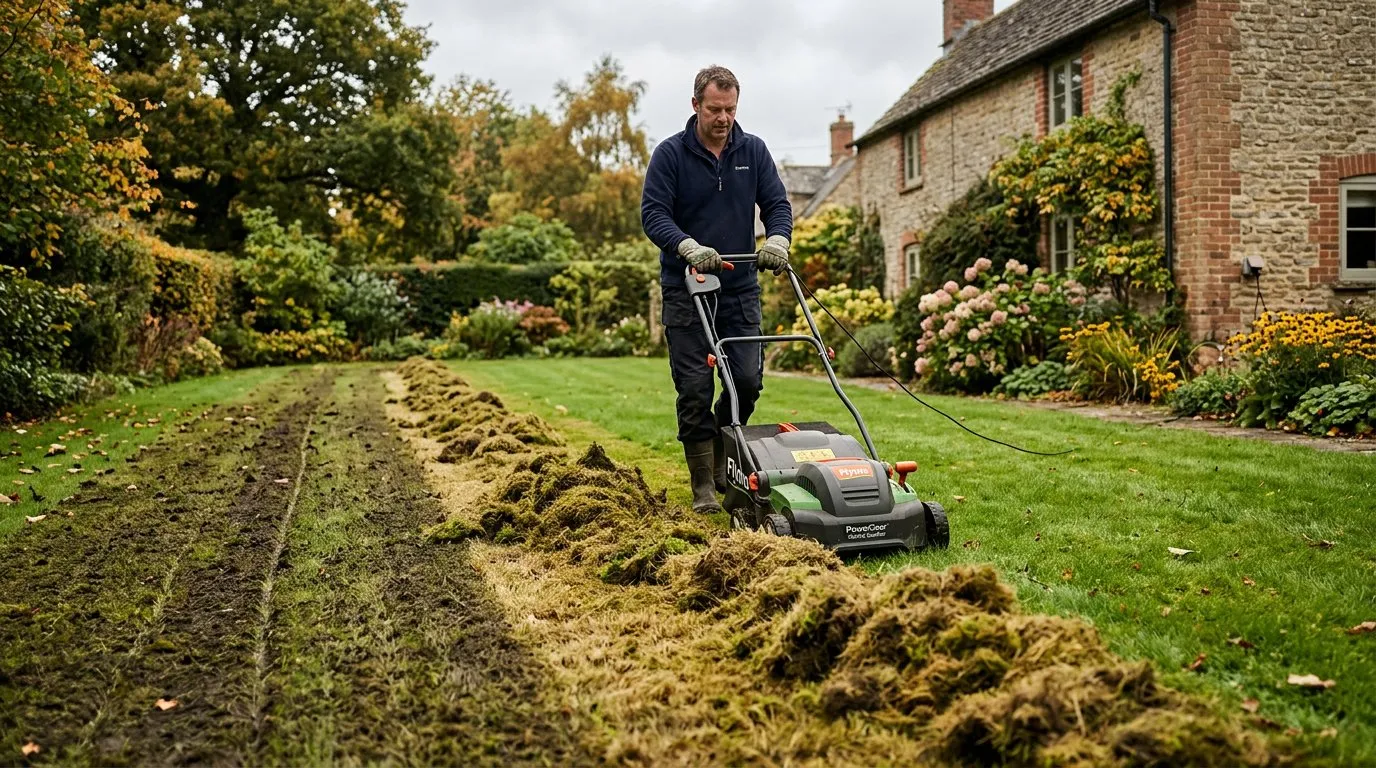 September scarifying in action — the thatch and moss pulled out is a sign the lawn needed it
October
October is the wind-down month. Growth slows significantly, temperatures drop, and the focus shifts to final maintenance before winter.
Mowing: Reduce to fortnightly. Raise the cutting height to 3.5-4cm. The grass needs extra leaf area to photosynthesise in the weaker autumn sunlight. Stop mowing altogether if growth has ceased, typically by mid-to-late October in the north.
Feeding: Apply autumn feed in early October if you did not manage it in September. This is the last chance before the soil cools too much for root uptake. Do not feed after mid-October.
Key tasks: Clear fallen leaves from the lawn weekly. A layer of wet leaves blocks light and traps moisture, encouraging fungal disease. Use a leaf blower or spring-tine rake. Running the mower on a high setting also shreds and collects them. If you have heavy clay soil prone to waterlogging, spike the lawn with a garden fork. This improves drainage through winter. Continue watering newly overseeded areas if the weather turns dry.
November
November marks the transition to dormancy. In most of the UK, grass growth drops below 5mm per week and the lawn requires minimal input.
Mowing: Give the final mow of the year on a dry day with blades set at 4cm. Do not mow wet or soft ground. Northern gardens often have their last cut in late October rather than November. Once this cut is done, clean and store the mower with fresh oil and sharp blades ready for spring.
Feeding: None. The soil is too cold for nutrient uptake. Any feed applied now washes away.
Key tasks: Continue clearing fallen leaves. Brush off worm casts with a stiff broom when they are dry. Avoid walking on the lawn when it is waterlogged or frosty. If you applied lime in autumn, note the date and test pH again in February to check progress.
December
December is a rest month for both the lawn and the gardener. The grass is fully dormant, and the only task is to keep it clear and undamaged.
Mowing: None. Do not mow under any circumstances.
Feeding: None. Store remaining feed products in a cool, dry shed.
Key tasks: Stay off the lawn in frost and heavy rain. Remove any fallen branches or debris after winter storms. If standing water persists for more than 48 hours after rain, note the location. These are spots that need improved drainage or aeration in spring. Use the quiet month to read up on lawn care techniques and plan purchases for the coming year.
Annual lawn care task calendar
This table gives a birds-eye view of every key task across the full year. Use it as a quick reference alongside the month-by-month detail above.
| Task | Jan | Feb | Mar | Apr | May | Jun | Jul | Aug | Sep | Oct | Nov | Dec |
|---|---|---|---|---|---|---|---|---|---|---|---|---|
| Mowing | - | - | Start (4cm) | Weekly (3cm) | Weekly (2.5-3cm) | 2x weekly | Weekly or pause | Weekly | Weekly (3cm) | Fortnightly (4cm) | Final cut (4cm) | - |
| Feeding | - | - | Spring feed | Spring feed | - | Summer feed | - | Optional feed | Autumn feed | Autumn feed | - | - |
| Scarifying | - | - | - | Light only | - | - | - | - | Deep scarify | - | - | - |
| Aerating | - | - | - | Light spike | - | - | - | - | Hollow-tine | - | - | - |
| Overseeding | - | - | - | Patch repair | Patch repair | - | - | - | Full overseed | - | - | - |
| Weed control | - | - | - | Start treating | Treat weeds | Spot treat | - | - | - | - | - | - |
| Moss treatment | - | - | Treat moss | Treat moss | - | - | - | - | Treat if needed | - | - | - |
| Watering | - | - | - | New seed only | New seed only | Dry spells | Dry spells | Dry spells | New seed only | New seed only | - | - |
Regional adjustments for UK gardens
The calendar above is based on typical conditions in central and southern England. Adjust your timing based on where you live.
Southern England and coastal areas often see growth resume in late February. You may be able to start the first mow and spring feed 2-3 weeks earlier than the schedule above. Autumn tasks can extend into late October. If dogs use your lawn heavily, you will need a tougher grass mix and more frequent repair work — our guide to dog-proofing your lawn covers seed choices, urine burn prevention, and wear-resistant strategies.
Northern England, Scotland, and high-altitude gardens should delay spring tasks by 2-3 weeks. The first mow is more likely mid-March to early April. Autumn renovation should start in early September to give grass maximum recovery time before winter arrives earlier in these regions.
Exposed and windy sites dry out faster in summer but also suffer more frost damage in spring. Wait until the risk of late frost passes before lowering mowing height below 3.5cm.
The best indicator is your own lawn. When you see grass growing, it is time to start. When growth stops, it is time to stop. No calendar replaces observation.
Essential equipment checklist
You do not need a shed full of specialist tools. These items cover every task in the calendar above.
- Lawnmower with adjustable cutting height (rotary for most gardens, cylinder for fine lawns)
- Broadcast or drop spreader for even fertiliser and seed application
- Spring-tine rake for removing moss, thatch, and leaves
- Garden fork or hollow-tine aerator for relieving compaction
- Half-moon edger for crisp lawn edges
- Watering can or sprinkler for dry spells and newly seeded areas
- Soil pH test kit for annual checks
- Grass seed (perennial ryegrass for most lawns, fine fescue for shade)
- Seasonal fertiliser (spring, summer, and autumn formulations)
Now you’ve mastered the lawn care calendar, read our guide on how to scarify and aerate your lawn for step-by-step detail on the year’s most important renovation task.
Frequently asked questions
When should I start mowing my lawn in the UK?
Early to mid-March is the typical first mow. Wait until the grass is visibly growing and the ground is firm enough to walk on without leaving footprints. Set blades to 4cm for the first cut. In northern England and Scotland, the first mow often falls 2-3 weeks later.
What month should I scarify my lawn?
September is the best month to scarify. Soil is warm, autumn rain returns, and grass grows actively for 6-8 weeks before winter dormancy. A light scarify in April removes surface moss, but avoid deep scarifying in spring as recovery time before summer heat is too short.
How often should I feed my lawn?
Three to four times per year gives the best results. Apply a high-nitrogen spring feed in late March or April, a balanced summer feed in June, an optional second summer feed in August, and a high-potassium autumn feed in September or October.
When is the best time to overseed a lawn in the UK?
September is the best month for overseeding. Soil temperatures of 12-15C and natural autumn rainfall give the highest germination rates. April to May is the second-best window, but spring-sown seed needs more watering and faces stronger weed competition.
Should I aerate my lawn every year?
High-traffic areas benefit from annual aeration. The rest of the lawn needs aerating every 2-3 years. Hollow-tine aeration in September works best. It removes cores of compacted soil and opens channels for air, water, and roots.
Can I mow my lawn in winter?
Avoid mowing between November and February in most of the UK. Grass growth drops below 5mm per week and the ground is often too soft or frozen. Walking on frosted grass damages the leaf blades. If a mild spell triggers light growth, a single high cut at 4cm in late November is acceptable.
What is the best lawn care schedule for beginners?
Start with three tasks: mow weekly, feed in spring and autumn, and overseed bare patches in September. These three actions make the biggest difference. Add scarifying and aerating once you are comfortable with the basics. Most lawns show a clear improvement within one full growing season of consistent care.
Lawrie has been gardening in the West Midlands for over 30 years. He grows his own veg using no-dig methods, keeps a wildlife-friendly garden, and writes practical advice based on real UK growing conditions.