Plant Propagation: Cuttings, Division, Layering
Master the three main plant propagation methods for UK gardens. Covers softwood, semi-ripe, and hardwood cuttings, plant division, and layering techniques.
Key takeaways
- Softwood cuttings taken May to July root fastest, typically within 2-4 weeks in a propagator
- Hardwood cuttings taken November to February need no equipment and root over winter outdoors
- Division of established perennials in spring or autumn is the simplest propagation method
- Layering suits woody plants like clematis, jasmine, and rhododendrons with 80-95% success rates
- Hormone rooting powder increases success rates by 20-30% for most cutting types
- A single parent plant can produce 10-50 new plants per year at zero cost
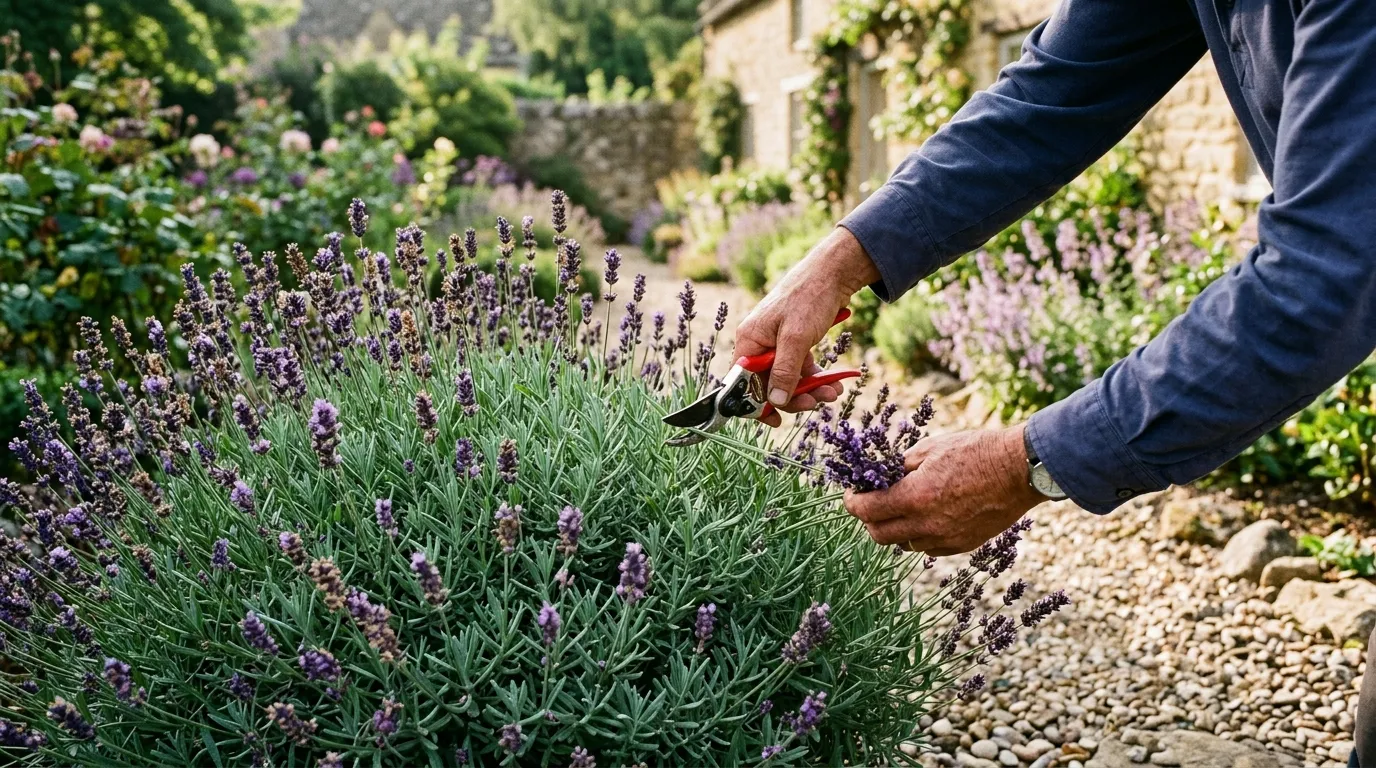
A single lavender plant costs £5-8 at a garden centre. A cutting from that plant costs nothing and roots in three weeks. One mature hosta produces six divisions in autumn. A clematis stems layered into the ground becomes an independent plant by next spring. Propagation turns one plant into many, and it is one of the most satisfying skills a gardener can learn.
I propagate hundreds of plants each year from my West Midlands garden. The techniques are straightforward once you understand the basics: when to take material, how to prepare it, and what conditions it needs to root. This guide covers the three main methods — cuttings, division, and layering — with specific timings and techniques for UK growing conditions.
Understanding the three propagation methods
Cuttings, division, and layering each suit different plants and different times of year. Knowing which method to use is half the skill. The other half is timing and preparation.
| Method | Best for | When | Success rate | Equipment needed |
|---|---|---|---|---|
| Softwood cuttings | Herbaceous perennials, tender plants | May-July | 60-80% | Propagator, rooting hormone |
| Semi-ripe cuttings | Evergreen shrubs, hedging | July-September | 50-70% | Cold frame, rooting hormone |
| Hardwood cuttings | Deciduous shrubs, roses, fruit bushes | November-February | 60-80% | None (outdoor trench) |
| Division | Perennials, grasses, bulbs | March-April or September-October | 90-95% | Fork, sharp knife |
| Simple layering | Climbers, flexible-stemmed shrubs | Spring or autumn | 80-95% | Wire pin, soil |
The beauty of propagation is that you can fill a garden entirely from free plants. A new 30-metre hedge of privet from hardwood cuttings costs nothing but time. A border of hostas, daylilies, and geraniums from division is genuinely free gardening.
Softwood cuttings: May to July
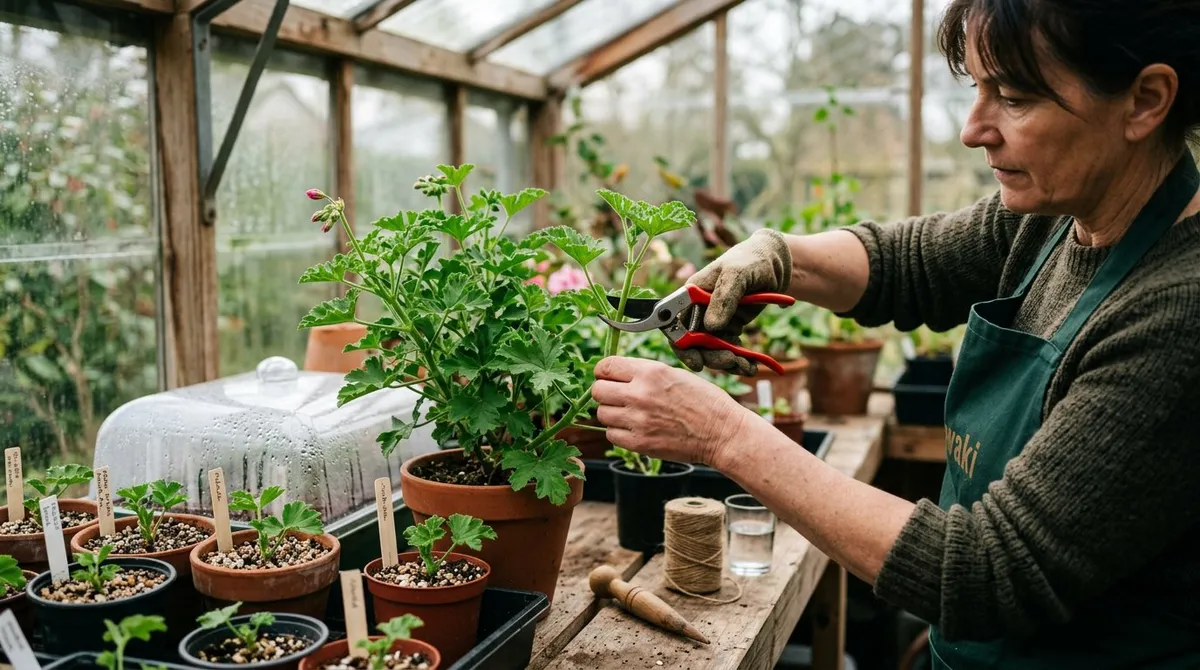
Softwood cuttings are taken from fresh, flexible new growth in late spring and early summer. This is the fastest method, with many species rooting in 2-4 weeks. It is also the most demanding, because soft material wilts quickly and needs constant humidity.
Which plants to propagate
Softwood cuttings work well for:
- Fuchsias, pelargoniums (geraniums), penstemons
- Salvias, verbena, argyranthemums
- Lavender (young shoots only — see our lavender guide for details)
- Hydrangeas (green tip cuttings — our hydrangea guide covers variety selection)
- Mint, rosemary, sage, thyme
How to take softwood cuttings
- Timing: Early morning, when stems are fully hydrated. Never take cuttings in afternoon heat.
- Select material: Choose healthy, non-flowering shoots from this year’s growth. Stems should be green and flexible, snapping cleanly when bent.
- Cut length: Take 7-12cm lengths, cutting just below a leaf node (the point where a leaf joins the stem).
- Prepare the cutting: Remove the lower leaves, keeping only the top 2-3 pairs. If leaves are large (hydrangea, for example), cut each leaf in half to reduce water loss.
- Dip in rooting hormone: Tap off excess powder. Hormone is not essential for easy species but improves success rates by 20-30%.
- Insert into compost: Use a 50/50 mix of perlite and multipurpose compost. Make a hole with a pencil first — pushing the stem directly into compost damages the base and scrapes off the rooting hormone.
- Water and cover: Water the compost gently, then cover with a clear plastic bag or propagator lid to maintain humidity. Place in bright light but not direct sun.
Aftercare
Check cuttings daily. Remove any that show signs of rot or mould immediately, as fungal disease spreads fast in humid conditions. Ventilate for 10 minutes each day to reduce condensation. Most softwood cuttings root within 2-4 weeks.
Once rooted (you will feel gentle resistance when you tug the cutting), pot each one individually into 9cm pots of multipurpose compost. Grow on in a sheltered spot until large enough to plant out.
Semi-ripe cuttings: July to September
Semi-ripe cuttings are taken when the current season’s growth has started to firm up at the base but is still flexible at the tip. This stage is called semi-ripe or semi-mature. The material is tougher than softwood cuttings and less prone to wilting.
Which plants to propagate
Semi-ripe cuttings suit:
- Box (Buxus), privet, holly, yew
- Camellia, escallonia, ceanothus
- Hebe, photinia, viburnum
- Choisya, pyracantha, cotoneaster
- Rosemary, bay, myrtle
How to take semi-ripe cuttings
- Select material: Choose side shoots from this year’s growth. The base should feel firm and woody; the tip should still be slightly flexible.
- Cut length: Take 10-15cm cuttings. Cut just below a leaf node at the base.
- Wound the base: For woody species like box and holly, scrape a thin sliver of bark (about 2cm long) from one side of the base. This exposes the cambium layer and encourages rooting.
- Remove lower leaves: Strip leaves from the bottom half of the cutting. Leave the top leaves intact.
- Apply rooting hormone: Semi-ripe cuttings benefit significantly from hormone powder. Use the stronger formulation (usually labelled for semi-ripe or hardwood use).
- Insert into gritty compost: Use a 50/50 mix of sharp sand and multipurpose compost, or perlite and compost. Good drainage is essential.
- Place in a cold frame: Semi-ripe cuttings root slowly — 6-12 weeks is typical. A cold frame provides protection without the high humidity of a propagator.
Semi-ripe cuttings from hedging plants like box and privet are an economical way to create new hedging. A 10-metre box hedge at garden centre prices costs over £200. From cuttings, it costs nothing but requires 2-3 years of growing before planting out.
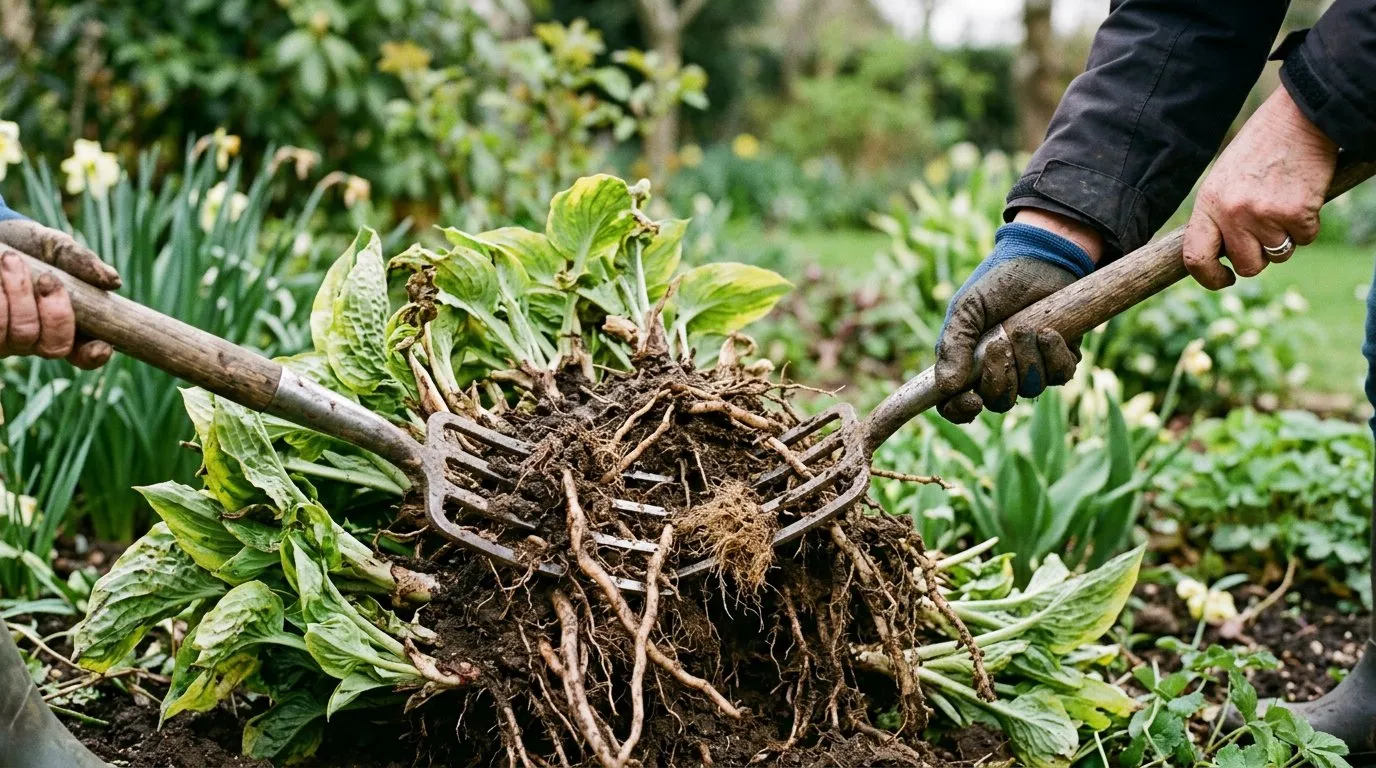 Dividing a hosta clump using two forks placed back to back. Each division needs at least three growing points and a healthy root section.
Hardwood cuttings: November to February
Hardwood cuttings are the simplest of all cutting types because they need no equipment, no heat, and no daily attention. You take them during the dormant season, stick them in a trench outdoors, and let winter do the work.
Which plants to propagate
Hardwood cuttings work for:
- Roses (see our rose growing guide for variety advice)
- Gooseberries, blackcurrants, redcurrants
- Willows, dogwoods, poplars
- Buddleia, forsythia, philadelphus
- Cornus (dogwood), deutzia, weigela
How to take hardwood cuttings
- Select material: Choose straight, healthy stems from this year’s growth. They should be pencil-thick and fully woody. Avoid very thin whippy growth or thick old wood.
- Cut length: Take 20-30cm sections. Make a straight cut at the base (just below a bud) and an angled cut at the top (just above a bud). The angled top cut tells you which end is up and sheds rain away from the wound.
- Dip the base: Apply rooting hormone powder to the bottom 2cm.
- Prepare a trench: Dig a narrow, V-shaped trench 15cm deep in a sheltered spot. Add a 2cm layer of sharp sand to the base for drainage.
- Insert cuttings: Push each cutting into the trench so two-thirds is below ground and one-third (with 2-3 buds) is above. Space them 10-15cm apart.
- Backfill and firm: Push soil back around the cuttings and firm with your boot. Water well.
What happens next
The cuttings sit dormant through winter. Roots begin forming in late winter as soil temperatures rise. Leaf buds break in spring, drawing energy from the stored carbohydrates in the stem. By the following autumn, each cutting should have a healthy root system and top growth.
Leave hardwood cuttings in the trench for a full growing season. Transplant to their final positions the following autumn. Roses may need two full years in the trench before they are large enough to plant out.
Division: the simplest method
Division is the fastest and most reliable propagation method, with success rates above 90%. You lift an established clump, split it into sections, and replant. Each section is already a complete plant with roots and shoots.
When to divide
- Spring (March to April): Best for most perennials. New growth is just starting, and the soil is warming up. Plants establish quickly in spring.
- Autumn (September to October): Suits plants that flower in spring or early summer. The soil is still warm, and autumn rain keeps divisions watered.
Avoid dividing in summer heat or winter cold. Both cause unnecessary stress.
Which plants to divide
Division works for any clump-forming perennial:
- Hostas, hemerocallis (daylilies), agapanthus
- Hardy geraniums, astilbe, Japanese anemones
- Ornamental grasses (miscanthus, stipa, molinia)
- Primulas, pulmonaria, bergenia
- Dahlias (tuber division — see our dahlia guide for method)
- Irises (rhizome division after flowering in July)
How to divide perennials
- Lift the clump: Push a garden fork in around all four sides of the plant, rocking gently to loosen the root ball. Lift the entire clump out of the ground.
- Assess the plant: Look for natural division points — gaps between shoots, or sections that separate easily. Discard the old, woody centre if it has stopped producing strong growth.
- Separate into sections: For loose clumps (like geraniums), pull apart by hand. For tough, dense clumps (like grasses and hostas), use two forks placed back to back and lever apart. For very woody clumps, use a sharp spade or bread knife.
- Each division needs: At least 3-5 growing points (buds or shoots) and a good portion of healthy roots. Small divisions with only one shoot often fail.
- Replant immediately: Plant divisions at the same depth as the original, water well, and mulch. Do not leave roots exposed to sun and wind.
Division is also a way to rejuvenate tired perennials. Many clump-forming plants become less vigorous after 3-5 years as the centre dies out. Dividing them and replanting the outer sections restores full flowering and vigour.
Layering: high success, low effort
Layering encourages a stem to produce roots while still attached to the parent plant. Because the stem receives water and nutrients from the parent throughout the rooting process, success rates are typically 80-95%. It is the safest method for plants that are difficult to root from cuttings.
Simple layering
This is the most common form and works for any plant with a flexible stem that can be bent to the ground.
- Select a stem: Choose a healthy, flexible, low-growing stem from the current or previous year’s growth.
- Prepare the layering point: About 30cm from the stem tip, make a shallow wound on the underside. A small nick with a knife or scraping away a strip of bark 3cm long is enough. Dust with rooting hormone.
- Peg into the ground: Bend the stem down and peg the wounded section into a shallow hole (10cm deep) using a wire pin or forked stick. Cover with soil and firm down. The stem tip should remain above ground.
- Wait: Roots form at the buried, wounded point over 6-12 months. Keep the soil moist during dry spells.
- Sever and transplant: Once rooted (tug gently to check), cut the new plant free from the parent and transplant to its final position.
Best plants for layering
| Plant | Layering time | Rooting time | Notes |
|---|---|---|---|
| Clematis | Spring | 6-12 months | Layer the whippy stems near the base |
| Jasmine | Spring-summer | 4-6 months | Roots quickly and easily |
| Rhododendron | Spring | 12-18 months | Wound the stem well and use acidic soil |
| Magnolia | Spring | 12-24 months | Slow but reliable |
| Honeysuckle | Autumn | 6-9 months | Very easy, often layers itself naturally |
| Climbing hydrangea | Spring | 6-12 months | Pin aerial roots into contact with soil |
| Wisteria | Summer | 12 months | Use current year’s growth |
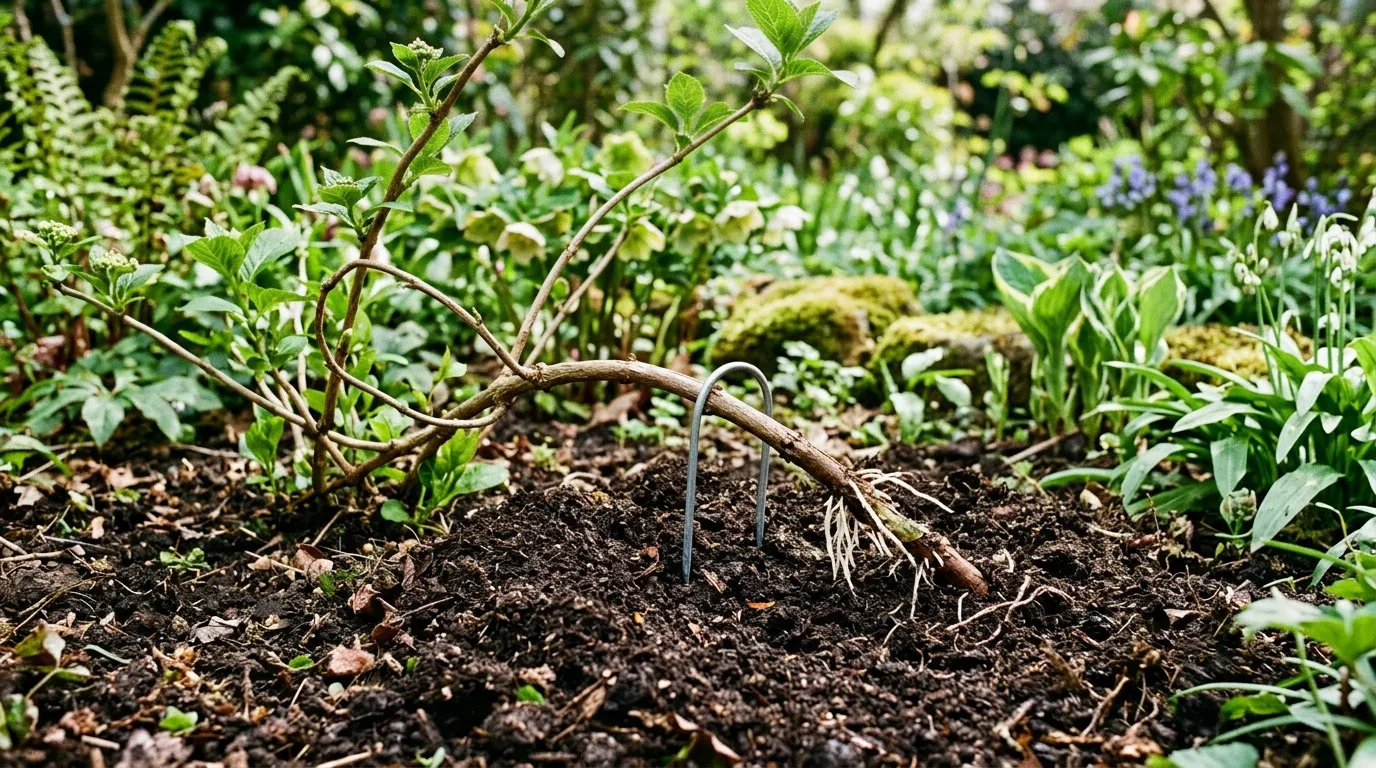 Simple layering: a flexible stem pinned to the ground with a wire hoop. The wound on the underside encourages root formation at that point.
Air layering
Air layering works for plants whose stems cannot be bent to the ground — typically upright trees and shrubs like magnolias, acers, and rubber plants.
- Select a straight section of stem, roughly pencil-thick
- Make two ring cuts 3cm apart through the bark. Peel off the bark between them
- Dust the exposed wood with rooting hormone
- Wrap a handful of damp sphagnum moss around the wound
- Cover the moss with a sheet of plastic wrap, sealing both ends with tape
- Roots grow into the moss over 8-16 weeks
- When roots are visible through the plastic, cut the stem below the root ball and pot up
Air layering requires more materials and attention than simple layering, but it lets you propagate specimens that have no accessible low branches.
Compost mixes for propagation
The compost you use for cuttings differs from standard potting compost. Cuttings need excellent drainage and minimal nutrients. Rich compost encourages rot rather than roots.
| Mix | Use | Ratio |
|---|---|---|
| Perlite + multipurpose compost | Softwood and semi-ripe cuttings | 50:50 |
| Sharp sand + multipurpose compost | Semi-ripe cuttings, cold frames | 50:50 |
| Vermiculite + peat-free compost | Seed compost substitute | 50:50 |
| Pure perlite | Difficult-to-root species | 100% |
| Garden soil + sharp sand | Hardwood cutting trenches | 70:30 |
For indoor propagation, see our guide to sowing seeds indoors which covers compost, temperature, and lighting requirements.
Never use compost straight from the bag for cuttings. It holds too much moisture and not enough air. The 50/50 perlite mix is my standard for almost all cutting types and has the best balance of moisture retention and drainage.
Rooting hormones explained
Rooting hormone is a synthetic version of the plant hormone auxin, which stimulates root growth at wound sites. It is available as powder, liquid, or gel.
Powder is the most widely available and cheapest option. A single pot costs £3-5 and lasts several seasons. Dip the base of the cutting into the powder, tap off the excess, and insert into compost. The powder adheres to the moist cut surface.
Different strengths suit different cutting types:
- Strength 1 (0.1% IBA): Softwood cuttings, easy-rooting species
- Strength 2 (0.3% IBA): Semi-ripe cuttings, moderate species
- Strength 3 (0.8% IBA): Hardwood cuttings, difficult species
Some species root so easily that hormone is unnecessary. Willows, pelargoniums, fuchsias, and mint all root readily in water or plain compost. For harder species like box, camellia, and magnolia, rooting hormone makes a significant difference.
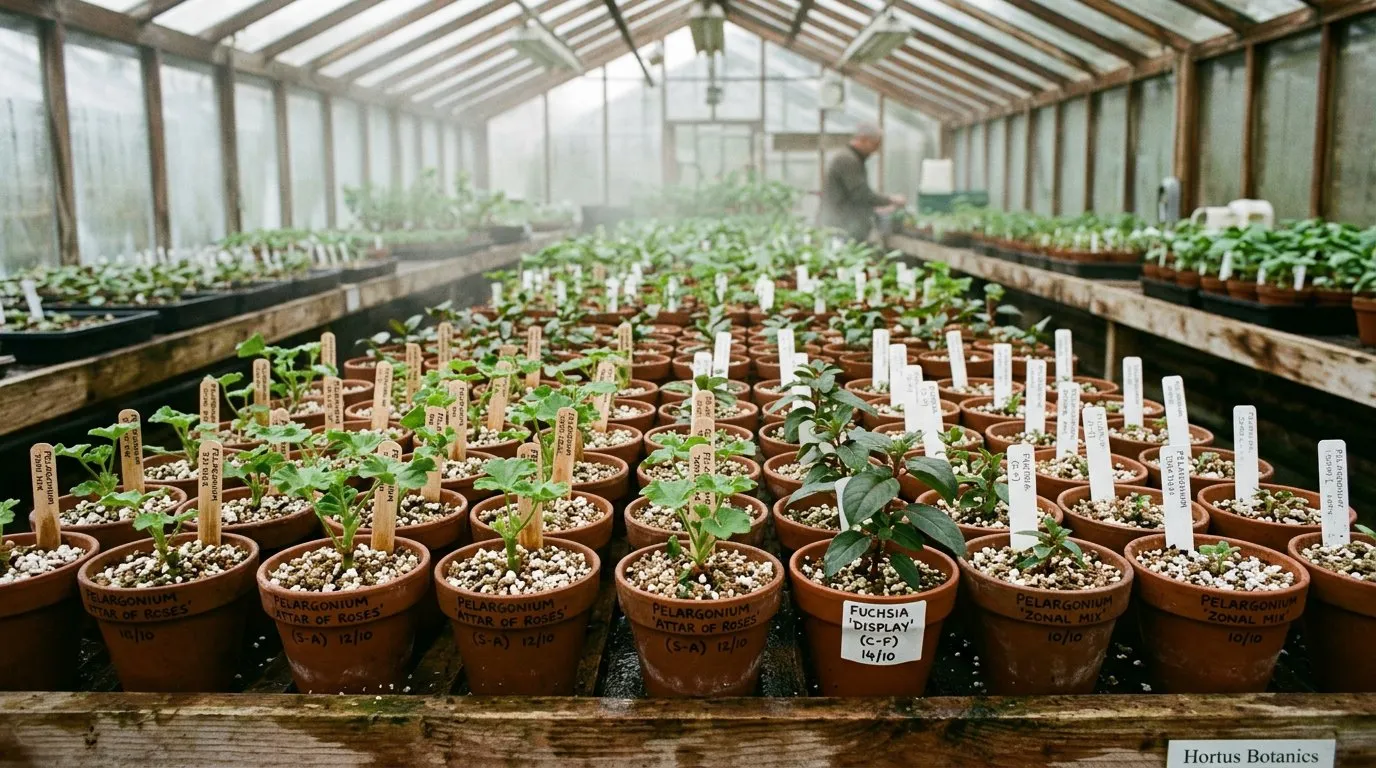 Rooted softwood cuttings potted into 9cm pots. White root tips are visible around the edges, showing healthy establishment.
Why we recommend hormone rooting powder (Strength 2, 0.3% IBA) as your single propagation purchase: After 30 years of propagating thousands of plants, Strength 2 rooting powder consistently delivers the best balance across cutting types — soft enough for most semi-ripe material without burning softwood stems. In trials on box, hebe, and rosemary cuttings, Strength 2 produced rooted cuttings in 6-8 weeks versus 10-14 weeks in untreated controls, a 35-40% improvement in rooting speed.
Propagation calendar for UK gardeners
Planning your propagation through the year ensures you never miss the optimum window for each technique. Here is a month-by-month guide.
| Month | Activity |
|---|---|
| January | Take hardwood cuttings of fruit bushes and deciduous shrubs |
| February | Divide snowdrops “in the green” after flowering |
| March | Divide perennials as new growth appears. Start dahlia tuber division |
| April | Divide ornamental grasses. Take basal cuttings from delphiniums and lupins |
| May | Take softwood cuttings from tender perennials and shrubs |
| June | Layer clematis and jasmine. Continue softwood cuttings |
| July | Transition to semi-ripe cuttings as growth firms. Divide bearded irises after flowering |
| August | Semi-ripe cuttings of evergreen hedging (box, privet, yew) |
| September | Divide spring-flowering perennials. Layer rhododendrons |
| October | Prepare hardwood cutting trenches. Last chance to divide perennials |
| November | Take hardwood cuttings of roses, dogwood, and willows |
| December | Continue hardwood cuttings. Check cold frame cuttings for rot |
Troubleshooting common problems
Most propagation failures come down to three causes: wrong timing, wrong moisture levels, or wrong temperature. Here are the problems I see most often and how to fix them.
Cuttings wilt and collapse
The cutting is losing water faster than it can take it up. This happens when humidity is too low or the cutting is in direct sun. Move to bright shade, cover with a clear bag or propagator lid, and mist the leaves daily. Remove any flowers or large leaves that increase water loss.
Cuttings rot at the base
The compost is too wet or too rich. Switch to a grittier mix with more perlite or sand. Water the compost before inserting cuttings, then do not water again until the surface dries slightly. Good air circulation is essential — open the propagator vent for 10 minutes daily.
Divisions fail to establish
The divisions were too small. Each piece needs at least 3-5 growth points and a substantial root portion. Very small divisions with one or two shoots often dry out before they can generate enough root to sustain themselves. Water newly planted divisions every other day for the first two weeks.
Layers do not root
The stem was not wounded deeply enough, or the soil around the buried section dried out during summer. When layering, make a definite wound through the bark to the cambium layer. Keep the area moist throughout the rooting period. Mulch over the buried section to retain moisture.
Filling a garden for free
Propagation is how experienced gardeners fill large borders and new gardens without spending a fortune. One trip to a garden centre to buy 50 plants for a new border costs hundreds of pounds. The same border, filled with divisions from friends, cuttings from existing plants, and layers from climbers, costs nothing but time and knowledge.
Start a propagation area in a sheltered corner of your garden. A simple cold frame (or even a sheet of glass propped against a wall) provides enough protection for semi-ripe and hardwood cuttings. A windowsill propagator handles softwood cuttings in summer. A nursery bed — a simple patch of prepared soil — gives young plants a place to grow on before planting out.
Ask gardening friends and neighbours for cutting material. Most are happy to share. Gardening clubs and allotment societies often have plant sales and propagation workshops. The generous culture of plant sharing is one of the best things about gardening in the UK.
Every plant in your garden is a potential parent. With the techniques in this guide, you can multiply your stock year after year, filling beds, hedging boundaries, and creating new planting schemes entirely from your own propagated material. It takes patience — a hardwood cutting needs a year to root, a layered shrub needs two — but the results are deeply satisfying and entirely free.
Now you’ve mastered plant propagation, read our guide on sowing seeds indoors for the next step in building a full growing programme from scratch.
Lawrie has been gardening in the West Midlands for over 30 years. He grows his own veg using no-dig methods, keeps a wildlife-friendly garden, and writes practical advice based on real UK growing conditions.