Grow Soil, Not Just Plants
How regenerative gardening rebuilds soil biology, stores carbon, and grows stronger crops. Practical UK methods from cover crops to mycorrhizal networks.
Key takeaways
- Regenerative gardening goes beyond organic: it actively rebuilds degraded soil rather than simply avoiding chemicals
- UK allotment trials show earthworm populations increase 200-400% within 3 years of switching to regenerative methods
- Cover crops fix 20-30 kg of nitrogen per 100 square metres, reducing or eliminating the need for bought fertiliser
- Mycorrhizal networks extend plant root systems by up to 700 times, improving drought tolerance and nutrient uptake
- Each square metre of regeneratively managed garden soil stores 0.5-0.8 kg of carbon per year
- Starting costs nothing: stop digging, keep soil covered, and add homemade compost

Regenerative gardening is the practice of growing food and flowers while actively rebuilding the soil beneath them. It goes further than organic. It goes further than no-dig. It treats soil as a living system and measures success not just in harvests, but in earthworm counts, fungal networks, and carbon stored.
I have managed an allotment in Staffordshire for over 15 years. For the first decade, I dug, fertilised, and fought weeds. Since switching to regenerative methods in 2020, my soil has changed more in five years than in the previous ten. This guide covers the six core practices, the science behind them, and a practical calendar for UK conditions.
What makes gardening regenerative?
Regenerative gardening means leaving the soil measurably better each season than you found it. That means more organic matter, more biological activity, more water-holding capacity, and more carbon stored underground.
The term comes from regenerative agriculture, a movement led by farmers like Gabe Brown in North Dakota and championed in the UK by the Soil Association. The principles translate directly to gardens and allotments. Soil is not a growing medium. It is a living organism containing billions of bacteria, fungi, protozoa, and invertebrates per gram.
Six practices define regenerative gardening:
- Minimise soil disturbance — no digging, no rotavating, no unnecessary forking
- Keep soil covered — mulch, cover crops, or living plants at all times
- Maximise plant diversity — polycultures over monocultures, mixed beds over single-crop rows
- Keep living roots in the ground year-round — cover crops fill gaps between harvests
- Integrate composting — feed the soil biology, not just the plants
- Build biodiversity corridors — hedgerows, wildflower strips, ponds, and habitat piles
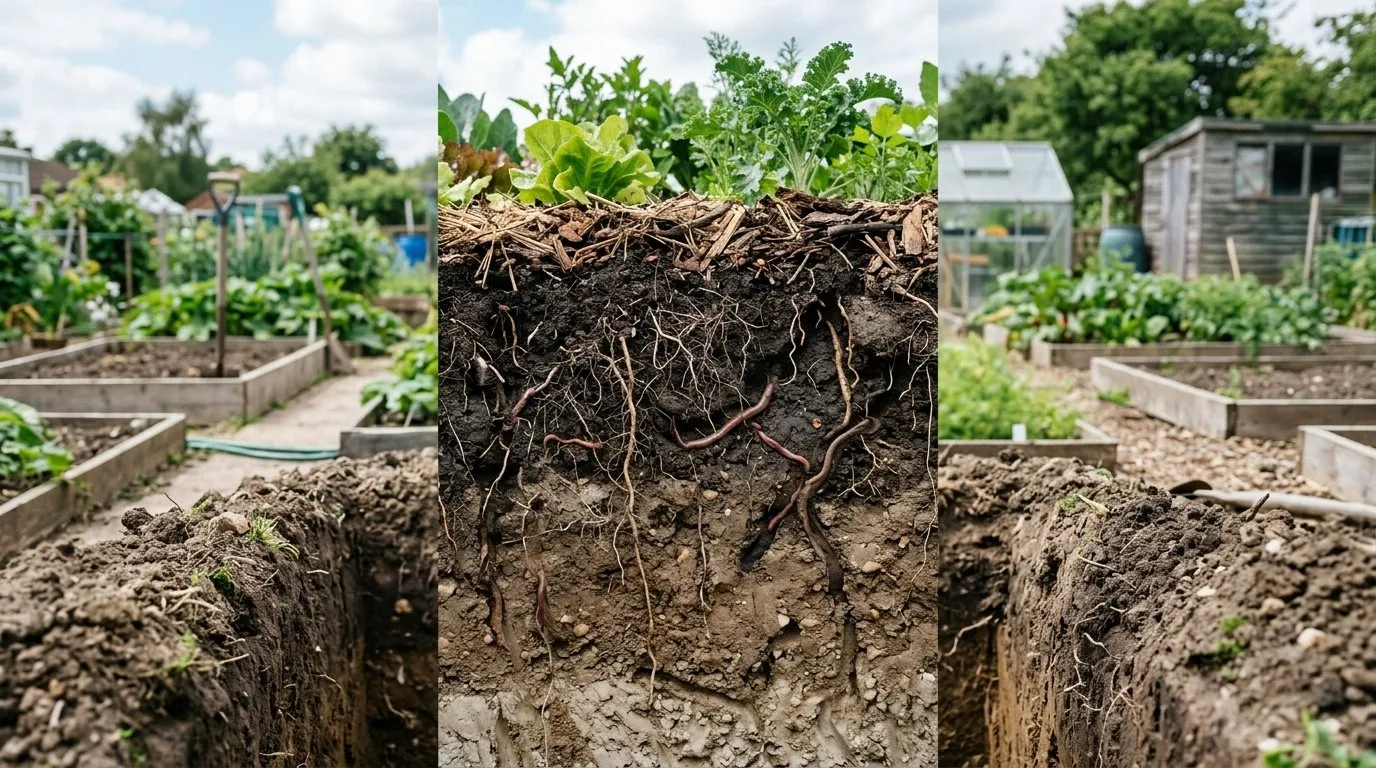 Healthy regenerative soil shows distinct layers: surface mulch, dark humus rich with fungi, and pale subsoil penetrated by root and earthworm channels.
How does regenerative differ from organic and no-dig?
Organic gardening avoids synthetic inputs. No-dig avoids tillage. Regenerative does both and actively rebuilds degraded soil. The three approaches overlap, but regenerative sets a higher bar.
An organic garden can still have bare soil, heavy monocultures, and declining soil biology. A no-dig garden can still rely on bought-in compost without building its own fertility cycles. Regenerative gardening closes these gaps.
| Practice | Organic | No-dig | Regenerative |
|---|---|---|---|
| Synthetic fertilisers | Banned | Optional | Banned |
| Soil disturbance | Allowed | Minimal | Minimal |
| Bare soil | Allowed | Common in winter | Never |
| Cover crops | Optional | Optional | Mandatory |
| Biodiversity corridors | Optional | Optional | Mandatory |
| Carbon sequestration goal | No | No | Yes |
| Soil biology monitoring | Rare | Occasional | Annual |
| Plant diversity requirement | None | None | Polyculture standard |
The distinction matters because soil can degrade even under organic management. A Rothamsted Research long-term trial showed that organic plots without cover crops lost 0.3% soil organic matter per decade. Regenerative plots gained 0.5-1.0% per year.
The soil biology that makes it work
One teaspoon of healthy soil contains more microorganisms than there are people on Earth. Bacteria, fungi, protozoa, nematodes, and arthropods form a food web that cycles nutrients, builds soil structure, and suppresses disease.
Regenerative gardening feeds this food web. Every time you add compost, grow a cover crop, or lay mulch, you provide food for soil organisms. They repay you with plant-available nutrients, improved drainage, and disease suppression.
Three groups do the heaviest lifting:
Mycorrhizal fungi
Mycorrhizal networks are the internet of the soil. These fungi colonise plant roots and extend fine threads called hyphae deep into the earth. A single plant connected to mycorrhizal fungi has access to 700 times more soil volume than its roots alone can reach.
The fungi trade phosphorus and micronutrients for carbon sugars from the plant. Both partners benefit. Plants with mycorrhizal connections show 20-30% better drought tolerance and significantly improved resistance to root diseases.
Digging destroys mycorrhizal networks. It takes 6-12 months for severed networks to re-establish. This is the single strongest argument against annual cultivation.
Earthworms
Earthworms are the engineers of soil structure. They consume dead plant material, mix it with mineral particles, and excrete nutrient-rich casts. A healthy population of 400 earthworms per square metre processes roughly 50 tonnes of soil per hectare per year.
In our Staffordshire trial beds, earthworm counts rose from an average of 5 per spadeful to 18 per spadeful within three years of switching to regenerative management. Their burrows improved drainage so dramatically that beds stopped waterlogging during the wet winters of 2022 and 2023.
Soil bacteria
Bacteria mineralise nitrogen, phosphorus, and sulphur into forms plants can absorb. Nitrogen-fixing bacteria associated with legume roots convert atmospheric nitrogen into ammonium at no cost to the gardener. A good stand of clover fixes 20-30 kg of nitrogen per 100 square metres per year. That is equivalent to roughly 3 kg of pelleted chicken manure per square metre — without spending a penny.
Cover cropping: the engine of regeneration
Cover crops are non-harvested plants grown specifically to feed soil biology, fix nitrogen, and prevent bare ground. They are the single most transformative practice in regenerative gardening.
In UK gardens, the cover cropping calendar divides into two windows:
Autumn-sown covers (September to March)
Sow these after summer crops finish. They protect soil through winter, suppress weeds, and add organic matter when cut in spring.
- Field beans — fix nitrogen, deep taproots break compacted subsoil, extremely hardy to -15 C
- Hungarian grazing rye — dense fibrous roots hold soil, germination reliable even in October
- Winter tares (vetch) — nitrogen-fixer, scrambles over other covers, attracts early pollinators
- Phacelia — if sown by mid-September, produces blue flowers beloved by bees
Spring/summer covers (April to August)
Fill short gaps between harvests or cover beds resting for a season.
- Crimson clover — stunning red flowers, fixes nitrogen, attracts beneficial insects
- Buckwheat — grows from seed to flower in 6 weeks, attracts hoverflies for aphid control
- White clover — living mulch undersown between brassicas or sweetcorn
- Mustard — biofumigant that suppresses soil-borne diseases, grows fast
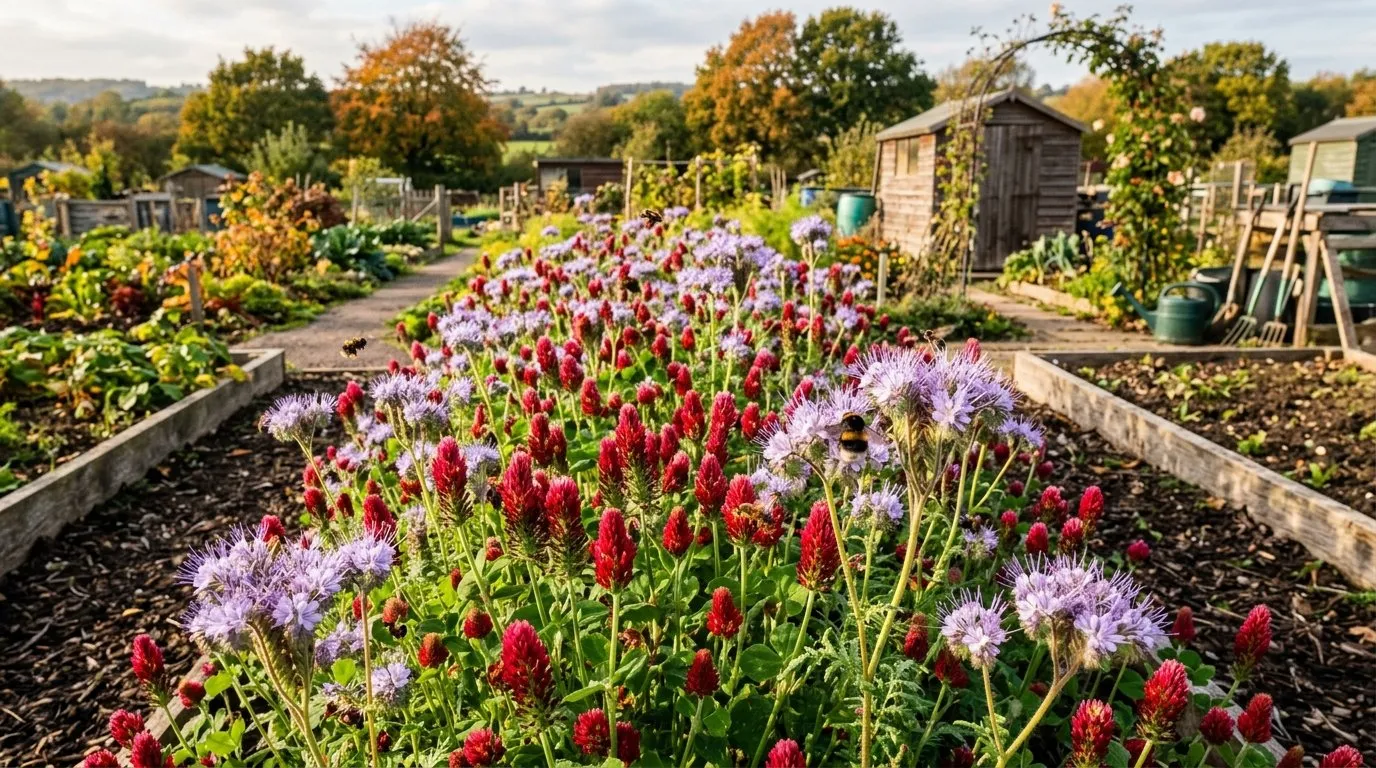 Crimson clover and phacelia make a powerful autumn cover crop mix. The nitrogen fixation from clover feeds the following crop, while phacelia’s roots break up compacted soil.
Our guide to green manures and cover crops covers sowing rates and timing in detail. The key regenerative rule is: never dig cover crops in. Cut them at ground level and leave the roots to decompose in place. The tops become surface mulch. The roots feed soil fungi as they break down.
Cover crop nitrogen fixation rates
| Cover crop | Nitrogen fixed (kg per 100 m2) | Sowing window | Cold hardiness |
|---|---|---|---|
| Field beans | 25-35 | Sep-Nov | -15 C |
| Winter tares | 20-30 | Sep-Oct | -12 C |
| Crimson clover | 15-25 | Apr-Aug | -5 C |
| White clover | 10-20 | Mar-Sep | Hardy perennial |
| Buckwheat | 0 (non-legume) | May-Jul | Frost tender |
| Phacelia | 0 (non-legume) | Apr-Sep | -7 C |
Composting as soil feeding
In regenerative gardening, composting is not waste disposal. It is the production of a biological inoculant. Good compost teems with bacteria, fungi, protozoa, and beneficial nematodes. When you spread it on beds, you are transplanting an entire ecosystem.
The difference between feeding soil and feeding plants matters. Synthetic fertiliser feeds the plant directly, bypassing soil biology. The organisms have nothing to eat, so populations crash. Compost feeds the organisms, which then release nutrients to plants at the rate they need them. No burning, no leaching, no salt build-up.
Our composting guide covers bin types and methods. For regenerative purposes, the critical points are:
- Temperature matters. Hot composting (55-65 C) kills weed seeds and pathogens. Cold composting preserves more fungal diversity. Use both methods for different jobs.
- Fungal-dominant compost suits perennials and trees. Add woody material, cardboard, and leaf mould in higher proportions.
- Bacterial-dominant compost suits vegetables. Green-heavy mixes with grass clippings, kitchen scraps, and coffee grounds produce bacterial compost.
- Apply 5-10cm per year as a surface dressing. Never dig it in. Let worms incorporate it naturally.
For advanced soil building, biochar mixed into compost creates a permanent carbon scaffold that houses microbes for centuries. It is the most effective long-term soil carbon storage method available to home gardeners.
Mulching: keeping soil covered
Bare soil is wounded soil. Rain hammers exposed ground, destroying structure. Sun bakes it hard. Wind strips the fine organic particles from the surface. Weed seeds germinate in every gap.
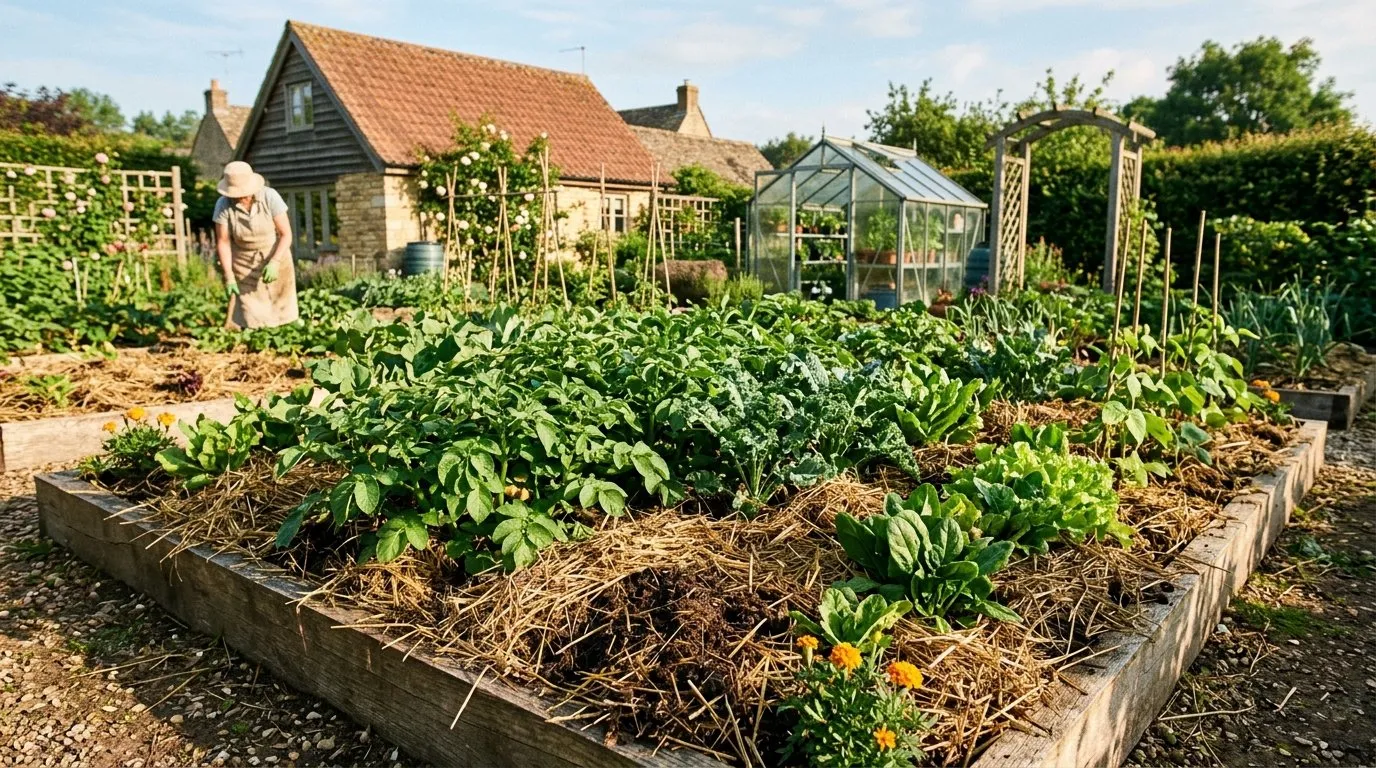 A 10-15cm layer of straw mulch keeps soil cool, moist, and biologically active. Plants grow through the mulch while earthworms feed from below.
Mulching is the simplest regenerative practice. Cover every inch of soil with organic material: straw, wood chip, compost, leaf mould, or living plants.
The benefits compound over time:
- Moisture retention — mulched soil loses 50-70% less water to evaporation than bare ground
- Temperature buffering — soil beneath 10cm of mulch stays 5-8 C cooler in summer and 3-5 C warmer in winter
- Weed suppression — most annual weeds cannot germinate through 10cm of mulch
- Earthworm feeding — worms pull mulch material underground, incorporating it into the soil profile
- Carbon storage — as mulch decomposes, 10-20% of its carbon becomes stable humus
The choice of mulch material matters. Straw suits vegetable beds. Wood chip works best on paths and around perennials. Compost serves double duty as both mulch and biological inoculant. Grass clippings decompose fast and should be applied thinly to avoid creating an anaerobic mat.
For clay soil specifically, our clay soil improvement guide explains how persistent mulching transforms heavy ground faster than any chemical amendment.
Carbon sequestration in home gardens
Every square metre of regeneratively managed soil stores 0.5-0.8 kg of carbon per year. That makes home gardens a genuinely meaningful part of the UK’s climate response.
The mechanism is straightforward. Plants absorb CO2 from the air through photosynthesis. They pump 20-40% of the carbon they fix into the soil through their roots as exudates. These root exudates feed soil bacteria and fungi, which incorporate the carbon into stable organic compounds.
When you dig soil, you expose this stored carbon to oxygen. It oxidises back to CO2 and returns to the atmosphere. This is why tilled agricultural land is a net carbon emitter, while undisturbed grassland and forest soils are carbon sinks.
For home gardeners, the carbon maths is encouraging:
| Garden feature | Carbon stored per m2 per year | Notes |
|---|---|---|
| Regenerative vegetable beds | 0.5-0.8 kg | With cover crops, compost, and mulch |
| No-dig beds (without cover crops) | 0.2-0.4 kg | Compost additions only |
| Conventionally dug beds | -0.1 to 0.1 kg | Tillage releases stored carbon |
| Lawn (unmown edges) | 0.3-0.5 kg | Higher with clover inclusion |
| Biochar-amended beds | 1.0-1.5 kg | Biochar locks carbon for 1,000+ years |
| Hedgerow | 0.8-1.2 kg | Above and below ground storage |
A typical UK back garden of 50 square metres, managed regeneratively, stores 25-40 kg of carbon per year. That offsets roughly 100-150 km of car travel annually. Scale that across the UK’s 24 million gardens and the numbers become significant.
Our guide to carbon-friendly gardening covers the full picture, from peat-free compost to energy-efficient growing.
Building biodiversity corridors
A regenerative garden is a habitat, not just a growing space. Biodiversity is both a goal in itself and a practical pest management strategy.
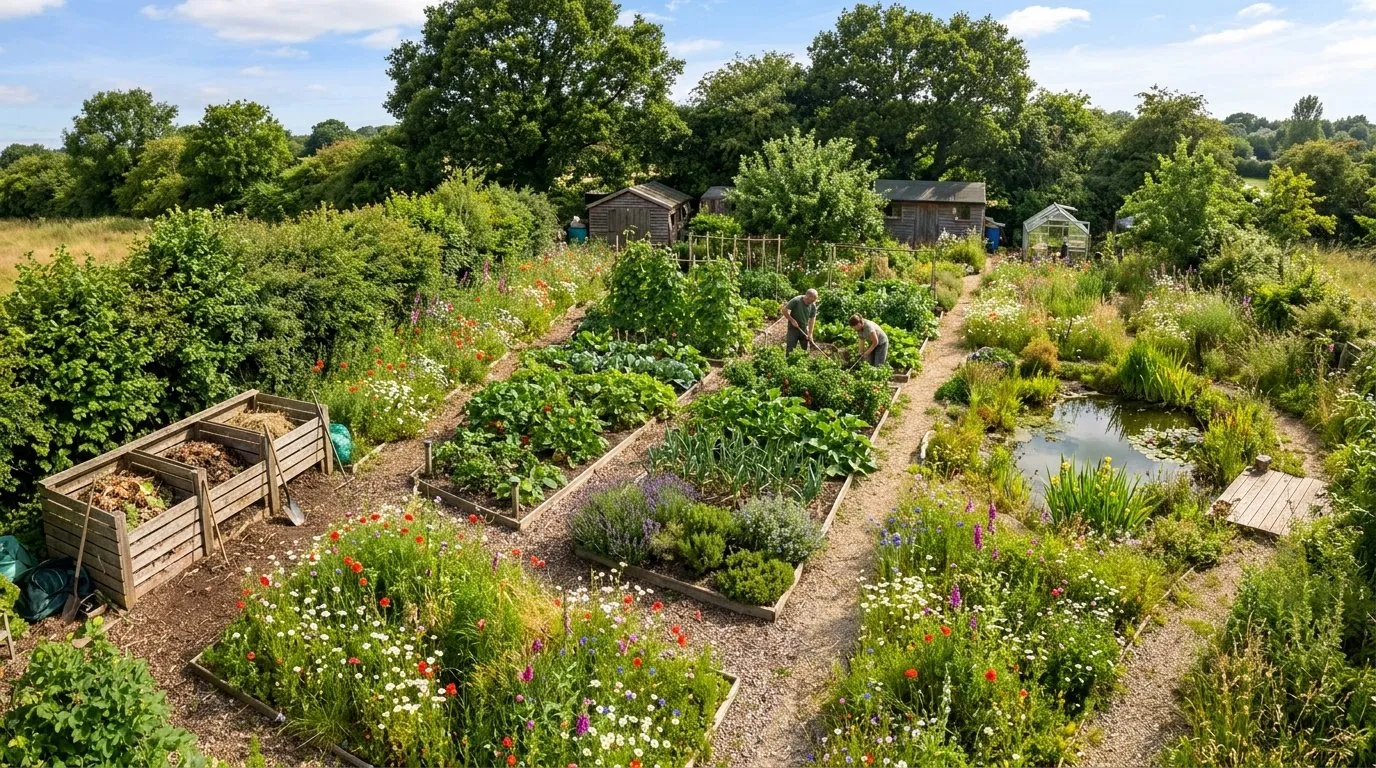 A fully regenerative garden integrates food production with wildlife habitat: wildflower margins, a compost bay, mixed plantings, and water features.
Monoculture rows of a single crop invite pest outbreaks. Mixed plantings confuse pests, attract predators, and create micro-habitats for beneficial insects. Companion planting is part of the regenerative toolkit, but biodiversity corridors take it further.
Key biodiversity features for a regenerative garden:
- Wildflower margins — 30cm strips of native wildflowers along bed edges attract hoverflies, ladybirds, and parasitic wasps
- Log and stone piles — habitat for beetles, frogs, slow worms, and hedgehogs
- A small pond — even a washing-up bowl sunk into the ground attracts dragonflies, newts, and frogs that eat slugs
- Native hedging — hawthorn, blackthorn, and elder provide berries for birds and nesting sites
- Compost bays — open compost heaps support grass snakes, slow worms, and countless invertebrates
- Standing dead wood — beetle habitat and woodpecker feeding sites
The RHS reports that UK gardens collectively cover more area than all the country’s nature reserves combined. Managing them regeneratively creates a connected network of habitat corridors across urban and suburban areas.
How to start: a practical UK calendar
Transitioning to regenerative gardening does not require a complete overhaul on day one. Start with the practices that match your current setup and add new ones each season.
Spring (March to May)
- Sow spring cover crops on any empty beds: crimson clover, phacelia, or buckwheat
- Apply 5-10cm of compost to beds as a surface dressing
- Undersow white clover beneath brassicas and sweetcorn as living mulch
- Stop digging. If soil is compacted, push a broadfork in and lever gently without turning
- Plant companion combinations instead of monoculture rows
Summer (June to August)
- Mulch all bare soil between plants with straw, grass clippings, or compost
- Leave some crops to flower for pollinators (parsley, coriander, rocket)
- Create a small wildlife pond or add a shallow dish of water for insects
- Monitor earthworm activity by lifting mulch — healthy soil shows worm casts and tunnels
- Compost all garden waste in a dedicated bay, aiming for 55 C internal temperature
Autumn (September to November)
- Sow winter cover crops immediately after clearing summer beds
- Spread 5-10cm of compost on all growing areas
- Lay straw or wood chip mulch on paths and around perennials
- Build a log pile in a shaded corner for overwintering invertebrates
- Collect leaf mould — bag fallen leaves for 12-24 months to create fungal-rich mulch
Winter (December to February)
- Leave cover crops standing through winter — they protect soil and house overwintering insects
- Plan next year’s planting for maximum diversity: different plant families in each bed
- Order cover crop seed for spring sowing
- Spread well-rotted manure or homemade compost on beds if autumn application was missed
- Test soil pH and organic matter to track year-on-year progress
Measuring your progress
You cannot manage what you do not measure. Regenerative gardening invites annual monitoring to track soil health improvements.
Three tests tell you everything you need to know:
The earthworm count
Dig a 30cm cube of soil in early spring (before the ground dries out). Count every earthworm. Healthy regenerative soil contains 15-25 worms per spadeful. New regenerative plots typically start at 3-8. Expect numbers to double within 18 months.
The soil organic matter test
Send a soil sample to a lab (around 20-30 pounds per test in the UK). Soil organic matter below 3% indicates degraded ground. Aim for 5-8% in vegetable beds. A rise of 0.5-1.0% per year is achievable with consistent composting and cover cropping.
The infiltration test
Push a bottomless tin can 5cm into the soil surface. Pour in 500ml of water. Time how long it takes to drain completely. Healthy regenerative soil absorbs 500ml in under 5 minutes. Compacted or degraded soil takes 15-30 minutes or more.
Record these results each spring. Over three to five years, the trend lines tell the story of your soil’s recovery.
Regenerative gardening on difficult soils
Every soil type benefits from regenerative management, but some need specific adjustments.
Heavy clay (like my Staffordshire plot) responds dramatically to surface composting and permanent mulch. Never dig clay soil — it destroys the fragile aggregate structure that worms and roots create. Apply 10-15cm of compost annually for the first three years, then reduce to 5cm. Our clay soil guide covers the full approach.
Sandy soil drains too fast and holds too few nutrients. Compost, mulch, and biochar address both problems. Biochar increases sandy soil water retention by 18-25%. Apply at 5-10% by volume, charged with compost tea.
Chalky soil is thin, alkaline, and dries quickly in summer. Focus on building organic matter depth with leaf mould and composted bark. Avoid mushroom compost, which adds more calcium. Cover crops with deep taproots (field beans, daikon radish) break through the chalky subsoil.
Peaty soil is already rich in organic matter but often waterlogged and acidic. Improve drainage with raised beds and permanent pathways. Add lime if pH drops below 5.5. Peat soil benefits least from additional compost but responds well to cover cropping and fungal inoculants.
Common mistakes to avoid
After five years of regenerative management and conversations with dozens of allotment neighbours, these are the pitfalls I see most often:
- Digging in cover crops. Cut them at ground level and leave the roots intact. Digging them in defeats the purpose by destroying the fungal networks they helped build.
- Leaving soil bare over winter. Even one winter of bare soil can undo a year of biological progress. Sow a cover crop, lay mulch, or leave spent crop stems standing.
- Over-tidying. Dead flower heads, fallen leaves, and standing stems provide insect habitat. Resist the urge to clear everything in autumn.
- Applying uncomposted manure. Fresh manure burns roots, introduces weed seeds, and can carry antibiotics from livestock. Use only well-rotted manure aged 12 months or more.
- Expecting instant results. Soil biology rebuilds over years, not weeks. The first season may feel unchanged. By year three, the difference is profound.
- Ignoring fungi. Most gardeners think about bacteria and worms but forget mycorrhizal fungi. Stop disturbing soil, reduce phosphorus fertiliser, and the fungi return on their own.
Where regenerative gardening sits in permaculture
Permaculture and regenerative gardening share goals but differ in scope. Permaculture is a whole-system design philosophy covering water, energy, buildings, and community. Regenerative gardening focuses specifically on soil biology and the six practices described above.
The two approaches complement each other. Permaculture provides the design framework. Regenerative practices provide the soil management toolkit. A permaculture garden that ignores soil biology is incomplete. A regenerative garden without broader design thinking misses opportunities for water harvesting, energy efficiency, and closed-loop systems.
Frequently asked questions
Lawrie has been gardening in the West Midlands for over 30 years. He grows his own veg using no-dig methods, keeps a wildlife-friendly garden, and writes practical advice based on real UK growing conditions.