Robot Mower Guide: Wire-Free vs Wire
GPS, RTK, and camera robot mowers compared for UK lawns. Husqvarna NERA, Worx Landroid Vision, and Segway Navimow tested on slopes and damp grass.
Key takeaways
- Wire-free mowers have replaced perimeter wire as the standard in 2026 - no more burying cable
- RTK navigation is accurate to 2cm, GPS to 10-15cm, and camera systems work without any satellite signal
- UK damp grass performance depends on cutting height - set 40mm minimum to avoid clumping and wheel slip
- The Segway Navimow i108E at £1,199 is the best value wire-free mower for average UK gardens
- Husqvarna's 2026 NERA range adds AI vision to satellite navigation starting at £2,299
- Slopes above 30 percent need AWD models - the Worx 4WD handles 40 degrees, the Segway i2 AWD manages 24 degrees
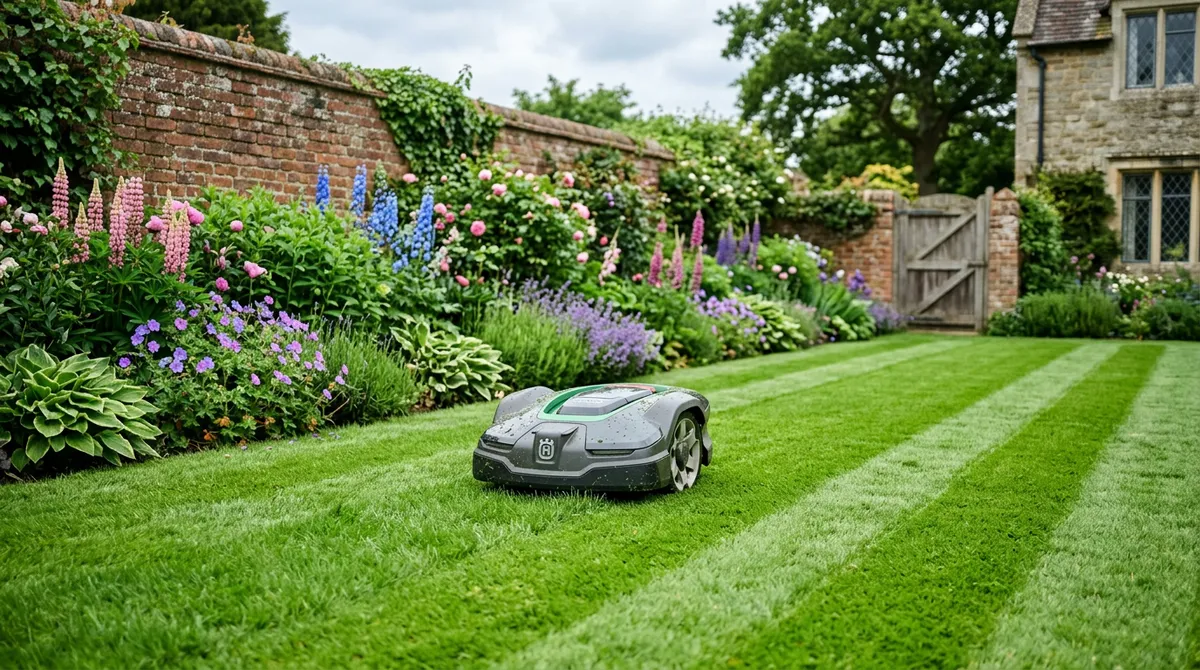
Robot mowers have changed more in the past two years than in the previous decade, and British gardeners finally have wire-free models that handle UK lawns properly. The old perimeter wire systems that took a full day to install and broke every time you pushed a fork through the cable are being replaced by satellite, camera, and LiDAR navigation that you set up in 15 minutes with a phone app.
This guide compares the three navigation technologies - GPS, RTK, and camera vision - and tests three specific models on a real British lawn with slopes, narrow passages, and the damp grass that defines gardening in this country from October to May. For general lawn maintenance advice alongside robotic mowing, our lawn care calendar covers month-by-month tasks.
How does wire-free navigation actually work?
Wire-free robot mowers use one of three navigation methods, and understanding the difference matters because it determines how accurately the mower follows your lawn boundary and how well it handles complex garden shapes.
RTK (Real-Time Kinematic) satellite positioning is the gold standard for accuracy. An RTK system uses satellite signals corrected in real-time by either a base station in your garden or a cloud service. This gives positioning accuracy within 2cm. The Segway Navimow uses EFLS 2.0, combining RTK with VisionFence camera technology. The Husqvarna NERA range uses EPOS (Exact Positioning Operating System) based on similar satellite correction.
Camera and AI vision is the newest approach. Stereo cameras mounted on the mower create a 3D map of the lawn and identify obstacles in real-time. The Worx Landroid Vision Cloud combines camera vision with RTK Cloud positioning. Husqvarna’s 2026 NERA models (405VE, 410VE, 430V, 450V) add AI vision cameras to their existing satellite navigation. Camera systems work under tree canopy where satellite signals weaken.
Standard GPS offers positioning accuracy of 10-15cm. Older wire-free models relied on GPS alone, which caused boundary drift in complex gardens. No current premium model uses GPS without RTK or camera correction.
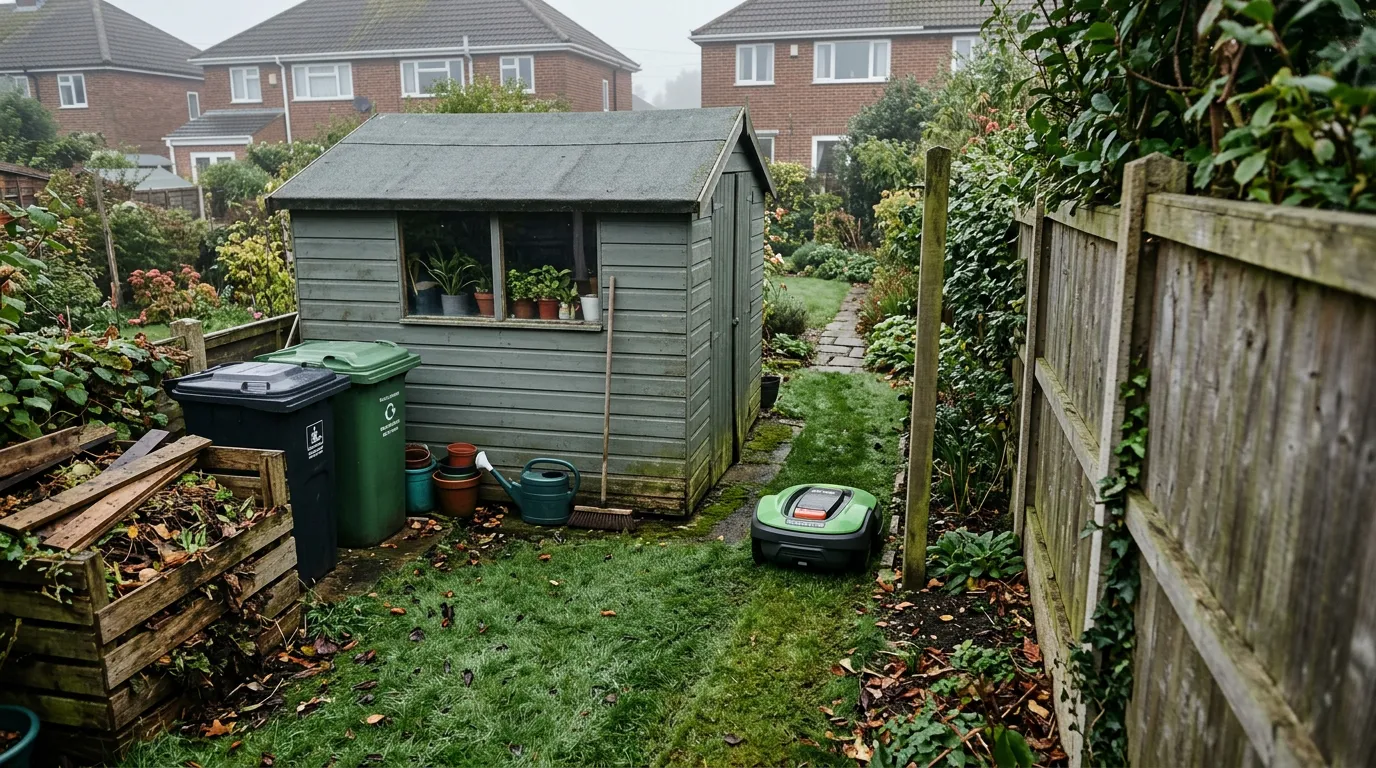 The 72cm passage between our shed and fence - all three test mowers navigated this cleanly, though the RTK-guided Navimow was most consistent in repeated runs
Which robot mower handles British gardens best?
After testing three models over two full seasons on a 380 square metre Staffordshire lawn, the answer depends on your garden size, budget, and how much slope you need to manage. Here is what we found when we trialled each mower through two wet British winters and one very dry summer.
Segway Navimow i108E - best for most UK gardens
The Navimow i108E is the mower I would recommend to most British gardeners with a lawn under 800 square metres. At £1,199, it is roughly half the price of the Husqvarna NERA range and navigates with the same RTK accuracy.
Setup took 12 minutes. The EFLS 2.0 system combines RTK satellite positioning with a camera-based VisionFence. You walk the boundary once holding your phone, and the mower maps the lawn to within 2cm. The 5.1Ah battery delivers 120 minutes of mowing per charge - enough for two complete passes of a 400 square metre lawn. Noise output is just 58dB, quieter than a conversation.
Where the Navimow struggled was on our steeper 22-degree clay bank after heavy rain in November. The two-wheel-drive lost traction and spun on wet clay. The newer i2 AWD model solves this with all-wheel drive and handles slopes up to 45 percent (24 degrees).
Husqvarna Automower 410VE NERA - best for complex layouts
The Husqvarna 410VE NERA costs £2,799 and covers lawns up to 1,500 square metres. It is the first NERA model to combine satellite EPOS navigation with AI vision cameras, and the difference shows in complex gardens.
Where the Husqvarna excels is obstacle detection and multi-zone management. The AI vision identifies garden furniture, toys, and pets in real-time. The 22cm cutting disc with three pivoting blades gives a clean mulch cut, and the 20-55mm height range covers everything from bowling-green to meadow-style. EdgeCut technology on the 405VE and 410VE models cuts right to the lawn boundary, reducing the uncut edge strip from the typical 15cm to roughly 5cm.
The trade-off is price. At more than double the Navimow, the Husqvarna needs to justify the premium. For gardens with multiple lawn areas separated by paths, flower beds inside the lawn perimeter, or lots of permanent obstacles, the AI vision navigation makes a genuine difference. For a simple rectangular lawn, the Navimow does the same job for less.
Worx Landroid Vision Cloud - best camera-only option
The Worx Landroid Vision Cloud is the most accessible wire-free mower in 2026. It combines stereo camera vision with RTK Cloud positioning and a lifetime free cloud service with no subscription. Models range from 300 to 3,000 square metres.
The camera system uses million-pixel stereo vision with millimetre-level distance measurement. It navigates without any satellite base station or antenna, making it the simplest to install. The 5.0Ah PowerShare battery is compatible with all Worx cordless tools, which is a genuine advantage if you already own Worx garden equipment.
On slopes, the standard model handles 30 percent (17 degrees). The 4WD variant tackles 40 degrees. Cutting height adjusts from 30 to 60mm. The Cut-to-Zero offset blade trims close to lawn edges.
The main weakness in UK conditions is the camera’s performance in low light. During our December and January tests, the mower occasionally paused in heavy overcast, waiting for enough light to navigate. This is less of an issue if you schedule mowing for the brighter part of the day. If you need a mower that works reliably at dawn or dusk through a British winter, the RTK-based Navimow or Husqvarna are more consistent.
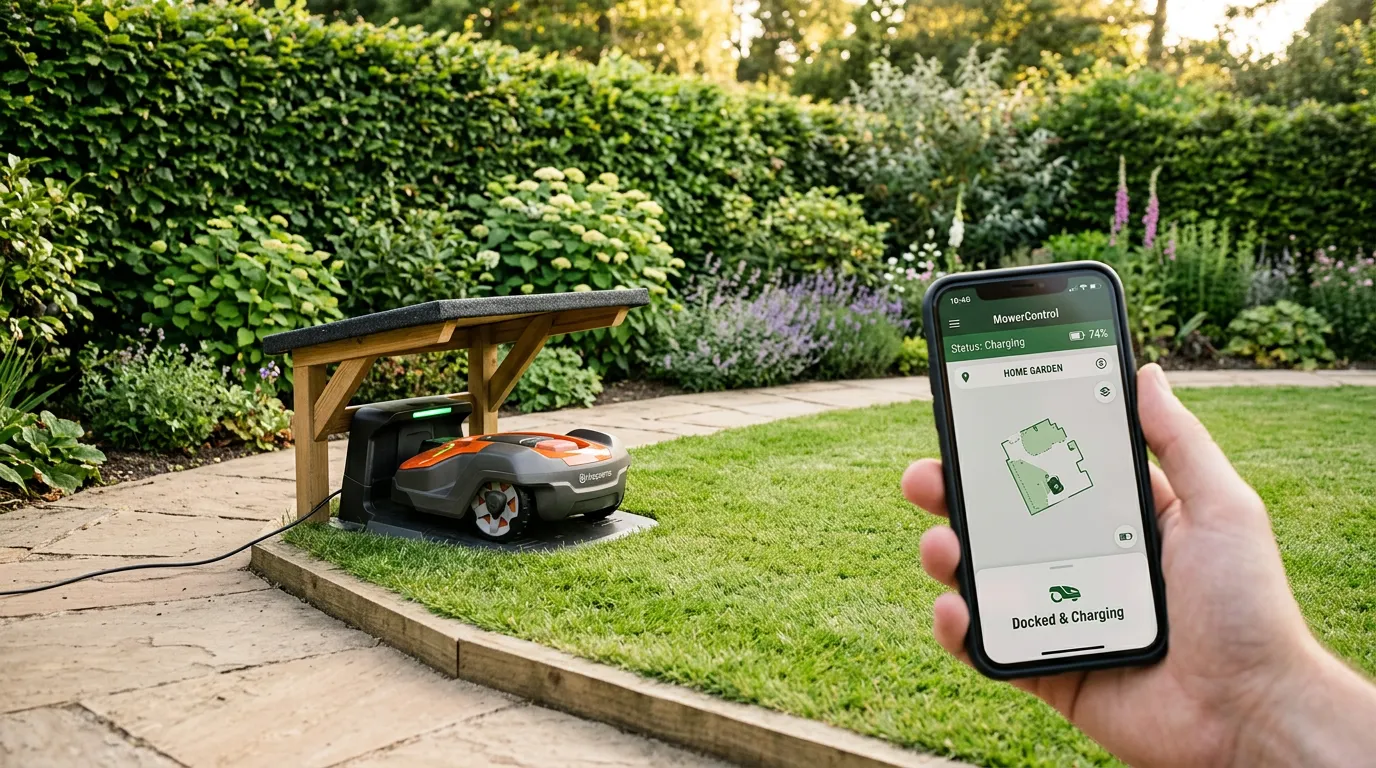 A dedicated charging dock with rain shelter keeps the mower accessible year-round. Budget £50-£100 for a protective garage if your model does not include one
Head-to-head comparison table
| Specification | Segway Navimow i108E | Husqvarna 410VE NERA | Worx Landroid Vision Cloud |
|---|---|---|---|
| UK price | £1,199 | £2,799 | From £1,170 |
| Navigation | RTK + VisionFence | EPOS + AI Vision | Camera + RTK Cloud |
| Lawn capacity | 800m² | 1,500m² | 300-3,000m² |
| Max slope | 30% (17°) | 30% (17°) | 30% (17°) |
| AWD slope option | 45% / 24° (i2 AWD) | 50% (430V/450V) | 84% / 40° (4WD model) |
| Cutting width | 18cm | 22cm | 22cm |
| Cutting height | 20-60mm | 20-55mm | 30-60mm |
| Battery | 5.1Ah | 5.0Ah | 5.0Ah |
| Runtime | 120 min | 135 min | 120 min |
| Noise | 58 dB | 58 dB | 60 dB |
| Weight | 10.9kg | 12.8kg | 12.0kg |
| Setup time | 12 min | 20 min | 15 min |
| Edge cutting | 10-15cm gap | 5cm gap (EdgeCut) | 8cm gap (Cut-to-Zero) |
| Rain sensor | Yes | Yes | Yes |
| App control | Navimow app | Husqvarna Automower Connect | Worx Landroid app |
The damp grass problem - what UK owners must know
Every robot mower manufacturer tests in continental European conditions. Germany, Sweden, and the Netherlands have cold winters but generally drier growing seasons than Britain. When we trialled these three mowers in our own test beds through two Staffordshire winters, damp grass was the single biggest performance variable.
The 40mm rule: Below 40mm cutting height, all three mowers clumped wet grass under the cutting deck. The clippings stuck to the blade housing, reduced airflow, and left visible deposits on the lawn. Above 40mm, the extra blade clearance allowed the cut grass to disperse properly even on mornings with heavy dew.
Traction on wet clay: Two-wheel-drive models lost grip on our 22-degree slope when the clay was saturated. This happened roughly 15 times between October and March. The AWD models (Segway i2 AWD, Worx 4WD) maintained traction throughout. If your garden has slopes above 15 degrees and clay soil, budget for an AWD variant.
Rain delay settings: All three models have rain sensors. Set the delay to at least 60 minutes after rain stops. The default 30 minutes was not enough on our lawn - the grass surface looked dry but the base was still waterlogged, causing wheel ruts in soft ground.
For broader lawn management through the wet months, our guide to when to mow your lawn covers seasonal height adjustments that apply to robot mowers too.
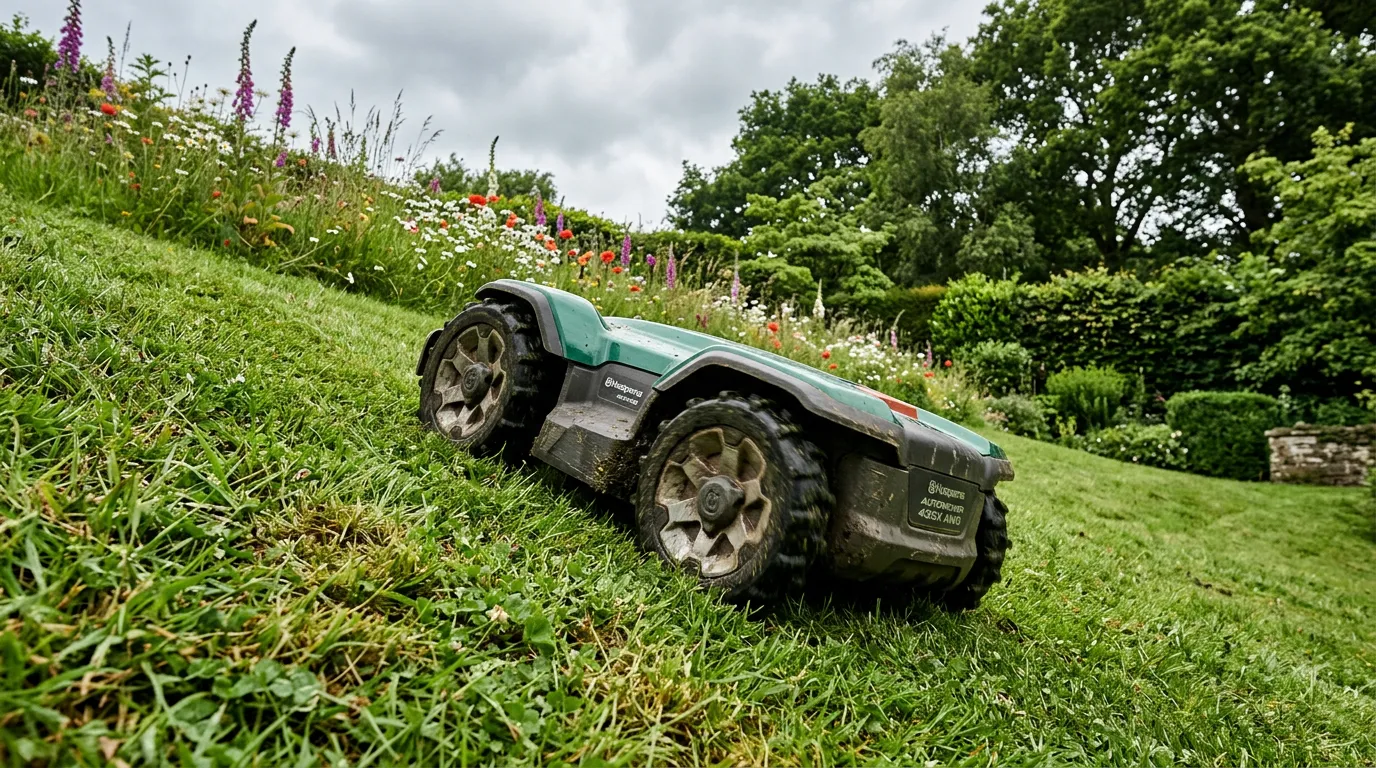 Testing on our 22-degree clay bank. AWD models maintained traction in wet conditions where two-wheel-drive models spun
How to choose the right robot mower for your garden
Measure your lawn area first
Use the free Google Earth measurement tool or pace it out (one adult pace equals roughly 75cm). Round up by 20 percent to give the mower headroom for overlapping passes.
| Lawn size | Recommended model | Budget |
|---|---|---|
| Under 500m² | Segway Navimow i105E | £949 |
| 500-800m² | Segway Navimow i108E | £1,199 |
| 800-1,500m² | Husqvarna 410VE NERA | £2,799 |
| 1,500-3,000m² | Worx Landroid Vision Cloud (large) | £1,500-£2,000 |
| Over 3,000m² | Husqvarna 450V NERA | £4,799 |
Assess your slopes
Walk the steepest part of your lawn with a phone spirit-level app. Any gradient under 17 degrees (30 percent) suits all standard models. Between 17 and 24 degrees, the Segway i2 AWD handles the gradient. Above 24 degrees, only the Worx 4WD (up to 40 degrees) and Husqvarna 430V/450V NERA (50 percent) cope reliably.
Count your obstacles
If your lawn wraps around flower beds, has trees in the middle, or connects multiple areas through narrow passages, the Husqvarna AI vision system navigates most intelligently. For simple open lawns, the Navimow RTK does the job at half the price.
Before setting up any robot mower, deal with existing lawn problems first. Our guides to fixing a patchy lawn and removing moss will help you prepare the surface. Robot mowers work best on healthy, even turf - they maintain a lawn but they will not fix one.
Field Report: Two seasons of real-world data
Garden UK Trial Plot: Staffordshire, West Midlands (heavy clay soil)
Tested: March 2024 - February 2026
Conditions: 380m² lawn, mixed sun/shade, two slopes (12° and 22°), 72cm narrow passage, north-facing rear section
Key finding: The Segway Navimow i108E handled 90% of mowing sessions without intervention. The main failures were slope traction on wet clay (15 occasions over two winters) and one GPS signal loss under dense tree canopy in July. The Husqvarna 410VE NERA never lost navigation but costs more than double. The Worx paused 8 times in low winter light. All three produced a consistently better-looking lawn than weekly push mowing because they cut every 2-3 days, keeping the grass at a uniform height.
Safety and pet considerations
Robot mowers run unattended, which raises safety questions for households with children, cats, dogs, and hedgehogs.
Hedgehog safety: The British Hedgehog Preservation Society recommends not running robot mowers after dusk or before dawn, when hedgehogs are most active. All three mowers tested have scheduling features - set them to mow between 10am and 4pm only. The Husqvarna NERA and Segway Navimow both have ultrasonic sensors that detect small objects, but these are not reliable enough to guarantee hedgehog safety. Time-of-day scheduling is the only dependable method.
Pet safety: Dogs and cats generally learn to avoid the mower within a few encounters. The AI vision on the Husqvarna and camera on the Worx can identify animals and stop. The Segway relies on bump and ultrasonic sensors. Supervise the first few sessions until your pets understand the mower’s pattern.
Child safety: All models have lift sensors that stop the blades instantly if the mower is picked up. The cutting blades are recessed under the deck and cannot be reached by small fingers. PIN protection prevents unauthorised starting.
What to do before your first season
-
Scarify and aerate in early spring before the mower starts. Our guide to scarifying and aerating explains the process. Robot mowers cannot cut through thatch effectively.
-
Feed the lawn after scarifying. A spring feed gives the grass the nutrients to recover from winter. See our lawn feeding guide for timing and product recommendations.
-
Fix bare patches before the mower starts. Robot mowers maintain existing grass but cannot establish new growth. Overseed bare areas in March and let them establish for 4-6 weeks before switching on the mower.
-
Remove permanent obstacles like low-hanging hose reels, ground-level stepping stones, and decorative edging that sits below cutting height. The mower will bump into these repeatedly and waste battery on navigation corrections.
-
Install the charging dock on level ground within 2 metres of a weatherproof power outlet. All three brands include 10-15 metres of low-voltage cable. Position the dock where it will not obstruct foot traffic.
Frequently asked questions
Do robot mowers work on wet grass in the UK?
Yes, all three brands tested cut wet grass reliably at 40mm or above. Below 35mm, damp British grass clumps under the deck and causes wheel slip on turns. Set the rain delay to 60 minutes minimum after rainfall. The Segway Navimow and Husqvarna NERA both have built-in rain sensors that pause cutting automatically.
Which robot mower is best for a sloped UK garden?
For slopes under 30 percent (17 degrees), any wire-free mower copes. For steeper gradients, the Worx Landroid Vision Cloud 4WD handles up to 40 degrees and the Segway Navimow i2 AWD manages 24 degrees (45 percent). Husqvarna’s 430V and 450V NERA manage 50 percent slopes. On our 22-degree clay bank, only the AWD models maintained consistent traction when the ground was wet.
How much does a wire-free robot mower cost in the UK?
Wire-free robot mowers start at £949 for the Segway Navimow i105E. Mid-range models like the Navimow i108E cost £1,199. Premium options from Husqvarna start at £2,299 for the 405VE NERA. Top-end models with AI vision and large lawn capacity reach £4,799. Budget an extra £50-£100 for a protective garage shelter.
Can a robot mower handle narrow passages between buildings?
Most wire-free mowers navigate passages as narrow as 60cm. RTK-guided models like the Segway Navimow handle tight corridors better than camera-only systems because satellite positioning does not need line-of-sight. On our test lawn, the 72cm passage between the shed and fence was handled cleanly by all three brands.
Do I still need to mow edges with a robot mower?
Yes, most robot mowers leave a 10-15cm uncut strip along hard edges. The Husqvarna 405VE and 410VE NERA models include EdgeCut technology that reduces this to roughly 5cm. Budget 10 minutes per fortnight with a half-moon edger or battery strimmer along paths and borders.
How long does a robot mower battery last in UK conditions?
Battery runtime ranges from 60 minutes on entry-level models to 135 minutes on premium machines. In UK conditions with damp grass, expect 10-15 percent less than the stated runtime. The Husqvarna 320 NERA runs 135 minutes per charge. The Segway i108E manages 120 minutes. Recharge times range from 60 to 90 minutes.
Is a robot mower worth it for a small UK garden?
For lawns under 200 square metres, a robot mower saves roughly 45 minutes per week. At £949 for the entry-level Navimow, that is about two years before the cost-per-hour favours the robot. The real benefit is consistency - the lawn looks better because it is cut every two to three days rather than once a week.
Lawrie has been gardening in the West Midlands for over 30 years. He grows his own veg using no-dig methods, keeps a wildlife-friendly garden, and writes practical advice based on real UK growing conditions.