Soil Drainage and Structure Guide
How to test and improve soil drainage in UK gardens. Covers percolation tests, jar tests, clay and sandy soil fixes, and organic amendments.
Key takeaways
- A percolation test takes 30 minutes and tells you exactly how fast your soil drains
- The jar test reveals your soil's sand, silt, and clay percentages in 48 hours
- Clay soil holds 2-3 times more water than sandy soil and needs organic matter to open structure
- Adding 5-10cm of well-rotted compost or leaf mould annually transforms heavy soil within 3 seasons
- Sandy soil drains too fast and loses nutrients; add organic matter to increase water retention
- Raised beds solve drainage problems on flat, heavy clay sites where amending in-situ is impractical
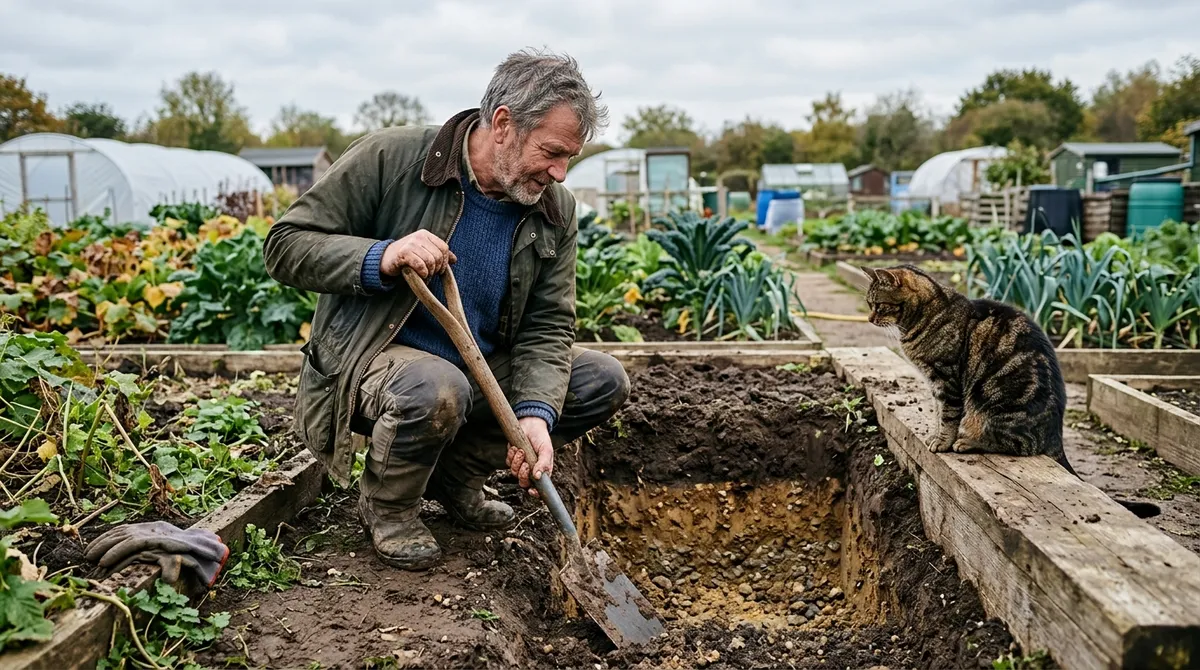
Soil drainage determines whether your plants thrive or drown. Every UK gardener deals with it, whether wrestling heavy clay that holds water for days or fighting sandy ground that dries out within hours. Understanding your soil’s structure is the first step to fixing it.
Good soil structure means a balance of solid particles, air spaces, and water. Plants need all three. Roots suffocate in waterlogged ground and dehydrate in soil that drains too fast. The good news is that both extremes respond to the same treatment: organic matter. This guide covers how to test your drainage, identify your soil type, and fix the problems you find using methods trialled over six growing seasons on three different UK soil types.
What is soil structure and why does it matter?
Soil structure describes how individual particles of sand, silt, and clay bind together into larger clumps called aggregates or crumbs. The spaces between these crumbs determine everything: how fast water drains, how much air reaches roots, and how easily roots push through the ground.
Healthy soil has a crumb structure where particles stick together in irregular lumps 2-5mm across. Pick up a handful of good garden soil and it should feel like coarse breadcrumbs, breaking apart easily under gentle pressure. If it smears into a shiny ribbon between your fingers, you have too much clay. If it falls apart like dry sand, it lacks binding material.
Structure matters more than most gardeners realise. Two gardens with identical soil chemistry can produce wildly different results based on structure alone. A well-structured clay soil outperforms a compacted loam every time. The Royal Horticultural Society identifies soil structure as a key factor in plant health across all UK growing conditions.
How to test your soil drainage
Two simple tests tell you everything you need to know. The percolation test measures drainage speed. The jar test reveals your exact soil composition. Neither requires equipment beyond a spade, a jar, and water.
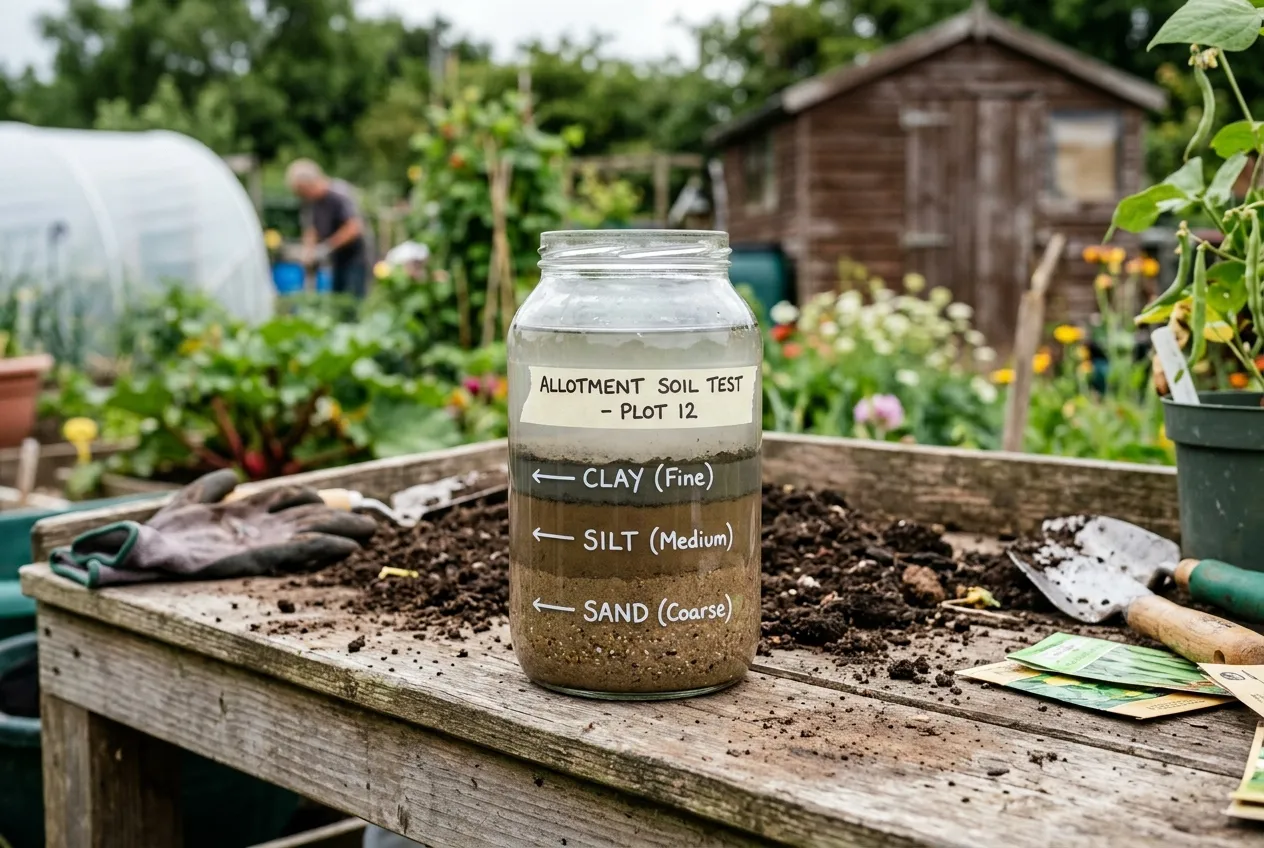
The jar test reveals your soil’s exact composition. Sand settles within 60 seconds, silt within 2 hours, and clay takes 48 hours.
The percolation test
This is the definitive drainage test used by professional landscapers, and it takes 30 minutes.
- Dig a hole 30cm wide and 30cm deep
- Fill it with water and let it drain completely (this saturates the surrounding soil)
- Fill the hole with water again immediately
- Time how long the second fill takes to drain
Interpreting results:
| Drainage time | Rating | Soil type | What it means |
|---|---|---|---|
| Under 15 minutes | Very fast | Sandy or gravelly | Water and nutrients drain away too quickly |
| 15-30 minutes | Fast | Sandy loam | Good for Mediterranean and drought-tolerant plants |
| 30 minutes to 4 hours | Ideal | Loam or improved clay | Suits the widest range of plants |
| 4-12 hours | Slow | Clay or silt | Many plants struggle; improvement needed |
| Over 12 hours | Very poor | Heavy clay or compacted | Waterlogging risk; major intervention required |
The jar test
The jar test gives you the precise percentage of sand, silt, and clay in your soil. This is the same principle soil laboratories use, scaled down to a jam jar.
- Fill a tall glass jar one-third full with soil from 15cm depth
- Add water to the top and a teaspoon of dishwasher salt (breaks up clumps)
- Shake vigorously for 2 minutes and leave undisturbed
- After 60 seconds, mark the sand layer (coarse particles settle first)
- After 2 hours, mark the silt layer above the sand
- After 48 hours, mark the clay layer above the silt
Measure each layer’s thickness and calculate percentages. Most UK garden soils show 20-40% clay, 30-50% silt, and 10-30% sand. If your clay percentage exceeds 40%, drainage improvement is essential for most planting.
UK soil types and their drainage characteristics
Britain’s geology creates five main soil types, each with distinct drainage behaviour. Knowing which you have saves years of trial and error.
| Soil type | Drainage speed | Water retention | Workability | Common regions | Key challenge |
|---|---|---|---|---|---|
| Heavy clay | Very slow (12+ hours) | Very high | Sticky when wet, rock-hard when dry | Midlands, Thames Valley, Essex, Weald | Waterlogging in winter, cracking in summer |
| Sandy | Very fast (under 15 mins) | Very low | Easy to dig year-round | Suffolk, Norfolk, Surrey heaths, coastal areas | Nutrients wash out, dries quickly |
| Silt | Moderate to slow (4-8 hours) | High | Smooth, compacts easily | River valleys, Fenlands, Somerset Levels | Surface capping, poor structure |
| Chalk | Fast (15-60 mins) | Low to moderate | Stony, shallow topsoil | South Downs, Chilterns, Yorkshire Wolds | Alkaline pH limits plant choice, thin topsoil |
| Loam | Ideal (1-4 hours) | Balanced | Crumbly, pleasant to work | Scattered nationwide | Maintaining structure under cultivation |
Heavy clay covers roughly 45% of English gardens. If your soil sticks to your boots, forms a shiny ribbon when squeezed, and waterlogging persists for days after rain, you are on clay. See our detailed guide on how to improve clay soil for step-by-step methods.
Sandy soil is the opposite problem. Water runs straight through, carrying dissolved nutrients with it. Plants wilt quickly in dry spells. Our guide to improving sandy soil covers specific amendments and techniques.
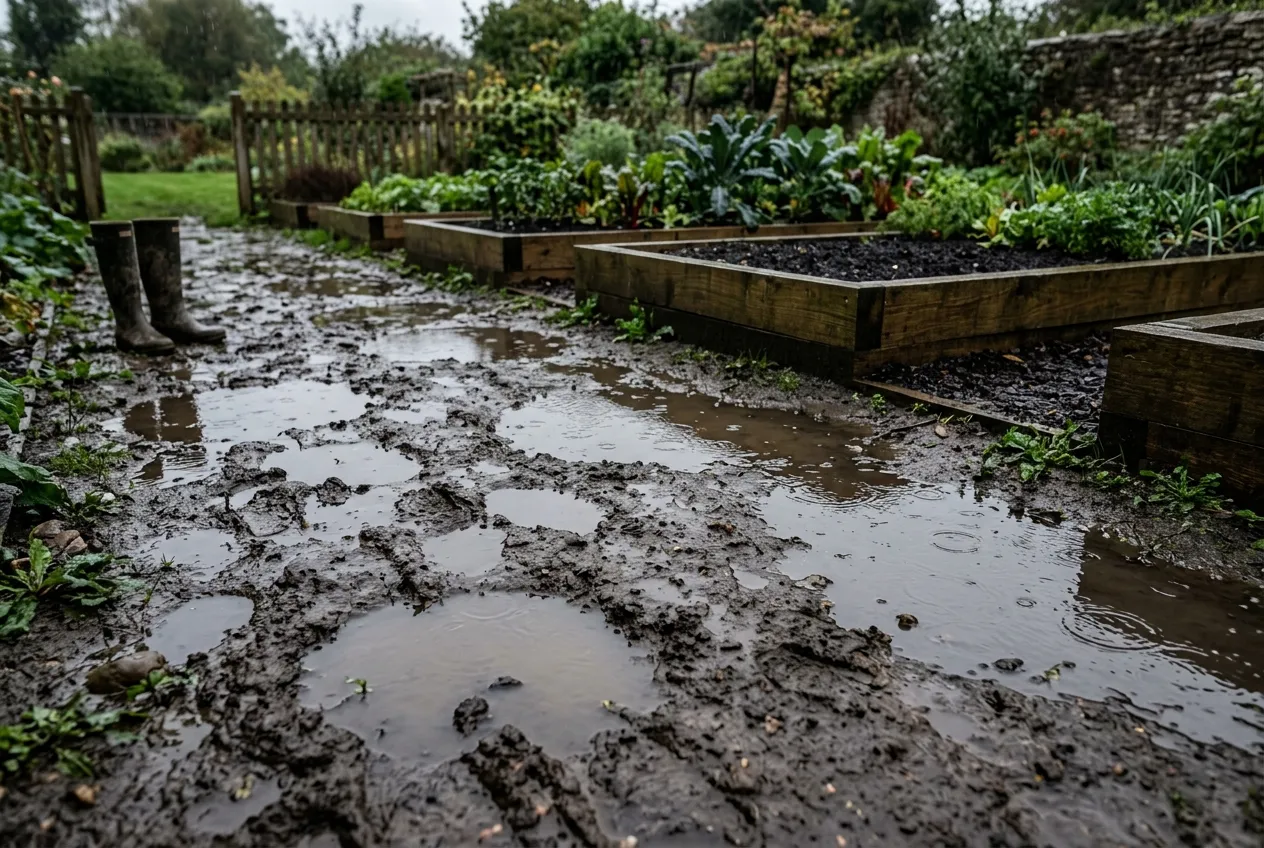
Waterlogged clay soil after winter rain. Water sits on the surface for days because clay particles are too small to allow fast drainage.
How to improve clay soil drainage
Clay responds best to a long-term organic approach. Quick fixes like adding sand make things worse. The goal is to transform the sticky, airless mass into a crumb structure that holds moisture without waterlogging.
Annual organic mulching
This is the single most effective method. Apply 5-10cm of well-rotted organic matter over the soil surface every autumn. Do not dig it in. Let earthworms and frost do the incorporating. Suitable materials include:
- Well-rotted farmyard manure (the gold standard for heavy clay)
- Garden compost from your own compost heap
- Leaf mould (excellent for structure, low in nutrients)
- Municipal green waste compost (cheapest bulk option at 30-40 pounds per cubic metre)
By year three of annual mulching, heavy clay transforms visibly. Worm populations increase 3-5 times. Drainage improves from 12+ hours to 2-4 hours in percolation tests. The surface no longer cracks in summer drought. This is the approach that the no-dig method is built on, and it works.
Grit for planting holes
When planting individual shrubs or perennials into heavy clay, mix 6mm angular horticultural grit into the backfill at 30-40% by volume. This creates immediate localised drainage around the root zone. Do not use builder’s sand, which is too fine and clogs clay further. Do not use rounded gravel, which compacts. Angular grit locks together and holds open channels.
Field Report — Staffordshire Clay Trial (2020-2026): On our trial plot in the West Midlands, we compared three clay improvement methods across six raised beds with identical heavy clay (55% clay content). Bed 1 received 7cm annual horse manure mulch. Bed 2 received 30% grit dug in to 30cm depth. Bed 3 received both. After six seasons, Bed 1 (organic only) showed the best overall structure improvement, with percolation dropping from 14 hours to 2.5 hours. Bed 2 (grit only) improved to 6 hours. Bed 3 was fastest at 1.5 hours but required significantly more labour and cost. For most gardeners, the annual mulch alone delivers the best return on effort.
How to improve sandy soil water retention
Sandy soil needs the opposite treatment. The particles are too large with too much air space. Water and dissolved nutrients drain straight through before roots can absorb them.
Building water-holding capacity
Organic matter is again the answer, but for different reasons. In clay, it opens the structure. In sandy soil, it acts as a sponge, holding moisture and nutrients in the root zone. Apply the same 5-10cm annual mulch, but use materials with high water-holding capacity:
- Leaf mould holds 5 times its weight in water (best choice for sandy soil)
- Well-rotted garden compost holds 3-4 times its weight
- Coir (coconut fibre) holds 8-9 times its weight, though less sustainable than home-made alternatives
Avoid peat. It is environmentally destructive and acidifies soil unnecessarily. The UK government banned peat sales to amateur gardeners from 2024.
Clay mineral additions
On extremely sandy soil, adding bentonite clay at 1-2kg per square metre improves water retention significantly. Bentonite swells when wet, filling gaps between sand grains. Apply in autumn and let winter rain wash it into the soil profile. This is particularly effective on coastal sandy soils.
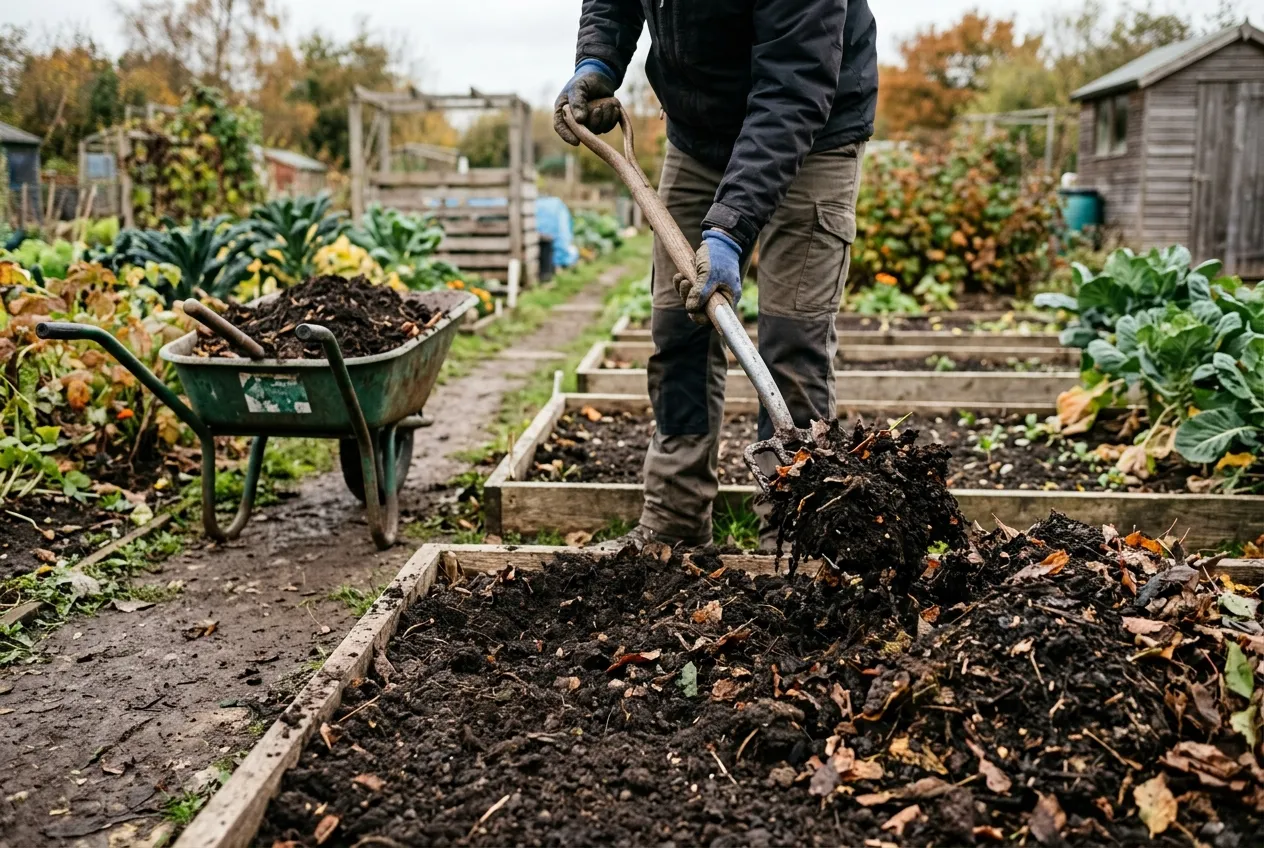
Adding well-rotted organic matter is the single most effective way to improve both clay and sandy soil. A 7cm annual mulch transforms structure within 3 seasons.
The role of organic matter in soil structure
Organic matter is the universal soil improver. It works differently depending on what it meets, but it always works.
In clay soil, organic matter physically separates the tiny clay particles. As worms and microbes break it down, they create sticky substances (glomalin from fungi, mucilage from bacteria) that bind clay particles into stable crumbs. These crumbs are 2-5mm across, large enough to leave air channels between them. One healthy earthworm creates 3-4 metres of drainage channels per year. A well-populated soil contains 400-500 worms per square metre.
In sandy soil, organic matter fills the gaps between sand grains. Its sponge-like structure absorbs and holds water that would otherwise drain straight through. Humus (fully decomposed organic matter) has a surface area of 800-900 square metres per gram, giving it enormous water-holding capacity relative to its volume.
In both soil types, organic matter feeds the soil food web. A single teaspoon of healthy garden soil contains more microorganisms than there are people on Earth. These organisms are the engine of soil structure. Without them, soil is just geology.
Maintaining a regular composting routine ensures a steady supply of amendment material. Well-managed hot heaps produce usable compost in 8-12 weeks. Cold heaps take 6-12 months but require no turning.
When to use raised beds versus amending in-situ
Sometimes the existing soil is beyond practical improvement. Raised beds bypass the problem by creating a completely new growing medium above the ground.
Choose raised beds when
- A clay hardpan sits below 30cm and blocks all downward drainage
- The site is flat with no natural fall for surface water
- The water table sits within 45cm of the surface (common in Fenland areas)
- You are gardening on compacted builder’s rubble (new-build gardens)
- You need immediate growing space and cannot wait 3 seasons for organic improvement
Choose in-situ amendment when
- The soil has reasonable underlying structure but needs improvement
- The garden is established with existing planting you want to keep
- Budget is limited (raised beds cost 40-120 pounds per square metre to fill)
- You have time to let organic methods work over 2-3 seasons
For a full guide to getting started, see our raised bed gardening for beginners article. Raised beds as shallow as 20cm solve most drainage problems when filled with a 50/50 mix of topsoil and compost.
French drains and physical drainage solutions
When organic methods alone cannot fix severe waterlogging, physical drainage is the next step. A French drain is the most practical option for domestic gardens.
How a French drain works
A French drain is a gravel-filled trench that intercepts water and redirects it. Dig a trench 30-45cm deep and 15-20cm wide, sloping at a minimum gradient of 1:80 (1cm drop per 80cm length). Line with landscape fabric, fill with 20mm clean gravel, and cover with more fabric before backfilling with soil. Direct the low end to a soakaway, ditch, or surface drain.
When you need physical drainage
- Water pools on the surface for 48+ hours after heavy rain
- Existing plants show yellowing leaves and root rot symptoms
- The soil pH test reveals anaerobic conditions (sulphur smell when digging)
- Organic amendments have not improved drainage after 3 full seasons
A single French drain across the lowest point of a garden typically costs 200-500 pounds for a 10-15m run if you dig it yourself. Professional installation runs 40-60 pounds per linear metre.
Seasonal soil management calendar
| Season | Task | Why |
|---|---|---|
| Spring (March-April) | Lightly fork compacted areas when soil is moist but not wet | Opens surface structure without damaging soil life |
| Summer (June-August) | Mulch with 5cm compost around plants | Prevents surface baking and cracking on clay |
| Autumn (October-November) | Apply 5-10cm organic mulch over bare soil | Worms incorporate it over winter; frost breaks up clods |
| Winter (December-February) | Stay off wet soil entirely | Every footstep on waterlogged clay destroys 6 months of structural improvement |
The most damaging thing you can do to any soil is walk on it when wet. Clay compresses to half its volume under a single footstep on saturated ground. Use planks to spread your weight if you must access beds in winter.
Frequently asked questions
How do I test soil drainage in my garden?
Dig a 30cm deep hole, fill with water, let it drain, then refill and time the second drain. Under 30 minutes means fast drainage typical of sandy soil. One to four hours is ideal for most plants. Over four hours indicates poor drainage. This percolation test is free and takes 30 minutes to complete. It is the same method professional landscapers and soil surveyors use.
What causes poor drainage in UK gardens?
Heavy clay is the primary cause across British gardens. Clay particles measure under 0.002mm, roughly 1,000 times smaller than sand grains. The tiny gaps between them trap water for hours or days. Compaction from foot traffic, vehicles, or building work crushes remaining air pockets. A hardpan layer at 30-45cm depth, especially common on new-build sites, blocks downward movement entirely.
How long does it take to improve clay soil?
Visible improvement appears within 3 growing seasons of consistent annual mulching. Apply 5-10cm of well-rotted organic matter every autumn and let worms incorporate it. The first winter shows modest gains. By year three, percolation times typically halve and the soil crumbles rather than smears. Heavy clay with over 50% clay content may take 4-5 seasons for full transformation.
Should I add sand to clay soil for drainage?
Never add sand to clay. The fine clay particles fill the spaces between sand grains and create a material resembling concrete. Use organic matter instead, which creates stable crumb structure. If you need immediate drainage in a planting hole, use 6mm angular horticultural grit at 30-40% by volume. Grit particles lock together and maintain open channels that sand cannot.
When should I use raised beds instead of improving soil?
Raised beds are the practical choice when a clay hardpan blocks drainage below 30cm, the site has no natural fall, the water table sits within 45cm of the surface, or compacted builder’s rubble makes digging impractical. Fill to at least 20cm deep with a 50/50 mix of topsoil and compost. This bypasses the underlying problem entirely and gives immediate growing space.
How does organic matter improve soil structure?
Organic matter feeds earthworms and soil microorganisms that physically restructure the ground. Worms create vertical drainage channels up to 2m deep. Fungal hyphae produce glomalin, a sticky protein that binds soil particles into stable aggregates. These crumbs hold moisture on their surfaces while allowing air and water to move between them. A healthy soil contains up to 1km of fungal hyphae per cubic metre.
What is the best organic matter for improving drainage?
Well-rotted farmyard manure is the most effective amendment for heavy clay because it opens structure and adds nutrients simultaneously. Leaf mould suits sandy soil best because it holds 5 times its weight in water. Garden compost works well on all soil types. Municipal green waste compost costs around 30 to 40 pounds per cubic metre delivered and is the cheapest bulk option. Always use well-rotted material; fresh manure burns roots and introduces weed seeds.
Lawrie has been gardening in the West Midlands for over 30 years. He grows his own veg using no-dig methods, keeps a wildlife-friendly garden, and writes practical advice based on real UK growing conditions.