When to Mow Your Lawn in the UK
Month-by-month UK lawn mowing guide covering cutting heights, seasonal frequency, the one-third rule, first and last cuts, and mulch mowing.
Key takeaways
- First mow of the year falls in early to mid-March, with blades set at 4cm
- Mow once a week from April to May, rising to twice weekly in June and July
- Never remove more than one-third of the grass blade length in a single cut
- Family lawns perform best at 2.5-3cm in summer, fine lawns at 2-2.5cm
- Mulch mowing returns nitrogen to the soil and cuts fertiliser use by up to 25%
- Stop mowing in late October or November once growth falls below 5mm per week
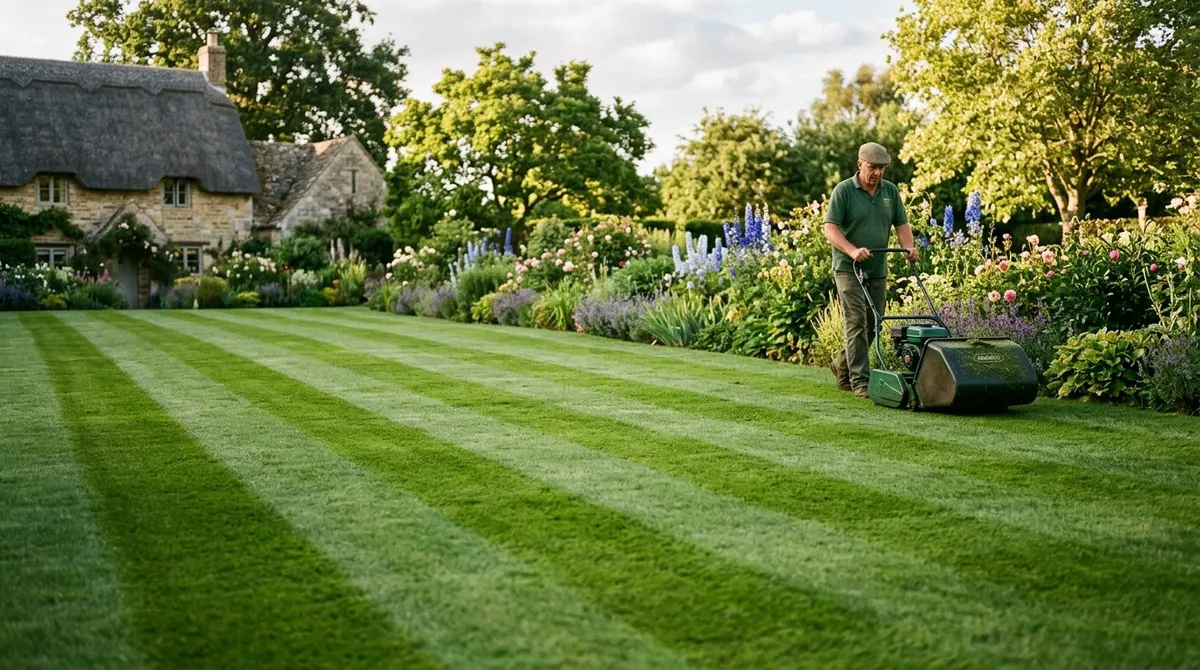
A well-mown lawn ties a garden together. It frames the borders, gives children somewhere to play, and makes the whole plot look cared for. But mowing at the wrong time, at the wrong height, or too often does more harm than good.
Timing matters because grass grows at different rates through the year. In the mild, damp UK climate, growth starts in March, peaks in June and July, and slows again by October. Matching your mowing schedule to this natural rhythm keeps the lawn thick, green, and resistant to weeds. Getting it wrong opens gaps for weeds and moss to colonise. Our lawn care calendar shows how mowing fits alongside feeding, scarifying, and every other monthly task. Our guide on lawn weed identification and control covers what to do when weeds do take hold.
When to start mowing in spring
The first mow of the year typically falls in early to mid-March. The exact date depends on your location and the weather. Southern gardens on free-draining soil may need a light trim from late February in mild years. Northern and exposed gardens often wait until late March.
Look for two signs before reaching for the mower. First, the grass should be visibly growing, with blades standing 5-6cm tall. Second, the ground should be firm enough to walk on without sinking. If your shoes leave visible impressions in the turf, wait another week. Mowing on waterlogged ground compacts the soil, damages grass roots, and leaves ruts from the mower wheels.
Setting the right height for the first cut
Set the mower to its highest cutting position, around 4cm, for the first cut. This removes just the tips of the grass without stressing the plant. After months of dormancy, grass roots are shallow and the crown is vulnerable. Scalping the lawn in March sets it back weeks.
Keep the blades at 4cm for the first three or four cuts. Gradually lower the height by 0.5cm per cut through April. By early May, you should be at your target summer height. This progressive approach is part of a broader set of spring gardening jobs that prepare the garden for the growing season.
The one-third rule
Never remove more than one-third of the grass blade length in a single mow. This is the single most important mowing principle and the one most often broken.
Grass stores energy in its leaf blades. Removing too much leaf in one pass forces the plant to divert energy from root growth to leaf regrowth. Over time, this produces a lawn with a shallow root system that suffers in drought and is easily colonised by weeds.
In practice, the one-third rule means mowing often enough that you never need to remove too much. If your target height is 3cm, mow before the grass reaches 4.5cm. If you return from a two-week holiday to a lawn at 8cm, bring it down in stages over three or four cuts rather than scalping it back to 3cm in one pass.
Gardener’s tip: If you have missed a cut and the grass is long, set the mower to its highest position first. Wait three days, then lower by one notch and mow again. Repeat until you reach your target height.
Seasonal mowing frequency and cutting heights
Grass growth rate determines how often you need to mow. In the UK, growth follows a predictable seasonal curve driven by temperature and daylight hours.
Spring (March to May)
March mowing is fortnightly at most. Growth is slow, soil temperatures are still below 10C, and daylight is limited. By April, weekly mowing becomes necessary as temperatures rise and days lengthen. In May, growth accelerates noticeably, and some fast-growing lawns need cutting every 5-6 days.
Spring cutting height: 3-4cm. This protects the developing root system while allowing the lawn to thicken and crowd out emerging weeds.
Summer (June to August)
This is the peak growth period. Mow twice a week in June and July if possible, or at least every 4-5 days. In August, growth slows slightly, especially during dry spells. Reduce to weekly mowing if the weather is hot and dry.
Summer cutting height: 2.5-3cm for a family lawn. Fine ornamental lawns can go to 2-2.5cm if they receive regular feeding and watering. During drought or heatwave, raise the height by 1cm. Longer grass shades the soil, reduces evaporation, and keeps roots cooler.
Autumn (September to November)
Growth slows through September and into October. Return to weekly mowing in September, then fortnightly from mid-October. Raise the cutting height back to 3-4cm. Longer grass going into winter is more resilient and better able to photosynthesise in the lower light levels.
The last cut usually falls in late October or early November. Wait for a dry day and set the mower to 4cm. A clean final cut prevents the lawn from looking untidy through winter. For more on preparing your garden for the season change, our guide on what mulch is and how to use it covers protecting borders and beds.
Winter (December to February)
Do not mow from November to February. Growth drops below 5mm per week and the grass enters semi-dormancy. Walking on frozen or waterlogged turf damages the grass. Keep off the lawn as much as possible during this period. Brush off fallen leaves with a spring-tine rake to prevent smothering.
Month-by-month mowing calendar
This table gives a practical week-by-week guide for a typical UK garden. Adjust for your region: northern and high-altitude gardens lag 2-3 weeks behind the south.
| Month | Cutting height | Frequency | Notes |
|---|---|---|---|
| January | No mowing | None | Stay off frozen or waterlogged turf |
| February | No mowing | None | Brush off leaves; service the mower |
| March | 4cm | Fortnightly or once | First cut when grass reaches 5-6cm |
| April | 3.5-4cm | Weekly | Gradually lower height over the month |
| May | 3cm | Weekly to every 5 days | Growth accelerates; keep on top of it |
| June | 2.5-3cm | Twice weekly | Peak growth period |
| July | 2.5-3cm | Twice weekly | Raise 1cm if drought or heatwave |
| August | 3cm | Weekly to twice weekly | Growth slows in dry weather |
| September | 3-3.5cm | Weekly | Begin raising height for autumn |
| October | 3.5-4cm | Fortnightly | Final cuts of the year |
| November | 4cm | Once (if needed) | Last cut on a dry day |
| December | No mowing | None | Rest the lawn and the mower |
Mowing heights for different lawn types
Not all lawns need the same treatment. Cutting height should match the type of grass and how the lawn is used.
| Lawn type | Summer height | Spring/autumn height | Mowing frequency (summer) | Typical grass species |
|---|---|---|---|---|
| Fine ornamental | 2-2.5cm | 3cm | Twice weekly | Fescue, bent grass |
| Family/utility | 2.5-3cm | 3-4cm | Weekly to twice weekly | Ryegrass, fescue mix |
| Shaded lawn | 3.5-4cm | 4-5cm | Weekly | Shade-tolerant fescue |
| Wildflower meadow | 8-10cm | Cut once in autumn | Monthly or less | Mixed native grasses |
| New lawn (first year) | 3.5-4cm | 4cm | Weekly | As sown/laid |
Shaded lawns need an extra 1cm of height compared to sunny areas. The longer blades capture more light, which compensates for the shade. Cutting a shaded lawn to the same height as a sunny lawn thins it out and invites moss.
New lawns should not be cut shorter than 3.5cm during their first year. The grass needs time to establish deep roots before close mowing begins. Wait until the grass reaches 5-6cm before the first cut.
How to create lawn stripes
Lawn stripes are created by a rear roller on the mower, not by cutting at different heights. The roller bends the grass blades in alternating directions. Blades bent towards you appear dark. Blades bent away appear light. The effect is most visible in direct sunlight.
To create straight stripes, pick a fixed point at the far end of the lawn and mow towards it. Turn the mower at each end and mow the return pass parallel to the first. Overlapping each pass by 5-10cm prevents missed strips.
Cylinder mowers with a heavy rear roller produce the sharpest stripes. Rotary mowers with a built-in roller create softer stripes. A basic rotary without a roller produces no visible striping at all. For a special-occasion finish, mow the stripes once, then mow diagonally across them for a diamond or chequerboard pattern.
Mulch mowing
Mulch mowing means cutting without collecting the clippings. A mulching mower has a sealed deck and specially designed blades that chop clippings into fine pieces. These pieces fall between the grass blades and decompose within 7-10 days.
The benefits are significant. Mulch mowing returns up to 25% of the lawn’s nitrogen requirement back to the soil, reducing the need for fertiliser. It saves time because there is no grass box to empty. It also saves money on green waste disposal.
Mulch mowing works best when you mow regularly. Short clippings from a weekly cut break down quickly and are invisible. Long clippings from a missed cut sit on the surface, block light, and encourage disease. The one-third rule is especially important when mulch mowing.
Why we recommend a rear-roller rotary mower for most UK lawns: After 30 seasons of maintaining lawns in British conditions, a rear-roller rotary mower consistently strikes the best balance between cut quality, practicality, and ease of use. It handles damp autumn grass without jamming, creates defined stripes for a well-kept look, and mulches clippings efficiently on a weekly cut. In tests across clay and free-draining soils, mulch-mowing with a rear-roller rotary reduced fertiliser inputs by around 20 percent over a full season.
Gardener’s tip: If you are composting your clippings instead, mix them with carbon-rich brown material like cardboard or dry leaves. Grass clippings on their own turn into a slimy, smelly mess. See our guide on how to make compost for the correct green-to-brown ratio.
Choosing the right mower
The type of mower affects cut quality, stripe definition, and suitability for different lawn sizes. Here is a practical comparison.
Cylinder mowers use a rotating cylinder of blades that cut against a fixed bottom blade, like scissors. They produce the cleanest cut and the best stripes. They struggle with long or wet grass and need regular adjustment. Best for: fine ornamental lawns under 100m2.
Rotary mowers use a single spinning blade that slashes the grass. They handle longer grass, rough ground, and uneven surfaces better than cylinder mowers. Cut quality is good but not as precise. Best for: family lawns and utility areas.
Hover mowers float on a cushion of air. They are light, manoeuvrable, and excellent for banks, slopes, and awkward corners. Cut quality is basic and they produce no stripes. Best for: slopes and small, irregular lawns.
Robotic mowers operate autonomously within a boundary wire or GPS zone. They mow daily, removing tiny amounts of growth each pass. The result is a consistently neat lawn with minimal effort. They mulch by default. Best for: busy households and lawns up to 1,000m2.
Ride-on mowers are necessary for lawns above 500m2, where pushing a walk-behind mower becomes physically tiring. They cut quickly but are expensive to buy and maintain.
Mowing wet grass
The short answer: avoid it whenever possible. Wet grass causes several problems. Clippings clump together and clog the mower deck. Wet clumps left on the lawn block light and create bare patches. The mower wheels compact damp soil. Wet blades of grass tear rather than cut cleanly, leaving ragged brown tips.
If you must mow after rain, wait until the leaf blades are dry even if the soil is still damp. Late morning is usually the best time. Raise the mower height by one notch. Clean the underside of the deck after every wet-weather cut to prevent rust and clogging.
A rotary mower handles damp conditions better than a cylinder mower. Cylinder mowers jam easily when wet clippings build up between the blades.
Common mowing mistakes
Cutting too short (scalping)
Scalping removes too much leaf, weakens the grass, and exposes bare soil to weed seeds. A lawn cut at 1.5cm looks neat for a day and terrible for the rest of the week. Keep above 2.5cm for family lawns.
Mowing on the same pattern every time
If you always mow in the same direction, the grass blades learn to lean one way. This produces a flattened, uneven appearance. Alternate your mowing direction each time, switching between lengthways, widthways, and diagonal patterns.
Mowing with blunt blades
Blunt mower blades tear the grass instead of cutting it. Torn tips turn brown within hours, giving the whole lawn a greyish tint. Sharpen mower blades at least twice a year: once before the season starts in March and once in mid-summer.
Ignoring the edges
A mown lawn with shaggy edges looks half-finished. Trim edges with long-handled shears or an electric edger after every second or third mow. A half-moon edger once a year restores a crisp, clean edge line.
Mowing too infrequently then cutting too short
This is the most damaging combination. Letting the grass grow long and then scalping it back breaks the one-third rule dramatically. The lawn goes into shock, growth stalls, and weeds take advantage. Regular, little-and-often mowing is far healthier.
Not adjusting for shade
Shaded areas grow more slowly and need a higher cutting height. Mowing shaded grass at the same height as the sunny lawn thins it out and allows moss to take over. If shade is a persistent problem, improving the soil beneath can help. Our guide on how to improve clay soil covers drainage and fertility improvements that benefit all areas of the garden.
Leaving an area unmown
Not every part of the lawn needs mowing every week. Leaving a strip or patch to grow long creates valuable habitat for bees, butterflies, and other pollinators.
Wildflower strips should be mown just once or twice a year. The first cut comes in late August or September after wildflowers have set seed. Leave the cuttings in place for a few days so seeds can drop, then rake them off. A second cut in late autumn keeps the area tidy for winter. The RHS guide to meadow management covers this approach in detail.
Grass paths through longer areas need mowing weekly to stay defined. A single mower-width path is enough. The contrast between the mown path and the long grass on either side looks attractive and intentional.
Now you’ve mastered mowing timing, read our guide on what mulch is and how to use it for the next step in keeping your lawn and borders in peak condition.
Mowing new lawns
A newly seeded or turfed lawn needs gentle treatment in its first year.
Seeded lawns should not be cut until the grass reaches 6-8cm, usually 6-8 weeks after sowing. Set the mower to 4cm and make sure the blades are sharp. A rotary mower is safer than a cylinder for the first few cuts, as there is less risk of pulling up seedlings. Do not use a heavy roller on a new lawn. Avoid walking on the lawn more than necessary.
Turfed lawns can be mown sooner, typically 2-3 weeks after laying. Again, set the height to 4cm. Gently tug a corner of the turf before mowing. If it lifts easily, the roots have not knitted into the soil yet. Wait another week.
In both cases, keep the mowing height at 3.5-4cm for the entire first growing season. Close mowing can begin in the second year once the root system is established.
Frequently asked questions
When should I mow my lawn for the first time in the UK?
The first mow is usually early to mid-March. Wait until the grass is actively growing and the ground is firm enough to walk on without leaving footprints. Set the mower to its highest setting, typically 4cm. A high first cut avoids shocking grass that has been dormant since November. Southern gardens on light soil may manage a late February cut in mild years, but most of the UK waits until March.
How often should I mow my lawn in the UK?
Mow weekly from April to May and September to October. Increase to twice weekly in June, July, and August when growth peaks. In early spring and late autumn, fortnightly cuts are enough. Adjust based on rainfall and temperature, which both drive growth rate. A wet June might mean three cuts per week, while a dry August might need only one.
What height should I cut my lawn?
Family lawns do best at 2.5-3cm in summer. Fine ornamental lawns can go to 2-2.5cm if they receive regular feeding and watering. In spring and autumn, raise the height to 3-4cm. Shaded areas need an extra centimetre of height to compensate for reduced light. Never scalp the lawn below 2cm, as this damages the growing point of the grass plant.
Can I mow wet grass?
Avoid mowing wet grass if possible. Wet clippings clog the mower, spread unevenly, and smother the lawn beneath. If you must mow after rain, wait until the leaf blades are dry even if the soil is still damp. A rotary mower handles damp conditions better than a cylinder mower. Raise the cutting height by one notch and clean the mower deck afterwards.
Should I leave grass clippings on the lawn?
Short clippings from regular mowing can be left on the lawn. They break down within 7-10 days and return nitrogen to the soil, reducing fertiliser needs by up to 25%. Long clippings from missed cuts should be collected, as they form a mat that blocks light and air. A dedicated mulching mower chops clippings finely for the best decomposition.
When should I stop mowing in autumn?
Stop mowing in late October or November when growth drops below 5mm per week. The exact date depends on your region and the weather. Northern gardens often stop by mid-October. Southern and coastal gardens may need an occasional cut into November. Set blades to 4cm for the final few cuts to leave the grass slightly longer going into winter.
Is it bad to mow in the middle of the day?
Mowing at midday in hot weather stresses the grass more than morning or evening cuts. The ideal time is late morning after dew has dried but before peak heat. In practice, most UK summers are mild enough that timing matters less than in hotter climates. During a heatwave above 30C, mow in the evening or skip a cut entirely and let the grass protect itself.
Lawrie has been gardening in the West Midlands for over 30 years. He grows his own veg using no-dig methods, keeps a wildlife-friendly garden, and writes practical advice based on real UK growing conditions.