Anemone
Anemone blanda
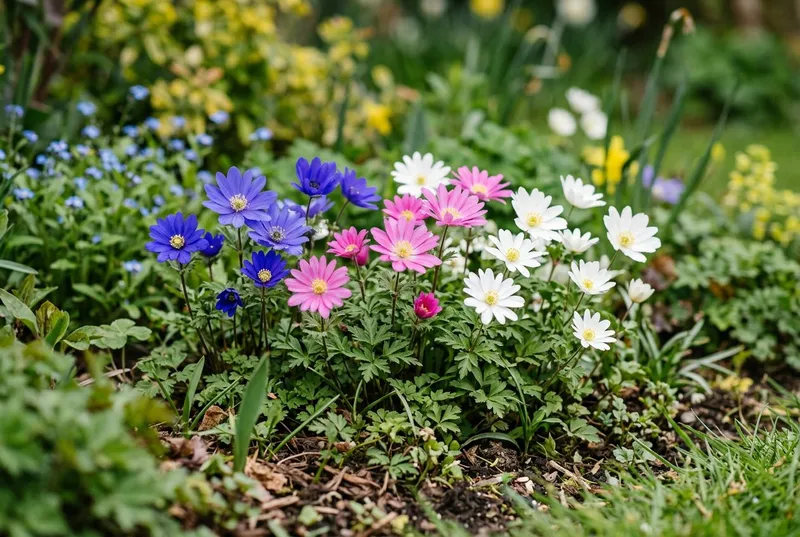
The Grecian windflower produces cheerful daisy-like flowers in shades of blue, pink, and white from February to April. Growing just 15 cm tall, it forms spreading carpets of colour under trees and shrubs. The knobbly tubers are small and irregularly shaped, making it impossible to tell which way is up — so plant them on their sides. Ideal for naturalising in dappled shade alongside snowdrops and crocuses.
How to grow anemone
Soak the hard, dried tubers overnight in tepid water before planting to rehydrate them — this dramatically improves establishment. Plant 5 cm deep and 5-8 cm apart in autumn. Since it is almost impossible to determine which end is up, plant tubers on their sides and let the shoots find their way. Choose a position with dappled shade and humus-rich, well-drained soil. They thrive under deciduous trees where they receive winter light. No feeding or watering is required once established. Anemone blanda self-seeds freely and forms dense colonies over time. The foliage dies back by early summer, leaving no trace above ground. Divide congested clumps in late summer when dormant.
Pruning
No pruning needed. Allow foliage to die back naturally. The plant goes fully dormant by midsummer.
Propagation
- Division of tubers in late summer
- Self-seeding
Common problems
- Powdery mildew
- Leaf spot
- Caterpillars on foliage
Good companions
Related guides
How to Grow Anemones in the UK
Grow anemones in the UK with confidence. Three types, when to plant, how to care for them, and which varieties give the best results in British gardens.
When to Plant Spring Bulbs in the UK
Find out when to plant spring bulbs across the UK. Covers daffodils, tulips, crocuses, hyacinths, alliums, and snowdrops with exact timing by type.
Best Plants for Shade in UK Gardens
Best shade-tolerant plants for UK gardens, from full shade to dappled light. Covers perennials, shrubs, ground cover, ferns, and climbers.