Hornwort
Ceratophyllum demersum
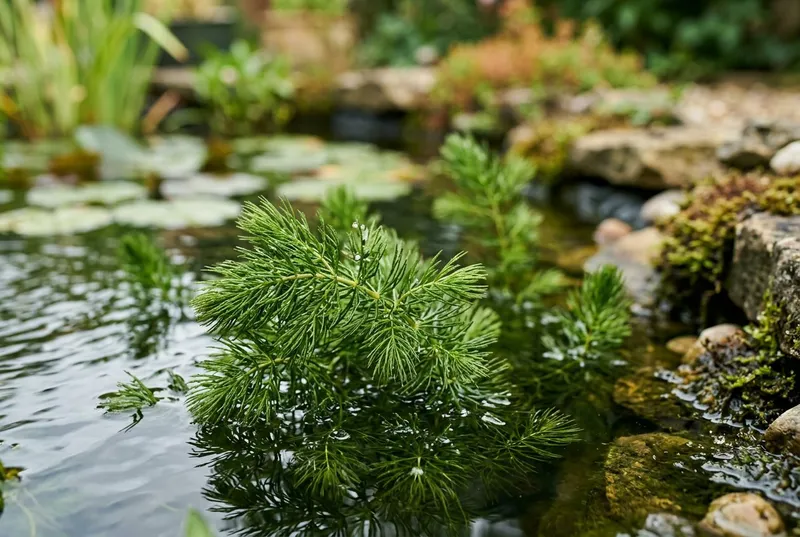
A fully submerged, rootless aquatic plant with dark green, finely divided foliage that floats freely beneath the water surface. Hornwort is one of the best oxygenating plants for UK garden ponds, releasing oxygen into the water and absorbing excess nutrients that would otherwise fuel algal blooms. It is native to Britain and found in ponds, lakes, and slow-moving waterways across the country. It provides excellent cover for fish fry, newts, and aquatic invertebrates.
How to grow hornwort
Simply drop weighted bunches into the pond in spring or summer. Hornwort has no roots and floats freely in the water column, absorbing nutrients directly through its foliage. It thrives in still or slow-moving water at almost any depth, from shallow container ponds to deeper garden ponds. Plant roughly five bunches per square metre of pond surface for effective oxygenation and algae suppression. Hornwort tolerates a wide range of water conditions, from full sun to shade, and from acid to alkaline water. It grows vigorously in summer, helping to keep pond water clear by outcompeting blanketweed for dissolved nutrients. In autumn, it sinks to the bottom and produces overwintering buds called turions, which regenerate the following spring. No feeding, soil, or compost is needed.
Pruning
Thin out excess growth in summer by removing handfuls of the plant from the water. This prevents it from choking the pond. Compost the removed material or add it to the garden as a nutrient-rich green mulch.
Propagation
- Stem fragmentation
- Turion buds in autumn
Common problems
- Can become invasive in nutrient-rich ponds
- Sinks and looks sparse in winter
- May tangle with pond pump intakes
Good companions
Related guides
Best Pond Plants for UK Gardens
Native UK pond plants for every planting zone. Covers water lilies, oxygenators, marginals, and bog plants with depths, spreads, and wildlife value.
How to Build a Wildlife Pond UK Guide
Step-by-step guide to building a wildlife pond in the UK. Covers liner choice, planting, depth, wildlife access, maintenance, and costs from fifty pounds.
How to Build a Garden Pond: UK Guide
Step-by-step guide to building a garden pond in the UK. Covers liner types, digging, pumps, filters, fish stocking, planting, and maintenance.
How to Create a Wildlife Garden UK
Turn any UK garden into a wildlife haven. Covers ponds, native planting, hedgehog access, bird feeding, bug hotels, and seasonal wildlife tasks.