Water Forget-me-not
Myosotis scorpioides
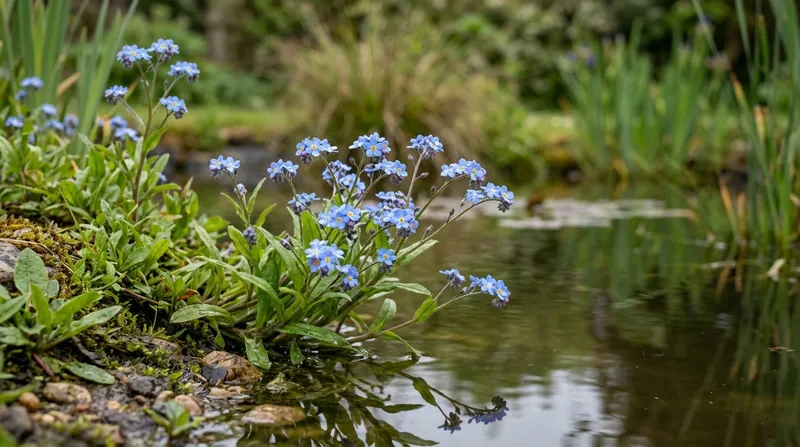
A charming, low-growing native British marginal plant producing clusters of small, sky-blue flowers with yellow centres from May to September. Water forget-me-not spreads gently along pond edges and stream banks, softening hard margins with its trailing stems and fresh green foliage. It is one of the easiest pond plants to grow and provides a long flowering season. The flowers attract bees, hoverflies, and other pollinators to the water's edge.
How to grow water forget-me-not
Plant in full sun or partial shade at the very edge of a pond, in shallow water up to 5 cm deep, or in permanently moist soil in a bog garden. Water forget-me-not roots happily in both muddy margins and damp terrestrial soil. Space plants 20-30 cm apart and they will quickly knit together to form a continuous carpet of foliage. Plant in aquatic baskets or directly into the pond shelf. No feeding is required. It self-seeds freely and also spreads by creeping stems that root at the nodes, forming new plantlets along the margin. Thin out excess growth in autumn if it encroaches too far across the pond surface. It grows well in containers and half-barrels filled with water. Combine with other marginal plants for a naturalistic pond edge.
Pruning
Cut back straggly growth and dead foliage in late autumn. Trim back vigorous stems in summer if the plant spreads beyond its allotted space. Remove any dead or yellowed leaves throughout the season.
Propagation
- Division in spring or autumn
- Stem cuttings rooted in water
- Self-seeds freely
Common problems
- Powdery mildew in dry conditions
- Can become straggly if too shaded
- Occasional aphid infestations on stems
Good companions
Related guides
Best Pond Plants for UK Gardens
Native UK pond plants for every planting zone. Covers water lilies, oxygenators, marginals, and bog plants with depths, spreads, and wildlife value.
How to Build a Wildlife Pond UK Guide
Step-by-step guide to building a wildlife pond in the UK. Covers liner choice, planting, depth, wildlife access, maintenance, and costs from fifty pounds.
How to Create a Wildlife Garden UK
Turn any UK garden into a wildlife haven. Covers ponds, native planting, hedgehog access, bird feeding, bug hotels, and seasonal wildlife tasks.
Best Bee-Friendly Plants for UK Gardens
Attract bees and pollinators with plants that thrive in British conditions. Covers spring, summer, and autumn flowering for year-round forage.