Best Flowering Shrubs for UK Gardens
Discover the best flowering shrubs for UK gardens. Covers hydrangea, lavender, buddleja, philadelphus and more with pruning groups and soil needs.
Key takeaways
- Spring-flowering shrubs (forsythia, ceanothus, deutzia) bloom on old wood — prune immediately after flowering
- Summer-flowering shrubs (buddleja, potentilla, hydrangea) bloom on new growth — prune in February or March
- Lavender needs well-drained, alkaline soil and dies in waterlogged clay — add grit before planting
- Buddleja davidii grows 3m in a single season and must be hard-pruned to 60cm each March
- Hydrangea flower colour depends on soil pH: blue in acid soil (pH 5.5), pink in alkaline (pH 7+)
- Most flowering shrubs need no feeding once established, making them lower-maintenance than perennials
- A well-planned shrub border provides structure, colour, wildlife value, and screening year-round
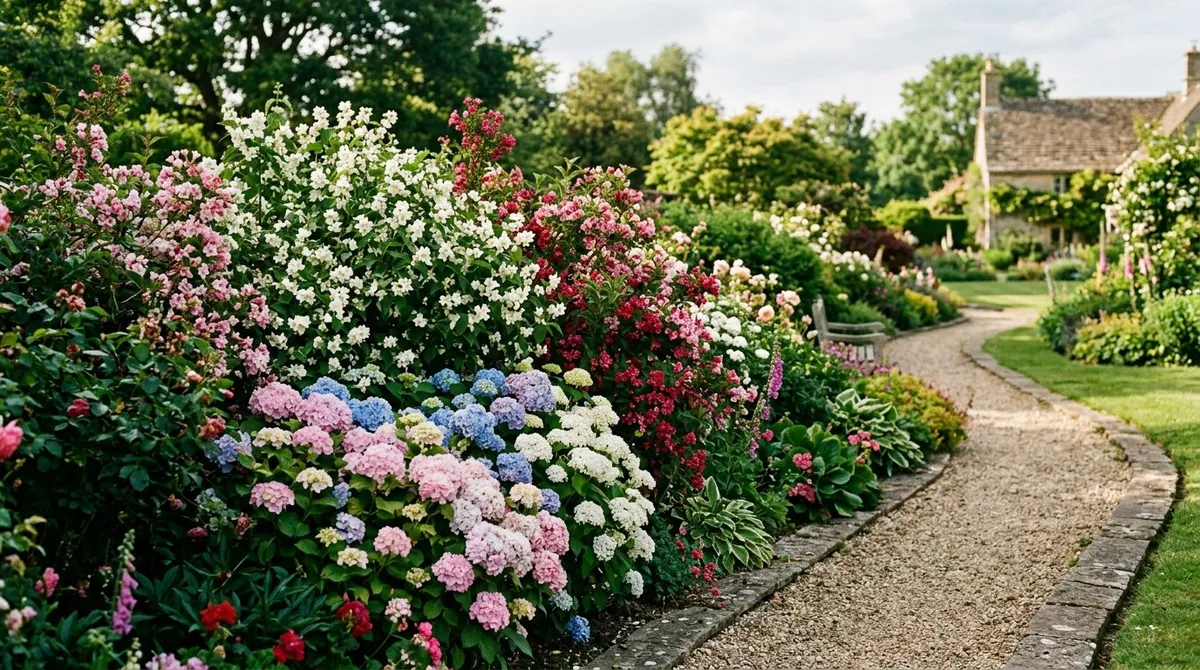
Flowering shrubs are the backbone of a British garden. They provide structure through winter, colour from early spring to late autumn, and habitat for pollinators and nesting birds. Unlike perennials that die back each year, shrubs build a permanent woody framework that only improves with age. A single mature buddleja attracts more butterflies than an entire herbaceous border.
The key to a long-flowering shrub border is choosing varieties from different seasonal groups. Spring-flowering shrubs carry the garden from February through May. Summer-flowering shrubs take over from June to September. Long-season performers bridge the gaps. This guide covers eleven proven performers, grouped by flowering season, with soil requirements and pruning instructions for each. If you already grow hydrangeas or lavender, the shrubs here will extend your season in both directions.
Spring-flowering shrubs
Spring-flowering shrubs bloom on stems produced the previous summer and autumn. This means their flower buds form during the second half of the year and sit dormant through winter. Prune these shrubs immediately after flowering finishes to give new growth the full summer to develop next year’s buds. Hard pruning in winter removes the flowering wood and results in a flowerless spring.
Forsythia
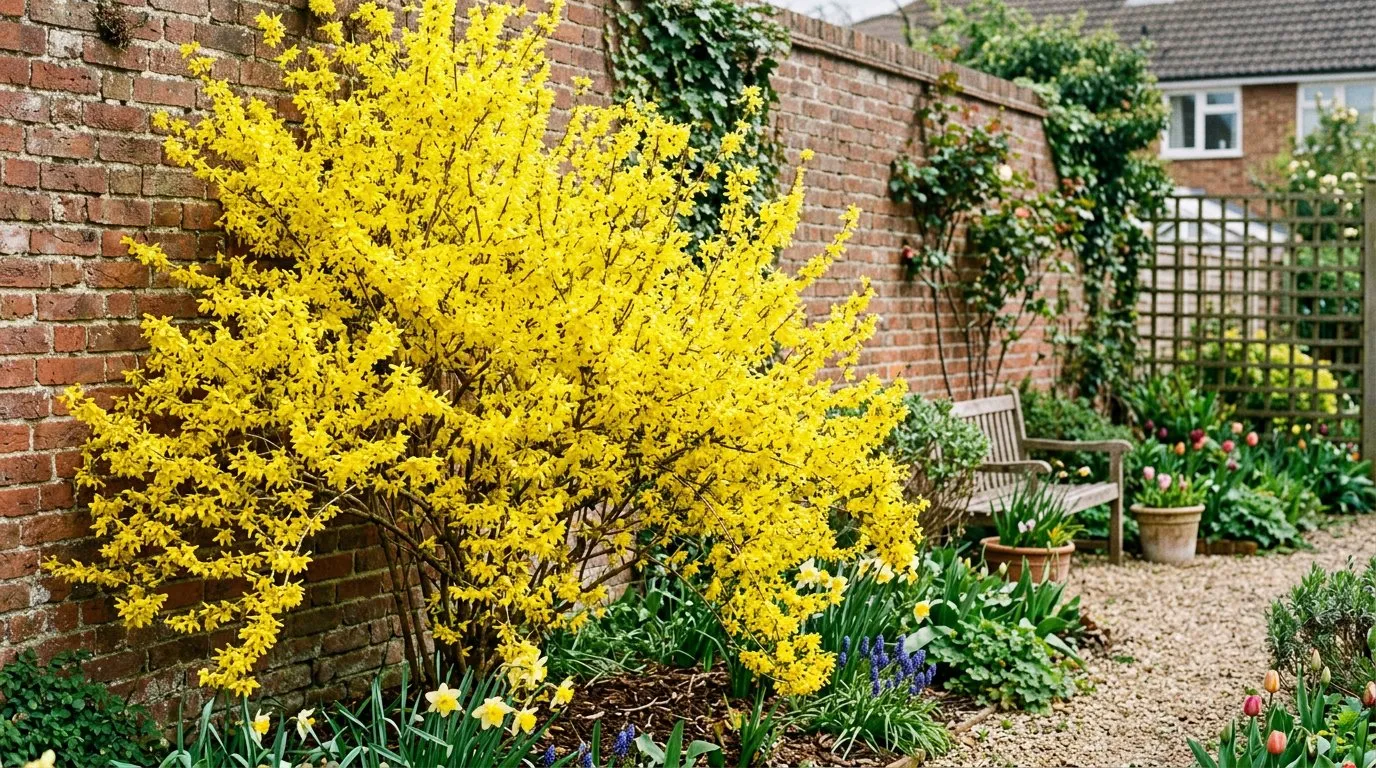
Forsythia x intermedia covers itself in bright yellow flowers in March and April, often before the leaves appear. It is one of the earliest flowering shrubs and a reliable signal that spring has arrived. Mature plants reach 2.5-3m tall and 2m wide. Forsythia tolerates any reasonable soil, including heavy clay, and grows in full sun or light shade. The variety ‘Lynwood Variety’ has the largest, most vivid flowers. Prune one in three of the oldest stems to ground level after flowering each year. This prevents the plant becoming a dense, tangled mass of non-flowering wood.
Ceanothus
Ceanothus, or California lilac, produces dense clusters of vivid blue flowers in May and June. Evergreen varieties such as ‘Concha’ and ‘Puget Blue’ keep their dark green foliage all year. Plants reach 2-3m and look outstanding against a south-facing wall or fence. Ceanothus demands full sun and well-drained soil. It will not survive waterlogged clay or heavy shade. The RHS ceanothus growing guide covers species selection in detail. Prune evergreen types lightly after flowering, cutting back flowered shoots by half. Never cut into old, bare wood, as ceanothus rarely regenerates from hard pruning.
Deutzia
Deutzia is an underused shrub that deserves wider planting. The species D. x hybrida ‘Strawberry Fields’ produces arching sprays of pink and white star-shaped flowers in June. It grows 1.5-2m tall and suits the middle of a mixed border. Deutzia tolerates most soils, including chalk, and flowers well in full sun or part shade. Prune after flowering by removing one in three of the oldest stems at ground level. The remaining stems flower the following year. Deutzia is one of the easiest flowering shrubs to grow and rarely suffers from pests or diseases.
Summer-flowering shrubs
Summer-flowering shrubs produce their blooms on the current year’s growth. They push new shoots in spring and flower on these fresh stems from June onwards. Prune them in late February or early March, just as buds begin to swell. Cutting back hard encourages vigorous new growth loaded with flower buds.
Buddleja
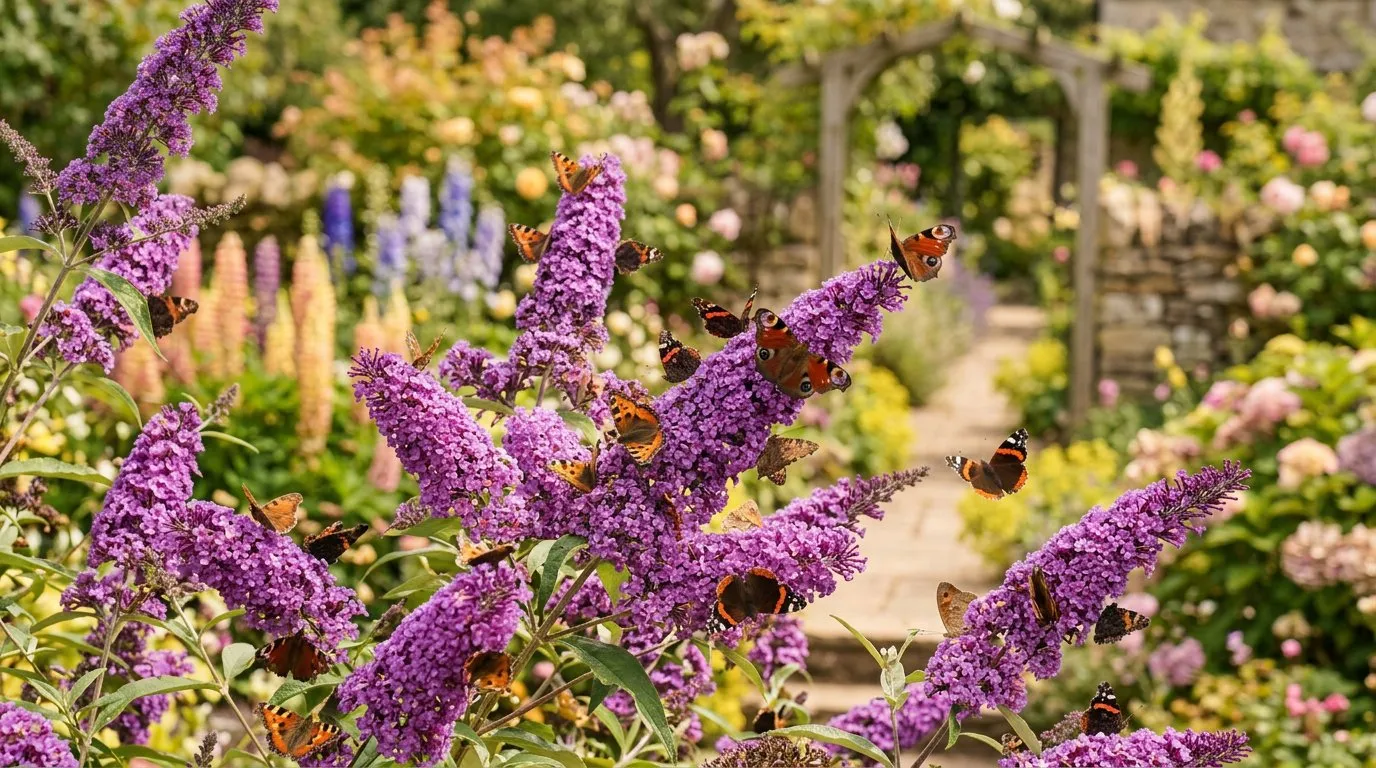
Buddleja davidii, the butterfly bush, produces long, conical flower spikes from July to September in purple, white, pink, or deep blue. It is the single best shrub for attracting butterflies, with red admirals, painted ladies, and peacocks feeding on the nectar-rich flowers throughout summer. A mature buddleja grows 3m tall in a single season if left unpruned. Cut all stems back hard to 60cm from ground level each March. Without annual pruning, the plant becomes leggy and flowers only at the tips, out of sight. ‘Black Knight’ has the deepest purple flowers. ‘White Profusion’ is the best white. Buddleja grows in any soil, including rubble and poor chalk, and tolerates urban pollution. For a garden rich in pollinators, combine it with the bee-friendly plants in our dedicated guide.
Hydrangea
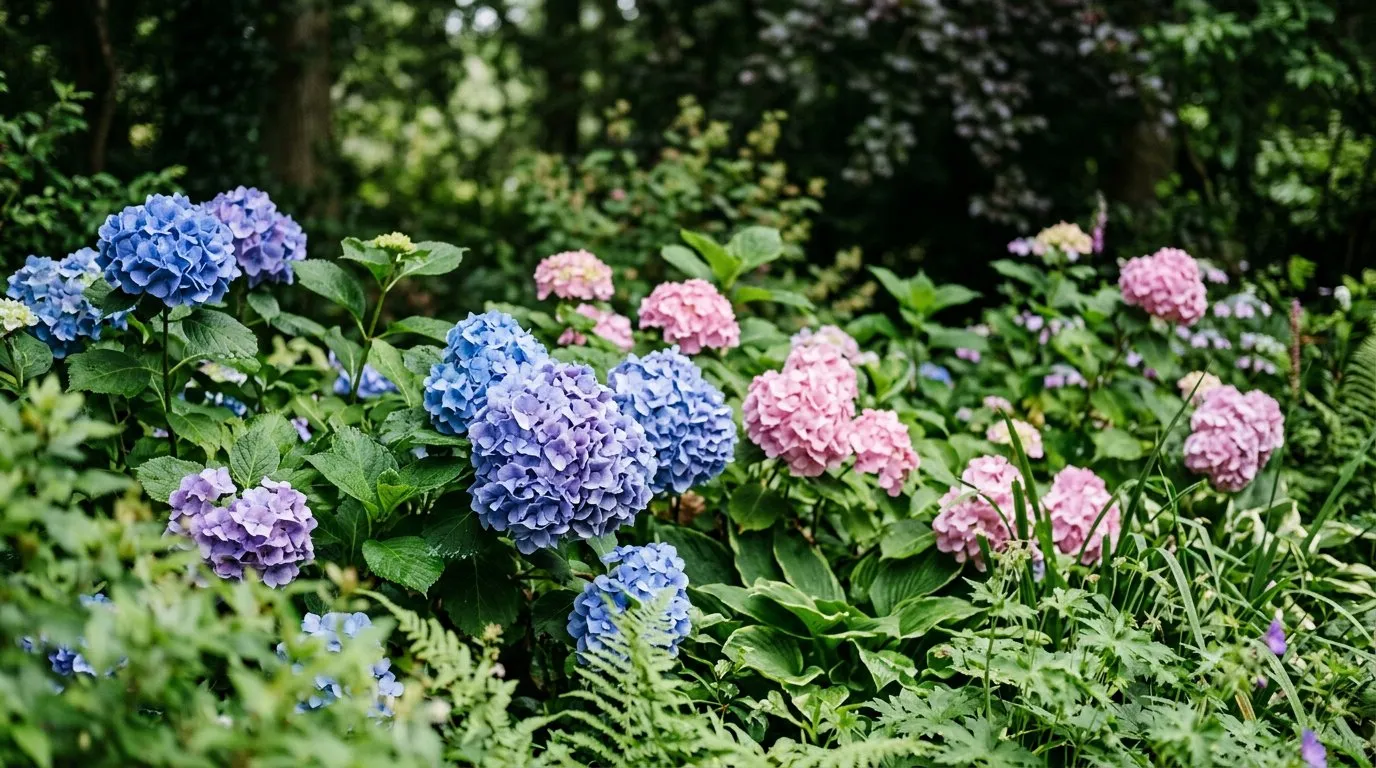
Hydrangea macrophylla is the classic mophead hydrangea seen in gardens across the UK. Large, rounded flower heads appear from July to September in blue, pink, purple, or white depending on variety and soil pH. In acid soil below pH 5.5, flowers turn blue. In alkaline soil above pH 7, they turn pink. The variety ‘Endless Summer’ reblooms on new and old wood, giving flowers from June to October. Hydrangeas prefer dappled shade and moisture-retentive soil. They struggle in full sun on dry ground, where leaves wilt daily. Mature plants reach 1.5-2m. Prune in March by removing dead flower heads, cutting back to the first pair of fat buds below the old flower. Do not cut lower or you remove next season’s buds. Our full hydrangea growing guide covers soil preparation, feeding, and colour control.
Weigela
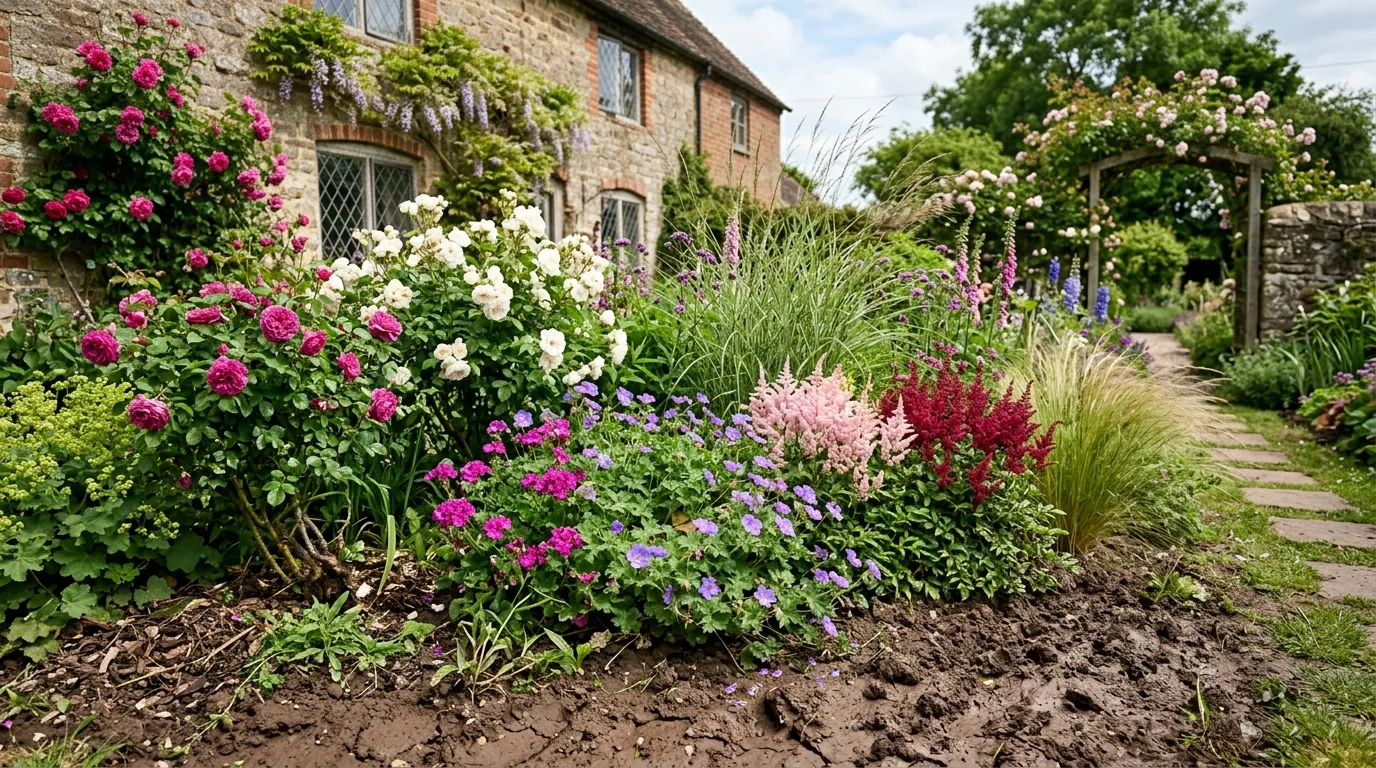
Weigela florida produces clusters of funnel-shaped pink, red, or white flowers in May and June, with some varieties reblooming in September. ‘Bristol Ruby’ has deep crimson flowers. ‘Wine and Roses’ combines dark burgundy foliage with rose-pink blooms. Plants grow 1.5-2m tall and wide. Weigela tolerates most soils, including heavy clay, and grows in sun or part shade. Prune after the main flush of flowers by removing one in three of the oldest branches at ground level. Weigela is tough, reliable, and one of the best shrubs for a cottage garden border.
Lavender
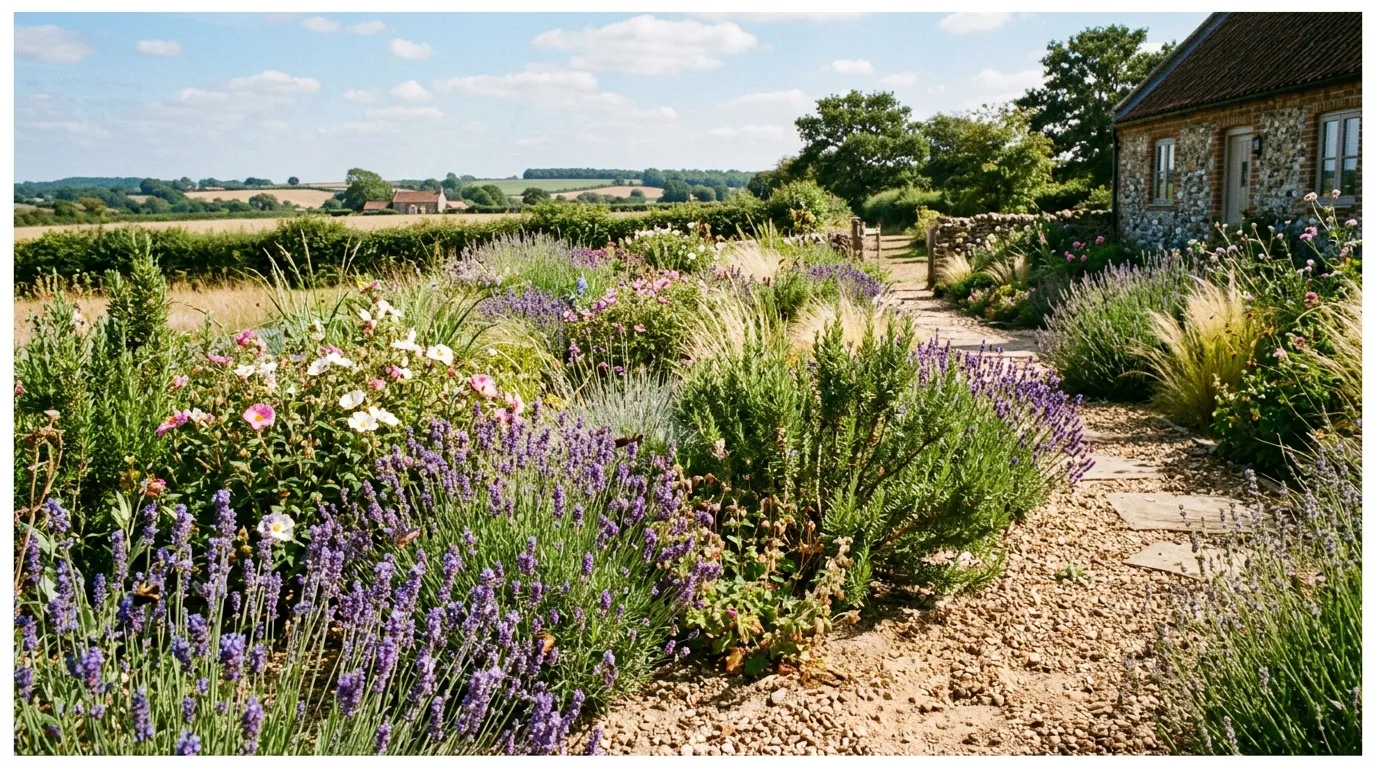
Lavandula angustifolia, English lavender, flowers from June to August with dense spikes of purple, blue, pink, or white blooms above silver-grey foliage. It is the finest pollinator shrub in UK gardens, attracting honeybees, bumblebees, and solitary bees in extraordinary numbers. ‘Hidcote’ grows 60cm tall with deep purple flowers. ‘Munstead’ is more compact at 45cm. Lavender demands full sun and very well-drained soil. It thrives on chalk, gravel, and sandy ground but rots and dies in waterlogged clay. Add 50% horticultural grit to the planting hole on heavier soils. Trim spent flower stalks in late August, then shape lightly in April. Never cut into old, bare wood. See our dedicated lavender guide for variety selection and overwintering. Lavender is also one of the best drought-tolerant plants for dry, sunny borders and is the standout top performer in our guide to plants for sandy soil.
Long-season flowering shrubs
These shrubs flower for three months or more, bridging the gap between spring and summer performers. They are especially valuable in small gardens where every plant must earn its space across multiple seasons.
Potentilla
Potentilla fruticosa is the longest-flowering shrub in the UK, blooming continuously from May to October. Small, buttercup-like flowers in yellow, white, orange, or pink cover a compact, mounded bush 80cm-1m tall. ‘Goldfinger’ has bright yellow flowers. ‘Abbotswood’ is the best white. Potentilla tolerates almost any soil, including poor, dry ground and exposed sites. It is fully hardy, pest-free, and genuinely low-maintenance. Trim lightly in March to keep the shape tidy. This is the shrub for gardeners who want months of colour without effort.
Spiraea
Spiraea japonica produces flat clusters of pink or crimson flowers from June to August above neat, coloured foliage. ‘Goldflame’ has orange-red new leaves that age to bright green. ‘Anthony Waterer’ has deeper crimson flowers and grows to 1.2m. Spiraea thrives in full sun on any well-drained soil. Cut all stems back to 15-20cm from the ground each March for the strongest foliage colour and heaviest flowering. A tough, adaptable shrub that works as an informal hedge, low border, or ground cover.
Abelia
Abelia x grandiflora flowers from July to October, producing tubular white-pink blooms with a sweet honey fragrance. The semi-evergreen foliage turns bronze-purple in autumn. Plants grow 1.5-2m tall and suit sheltered spots in full sun. Abelia is borderline hardy in northern England and Scotland, so plant against a warm, south-facing wall north of the Midlands. ‘Kaleidoscope’ has variegated gold and green leaves. Prune lightly in April, removing dead or frost-damaged stems.
Philadelphus
Philadelphus coronarius, mock orange, fills the garden with an intoxicating orange-blossom scent in June and July. Clusters of cup-shaped white flowers cover the arching branches for 3-4 weeks. ‘Belle Etoile’ has a purple blotch at the centre of each flower and reaches 2m. ‘Aureus’ has golden-yellow foliage that adds colour even when not in flower. Philadelphus grows in any soil, including chalk and clay, and tolerates shade. Prune immediately after flowering by cutting one in three of the oldest stems to ground level. This is essential to prevent the plant becoming a thicket of old, non-flowering wood.
Flowering shrub comparison table
| Shrub | Flowers | Height | Spread | Pruning group | Soil preference |
|---|---|---|---|---|---|
| Forsythia | Mar-Apr (yellow) | 2.5-3m | 2m | After flowering | Any, including clay |
| Ceanothus | May-Jun (blue) | 2-3m | 2m | After flowering (light) | Well-drained, sunny |
| Deutzia | Jun (pink/white) | 1.5-2m | 1.5m | After flowering | Any, including chalk |
| Buddleja | Jul-Sep (purple/white) | 3m+ | 2.5m | Hard prune March | Any, even poor soil |
| Hydrangea | Jul-Sep (blue/pink) | 1.5-2m | 1.5m | Deadhead March | Moist, acid to neutral |
| Weigela | May-Jun (pink/red) | 1.5-2m | 1.5m | After flowering | Any, including clay |
| Lavender | Jun-Aug (purple) | 45-60cm | 45-60cm | Trim Aug, shape Apr | Well-drained, alkaline |
| Potentilla | May-Oct (yellow/white) | 80cm-1m | 80cm | Light trim March | Any, including poor |
| Spiraea | Jun-Aug (pink) | 80cm-1.2m | 1m | Hard prune March | Well-drained, any |
| Abelia | Jul-Oct (white-pink) | 1.5-2m | 1.5m | Light prune April | Sheltered, well-drained |
| Philadelphus | Jun-Jul (white) | 2-2.5m | 2m | After flowering | Any, including clay |
Gardener’s tip: Plant spring-flowering shrubs at the back of the border and summer-flowering types at the front. Spring bloomers finish early and become green backdrops by summer, so shorter summer shrubs in front keep the display fresh without being hidden.
How to plant a flowering shrub
Autumn (September to November) is the best time to plant container-grown shrubs. The soil is still warm from summer, encouraging root growth, and autumn rains reduce the need for watering. Spring planting works too, but you must water weekly through the first summer.
Dig a hole twice the width of the rootball and the same depth. Place the shrub so the top of the rootball sits level with the surrounding soil. Backfill with the excavated soil, firm gently with your foot, and water with 10 litres. Apply a 5-8cm mulch of garden compost around the base, keeping it clear of the stems.
On heavy clay, dig the hole 10cm shallower and mound soil around the rootball so it sits slightly proud of ground level. This prevents water pooling around the crown. Work in coarse grit at the base of the hole to improve drainage.
Do not add fertiliser at planting time. Bone meal in the planting hole is sufficient. Feed with a general-purpose granular fertiliser the following spring, and let the annual compost mulch provide ongoing nutrition after that.
Pruning groups explained
Understanding pruning groups prevents the most common mistake with flowering shrubs: cutting off next year’s flowers.
Group 1: prune after flowering. This applies to all spring-flowering shrubs and any shrub that blooms before midsummer. The flowers form on wood produced the previous year. Prune within 4-6 weeks of the last flowers fading. Remove one in three of the oldest stems at ground level to encourage fresh replacement growth. This applies to forsythia, ceanothus, deutzia, weigela, and philadelphus.
Group 2: prune in late winter. This applies to shrubs that flower from midsummer onwards on the current year’s stems. Hard prune in February or March, cutting back to a low framework or to 15-60cm from the ground depending on species. New spring growth carries that year’s flowers. This applies to buddleja, spiraea, and potentilla.
Group 3: minimal pruning. Hydrangeas, abelia, and lavender need lighter, more targeted pruning. Remove dead flower heads and any frost-damaged growth in spring. Shape lightly but do not cut hard into old wood unless renovation is needed. Our guide to pruning shrubs explains each technique with step-by-step instructions.
Designing a shrub border for year-round colour
A well-planned shrub border should have something in flower every month from February to October. Arrange plants in layers: taller shrubs (buddleja, philadelphus) at the back, mid-height varieties (weigela, hydrangea) in the middle, and compact types (lavender, potentilla, spiraea) at the front.
For a 4m-long border against a fence, try this combination: one philadelphus ‘Belle Etoile’ at the rear, one weigela ‘Bristol Ruby’ and one hydrangea ‘Endless Summer’ in the middle, and three lavender ‘Hidcote’ at the front with a potentilla ‘Goldfinger’ between them. This gives white scented flowers in June, crimson in May, blue mopheads in July, purple spikes through summer, and yellow buttercups from May to October.
Add underplanting of spring bulbs and hardy geraniums for ground-level interest. The shrubs provide the permanent structure while the cottage garden planting plan covers companion planting combinations in more detail.
Why we recommend Potentilla fruticosa ‘Goldfinger’ for low-maintenance borders: After 30 seasons of trialling shrubs in British gardens, potentilla is the one I recommend without hesitation for gardeners who want reliable colour with almost no intervention. ‘Goldfinger’ flowers continuously from May to October on my test plots — that is 22 weeks of bright yellow flowers from a single undemanding plant. In five years of growing it alongside buddleja, weigela, and spiraea, it has never failed to flower regardless of the summer’s weather.
Common problems with flowering shrubs
Shrub not flowering
The most frequent cause is pruning at the wrong time. Cutting a spring-flowering shrub in winter removes all the flower buds. Too much shade is the second cause: most flowering shrubs need at least 4-5 hours of direct sun daily. Excessive nitrogen from lawn fertiliser runoff promotes leaf growth at the expense of flowers. Switch to a high-potash feed (tomato fertiliser works) to encourage bud formation.
Yellow leaves on hydrangeas
This usually indicates chlorosis caused by iron deficiency in alkaline soil. Hydrangeas prefer acid to neutral soil (pH 5.5-6.5). Apply sequestered iron in spring and mulch with ericaceous compost. In very alkaline soil above pH 7.5, consider growing hydrangeas in large containers with ericaceous compost instead.
Lavender dying in winter
Lavender rarely dies from cold in the UK. It dies from waterlogging. Wet roots in winter cause root rot, turning plants brown from the base. Improve drainage before planting by working in 50% grit by volume. On heavy clay, grow lavender in raised beds or gravel gardens where water drains freely.
Buddleja becoming leggy
Unpruned buddleja quickly becomes a tall, bare-stemmed plant that flowers only at the unreachable tips. Hard prune every March to 60cm from the ground. This produces a bushy, compact plant covered in flowers at a height you can actually see and enjoy.
Now you have chosen your flowering shrubs, read our guide on best climbing plants for UK gardens to add a vertical layer of colour and wildlife value behind the border.
Frequently asked questions
What is the best flowering shrub for shade in the UK?
Hydrangea macrophylla thrives in dappled shade and moist soil. It produces large mophead flowers from July to September without needing direct sun. Other shade-tolerant options include mahonia, which flowers in winter, and skimmia, which produces scented spring flowers and red berries. Avoid sun-loving species like lavender and ceanothus in shaded positions, as they become leggy and flower poorly.
When should I prune flowering shrubs?
Prune spring-flowering shrubs immediately after they finish flowering. Prune summer-flowering shrubs in late February or March before new growth starts. The timing depends on when the plant produces its flower buds. Spring bloomers set buds on old wood during the previous summer, so winter pruning removes them. Summer bloomers set buds on new spring growth, so late-winter pruning stimulates the fresh stems that carry flowers.
Which flowering shrubs attract the most bees?
Lavender attracts more bee species than any other garden shrub, supporting over 20 species of bee in the UK. Buddleja is equally valuable, drawing bumblebees, honeybees, and butterflies from July to September. Ceanothus buzzes with bees during its May flowering. For the longest pollinator season, plant all three alongside other bee-friendly plants to cover spring through autumn.
Can I grow flowering shrubs in clay soil?
Many flowering shrubs grow well in clay. Philadelphus, weigela, forsythia, hydrangea, and buddleja all tolerate heavy ground. The key is improving drainage at planting time by working coarse grit and organic matter into the base of the planting hole. Avoid lavender and ceanothus on clay, as both need sharp drainage and will rot over winter in waterlogged soil. Deutzia and spiraea also manage clay well once established.
How far apart should I plant flowering shrubs?
Space shrubs at half their expected mature spread for a border that fills naturally within 2-3 years. A shrub with a 2m spread needs planting 1m from its neighbour. Closer spacing creates a screen faster but requires heavier pruning to prevent overcrowding. Wider spacing gives each shrub room to develop its natural shape. Check the plant label or nursery listing for expected height and spread at maturity.
What are the best low-maintenance flowering shrubs?
Potentilla fruticosa tops the list. It flowers from May to October, tolerates poor soil and drought, and needs only a light trim each March. Hardy fuchsia, spiraea, and abelia are equally undemanding. All four establish quickly and rarely suffer from pests or diseases. For a low-effort border, combine these with other low-maintenance plants suited to your soil type.
Do flowering shrubs need feeding?
Established shrubs rarely need fertiliser. A 5-8cm spring mulch of garden compost provides slow-release nutrients through the growing season. Newly planted shrubs benefit from bone meal in the planting hole. On thin or chalky soil, a top-dressing of fish, blood, and bone in March gives an extra boost. Avoid high-nitrogen feeds, which produce leafy growth at the expense of flower buds.
Which flowering shrubs are evergreen?
Ceanothus is the most striking evergreen flowering shrub, keeping glossy dark leaves year-round and producing vivid blue flowers in May. Lavender retains its grey-green foliage through winter. Abelia x grandiflora is semi-evergreen, holding most of its leaves in mild winters. For dense, year-round screening, ceanothus planted against a sunny wall or fence is hard to beat.
Lawrie has been gardening in the West Midlands for over 30 years. He grows his own veg using no-dig methods, keeps a wildlife-friendly garden, and writes practical advice based on real UK growing conditions.