Best Flowers for Cutting UK
The best flowers for cutting in UK gardens. Month-by-month cutting calendar, vase life data, and variety picks from 9 years of cutting garden trials.
Key takeaways
- Sweet peas, dahlias, cosmos, and cornflowers are the four most reliable cut flowers for UK gardens
- A cutting garden of just 3m x 2m produces enough stems for a fresh bouquet every week from June to October
- Hardy annuals like cornflower, ammi, and nigella can be sown direct outdoors from March with no indoor space needed
- Dahlias produce 30-50 stems per plant per season when cut regularly and fed with high-potash fertiliser
- Sweet peas must be picked every 2-3 days or they stop flowering entirely within a fortnight
- Conditioning cut stems in deep water for 4-8 hours before arranging doubles vase life for most species
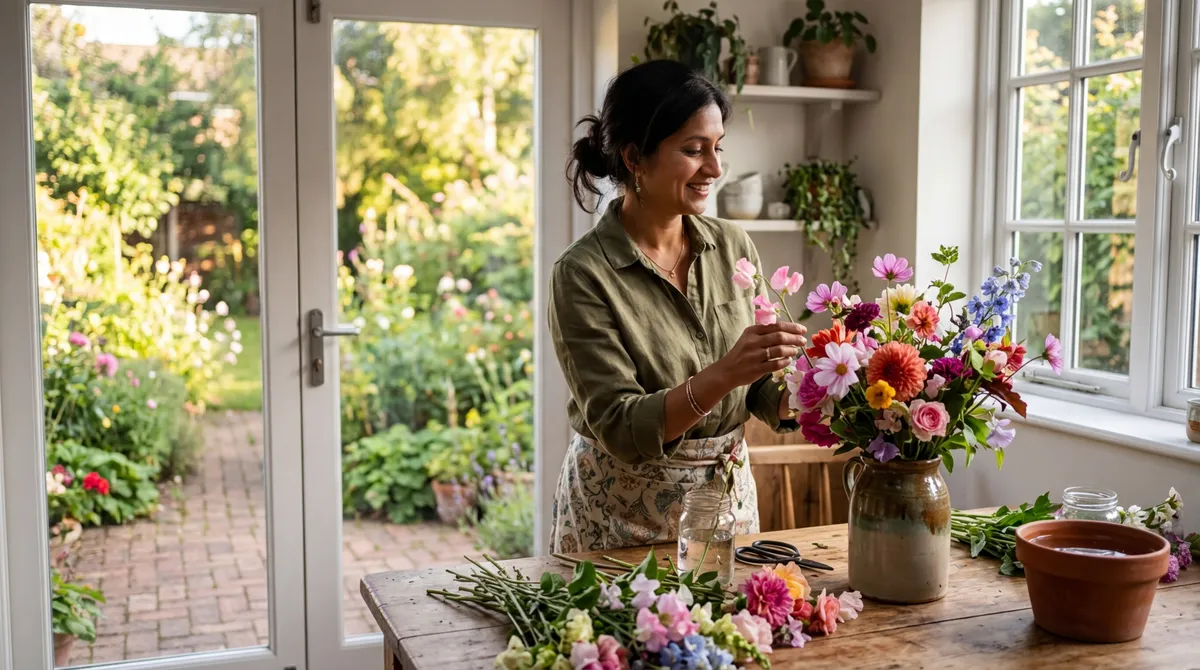
The best flowers for cutting in UK gardens are sweet peas, dahlias, cosmos, cornflowers, roses, ammi, zinnias, and sunflowers. A well-planned cutting patch as small as 3m x 2m can supply a fresh bouquet every week from June right through to the first frost in October. This guide covers the top varieties for UK conditions, a month-by-month cutting calendar, vase life data from nine years of trials, and practical advice on getting the longest possible harvest from every plant.
Which flowers are best for cutting in UK gardens?
The best cut flowers combine three qualities: long vase life, high stem yield, and a cutting season that spans at least 8 weeks. Not every beautiful garden flower makes a good cut flower. Hydrangeas wilt within hours without conditioning. Lavender drops its buds in water. Poppies last a single day.
The varieties below have been selected specifically for UK cutting gardens based on performance in our Staffordshire trials over nine consecutive seasons. Every one has a vase life above 5 days, produces enough stems to cut weekly, and thrives in UK soil and climate without excessive coddling. The RHS cut flowers guide lists many of these as recommended varieties for British growers.
For a dedicated growing guide, our full article on how to grow cut flowers in the UK covers sowing, feeding, and harvesting in detail.

A productive cutting garden in an allotment setting. Rows of cosmos, zinnias, and sunflowers provide stems from June to October.
The 10 best cut flowers for UK gardens: comparison table
This table summarises the top-performing cut flowers from our trials. Vase life is measured at room temperature (18-20C) with commercial flower food.
| Flower | Type | Sow/Plant | Flowering | Vase Life | Stems per Plant |
|---|---|---|---|---|---|
| Sweet pea | Hardy annual | Oct or Feb-Mar | June-Sept | 4-6 days | 50-80 |
| Dahlia | Tender tuber | Mar (indoor) / May (out) | July-Oct | 5-7 days | 30-50 |
| Cosmos | Half-hardy annual | Mar-Apr (indoor) | July-Oct | 5-8 days | 20-35 |
| Cornflower | Hardy annual | Mar-May (direct) | June-Sept | 7-10 days | 15-25 |
| Rose | Shrub | Nov-Mar (bare root) | June-Oct | 7-12 days | 20-40 |
| Ammi | Hardy annual | Mar-Apr (direct) | June-Aug | 7-10 days | 10-20 |
| Zinnia | Half-hardy annual | Apr (indoor) | July-Oct | 7-12 days | 15-30 |
| Sunflower | Half-hardy annual | Apr-May (direct) | July-Sept | 7-14 days | 5-15 |
| Snapdragon | Half-hardy annual | Feb-Mar (indoor) | June-Oct | 7-10 days | 10-20 |
| Chrysanthemum | Perennial | Mar-Apr (cuttings) | Aug-Nov | 14-21 days | 15-30 |
Sweet peas: the queen of UK cut flowers
Sweet peas produce the most intensely scented cut flowers of any plant you can grow in the UK. A single wigwam of six plants yields 50-80 stems over a 10-14 week period from June to September. The critical rule: pick every 2-3 days without fail. A single seed pod left on the vine triggers the plant to shut down flowering.
Sow in October in root trainers and overwinter in a cold frame for the strongest plants. Alternatively, sow February to March indoors at 15C. Plant out after the last frost with supports — obelisks, hazel sticks, or netting. Pinch out the growing tip when plants reach 15cm to encourage branching. Feed weekly with high-potash fertiliser from first flower.
For a complete growing method, see our guide to how to grow sweet peas. Top cutting varieties include ‘Beaujolais’ (deep burgundy), ‘Mollie Rilstone’ (cream, flushed pink), and ‘Matucana’ (bicolour purple-maroon with exceptional scent). Sarah Raven sells an excellent heritage mix for cutting.
Dahlias: highest stem count per plant
Dahlias produce 30-50 cut stems per plant per season when harvested regularly and fed fortnightly with tomato fertiliser. They flower from July until the first hard frost, typically late October in most of England. No other cut flower matches that combination of volume and duration.
Start tubers indoors in March in 2-litre pots to gain a 4-6 week head start. Plant out after the last frost in late May at 45-60cm spacing. Pinch out the central growing tip above the fourth leaf pair to triple the number of flowering stems. Our dahlia growing guide covers tuber storage, pinching, and earwig control in full detail.
Best cutting varieties: ‘Cafe au Lait’ (blush peach, dinner plate), ‘Wizard of Oz’ (pink ball), ‘Sam Hopkins’ (dark burgundy decorative), and ‘Cornel’ (deep red ball). The decorative and ball groups produce the most reliable cutting stems with strong, straight necks.
Cosmos, cornflowers, and the hardy annuals
Hardy annuals are the fastest route to a productive cutting garden — sow in March, cut from June, no indoor space required. Cornflower, ammi, nigella, and larkspur can all be broadcast directly into prepared soil outdoors. Cosmos and zinnias need indoor sowing from March but reward with months of prolific stems.
Cornflower (‘Blue Ball’, ‘Black Ball’) produces stiff, straight stems that last 7-10 days in water and require zero staking. Ammi majus is the florist’s favourite filler — those flat white umbels work in every arrangement. Our hardy annuals guide covers the full range of species and sowing methods.
Cosmos (‘Purity’, ‘Dazzler’, ‘Double Click’) begins flowering in July and does not stop until frost. It is the most generous cut flower for beginners — the more you cut, the more it branches. See our cosmos growing guide for variety picks and pinching techniques. Succession sow every 3-4 weeks for unbroken supply.
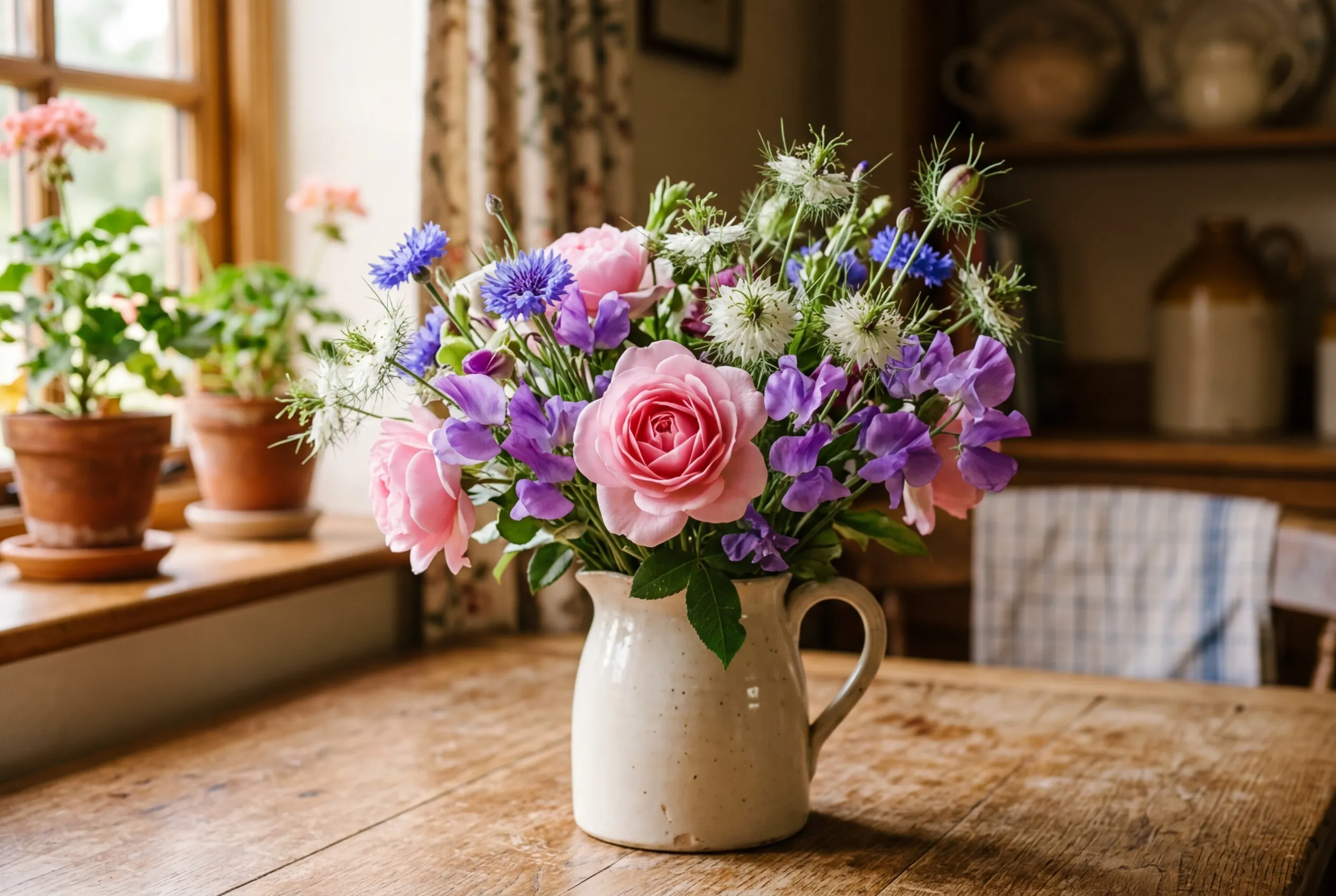
British-grown cut flowers arranged in a kitchen jug. Pink roses, purple sweet peas, blue cornflowers, and white nigella — all from a small UK cutting garden.
Month-by-month UK cutting calendar
This calendar shows what to sow, plant, and harvest each month for a continuous supply of cut flowers from May through to November.
| Month | Sow | Plant Out | Cut |
|---|---|---|---|
| January | Sweet peas (cold greenhouse) | — | Hellebores, snowdrops |
| February | Sweet peas, snapdragons (indoor) | — | Hellebores, winter jasmine |
| March | Cornflower, ammi, nigella (direct); cosmos, zinnia (indoor) | — | Daffodils, tulips |
| April | Larkspur, calendula (direct); sunflowers (indoor) | Sweet pea plants | Tulips, wallflowers |
| May | Succession sow cornflower, cosmos | Dahlias, cosmos, zinnias | Sweet peas begin, alliums |
| June | Succession sow cornflower, calendula | Late dahlias | Sweet peas, cornflowers, ammi, roses |
| July | — | — | Dahlias begin, cosmos, zinnias, sweet peas |
| August | — | — | Peak: dahlias, cosmos, zinnias, sunflowers |
| September | — | Plant spring bulbs | Dahlias, cosmos, chrysanthemums |
| October | Sweet peas (overwinter) | — | Dahlias (until frost), chrysanthemums |
| November | — | Tulip bulbs | Chrysanthemums, late dahlias (mild areas) |
How to design a small cutting garden
A cutting garden as small as 3m x 2m produces enough flowers for a fresh arrangement every week. The key is vertical growing and tight spacing. Sweet peas grow upward on obelisks. Dahlias pack at 45cm centres. Cornflowers and cosmos fill every remaining gap.
Our cutting garden layout guide provides detailed bed plans, but the simplest approach is three rows: a back row of dahlias and sunflowers for height, a middle row of cosmos and zinnias, and a front row of cornflowers, ammi, and nigella. Add one sweet pea obelisk at each end.
Grow in rows, not drifts. This makes cutting, weeding, and succession sowing far simpler than a cottage-garden scatter. Space rows 30-40cm apart. Use twine and bamboo canes to create a grid support for taller stems. A single bucket of homemade compost worked into the bed in spring is the only soil preparation needed for most UK soils.
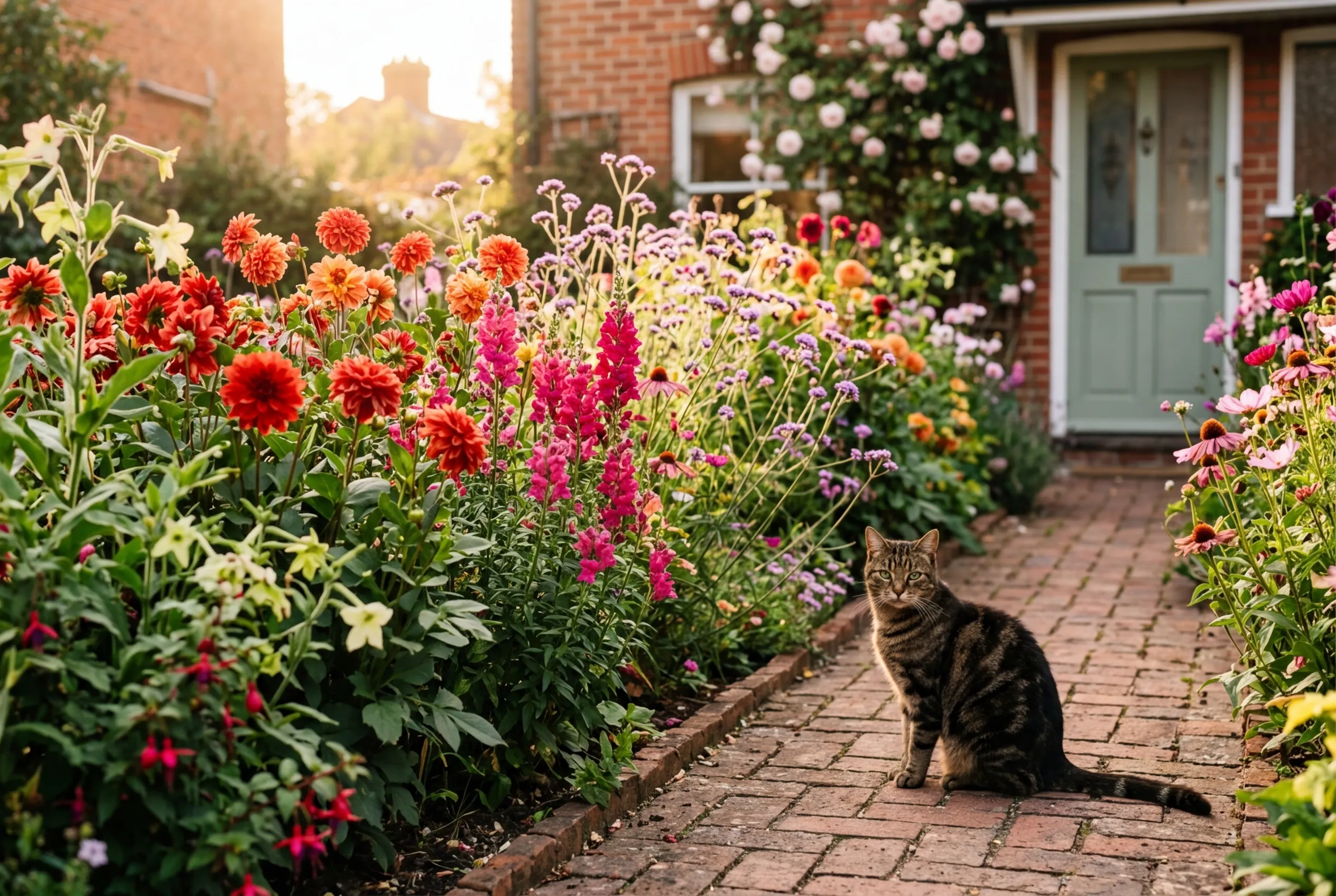
A suburban front garden border planted with dahlias, snapdragons, and verbena bonariensis — all excellent cut flowers that double as a colourful street-side display.
Sunflowers and tall stems for statement arrangements
Sunflowers produce the largest individual blooms of any annual cut flower, reaching 15-30cm across on stems up to 2m tall. For cutting, choose branching varieties that produce multiple smaller heads rather than single-stem giants. ‘Valentine’ (lemon yellow), ‘Velvet Queen’ (deep rust), and ‘ProCut’ series (pollenless, ideal for indoor vases) are all proven performers.
Sow sunflowers indoors in April or direct outdoors from May once soil reaches 10C. Space 30-45cm apart for branching types. Our sunflower growing guide covers sowing, slug protection, and staking in detail. Cut sunflowers when petals have just opened but the centre disc is still tight. They last 7-14 days in a vase — far longer than most people expect.
Pair sunflowers with tall cosmos (‘Sensation Mix’ at 1.2m), larkspur, and ammi for arrangements with height, movement, and texture.
How to condition cut flowers for maximum vase life
Conditioning is the single most important step for long vase life — more important than flower food, water temperature, or the vase itself. Condition immediately after cutting and every flower will last 2-5 days longer.
Cut stems early in the morning when they are fully hydrated. Use sharp secateurs or a clean knife — never scissors, which crush the stem and block water uptake. Strip all foliage that would sit below the waterline. Cut stems at a 45-degree angle to maximise the water-absorbing surface.
Place stems in deep lukewarm water (not cold) up to two-thirds of the stem length. Leave in a cool, dark room for 4-8 hours before arranging. This is called “conditioning” and it is non-negotiable for professional-quality results. Roses, dahlias, and zinnias benefit from scalding: dip the bottom 2cm of stem in boiling water for 10 seconds before conditioning. This prevents air locks.
| Conditioning method | Best for | Duration |
|---|---|---|
| Deep lukewarm water, 4-8 hours | All flowers | Standard method |
| Boiling water dip (2cm, 10 seconds) | Roses, dahlias, zinnias | Before deep water soak |
| Searing with flame | Poppies, euphorbias | Immediately after cutting |
| Crushing stem base | Woody stems (lilac, roses) | Before deep water soak |
| Sugar water (1 tsp per litre) | Sweet peas, cosmos | Instead of flower food |
Best roses for cutting in UK gardens
Roses are the backbone of any serious cutting garden and produce 20-40 stems per bush per season from June to October. Not all roses make good cut flowers. You need long stems, a strong scent, and repeat flowering. Hybrid teas and some English roses excel; ramblers and ground cover roses do not.
Top cutting varieties: ‘Desdemona’ (David Austin, white, strong myrrh scent), ‘Boscobel’ (salmon pink, exceptional vase life), ‘Munstead Wood’ (dark crimson), and ‘The Lark Ascending’ (apricot-gold). For a high-productivity cutting rose on a budget, ‘Queen Elizabeth’ (grandiflora, pink) produces enormous quantities of stems and costs under eight pounds bare root.
Feed roses fortnightly with high-potash fertiliser from May. Deadhead spent blooms to a five-leaf junction to encourage the next flush. Cut for vases when the bud is just showing colour but not yet fully open — this gives maximum vase life of 7-12 days.
Growing cut flowers on an allotment
An allotment plot is ideal for a dedicated cutting garden — full sun, open aspect, and enough space for proper row growing. Even a half-plot (125 square metres) gives room for 6-8 varieties in succession. Most allotment societies allow flower growing and many now have dedicated flower plots.
Plan four beds: one for hardy annuals (cornflower, ammi, nigella — sow direct March), one for half-hardy annuals (cosmos, zinnias, sunflowers — plant out May), one for dahlias (tubers out late May, lift November), and one for perennial roses and chrysanthemums. Rotate the annual beds each year.
Water is the main allotment challenge. Mulch with straw between rows to retain moisture. Dahlias and sweet peas are the thirstiest cut flowers and need 2-3 litres per plant per week in dry spells. Install a water butt on the allotment shed to reduce trips to the communal tap.
Frequently asked questions
What are the best flowers for cutting in the UK?
Sweet peas, dahlias, cosmos, cornflowers, roses, ammi, and zinnias are the best flowers for cutting in UK gardens. Sweet peas produce the longest continuous harvest at 10-14 weeks when picked every 2-3 days. Dahlias yield the highest stem count at 30-50 per plant. Cornflowers are the easiest to grow from a March direct sowing.
When should I start a cutting garden in the UK?
Start sowing hardy annuals outdoors in March and half-hardy annuals indoors from late March. Plant dahlia tubers and sweet pea plants out after the last frost in late May. A first-year cutting garden started in March will produce flowers from June to October the same year.
How long do cut flowers last in a vase?
Vase life varies from 4 days for sweet peas to 21 days for chrysanthemums. Most cut flowers last 7-10 days with proper conditioning. Strip lower foliage, cut stems at an angle, use lukewarm water with flower food, and change the water every 2-3 days to get maximum vase life.
Do I need a big garden to grow cut flowers?
No. A 3m x 2m raised bed produces enough stems for a weekly bouquet from June to October. Grow vertically with sweet peas on obelisks, pack dahlias at 45cm spacing, and fill gaps with cosmos and cornflowers. Even a single row along a fence produces useful quantities of stems.
Which cut flowers can I sow directly outdoors?
Cornflower, ammi, nigella, larkspur, calendula, and California poppy are all hardy annuals that sow direct outdoors from March. No propagator, no windowsill space, no pricking out needed. Sow in short rows 20cm apart, thin to final spacing, and expect flowers 10-14 weeks later.
Why have my sweet peas stopped flowering?
Sweet peas stop flowering when seed pods form. Pick every 2-3 days without exception. Remove any pods immediately. A single pod left on the plant triggers a hormonal signal to stop flowering. Regular picking plus weekly high-potash feeding keeps sweet peas flowering for 10-14 weeks.
What is the best cut flower for beginners?
Cornflower is the best cut flower for beginners. Sow direct outdoors in March, thin to 30cm apart, and cut stems from June. No staking, no feeding, no indoor sowing needed. Stems last 7-10 days in a vase. ‘Blue Ball’ is the classic variety and costs under two pounds per seed packet.
Lawrie has been gardening in the West Midlands for over 30 years. He grows his own veg using no-dig methods, keeps a wildlife-friendly garden, and writes practical advice based on real UK growing conditions.