Best Ground Cover Plants UK
Best ground cover plants for UK gardens covering shade, sun, slopes and paving. Expert picks with heights, spreads and planting advice.
Key takeaways
- Vinca minor is the most reliable evergreen ground cover for shade, spreading 1.5m per plant
- Creeping thyme and sedum are the best ground cover for sunny spots and paving gaps
- A dense planting of 9 plants per square metre suppresses weeds within 18 months
- Epimedium and geranium macrorrhizum solve the hardest problem: dry shade under trees
- Evergreen options like pachysandra and vinca provide year-round weed suppression
- Most ground cover plants cost between 3 and 8 pounds per pot at UK garden centres
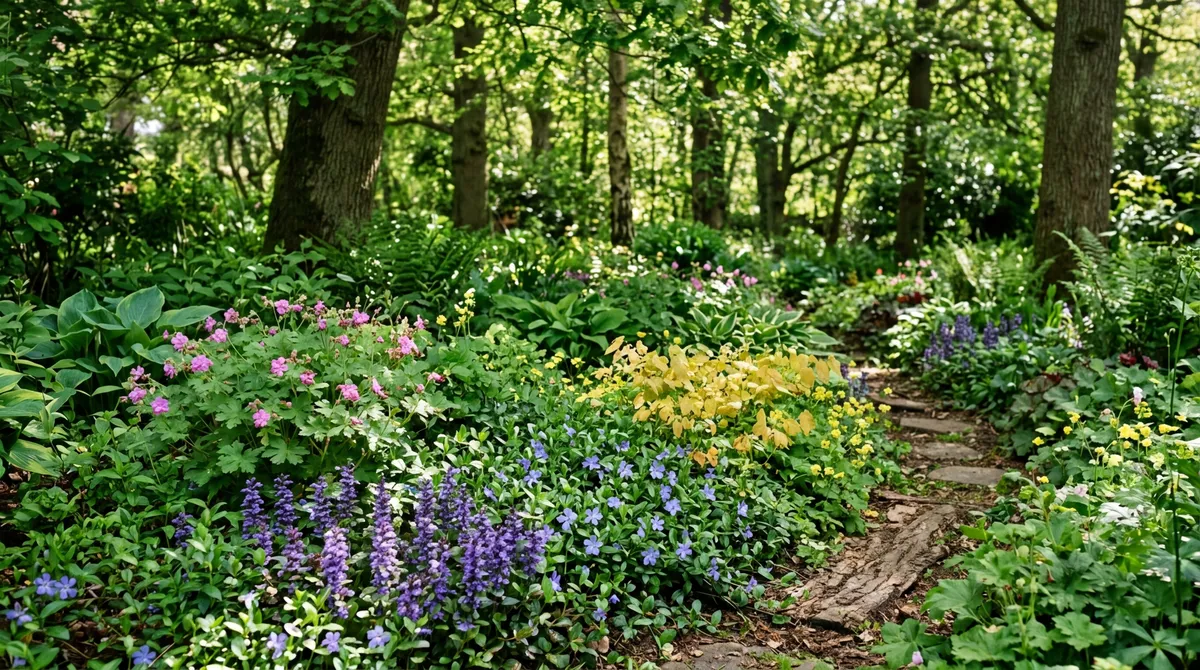
Best ground cover plants for UK gardens fall into two groups: shade lovers like vinca and ajuga that thrive under trees, and sun lovers like creeping thyme and sedum that colonise gravel, paving gaps and dry banks. Choosing the right species for your conditions is the difference between a weed-free carpet and a patchy failure.
This guide covers the top-performing ground cover plants tested in UK gardens, with specific heights, spreads, and planting densities. The RHS guide to ground cover plants provides additional variety suggestions. Whether you need to suppress weeds without chemicals, cover a shady bank, or replace a struggling lawn, there is a ground cover plant that fits.
What makes a good ground cover plant?
A good ground cover plant spreads horizontally to form a dense mat that blocks light from reaching the soil surface. This prevents weed seeds from germinating. The best species share four traits: they grow outward rather than upward, they tolerate competition, they keep their foliage through most or all of the year, and they need minimal maintenance once established.
Height matters less than density. A 5cm creeping thyme mat suppresses weeds just as effectively as a 30cm geranium clump, provided neither leaves bare soil between plants. The critical factor is how quickly the canopy closes. At 30cm spacing, most ground cover plants achieve full coverage within 12-18 months.
Evergreen ground cover provides year-round weed suppression. Deciduous types like hardy geraniums die back in winter, leaving gaps where annual weeds can germinate. Pairing deciduous and evergreen species solves this. Plant epimedium (semi-evergreen) with ajuga (evergreen) for continuous cover.
Best ground cover plants for shade
Shade is where ground cover plants earn their keep. Grass struggles under trees and beside north-facing walls. Ground cover thrives there. These species tolerate the low light, root competition and dry soil that defeat most other plants.
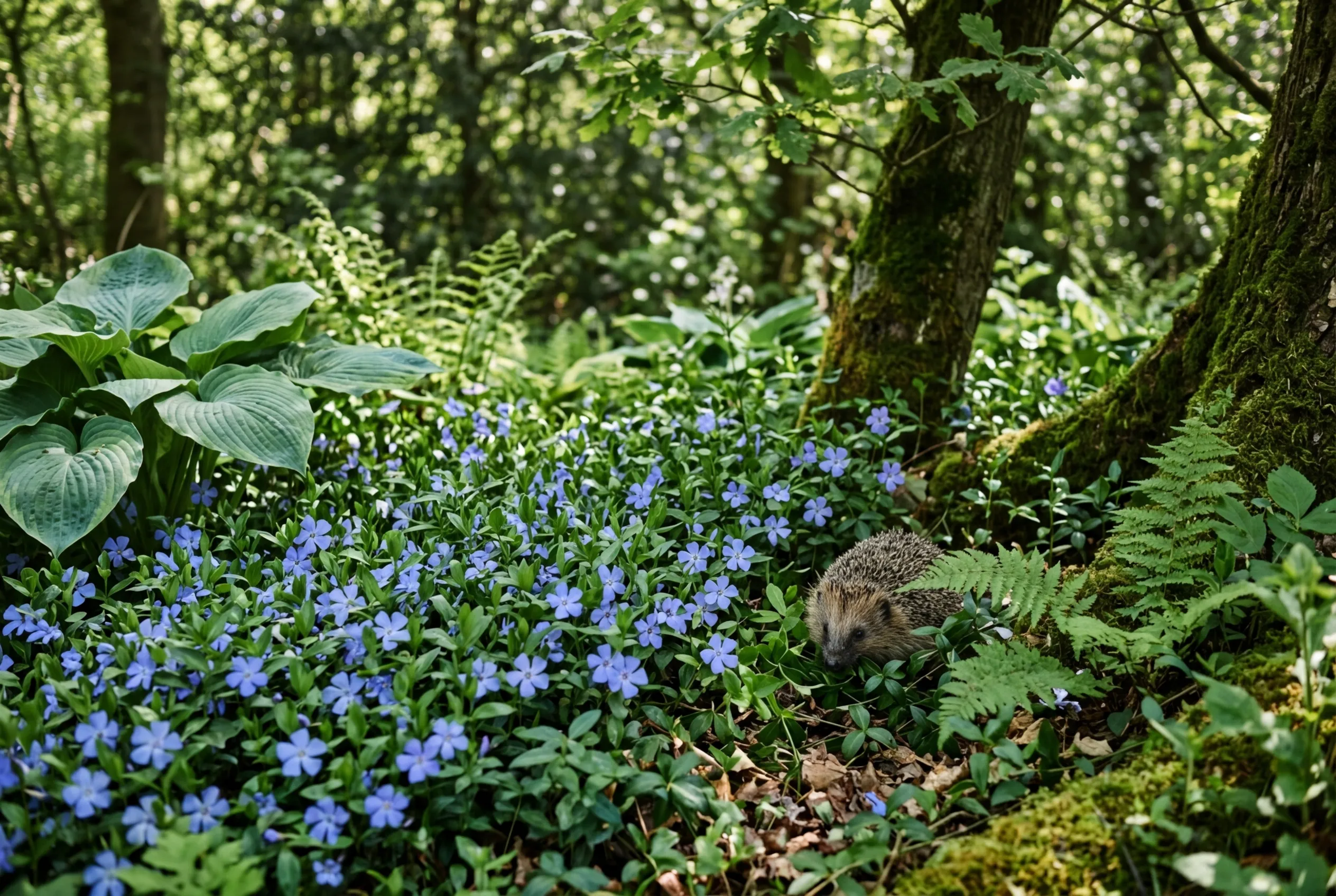 Vinca minor forming a dense carpet of blue flowers in a shady woodland garden corner, providing shelter for wildlife including hedgehogs
Vinca minor (lesser periwinkle)
Vinca minor is the single most reliable evergreen ground cover for shade in UK gardens. It grows 15-20cm tall, spreads 1.5m per plant, and produces blue-purple flowers from March to May. It tolerates dry shade under trees, north-facing walls, and poor soil. Once established, it forms an impenetrable mat that no weed can push through.
Plant at 30cm spacing in autumn. Water weekly for the first summer if spring-planted. Trim back hard in March every 3-4 years to keep it dense and prevent legginess. Vinca minor has the RHS Award of Garden Merit. It also provides excellent shelter for hedgehogs and other ground-dwelling wildlife.
Ajuga reptans (bugle)
Ajuga reptans spreads by runners at 60cm per season, making it one of the fastest shade ground covers. It grows just 10-15cm tall with glossy purple-bronze foliage and blue flower spikes in April-June. The cultivar ‘Atropurpurea’ has deep bronze leaves that darken in sun. ‘Burgundy Glow’ adds cream and pink variegation.
Ajuga prefers moist soil and partial to full shade. It struggles in dry, sandy ground. On heavy clay, it performs well without amendment. Plant 7-9 per square metre for coverage within one growing season. It dies back slightly in hard winters but regrows from the crown in spring.
Epimedium (barrenwort)
Epimedium solves the toughest ground cover problem: dry shade under mature trees. Once established, it tolerates root competition, drought and deep shade. Most species grow 25-35cm tall with heart-shaped leaves that turn copper in autumn. Dainty flowers appear in April before the new foliage.
Epimedium x versicolor ‘Sulphureum’ is the toughest for dry shade. Epimedium grandiflorum has larger flowers in pink, white or purple. Cut back old foliage in February to reveal the spring flowers. Plant at 30cm spacing. Epimedium is slow in its first year but spreads steadily from year two onward.
Pachysandra terminalis (Japanese spurge)
Pachysandra terminalis forms a 20cm-tall evergreen carpet in the deepest shade. It spreads by underground runners and tolerates north-facing walls, dense tree canopy and poor soil. The glossy green foliage stays neat year-round. White flower spikes appear in early spring but are not showy.
This is the ground cover of choice for problem areas where nothing else will grow. It is slow to establish (allow 2-3 years for full coverage) but virtually maintenance-free once settled. It dislikes waterlogged soil and full sun. The variegated form ‘Variegata’ brightens dark corners with cream-edged leaves.
Best ground cover plants for sun
Sunny ground cover plants need different qualities. They must tolerate heat, drought and poor soil. Many originate from Mediterranean or alpine habitats. They tend to be lower-growing, tighter in habit, and often aromatic when stepped on.
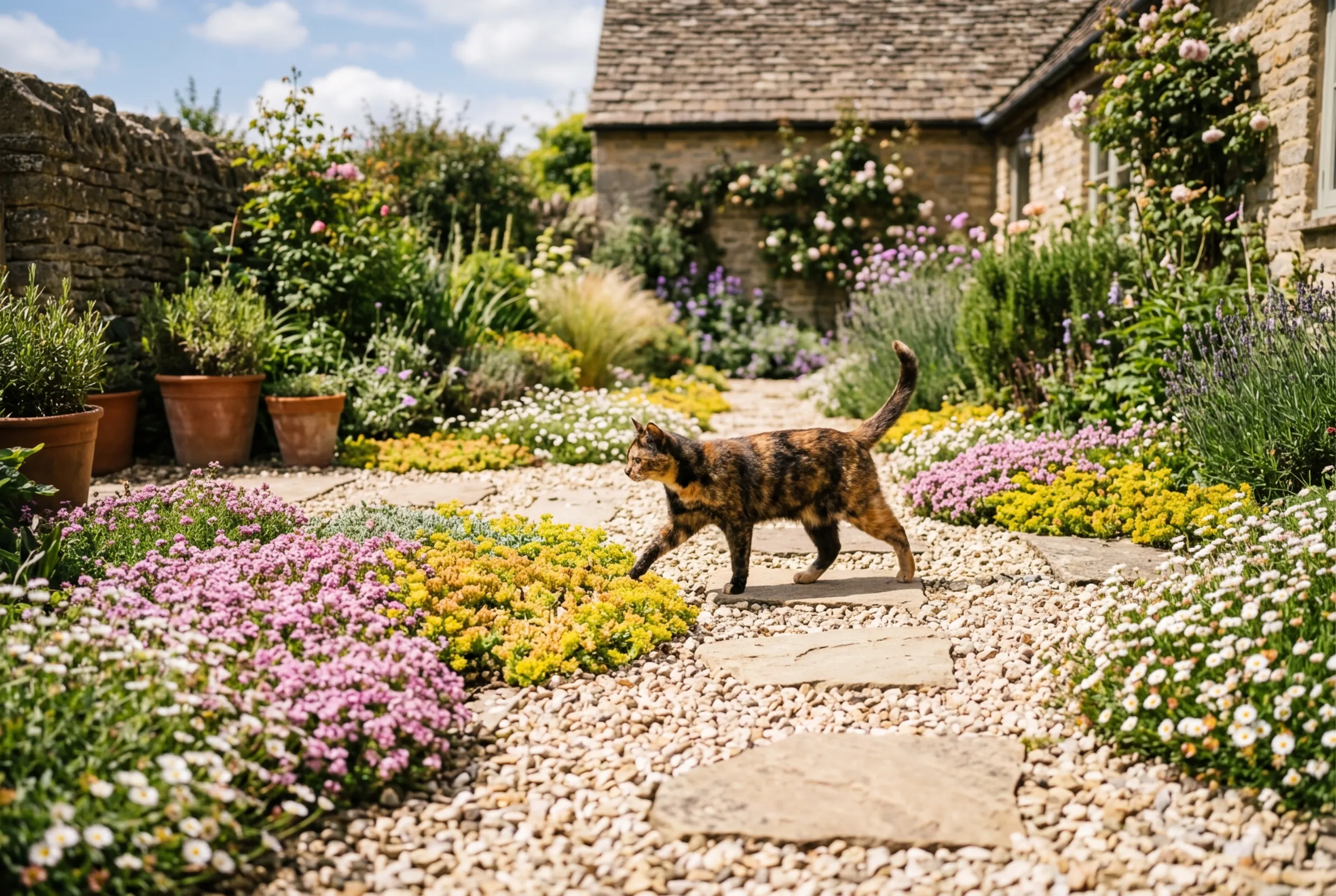 Creeping thyme, yellow sedum and white erigeron filling the gaps in a sunny gravel garden — perfect ground cover for hot, dry positions
Creeping thyme (Thymus serpyllum)
Creeping thyme is the best ground cover for sunny paving, gravel and paths. It grows just 5-8cm tall, spreads 30-45cm per plant, and produces masses of pink-purple flowers from June to August. Walking on it releases a warm herbal scent. Bees love it.
Plant in well-drained soil or gritty compost. It thrives in gravel gardens, between stepping stones, and on sunny banks. Avoid heavy clay or shaded positions. ‘Coccineus’ has deep crimson flowers. ‘Albus’ has white flowers. Trim lightly after flowering to keep it compact. Thyme is one of the best drought-tolerant plants for UK gardens.
Sedum acre (biting stonecrop)
Sedum acre grows on virtually nothing — thin soil, gravel, even cracks in walls. It forms a 5cm mat of succulent green leaves topped with bright yellow star-shaped flowers in June-July. It is native to the UK and found wild on coastal cliffs, old walls and railway embankments.
This is the lowest-maintenance ground cover on this list. It needs no watering, no feeding, and no pruning. Plant rooted cuttings at 20cm spacing in spring. It fills in within one season on well-drained soil. Avoid rich, damp soil where it rots. For a taller option, Sedum spurium grows to 15cm and comes in pink, red and white flowering forms.
Erigeron karvinskianus (Mexican fleabane)
Erigeron karvinskianus self-seeds prolifically and fills every gap, crack and crevice in sunny gardens. It grows 15-30cm tall with a continuous show of small daisy flowers from May to November. The flowers open white, age to pink, then darken to rose — giving a two-tone effect across the plant.
Plant it once and it appears everywhere. It seeds into gravel paths, wall tops, paving joints and raised bed edges. In mild areas of the UK (RHS hardiness H4), it is fully perennial. In colder regions, it may die back in harsh winters but self-sown seedlings replace it. Trim back to 5cm in March.
Geranium macrorrhizum (bigroot cranesbill)
Geranium macrorrhizum works in both sun and partial shade, making it the most versatile ground cover on this list. It grows 30-40cm tall with aromatic, semi-evergreen foliage that turns red-orange in autumn. Flowers appear in May-June in shades of pink, magenta and white.
‘Ingwersen’s Variety’ (pale pink) and ‘Bevan’s Variety’ (deep magenta) both hold the RHS AGM. The thick rhizomes spread to form dense clumps that exclude weeds. It tolerates dry shade, poor soil and exposed sites. This is the ground cover I recommend for steep banks and slopes where maintenance is difficult.
Best ground cover for slopes and banks
Steep banks present a unique challenge. Soil washes away in rain, mowing is dangerous, and planting is awkward. Ground cover is the practical solution. The best plants for slopes have strong root systems that bind the soil and spreading habits that cover quickly.
Geranium macrorrhizum is the top choice for banks. Its thick rhizomes grip the soil and the dense foliage sheds rain without erosion. Cotoneaster dammeri (evergreen, red berries) is another excellent option for larger banks. Hypericum calycinum (rose of Sharon) spreads aggressively on dry banks and flowers from June to September.
For a wildlife-friendly bank, combine vinca minor with native wild strawberry (Fragaria vesca) and bugle (Ajuga reptans). This provides flowers across spring and summer, evergreen cover, and food for birds and insects. Our guide to lawn alternatives covers more options for replacing grass on banks.
Ground cover between paving and paths
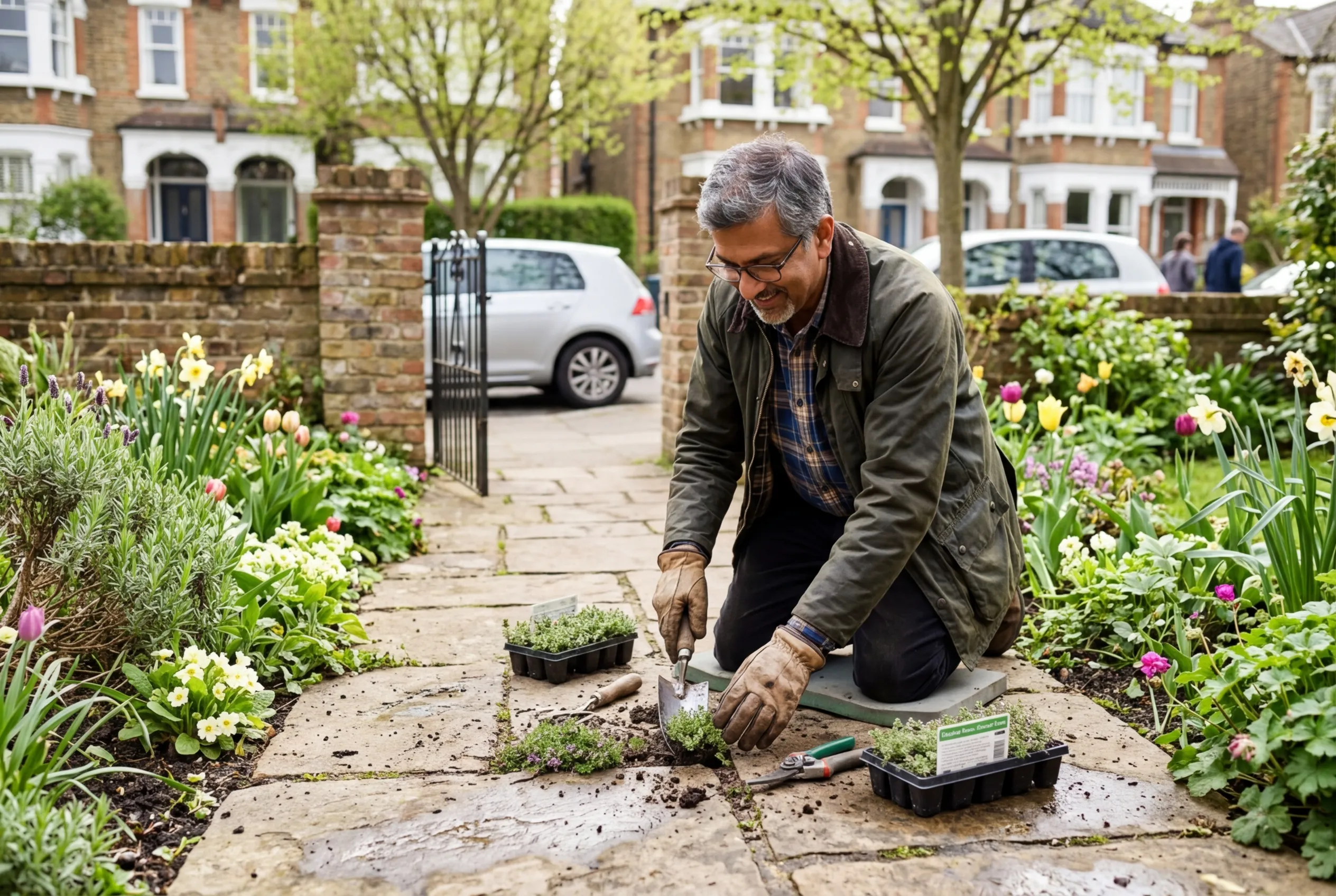 Planting creeping thyme between paving slabs — the best ground cover for paths, releasing scent when walked on
Planting between paving transforms a hard surface into a living feature. The right plants tolerate foot traffic, drought, and the reflected heat from stone or concrete. They also reduce the need to weed between slabs manually.
Creeping thyme (Thymus serpyllum) is the top choice. It withstands light to moderate foot traffic and releases scent when stepped on. Chamomile (Chamaemelum nobile ‘Treneague’) is a non-flowering variety bred specifically for paths and lawns. Soleirolia soleirolii (mind-your-own-business) fills shady paving joints but is invasive — only use it where containment is easy.
To plant between existing paving, scrape out the old mortar or compacted soil with a narrow trowel. Fill the gap with gritty compost (50% multipurpose, 50% horticultural grit). Press small plug plants into the gaps in spring. Water daily for the first two weeks, then leave them to establish.
Evergreen ground cover for year-round interest
Evergreen ground cover maintains its appearance through winter when deciduous plants are dormant. This matters for front gardens, path edges and prominent borders where bare soil looks untidy from November to March.
| Plant | Height | Spread per plant | Sun/Shade | Evergreen | Flowers | Weed suppression |
|---|---|---|---|---|---|---|
| Vinca minor | 15-20cm | 1.5m | Shade/partial | Yes | Blue, Mar-May | Excellent |
| Ajuga reptans | 10-15cm | 60cm/year | Shade/partial | Semi | Blue, Apr-Jun | Good |
| Epimedium | 25-35cm | 40cm | Shade/dry shade | Semi | Various, Apr | Good |
| Pachysandra | 20cm | 60cm/year | Full shade | Yes | White, Mar | Excellent |
| Creeping thyme | 5-8cm | 30-45cm | Full sun | Yes | Pink, Jun-Aug | Excellent |
| Sedum acre | 5cm | 30cm | Full sun | Yes | Yellow, Jun-Jul | Good |
| Erigeron | 15-30cm | Self-seeds | Full sun | Semi | White/pink, May-Nov | Moderate |
| Geranium mac. | 30-40cm | 60cm | Sun/partial | Semi | Pink, May-Jun | Excellent |
| Cotoneaster dammeri | 20cm | 1.5m | Sun/partial | Yes | White, May | Excellent |
| Lamium maculatum | 15-20cm | 60cm | Shade/partial | Semi | Pink/white, May-Jun | Good |
The standout evergreen choices are Vinca minor for shade, creeping thyme for sun, and Cotoneaster dammeri for larger areas and banks. All three maintain dense foliage through winter and need no cutting back until spring.
How to plant ground cover for maximum weed suppression
Weed suppression depends on planting density and timing. Follow this method for reliable results:
- Clear the site completely. Remove all existing weeds, including roots. For perennial weeds like couch grass and bindweed, wait for full regrowth and remove manually or smother with cardboard for 3-6 months first.
- Improve the soil. Add 5cm of garden compost or well-rotted manure. Most ground cover plants are not fussy, but better soil means faster establishment.
- Plant at 30cm spacing. This gives 9 plants per square metre. Use a triangular planting pattern rather than rows — it fills gaps faster and looks more natural.
- Mulch between plants. Apply 5cm of bark mulch or composted woodchip around (not over) the new plants. This suppresses weeds during the 12-18 months before the ground cover canopy closes.
- Water weekly in the first summer. Even drought-tolerant species need regular water during their first growing season while roots establish.
- Weed monthly in year one. Remove any weed seedlings by hand before they compete with the ground cover. By year two, the canopy should be dense enough to suppress weeds on its own.
Autumn planting (September-November) gives the best results. The soil is warm from summer, autumn rain provides free irrigation, and roots establish through winter. Spring-planted ground cover loses 3-4 months of growing time and needs more watering.
Choosing ground cover for your garden
Match the plant to the conditions. There is no single ground cover that suits every situation. A shady north-facing border needs vinca or pachysandra. A sunny gravel path needs thyme or sedum. A steep bank needs geranium macrorrhizum or cotoneaster.
Consider the wildlife value too. Ground cover creates habitat for hedgehogs, slow worms, beetles and other beneficial creatures. Flowering ground covers like thyme, ajuga and erigeron feed bees and butterflies from spring to autumn. Dense evergreen cover provides winter shelter for overwintering insects.
For more planting ideas, explore our guides to shade plants and perennials that pair well with ground cover species. Plant Heritage maintains national plant collections including several ground cover genera, and is a valuable resource for finding specialist varieties.
Frequently asked questions
What is the best ground cover to stop weeds UK?
Vinca minor is the best weed-suppressing ground cover. Its dense evergreen mat blocks light to the soil year-round. Plant at 30cm spacing for full coverage within 18 months. Pachysandra terminalis and Geranium macrorrhizum are equally effective in shade. For sunny areas, creeping thyme and Sedum acre form tight mats that leave no bare soil for weed seeds to germinate.
What is the fastest growing ground cover plant UK?
Ajuga reptans is one of the fastest UK ground covers. It spreads by runners and can cover 60cm in a single growing season. Lamium maculatum and Persicaria affinis also establish quickly. For sunny sites, Erigeron karvinskianus self-seeds rapidly and fills gaps within months of planting.
What ground cover grows in full shade UK?
Vinca minor, Pachysandra terminalis and ivy all grow in full shade. Vinca minor is the best choice because it flowers in spring and stays neat. Pachysandra is slower to establish but forms a dense carpet. Avoid planting anything that needs more than 2 hours of sun in full shade positions.
Can I use ground cover instead of grass?
Yes, ground cover replaces grass in areas where lawns struggle. Shady spots under trees, steep banks, and narrow side passages all suit ground cover better than turf. Creeping thyme and chamomile tolerate light foot traffic on paths. See our full guide to lawn alternatives for more options.
When is the best time to plant ground cover UK?
Autumn (September to November) is the best planting time. Soil is warm, rain is reliable, and roots establish before winter. Spring planting (March to May) also works but needs regular watering through the first summer. Avoid planting in frozen or waterlogged soil.
How many ground cover plants do I need per square metre?
Plant 9 per square metre at 30cm spacing for full coverage within 12-18 months. Vigorous spreaders like ajuga and vinca need fewer (5-7 per square metre). Slower species like epimedium need the full 9. Closer spacing gives faster coverage but costs more.
Is ground cover low maintenance?
Ground cover is lower maintenance than lawns or bare borders. Once established, it suppresses weeds, retains soil moisture, and needs no mowing. Annual maintenance is limited to trimming edges, removing any weed seedlings in the first year, and cutting back overgrowth in spring.
Lawrie has been gardening in the West Midlands for over 30 years. He grows his own veg using no-dig methods, keeps a wildlife-friendly garden, and writes practical advice based on real UK growing conditions.