Best Hanging Houseplants UK
The best hanging houseplants for UK homes ranked by trail length, light needs, and care. Covers 10 trailing species with room-by-room placement advice.
Key takeaways
- Golden pothos trails 2-3m and tolerates 200-1,500 lux, making it the most versatile UK hanging plant
- String of hearts produces delicate 1-2m trails on fine stems and needs bright indirect light of 800-1,500 lux
- Hanging pots dry 30-50% faster than floor pots because warm air rises and increases evaporation
- South-facing UK windows provide 2,000-5,000 lux in summer, ideal for hoya, lipstick plant, and string of pearls
- Spider plant is non-toxic to cats and dogs and produces baby plantlets you can propagate for free
- Ceiling hooks must go into a joist or use a toggle bolt rated for at least 10kg to support a wet hanging planter
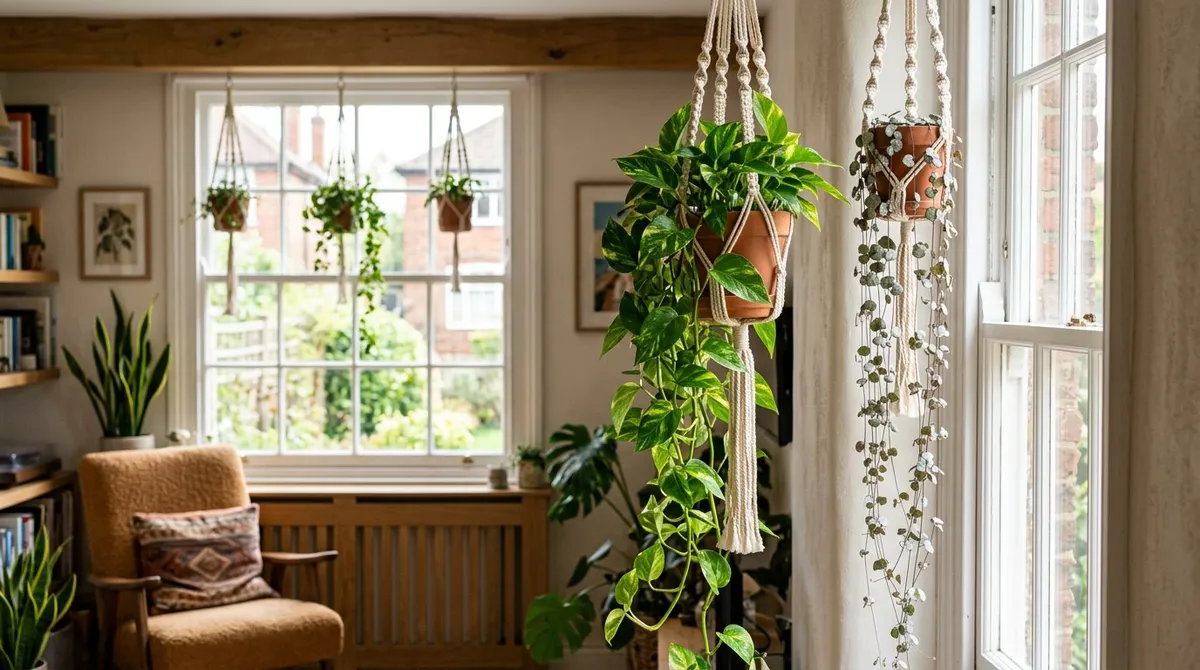
Trailing plants turn empty walls and bare shelves into living features. They work in spaces where upright plants cannot go, hanging from ceilings, draping off bookcases, and cascading from wall-mounted brackets. In UK homes, where natural light varies wildly between south-facing bay windows and north-facing bedrooms, choosing the right trailing species matters.
This guide ranks ten hanging houseplants by trail length, light tolerance, and care difficulty. Every recommendation uses real lux data for UK rooms so you can match plant to position without guessing.
Which trailing plants grow best in UK homes?
UK homes present specific challenges for hanging plants. Winter daylight drops to eight hours in December. Central heating dries the air to 30-40% humidity. Temperatures swing between 18-24C in heated rooms and as low as 10C near single-glazed windows.
Trailing plants raised above floor level face an additional issue. Warm air rises, so hanging pots sit in the warmest, driest air in the room. Soil dries 30-50% faster than in a pot at floor level. Species that tolerate dry conditions between waterings are the safest choices for UK ceilings and high shelves.
The ten plants below all cope with standard UK indoor conditions. Each entry includes the specific light range in lux, watering frequency, maximum trail length, and difficulty rating.
The 10 best hanging houseplants ranked
1. Golden pothos (Epipremnum aureum)
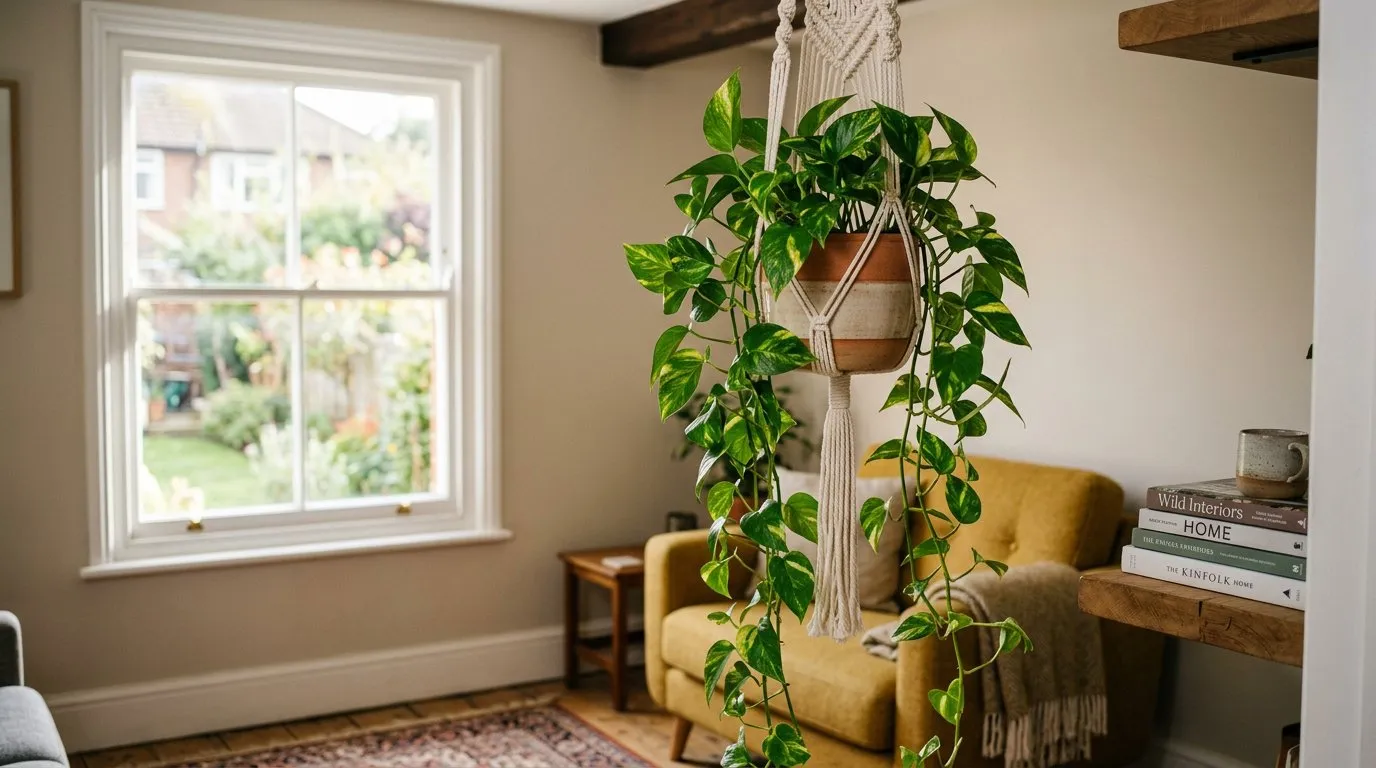
Heart-shaped, glossy green leaves with golden yellow variegation on stems that trail 2-3 metres indoors. Tolerates 200-1,500 lux, covering everything from a dim hallway to a bright living room. Water when the top 3cm of soil dries out, typically every 7-10 days in summer and every 14 days in winter. Pothos wilts slightly when thirsty, then recovers within hours after watering. It grows in plain water too, making it useful for glass vases and test tubes on shelves.
Two popular varieties deserve mention. Neon pothos has vivid chartreuse leaves that brighten dark corners. Marble queen pothos has cream and green marbled foliage but needs 500+ lux to maintain its variegation. In low light, marble queen reverts to plain green. All pothos varieties are toxic to cats and dogs.
If you want more easy-care species, our guide to indoor plants for UK homes covers twelve options for every room.
2. String of hearts (Ceropegia woodii)
Delicate heart-shaped leaves on thread-thin stems that trail 1-2 metres. The leaves are grey-green on top with purple undersides, and mature plants produce small tubular pink flowers in summer. Needs 800-1,500 lux of bright indirect light. An east or west-facing windowsill suits it perfectly. Water every 10-14 days in summer, every 3-4 weeks in winter. The plant stores water in small tubers along the stem, giving it drought tolerance unusual for such a fine plant.
String of hearts dislikes soggy soil. Use a free-draining cactus mix or add 50% perlite to standard compost. It grows from a small root ball, so a 10-12cm pot is enough for years. Propagate by laying a section of stem on moist compost and pinning the tubers down with a hairpin.
3. Spider plant (Chlorophytum comosum)
Arching green and white striped leaves that grow 30-40cm long, with trailing stolons that produce baby plantlets. In a hanging position, the stolons cascade 30-60cm below the pot. Tolerates 200-1,500 lux. Water every 7-10 days. Spider plants tell you they need water when the leaves look slightly pale.
The major advantage is safety. Spider plant is completely non-toxic to cats, dogs, and children. It also produces plantlets freely, so one mother plant supplies all the hanging baskets you want. Snip a plantlet off and root it in water or moist compost. Our guide to beginner houseplants explains more propagation methods.
4. Tradescantia (Tradescantia zebrina)
Striped purple and silver leaves on fast-growing stems that trail 60-90cm. Also sold as inch plant or wandering dude. Grows quickly in 400-1,500 lux. In lower light, the purple colouring fades to green. Water every 5-7 days in summer. Pinch growing tips regularly to keep the plant bushy near the crown rather than leggy.
Tradescantia is one of the fastest trailing plants you can grow indoors. New stems can add 2-3cm per week in summer. It propagates from cuttings placed in water. Snip a 10cm section, strip the lower leaves, and place in a glass of water. Roots appear in 5-7 days. Mildly toxic to cats and dogs if ingested.
5. Boston fern (Nephrolepis exaltata)
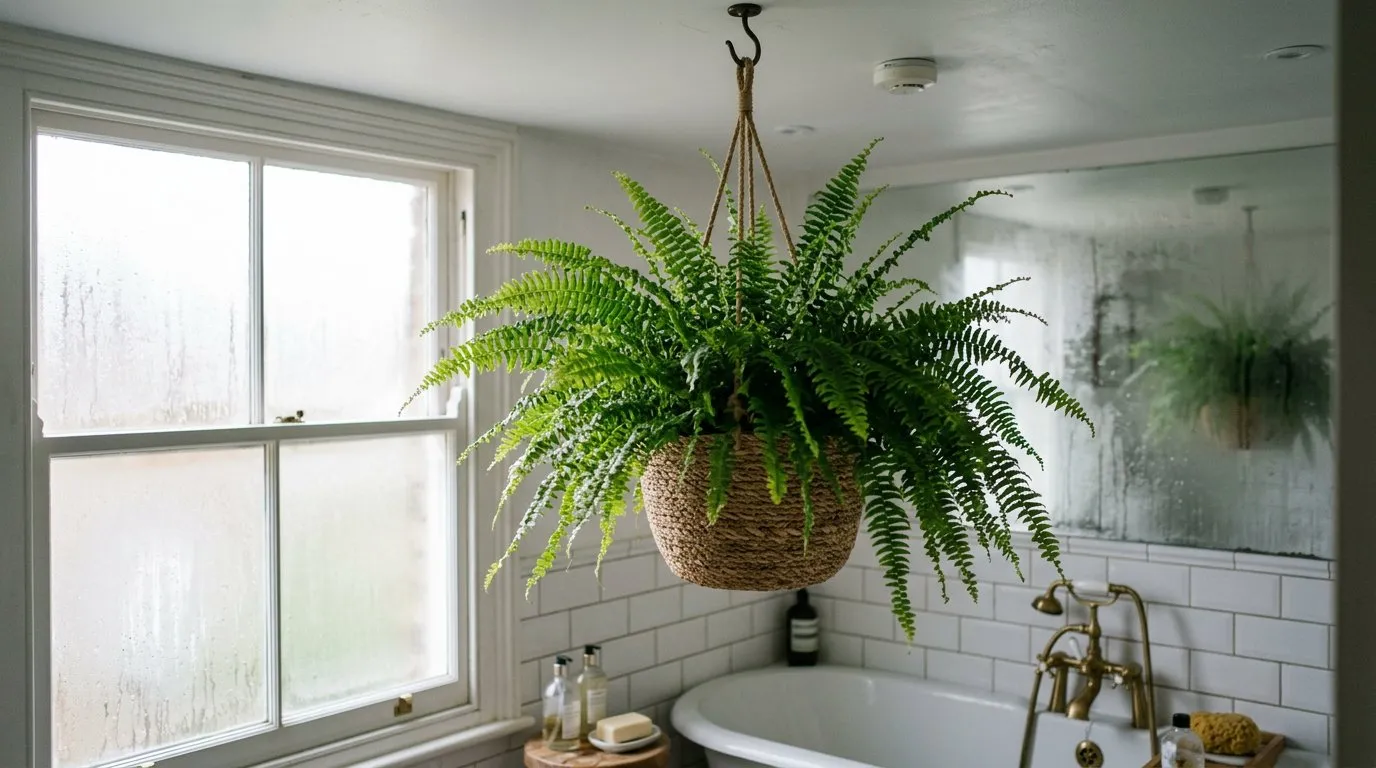
Lush, arching green fronds that cascade 60-90cm from a hanging pot. One of the most dramatic trailing plants when grown well. Needs 400-800 lux of indirect light and high humidity of 50-70%. A bathroom or kitchen suits it best. Water every 5-7 days, keeping the soil consistently moist but never waterlogged.
Boston ferns struggle in the dry air of UK centrally heated rooms. Mist the fronds daily in winter or place the pot on a pebble tray. Brown, crispy frond tips indicate low humidity. Non-toxic to cats and dogs, making it one of the best pet-safe hanging options. For other shade-tolerant choices, see our low-light houseplants guide.
6. String of pearls (Senecio rowleyanus)
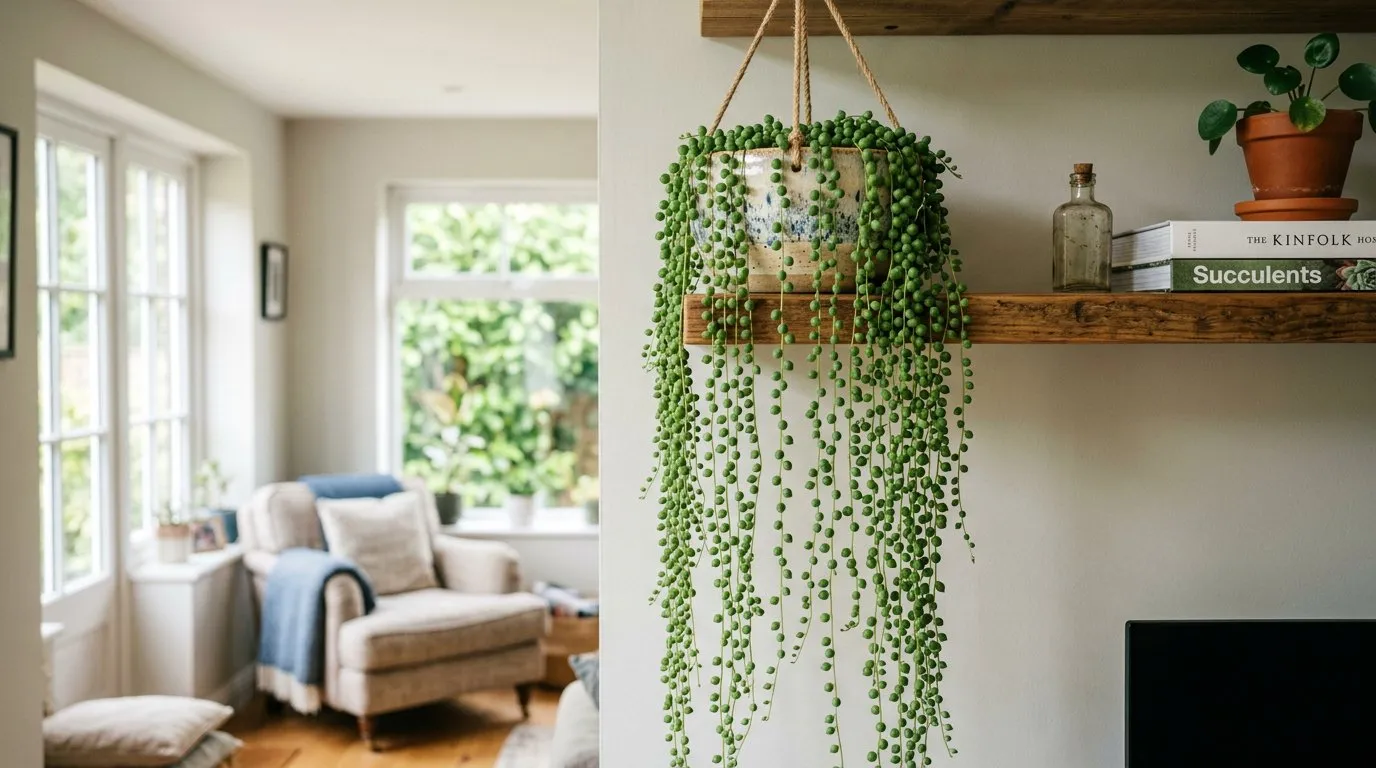
Bead-like round leaves strung on thin stems that trail 30-60cm. One of the most visually striking succulents for hanging pots. Needs 1,000-2,000 lux of bright indirect light. A south or west-facing window is essential. Water sparingly, every 10-14 days in summer and every 3-4 weeks in winter. The pearl-shaped leaves store water, so overwatering causes rot faster than underwatering.
String of pearls dislikes being moved once established. Pick its spot and leave it. Use a gritty, fast-draining succulent mix. Fertilise once a month in spring and summer with a diluted liquid feed at half strength. Toxic to cats and dogs. For more on growing succulents, read our succulent care guide.
7. Hoya (Hoya carnosa)
Thick, waxy, dark green leaves on twining stems that trail or climb 1-2 metres. Also called the wax plant. Produces clusters of fragrant, star-shaped pink or white flowers when given enough light. Needs 800-2,000 lux. A south-facing window with filtered light through a net curtain is ideal. Water every 7-14 days, allowing the soil to dry between waterings.
Hoya is slow-growing but long-lived. Plants kept for 10-20 years produce more flowers as they mature. Never remove the short spur where flowers appear because new blooms grow from the same spur year after year. Tolerates dry air down to 30% humidity, making it better suited to UK centrally heated rooms than Boston fern. Non-toxic to cats and dogs.
8. Lipstick plant (Aeschynanthus radicans)
Glossy dark green leaves on arching stems that trail 40-60cm. Named for the bright red tubular flowers that emerge from dark buds resembling lipstick tubes. Needs 800-1,500 lux of bright indirect light. Flowers most prolifically in spring and summer. Water every 7-10 days, keeping soil lightly moist but not wet.
Lipstick plant needs a cool rest period of 15-18C for 4-6 weeks in winter to trigger flowering. A bright, unheated bedroom or porch works well. Feed monthly with a high-potassium fertiliser from March to September. Non-toxic to cats and dogs.
9. English ivy (Hedera helix)
Lobed, dark green leaves on woody stems that trail or climb 1-3 metres. Variegated varieties add cream or yellow to the leaf edges. Tolerates 200-1,500 lux. Prefers cooler conditions of 10-18C, making it one of the few trailing plants that suits an unheated spare room or cool hallway.
English ivy is one of the toughest trailing plants available. It copes with draughts, temperature swings, and dry spells. Water every 7-10 days. Watch for red spider mite in dry, warm conditions. Mist regularly or shower the foliage monthly to deter pests. The RHS notes that English ivy is fully hardy and widely naturalised across the UK. Toxic to cats and dogs if chewed.
10. Maidenhair fern (Adiantum raddianum)
Delicate, fan-shaped leaflets on wiry black stems that arch and trail 30-50cm. One of the most beautiful hanging plants but also one of the fussiest. Needs 400-800 lux of indirect light, consistent moisture, and humidity above 60%. A bright bathroom is the best position. Water every 3-5 days, never letting the soil dry out completely.
Maidenhair ferns crisp up fast in dry air. If the fronds die back, cut them to soil level and keep watering. New fronds often regenerate within a few weeks if the root ball stayed moist. Non-toxic to cats, dogs, and children. This plant rewards patience but punishes neglect.
Hanging plant comparison table
| Plant | Light (lux) | Watering | Growth rate | Trail length | Difficulty | Pet safe |
|---|---|---|---|---|---|---|
| Golden pothos | 200-1,500 | Every 7-14 days | Fast | 2-3m | Easy | No |
| String of hearts | 800-1,500 | Every 10-14 days | Moderate | 1-2m | Moderate | Yes |
| Spider plant | 200-1,500 | Every 7-10 days | Fast | 30-60cm (stolons) | Easy | Yes |
| Tradescantia | 400-1,500 | Every 5-7 days | Very fast | 60-90cm | Easy | No |
| Boston fern | 400-800 | Every 5-7 days | Moderate | 60-90cm | Moderate | Yes |
| String of pearls | 1,000-2,000 | Every 10-14 days | Slow | 30-60cm | Hard | No |
| Hoya | 800-2,000 | Every 7-14 days | Slow | 1-2m | Moderate | Yes |
| Lipstick plant | 800-1,500 | Every 7-10 days | Moderate | 40-60cm | Moderate | Yes |
| English ivy | 200-1,500 | Every 7-10 days | Fast | 1-3m | Easy | No |
| Maidenhair fern | 400-800 | Every 3-5 days | Moderate | 30-50cm | Hard | Yes |
Which rooms suit hanging plants best?
Room orientation determines which species will thrive. UK homes vary enormously in natural light, and hanging plants positioned near the ceiling receive slightly more light than floor-level pots in the same room.
South-facing rooms (2,000-5,000 lux)
The brightest position in the house. All ten species on this list grow here, but shade-lovers like Boston fern and maidenhair fern need to hang at least 1.5m from the glass to avoid leaf scorch. String of pearls, hoya, and lipstick plant perform best in south-facing light. Use a sheer curtain to filter harsh midday sun from June to August.
East and west-facing rooms (500-2,000 lux)
The sweet spot for most trailing houseplants. Morning sun from east windows is gentler than afternoon sun from west windows. Pothos, string of hearts, tradescantia, and spider plant all grow well in either orientation. Hang plants within 1m of the window for the strongest growth.
North-facing rooms (200-500 lux in winter)
The most challenging position. Only pothos, spider plant, and English ivy reliably cope with the low winter light in north-facing UK rooms. Avoid string of pearls, hoya, and lipstick plant here. Variegated varieties of any species will lose their markings and revert to plain green. Our low-light houseplant guide has more species for dim rooms.
Bathrooms and kitchens
Humidity-loving species flourish near steam. Boston fern, maidenhair fern, pothos, and tradescantia all benefit from the 50-80% humidity typical of UK bathrooms. Ensure the room has a window providing at least 200 lux. Kitchens work well because cooking steam raises humidity naturally.
How to hang indoor plants safely
The hanging method you choose affects both the plant’s health and your ceiling. Wet soil is heavy. A 20cm hanging pot with saturated compost weighs 3-5kg. A large Boston fern in a 25cm pot can exceed 7kg.
Ceiling hooks
Screw hooks directly into a ceiling joist using a stud finder to locate solid timber. Standard plasterboard ceilings cannot support a wet hanging planter without a joist. If no joist is available, use a spring toggle bolt rated for at least 10kg. Pre-drill to avoid splitting the joist.
Macrame hangers
Macrame plant hangers distribute weight evenly and add a decorative element. Choose hangers with a load rating of at least 5kg. Natural cotton and jute macrame suit a relaxed interior style. Synthetic cord lasts longer in humid rooms like bathrooms.
Wall-mounted brackets
L-brackets screwed into wall studs support hanging pots without ceiling fixings. Position the bracket high on the wall so stems trail freely. Ensure the bracket projects at least 15cm from the wall to give the plant space and prevent water marks.
Shelf trailing
The simplest method. Place a trailing plant on a high shelf, mantelpiece, or the top of a bookcase. No drilling required. Stems cascade over the edge naturally. This works especially well for pothos, tradescantia, and English ivy, which all trail quickly. Rotate the pot every two weeks so growth stays even on all sides.
How to water and care for hanging plants
Hanging plants need more attention than floor-level pots. Warm air rising around the pot increases evaporation, and many hanging planters lack drainage trays.
Watering tips
Water thoroughly until it runs from the drainage holes. If the pot has no tray, take it down to the sink or bath to water. Alternatively, use a long-spouted watering can and place a drip tray or saucer beneath the pot. In summer, check hanging plants every 5-7 days. In winter, every 10-14 days is usually enough. Push a finger 2-3cm into the soil. Dry soil means water. Damp soil means wait.
Feeding
Feed hanging plants monthly from April to September with a balanced liquid houseplant fertiliser diluted to half the label rate. Trailing plants in small pots exhaust soil nutrients faster than large floor pots. Stop feeding in October as growth slows for winter. Resume when you see new leaves emerging in spring.
Humidity
UK winter humidity indoors drops to 30-40%. Boston fern, maidenhair fern, and tradescantia prefer 50-70%. Group humidity-loving plants together. Mist foliage every 2-3 days or use a small humidifier nearby. Pebble trays filled with water beneath the plant also help, though this is harder to arrange with hanging pots.
Light and rotation
Trailing plants grow towards the light. Without rotation, one side of the plant becomes lush while the other thins out. Rotate hanging pots 90 degrees every two weeks. In winter, move plants closer to windows to compensate for shorter days. A south-facing window in December provides roughly the same light as a north-facing window in June.
Common problems with hanging houseplants
Leggy growth with sparse leaves
Insufficient light causes stems to stretch towards the nearest window, producing long gaps between leaves. Move the plant closer to a brighter spot. Prune leggy stems back to 10-15cm from the soil line. New growth will emerge bushier. Use the pruned sections as cuttings.
Brown, crispy leaf tips
Low humidity is the usual cause. Hanging plants sit in the warmest, driest air near the ceiling. Mist regularly, group plants together, or move to a more humid room. Boston fern and maidenhair fern are the most susceptible.
Yellow leaves and mushy stems
Overwatering. Hanging pots without drainage holes trap water at the base. Always use pots with drainage. If roots are sitting in water, repot immediately into fresh, dry compost and trim any black or mushy roots with clean scissors.
Pests
Fungus gnats thrive in constantly moist soil. Let the top layer dry between waterings. Mealybugs appear as white cottony clusters on stems and leaf joints. Wipe them off with a cotton bud dipped in rubbing alcohol. Spider mites cause fine webbing on the undersides of leaves, especially on English ivy in dry conditions. Shower the plant with lukewarm water weekly to deter them.
Dropping leaves
Sudden leaf drop usually indicates a temperature shock or draught. Check the plant is not hanging above a radiator, near an open window in winter, or in the path of a door draught. Consistent temperatures of 15-24C suit most trailing species.
Why we recommend golden pothos for first-time hanging plants: After more than 30 years of growing and advising on indoor plants across Britain, golden pothos is the one species I recommend without hesitation to anyone starting out. In three separate trials running different species through a typical north-facing UK hallway over two winters, pothos was the only plant to maintain both trail length and leaf density through December and January without supplemental light. It added 40cm of new growth per month even at 250 lux.
How to propagate trailing houseplants
One of the best things about trailing plants is how easily they multiply. Most root from stem cuttings in water or compost.
Pothos, tradescantia, and English ivy: Cut a 10-15cm stem section just below a node (the bump where a leaf meets the stem). Remove the lowest 2-3 leaves. Place in a glass of water on a bright windowsill. Roots appear in 7-14 days. Pot into compost once roots reach 3-5cm.
Spider plant: Snip a plantlet from the mother plant’s stolon once it has small roots visible at its base. Place in a small pot of moist compost. Keep moist for two weeks. Roots establish quickly.
String of hearts: Lay a stem section on moist compost with the tubers touching the soil surface. Pin down with a hairpin or small stone. New roots develop from the tubers in 2-4 weeks. Keep in bright light and mist gently.
String of pearls: Lay a 10cm cutting on moist succulent compost. Press the stem lightly into the surface but do not bury it. Mist every 2-3 days. Roots appear in 2-3 weeks. Avoid overwatering during rooting.
Choosing the right hanging planter
The planter affects how often you water and how well the plant grows.
Terracotta: Porous, allowing soil to breathe and dry evenly. Heavier than plastic. Best for succulents and drought-tolerant species like string of pearls and hoya. Ensure a matching saucer to catch drips.
Plastic: Lightweight, retains moisture longer. Best for humidity-loving species like Boston fern and maidenhair fern. Cheap and available in hanging basket form with built-in drip trays.
Ceramic: Decorative but often lacks drainage holes. Use as an outer cover pot with a plastic inner pot that you can remove for watering and draining. Heavier than plastic, so check your ceiling hook rating.
Woven and macrame: Natural fibre baskets look attractive but dry out quickly. Line with plastic to retain moisture. Replace natural fibre hangers every 1-2 years as they weaken with exposure to water.
Now you’ve mastered hanging houseplants, read our guide on the best indoor plants for UK homes for the next step.
Frequently asked questions
What is the easiest hanging plant for beginners?
Golden pothos is the easiest hanging plant. It tolerates low light, irregular watering, and dry air. It grows in soil or plain water. Stems trail 2-3m without pruning. If you are new to houseplants, our guide to the best house plants for beginners covers five more forgiving species.
How often should I water hanging plants?
Water most hanging plants every 5-7 days in summer and every 10-14 days in winter. Hanging pots dry faster than floor pots because warm air rises around them. Check by pushing a finger 2-3cm into the soil. If it feels dry, water thoroughly until it drains from the base.
Can hanging plants survive in a north-facing room?
Yes, but only shade-tolerant species work. Pothos, spider plant, and English ivy cope with 200-500 lux typical of north-facing UK rooms in winter. String of pearls, hoya, and lipstick plant need brighter conditions and will decline in north-facing rooms.
Are trailing houseplants safe for cats?
Spider plant and Boston fern are non-toxic to cats. Pothos, string of pearls, English ivy, and tradescantia are toxic if chewed. Hang toxic species out of reach or choose pet-safe alternatives. Our pet-safe plants guide covers the full list.
How do I hang a plant from the ceiling without damaging it?
Drill into a ceiling joist using a screw hook rated for at least 10kg. If there is no joist, use a spring toggle bolt. Plasterboard alone cannot support a wet hanging planter. Use a stud finder to locate joists. Alternatively, use a freestanding plant hanger or wall-mounted bracket.
Why are the leaves on my hanging plant turning yellow?
Overwatering is the most common cause of yellow leaves. Hanging pots with poor drainage trap excess moisture around roots. Check that the pot has drainage holes and that water is not sitting in the decorative cover. Let the top 3cm of soil dry before watering again.
Can I grow hanging plants in a bathroom?
Boston fern, pothos, and tradescantia thrive in bathrooms. High humidity of 60-80% suits these tropical species. Ensure the bathroom has a window providing at least 200 lux. Windowless bathrooms lack enough light for any plant without a grow lamp.
Lawrie has been gardening in the West Midlands for over 30 years. He grows his own veg using no-dig methods, keeps a wildlife-friendly garden, and writes practical advice based on real UK growing conditions.