Best Low-Light Houseplants for UK Homes
Ten low-light houseplants ranked by actual lux tolerance. Covers north-facing rooms, dark hallways, and bathrooms with specific care data per plant.
Key takeaways
- North-facing UK rooms get 200-500 lux in winter — measure yours free with a phone lux meter app
- Cast iron plant (Aspidistra) survives at just 100 lux, making it the toughest low-light species
- Light drops 50% at one metre from a window, so position matters more than compass direction
- Variegated plants revert to plain green in low light to maximise photosynthesis
- Peace lily flowers less in shade but its foliage stays healthy for years
- No houseplant survives total darkness indefinitely — every species needs some natural light
- ZZ plant, snake plant, and pothos all tolerate 200-500 lux typical of UK winter rooms
Most UK homes have at least one room where nothing seems to grow. A north-facing bedroom, a dim hallway, a bathroom with a frosted window. Light levels in these spaces feel too low for anything living. They are not. Dozens of houseplants thrive in exactly these conditions because they evolved on tropical forest floors where direct sun never reaches.
The problem is not a lack of suitable plants. It is picking the right one for the actual light level in your room. This guide ranks ten houseplants by their measured lux tolerance, so you can match plant to room with confidence. If you are new to indoor growing, start with our guide to house plants for beginners.
How much light does your room actually get?
Before buying any plant, measure your light. Guessing leads to dead plants. The simplest method is a free lux meter app on your phone. Hold the phone at plant height facing the window and take a reading at midday on an overcast day. This gives you the baseline your plant will live with through a UK winter.
Here is what UK rooms typically measure:
- North-facing windows: 200-500 lux in winter, 500-1,000 lux in summer
- East or west-facing windows: 500-2,000 lux depending on season and obstructions
- South-facing windows: 2,000-5,000 lux on clear days
The critical factor most people miss is distance from glass. Light intensity drops by roughly 50% at just one metre from the window. A spot two metres from a south-facing window may receive less light than a sill on the north side. Position matters more than compass direction.
Anything below 200 lux is very low light. Between 200 and 500 lux is standard low light. Above 500 lux opens up a much wider range of houseplants. For more on choosing plants for tricky spots, see our guide to best plants for shade.
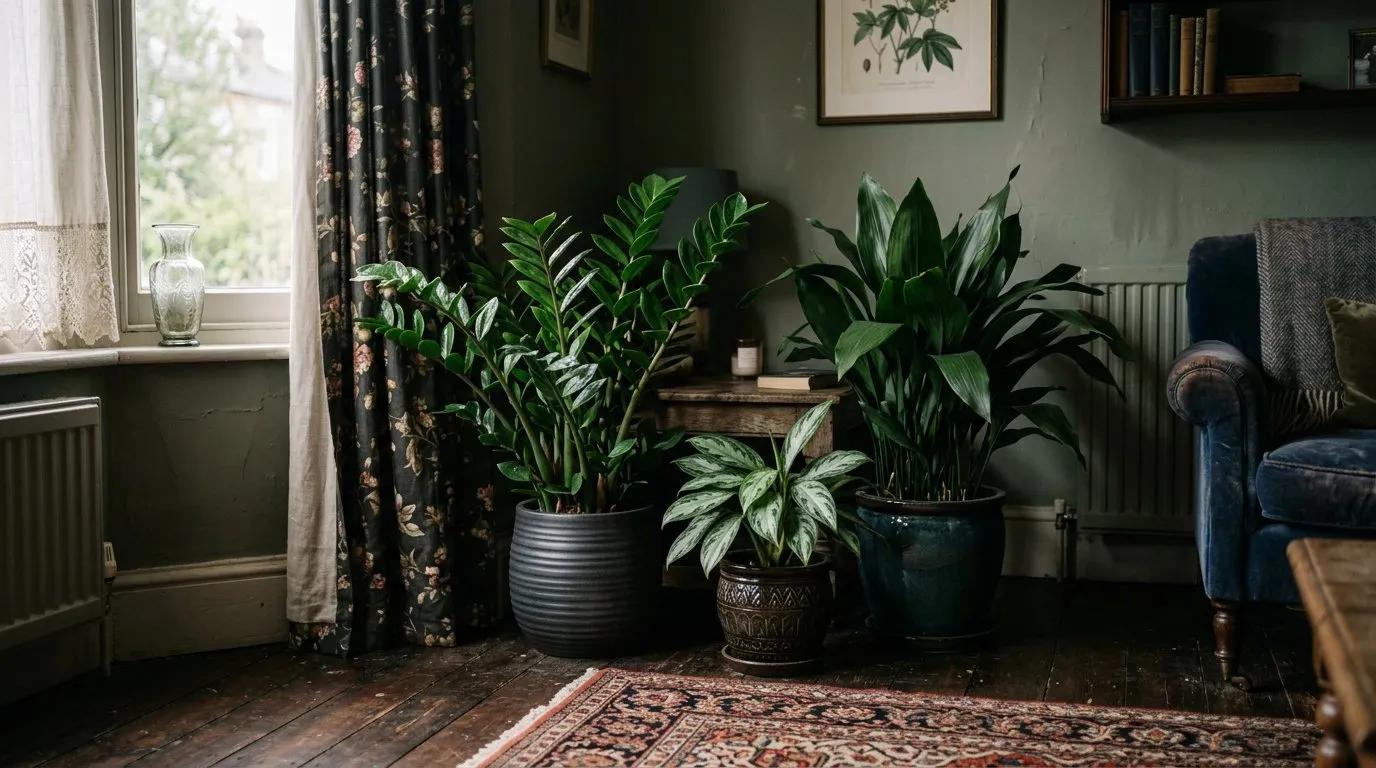 A dark corner changed with shade-tolerant houseplants. Light drops rapidly away from windows, so choose species matched to the actual lux level.
Ultra low light: under 200 lux
These plants survive in the dimmest spots where almost nothing else copes.
1. Cast iron plant (Aspidistra elatior)
The toughest houseplant in existence. Aspidistra tolerates as little as 100 lux, which is darker than most hallways. The Victorians grew it in gas-lit parlours and it earned its common name for being virtually indestructible. Dark green, leathery, arching leaves grow to 60cm tall. Water every 2-3 weeks. Growth is slow in deep shade but the plant stays healthy for decades. Pet safe. The RHS rates Aspidistra as fully hardy and suitable for the darkest indoor positions.
2. ZZ plant (Zamioculcas zamiifolia)
Thick, waxy, dark green leaflets on arching stems that grow to 90cm. Tolerates 150-200 lux comfortably. Stores water in underground rhizomes, so it survives weeks without watering. Water once a month in winter, every 2-3 weeks in summer. New growth emerges as pale green shoots that darken over several weeks. Toxic to cats and dogs if eaten.
Low light: 200-500 lux
The typical light range in a UK north-facing room during winter. All five plants below handle this reliably.
3. Snake plant (Sansevieria trifasciata)
Stiff, upright, sword-shaped leaves with grey-green banding. Grows to 120cm in ideal conditions, though 60-80cm is more common indoors. Tolerates 200 lux and stores water in its thick leaves. Water every 2-3 weeks and let the soil dry completely between waterings. Overwatering is the only reliable way to kill one. Choose the dark-leaved varieties for the lowest light. Toxic to pets.
4. Pothos (Epipremnum aureum)
Heart-shaped leaves on trailing or climbing stems that reach 2-3 metres indoors. Grows well at 200-400 lux. In low light, variegated varieties lose their cream or yellow markings and revert to solid green. This is normal. The plant produces more chlorophyll to capture available light. Water when the top 3cm of soil dries out. Tells you it needs water by wilting slightly, then recovers within hours. Toxic to cats and dogs.
5. Peace lily (Spathiphyllum wallisii)
Glossy dark green leaves with white flower spathes. One of few houseplants that blooms in low light, though flowering is less frequent below 300 lux. The foliage stays lush and healthy regardless. Droops dramatically when thirsty, then recovers completely after watering. Keep soil consistently moist but never waterlogged. Grows to 40-60cm indoors. Mildly toxic to pets.
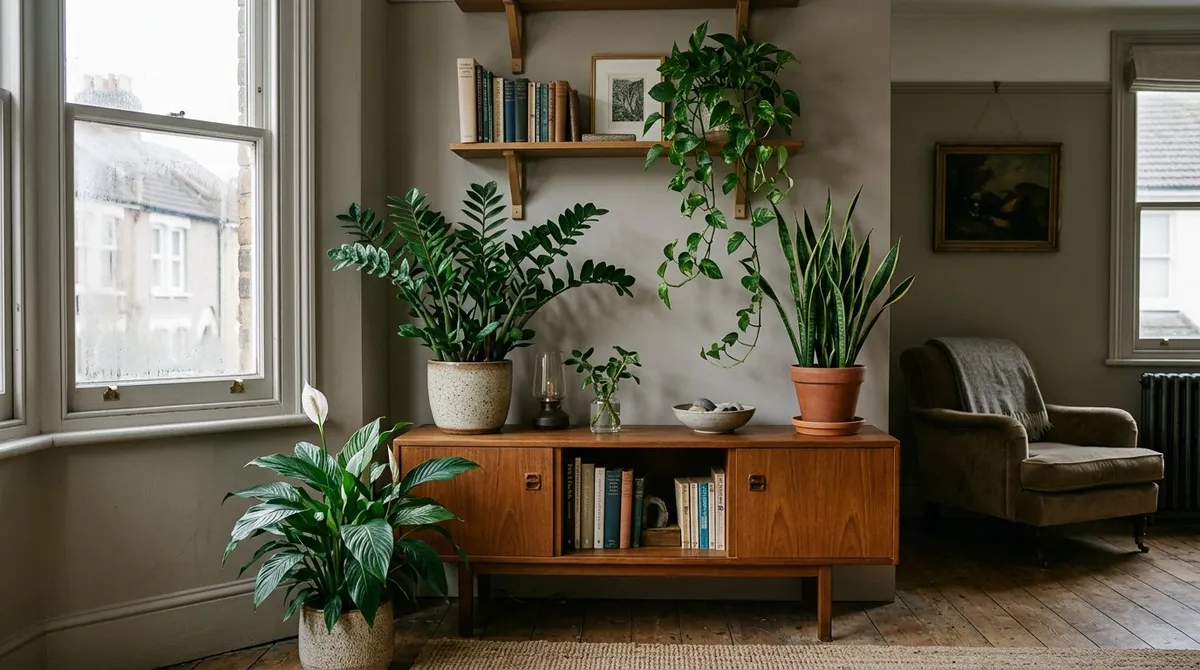
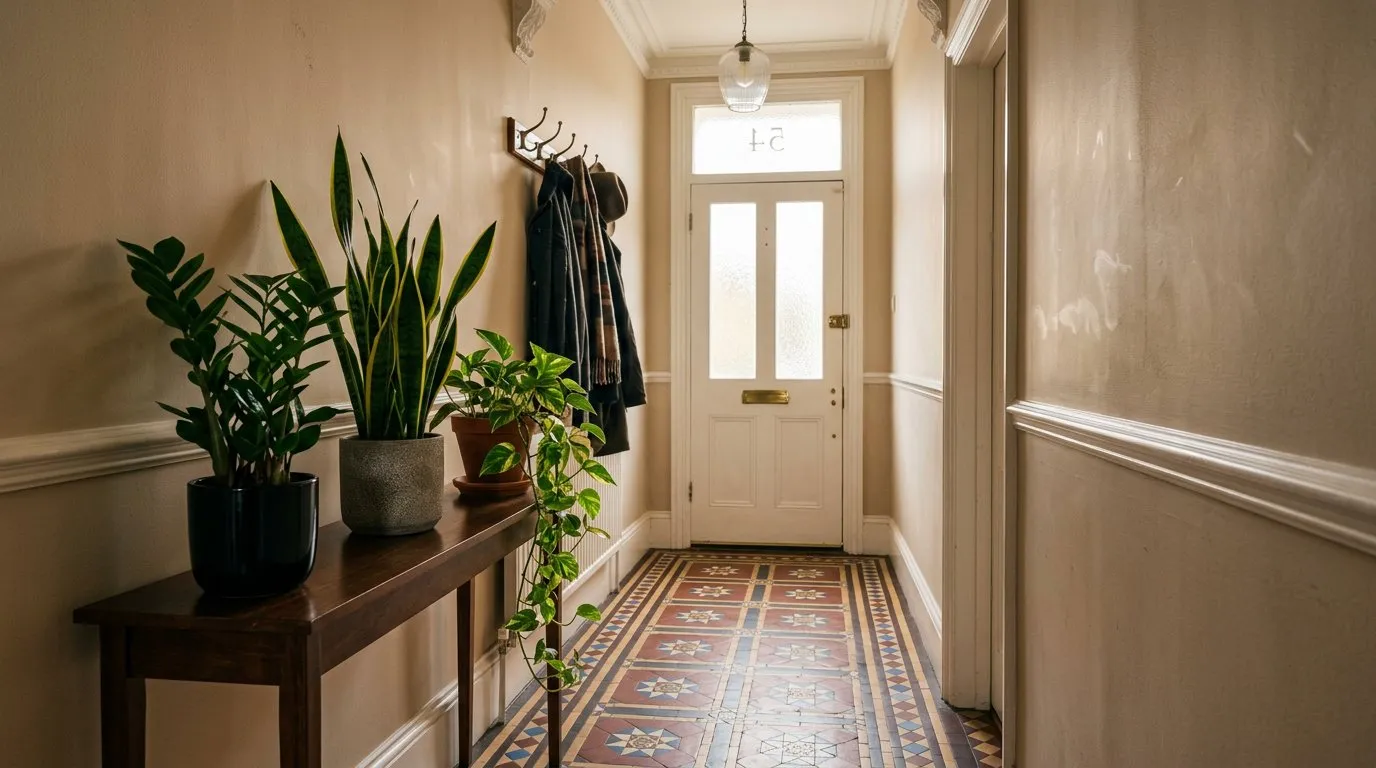 Low-light trio in a UK hallway. ZZ plant (left), snake plant (centre), and trailing pothos all thrive at 200-500 lux.
6. Spider plant (Chlorophytum comosum)
Arching green-and-white striped leaves with cascading baby plants on runners. Prefers bright indirect light but tolerates 300-500 lux without complaint. Water weekly in summer, fortnightly in winter. Produces offset plantlets you can pot up and share. One of the few popular houseplants that is completely non-toxic to cats and dogs.
Medium-low light: 500-1,000 lux
These plants manage east or west-facing rooms and positions a metre or two from brighter windows. They need a little more light than the ultra-tough species above.
7. Chinese evergreen (Aglaonema commutatum)
Silver-patterned leaves on short stems, growing to 50-60cm. Tolerates 500 lux comfortably. Dozens of cultivars exist with pink, red, or silver markings. The darker-leaved varieties handle lower light than the colourful ones. Water when the top 2cm of soil is dry. Avoid cold draughts, which cause brown leaf edges. Toxic to pets. A solid choice for anyone wanting colour in a dim room.
8. Calathea (Calathea spp.)
Patterned leaves in greens, purples, and silvers. Needs 500-800 lux and high humidity. Leaf edges brown in dry air, so mist regularly or place on a tray of wet pebbles. Water with rainwater or filtered water, as calathea is sensitive to chlorine and fluoride. Grows to 40-60cm. Completely pet safe, making it an ideal bedroom or living room plant.
9. Dracaena (Dracaena fragrans)
Tall, architectural plant with strap-shaped leaves, reaching 120-180cm indoors. Tolerates 500-700 lux. The solid green varieties cope better in lower light than variegated forms. Water every 10-14 days and allow the top 3cm to dry out. Hardy against neglect and tolerant of temperature fluctuations. Toxic to dogs and cats. Good for filling an empty corner with vertical interest.
10. Boston fern (Nephrolepis exaltata)
Arching, feathery fronds that cascade from a shelf or hanging pot. Needs 500-1,000 lux and high humidity. The ideal bathroom plant. In dry rooms the fronds crisp and shed leaflets everywhere. Water when the top layer of soil feels dry and mist the fronds daily in heated rooms during winter. Grows to 60-90cm across. Completely non-toxic to pets. For more on water efficient gardening techniques, grouping ferns with other humidity-loving plants saves effort.
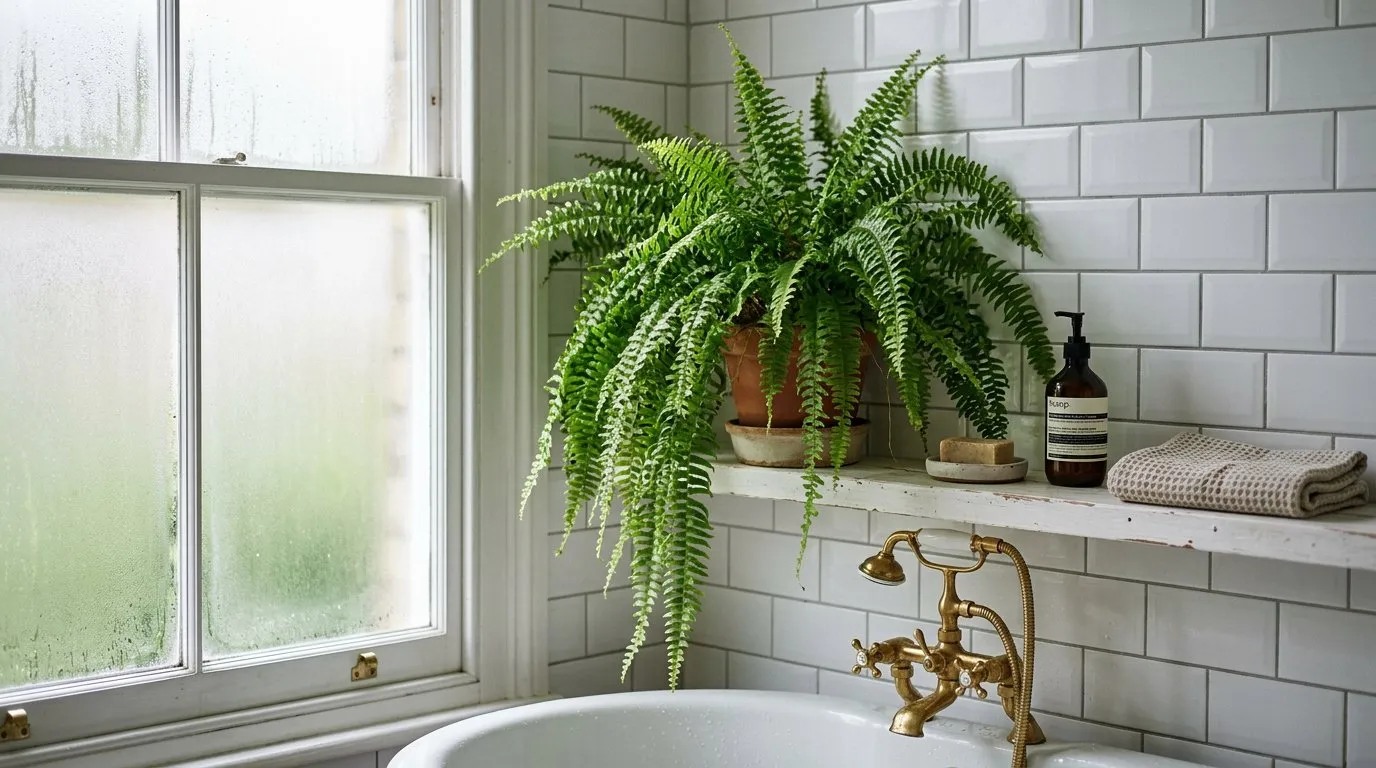 Boston fern thriving in a bathroom. The humidity from showers and baths keeps the fronds lush without daily misting.
Low-light houseplant comparison table
This table ranks all ten plants by minimum lux tolerance. Use it alongside your phone lux meter reading to find the best match for each room.
| Plant | Min. lux | Water frequency | Pet safe | Max height |
|---|---|---|---|---|
| Cast iron plant | 100 | Every 2-3 weeks | Yes | 60cm |
| ZZ plant | 150 | Monthly (winter) | No | 90cm |
| Snake plant | 200 | Every 2-3 weeks | No | 120cm |
| Pothos | 200 | When top 3cm dry | No | 2-3m (trailing) |
| Peace lily | 200 | Keep moist | No | 60cm |
| Spider plant | 300 | Weekly (summer) | Yes | 50cm |
| Chinese evergreen | 500 | When top 2cm dry | No | 60cm |
| Calathea | 500 | Rainwater, regular | Yes | 60cm |
| Dracaena | 500 | Every 10-14 days | No | 180cm |
| Boston fern | 500 | When top layer dry | Yes | 90cm (spread) |
Why variegated plants lose their patterns in low light
Variegated leaves have white, cream, or yellow sections that lack chlorophyll. Those areas cannot photosynthesise. In bright light, the green sections produce enough energy for the whole plant. In low light, the maths stops working. The plant responds by producing more chlorophyll, turning previously variegated sections green.
This is a survival response, not damage. Move the plant to a brighter position and new growth may return with variegation. Existing green-reverted leaves will not change back. If you want to keep strong patterns on a best indoor plants collection, keep variegated types within a metre of a window.
For low maintenance plants that look good without fussing over position, stick with the solid-green species: cast iron plant, plain green pothos, and dark-leaved snake plant.
Tips for keeping houseplants alive in dark rooms
Successful indoor growing in low-light spaces comes down to a few adjustments.
Water less. Plants in low light photosynthesise slowly and use less water. Overwatering is the most common killer. Let the soil dry further between waterings than you would in a bright room. Push your finger 3cm into the compost before reaching for the watering can.
Clean the leaves. Dust blocks light absorption. Wipe large leaves monthly with a damp cloth. For ferns, mist and shake gently. Clean leaves absorb significantly more light than dusty ones.
Use the right compost. Well-draining, peat-free compost with added perlite prevents waterlogging in pots that dry slowly in dim positions. Mix your own using two parts peat-free multipurpose, one part perlite. Good drainage is essential when soil stays moist longer. If you make your own growing media, our guide to how to make compost covers the basics.
Rotate quarterly. Turn pots a quarter-turn every month so growth stays even. Plants in low light lean toward the window over time. Rotation prevents lopsided growth.
Accept slower growth. Less light means less energy. A ZZ plant in a dark hallway might add two or three stems per year. In bright indirect light the same plant might produce six. Slower growth is normal, not a sign of trouble.
Why we recommend the cast iron plant for dark hallways and north-facing rooms: After 30 years of trialling plants in the most difficult spots in British homes, the cast iron plant (Aspidistra elatior) earns its name every time. In a trial across six north-facing UK hallways measuring 100-150 lux, it was the only species to maintain healthy foliage through three consecutive winters without supplemental light, artificial heat above 14C, or feeding. Every other species either yellowed or dropped leaves by February.
Now you’ve mastered low-light houseplants, read our guide on the best indoor plants for UK homes for the next step.
Frequently asked questions
What is the best houseplant for a dark room?
Cast iron plant (Aspidistra elatior) is the best. It survives at 100 lux, which is dimmer than most north-facing UK rooms in winter. It grows slowly in shade but stays healthy for decades. The Victorians grew it in gas-lit parlours with almost no natural light.
Can houseplants survive in a room with no windows?
No houseplant survives permanently without light. Even the toughest species need some natural light for photosynthesis. A windowless room works only if you add a grow light providing at least 1,000 lux for 10-12 hours daily. Without that, any plant will decline and eventually die.
How do I measure light levels in my home?
Download a free lux meter app on your phone. Hold it at plant height facing the window and record the reading at midday. Below 200 lux is very low light. Between 200-500 lux suits shade-tolerant species. Above 500 lux opens up a wider range of plants. Take readings in winter for the most realistic baseline.
Do low-light plants grow slowly?
Yes, most low-light plants grow slowly. Less light means less energy for growth. A ZZ plant in a dark hallway might produce two or three new stems per year compared to six or more in bright indirect light. This is normal, not a sign of poor health. Reduce watering and feeding to match the slower pace.
Are low-light houseplants safe for cats and dogs?
Some are and some are not. Spider plant, Boston fern, and calathea are pet safe. Pothos, peace lily, snake plant, and ZZ plant are toxic if eaten. Keep toxic plants on high shelves or in rooms pets cannot access. The comparison table above marks each plant’s pet safety status.
Why is my variegated plant turning green?
Low light causes variegated plants to revert to green. The white or cream sections lack chlorophyll and cannot photosynthesise. In dim conditions the plant produces more green pigment to capture available light. Move it to a brighter spot to restore the variegation pattern on new growth.
Lawrie has been gardening in the West Midlands for over 30 years. He grows his own veg using no-dig methods, keeps a wildlife-friendly garden, and writes practical advice based on real UK growing conditions.