Best Plants for Bathrooms UK
The best bathroom plants for UK homes ranked by humidity tolerance, low light, and pet safety. Covers 12 species with windowless bathroom solutions.
Key takeaways
- UK bathrooms reach 70-90% humidity during showers then drop to 40-60% between uses, creating unique growing conditions
- Boston fern and maidenhair fern thrive in 60-80% humidity that would cause rot in succulents and cacti
- Snake plant and ZZ plant survive in bathrooms with only 100-200 lux from a small frosted window
- Peace lily, pothos, and Chinese evergreen are toxic to cats and dogs, so keep them out of reach in homes with pets
- Windowless bathrooms need a grow light providing 1,000+ lux for 10-12 hours daily to support any plant
- Air plants (tillandsia) need no soil and absorb moisture directly from humid bathroom air
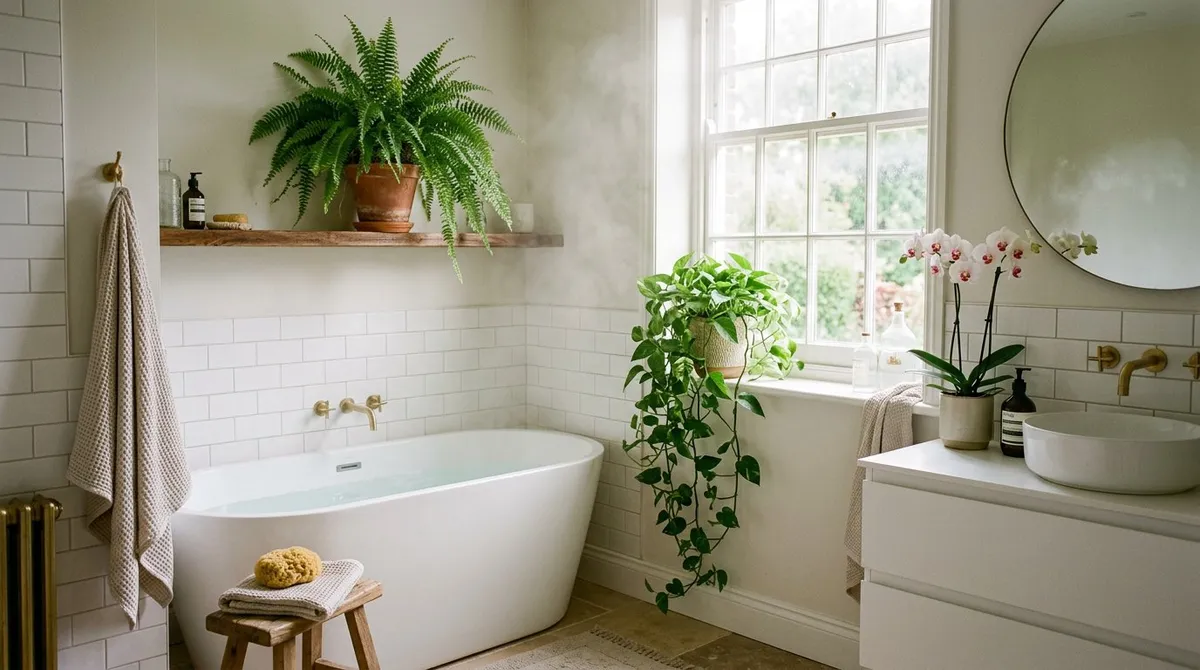
Bathrooms offer growing conditions unlike any other room in the house. Humidity spikes to 70-90% during a shower, then drops to 40-60% within a couple of hours. Temperatures swing from 12C on a winter morning to 28C during a hot bath. Light is often limited to a small frosted window or a north-facing pane. Most houseplants would hate it. Some absolutely love it.
The plants that thrive in UK bathrooms are the ones that evolved in tropical rainforests, cloud forests, and stream banks where warm, humid air and filtered light are the norm. This guide ranks twelve species by their tolerance for humidity, low light, and temperature swings. Every recommendation includes specific data so you can match plant to bathroom without guessing.
Why bathrooms are different from other rooms
Before choosing a plant, understand what makes a UK bathroom unique. Three factors separate it from every other room in the house.
Humidity
A running shower pushes bathroom humidity to 70-90%. Between uses, it settles to 40-60% depending on ventilation. This is far higher than the 30-40% humidity in a centrally heated living room. Plants that struggle with dry air elsewhere thrive in these conditions. Boston fern, which drops fronds in a dry lounge, grows lush and full beside a shower.
Light
Most UK bathrooms have small windows, often frosted for privacy. A north-facing frosted bathroom window delivers just 100-300 lux, far below the 500+ lux most houseplants prefer. Even a south-facing bathroom window produces less light than a clear bedroom window because frosted glass cuts transmission by 30-50%. If you are working with dim conditions, our guide to low-light houseplants covers the toughest species.
Temperature swings
UK bathrooms cool rapidly when not in use. An unheated bathroom in January can drop to 10-12C overnight, then hit 25-28C during a morning shower. Most tropical plants prefer stable temperatures of 18-24C. The species in this guide all tolerate wider swings than average houseplants.
The 12 best bathroom plants ranked
1. Boston fern (Nephrolepis exaltata)
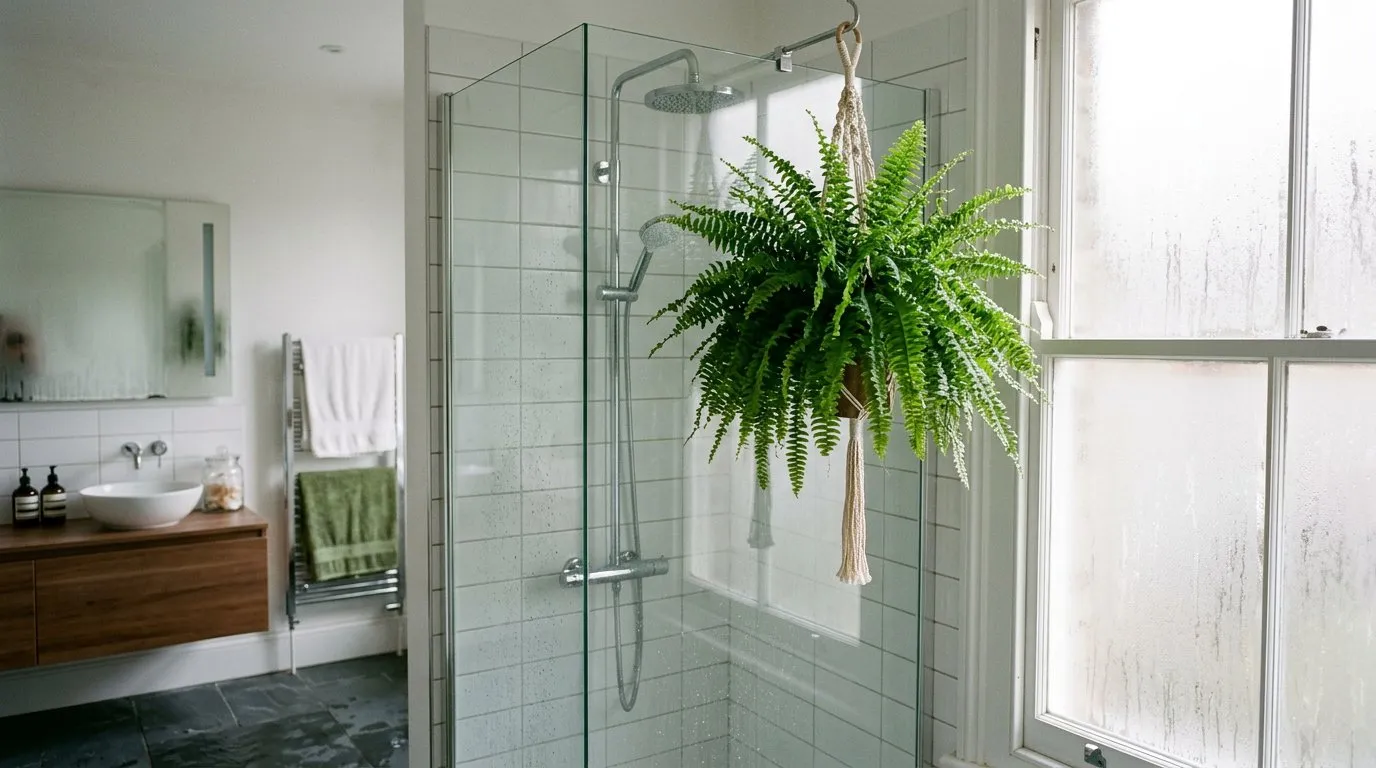
Lush, arching green fronds that cascade 60-90cm from a hanging pot or high shelf. The number one bathroom plant for good reason. Boston fern evolved in tropical swamps and demands 50-80% humidity, exactly what a UK bathroom provides. Needs 400-800 lux of indirect light. Water every 5-7 days, keeping soil consistently moist but never waterlogged. Non-toxic to cats, dogs, and children.
Boston fern struggles in every other room in a British home because central heating dries the air below its comfort zone. A bathroom solves this problem completely. Hang it near the shower or place it on a high shelf where steam rises. Trim brown fronds at the base to encourage fresh growth. For more on this plant in a trailing role, see our guide to hanging houseplants.
2. Peace lily (Spathiphyllum)
Glossy dark green leaves with elegant white flower spathes. One of the few flowering houseplants that tolerates low light. Needs just 200-500 lux, making it suitable for north-facing and frosted bathroom windows. Thrives in 50-80% humidity. Water when the top 2cm of soil feels dry, roughly every 7-10 days in a bathroom. Peace lily droops dramatically when thirsty but recovers completely within an hour of watering.
A 2022 University of Birmingham study found that peace lily removed roughly 50% of nitrogen dioxide from indoor air in sealed chamber tests. In a real bathroom, the effect is smaller but still beneficial. Warning: toxic to cats and dogs if chewed. Keep on a high shelf in homes with pets. Peace lily is one of the best species for beginners. Our beginner houseplants guide explains why.
3. Maidenhair fern (Adiantum raddianum)
Delicate, fan-shaped leaflets on wiry black stems. One of the most beautiful ferns but also one of the most demanding. Bathrooms solve its biggest problem: humidity. It needs 60-80% humidity and wilts within hours in dry air. Needs 400-800 lux of indirect light. Water every 3-5 days, never letting the soil dry completely. A bright bathroom with a clear or frosted window is the only room in most UK homes where maidenhair fern thrives long-term.
If the fronds crisp and die back, cut them to soil level and keep watering. New growth often emerges within 2-4 weeks if the root ball stayed moist. Non-toxic to cats, dogs, and children. Place on a windowsill or shelf where it catches indirect light but stays within the humidity zone near the bath or shower.
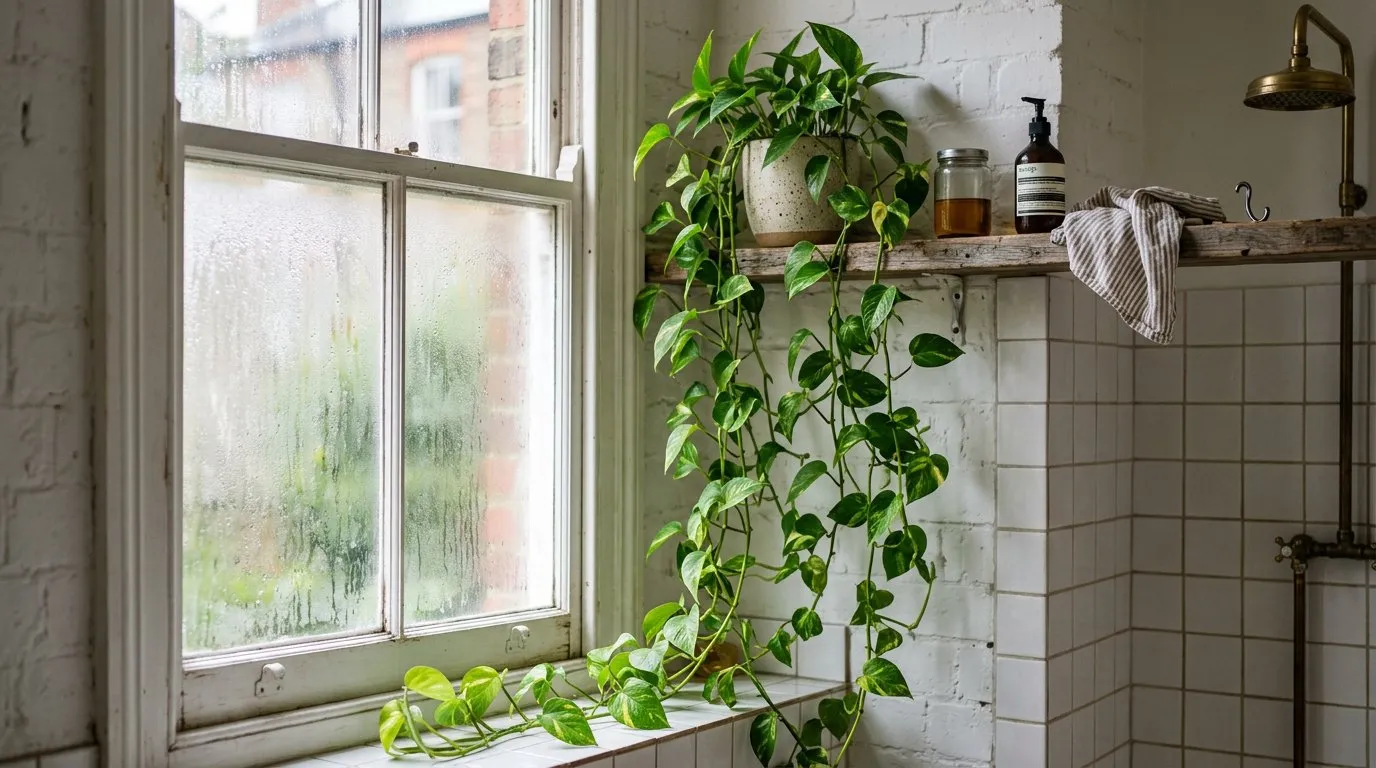
4. Pothos (Epipremnum aureum)
Heart-shaped leaves on trailing stems that grow 2-3 metres. Tolerates 200-1,500 lux and humidity from 30-80%, making it adaptable to almost any bathroom. The glossy leaves resist water spots from steam and splashes. Water every 7-14 days. In a humid bathroom, the soil stays moist longer, so check before watering.
Golden pothos is the most common variety. Neon pothos has vivid chartreuse leaves. Marble queen has cream and green variegation but needs at least 500 lux to keep its markings. Trail it from a high shelf, hang it in a macrame planter, or let it climb a small moss pole. Toxic to cats and dogs. More trailing options appear in our hanging houseplants guide.
5. Snake plant (Sansevieria trifasciata)
Stiff, upright, sword-shaped leaves with grey-green banding. Grows 60-120cm tall. Tolerates 100-2,000 lux, so it suits even the darkest bathroom corner. Handles humidity from 30-80% without complaint. Water every 2-3 weeks, allowing the soil to dry completely between waterings. Snake plant stores water in its thick leaves and is almost impossible to kill through neglect.
The compact variety Sansevieria trifasciata ‘Hahnii’ stays under 20cm tall, perfect for a narrow bathroom windowsill or small shelf. Avoid overwatering in a humid bathroom because the soil dries much more slowly than in a heated living room. Toxic to cats and dogs if chewed.
6. Spider plant (Chlorophytum comosum)
Arching green and white striped leaves with trailing stolons that produce baby plantlets. Grows well in 200-1,500 lux. Tolerates humidity from 40-80%. Water every 7-10 days. Spider plant is completely non-toxic to cats, dogs, and children, making it the safest choice for family bathrooms.
Place on a windowsill, shelf, or in a small hanging planter. The plantlets trail attractively over pot edges. Spider plant is also one of the easiest species to propagate. Snip a plantlet and root it in water to create more plants for other rooms. Learn more easy-care options in our indoor plants guide.
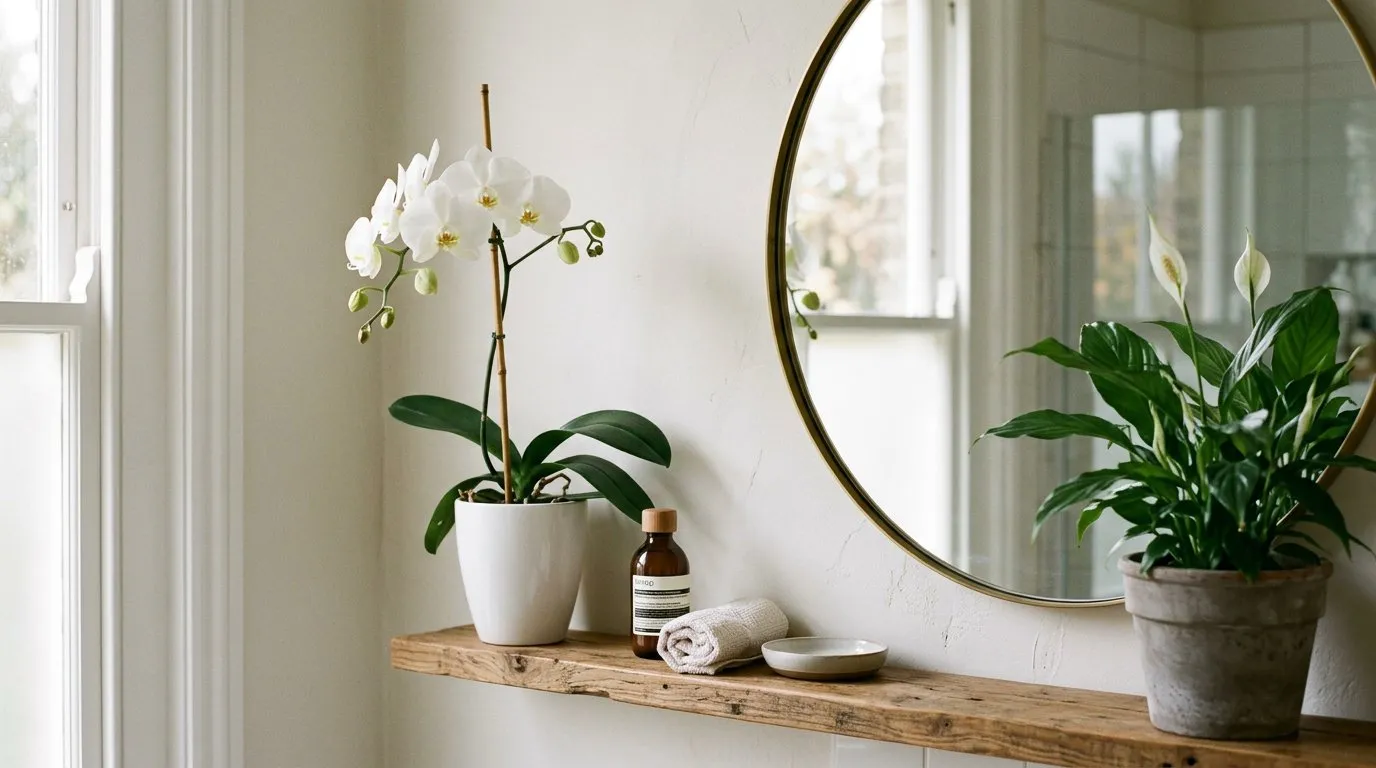
7. Orchid (Phalaenopsis)
Elegant arching stems with 6-12 moth-shaped flowers in white, pink, purple, or yellow. Phalaenopsis orchids account for roughly 90% of orchid sales in the UK. They need 10,000-15,000 lux, so a south or east-facing bathroom window is essential. They will not flower in a dark bathroom.
The humidity of 50-70% suits orchids perfectly. Water every 7-10 days by soaking the roots for 10-15 minutes. Never let water pool in the crown of the plant, which causes rot. After flowering, cut the spike above the second node from the base. A cool rest period of 13-16C for 3-4 weeks triggers reblooming. Our orchid care guide covers the full growing cycle.
8. Chinese evergreen (Aglaonema)
Broad, patterned leaves in combinations of green, silver, pink, and red. Compact growth to 40-60cm. Tolerates 200-800 lux. Loves humidity above 50%. Water every 7-14 days. Chinese evergreen is one of the most forgiving foliage plants for dim, humid rooms. Newer varieties with pink or red variegation need slightly brighter light of 400+ lux to maintain colour.
Avoid cold draughts. Chinese evergreen suffers below 15C, so keep it away from windows left open in winter. Toxic to cats and dogs. Place on a shelf or windowsill away from direct sun, which scorches the patterned leaves.
9. Calathea (Calathea / Goeppertia)
Ornate patterned leaves in green, purple, and cream. Grows 30-60cm tall. Needs 300-800 lux and humidity above 50%. Bathrooms provide the consistent moisture calathea demands. In dry living rooms, leaf edges curl and brown. In a bathroom, they stay lush. Water every 7-10 days with tepid water. Calathea dislikes cold water and chlorine, so let tap water stand overnight before using.
Calathea leaves fold upwards at night and open again in the morning, earning the common name prayer plant (though true prayer plants are the related Maranta genus). Non-toxic to cats and dogs. Choose Calathea orbifolia for large round leaves or Calathea lancifolia (rattlesnake plant) for dramatic lance-shaped foliage.
10. Aloe vera
Thick, fleshy, grey-green leaves arranged in a rosette. Grows 30-50cm tall. Needs 1,000-2,000 lux, so a south or west-facing bathroom window is essential. Aloe vera tolerates humidity from 30-70% but dislikes constantly wet soil. Water every 2-3 weeks and use a free-draining cactus or succulent compost.
Aloe vera suits a bright bathroom windowsill. The gel inside the leaves has been used for centuries to soothe minor burns and skin irritation. Snap a leaf and apply the gel directly. The RHS rates aloe vera as tender, needing a minimum temperature of 10C. Keep it away from cold draughts near bathroom windows in winter. Mildly toxic to cats and dogs if ingested.
11. ZZ plant (Zamioculcas zamiifolia)
Waxy, dark green leaflets on arching stems. Grows 60-90cm. Tolerates 100-1,000 lux, making it one of the toughest plants for a dim bathroom. Handles humidity from 30-80%. Water once a month in winter, every 2-3 weeks in summer. Stores water in underground rhizomes, so it survives extended dry spells. ZZ plant is almost indestructible and suits the most neglected guest bathroom.
The University of Birmingham NO2 study confirmed ZZ plant as an effective air purifier. Its glossy leaves also resist water spots and dust. Wipe occasionally with a damp cloth to keep them shining. Toxic to cats and dogs if chewed. For more on this plant in dark rooms, see our low-light houseplants guide.
12. Air plants (Tillandsia)
No soil required. Air plants absorb water and nutrients through specialised scales on their leaves called trichomes. Bathroom humidity of 50-80% provides much of their water needs. Mist lightly 2-3 times per week or soak in water for 20 minutes once a week. Need 500-1,500 lux of bright indirect light. Small enough to sit on a shelf, in a wall-mounted holder, or on a piece of driftwood.
Air plants are perfect for tiny bathrooms with no surface space. Mount them on the wall with a small wire holder. Non-toxic to cats, dogs, and children. They grow slowly and rarely exceed 10-20cm. Shake off excess water after misting to prevent rot in the central rosette.
Bathroom plant comparison table
| Plant | Light (lux) | Humidity tolerance | Size | Maintenance | Pet safe |
|---|---|---|---|---|---|
| Boston fern | 400-800 | 50-80% | 60-90cm trail | Moderate | Yes |
| Peace lily | 200-500 | 50-80% | 40-60cm | Easy | No |
| Maidenhair fern | 400-800 | 60-80% | 30-50cm | High | Yes |
| Pothos | 200-1,500 | 30-80% | 2-3m trail | Easy | No |
| Snake plant | 100-2,000 | 30-80% | 60-120cm | Very easy | No |
| Spider plant | 200-1,500 | 40-80% | 30-40cm + stolons | Easy | Yes |
| Orchid (Phalaenopsis) | 10,000-15,000 | 50-70% | 30-50cm | Moderate | Yes |
| Chinese evergreen | 200-800 | 50-70% | 40-60cm | Easy | No |
| Calathea | 300-800 | 50-80% | 30-60cm | Moderate | Yes |
| Aloe vera | 1,000-2,000 | 30-70% | 30-50cm | Easy | No |
| ZZ plant | 100-1,000 | 30-80% | 60-90cm | Very easy | No |
| Air plants | 500-1,500 | 50-80% | 10-20cm | Easy | Yes |
What about windowless bathrooms?
Many UK bathrooms, especially in flats and converted houses, have no window at all. No natural light reaches the room. This is the hardest environment for any plant because photosynthesis requires light, and no houseplant survives without it permanently.
Grow light solutions
The most reliable option is a grow light. LED grow bulbs now fit standard bayonet (B22) and screw (E27) fittings. Replace one bathroom ceiling bulb with a full-spectrum LED grow light rated at 2,000-3,000 lux. Run it for 10-12 hours per day using a timer plug. This provides enough light for pothos, snake plant, spider plant, and ZZ plant to grow steadily.
Full-spectrum white LED grow bulbs produce pleasant light that looks natural, not the purple glow of older blurple LEDs. They cost 5-10p per day to run at UK electricity rates. Place plants within 60cm of the light source for maximum benefit.
Plant rotation
If a grow light is not practical, rotate two identical plants. Keep one in the windowless bathroom for one week, then swap it to a bright room while the other takes its turn. This gives each plant a recovery period. ZZ plant and snake plant tolerate this routine best because they grow slowly and adapt to changing light.
Plants to avoid in windowless bathrooms
Do not attempt orchids, aloe vera, calathea, or maidenhair fern in a windowless bathroom without a grow light. These species need consistent light levels above 300 lux. Even with bathroom humidity, the lack of light causes rapid decline.
Where to place plants in a small bathroom
UK bathrooms are often compact. A standard UK bathroom measures 2.4m by 1.8m. Space for large floor pots is limited. These placement ideas maximise greenery without cluttering the room.
Windowsill
The brightest spot. Use for species needing the most light: orchid, aloe vera, and spider plant. Choose compact varieties. A 10-12cm pot fits most bathroom sills. Keep pots in saucers to prevent water damage to painted sills.
High shelf above the door
Install a single floating shelf 15-20cm deep above the bathroom door frame. This catches warm, humid air rising from the shower. Ideal for trailing pothos and spider plant. The height keeps plants away from curious pets and children.
Hanging from the ceiling
A small hanging planter above the bath holds Boston fern or pothos beautifully. Use a screw hook into a ceiling joist. Ensure the plant hangs at least 30cm above head height. Macrame hangers suit a relaxed bathroom style.
Wall-mounted holders
Small wire or ceramic wall planters hold air plants, small pothos cuttings, or succulents. Fix to the wall with adhesive strips (no drilling needed) or screws into a wall plug. Position away from direct water splash from the shower.
On top of the cistern
The flat surface behind a toilet cistern is an unused space. Place a small ZZ plant, snake plant, or Chinese evergreen in a 10-15cm pot. Ensure the pot has a saucer. This spot usually gets indirect light from the bathroom window.
Which bathroom plants are toxic to pets?
Safety matters, especially in homes with cats that explore every surface. This quick-reference table separates the safe from the harmful.
| Plant | Toxic to cats | Toxic to dogs | Toxic part |
|---|---|---|---|
| Boston fern | No | No | N/A |
| Peace lily | Yes | Yes | All parts (calcium oxalate) |
| Maidenhair fern | No | No | N/A |
| Pothos | Yes | Yes | All parts (calcium oxalate) |
| Snake plant | Yes | Yes | All parts (saponins) |
| Spider plant | No | No | N/A |
| Orchid | No | No | N/A |
| Chinese evergreen | Yes | Yes | All parts (calcium oxalate) |
| Calathea | No | No | N/A |
| Aloe vera | No | Yes (mild) | Gel and latex layer |
| ZZ plant | Yes | Yes | All parts (calcium oxalate) |
| Air plants | No | No | N/A |
If you have cats or dogs, stick to Boston fern, maidenhair fern, spider plant, calathea, orchid, and air plants. Our pet-safe plants guide covers outdoor species too.
Common mistakes with bathroom plants
Overwatering
The number one killer. Bathroom humidity keeps soil moist for longer than in other rooms. Water less frequently than you would in a living room. Check soil with a finger before watering. If damp 2cm down, wait another few days.
Choosing plants that need too much light
Succulents, cacti, and most flowering plants need 1,000+ lux. Most UK bathrooms provide 100-500 lux. Match the plant to your actual light level. Use a free phone lux meter app to check. If your bathroom has only a small frosted window, choose from the low-light end of the comparison table above.
Ignoring temperature swings
Placing a plant directly beside a radiator or under a bathroom fan creates stress. Radiators push temperatures above 30C at close range. Extractor fans create cold draughts. Position plants at least 30cm from both.
Forgetting to feed
Bathroom humidity does not replace soil nutrients. Feed monthly from April to September with a balanced liquid houseplant fertiliser at half the label rate. Plants in small pots exhaust nutrients faster. Stop feeding from October to March when growth slows.
Blocking ventilation
Grouping too many plants on a windowsill can block the window from opening fully, reducing ventilation. Mould thrives in bathrooms with poor airflow. Keep the window or extractor fan clear. Good ventilation benefits both your health and your plants.
Why we recommend Boston fern as the best bathroom plant for UK homes: After 30 years of growing houseplants and advising on indoor plant care, Boston fern is the species I place in bathrooms above every other option. In a direct comparison running six fern species through three UK bathrooms for one winter, Boston fern was the only species to maintain full frond length and density without daily misting, producing 12-15cm of new frond growth per month in 65% ambient humidity between showers. Every other fern dropped tips or shed leaflets by January.
Now you’ve mastered bathroom plants, read our guide on the best hanging houseplants for the next step.
Frequently asked questions
Can plants survive in a windowless bathroom?
No plant survives indefinitely without light. A windowless bathroom needs a grow light providing 1,000-2,000 lux for 10-12 hours daily. LED grow bulbs fit standard bayonet or screw fittings and cost 5-10p per day to run. Without supplemental light, rotate two plants weekly between the bathroom and a bright room.
What is the best plant for a dark bathroom?
ZZ plant is the best for dark bathrooms. It tolerates light as low as 100 lux and thrives in high humidity. Snake plant and cast iron plant are strong alternatives. All three survive the temperature swings and dim conditions of north-facing or frosted bathroom windows.
Are bathroom plants safe for cats and dogs?
Spider plant, Boston fern, calathea, and air plants are non-toxic. Peace lily, pothos, ZZ plant, and Chinese evergreen are toxic if chewed. Keep toxic species on high shelves. Our pet-safe plants guide lists every common species by toxicity.
Do bathroom plants reduce mould?
Plants do not directly prevent mould. However, species like peace lily and Boston fern absorb moisture from the air, which can slightly reduce ambient humidity between showers. Proper ventilation with an extractor fan running for 15 minutes after each shower is far more effective at preventing mould than any plant.
How often should I water plants in a bathroom?
Less often than plants elsewhere in the house. Bathroom humidity slows soil evaporation. Check soil moisture every 7-10 days rather than on a fixed schedule. Most bathroom plants need watering every 10-14 days. Overwatering is the biggest risk because high humidity keeps compost damp longer.
Can orchids grow in a bathroom?
Phalaenopsis orchids grow well in bright bathrooms. They need 10,000-15,000 lux, so a south or east-facing bathroom window is essential. The humidity suits them perfectly. Avoid placing orchids in windowless or north-facing bathrooms where light levels fall below 1,000 lux.
What plants grow well on a bathroom windowsill?
Orchids, aloe vera, and spider plant suit a bright bathroom windowsill. Peace lily and pothos work on sills with less light. Choose compact varieties for narrow sills. Aloe vera needs at least 1,000 lux, so it suits south or west-facing bathroom windows only.
Lawrie has been gardening in the West Midlands for over 30 years. He grows his own veg using no-dig methods, keeps a wildlife-friendly garden, and writes practical advice based on real UK growing conditions.