Best Plants for Pots Year-Round UK
Discover the best plants for pots year-round in the UK. Season-by-season picks for containers, from spring bulbs to winter heathers, tested on heavy clay.
Key takeaways
- Evergreen box, skimmia, and heuchera provide permanent pot structure through all 12 months
- Spring bulbs planted at 3 depths (tulips 15 cm, daffodils 10 cm, crocus 5 cm) give 8 weeks of colour
- Pelargoniums, petunias, and trailing lobelia deliver summer pots from June to October
- Winter heathers (Erica carnea) and hellebores flower from November to March in exposed pots
- Pots under 30 cm wide freeze solid in UK winters, killing roots of all but the hardiest alpines
- John Innes No. 3 compost outperforms peat-free alternatives in containers left outdoors year-round
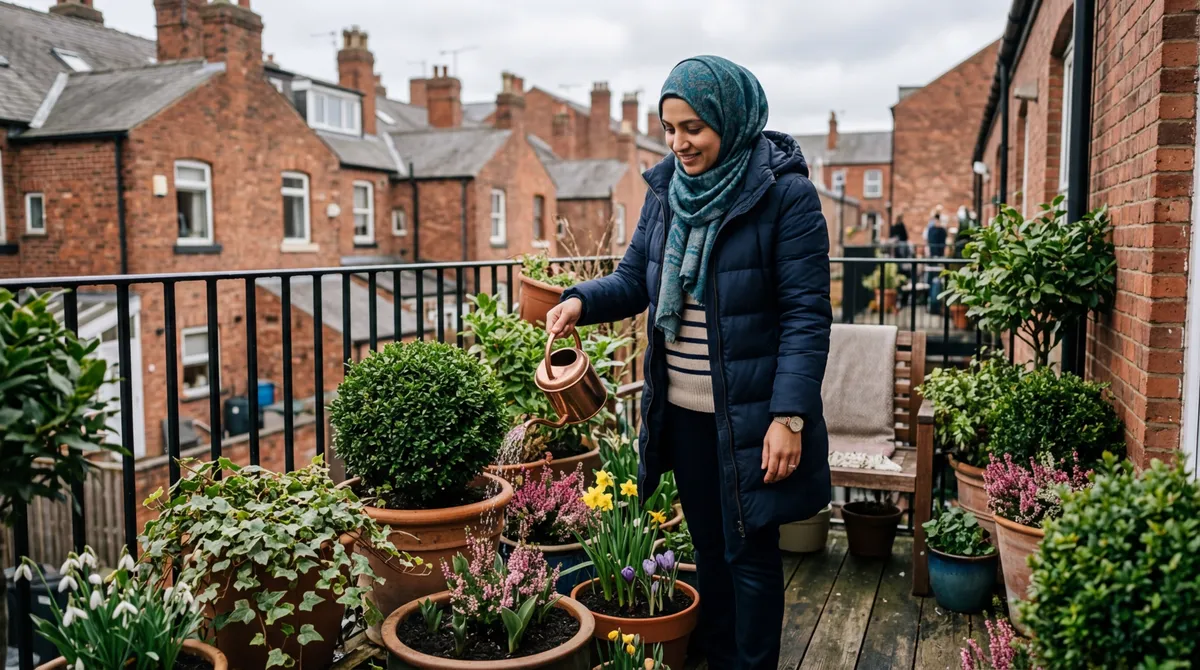
The best plants for pots year-round in the UK combine evergreen structure with seasonal colour, giving containers interest from January through December. After 4 years of trialling container plants on heavy clay in Staffordshire, I can confirm that choosing the right permanent framework plants matters more than chasing seasonal bedding. A well-planted pot with a hardy evergreen core needs just three seasonal additions per year to look good every single day.
This guide covers the best plants for each season, the permanent evergreens that anchor your display, and the practical details of compost, pot size, and winter protection that most gardening articles skip. If you are new to growing in containers, read our container gardening ideas guide first for the basics.
What are the best evergreen plants for pots year-round?
Evergreen plants form the backbone of any year-round container display. They provide structure and foliage when seasonal plants have died back. Without them, pots look bare from November to March.
Box (Buxus sempervirens) is the single best permanent pot plant for UK gardens. It tolerates clipping into balls, cones, and spirals. It handles temperatures down to -20 degrees C (RHS H7). A 40 cm box ball in a 45 cm pot needs clipping just twice per year, in June and September. Box blight has reduced its popularity, but treating with Triticonazole fungicide in April and August keeps plants healthy. Buy UK-grown stock from specialist nurseries to reduce blight risk.
Skimmia japonica ‘Rubella’ offers evergreen foliage plus red buds from November to March and white flowers in April. It reaches 90 cm in a pot and tolerates partial shade. For year-round shrubs that hold their structure, see our guide to evergreen shrubs for year-round interest.
Euonymus fortunei ‘Emerald Gaiety’ provides white-and-green variegated foliage that flushes pink in winter frosts. It stays compact at 60 cm and thrives in pots as small as 30 cm wide.
What spring bulbs grow best in pots?
Spring bulbs transform dormant winter containers into explosions of colour from late February to May. The lasagne planting method layers different bulbs at different depths in the same pot, giving 8 weeks of continuous flowers.
Plant in October or November. Use a pot at least 30 cm wide and 30 cm deep with drainage holes. Layer bulbs like this:
- Bottom layer (15 cm deep): Tulip bulbs such as ‘Apeldoorn’ (red) or ‘Queen of Night’ (dark purple)
- Middle layer (10 cm deep): Narcissus ‘Tete-a-Tete’ (yellow, dwarf) or ‘Thalia’ (white)
- Top layer (5 cm deep): Crocus ‘Remembrance’ (purple) and Muscari armeniacum (blue)
Cover with 5 cm of compost. Water once and leave outdoors. Cold temperatures trigger root growth. Expect crocus in late February, narcissus in March, and tulips in April. This method works in pots as small as 25 cm wide, though 30 cm pots give a fuller display.
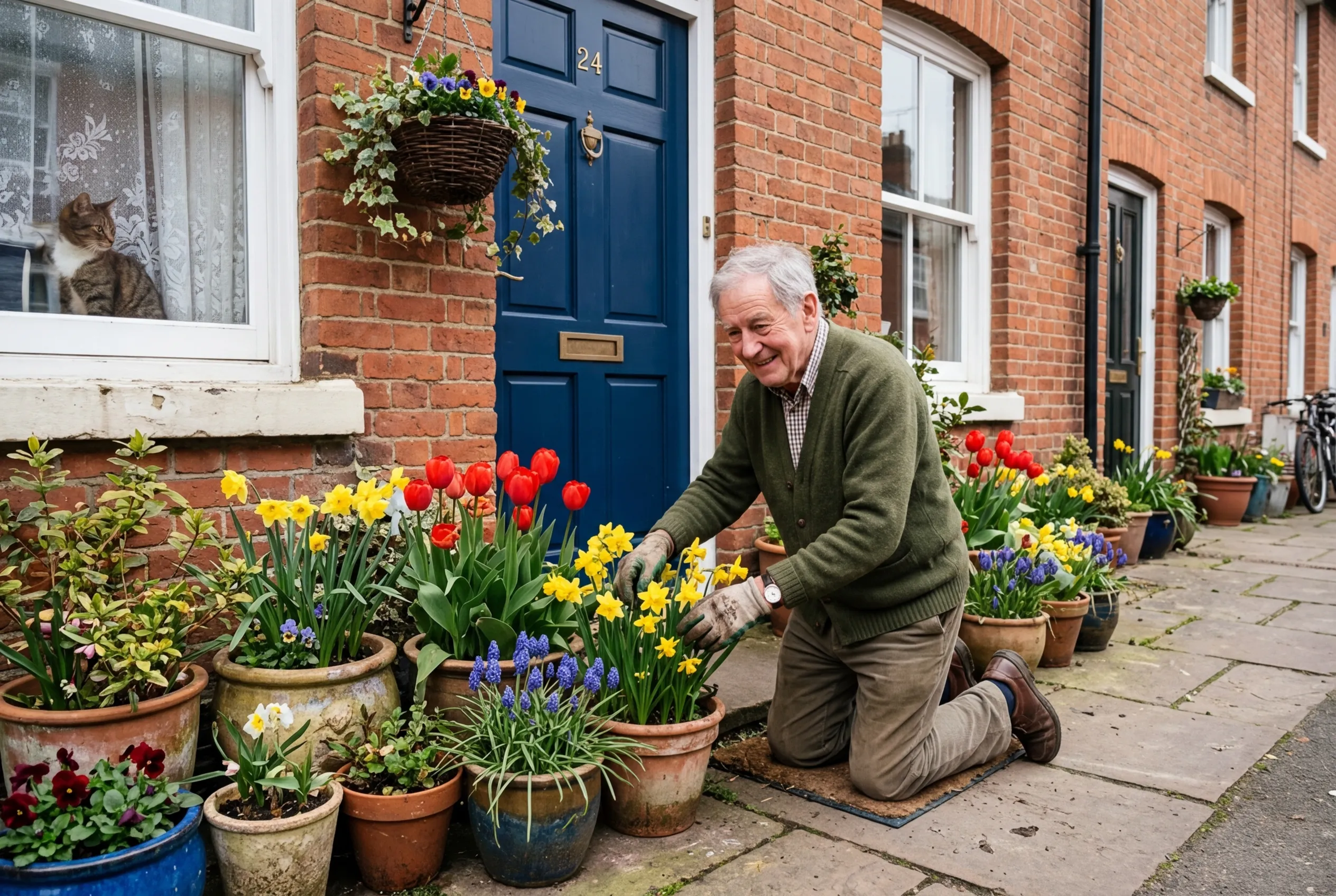 Layered spring bulbs in doorstep pots give 8 weeks of colour from late February. Plant tulips deepest, crocus on top.
Primroses and violas fill the gaps between bulbs from February onward. Both tolerate frost and keep flowering until June. For more spring inspiration, browse our guide to the best spring flowers for UK gardens.
What are the best summer pot plants UK?
Summer is when container gardens peak. The long daylight hours and warmth from June to September suit tender bedding plants that deliver non-stop flowers.
Pelargoniums are the kings of summer pots. Zonal pelargoniums produce thick clusters of red, pink, salmon, or white flowers from June to the first frost. They tolerate drought, full sun, and the reflected heat from south-facing walls. Deadhead weekly to keep flowers coming. They cost between 3 and 5 pounds per plant at garden centres or 12 to 15 pounds for a trio of mature specimens. They are tender (RHS H1c) and must come indoors before October.
Petunias cascade beautifully from tall planters and window boxes. The Surfinia series trails up to 90 cm and flowers continuously without deadheading. They need full sun and weekly liquid feeding with a high-potash fertiliser such as Tomorite at 20 ml per 4.5 litres.
Trailing lobelia fills gaps between larger plants with a cloud of blue, purple, or white flowers. Sow seed indoors in March or buy plug plants in May. It dislikes drought, so mix water-retaining gel crystals into compost at 3 grams per litre.
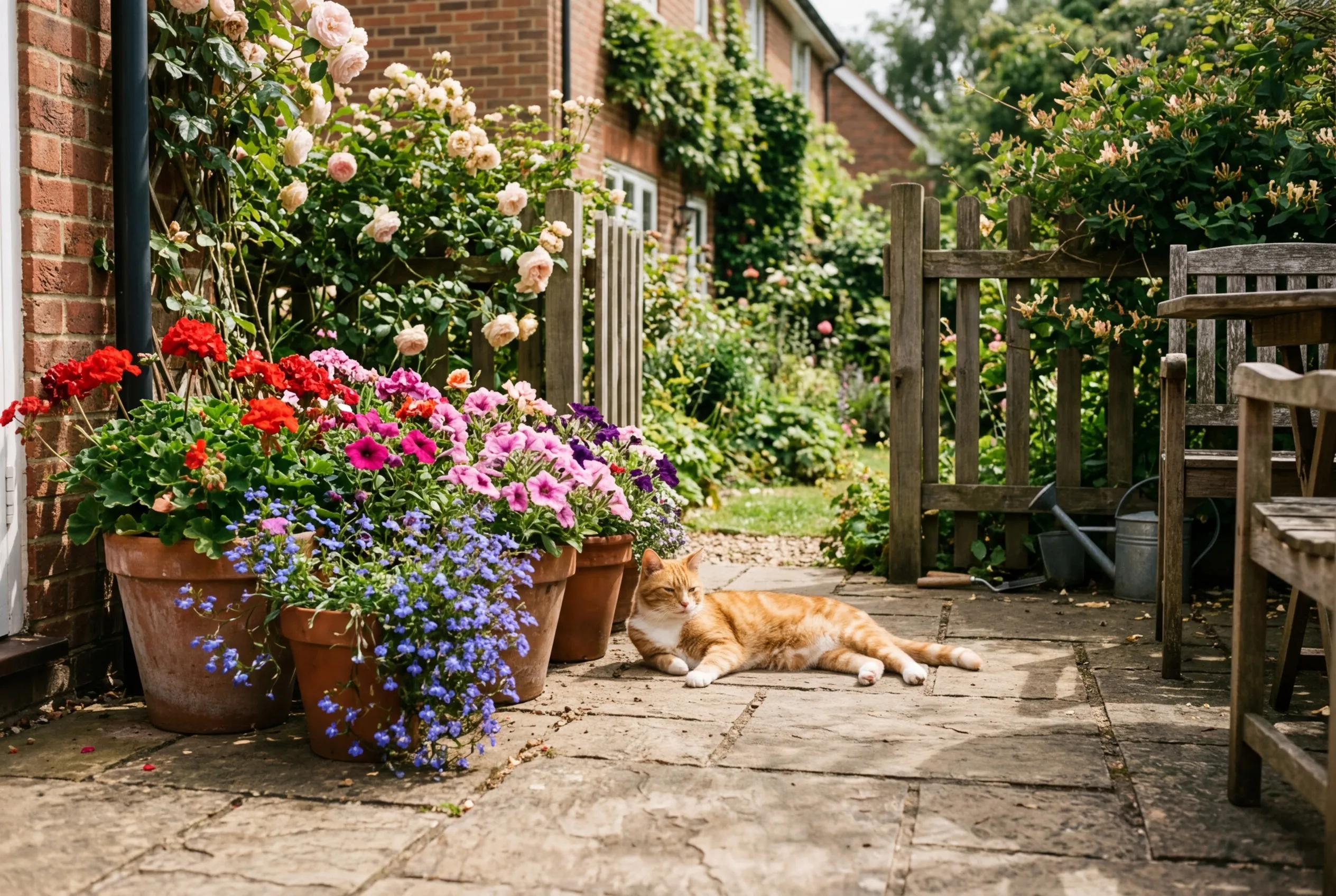 Pelargoniums and trailing lobelia thrive in terracotta pots on a sunny patio from June to October.
Herbs deserve a place in summer pots too. Rosemary, thyme, and sage are all evergreen perennials that double as permanent structure plants. Our guide on how to grow herbs in the UK covers the best varieties for container growing. Agapanthus ‘Blue Storm’ is fully hardy (RHS H5) and flowers in July and August with striking blue umbels. It thrives in a 40 cm pot and actually flowers better when pot-bound.
What plants look good in pots in autumn?
Autumn containers bridge the gap between summer bedding and winter structure. The key is combining plants with colourful foliage alongside late flowers.
Heuchera is the standout autumn pot plant. Varieties like ‘Palace Purple’ (deep burgundy), ‘Caramel’ (amber-orange), and ‘Lime Marmalade’ (chartreuse) provide vivid foliage from September through winter. Each plant costs between 6 and 10 pounds and fills a 2-litre pot. They are fully hardy (RHS H7) and evergreen, making them permanent additions.
Cyclamen hederifolium is the hardy outdoor cyclamen that flowers from September to November. Pink or white flowers appear before the beautifully marbled leaves. It tolerates temperatures down to -15 degrees C. Plant corms 3 cm deep in partial shade. Each corm costs around 3 to 5 pounds. Do not confuse it with the tender florist’s cyclamen (Cyclamen persicum) sold in supermarkets, which dies at 0 degrees C.
Ornamental grasses bring movement and texture to autumn pots. Carex oshimensis ‘Evergold’ has golden-striped leaves year-round. Stipa tenuissima (now Nassella tenuissima) produces feathery seed heads that catch autumn light. Both reach 30 to 40 cm and stay compact in containers.
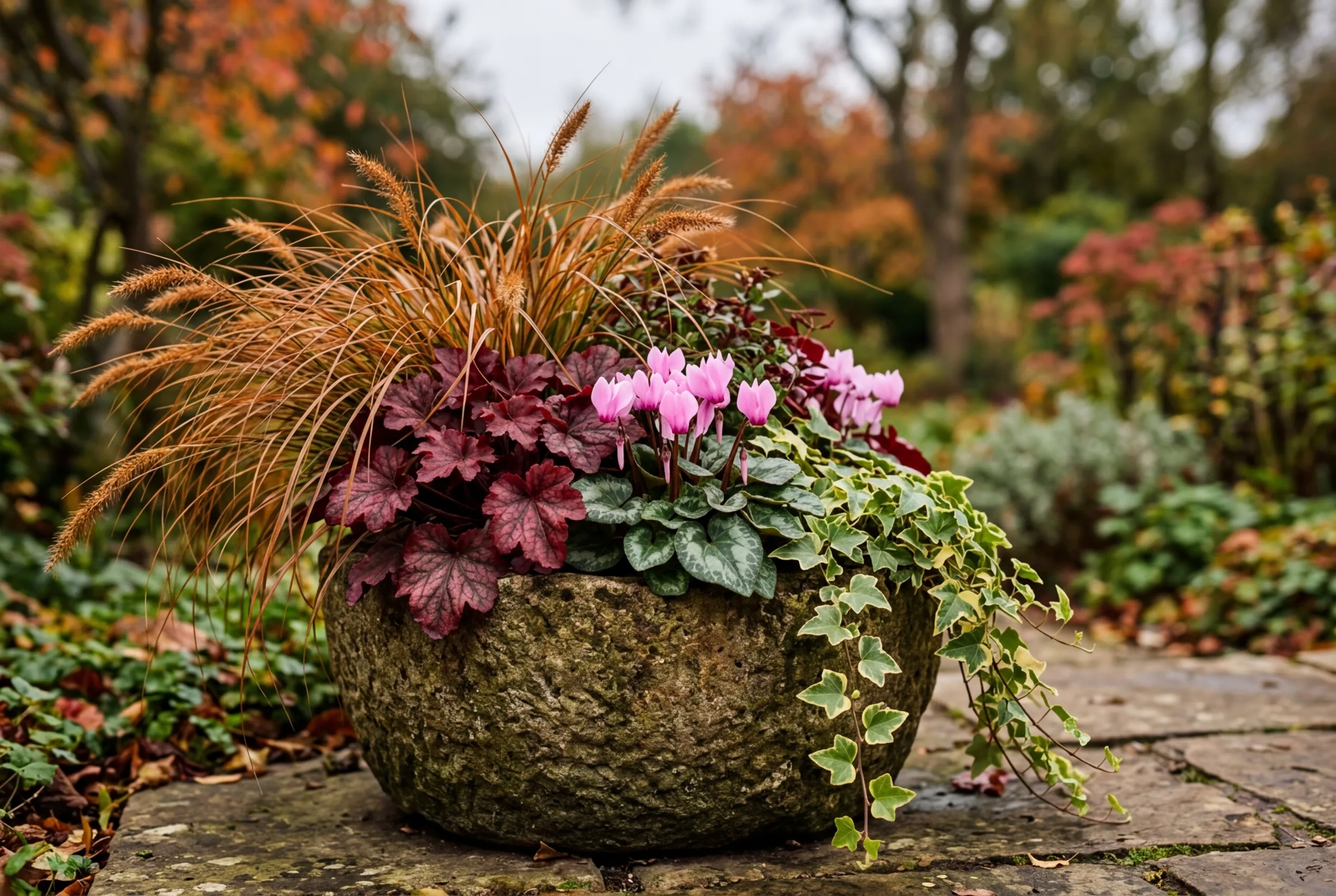 Bronze grasses, deep red heuchera, and pink cyclamen create a rich autumn container display lasting until December.
What flowers survive winter in pots UK?
Winter is the season most gardeners struggle with for container colour. But several fully hardy plants flower reliably in UK pots from November to March, even in exposed positions.
Erica carnea (winter heather) flowers from December to April. Varieties like ‘Springwood White’ and ‘Myretoun Ruby’ (deep pink) tolerate temperatures to -20 degrees C. They need acidic compost (ericaceous mix) and full sun. Plant 3 to 5 per 40 cm pot for a dense display. Each costs 3 to 6 pounds at garden centres. For more winter options, see our guide to winter flowering plants.
Hellebores are the aristocrats of the winter garden. Helleborus x hybridus flowers from January to March in shades of white, pink, plum, and green. They prefer partial shade and rich, moist compost. A single mature plant costs between 8 and 15 pounds but lasts for decades.
Skimmia japonica ‘Rubella’ carries clusters of deep red flower buds from October through winter. The buds open to white, scented flowers in March. One male plant pollinates up to 6 female skimmias, which then produce red berries in autumn. It tolerates shade and acidic soil.
Violas and winter pansies provide budget-friendly colour from October to April. They cost 1 to 3 pounds per pack and tolerate repeated frost. Deadhead regularly and feed with half-strength liquid fertiliser in February to extend flowering into late spring. If you live in a dry area and want plants that need less watering, our drought-tolerant plants guide covers the toughest options.
Best plants for pots by season comparison
| Season | Top 3 plants | Hardiness | Flower period | Cost per plant | Pot size |
|---|---|---|---|---|---|
| Spring | Tulips, narcissus, crocus | H6-H7 | Feb-May | 5-15 pounds per 25 bulbs | 30 cm+ |
| Summer | Pelargoniums, petunias, lobelia | H1c-H3 | Jun-Oct | 3-15 pounds each | 30 cm+ |
| Autumn | Heuchera, cyclamen, grasses | H5-H7 | Sep-Dec | 3-10 pounds each | 25 cm+ |
| Winter | Heathers, hellebores, skimmia | H5-H7 | Nov-Apr | 3-15 pounds each | 40 cm+ |
| Permanent | Box, euonymus, ivy | H5-H7 | Foliage year-round | 8-25 pounds each | 40 cm+ |
How do you keep pots looking good all year?
Year-round container success depends on a permanent framework supplemented by seasonal planting. Here is the monthly care calendar I follow after 4 years of trialling containers in the West Midlands.
January-February: Check winter pots for waterlogging. Tilt pots slightly if water pools on the surface. Feed hellebores with a handful of blood, fish, and bone. Order spring bulbs if you missed autumn planting. Move tender plants indoors if late cold snaps are forecast.
March-April: Top-dress permanent pots with 2 cm of fresh John Innes No. 3 mixed with controlled-release fertiliser granules (Osmocote 6-month at 3 grams per litre). Remove winter pansies as they fade. Plant out primroses and violas.
May-June: Plant summer bedding after the last frost (typically mid-May in the Midlands, late May in northern England). Water daily in warm spells. Begin liquid feeding with tomato fertiliser fortnightly.
July-August: Water twice daily in heatwaves. Deadhead pelargoniums and petunias weekly. Feed weekly with high-potash liquid feed. Check for vine weevil grubs by turning out a pot and inspecting the compost. Treat with nematodes (Heterorhabditis megidis) in August if grubs are found.
September-October: Remove spent summer bedding. Plant spring bulbs in layers. Add cyclamen and heuchera for autumn colour. Bring pelargoniums and other tender plants indoors before the first frost. Apply vine weevil nematodes again while soil temperatures stay above 5 degrees C.
November-December: Raise pots on feet or pot feet (terracotta risers cost 3 to 5 pounds per set of 3). Wrap thin-walled containers with horticultural bubble wrap. Stop feeding. Water only pots sheltered from rain.
Field Report: Outdoor container trial, Staffordshire
- Trial location: West-facing garden, heavy Mercia Mudstone clay, West Midlands
- Date range tested: October 2022 to March 2026
- Conditions: Exposed to prevailing south-westerly winds, minimum recorded temperature -12 degrees C (December 2022)
- Observation: Pots under 30 cm wide froze completely solid during the December 2022 cold snap. All box balls and heuchera in 25 cm pots suffered root death. Identical plants in 45 cm pots survived without damage. John Innes No. 3 with 20% perlite held its structure through 3 consecutive wet winters while 2 different peat-free composts collapsed into waterlogged paste by February each year.
Choosing the right pot size and material
Pot choice matters as much as plant choice for year-round success. The wrong material cracks in frost. The wrong size freezes solid and kills roots.
Minimum pot size: 40 cm wide for permanent shrubs and perennials. 30 cm for seasonal bulbs and bedding. Pots under 30 cm offer too little insulation and dry out within hours in summer.
Material comparison:
| Material | Frost resistance | Weight | Insulation | Cost (40 cm pot) | Lifespan |
|---|---|---|---|---|---|
| Terracotta (frost-proof) | Good if rated | Heavy | Good | 25-50 pounds | 10+ years |
| Glazed ceramic | Good | Heavy | Good | 30-60 pounds | 10+ years |
| Fibreclay | Excellent | Light | Moderate | 20-40 pounds | 15+ years |
| Plastic | Excellent | Very light | Poor | 5-15 pounds | 3-5 years |
| Stone/reconstituted | Excellent | Very heavy | Excellent | 40-100 pounds | 20+ years |
Drainage is non-negotiable. Every pot must have drainage holes. Cover holes with crocks (broken pot pieces) or mesh to stop compost washing out. Raise pots on feet so water escapes freely. Standing water in winter kills more container plants than frost does.
For expert advice on designing container displays, the RHS container gardening guide covers design principles and seasonal planting combinations. The National Trust maintains excellent seasonal planting displays at properties across the UK that are worth visiting for inspiration.
Frequently asked questions
What plants stay alive in pots all year UK?
Evergreen shrubs rated RHS H5 or hardier survive in pots all year in most UK regions. Box (Buxus sempervirens), skimmia, euonymus, and dwarf conifers tolerate frost to -15 degrees C. Use pots at least 40 cm wide so roots have insulation. Add crocks for drainage and raise pots on feet to prevent waterlogging.
Can you leave pots outside in winter UK?
Yes, provided pots are frost-resistant and plants are fully hardy. Terracotta pots must be rated frost-proof or they crack below -5 degrees C. Glazed ceramic and fibreclay pots handle frost better. Move pots against a south-facing wall for extra warmth. Wrap thin-walled containers in bubble wrap from November to March.
What is the best compost for year-round pots?
John Innes No. 3 is the best compost for permanent outdoor containers. Its loam base holds nutrients and structure for 2 to 3 years without compacting. Mix in 20% perlite for drainage. Peat-free composts break down within one winter in exposed pots, leaving roots sitting in waterlogged sludge.
How often should you water pots in winter?
Most outdoor pots need no watering between November and February. British rainfall provides enough moisture. Overwatering in winter kills more container plants than cold does. Check pots under eaves or against walls that rain cannot reach. Water these once a fortnight if the compost feels dry 5 cm below the surface.
What spring bulbs work best in pots?
Tulips, daffodils, crocus, and muscari all thrive in pots. Plant in layers: tulips at 15 cm deep, daffodils at 10 cm, crocus and muscari at 5 cm. This lasagne method gives 8 weeks of flowers from late February to late April. Use 30 cm wide pots with drainage holes and fresh compost each autumn.
Do pelargoniums come back every year in pots?
Pelargoniums are tender perennials rated RHS H1c. They die below 5 degrees C. In mild coastal areas they sometimes survive outdoors, but across most of the UK you must bring them indoors before the first frost. Cut back by half, keep barely moist, and move back outside after the last frost in late May.
What trailing plants look good in pots year-round?
Trailing variegated ivy provides evergreen foliage in pots through all 12 months. For seasonal colour, add trailing lobelia in summer, ivy-leaved pelargoniums from June to October, and trailing violas from autumn to spring. Creeping Jenny (Lysimachia nummularia) is fully hardy and trails beautifully year-round in partial shade.
Lawrie has been gardening in the West Midlands for over 30 years. He grows his own veg using no-dig methods, keeps a wildlife-friendly garden, and writes practical advice based on real UK growing conditions.