Best Trees for Small Gardens in the UK
Top trees for small UK gardens with ultimate heights under 8m. Covers Amelanchier, crab apple, Japanese maple, birch, magnolia, rowan, and cherry.
Key takeaways
- Amelanchier lamarckii is the most versatile small garden tree, offering spring blossom, autumn colour, and edible berries in one package
- Japanese maples (Acer palmatum) stay under 4m and thrive in sheltered, partially shaded spots with acid or neutral soil
- Crab apples (Malus) double as pollinators for dessert apple trees, making them ideal for productive small gardens
- Betula pendula 'Youngii' is the best weeping tree for small spaces at just 4-6m tall with a 3-4m spread
- Magnolia stellata flowers reliably in March before the leaves appear and rarely exceeds 3m in height
- Plant bare-root trees from November to March for 30-50% cost savings over container-grown specimens
- All eight trees recommended here have an RHS Award of Garden Merit, confirming reliable UK performance
Every garden has room for at least one tree. Even a 5m x 5m courtyard can support a well-chosen small tree that provides blossom, autumn colour, wildlife value, and year-round structure. The key is choosing species that stay below 6-8m in height without aggressive pruning, and that match your soil and aspect.
This guide covers eight of the best trees for small UK gardens. Each one holds an RHS Award of Garden Merit, confirming reliable performance across British conditions. Whether you want spring flowers, autumn berries, dramatic foliage, or all three at once, there is a tree here for your plot. For broader ideas on maximising limited space, see our guide to small garden design ideas.
Amelanchier lamarckii
Amelanchier is the single best tree for a small UK garden. It delivers in every season: clouds of white star-shaped blossom in April, small purple-black berries in June that birds adore, vivid orange and red foliage in October, and an elegant silhouette of grey bark in winter. No other small tree covers all four seasons this well.
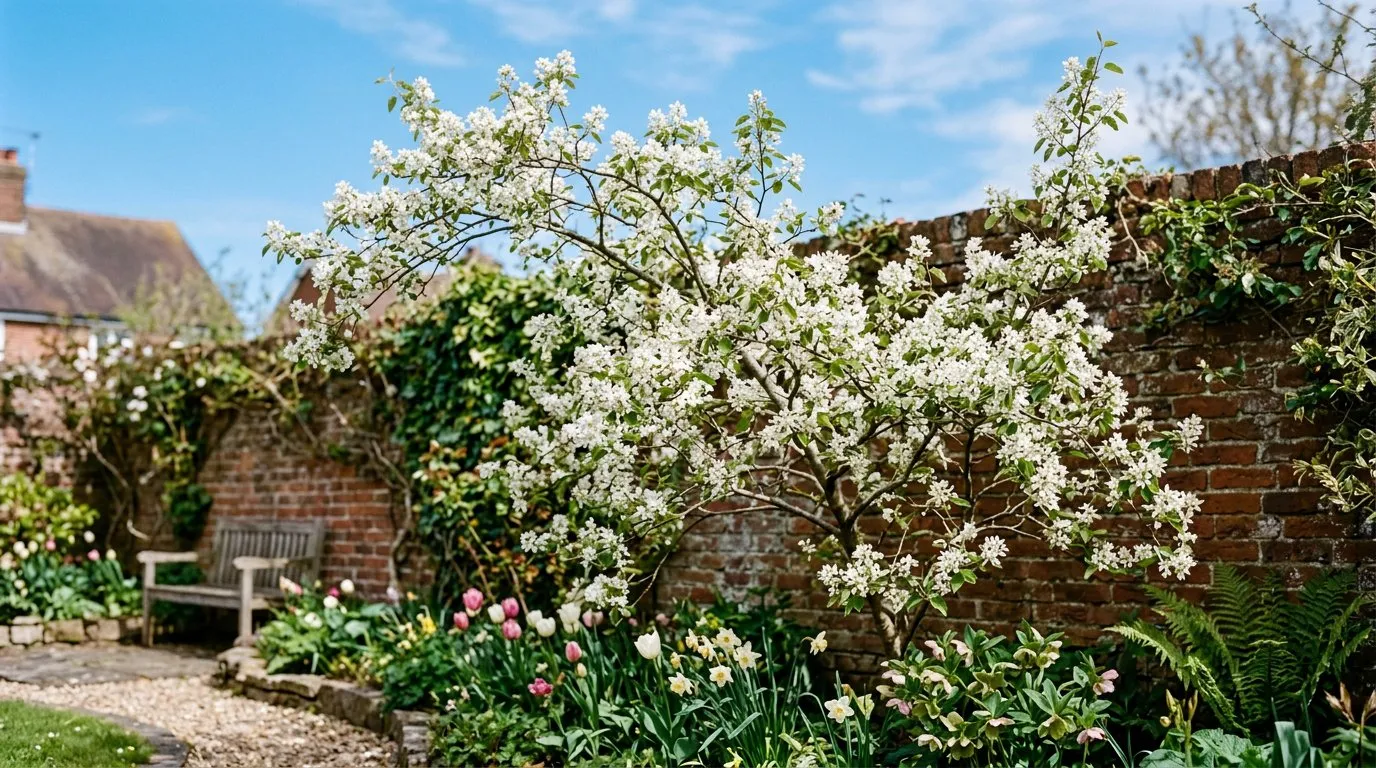
Amelanchier lamarckii in full white spring blossom against a brick wall — one of the best trees for small gardens in the UK
The species reaches 5-6m tall with a 4m spread over 15-20 years. Growth is upright and airy, casting only light dappled shade. It thrives in full sun or partial shade on any reasonable soil, including acid, neutral, and slightly alkaline ground. It tolerates urban pollution, exposed sites, and coastal winds. The only condition it dislikes is waterlogged clay.
The berries are edible and taste similar to blueberries. In North America they are called serviceberries and used in pies and jams. Most UK gardeners leave them for blackbirds and thrushes, which strip the tree within days of ripening.
Gardener’s tip: Buy a multi-stemmed Amelanchier rather than a single-trunk standard. The multi-stem form looks more natural, stays slightly more compact, and gives a better display of bark and autumn colour at eye level.
Crab apple (Malus)
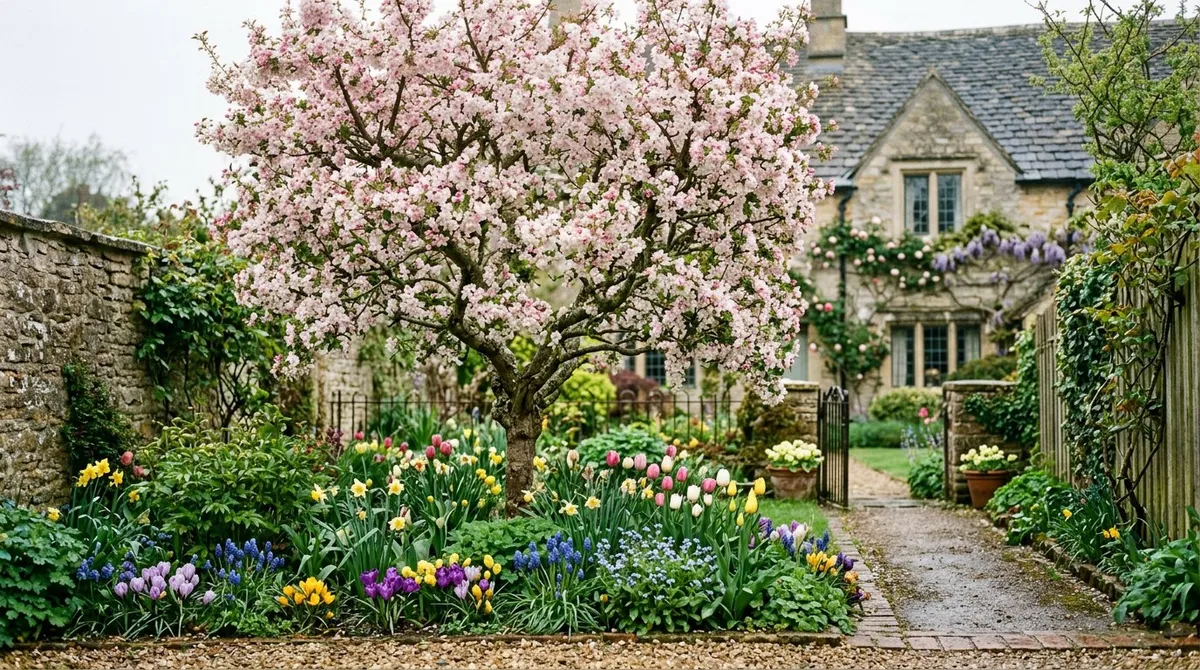
Crab apples are the hardest-working small trees. They flower heavily in spring, produce colourful fruit from September to December, and act as pollination partners for any dessert or cooking apple trees within 15-20m. A single crab apple in a small garden can pollinate every apple variety in the neighbourhood.
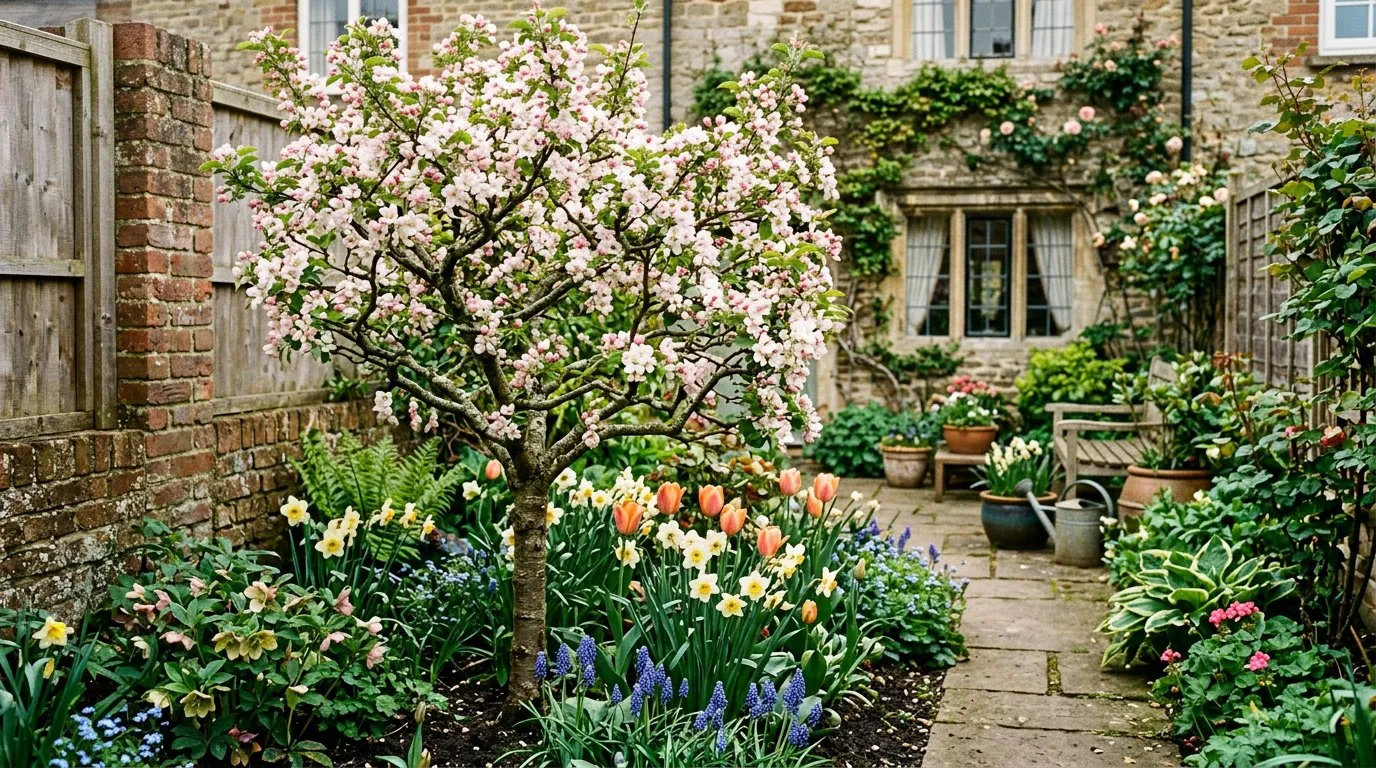
A crab apple tree in full spring blossom underplanted with bulbs — ideal trees for small gardens that also pollinate nearby fruit trees
Malus ‘Evereste’ is the best all-round cultivar. It reaches 5-6m tall with a 4m spread. White flowers open from pink buds in May. Orange-red fruit, 2-3cm across, hang in heavy clusters from October and persist well into winter. It resists scab and mildew better than most crab apples. Pollination Group 4.
Malus ‘Red Sentinel’ holds its deep red, cherry-sized fruit right through winter until February. The fruit is too bitter to eat raw but makes excellent crab apple jelly. Ultimate height 6-7m. Pollination Group 4. Outstanding winter interest when most other trees are bare.
Malus x robusta ‘Red Jade’ is a weeping form reaching just 4m. Cascading branches carry white blossom in spring and glossy red fruit in autumn. Stunning as a specimen in a lawn or courtyard. If you grow fruit trees, our cherry tree guide covers another excellent small garden option.
Japanese maple (Acer palmatum)
Japanese maples are the aristocrats of small garden trees. Their finely cut leaves, graceful habit, and extraordinary autumn colour make them the most sought-after ornamental trees for sheltered UK gardens. Most cultivars stay well under 4m in height.
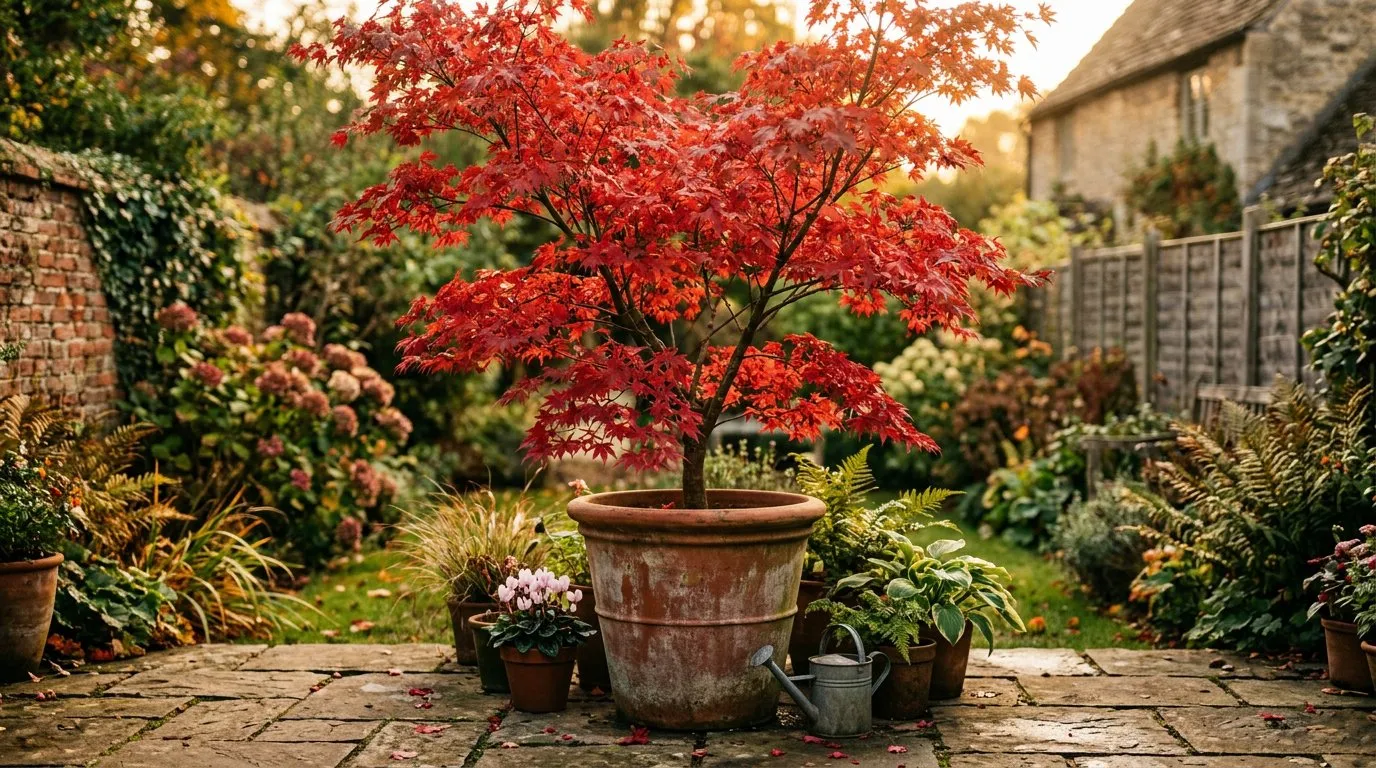
A Japanese maple in a large terracotta pot displaying vivid red autumn foliage — perfect trees for small gardens and patios
Acer palmatum ‘Bloodgood’ has deep purple-red foliage from spring to autumn, turning brilliant crimson in October. It reaches 3-4m tall and 3m wide over 15-20 years. The dark leaves contrast superbly against green hedging or pale stone walls.
Acer palmatum ‘Sango-kaku’ (coral bark maple) has bright coral-red stems that glow in winter sunlight. Spring leaves emerge salmon-pink, turn green in summer, then golden-yellow in autumn. Four-season interest from a single tree. Ultimate height 4-5m. For advice on long-term care, see our guide to Japanese maple care.
Acer palmatum var. dissectum forms a low, mounding shrub-tree just 1.5-2m tall with deeply divided, feathery leaves. Perfect for a large pot or a prominent spot beside a path or water feature. Green-leaved forms tolerate more sun than purple cultivars.
Japanese maples need shelter from cold winds and morning sun after frost, which scorches frozen leaves. Moist, well-drained, acid to neutral soil (pH 5.5-6.5) is ideal. They grow poorly on shallow chalk. Dappled shade suits them well, making them ideal under the canopy of larger trees.
Silver birch (Betula pendula ‘Youngii’)
Young’s weeping birch is the best weeping tree for a small garden. Where a standard silver birch rockets to 15-20m, ‘Youngii’ forms a graceful dome of pendulous branches reaching just 4-6m tall with a 3-4m spread. The white bark develops its characteristic papery peeling from about year five.
It grows on almost any soil except waterlogged ground. Sandy, chalky, clay, acid, or alkaline soil all suit it. Growth is rapid at 30-50cm per year in the first decade, then slowing. It tolerates exposed sites, coastal gardens, and cold northern positions. Full sun gives the best bark colour and canopy shape.
The tree supports over 300 insect species, more than any other UK native tree genus. Birch catkins appear in spring, and the fine autumn leaves turn golden-yellow before falling. The light canopy casts minimal shade, allowing underplanting with spring bulbs, ferns, and shade-tolerant perennials.
Plant bare-root specimens in winter for the best results. Stake for the first two years. Birch have shallow, wide-spreading roots, so avoid planting directly above drains. The roots are not aggressive enough to damage foundations at 4m distance on normal soil.
Magnolia stellata
Star magnolia is one of the first trees to flower each year. The white, star-shaped blooms open in March, before the leaves appear, covering the bare branches in a spectacular display. Each flower has 12-18 narrow petals and a faint, sweet scent. The tree is completely hardy throughout the UK.
Magnolia stellata grows slowly, reaching just 2-3m tall and 2.5m wide after 10-15 years. This makes it one of the smallest genuine trees available. It suits even the tiniest gardens, courtyards, and large containers. Growth is compact and bushy, needing no regular pruning.
Plant in a sheltered spot away from cold north and east winds. Late spring frost damages open flowers, so avoid frost pockets. The tree prefers acid to neutral, moisture-retentive soil. It grows on clay if drainage is improved with organic matter. It does not thrive on thin, chalky ground.
The closely related Magnolia x loebneri ‘Leonard Messel’ is a slightly larger alternative at 4-5m. Its flowers are pink in bud, opening to pale pink-white. Both species combine beautifully with underplanting of hellebores, pulmonaria, and spring bulbs.
Rowan (Sorbus)
Rowans are tough, wildlife-rich native trees. They thrive in cold, exposed, and acidic conditions where many ornamental trees struggle. Berry clusters in autumn feed fieldfares, redwings, waxwings, and blackbirds. Most garden cultivars stay below 8m.
Sorbus ‘Joseph Rock’ is the finest garden rowan. It carries large clusters of amber-yellow berries from September that birds leave longer than red varieties, extending the display. Autumn leaf colour is vivid orange, red, and purple. Ultimate height 6-8m with a narrow, upright crown just 3-4m wide.
Sorbus aucuparia (native rowan, mountain ash) grows across the UK from sea level to 1,000m altitude. It carries heavy clusters of orange-red berries from August. Ultimate height 8-10m, but easily kept below 6m by occasional crown reduction. It grows on the poorest, most acidic soils. One of the best trees for attracting birds.
Sorbus cashmiriana (Kashmir rowan) produces white or pale pink berries that glow against dark autumn foliage. It reaches 6-8m and has a light, open canopy. The white berries are ignored by birds, so the display lasts well into December. Extraordinary winter interest.
Hawthorn (Crataegus)
Hawthorn is the backbone of British hedgerows, but trained as a single-stem tree it makes a first-rate small garden specimen. It flowers heavily in May with white or pink blossom, produces red haws from September, and supports over 200 insect species. It is almost indestructible.
Crataegus monogyna ‘Stricta’ is a narrow, columnar form reaching 6-7m tall but only 2-3m wide. This fastigiate habit makes it perfect for tight spaces, boundaries, and front gardens where a spreading canopy would overhang paths or neighbours.
Crataegus laevigata ‘Paul’s Scarlet’ produces double, deep pink-red flowers in May. No haws follow the double flowers, but the blossom display is stunning. Ultimate height 5-6m. Works well as a focal point tree in a lawn.
Hawthorn tolerates every soil type including heavy clay, shallow chalk, and exposed hilltops. It copes with salt spray, pollution, and neglect. The only thing it dislikes is dense shade. Full sun produces the best flowering and fruiting. Hawthorn provides dense cover for nesting birds and is one of the most important wildlife trees in the UK. For more pollinator-friendly choices, see our bee-friendly garden plants guide.
Cherry (Prunus)
Ornamental cherries deliver the most dramatic spring blossom of any garden tree. For small gardens, choose a columnar or compact cultivar rather than the wide-spreading Prunus ‘Kanzan’ that reaches 10m.
Prunus ‘Amanogawa’ is the best cherry for tight spaces. Its strictly columnar habit reaches 6-8m tall but only 2m wide. Upright branches carry clusters of semi-double, pale pink, fragrant flowers in April. The narrow form fits against walls, in corners, and along boundaries. Autumn colour is warm orange-yellow.
Prunus incisa ‘Kojo-no-mai’ (Fuji cherry) is a twisting, architectural tree reaching just 2-3m. White flowers appear on bare, zig-zag branches in March. Excellent in a large container or as a specimen in a gravel garden. The contorted stems provide year-round interest.
Prunus ‘The Bride’ forms a graceful, spreading small tree at 4-5m tall. White flowers smother the branches in April. Dark fruits follow, attracting birds. The crown spreads to 4m, so give it room. For other small fruiting trees, our dwarf fruit tree guide covers rootstock choices and varieties that stay under 2.5m.
Small tree comparison table
| Tree | Ultimate height | Spread | Key feature | Soil preference | Season of interest |
|---|---|---|---|---|---|
| Amelanchier lamarckii | 5-6m | 3-4m | Four-season interest | Any well-drained | Spring, summer, autumn, winter |
| Malus ‘Evereste’ | 5-6m | 3-4m | Blossom + winter fruit | Any including clay | Spring, autumn, winter |
| Acer palmatum ‘Bloodgood’ | 3-4m | 2-3m | Deep purple foliage | Acid to neutral, moist | Spring, summer, autumn |
| Betula pendula ‘Youngii’ | 4-6m | 3-4m | Weeping habit + white bark | Any except waterlogged | All year (bark) |
| Magnolia stellata | 2-3m | 2-2.5m | Early March blossom | Acid to neutral, moist | Spring |
| Sorbus ‘Joseph Rock’ | 6-8m | 3-4m | Amber berries + autumn colour | Any including acid | Autumn, winter |
| Crataegus ‘Stricta’ | 6-7m | 2-3m | Columnar habit + May blossom | Any including clay/chalk | Spring, autumn |
| Prunus ‘Amanogawa’ | 6-8m | 1.5-2m | Columnar pink blossom | Any well-drained | Spring, autumn |
Why we recommend Amelanchier lamarckii as the best all-round small garden tree: After 30 seasons of planting small trees and watching them mature in British conditions, Amelanchier consistently delivers more seasonal interest per square metre than any alternative. In a 5m x 6m back garden, a multi-stemmed specimen reached 4.5m in 12 years with no pruning, produced blossom, berries, and autumn colour in its third season, and survived the 2022 drought without supplementary watering after its establishment period.
How to choose the right tree for your garden
Start with three practical questions before falling in love with any species.
How much space do you have? Measure the planting area and check the ultimate height and spread in the table above. Allow at least 1m between the mature canopy edge and any boundary fence. For gardens under 6m wide, choose the most columnar options: Prunus ‘Amanogawa’ (2m spread) or Crataegus ‘Stricta’ (2-3m spread).
What is your soil type? Grab a handful of moist garden soil and squeeze it. If it holds its shape and feels sticky, you have clay. If it crumbles and feels gritty, you have sand. Chalky soil fizzes when you drip vinegar on it. Japanese maples and magnolias need acid to neutral soil. Crab apples, hawthorn, and rowan tolerate almost anything.
What aspect does the spot face? A south-facing wall creates a warm microclimate ideal for magnolia and cherry. A north-facing spot suits birch and rowan. East-facing positions expose early-flowering trees like magnolia to morning sun after frost, which damages blooms. Shelter from the prevailing wind matters more than compass direction for most species.
Gardener’s tip: Visit a garden centre in October, not spring. You will see the autumn colour in person, check the form and branching structure without leaves, and bare-root trees become available from November at 30-50% less than container prices.
How to plant a small garden tree
Bare-root trees planted between November and March establish fastest and cost far less than container-grown specimens. Follow this method for any of the eight trees above.
- Dig a hole three times the width of the root ball and the same depth as the nursery soil mark on the trunk
- Fork over the base and sides of the hole to break up compaction
- Drive a short stake (60cm above ground) into the hole before placing the tree
- Place the tree with the root flare at soil level. Planting too deep suffocates the root collar
- Backfill with the excavated soil. Do not add compost to the backfill as it creates a “sump” that holds water around the roots
- Firm with your foot, working inward from the edges
- Tie the trunk to the stake with a rubber tree tie and spacer
- Water with 10-15 litres immediately, even in winter
- Apply a 5-8cm mulch of garden compost or bark chips, keeping it 10cm from the trunk
Remove the stake after 2-3 years for most species. Birch and cherry establish quickly and can be unstaked after one full growing season. Japanese maples on exposed sites may benefit from a permanent low stake.
The RHS tree planting guide provides additional detail on preparing difficult sites.
Aftercare in the first two years
Newly planted trees need attention during their first two growing seasons. After that, all eight species are low-maintenance.
Watering is critical from April to September in the first year. Give 20-30 litres per week during dry spells. Focus water at the base of the trunk, not over the canopy. A slow trickle from a hose left for 20 minutes is more effective than a quick splash. Reduce to fortnightly watering in the second year.
Mulching each spring with a 5-8cm layer of bark or garden compost conserves moisture, suppresses weeds, and feeds the soil as it decomposes. Top up annually. Never pile mulch against the trunk, which causes bark rot.
Pruning is minimal for most small trees. Remove dead, damaged, or crossing branches in winter (November to February). Japanese maples should only be pruned in late summer to avoid bleeding sap. Avoid heavy pruning in the first two years while the tree establishes.
Feeding is unnecessary on average garden soil. On very poor or sandy ground, a handful of general-purpose fertiliser (such as blood, fish, and bone) scattered around the root zone in March helps establishment.
Now you’ve chosen the right tree, read our guide on best trees for privacy to see which screening options suit small gardens too.
Frequently asked questions
What is the best small tree for a front garden in the UK?
Amelanchier lamarckii is the best all-round front garden tree. It reaches 5-6m with a 4m spread, providing white spring blossom, summer berries, and vivid autumn colour. The airy canopy avoids heavy shade over windows. It tolerates urban pollution, compacted soil, and road salt spray. For a tighter space, Prunus ‘Amanogawa’ has a columnar habit at just 2m wide, fitting neatly beside a front path or driveway.
How close to a house can I plant a small tree?
Keep small trees at least 3-4m from the house wall. Species like Amelanchier, magnolia, and Japanese maple have non-aggressive root systems safe at this distance on most soils. On shrinkable clay, increase the distance to 5m or more. Clay soils expand when wet and shrink when dry; tree roots accelerate this cycle by extracting moisture. Check your buildings insurance policy for specific tree distance clauses.
Which small trees grow well in shade?
Japanese maples and hawthorn tolerate partial shade well. Amelanchier flowers adequately in light shade but produces fewer berries. Holly and yew handle deep shade but are very slow growing. No tree flowers or fruits abundantly in full, all-day shade. If your garden receives at least 3-4 hours of direct sun, most small trees will perform well. East-facing gardens suit maples, which prefer protection from hot afternoon sun.
Do small trees damage foundations?
Small trees with compact root systems pose minimal risk. Amelanchier, magnolia, crab apple, and Japanese maple are all safe near buildings at 3-4m distance. The risk increases on shrinkable clay soil, where any tree can contribute to seasonal ground movement. Birch, even the compact ‘Youngii’, has wide-spreading surface roots that can lift paving within 3m. Always match tree placement to your soil type.
When is the best time to plant a tree in a small garden?
Plant bare-root trees from November to March while they are dormant. Roots establish during winter before the energy demands of spring growth begin. Container-grown trees can go in at any time, but autumn planting always gives the strongest first-year growth. Avoid frozen or waterlogged ground. If a bare-root tree arrives during unsuitable weather, heel it into a temporary trench of moist soil and plant within two weeks.
What is the fastest growing small tree for the UK?
Betula pendula ‘Youngii’ and Amelanchier lamarckii both grow 30-50cm per year in their first decade. Crab apples add 30-40cm annually. Sorbus ‘Joseph Rock’ reaches 6-8m in 15-20 years. Japanese maples and magnolias are the slowest, adding 15-25cm per year, but their compact size means they rarely outgrow a small garden. Fast growth usually means less structural strength, so staking is important.
Can I plant a tree in a small garden with clay soil?
Yes. Crab apples, hawthorn, rowan, and Amelanchier all thrive in clay. Dig a wide, shallow planting hole rather than a deep, narrow one. Mix the excavated clay with organic matter to improve structure. Do not plant Japanese maples or magnolias in waterlogged heavy clay; they need better drainage. On heavy clay, consider planting 5-10cm above the surrounding soil level on a slight mound so water drains away from the root collar.
How do I choose between an ornamental and a fruit tree for a small garden?
A crab apple gives the best of both worlds: ornamental blossom, decorative fruit, and pollination for any nearby apple trees. For edible fruit in small spaces, dwarf trees on M9 or M27 rootstock stay under 2.5m and crop within 2-3 years. If you want minimal maintenance, purely ornamental trees like Amelanchier and magnolia need almost no ongoing care. Fruit trees require annual pruning, pest management, and harvesting.
Lawrie has been gardening in the West Midlands for over 30 years. He grows his own veg using no-dig methods, keeps a wildlife-friendly garden, and writes practical advice based on real UK growing conditions.