Best Winter Flowering Plants for the UK
Ten best winter flowering plants for UK gardens from November to March. Covers hellebores, snowdrops, witch hazel, and winter jasmine with care advice.
Key takeaways
- Hellebores flower from January to April, thrive in shade, and naturalise freely once established
- Snowdrops (Galanthus nivalis) bloom from January to March and spread into large drifts over time
- Witch hazel (Hamamelis) has spidery, fragrant flowers on bare branches from December to February
- Winter jasmine covers north-facing walls with yellow flowers from November to March
- Cyclamen coum provides ground-level colour from January to March in shaded spots
- Plant winter-flowering bulbs in autumn (September to November) for blooms the following year
- A mix of all ten plants gives continuous colour from the first week of November to late March
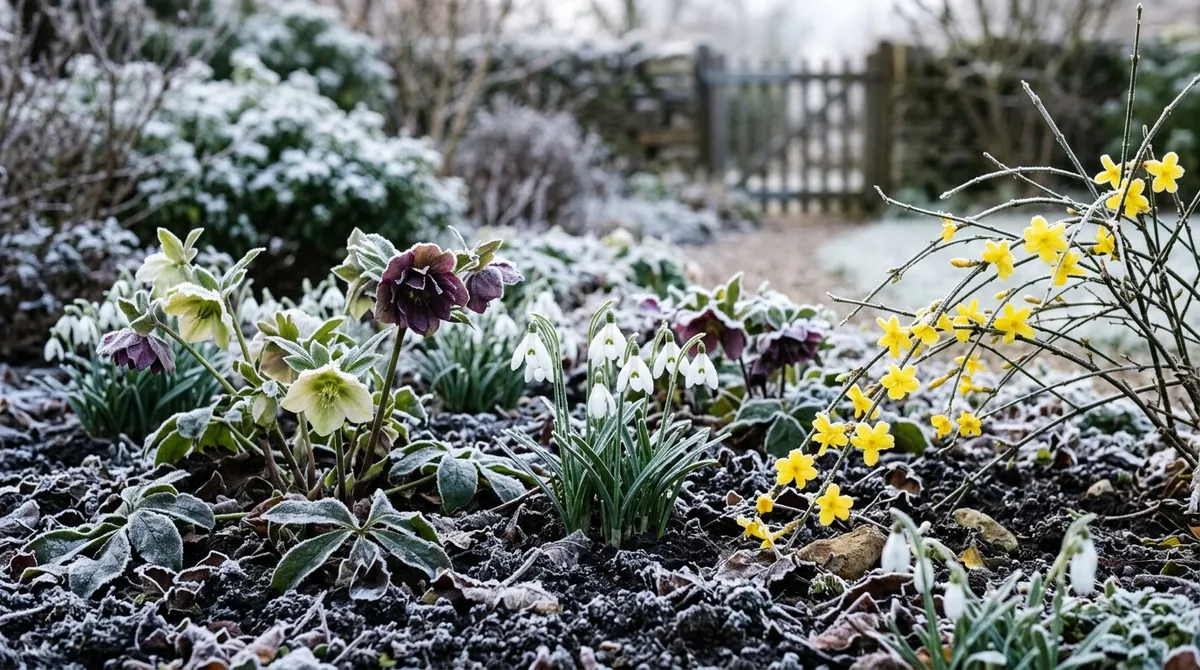
The darkest months in a British garden are not the colourless weeks most people assume. From the first Mahonia spikes in November to the last snowdrops in March, winter offers a quiet, rewarding flowering season. The colours are subtler than summer. The fragrances are sweeter. The flowers feel more precious because they arrive when nothing else does.
The ten plants below provide continuous colour from November to March. They cover every garden situation: shade, sun, walls, woodland floor, and open borders. Most are fully hardy to at least -15C. Several have been flowering in British gardens for centuries. Together they prove that winter is a genuine season of interest, not a gap to endure between autumn and spring. For broader winter garden tasks and planning, our seasonal guide covers pruning, soil preparation, and planting schedules.
Hellebores (Helleborus)
Hellebores are the backbone of the winter garden. They flower from January through to April, thrive in shade, need minimal care, and improve year on year. A single plant produces 30-50 blooms per season. A mature clump of six or eight plants creates a display that draws the eye from across the garden.
Helleborus x hybridus (Lenten rose) is the most widely grown group. Flower colours range from pure white through pink, plum, and near-black, often with speckles and picotee edges. Double-flowered forms are increasingly popular. Plants reach 45-60cm tall with a 60cm spread. They flower from February to April, peaking in March.
Helleborus niger (Christmas rose) flowers earlier, from December to February, with pure white blooms that age to pink. It is shorter at 30cm and slightly fussier, preferring moisture-retentive, alkaline soil. Place it at the front of a shaded border where the downward-facing flowers are visible. Plant alongside other December performers for the richest display.
Cut all old foliage to the ground in late December before new flower stems emerge. This prevents leaf spot spreading and shows the blooms at their best. Mulch generously with garden compost or leafmould each autumn. Hellebores self-seed freely, producing varied offspring. Remove seedlings you do not want before they establish deep roots.
Gardener’s tip: To see hellebore flowers properly, plant them on a raised bank, at the top of a retaining wall, or along a raised bed edge. The flowers nod downward, and at ground level you see only the backs of the sepals. Elevation of just 30-40cm makes all the difference.
Snowdrops (Galanthus nivalis)
Snowdrops are the most beloved winter bulb in Britain. Their nodding white flowers push through frozen soil from January to March, often appearing while snow still covers the ground. They naturalise freely in grass, under deciduous trees, and along hedgerows. A small planting of 50 bulbs becomes a carpet of thousands within a decade.
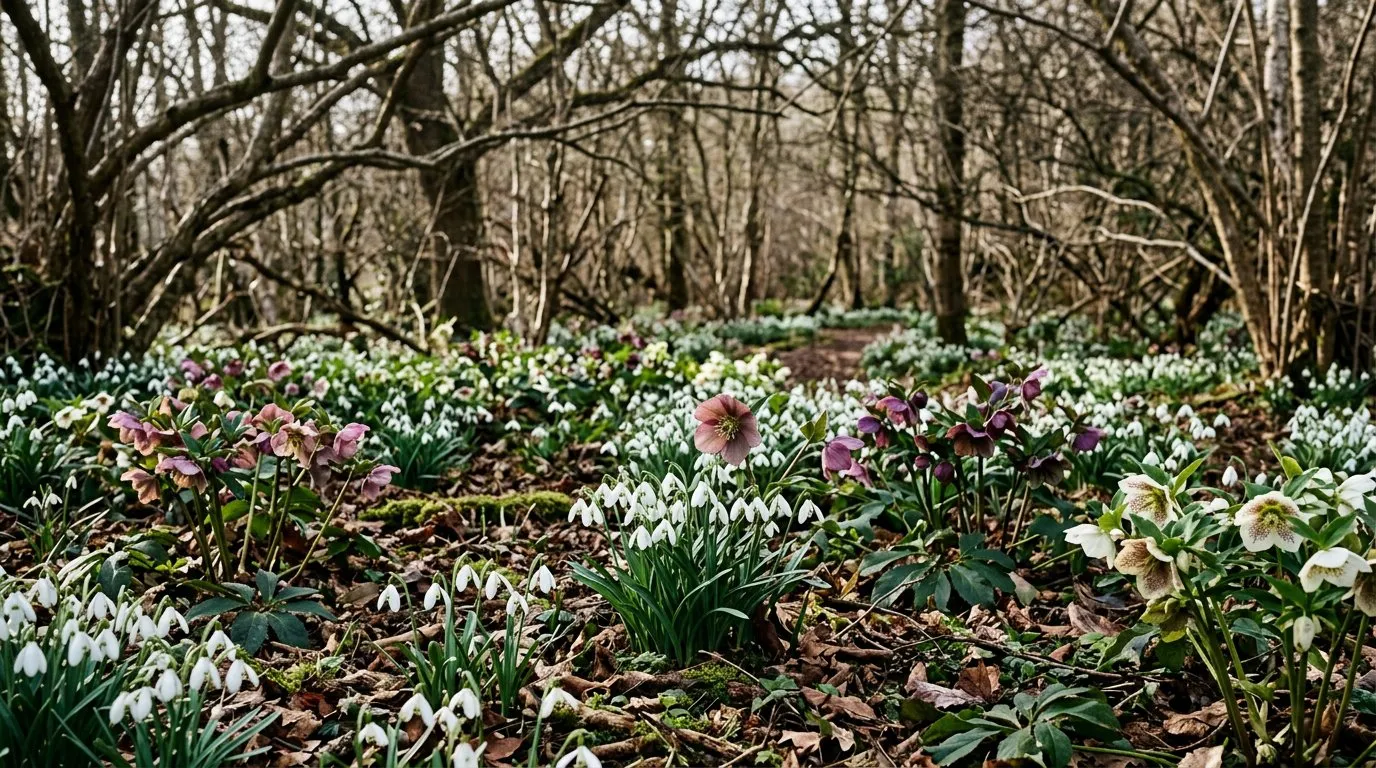
Snowdrops and hellebores flowering together beneath bare trees in a UK woodland garden — proof that winter has its own quiet beauty.
The common snowdrop (Galanthus nivalis) reaches 10-15cm tall. Each flower has three long outer petals and three shorter inner petals marked with green. ‘Flore Pleno’ is a popular double form with extra petals. For galanthophiles (and there are thousands in the UK), named cultivars like ‘S. Arnott’ (taller, larger-flowered, honey-scented) and ‘Magnet’ (flowers on long, arching stems) offer subtle refinements.
Plant snowdrops in the green — that is, while still in leaf, immediately after flowering in February or March. Dry bulbs planted in autumn are far less reliable. Lift established clumps after flowering, split into groups of 3-5 bulbs, and replant at the same depth 8-10cm apart. They thrive in partial shade and humus-rich soil. Beneath deciduous trees is the perfect spot: winter sun reaches the bulbs through bare branches, while summer shade keeps the soil cool and moist.
Winter jasmine (Jasminum nudiflorum)
Winter jasmine is one of the most useful plants for the UK garden. It flowers from November to March, producing bright yellow blooms on bare, arching green stems. It grows on any aspect, including north-facing walls, and is fully hardy to -15C. Few plants give so much colour for so little effort.
Despite its name, winter jasmine is not a true climber. The stems need tying to support wires or a trellis. Left unsupported, it scrambles as ground cover or cascades over a wall. It reaches 3-4m in height and spread. The flowers appear on stems produced the previous summer, so prune immediately after flowering in March by cutting back all flowered shoots to 5cm from the main framework. This produces vigorous new green stems through summer that flower the following winter.
Winter jasmine suits problem spots where other climbers struggle. North-facing fences, shaded walls, and cold, exposed positions are all within its range. The green stems add interest even without flowers. For a more detailed look at plants for vertical spaces, see our guide to climbing plants for UK gardens.
Witch hazel (Hamamelis)
Witch hazel is the most spectacular winter-flowering tree for UK gardens. Spidery, ribbon-like flowers in yellow, orange, or red appear on bare branches from December to February. The fragrance carries several metres on cold air. In autumn, the leaves turn vivid gold and orange before falling. It is a plant that earns its space twice over.
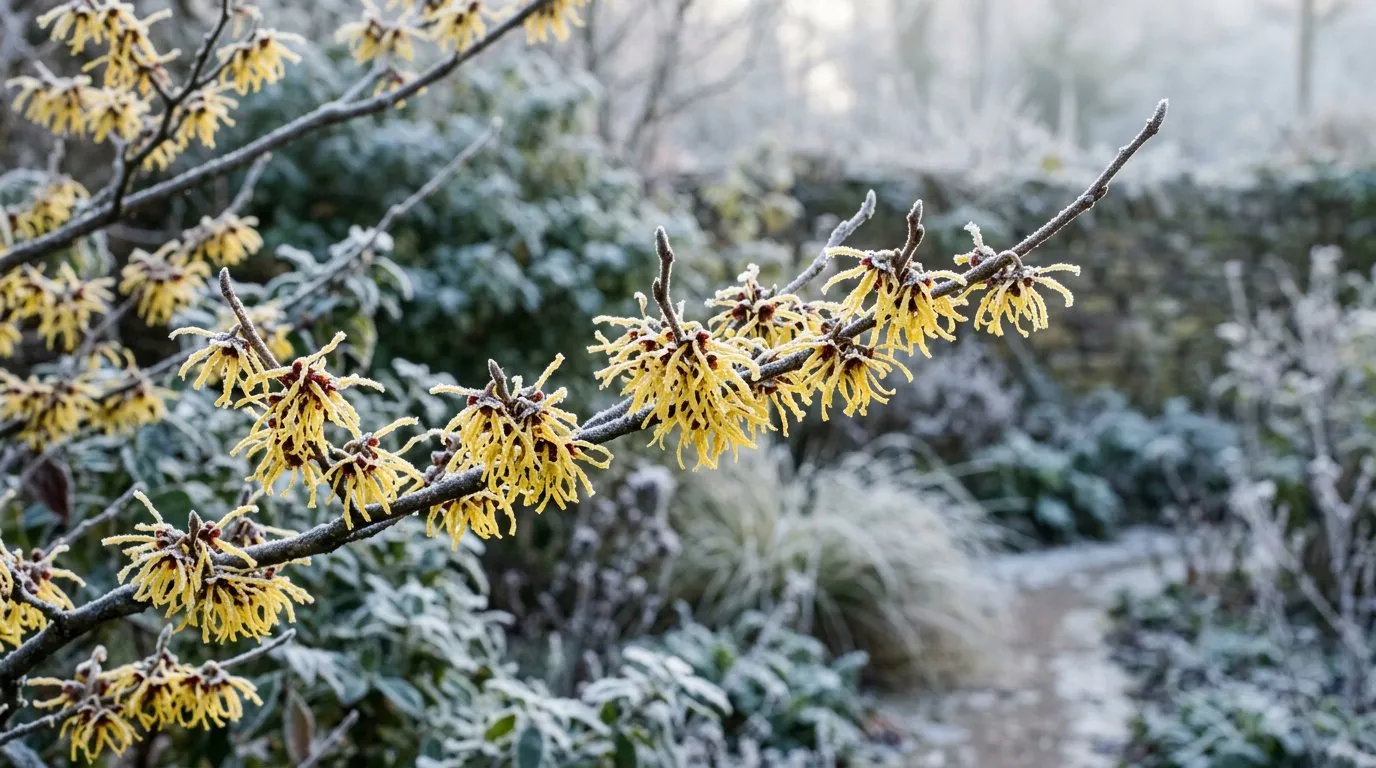
Witch hazel (Hamamelis) lighting up a frosty UK garden with spidery yellow flowers on bare December branches.
Hamamelis x intermedia ‘Pallida’ is the finest yellow cultivar, with large, sulphur-yellow flowers and a strong, sweet scent. ‘Jelena’ has coppery-orange flowers. ‘Diane’ has deep red blooms but less fragrance. All reach 3-4m tall and 3m wide over 15-20 years. Growth is slow at 15-20cm per year.
Witch hazel needs acid to neutral soil (pH 5.5-7.0) and will not thrive on chalk or limestone. It prefers a sheltered position in full sun or light shade. Plant it where low winter sunlight catches the translucent flowers — against a dark evergreen hedge such as yew is the classic backdrop. Once planted, leave it alone. Witch hazel resents transplanting and needs no routine pruning. Remove crossing or dead branches only.
Winter-flowering cherry (Prunus subhirtella ‘Autumnalis’)
This small tree is unique among cherries for flowering in winter. Delicate, semi-double, pale pink to white blossoms appear intermittently from November through to March, opening during mild spells and pausing during hard frosts. No other tree provides winter blossom on this scale.
It reaches 6-8m at maturity with a graceful, spreading habit. The spring flush of small leaves is bronze-tinted, turning green in summer and amber-yellow in autumn. As a four-season tree, it has few equals. ‘Autumnalis Rosea’ has deeper pink flowers.
Plant in full sun in any well-drained soil. It tolerates clay, chalk, and poor ground better than most ornamental cherries. It needs no routine pruning beyond removing dead or crossing branches. Site it where you see it from indoors through winter — beside a window, near the front door, or at the end of a path. Underplant with snowdrops and Cyclamen coum for ground-level colour beneath the winter blossom.
Cyclamen coum
Cyclamen coum is a ground-level jewel of the winter garden. Tiny, swept-back flowers in shades of magenta, pink, and white appear from January to March, just 8-10cm above the soil. The rounded, dark green leaves, often marbled with silver, are handsome in their own right from autumn through to spring.
Each tuber is small, just 3-5cm across, but colonies spread by seed to form dense carpets over time. Plant tubers 3-5cm deep in September or October in well-drained, humus-rich soil. They thrive in the dry shade beneath deciduous trees and shrubs, making them perfect companions for hellebores, snowdrops, and shade-loving plants.
Cyclamen coum needs no feeding, watering, or maintenance once established. The foliage dies back in late spring and the tuber rests dormant through summer. Avoid disturbing the soil around the tubers during summer dormancy. Hardy to -15C. Mark the planting position to avoid accidentally digging into dormant tubers.
Mahonia
Mahonia flowers from November to March, bridging the gap between autumn and spring with upright spikes of bright yellow, honey-scented flowers. It is one of the longest-flowering shrubs in the British garden and one of the most undervalued. For full details on this outstanding evergreen shrub, see our companion guide.
Mahonia x media ‘Charity’ is the most widely grown garden cultivar. It produces clusters of flower spikes at the branch tips from November to February, filling the garden with a distinctive honey fragrance. The pinnate, holly-like leaves are bold and architectural year-round. Height reaches 3-4m. It tolerates shade, dry soil, and temperatures to -20C.
Mahonia aquifolium (Oregon grape) is a shorter alternative at 1-1.5m. It flowers in February and March, later than ‘Charity’, extending the Mahonia season. Blue-black berries follow the flowers and are eaten by birds. Both species are extremely tough and handle poor soil, pollution, and neglect. Prune by removing one in three of the oldest stems at the base after flowering to prevent legginess.
Viburnum x bodnantense ‘Dawn’
This deciduous shrub flowers on bare wood from November to March, producing clusters of sweetly fragrant, deep pink buds opening to pale pink flowers. The scent is strongest on still, mild days and carries 3-4m. It reaches 2.5-3m tall and 1.5-2m wide with a stiff, upright habit.
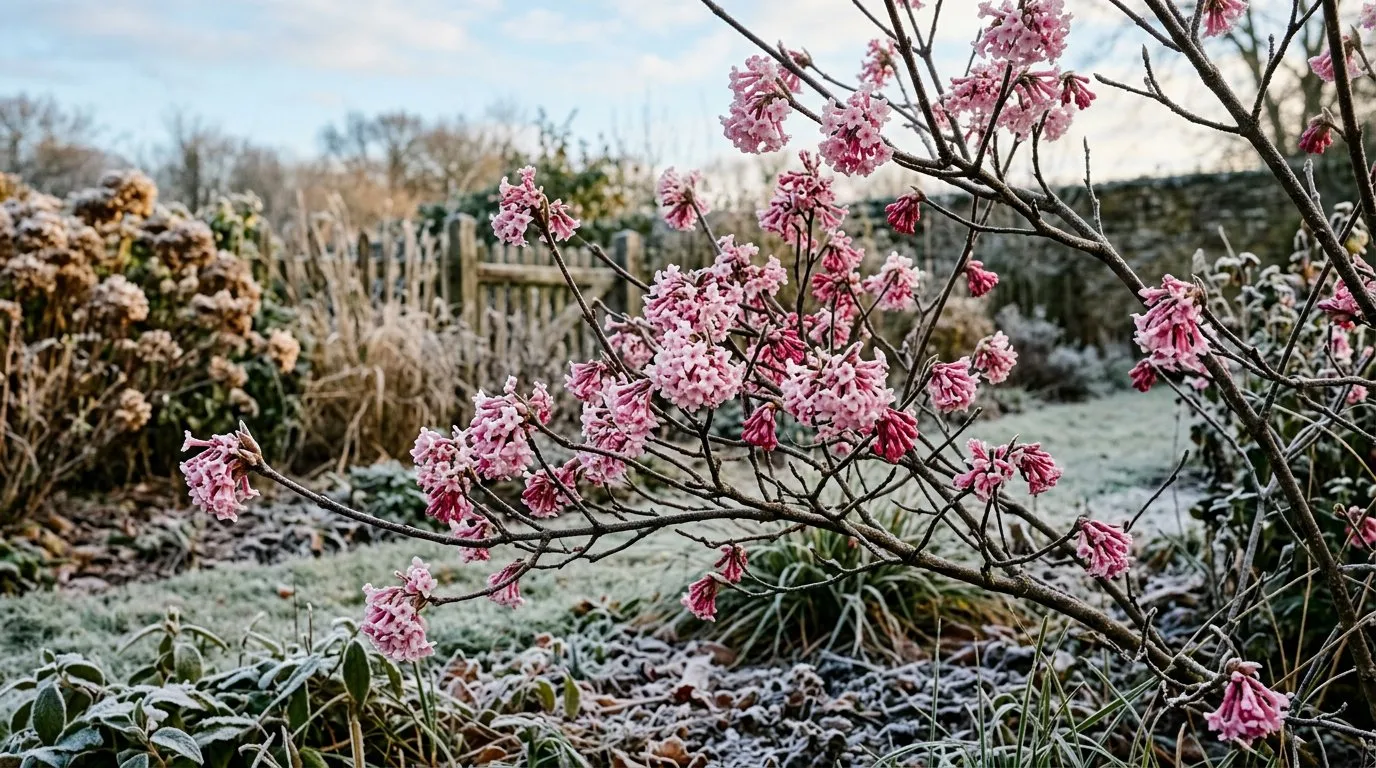
Viburnum x bodnantense ‘Dawn’ bearing clusters of fragrant pink flowers on frosty bare stems — one of the hardiest winter-flowering shrubs for UK gardens.
‘Dawn’ is among the hardiest winter-flowering shrubs, tolerating temperatures to -20C. It grows in any reasonable soil in sun or partial shade. Avoid east-facing positions where morning sun after overnight frost damages the open flowers. A west or south-facing spot gives the best results.
Prune after flowering in March by removing one in four of the oldest stems at the base to encourage new growth from below. Left unpruned, the shrub becomes bare at the base. It pairs beautifully with a cottage garden planting scheme and works well underplanted with snowdrops and Cyclamen coum.
Daphne bholua ‘Jacqueline Postill’
Daphne bholua ‘Jacqueline Postill’ has the most intoxicating fragrance of any winter-flowering plant. Rich, sweet, almost overpowering scent pours from clusters of pink and white flowers from January to March. It is evergreen in mild areas and semi-evergreen in cold regions. Height reaches 2-3m with an upright, narrow habit.
This Daphne needs well-drained soil enriched with organic matter, and a sheltered spot away from cold winds. It dislikes root disturbance and should be planted in its final position from a container in spring. Do not attempt to transplant it. Hardy to -10C in a sheltered position. The roots need cool, moist conditions, so mulch annually but never dig around the base.
Plant it near a path or entrance where passers-by catch the scent. One plant is enough to perfume an entire front garden. Combine with Sarcococca and hellebores for a layered winter fragrance garden. The only drawback is a relatively short lifespan of 10-15 years, but the winter scent makes every year worthwhile.
Winter aconites (Eranthis hyemalis)
Winter aconites are among the first flowers of the year, appearing from late January. The buttercup-yellow flowers sit in a ruff of bright green, deeply cut leaves, looking like tiny golden suns against the brown winter soil. Each flower is just 3-5cm tall but colonies carpet the ground beneath trees and along hedgerows with brilliant colour.
Plant the small, knobbly tubers in September, 5cm deep and 5cm apart, in humus-rich soil. Alternatively, buy plants in the green (in leaf) in February for more reliable establishment. Like snowdrops, dry tubers often fail. Winter aconites prefer dappled shade and moisture-retentive but well-drained soil. They naturalise well under deciduous trees, in wildflower areas, and along the base of hedges.
Once established, winter aconites self-seed freely. Seedlings flower within 2-3 years. Avoid disturbing the soil in their area during summer when the tubers are dormant. They are fully hardy to -20C and completely maintenance-free. The early flowers provide vital nectar for emerging bees and pollinators when little else is available. A drift of winter aconites beneath a white-barked birch is one of the finest sights in any British garden.
Why we recommend Hamamelis x intermedia ‘Pallida’ as the standout winter shrub: After 30 years of planting for winter interest, witch hazel ‘Pallida’ is the plant visitors always ask about first. The sulphur-yellow flowers carry a fragrance that travels 4-5 metres on a still winter morning, and the plant puts on this display for six to eight weeks from December without any care from me. In one north-facing corner where nothing else flowered in January, ‘Pallida’ established within three seasons and has never looked back.
Month-by-month winter colour guide
| Month | In flower | Key highlight |
|---|---|---|
| November | Winter jasmine, Mahonia ‘Charity’, Viburnum x bodnantense, Prunus ‘Autumnalis’ | Mahonia fragrance at its peak |
| December | Winter jasmine, Mahonia, Helleborus niger, Viburnum ‘Dawn’, Prunus ‘Autumnalis’ | Christmas rose opens its white blooms |
| January | Snowdrops (late), winter aconites, Cyclamen coum, Helleborus niger, Daphne bholua, winter jasmine, Mahonia, Hamamelis | Witch hazel and Daphne scent the air |
| February | Snowdrops at peak, winter aconites at peak, Helleborus x hybridus, Cyclamen coum, Hamamelis, Daphne, winter jasmine | Snowdrop carpets under trees |
| March | Helleborus x hybridus at peak, late snowdrops, Cyclamen coum, Mahonia aquifolium, Daphne | Hellebore season peaks |
Winter flowering plant comparison table
| Plant | Flowers when | Height | Colour | Scent | Position |
|---|---|---|---|---|---|
| Helleborus x hybridus | Jan-Apr | 45-60cm | White, pink, plum | None | Partial to full shade |
| Helleborus niger | Dec-Feb | 30cm | White to pink | None | Partial shade, moist soil |
| Galanthus nivalis | Jan-Mar | 10-15cm | White with green | Honey (some) | Partial shade, humus-rich soil |
| Jasminum nudiflorum | Nov-Mar | 3-4m | Yellow | None | Any aspect, any soil |
| Hamamelis x intermedia | Dec-Feb | 3-4m | Yellow, orange, red | Sweet, carries far | Sun, acid to neutral soil |
| Prunus subhirtella ‘Autumnalis’ | Nov-Mar | 6-8m | White to pale pink | Faint | Full sun, well-drained |
| Cyclamen coum | Jan-Mar | 8-10cm | Magenta, pink, white | None | Dry shade, well-drained |
| Mahonia x media ‘Charity’ | Nov-Feb | 3-4m | Yellow | Honey | Shade to partial sun |
| Viburnum x bodnantense ‘Dawn’ | Nov-Mar | 2.5-3m | Pink to white | Sweet, carries 3-4m | Sun, avoid east-facing |
| Daphne bholua | Jan-Mar | 2-3m | Pink and white | Intense, intoxicating | Sheltered, well-drained |
| Eranthis hyemalis | Late Jan-Feb | 3-5cm | Yellow | None | Dappled shade, humus-rich |
Planting for continuous winter colour
The secret to a successful winter garden is planning for succession. No single plant flowers for all five months from November to March. But by combining early, mid, and late bloomers, you achieve unbroken colour.
Start the season in November with winter jasmine, Mahonia, and Viburnum ‘Dawn’. These carry through December alongside Helleborus niger and the first witch hazel buds. January brings snowdrops, winter aconites, Cyclamen coum, and Daphne. February is the peak month, with almost everything overlapping. March sees hellebores and late snowdrops carrying colour into spring as bulbs and perennials take over.
Plant winter-flowering shrubs and trees as a backdrop. Underplant with bulbs and tubers at ground level. This vertical layering ensures colour at every height, from the 3-5cm winter aconites to the 6-8m winter cherry overhead. Add evergreen shrubs for permanent structure between the seasonal performers.
Caring for winter-flowering plants
Most winter-flowering plants are remarkably low maintenance. They evolved to bloom during the harshest months and need little help to do so. However, a few simple practices improve the display and keep plants healthy.
Mulch in autumn. Apply 5-8cm of well-rotted compost, leafmould, or bark around the base of shrubs and over bulb plantings in October. This insulates roots, retains moisture, suppresses weeds, and feeds the soil as it breaks down. Keep mulch 5cm clear of woody stems.
Avoid disturbing bulb sites. Snowdrops, winter aconites, and cyclamen rest dormant underground through summer. Mark their positions with small labels so you do not accidentally dig into them. Never plant summer annuals over dormant winter bulb sites.
Remove old hellebore foliage. Cut the previous year’s leaves off hellebores in late December. This prevents leaf spot disease and reveals the flowers. New foliage emerges alongside the flower stems in January.
Prune winter-flowering shrubs after flowering. Viburnum ‘Dawn’, winter jasmine, and Mahonia should all be pruned in March or April, immediately after flowering. Do not prune in autumn or you will remove the flower buds.
Common problems with winter flowers
Hellebore black death is a viral disease causing black streaks on leaves and stunted, distorted flowers. There is no cure. Remove and burn infected plants immediately to prevent spread. Buy plants from reputable nurseries and inspect before planting. The RHS guide to hellebore problems covers identification and prevention.
Snowdrop grey mould (Botrytis) causes fluffy grey fungal growth on leaves and flowers in wet winters. Improve air circulation by thinning overcrowded clumps. Remove infected material promptly. Snowdrops in overly damp, airless positions are most at risk.
Witch hazel failure on alkaline soil is the most common reason for disappointing plants. Witch hazel absolutely requires acid to neutral soil. On chalk or limestone, leaves yellow, growth stalls, and the plant eventually dies. Test soil pH before buying. If your soil is alkaline, grow witch hazel in a large container of ericaceous compost instead.
Winter jasmine bare patches develop when the plant is not pruned annually. Old stems flower less freely. Hard pruning after flowering stimulates new green stems that flower heavily the following winter. Without pruning, the plant becomes a tangled mass of old wood with flowers only at the tips.
Frost damage to open flowers occurs when temperatures drop sharply overnight. Viburnum ‘Dawn’ and winter cherry flowers turn brown after hard frost but the plant produces replacement buds during the next mild spell. Avoid east-facing positions where morning sun hits frozen flowers, as rapid thawing causes the most damage. Position in south or west-facing spots for best results.
Now you’ve planned your winter flowering display, read our guide on evergreen shrubs for year-round interest for the next step.
Frequently asked questions
What flowers bloom in winter in the UK?
Many plants flower reliably through the British winter. The most dependable are hellebores (January to April), snowdrops (January to March), winter jasmine (November to March), witch hazel (December to February), Mahonia (November to March), and Viburnum x bodnantense ‘Dawn’ (November to March). Winter cherry provides intermittent blossom from November. Cyclamen coum, Daphne bholua, and winter aconites add colour from January. With the right selection, every week from November to March has something in flower.
When should I plant winter flowering bulbs?
Plant snowdrops and winter aconites in the green (while in leaf, after flowering) in February or March for the most reliable results. Dry bulbs planted in autumn often fail. Cyclamen coum tubers go in during September or October, planted 3-5cm deep. All benefit from humus-rich, well-drained soil. Under deciduous trees is ideal, where they receive winter light through bare branches and summer shade. Mark planting spots to avoid disturbing dormant tubers.
Do hellebores grow well in shade?
Hellebores are among the best plants for shaded gardens. They flower and thrive in partial to full shade. Their natural habitat is the woodland floor, receiving dappled light through a bare winter canopy. Once established, they tolerate dry shade. Full sun on hot, south-facing banks scorches foliage and shortens flowering. The ideal position is beneath deciduous trees or on the north side of a wall, with moisture-retentive, humus-rich soil enriched with leafmould.
How do I care for hellebores?
Cut the previous year’s foliage to ground level in late December or early January. This removes leaf spot spores and reveals the emerging flowers. Mulch with 5cm of leafmould or well-rotted compost in autumn. Feed with a dressing of blood, fish, and bone meal in March. Remove spent flower stems in May if you do not want self-sown seedlings. Divide congested clumps in spring after flowering, though hellebores generally prefer to be left undisturbed.
Can I grow winter jasmine on a north-facing wall?
Winter jasmine is one of the finest plants for north-facing walls. It flowers from November to March regardless of how much direct sunlight it receives. The green stems photosynthesise without relying on a sunny aspect. Tie stems to horizontal support wires spaced 30cm apart. After flowering, cut all flowered shoots back to 5cm from the main framework to stimulate vigorous new growth that flowers the following winter.
How do I get snowdrops to spread?
Divide clumps in the green (while in leaf, just after flowering) in February or March. Lift with a fork, separate into groups of 3-5 bulbs with roots and leaves intact, and replant immediately at the same depth, 10cm apart. Never let bulbs dry out. Snowdrops also self-seed, but seedlings need 3-4 years to flower. Leave seed heads on the plant and avoid mowing or tidying until late spring to allow seeds to disperse. A colony roughly doubles every 3-4 years.
Is witch hazel difficult to grow?
Witch hazel is straightforward if your soil is right. It needs acid to neutral soil with a pH between 5.5 and 7.0. Chalky or alkaline soil causes failure. Beyond this requirement, it asks only for reasonable drainage and a sheltered spot. Plant in full sun or light shade where low winter sun illuminates the translucent flowers. It needs no regular pruning, suffers no serious pests, and lives for decades. The only limitation is slow growth at 15-20cm per year.
What is the earliest flowering plant in the UK?
Winter aconites (Eranthis hyemalis) are among the very earliest, flowering from late January, often pushing through frozen soil. Snowdrops follow in February. Mahonia and Viburnum x bodnantense ‘Dawn’ can begin flowering as early as late October in mild autumns. Among trees, Prunus subhirtella ‘Autumnalis’ starts flowering from November. What to plant in November covers timing for getting winter plants established before the cold sets in.
Lawrie has been gardening in the West Midlands for over 30 years. He grows his own veg using no-dig methods, keeps a wildlife-friendly garden, and writes practical advice based on real UK growing conditions.