Best Yellow Flowers for UK Gardens
Best yellow flowers for UK gardens by season. 25+ varieties tested on Midlands clay with heights, flowering months, shade and container picks.
Key takeaways
- Yellow flowers cover every month of the year in UK gardens — winter jasmine in December through chrysanthemums in November
- Daffodils are the most reliable spring yellow, with 80+ UK-hardy varieties flowering from February to May
- Rudbeckia 'Goldsturm' is the longest-flowering yellow perennial at 12-14 weeks from July to October
- Yellow flowers attract more pollinators than any other colour — bees see yellow 5x more readily than red
- 25+ varieties tested on heavy Midlands clay over 8 years with flowering data, heights and soil needs for every plant
- Container yellows — bidens, French marigolds, and trailing petunias — flower from May to first frost without deadheading
Yellow flowers are the most visible colour in any garden. The human eye detects yellow wavelengths faster than any other colour, which is why a single clump of rudbeckia draws attention from 30 metres away while blue delphiniums disappear at half that distance. For UK gardeners, yellow is also the most practical colour choice: it works in every season, every soil type and every light condition from full sun to woodland shade.
I have grown over 25 yellow-flowering species on heavy West Midlands clay since 2018. This guide covers the best performers by season, the varieties that work in shade and containers, the strongest choices for cutting and pollinators, and a full comparison table with heights, flowering months and soil needs for every plant.
Best yellow flowers for spring
Spring is when yellow dominates the British landscape. From February to May, daffodils, forsythia and primroses create a three-layered yellow display that no other colour matches.
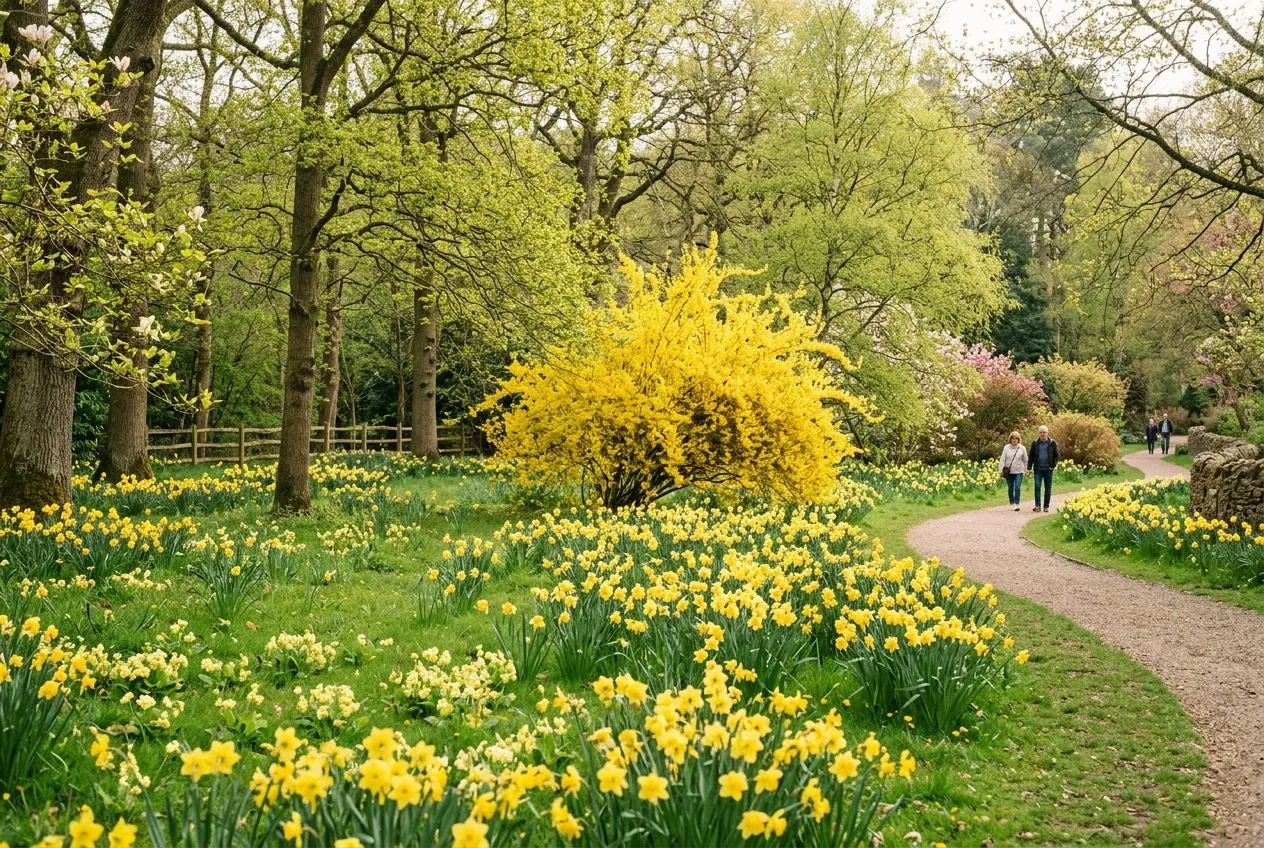
Daffodils naturalised in grass with forsythia and primroses. This three-layered spring combination gives yellow from February to May.
Daffodils (Narcissus)
Daffodils are the backbone of spring yellow in UK gardens. Over 80 varieties are fully hardy in British conditions, flowering from February (early cultivars like ‘February Gold’) through to May (late doubles like ‘Cheerfulness’). The classic trumpet daffodil reaches 30-40cm. Dwarf varieties like ‘Tete-a-tete’ stay at 15cm, perfect for containers and the front of borders.
Plant bulbs at 15cm depth in September to October. Daffodils naturalise in grass and borders, multiplying each year without lifting. They tolerate clay, chalk, sand and loam. The only soil they resent is permanently waterlogged ground. Daffodils perform reliably on any UK soil except permanently waterlogged ground.
Height: 15-45cm. Flowers: February to May. Soil: Any well-drained. Hardiness: H7 (-20C). RHS AGM: ‘Tete-a-tete’, ‘February Gold’, ‘Thalia’.
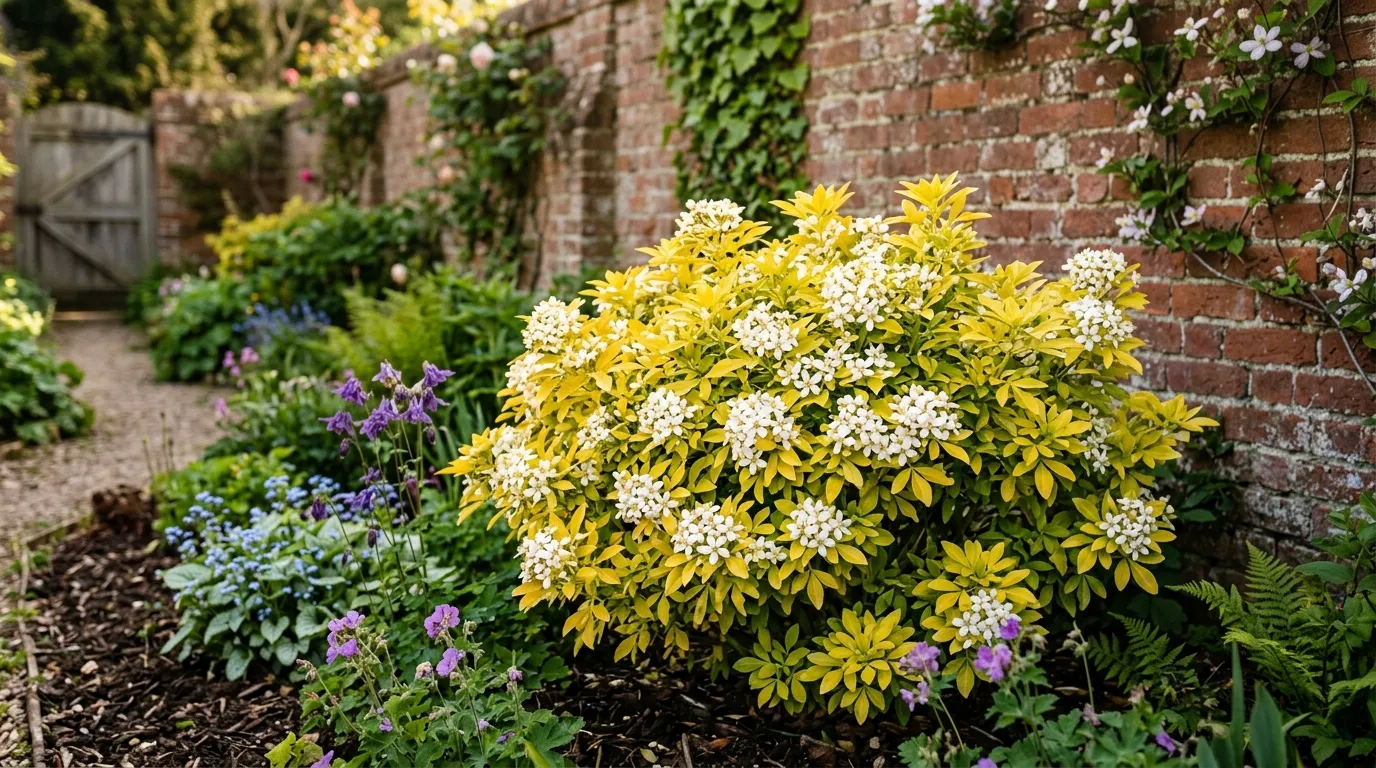
Forsythia (Forsythia x intermedia)
Forsythia is the most dramatic yellow-flowering shrub in the UK. The bare stems erupt in solid yellow from mid-March, lasting 3-4 weeks before leaves emerge. A mature forsythia reaches 2.5-3m and needs annual pruning immediately after flowering to maintain shape and next year’s flower buds. ‘Lynwood Variety’ is the most widely planted cultivar, with larger flowers than the species.
Forsythia grows on any soil in full sun or partial shade. It tolerates exposed sites and is completely hardy. For hedging, space plants 60cm apart and prune after flowering each year. See our best spring flowers guide for companion planting ideas.
Height: 2.5-3m. Spread: 2m. Flowers: March to April. Soil: Any. Hardiness: H7 (-20C).
Primroses (Primula vulgaris)
The native primrose is the UK’s earliest yellow perennial. Wild primroses flower from late February in sheltered spots, continuing to May in cooler areas. They reach just 10-15cm and prefer dappled shade under deciduous trees or along hedge bottoms. The pale lemon-yellow flowers are a critical early nectar source for bumblebees emerging from hibernation.
Primroses self-seed gently in undisturbed soil. They dislike hot, dry positions and perform best on moisture-retentive clay or loam at pH 5.5-7.0. Polyanthus hybrids (Primula x polyantha) offer brighter yellows and oranges at 20-25cm for more formal planting.
Height: 10-15cm. Flowers: February to May. Soil: Moist, humus-rich. Hardiness: H7 (-20C).
Best yellow flowers for summer
Summer is peak season for yellow, with the widest range of species flowering from June to September.
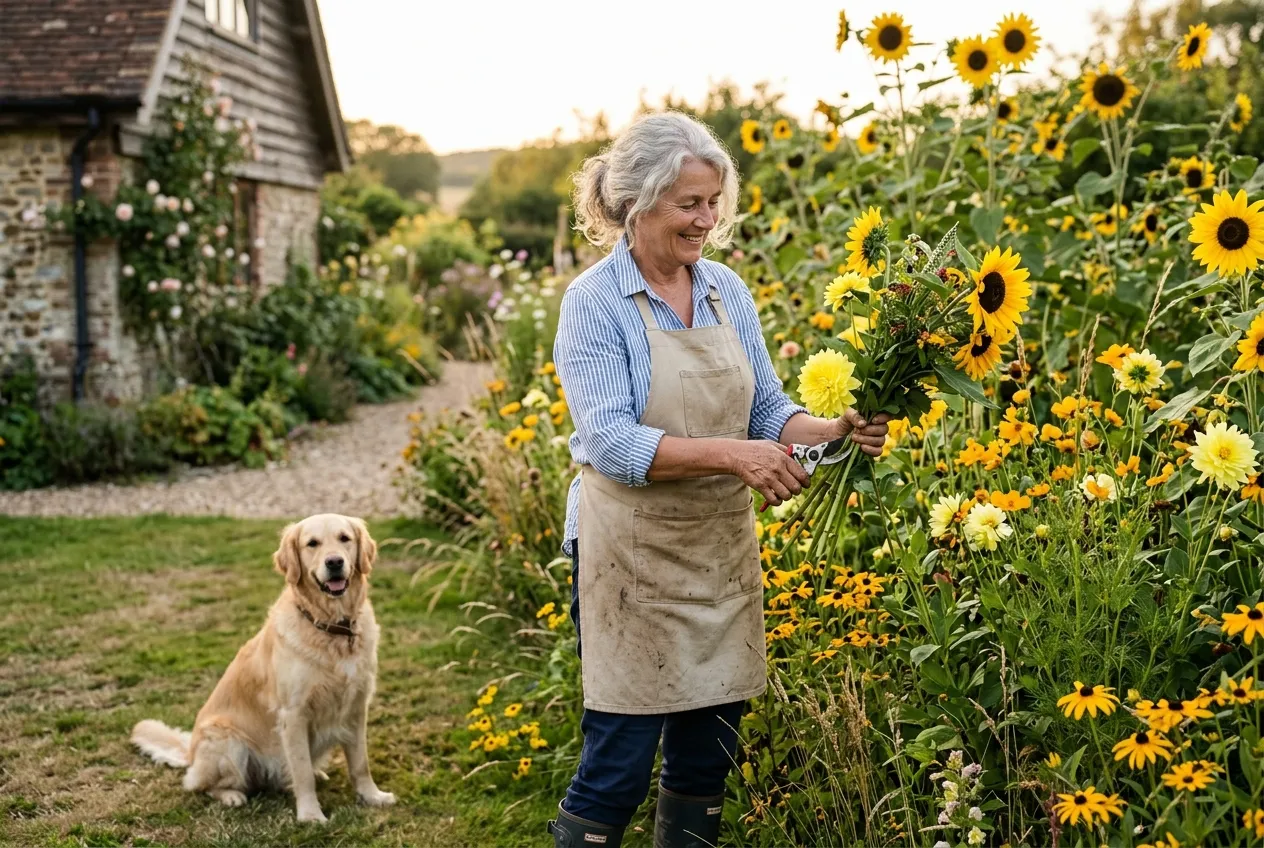
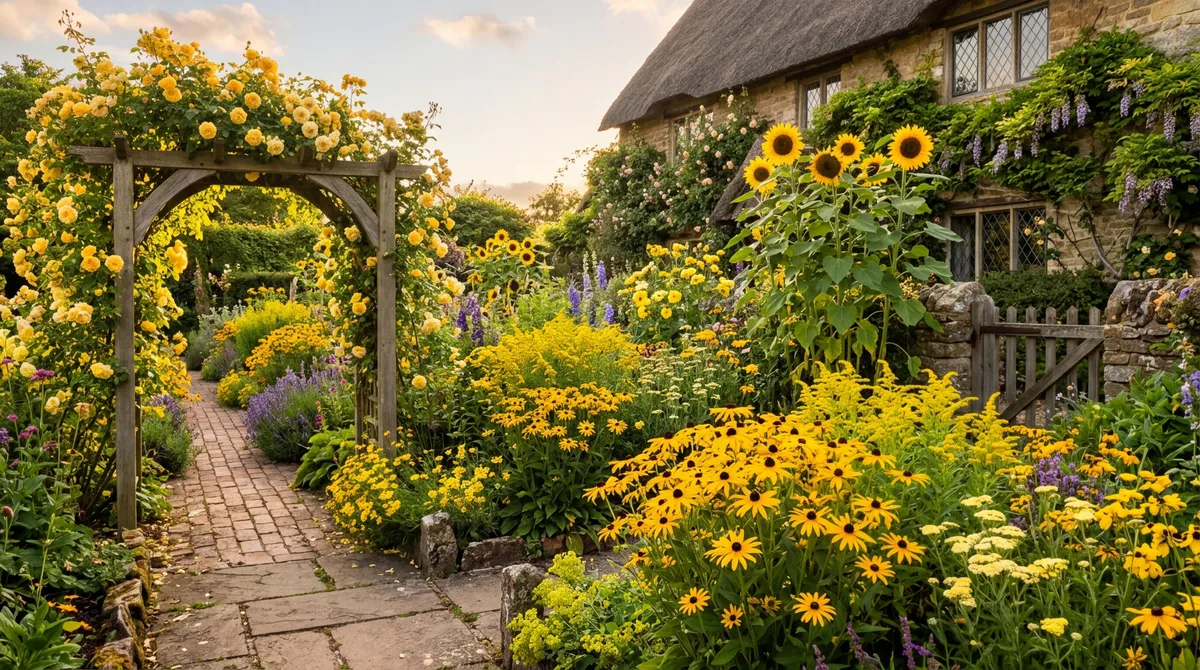
Late summer yellow borders are ideal for cutting gardens. Sunflowers and dahlias provide the tallest, most dramatic stems for vases.
Sunflowers (Helianthus annuus)
Sunflowers are the tallest and most recognisable yellow flowers in British gardens. Dwarf varieties (‘Little Becka’) stay at 30-40cm. Giant varieties (‘Russian Mammoth’) reach 300cm in 12 weeks from seed. Branching varieties like ‘Velvet Queen Mix’ produce 15-20 side stems for continuous cutting from July to September.
Sow indoors in April or direct in May after the last frost. Sunflowers need full sun, shelter from wind for tall varieties, and regular watering during establishment. A single flower head produces up to 2,000 seeds, feeding goldfinches and greenfinches through autumn and winter. See our sunflower growing guide for the full sowing method.
Height: 30-300cm. Flowers: July to September. Soil: Any fertile, well-drained. Hardiness: Half-hardy annual.
Rudbeckia (Rudbeckia fulgida ‘Goldsturm’)
Rudbeckia ‘Goldsturm’ is the single best yellow perennial for UK gardens. It flowers for 12-14 weeks from July to October without deadheading, producing hundreds of golden-yellow daisies with dark brown central cones at 60cm. It spreads steadily by rhizomes to form dense clumps over 3-5 years and tolerates clay, chalk and loam without complaint. It holds an RHS Award of Garden Merit.
On my own heavy clay, ‘Goldsturm’ has survived -15C winters, summer drought and waterlogging without any intervention since planting in 2019. It is fully pest-free in UK conditions. For a taller option, Rudbeckia laciniata ‘Herbstsonne’ reaches 200cm with lemon-yellow flowers from August to October.
Height: 60cm. Spread: 45cm. Flowers: July to October (12-14 weeks). Soil: Any. Hardiness: H7 (-20C).
Coreopsis (Coreopsis verticillata ‘Zagreb’)
Coreopsis ‘Zagreb’ is the neatest long-flowering yellow perennial. Thread-leaved foliage at 30cm supports masses of small golden daisies from June to September. It never needs staking, tolerates poor soil, and is drought-resistant once established. ‘Moonbeam’ offers a paler lemon-yellow at the same height.
Coreopsis performs best in full sun on well-drained soil. It struggles on wet winter clay — on heavy soils, improve drainage with grit or grow in raised beds. Divide clumps every 3-4 years in spring to maintain vigour.
Height: 30cm. Spread: 30cm. Flowers: June to September. Soil: Well-drained. Hardiness: H7 (-20C).
Yellow dahlias
Yellow dahlias provide the boldest late-summer colour. ‘Bishop of York’ (60cm, single orange-yellow, dark foliage) and ‘Kelvin Floodlight’ (120cm, dinner-plate yellow, 25cm flower heads) are the two strongest yellow performers in UK trials. Dahlias flower from July to the first hard frost, typically mid-November in mild areas.
Plant tubers 10-15cm deep in May after the last frost. Lift tubers in November and store frost-free over winter, or mulch heavily in mild areas to overwinter in the ground. See our full dahlia growing guide for storage and overwintering methods.
Height: 60-120cm. Flowers: July to November. Soil: Fertile, well-drained. Hardiness: H3 (lift or mulch for winter).
Yellow roses
Yellow roses repeat-flower from June to October, giving 5 months of colour. ‘Graham Thomas’ (David Austin, 120cm, deep golden-yellow, strong fragrance) is the best-known yellow rose in UK gardens. ‘Golden Celebration’ offers larger cupped blooms. For ground cover, Rosa ‘Flower Carpet Gold’ stays at 60cm and covers 90cm of ground.
Yellow roses need full sun (minimum 6 hours), fertile soil, and a spring feed with rose fertiliser (high potassium). Most yellow varieties are more susceptible to blackspot than pink or red cultivars — spray preventatively with a fungicide from May or choose disease-resistant varieties like ‘Graham Thomas’.
Height: 60-180cm. Flowers: June to October. Soil: Fertile, well-drained. Hardiness: H6 (-20C).
Best yellow flowers for autumn
Autumn yellow extends the season well into November when most colours have faded.
Helenium (Helenium ‘Sahin’s Early Flowerer’)
Helenium is the richest autumn yellow. ‘Sahin’s Early Flowerer’ produces waves of orange-red and gold daisies from July to November at 90cm. Pure yellow varieties include ‘Butterpat’ (90cm, clear yellow, August to October). Helenium thrives on moisture-retentive clay and tolerates partial shade. It holds an RHS AGM and is one of the best late-season pollinator plants.
Divide clumps every 3 years in spring to prevent die-back at the centre. Support stems with pea sticks in exposed positions. Helenium pairs with ornamental grasses and asters for classic autumn borders.
Height: 90cm. Flowers: July to November. Soil: Moisture-retentive. Hardiness: H7 (-20C).
Chrysanthemums
Chrysanthemums extend yellow into late autumn. Hardy garden chrysanthemums (‘Clara Curtis’ in yellow, ‘Mary Stoker’ in apricot-yellow) flower from September to November at 60-90cm. Korean hybrids are the hardiest group for UK gardens, surviving -15C without lifting.
Plant in spring in full sun on well-drained soil. Pinch growing tips in May and June to encourage bushy growth and more flowers. Hardy chrysanthemums are genuinely perennial in UK conditions — they come back reliably year after year without protection.
Height: 60-90cm. Flowers: September to November. Soil: Well-drained. Hardiness: H5 to H7.
Goldenrod (Solidago)
Goldenrod produces feathery yellow plumes from August to October. Modern compact varieties like ‘Golden Baby’ (60cm) and ‘Little Lemon’ (30cm) have replaced the old spreading species that gave goldenrod a bad reputation for invasiveness. These newer cultivars clump neatly and do not run.
Goldenrod thrives on poor soil in full sun. It is drought-tolerant once established and attracts late-season pollinators. The feathery plumes dry well for winter arrangements.
Height: 30-90cm. Flowers: August to October. Soil: Any well-drained. Hardiness: H7 (-20C).
Best yellow flowers for winter
Winter yellow is rare and therefore high-impact. Three plants carry yellow through the darkest months.
Winter jasmine (Jasminum nudiflorum)
Winter jasmine is the most reliable yellow flower from December to March. Bright yellow star-shaped flowers appear on bare green stems throughout the coldest months, unfazed by frost, snow or wind. It grows on any aspect including north-facing walls, reaching 3m as a wall shrub or trailing down banks.
Winter jasmine is not self-supporting — tie stems to wires or trellis. Prune hard after flowering in March to prevent a tangled mass. It tolerates any soil, any pH, and complete neglect.
Height: 3m (wall-trained). Flowers: December to March. Soil: Any. Hardiness: H6 (-20C).
Mahonia (Mahonia x media ‘Charity’)
Mahonia produces fragrant yellow flower spikes in deep shade from November to February. The lily-of-the-valley-scented yellow racemes reach 30cm long on a bold architectural evergreen shrub at 3-4m. ‘Charity’ is the most widely planted variety. ‘Winter Sun’ is more compact at 2m.
Mahonia grows in full shade on any soil. The spiny evergreen foliage provides year-round structure. Blue-black berries follow the flowers and are eaten by blackbirds and thrushes through spring.
Height: 3-4m. Spread: 2-3m. Flowers: November to February. Soil: Any. Hardiness: H6 (-15C).
Witch hazel (Hamamelis x intermedia)
Witch hazel produces spidery yellow flowers on bare branches from January to March. ‘Pallida’ is the best pure yellow with a sweet fragrance that carries in cold winter air. The flowers withstand -10C without damage. Autumn foliage turns vivid orange and gold before leaf drop.
Witch hazel needs acid to neutral soil (pH 5.0-7.0) and resents chalk. It is slow-growing, reaching 3-4m in 15-20 years. Plant as a specimen in a visible position — the winter flowers are wasted if hidden at the back of a border.
Height: 3-4m (after 15 years). Flowers: January to March. Soil: Acid to neutral, moisture-retentive. Hardiness: H7 (-20C).
Best yellow flowers for shade
Yellow is especially effective in shade because it reflects available light. These five species flower reliably in partial to full shade.
| Plant | Flowers | Height | Shade tolerance | Soil |
|---|---|---|---|---|
| Welsh poppy | May-Sep | 30-45cm | Full shade | Any moist |
| Primrose | Feb-May | 10-15cm | Dappled shade | Moist clay/loam |
| Winter jasmine | Dec-Mar | 3m (trained) | North-facing walls | Any |
| Mahonia | Nov-Feb | 3-4m | Full shade | Any |
| Yellow loosestrife | Jun-Aug | 90cm | Heavy shade | Wet clay |
Welsh poppies (Meconopsis cambrica) deserve special mention. Native to Wales and south-west England, they self-seed freely in cracks, walls and shaded corners, producing lemon-yellow cup-shaped flowers from May to September without any attention. They are the easiest yellow-flowering plant in the UK. See our guide to the best plants for shade for more options.
Best yellow flowers for cutting
A cutting garden focused on yellow produces stems from March to November.
Spring cuts: Daffodils (cut when the bud is at “goose neck” stage, just before opening). Tulip ‘Strong Gold’ (45cm, classic goblet shape, lasts 10 days in water).
Summer cuts: Sunflowers (cut when petals are just opening for 7-10 day vase life). Dahlias (cut in early morning into warm water, lasts 5-7 days). Coreopsis (small but prolific, adds texture to mixed arrangements).
Autumn cuts: Chrysanthemums (the longest-lasting cut flower at 14-21 days in water). Helenium (6-8 days). Rudbeckia seed heads (dried, for winter arrangements).
For a full year-round cutting garden layout, see our cutting garden guide.
Best yellow flowers for containers
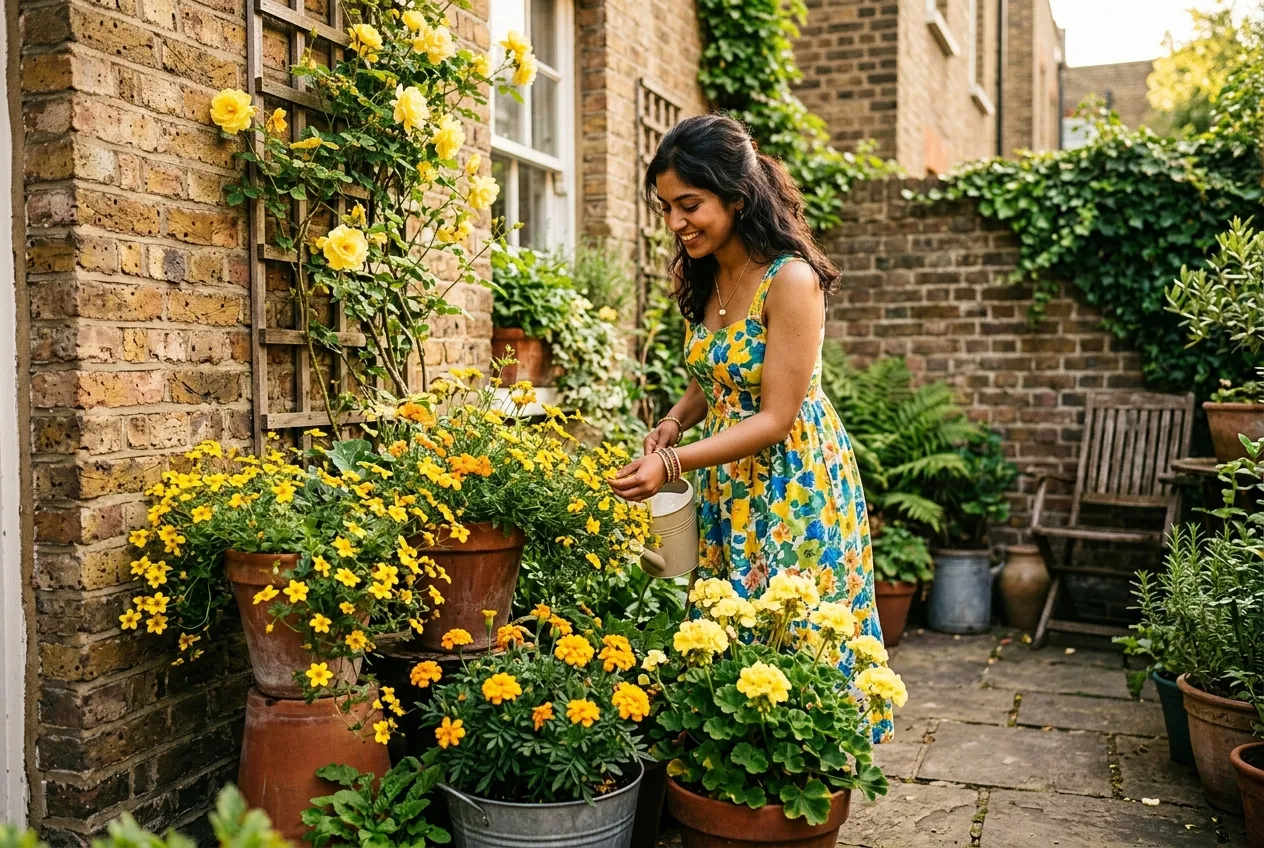
Yellow container planting brings colour to even the smallest courtyard. Trailing bidens, French marigolds, and yellow climbing roses on a trellis create impact in under 2 square metres.
Yellow container plants flower for months with minimal care. The best performers are:
Bidens ferulifolia — Trails 40-60cm from hanging baskets and window boxes. Small golden flowers from June to October. Self-cleaning (no deadheading needed). Needs regular watering in hot spells but tolerates brief drought.
French marigolds (Tagetes patula) — Compact at 20-30cm. Masses of orange-yellow double flowers from May to first frost. Excellent in pots, window boxes and edging. The pungent foliage deters whitefly when planted near tomatoes in a greenhouse.
Dwarf daffodils (‘Tete-a-tete’) — Plant bulbs in October, 8cm deep in pots of multipurpose compost. Flowers appear in February to March at 15cm. Leave to die back naturally after flowering, then store pots dry or plant bulbs out into the garden.
Yellow geraniums (Pelargonium) — Drought-tolerant, flowering May to September. Perfect for south-facing balconies and windowsills where other plants scorch.
Best yellow flowers for pollinators
Yellow flowers evolved to attract pollinators. Bees detect yellow wavelengths (550-580nm) five times more readily than red, which is why most wildflowers visited by bees are yellow. According to the RHS Plants for Pollinators initiative, yellow-flowering plants are among the most important for supporting wild bee populations.
The top five yellow pollinator plants for UK gardens are:
- Sunflowers — a single flower head supports 500+ bee visits. Plant branching varieties for more flowers.
- Rudbeckia — attracts bees, butterflies and hoverflies continuously from July to October.
- Coreopsis — visited by solitary bees and small butterflies from June to September.
- Mahonia — critical winter nectar source when almost nothing else flowers.
- Forsythia — early spring nectar for bumblebees emerging from hibernation in March.
The National Garden Scheme’s open gardens showcase many of the UK’s best pollinator-friendly planting schemes, including several renowned yellow-themed borders.
Yellow flowers comparison table
This table covers every yellow flower in this guide with flowering period, height, sun needs and soil tolerance.
| Plant | Type | Flowers | Height | Sun | Soil | Hardy |
|---|---|---|---|---|---|---|
| Daffodil | Bulb | Feb-May | 15-45cm | Sun/part shade | Any drained | H7 |
| Forsythia | Shrub | Mar-Apr | 250cm | Sun/part shade | Any | H7 |
| Primrose | Perennial | Feb-May | 10-15cm | Part shade | Moist | H7 |
| Sunflower | Annual | Jul-Sep | 30-300cm | Full sun | Fertile | HH |
| Rudbeckia | Perennial | Jul-Oct | 60cm | Sun/part shade | Any | H7 |
| Coreopsis | Perennial | Jun-Sep | 30cm | Full sun | Drained | H7 |
| Yellow dahlia | Tuber | Jul-Nov | 60-120cm | Full sun | Fertile | H3 |
| Yellow rose | Shrub | Jun-Oct | 60-180cm | Full sun | Fertile | H6 |
| Helenium | Perennial | Jul-Nov | 90cm | Sun/part shade | Moist | H7 |
| Chrysanthemum | Perennial | Sep-Nov | 60-90cm | Full sun | Drained | H5-7 |
| Goldenrod | Perennial | Aug-Oct | 30-90cm | Full sun | Any drained | H7 |
| Winter jasmine | Climber | Dec-Mar | 300cm | Any aspect | Any | H6 |
| Mahonia | Shrub | Nov-Feb | 300-400cm | Full shade OK | Any | H6 |
| Witch hazel | Tree/shrub | Jan-Mar | 300-400cm | Sun/part shade | Acid-neutral | H7 |
| Welsh poppy | Perennial | May-Sep | 30-45cm | Full shade OK | Any moist | H7 |
| Loosestrife | Perennial | Jun-Aug | 90cm | Shade OK | Wet clay | H7 |
| Bidens | Annual | Jun-Oct | 40-60cm trail | Full sun | Any | HH |
| French marigold | Annual | May-frost | 20-30cm | Full sun | Any | HH |
| Tulip (yellow) | Bulb | Apr-May | 30-60cm | Full sun | Drained | H7 |
H7 = hardy to -20C. H6 = hardy to -20C. H5 = hardy to -15C. H3 = hardy to -5C (lift or mulch). HH = half-hardy (killed by frost).
Field report: yellow borders on heavy Midlands clay
Trial location: GardenUK Trial Plot, West Midlands (Mercia Mudstone clay, pH 6.8-7.2) Date range: March 2018 to March 2026 Conditions: South-facing border (3m x 8m), unimproved clay, exposed to westerly winds
I planted a dedicated yellow test border in March 2018 with 25 varieties across all four seasonal groups. After 8 years of observation, the standout finding is that rudbeckia, helenium and daffodils are essentially indestructible on heavy clay. All three have spread significantly without any feeding, dividing or soil improvement. Coreopsis struggled in the first two winters on waterlogged clay until I added 5cm of horticultural grit around the crowns. Witch hazel failed entirely on my alkaline clay (pH 7.2) and had to be replaced with mahonia, which thrives. The critical lesson: check your soil pH before planting acid-lovers. A simple pH test kit costs under 5 and saves years of frustration.
How to plan a year-round yellow border
A 3m x 1.5m border can hold yellow flowers in every month. Here is the planting plan I use:
Back layer (100-300cm): Forsythia at one end, winter jasmine on wires at the other. One sunflower group (5 plants) for summer height.
Middle layer (50-90cm): Three rudbeckia ‘Goldsturm’, two helenium ‘Butterpat’, one yellow rose (‘Graham Thomas’). These give solid colour from June to November.
Front layer (15-40cm): Daffodils (‘Tete-a-tete’ and ‘February Gold’) interplanted with primroses for February to May. Coreopsis ‘Zagreb’ for summer. Three hardy chrysanthemums for autumn.
Total cost: approximately 65-85 for all plants. The border fills completely by year two and needs only annual pruning of the forsythia and winter jasmine plus division of rudbeckia every 4 years.
For colour combination ideas mixing yellow with white flowers and purple and blue flowers, plan borders where warm yellows sit alongside cool purples for maximum contrast. The complementary colour pairing of yellow and purple is the strongest combination on the colour wheel.
Frequently asked questions
What are the best yellow flowers for a UK garden?
Daffodils, rudbeckia and sunflowers are the three most impactful yellow flowers for British gardens. Daffodils give reliable spring colour from February to May with zero maintenance. Rudbeckia ‘Goldsturm’ flowers for 12-14 weeks from July to October on any soil. Sunflowers reach 150-300cm in a single season and attract pollinators throughout August and September. Together these three plants cover 8 months of yellow without overlapping.
Which yellow flowers bloom all summer in the UK?
Coreopsis ‘Zagreb’ flowers from June to September without deadheading. Rudbeckia ‘Goldsturm’ runs July to October. French marigolds flower from May to first frost. Yellow trailing bidens gives continuous bloom from June to October in containers. For a perennial that returns annually, rudbeckia is the most reliable summer-long yellow — it needs no staking, tolerates clay, and holds its colour in full sun or partial shade.
What yellow flowers grow in shade in the UK?
Welsh poppies, primroses, winter jasmine and mahonia all flower in shade. Welsh poppies self-seed freely in full shade from May to September. Primroses flower in dappled shade from February to April. Winter jasmine flowers on north-facing walls from December to March. Mahonia produces fragrant yellow spikes in deep shade from November to February.
Are yellow flowers good for bees and pollinators?
Yellow flowers attract more pollinators than any other colour. Bees see yellow wavelengths (550-580nm) five times more readily than red. Sunflowers, rudbeckia, coreopsis and marigolds are all high-nectar yellow species. A single sunflower head can support over 500 bee visits in its lifetime. Plant yellow flowers from March to October to provide continuous forage through the full pollinator season.
What are the best yellow flowers for pots and containers?
Bidens ferulifolia trails 40-60cm and flowers yellow from June to October without deadheading. French marigolds give compact colour at 20-30cm from May to first frost. Yellow trailing petunias flower continuously from June to October. For spring, plant dwarf daffodils (‘Tete-a-tete’) in October for February-March flowers at just 15cm tall.
Which yellow flowers come back every year in UK gardens?
Daffodils, rudbeckia, coreopsis, helenium, forsythia and winter jasmine are all fully hardy perennials that return annually. Daffodils naturalise and multiply each year. Rudbeckia ‘Goldsturm’ spreads to form dense clumps over 3-5 years. Forsythia and winter jasmine are long-lived shrubs lasting 20+ years. Plant perennials as the backbone and add annuals like marigolds and sunflowers for extra summer colour.
When should I plant yellow flowers in the UK?
Plant daffodil bulbs in September to October for spring flowers. Sow sunflower seeds indoors in April or direct-sow in May after last frost. Plant rudbeckia, coreopsis and helenium as pot-grown perennials from March to May or September to October. Plant winter jasmine and forsythia from November to March. French marigolds go out after the last frost date, typically mid-May in central England.
Lawrie has been gardening in the West Midlands for over 30 years. He grows his own veg using no-dig methods, keeps a wildlife-friendly garden, and writes practical advice based on real UK growing conditions.