Best Evergreen Shrubs for UK Gardens
Ten best evergreen shrubs for year-round interest in UK gardens. Covers Mahonia, Viburnum tinus, Sarcococca, and more with planting and care advice.
Key takeaways
- Evergreen shrubs hold their leaves year-round, giving gardens structure when deciduous plants are bare
- Sarcococca and Mahonia flower from November to March, filling winter gardens with fragrance
- Aucuba japonica and Fatsia japonica tolerate deep shade where most shrubs fail
- Photinia 'Red Robin' produces vivid red new growth in spring, rivalling any flowering display
- Most evergreen shrubs need minimal pruning — a single trim after flowering keeps them tidy
- Plant evergreens in autumn (September to November) for best root establishment before winter
- A mix of five or six varieties creates interest in every month without seasonal gaps
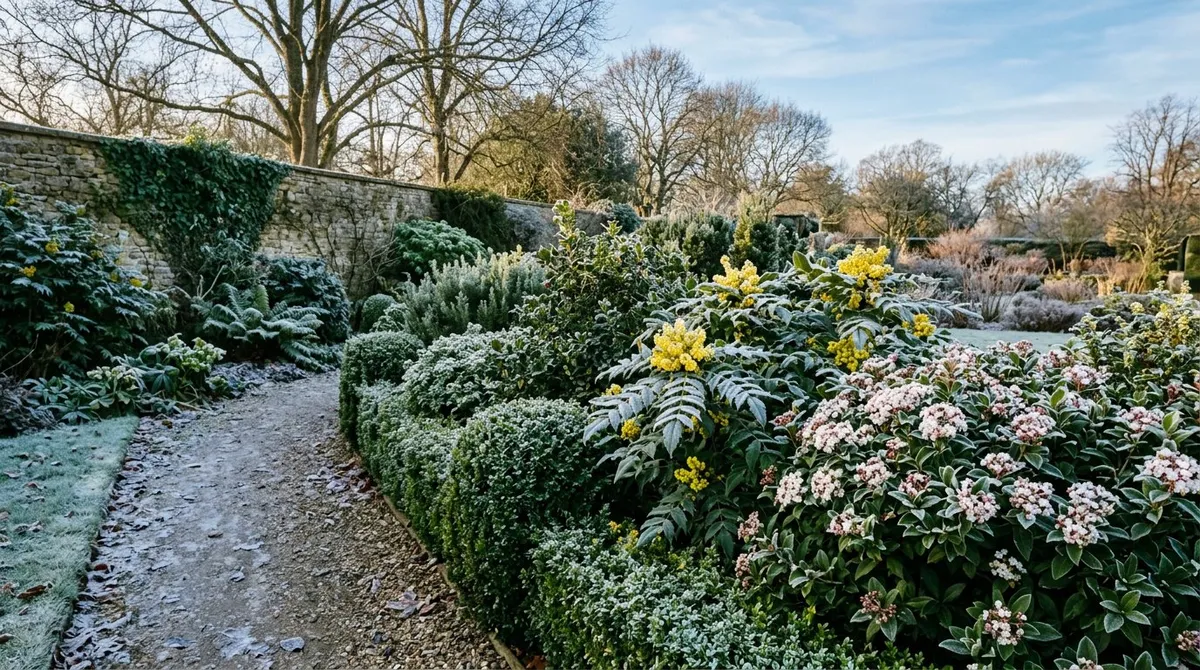
Evergreen shrubs do something no other garden plant can match. They hold their shape, colour, and presence through the bare months of winter when everything else retreats underground. A garden without evergreens looks full in June and empty in January. A garden with a thoughtful mix of evergreen shrubs looks furnished in every season.
The ten shrubs below are chosen for British conditions. All are fully hardy to at least -10C, most to -15C. They cover every garden situation: sun, shade, dry soil, clay, exposed sites, and sheltered corners. Several flower in winter. Others earn their place through foliage, berries, or architectural form. Between them, they ensure something is performing in every month of the year. For shade-specific choices, see our guide to the best plants for shade.
Shrubs for winter flowers and fragrance
Winter-flowering evergreens change the coldest months. While most plants are dormant, these shrubs produce blooms that attract early pollinators and fill the garden with scent on still, frosty mornings. Plant them near doorways, paths, and seating areas to enjoy the fragrance. For a full guide to winter colour, see our winter flowering plants guide.
Mahonia
Mahonia x media ‘Charity’ is the most widely grown cultivar and the best for UK gardens. It produces upright spikes of bright yellow, honey-scented flowers from November to February. The blooms appear at the branch tips above dramatic, pinnate, holly-like leaves that stay deep green all year. Height reaches 3-4m with a 2-2.5m spread. It tolerates shade, dry soil, and cold down to -20C.
Mahonia aquifolium (Oregon grape) is a shorter alternative at 1-1.5m, useful as ground cover or low hedging. It produces blue-black berries after flowering that birds enjoy. Both species handle neglect well. Prune after flowering by removing one in three of the oldest stems at the base to keep the plant bushy rather than leggy.
Viburnum tinus
Viburnum tinus ‘Eve Price’ flowers from October through to April, making it one of the longest-flowering shrubs in UK gardens. The compact pink buds open to clusters of small white flowers. Dark, glossy leaves provide year-round structure. It reaches 2-3m tall and wide, forming a dense, rounded shape without pruning.
This shrub is almost indestructible. It grows in sun or partial shade, tolerates coastal exposure, handles clay or chalk, and survives down to -15C. The blue-black berries that follow the flowers feed birds through spring. Plant it as a hedge, screen, or standalone specimen. Trim immediately after flowering in April to control size.
Sarcococca (Christmas box)
Sarcococca confusa earns its place entirely through fragrance. From December to February, tiny white flowers release an intensely sweet scent that carries several metres on cold air. The plant itself is modest: a neat, dome-shaped shrub reaching 1-1.5m tall with dark, glossy, lance-shaped leaves. Small black berries follow the flowers.
Sarcococca thrives in shade, including dry shade under trees where almost nothing else flowers. It is perfect planted beside a front door, along a path, or under a window. It needs no pruning and no special care. Hardy to -15C. Space plants 60cm apart for a low, fragrant hedge. This is the single best shrub for winter scent in a shaded garden.
Why we recommend Sarcococca confusa for north-facing gardens: After 30 years of trialling winter-interest plants in difficult spots, Sarcococca confusa consistently performs where everything else fails. Planted in dry shade under a north-facing eave, it still flowers reliably from December to February and carries its scent up to three metres on still mornings. No other shrub in that position has ever matched it.
Shrubs for structure and form
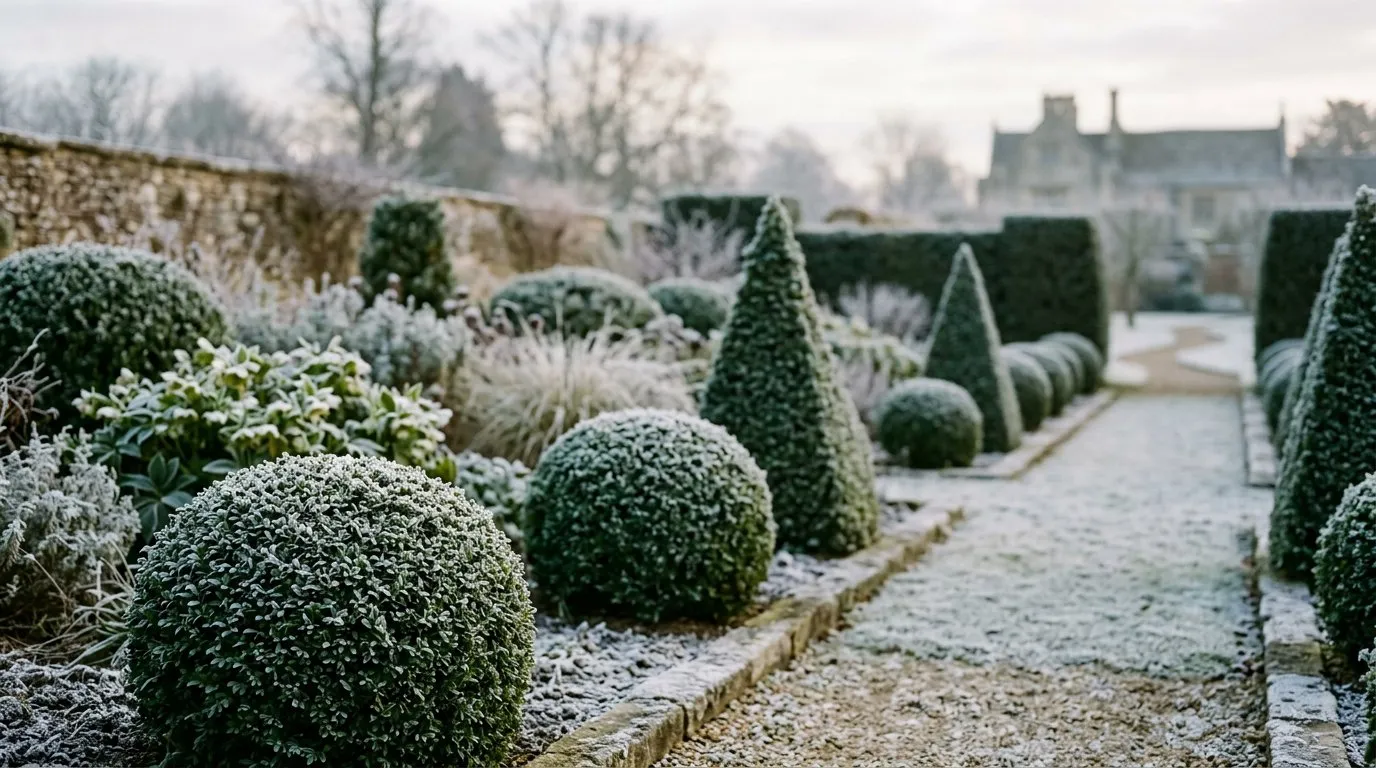
Every garden needs plants that provide a solid framework. These evergreens give year-round shape and act as the backbone of a cottage garden planting scheme or a more formal design.
Rhododendron
Rhododendrons are the showstoppers of spring, but their evergreen foliage provides structure for the other eleven months. Choose compact hybrids for smaller gardens: ‘Christmas Cheer’ reaches just 1.5m, while ‘Cunningham’s White’ tops out at 2m. Larger hybrids like ‘Pink Pearl’ grow to 3-4m and make substantial specimens.
All rhododendrons need acidic soil with a pH below 6.0. On alkaline ground, grow them in large containers of ericaceous compost. They prefer dappled shade and shelter from cold, drying winds. The root system is shallow, so mulch annually with a thick layer of bark or leafmould to conserve moisture. Deadhead spent flower trusses carefully, snapping them off without damaging the growth buds below.
Photinia x fraseri ‘Red Robin’
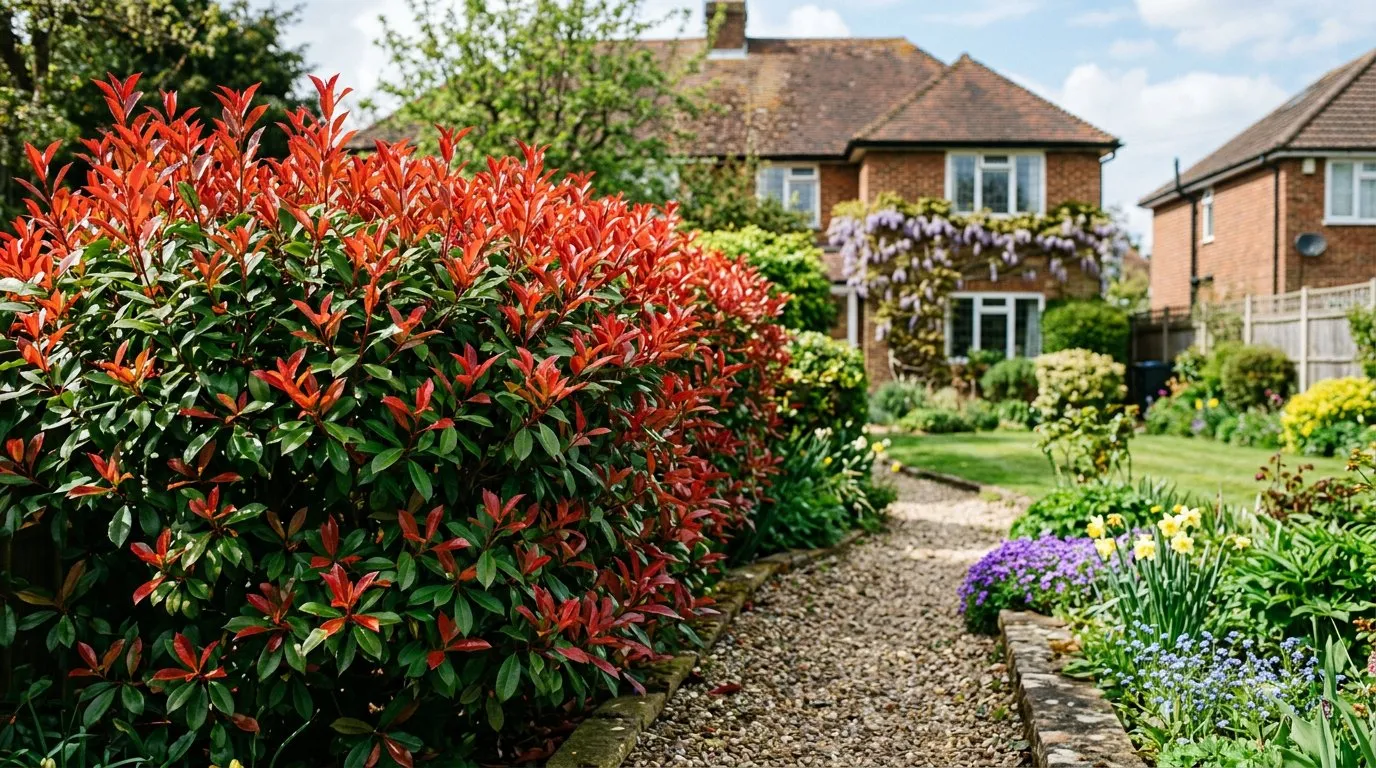
Photinia earns its place through foliage colour rather than flowers. New growth emerges a vivid, glossy red in April and May, creating a display as striking as any blossom. The older leaves are deep green, so the plant looks two-toned in spring. It reaches 3-4m if left unpruned but responds well to clipping.
Trim in late May after the red flush matures to green. A second, lighter trim in August sometimes triggers another flush of red growth in early autumn. Photinia makes an excellent hedge, screen, or standalone specimen. It needs full sun to partial shade and well-drained soil. Hardy to -12C but young plants need protection from harsh east winds. Avoid waterlogged ground, as Photinia is prone to root rot in wet clay.
Fatsia japonica
Fatsia japonica is the most architectural evergreen shrub for UK gardens. The huge, glossy, palmate leaves can reach 40cm across, giving a bold, tropical look. White drumstick flower clusters appear in October and November, followed by black berries. Mature plants reach 2-3m tall and wide.
This shrub excels in shade, including deep shade against north-facing walls. It tolerates pollution, salt spray, and dry spells once established. Hardy to -10C in sheltered spots, though leaf tips may brown in exposed locations. It looks spectacular in a large pot beside a front door or as an understory plant beneath trees. Combine it with ferns and hostas for a lush, layered woodland effect.
Shrubs for difficult spots and ground cover
Not every garden situation is ideal. These evergreens solve common problems: deep shade, poor soil, and the need for low-maintenance ground cover.
Aucuba japonica (spotted laurel)
Aucuba japonica ‘Crotonifolia’ has bold, gold-spotted leaves that brighten the darkest corners. It tolerates deeper shade than almost any other shrub, including the dry, root-filled ground beneath mature trees. Female plants produce bright red berries in autumn if a male plant is nearby. Height reaches 2-3m.
Aucuba handles neglect, pollution, coastal winds, and temperatures down to -15C. It grows in any soil type. Prune in April by cutting back to a leaf joint. The only thing it dislikes is waterlogged ground. For a simpler look, choose ‘Rozannie’, a compact self-fertile cultivar that produces berries without needing a separate male plant.
Euonymus fortunei
Euonymus fortunei varieties are among the most versatile low-growing evergreens. ‘Emerald Gaiety’ has green leaves edged in white, reaching 0.6m tall and spreading to 1m. ‘Emerald ‘n’ Gold’ has gold-edged foliage. Both make excellent ground cover, edging, or small hedging.
These shrubs grow in sun or shade and tolerate most soil types. They are tough enough for exposed sites and handle temperatures to -20C. Use them to fill gaps at the front of borders, edge paths, or cover bare ground beneath taller shrubs. They also climb if planted against a wall, reaching 2m or more. Trim in late spring to keep them tidy and encourage dense, bushy growth.
Skimmia japonica
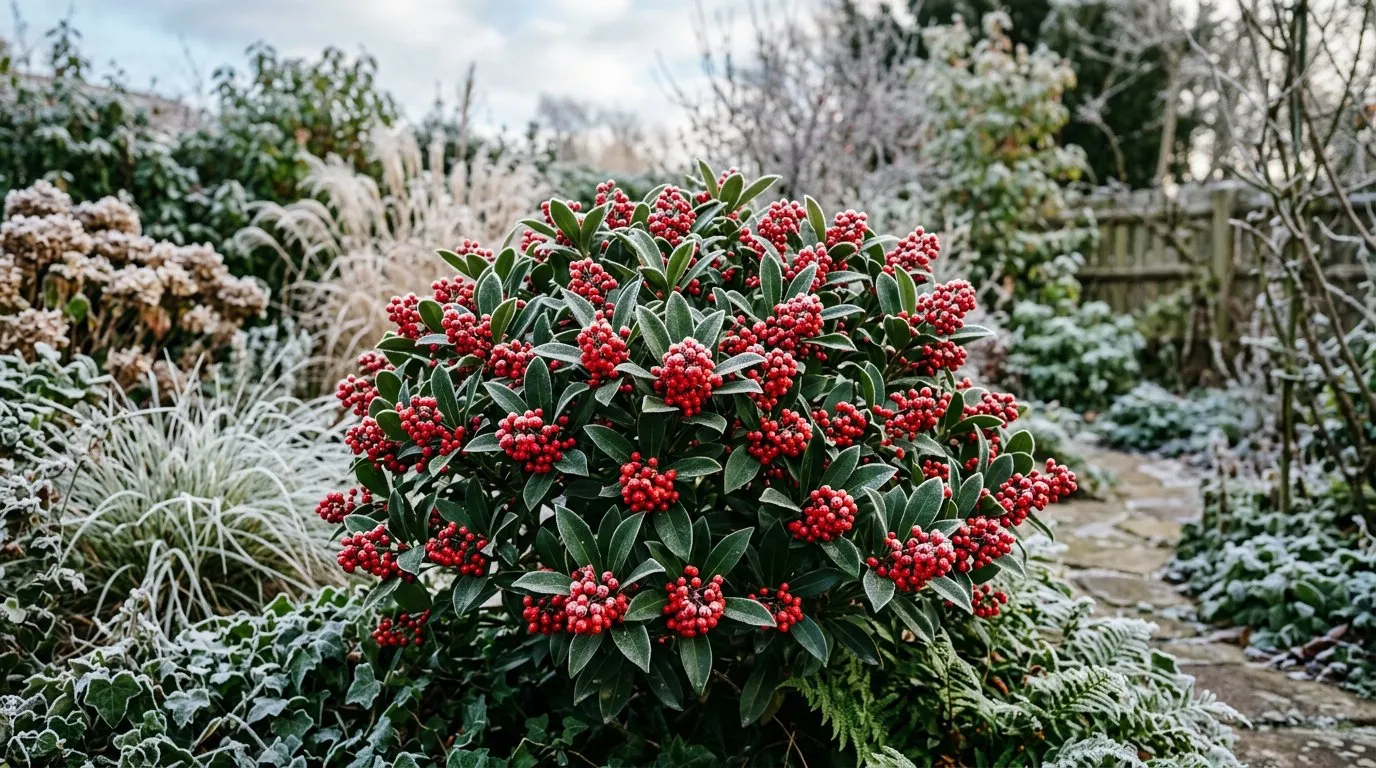
Skimmia is a compact, dome-shaped shrub reaching 1-1.2m. Male plants like ‘Rubella’ produce red flower buds in autumn that persist through winter, opening to fragrant white flowers in March. Female plants produce bright red berries that last from autumn into spring. Plant both sexes for the full display, or choose ‘Reevesiana’, a hermaphrodite cultivar.
Skimmia prefers partial shade and acidic to neutral soil. It struggles on alkaline ground, where leaves yellow from chlorosis. It thrives in containers of ericaceous compost. Virtually no pruning is needed. Hardy to -15C. Excellent for pots beside a front door, in woodland planting schemes, or combined with heathers and rhododendrons.
Shrubs for year-round fragrance
Choisya ternata (Mexican orange blossom)
Choisya ternata has glossy, trifoliate leaves that release a sharp, aromatic scent when crushed. The white, star-shaped flowers appear in May and carry a sweet orange-blossom fragrance. A second, lighter flush often follows in September. It reaches 2-2.5m tall and wide, forming a neat, rounded shape.
Choisya needs a sunny, sheltered spot and well-drained soil. It dislikes cold, wet clay. Plant it against a south or west-facing wall for protection from harsh winter winds. Hardy to -10C in a sheltered position. ‘Sundance’ has yellow-green foliage but flowers less freely. ‘White Dazzler’ is compact at 1.5m with more prolific flowering. Prune lightly after the spring flowering to maintain shape.
Evergreen shrub comparison table
| Shrub | Height | Spread | Flowers | Best feature | Position |
|---|---|---|---|---|---|
| Mahonia x media ‘Charity’ | 3-4m | 2-2.5m | Nov-Feb, yellow | Winter fragrance | Shade to partial sun |
| Viburnum tinus ‘Eve Price’ | 2-3m | 2-3m | Oct-Apr, white/pink | Longest flowering season | Sun or partial shade |
| Sarcococca confusa | 1-1.5m | 1m | Dec-Feb, white | Intense winter scent | Shade, including dry shade |
| Rhododendron (compact hybrids) | 1.5-3m | 1.5-2.5m | Apr-Jun, various | Spring flower display | Dappled shade, acid soil |
| Photinia ‘Red Robin’ | 3-4m | 2-3m | Apr (insignificant) | Vivid red new foliage | Full sun to partial shade |
| Fatsia japonica | 2-3m | 2-3m | Oct-Nov, white | Architectural leaves | Shade, including deep shade |
| Aucuba japonica | 2-3m | 2-3m | Mar-Apr (insignificant) | Tolerates deepest shade | Any position, any soil |
| Euonymus fortunei | 0.6m | 1m+ | Jun (insignificant) | Low ground cover | Sun or shade |
| Skimmia japonica | 1-1.2m | 1m | Mar-Apr, white | Winter buds and berries | Partial shade, acid soil |
| Choisya ternata | 2-2.5m | 2-2.5m | May + Sep, white | Fragrant flowers and foliage | Sunny, sheltered |
Gardener’s tip: When planting evergreens in autumn, water them thoroughly once a week through their first winter if the weather is dry. Evergreen leaves lose moisture all year round, unlike deciduous plants that shut down in winter. A newly planted evergreen with an unestablished root system can dry out and die in a cold, dry February wind even if the soil looks damp on the surface.
How to plant evergreen shrubs
Autumn is the best time to plant evergreens. The soil is warm enough for root growth, and rain is more reliable. September to November gives the plant several months to settle before spring growth begins. Spring planting (March to April) is the second-best window.
Dig a hole twice the width of the root ball and the same depth. Mix the excavated soil with a generous handful of well-rotted garden compost or planting compost. Set the plant at the same depth it sat in its container. Firm the soil gently and water with 10 litres to settle the roots. Apply a 5-8cm mulch of bark or compost, keeping it 5cm clear of the stem.
On heavy clay, improve drainage by mixing sharp grit into the backfill. On thin, chalky soil, add plenty of organic matter to improve moisture retention. For acid-loving species like Rhododendron and Skimmia, test soil pH first with a simple kit from any garden centre.
Pruning evergreen shrubs
Most evergreen shrubs need far less pruning than deciduous types. The general rule is to prune immediately after flowering. For spring-flowering species like Choisya and Rhododendron, this means late May or June. For winter-flowering species like Mahonia and Sarcococca, prune in late March or April. Our guide to pruning shrubs covers techniques for both evergreen and deciduous types in detail.
Photinia and Aucuba are pruned for foliage rather than flowers. Trim these in late spring after new growth has hardened. Photinia can be clipped as a formal hedge two or three times per year. Aucuba tolerates hard renovation pruning if it becomes overgrown, cutting back to 30cm from the ground in April.
Avoid pruning evergreens in autumn or early winter. New growth stimulated by late pruning is vulnerable to frost damage. The exception is removing dead or damaged branches, which you should cut out whenever you notice them.
Designing with evergreen shrubs
The best evergreen plantings combine shrubs of different heights, leaf textures, and seasonal highlights. A planting of five or six different species ensures something catches the eye in every month.
Place tall, architectural shrubs like Fatsia or Mahonia at the back of a border. Use medium shrubs like Viburnum tinus and Choisya in the middle. Edge with low growers like Euonymus fortunei and Sarcococca. This layered approach creates depth and interest even in a narrow border against a fence.
Evergreens work as backdrops for seasonal perennials and bulbs. The dark foliage of Viburnum tinus or Aucuba makes snowdrops, daffodils, and tulips stand out dramatically in spring. In summer, the green framework anchors the border while herbaceous plants provide colour. In winter, the evergreen framework IS the garden.
For formal gardens, use Photinia or Choisya as clipped specimens or hedging. For naturalistic planting, let Mahonia, Fatsia, and Sarcococca grow into their natural shapes. Both approaches work equally well. The key is committing to evergreen structure first and adding seasonal colour around it.
Common problems with evergreen shrubs
Leaf browning in winter usually indicates wind scorch or drought stress rather than cold damage. Evergreens lose moisture through their leaves all winter but cannot replace it if the soil is frozen or the roots have not established. Water new plantings in dry winter spells. Position tender species away from cold east winds.
Yellow leaves on Rhododendron or Skimmia signal lime-induced chlorosis. The soil is too alkaline for these acid-loving plants. Apply ericaceous feed and mulch with pine bark. In severe cases, move the plant to a container of ericaceous compost. Test your soil pH before planting acid-lovers to avoid this problem entirely.
Leggy, bare-based growth on Mahonia or Viburnum happens when plants are left unpruned for years. Most evergreens respond to renovation pruning in April, cutting one-third of the oldest stems to the base each year over three years. This gradual approach maintains some structure while encouraging fresh growth from the base.
Phytophthora root rot affects Rhododendron, Viburnum, and Choisya on waterlogged sites. Symptoms include wilting despite wet soil, dark stem bases, and sudden branch death. There is no chemical cure. Improve drainage before planting, avoid overwatering, and remove infected plants promptly to prevent spread.
Month-by-month evergreen shrub highlights
| Month | What’s performing |
|---|---|
| January | Mahonia in full flower, Sarcococca at peak scent, Viburnum tinus flowering |
| February | Sarcococca and Mahonia still flowering, Skimmia ‘Rubella’ buds at their reddest |
| March | Skimmia flowers open, Aucuba berries bright red, Viburnum tinus still blooming |
| April | Rhododendron buds breaking, Photinia red flush begins, Choisya buds forming |
| May | Choisya in full bloom, Photinia red growth at peak, Rhododendron flowering |
| June | Rhododendron finishing, all shrubs in full leaf, trim spring-flowerers now |
| July | Euonymus neat and fresh, evergreen framework supporting summer perennials |
| August | Second flush of Photinia red if trimmed in June, evergreens providing structure |
| September | Choisya second flowering, Aucuba berries forming, Skimmia buds developing |
| October | Viburnum tinus begins flowering, Fatsia japonica in bloom, autumn berry displays |
| November | Mahonia flowers opening, Sarcococca buds swelling, Skimmia buds reddening |
| December | Sarcococca in flower, Mahonia at peak, evergreens anchoring the winter garden |
The RHS guide to evergreen shrubs provides detailed cultivation notes for hundreds of species suited to British gardens.
Now you’ve mastered evergreen shrubs, read our guide on the best winter flowering plants for the next step.
Frequently asked questions
When is the best time to plant evergreen shrubs?
Autumn, from September to November, is the ideal planting window. Soil is still warm enough for root growth while cooler air temperatures reduce moisture loss through leaves. Spring planting from March to April also works, though the plant has less time to establish before summer heat. Container-grown shrubs can go in year-round, but watering needs are higher with summer planting. Avoid planting into frozen or waterlogged ground.
Do evergreen shrubs lose their leaves in winter?
Evergreen shrubs retain their foliage throughout winter. They shed individual old leaves gradually during the growing season, so the plant always appears fully clothed. In extreme cold below -15C, leaf edges may brown or curl, but plants recover once temperatures rise. Some semi-evergreens like Viburnum x bodnantense may lose a proportion of their leaves in harsh winters but regrow them quickly in spring.
Which evergreen shrubs grow well in shade?
Aucuba japonica tolerates the deepest shade of any common garden shrub, including dry shade under mature trees. Sarcococca confusa flowers reliably in full shade and dry conditions. Fatsia japonica thrives against north-facing walls. Skimmia prefers partial shade and actually scorches in full sun. For dappled shade, Rhododendron and Viburnum tinus perform well. Photinia and Choisya need more light and are poor choices for heavily shaded spots.
How do I prune evergreen shrubs?
Prune spring-flowering types like Choisya and Rhododendron immediately after flowering finishes in late spring. Prune foliage shrubs like Photinia in late May after the red flush hardens. Winter-flowering Mahonia and Sarcococca should be pruned in late March. Use sharp secateurs and cut to a leaf joint or outward-facing bud. Most evergreens need only one annual trim. Avoid pruning in autumn, as new growth triggered by cutting is vulnerable to frost.
Can evergreen shrubs grow in pots?
Many compact evergreens thrive in containers. Sarcococca, Skimmia, Euonymus fortunei, and compact Choisya varieties all suit pots of 30-40 litres. Use loam-based compost (John Innes No 3) for weight and stability. Water regularly even in winter, as pot-grown evergreens dry out faster than ground-planted ones. Feed with a controlled-release fertiliser each April. Top-dress with fresh compost annually and repot completely every 3-4 years.
Which evergreen shrubs have fragrant flowers?
Sarcococca confusa is the most powerfully scented winter-flowering shrub, with sweetly fragrant blooms from December to February. Mahonia produces honey-scented yellow flower spikes from November to March. Choisya ternata has orange-blossom-scented white flowers in May. Viburnum tinus has a subtle sweet fragrance in mild winter spells. For year-round fragrance in the garden, plant Sarcococca near a winter path and Choisya where you sit in summer.
How fast do evergreen shrubs grow?
Growth rates vary from 10cm to 40cm per year. Photinia ‘Red Robin’ is the fastest at 30-40cm annually, reaching 3-4m within a decade. Viburnum tinus and Choisya add 20-30cm per year. Sarcococca and Skimmia are slow at 10-15cm annually. Rhododendron growth depends heavily on soil acidity and moisture. Good soil preparation, autumn planting, and annual mulching all speed establishment. Most reach mature size within 8-12 years.
Are evergreen shrubs deer resistant?
Several common evergreens resist deer browsing. Mahonia has spiny, holly-like leaves that deer avoid. Aucuba and Fatsia are rarely damaged. Rhododendron foliage contains toxins that deer learn to leave alone. Choisya’s aromatic leaves offer some protection. Skimmia and Euonymus are browsed more readily and need protection with netting in deer-prone areas. No plant is completely deer proof, but tough-leaved, spiny, or aromatic evergreens suffer least.
Lawrie has been gardening in the West Midlands for over 30 years. He grows his own veg using no-dig methods, keeps a wildlife-friendly garden, and writes practical advice based on real UK growing conditions.