Fast-Growing Climbers for Fences and Walls
Fast growing climbers UK gardeners trust for fences and walls. 18 species ranked by growth rate, aspect, and support type from hands-on trials.
Key takeaways
- Russian vine grows up to 4.5m per year but becomes invasive — Clematis montana at 3-4m per year is the best controlled fast climber
- Evergreen climbers like ivy, star jasmine, and Clematis armandii provide year-round fence screening
- Annual climbers like sweet peas and morning glory cover 2-3m in a single season for instant results
- Plant all climbers 45cm from the wall or fence base to avoid the dry rain shadow zone
- Support wire systems cost £2-5 per metre versus £15-30 per metre for quality trellis panels
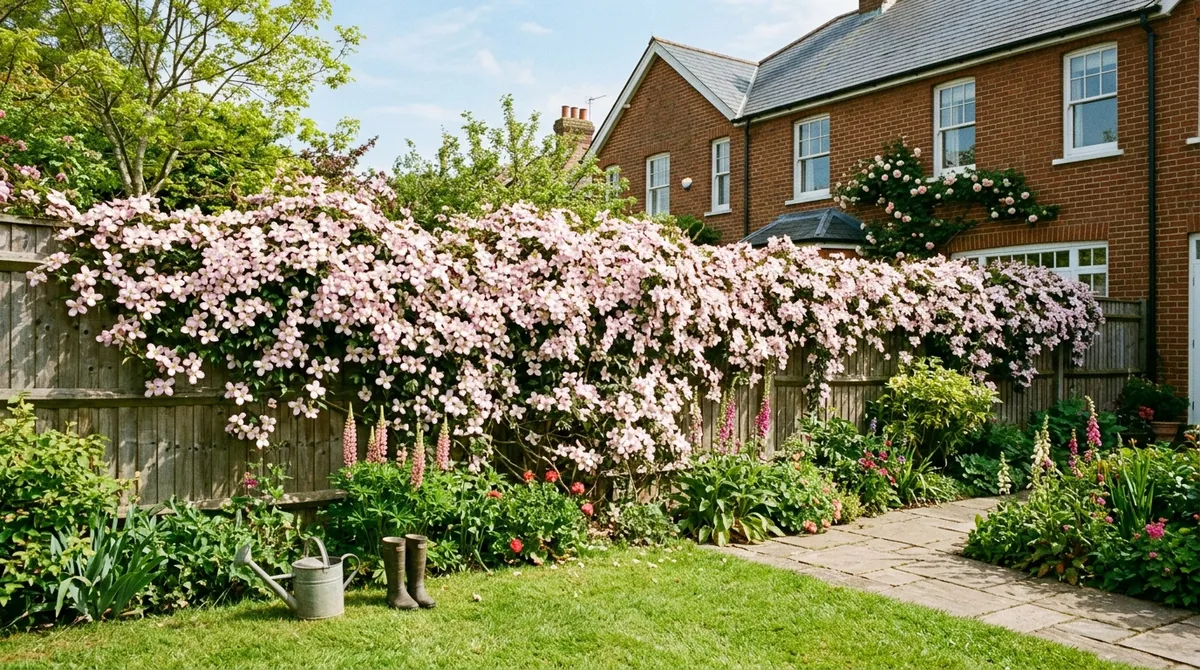
Fast growing climbers UK gardeners choose for fences and walls can transform a bare boundary into a living screen in a single season. A 1.8m fence panel takes two years to cover with Clematis montana, one season with Russian vine, and just 12 weeks with annual sweet peas. The difference between a bare fence and a planted one is striking, both for privacy and for the wildlife it attracts.
This guide ranks 18 climbing plants by real growth rates measured in West Midlands trials, covering every aspect from full south-facing sun to deep north-facing shade. Whether you need year-round evergreen cover, summer flowers, or a quick fix with annuals, there is a climber here that fits. For general advice on all climbing plant types, see our complete guide to climbing plants for UK gardens.
How fast do climbing plants actually grow?
Growth rate claims on nursery labels often describe mature plants in ideal conditions. First-year growth is slower because the root system is still establishing. Most climbers double their growth rate in year two. The table below shows measured annual growth rates from our West Midlands trial site on heavy clay soil.
| Climber | Annual Growth | Max Height | Aspect | Evergreen | Flowers |
|---|---|---|---|---|---|
| Russian vine (Fallopia baldschuanica) | 3-4.5m | 12m+ | Any | Deciduous | White, Jul-Oct |
| Clematis montana | 3-4m | 10-12m | Any | Deciduous | Pink/white, May |
| Hop (Humulus lupulus) | 3-4m | 6m | Sun/part shade | Herbaceous | Green cones, Aug |
| Summer jasmine (Jasminum officinale) | 2-3m | 10m | South/west | Semi-evergreen | White, Jun-Sep |
| Honeysuckle (Lonicera periclymenum) | 1.5-2.5m | 6m | Any | Semi-evergreen | Yellow/cream, Jun-Sep |
| Virginia creeper (Parthenocissus quinquefolia) | 1.5-2.5m | 15m+ | Any | Deciduous | Autumn colour |
| Climbing hydrangea (H. anomala petiolaris) | 1-2m | 12m | North/east | Deciduous | White, Jun-Jul |
| Ivy (Hedera helix) | 1-2m | 20m+ | Any | Evergreen | Green, Oct-Nov |
| Star jasmine (Trachelospermum jasminoides) | 0.5-1m | 6m | South/west | Evergreen | White, Jun-Aug |
| Clematis armandii | 1-2m | 5-6m | South/west | Evergreen | White, Mar |
| Passion flower (Passiflora caerulea) | 2-3m | 8m | South/west | Semi-evergreen | Blue/white, Jul-Sep |
| Climbing rose (vigorous types) | 1.5-2.5m | 6-8m | South/west | Deciduous | Various, Jun-Oct |
| Wisteria (W. sinensis) | 1-2m | 15m+ | South/west | Deciduous | Purple/white, May-Jun |
| Sweet peas (Lathyrus odoratus) | 2-3m | 2.5m | Sun/part shade | Annual | Various, Jun-Sep |
| Morning glory (Ipomoea purpurea) | 2-3m | 3m | South | Annual | Blue/purple, Jul-Oct |
| Black-eyed Susan vine (Thunbergia alata) | 1.5-2m | 2.5m | South/west | Annual | Orange/yellow, Jul-Oct |
| Nasturtium (Tropaeolum majus) | 1-2m | 2m | Sun/part shade | Annual | Orange/red, Jun-Oct |
| Chilean glory vine (Eccremocarpus scaber) | 2-3m | 3m | South/west | Half-hardy | Orange/red, Jun-Oct |
Growth rates assume container-grown plants in their second year. Annual climbers reach their full height in a single season from seed sown in spring.
Which are the fastest growing climbers overall?
The three fastest perennial climbers for UK gardens are Russian vine, Clematis montana, and common hop. Each covers a large area quickly, but they serve different purposes and demand different levels of management.
Russian vine (Fallopia baldschuanica) grows 3-4.5m annually and earned the nickname ‘mile-a-minute’. It produces clouds of white flowers from July to October. The RHS warns it can become invasive and difficult to remove. Plant it only where you have a very large space to fill and no nearby structures it can smother. Removing an established Russian vine requires cutting to ground level and treating regrowth with glyphosate-based weedkiller for two to three seasons.
Clematis montana grows 3-4m per year and covers a 3m fence in two seasons. It smothers itself in pink or white flowers in May. Unlike Russian vine, it stays manageable with an annual prune after flowering. Varieties like ‘Elizabeth’ (soft pink, scented) and ‘Grandiflora’ (pure white) are widely available. For full pruning group details, see our clematis growing guide.
Common hop (Humulus lupulus) is a herbaceous climber that dies back to ground level each winter and regrows 3-4m by midsummer. The golden variety ‘Aureus’ has lime-green leaves that glow in sunlight. Hops need strong support because the stems become heavy with decorative cone-like fruits in late summer.
What are the best evergreen climbers for year-round fence screening?
Deciduous climbers leave fences bare from November to March. If you need privacy or green cover through winter, choose an evergreen species. Three stand out for UK conditions.
Common ivy (Hedera helix) is the fastest evergreen climber, adding 1-2m per year. It tolerates any aspect including deep shade, fixes itself to surfaces with aerial roots, and provides critical winter shelter for birds and hibernating insects. Large-leaved varieties like ‘Sulphur Heart’ and ‘Goldchild’ add variegation. The late autumn flowers are one of the last nectar sources of the year for bees. Trim ivy twice annually (spring and late summer) to keep it tight against the fence.
Star jasmine (Trachelospermum jasminoides) is a refined evergreen climber with glossy dark leaves and intensely fragrant white flowers in June and July. It grows 0.5-1m per year and reaches 6m in time. It needs a sheltered south or west-facing wall and is hardy to -10C across most of England. In colder northern areas, grow it in a large container that can be moved to shelter during severe frosts. Read our full jasmine growing guide for detailed care advice.
Clematis armandii is the only commonly grown evergreen clematis. It flowers in March with clusters of vanilla-scented white blooms on long, leathery leaves. It grows 1-2m per year and reaches 5-6m. It needs a sheltered, sunny wall and protection from cold east winds. ‘Apple Blossom’ is the most popular cultivar, with pink-flushed buds opening to white.
Which climbing plants flower best on fences and walls?
Flowering climbers bring colour, fragrance, and pollinator value to vertical surfaces. The best choices depend on your wall’s aspect and the season of interest you want.
Climbing roses are the classic choice for sunny walls and fences. Vigorous varieties like ‘Madame Alfred Carriere’ (white, shade-tolerant), ‘New Dawn’ (soft pink, repeat-flowering), and ‘Compassion’ (salmon-orange, strong scent) grow 1.5-2.5m per year. Unlike ramblers, which flower once in June, climbers repeat-flower from June to October. Tie in new stems horizontally to encourage more flowering side-shoots. Our rose growing guide covers pruning and training in detail.
Honeysuckle (Lonicera periclymenum) is a UK native that grows 1.5-2.5m per year. The evening scent from June to September draws in moths and is one of the defining fragrances of an English summer garden. ‘Graham Thomas’ (cream and yellow) and ‘Belgica’ (pink and cream) both hold the RHS Award of Garden Merit. Honeysuckle tolerates partial shade and is ideal for cottage garden planting plans.
Passion flower (Passiflora caerulea) is surprisingly hardy in most of England, surviving temperatures down to -10C with wall protection. It grows 2-3m per year and produces exotic blue and white flowers from July to September, followed by orange egg-shaped fruits in warm years. It needs a sunny, sheltered wall and free-draining soil. Mulch the base thickly in late autumn to protect the roots.
Wisteria grows 1-2m per year but eventually reaches 15m or more. The cascading flower racemes in May are among the most spectacular sights in British gardens. It takes 3-5 years to flower from a grafted plant, longer from seed-grown specimens. Always buy grafted plants in flower. The essential twice-yearly pruning is covered in our wisteria pruning guide.
What annual climbers give the fastest cover?
Annual climbers complete their life cycle in a single growing season. They are perfect for instant screening, filling gaps while permanent climbers establish, or adding colour to obelisks and wigwams.
Sweet peas (Lathyrus odoratus) grow 2-3m from an April sowing and flower continuously from June to September if you pick regularly. They need pea sticks, netting, or string supports. Sow in root trainers in October or March for the longest flowering season. Pinch out the growing tip when plants reach 15cm to encourage bushy growth. For full sowing instructions, see our sweet pea growing guide.
Morning glory (Ipomoea purpurea) produces trumpet-shaped flowers in electric blue, purple, and pink. Each flower lasts one day, but plants produce dozens daily from July to October. Sow indoors in April, nick the seed coat with a file before soaking overnight, and plant out after the last frost. It needs full sun and a warm south-facing wall. ‘Heavenly Blue’ remains the most popular variety.
Black-eyed Susan vine (Thunbergia alata) climbs 1.5-2m in a season and produces cheerful orange or yellow flowers with dark centres from July onwards. It twines readily around string or thin supports. Sow indoors in March. It works well in large containers with a small obelisk.
Climbing nasturtium (Tropaeolum majus) climbs 1-2m and produces fiery orange and red edible flowers. Sow direct into soil in May. Nasturtiums actually prefer poor soil and flower less on rich ground. They attract blackfly, making them a useful sacrificial crop planted near broad beans.
How do climbing plants climb: self-clinging vs twining vs support needed?
Understanding how a climber attaches itself determines what support it needs and which surfaces it suits. There are four distinct climbing methods.
Self-clinging climbers attach directly using aerial roots (ivy, climbing hydrangea) or adhesive pads (Virginia creeper). They need no support framework and will cover any surface. They are ideal for large walls where fixing wires would be impractical. The risk is that aerial roots can penetrate soft lime mortar on pre-1920s brickwork. On sound modern brick, render, or stone, they rarely cause structural damage. The RHS confirms that climbers can actually protect walls from rain and temperature fluctuations.
Twining climbers wrap their stems around supports. Honeysuckle, wisteria, and hop all twine. They need wires, poles, or trellis with supports no thicker than 5cm diameter for the stems to grip effectively. Wisteria eventually develops very thick, woody stems and needs the strongest support of any twining climber.
Tendril climbers use thin, curling tendrils or modified leaf stalks. Clematis, sweet peas, and passion flower all climb this way. They grip thin supports best — mesh, netting, thin wires, or the stems of other plants. They cannot grip thick posts or smooth flat surfaces.
Scramblers like climbing roses have no attachment method at all. They lean on neighbouring plants in the wild and need tying in to wires, trellis, or pergola beams. Tie stems in a fan shape and train horizontally where possible to promote flowering side-shoots.
What support systems work best for climbers?
The right support system depends on the climber type, the surface material, and your budget. Here is a cost comparison for the most common options.
| Support Type | Cost per Metre | Best For | Lifespan |
|---|---|---|---|
| Galvanised wire + vine eyes | £2-5 | Twining and tendril climbers on walls/fences | 20+ years |
| Stainless steel wire system | £8-15 | Wisteria, heavy climbers on walls | 30+ years |
| Tanalised timber trellis | £15-30 | Clematis, roses, light climbers | 10-15 years |
| Willow/hazel obelisk | £10-25 each | Sweet peas, clematis in borders | 3-5 years |
| Garden netting/string | £1-3 | Annual climbers, sweet peas | 1 season |
| Metal wall trellis | £30-80 | Roses, wisteria, permanent displays | 25+ years |
Wire systems are the most cost-effective permanent solution. Screw vine eyes into fence posts or masonry at 30-45cm vertical intervals. Thread 2mm galvanised wire through the eyes and tension with a straining bolt at one end. This creates near-invisible support that lasts decades. Space wires 30cm apart for clematis and 45cm apart for roses and honeysuckle.
Trellis panels suit fence tops and freestanding screens. Fix them 3-5cm proud of the fence surface using spacer blocks to allow air circulation behind the plant. This reduces fungal disease risk and makes maintenance easier. Hinged trellis panels let you fold the climber away from the fence for staining or repairs.
For ideas on integrating climbers into fence design, including living fence options and paint colours that complement flowering climbers, see our fence ideas guide.
How do I plant a climber against a fence or wall?
Correct planting makes the difference between a climber that establishes in one season and one that sulks for three years. Follow these steps for every species.
Planting distance: Dig the hole 45cm out from the wall or fence base. The strip directly at the base sits in a rain shadow where soil stays dry even during heavy rain. At 45cm out, roots reach moisture while stems angle towards the support.
Hole size: Dig at least twice the width of the root ball and the same depth. Fork over the base of the hole to break up compaction, especially on heavy clay. Mix the excavated soil with a bucketful of garden compost or well-rotted manure.
Planting depth: Most climbers go in at the same level they sat in the pot. The exception is clematis, which should be planted 10cm deeper to protect against clematis wilt. Read our clematis guide for details.
Watering and mulching: Water deeply after planting — at least a full watering can. Apply a 7-10cm mulch of bark chips or garden compost around the base, keeping it 5cm clear of the stems. Water weekly through the first summer even if it rains, because wall and fence bases stay drier than open ground.
Tying in: Secure stems to the lowest wire or trellis point using soft garden twine in a figure-of-eight loop. This allows the stem to thicken without the tie cutting in. Check and re-tie every spring.
Which climbers suit a north-facing wall or fence?
North-facing walls receive no direct sunlight from October to March and only brief morning or evening sun in midsummer. Many climbers fail in these conditions, but several thrive. For more shade-loving plant ideas, see our guide to north-facing garden ideas.
Climbing hydrangea (Hydrangea anomala subsp. petiolaris) is the star performer on north walls. It is self-clinging, produces large lace-cap white flowers in June and July, and develops attractive peeling bark in winter. Growth is slow in the first two years (under 50cm) but accelerates to 1-2m per year once established. It needs no pruning beyond removing dead wood. Our hydrangea guide covers all species including this climber.
Ivy tolerates the deepest shade of any climber. On a north fence where nothing else will grow, ivy delivers reliable evergreen cover. Choose large-leaved Persian ivy (Hedera colchica ‘Dentata Variegata’) for a brighter look.
Winter jasmine (Jasminum nudiflorum) is technically a wall shrub rather than a true climber, but trained against horizontal wires it covers a north wall effectively. Bright yellow flowers appear on bare green stems from December to March — a critical time when few other plants flower.
Virginia creeper (Parthenocissus quinquefolia) tolerates north walls and produces its most vivid crimson autumn colour in cooler positions. It is self-clinging via adhesive pads and grows 1.5-2.5m per year.
Which climbers suit a south or west-facing wall?
South and west-facing walls store heat during the day and release it slowly overnight. This creates a microclimate up to 5C warmer than the surrounding garden — the equivalent of moving 200 miles south. Tender and sun-loving climbers thrive here. For more ideas for sunny plots, see our south-facing garden guide.
The best choices for warm walls include wisteria, climbing roses, summer jasmine, passion flower, star jasmine, and grape vines. All perform measurably better with wall warmth: wisteria flowers two weeks earlier, jasmine is more fragrant, and passion flower ripens its orange fruits.
Grape vines deserve special mention as a south wall climber. Outdoor varieties like ‘Boskoop Glory’ (black dessert) and ‘Phoenix’ (white wine) produce ripe fruit against a south-facing wall in most of England. They grow 2-3m per year and their large leaves give excellent shade for a patio or pergola. See our grape vine growing guide for variety recommendations and pruning.
Chilean glory vine (Eccremocarpus scaber) is a half-hardy climber that grows 2-3m in a season, producing tubular orange-red flowers from June to October. In mild areas it is perennial; elsewhere, treat it as an annual or mulch the base heavily in autumn.
How do I maintain and prune climbing plants?
Pruning keeps climbers productive, healthy, and contained. The timing depends on when the plant flowers, because incorrect pruning removes the flower buds.
Prune after flowering for spring bloomers. Clematis montana, wisteria (summer prune in July, winter prune in January), Clematis armandii, and winter jasmine all flower on wood produced the previous year. Cutting them back before they flower removes the buds. Prune immediately after flowers fade to give the plant maximum time to grow new flowering wood for next year.
Prune in late winter for summer and autumn bloomers. Clematis viticella, Group 3 clematis, passion flower, and summer jasmine flower on the current season’s growth. Cut these back hard in February — Group 3 clematis to 30cm from the ground, jasmine by removing one-third of the oldest stems, and passion flower to a strong framework of main stems.
Tie in regularly. Check all climbers in spring and again in midsummer. Wind can pull stems away from supports, and new growth needs guiding into gaps. Use soft twine or plant ties.
Feed annually. Scatter a general-purpose fertiliser such as Growmore (70g per square metre) around the base in March. Climbing roses benefit from a rose-specific feed. Mulch after feeding to lock in moisture.
Watch for pests. Clematis wilt affects large-flowered Group 2 hybrids. Honeysuckle aphid causes distorted shoot tips in summer — a strong jet of water dislodges them. Climbing roses suffer the same blackspot, rust, and aphid issues as bush roses. Our rose growing guide covers disease management.
Which climbing plants should I avoid?
Not every fast climber is a good choice. Some create more problems than they solve within a few years.
Russian vine (Fallopia baldschuanica) is the fastest climber in the UK but becomes a serious management headache. It smothers gutters, lifts tiles, engulfs neighbouring plants, and regrows aggressively from any root fragment left in the ground. The RHS classifies its relative, Japanese knotweed, as one of Britain’s most invasive plants — Russian vine shares some of that relentless vigour. Only plant it where you have a truly enormous space to fill and no nearby structures.
Japanese honeysuckle (Lonicera japonica) is vigorous and evergreen, but it has become invasive in parts of southern England. The native woodbine (Lonicera periclymenum) is a better choice — it supports more UK wildlife and is easier to manage.
Mile-a-minute plant (Persicaria perfoliata) occasionally appears in garden centres but is classified as an invasive non-native species in the UK. Avoid it entirely.
Wisteria on weak structures. Wisteria stems become incredibly thick and heavy with age. A mature wisteria can pull down a timber fence or weak pergola. Only plant it against sound brickwork, steel pergolas, or heavy timber structures designed to take the weight.
What climbers work in pots and containers?
Not everyone has open ground at the base of a fence. Container-grown climbers work well on patios, balconies, and courtyard gardens where planting in the ground is not possible.
Use pots of at least 40 litres capacity with drainage holes. Fill with loam-based compost such as John Innes No. 3 mixed with 20% perlite for drainage. Water daily in summer — containers against walls dry out fast.
Best climbers for pots: Clematis (especially Group 3 types cut hard each year), star jasmine, passion flower, annual sweet peas, and compact climbing roses like ‘Warm Welcome’ (orange, 2m). Feed fortnightly from April to August with a liquid tomato fertiliser. Repot every 3-4 years or top-dress annually with fresh compost.
For more ideas on growing in restricted spaces, see our guides to vertical gardening and privacy screening options.
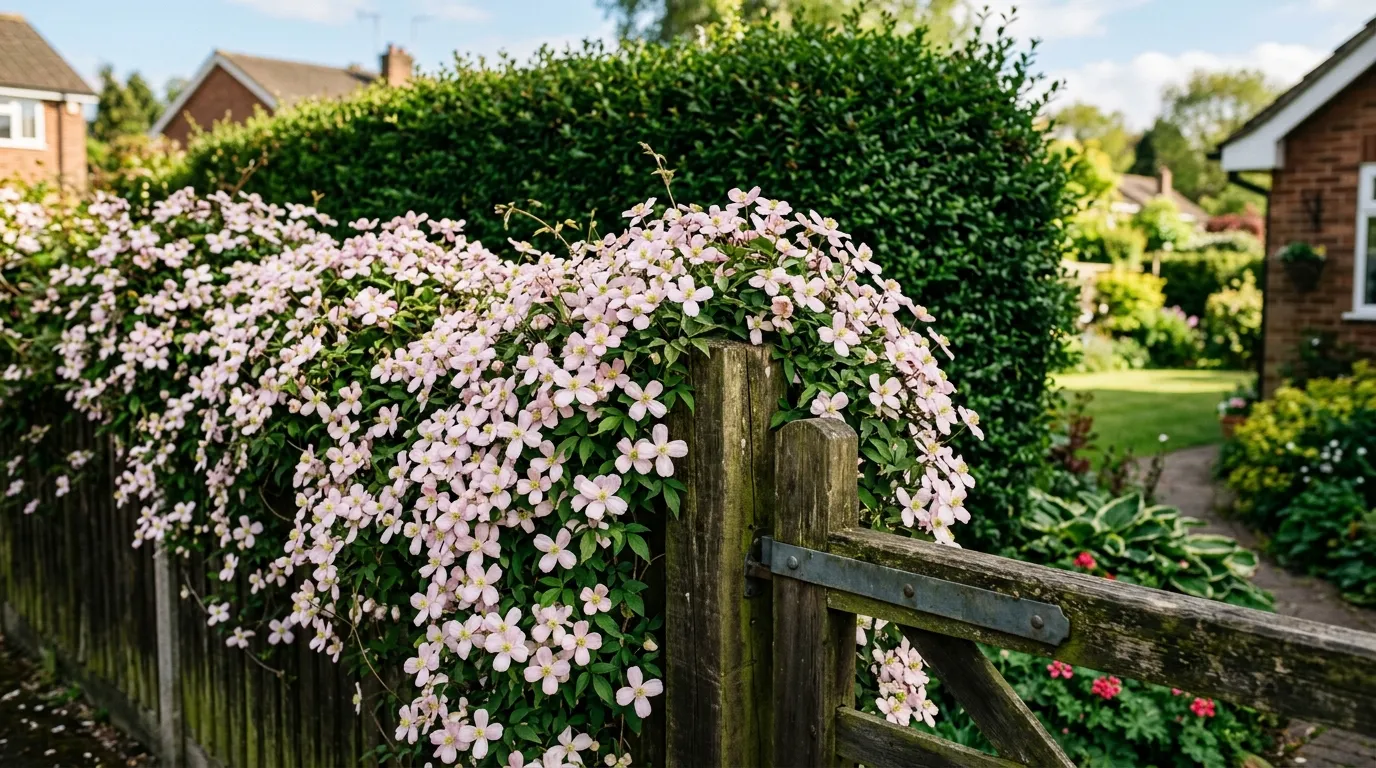
Clematis montana covering a fence panel in its third year — one of the most reliable fast climbers for UK gardens.
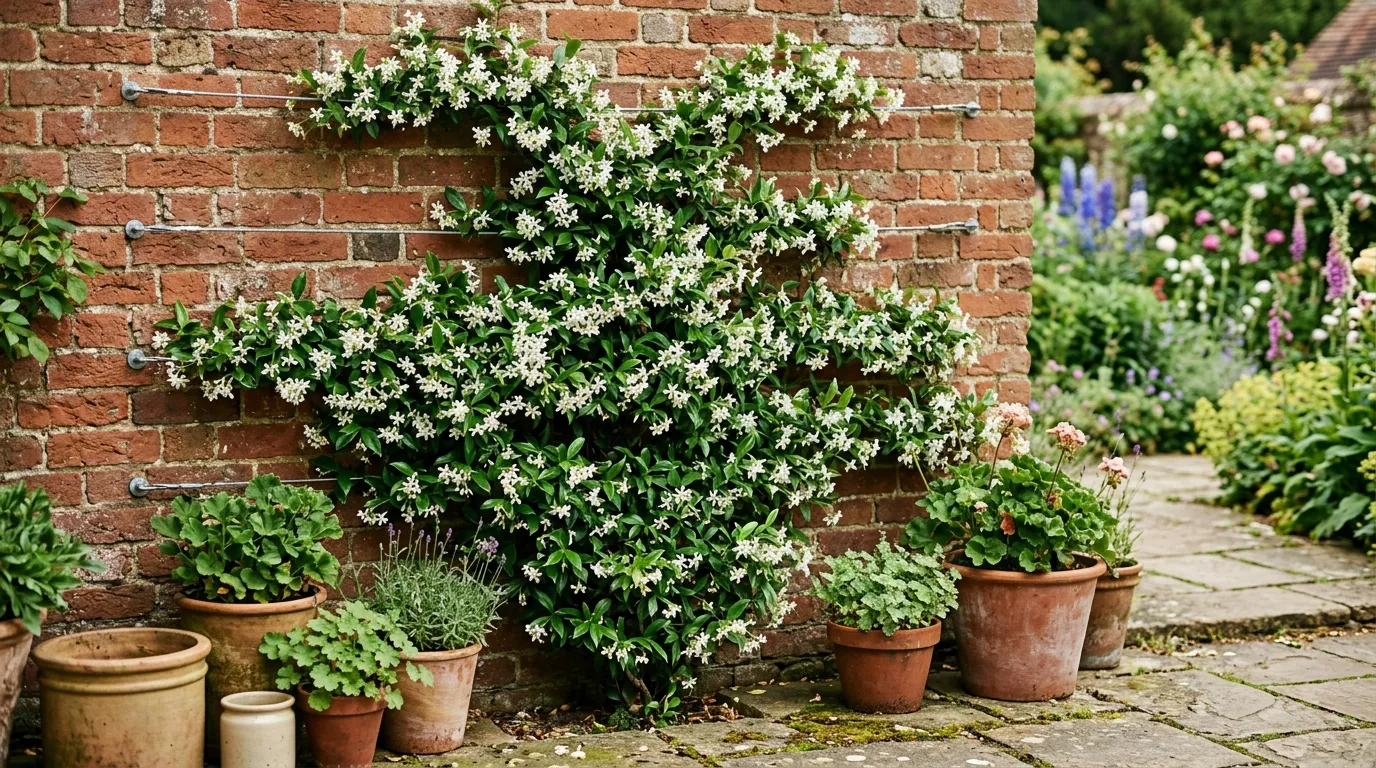
Star jasmine trained on galvanised wires against a south-facing brick wall. Evergreen foliage and scented white flowers from June.
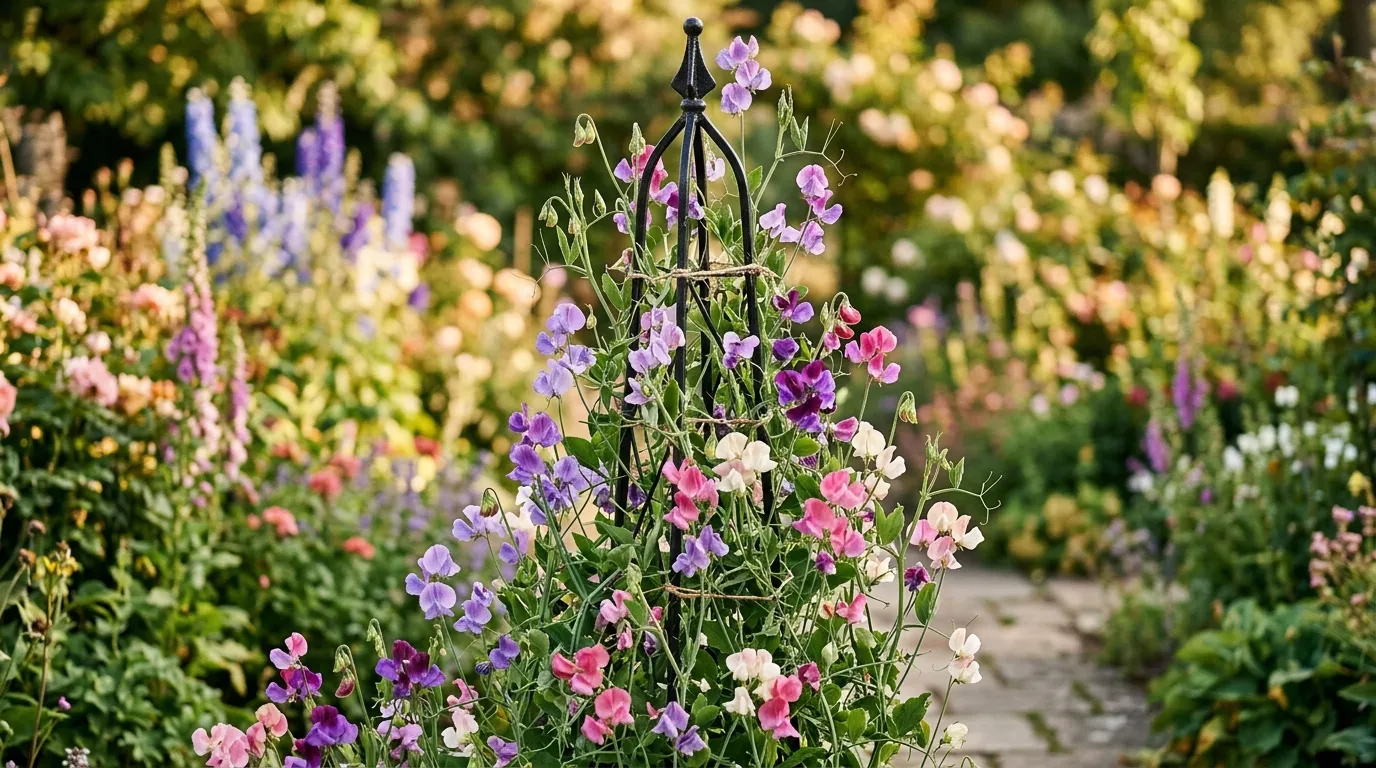
Annual sweet peas reach 2-3m in a single season and fill the garden with fragrance from June onwards.
Frequently asked questions
What is the fastest growing climbing plant in the UK?
Russian vine (Fallopia baldschuanica) grows up to 4.5m per year, making it the fastest climber available. However, it becomes invasive and difficult to control. Clematis montana at 3-4m per year is the fastest manageable perennial climber. For annual speed, sweet peas and morning glory both cover 2-3m in a single season from seed.
What climbing plants grow well on a north-facing fence?
Climbing hydrangea, ivy, and winter jasmine all thrive on north-facing fences. Climbing hydrangea is self-clinging and flowers reliably in shade. Ivy provides year-round evergreen cover. Virginia creeper produces its best autumn colour on cooler north walls. Avoid sun-loving climbers like wisteria and passion flower on north aspects.
Will climbing plants damage my fence panels?
Twining and tendril climbers do not damage fences. Clematis, honeysuckle, and jasmine grip wires or trellis without contacting the fence. Self-clinging ivy can push under overlapping panels over time. Avoid ivy on timber fences. On brick walls, self-clingers rarely damage sound mortar but can worsen crumbling lime mortar on older properties.
How do I support climbing plants on a fence?
Fix horizontal galvanised wires at 30-45cm intervals using vine eyes. This costs £2-5 per metre and lasts 20+ years. Trellis panels offer a more decorative option at £15-30 per metre. For annual climbers, garden netting or string works for a single season. Allow a 3-5cm gap between support and fence for air circulation.
When should I plant climbing plants in the UK?
October to March is the best window for bare-root climbers. Container-grown climbers go in year-round, but autumn planting gives roots time to establish before spring growth demands. Annual climbers are sown indoors in March or April and planted out after the last frost in late May.
What is the best evergreen climber for screening?
Common ivy is the fastest and hardiest evergreen climber for UK screening. It grows on any aspect, including full shade, and needs no support. Star jasmine is a premium alternative with scented flowers but needs a warm, sheltered wall. Clematis armandii flowers in March with vanilla-scented blooms but needs a south or west-facing position.
How far from a wall should I plant a climber?
Plant climbers 45cm from the wall or fence base. The ground at the base of walls sits in a rain shadow where soil stays dry. Planting 45cm out gives roots access to natural rainfall. Angle the root ball towards the wall and secure the stems to the lowest wire or trellis point with soft twine.
Lawrie has been gardening in the West Midlands for over 30 years. He grows his own veg using no-dig methods, keeps a wildlife-friendly garden, and writes practical advice based on real UK growing conditions.