Growing Roses in Containers UK
Growing roses in containers in the UK. Best varieties, pot sizes, compost mixes, feeding schedules and winter care from 10 years of container rose trials.
Key takeaways
- Use pots at least 40cm wide and 40cm deep. Anything smaller dries out within hours in a UK summer and stunts root growth
- John Innes No. 3 mixed with 20% multi-purpose compost gives the weight, drainage, and nutrient retention container roses need
- Feed fortnightly with liquid rose food from March to late August. Stop feeding in September so stems harden before frost
- Patio roses like 'Sweet Dream' and 'Top Marks' stay under 50cm and are purpose-bred for container growing
- Move pots against a house wall in winter or wrap in bubble wrap. Roots in containers freeze faster than roots in open ground
- Repot every three years into fresh compost. Root-bound roses stop flowering even when fed correctly
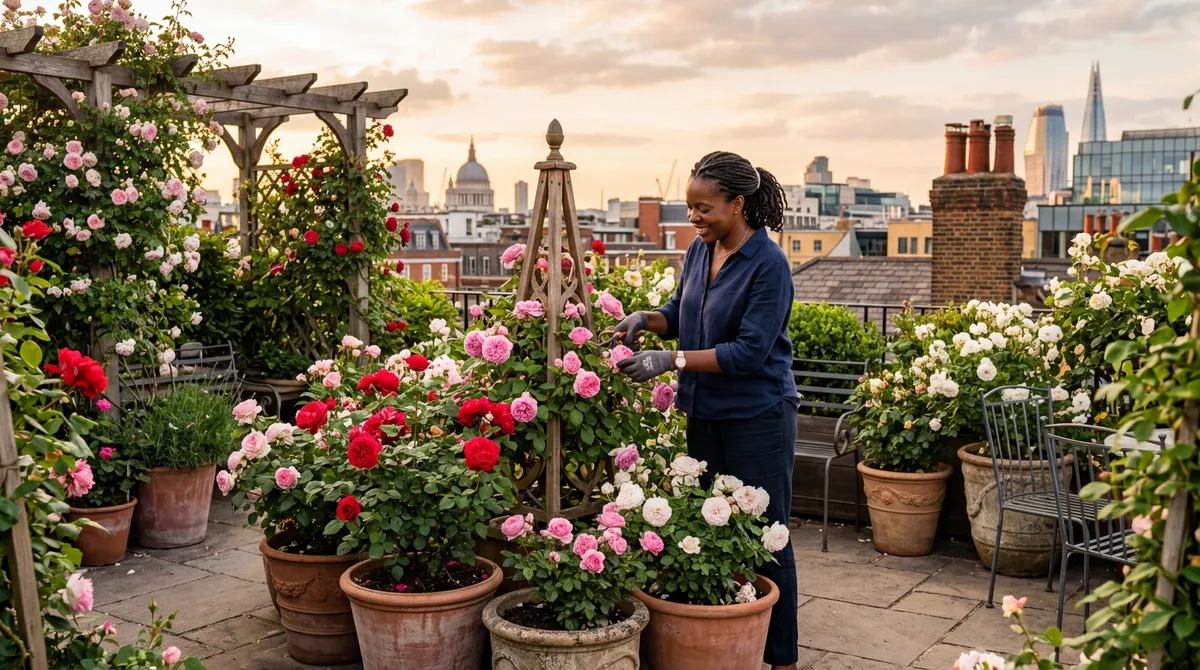
Growing roses in containers works in every UK outdoor space. Balconies, patios, courtyards, rooftops, and doorsteps all suit container-grown roses, provided you get three things right: pot size, compost mix, and feeding schedule. I have been trialling roses in pots across south and west-facing positions in the West Midlands since 2016, testing over 25 varieties in containers ranging from 30cm to 60cm. This guide covers what actually works, drawn from a decade of hands-on results rather than catalogue descriptions.
For the broader picture on rose types and garden planting, see our guide to growing roses in the UK.
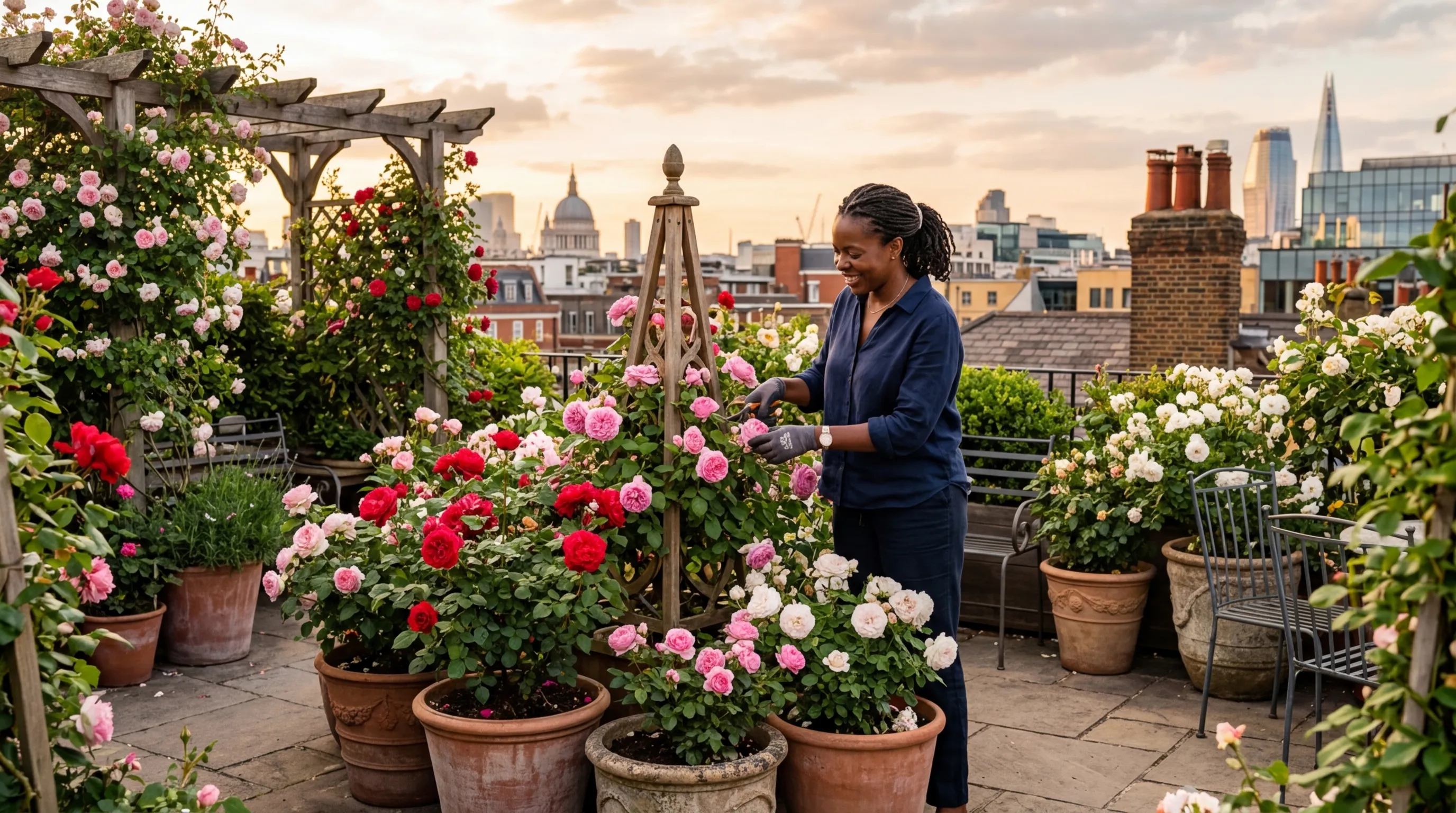
Container roses on a city rooftop terrace. Terracotta and stone pots give the weight and stability roses need.
Which roses grow best in containers?
Not every rose suits a pot. Vigorous hybrid teas and large shrub roses outgrow containers within two seasons and flower poorly when root-bound. The best container roses are compact types bred for restricted root space.
Patio roses are the top choice. These stay between 30cm and 60cm tall, flower continuously from June to October, and produce proportionally large blooms on short stems. ‘Sweet Dream’ (apricot, 45cm) has been the standout performer in my trials. It flowers non-stop for five months with only fortnightly liquid feeding. ‘Top Marks’ (red, 40cm) runs it close, with exceptional disease resistance that means almost no blackspot even in wet Midlands summers.
Miniature roses suit windowsills, table centres, and small balcony pots. They stay under 30cm tall with tiny flowers in clusters. ‘Stars ‘n’ Stripes’ and ‘Little Flirt’ are reliable UK performers. They cope in 25-30cm pots but need daily watering from June onwards.
Compact shrub roses work in larger containers of 50cm or more. David Austin’s ‘Harlow Carr’ (pink, 100cm) and ‘Desdemona’ (white, 100cm) both thrive in pots when given enough root space. These give the scent and flower form that patio roses lack, at the cost of needing bigger pots and more feed.
Small climbing roses trained on obelisks make striking container features. ‘Warm Welcome’ (orange-red, 1.8m) and ‘Phyllis Bide’ (pale yellow, 2.5m) are the best container climbers. Use a 50-60cm pot and a sturdy 1.5m obelisk inserted before planting. For more on climbing varieties, see our guide to climbing roses for UK gardens.
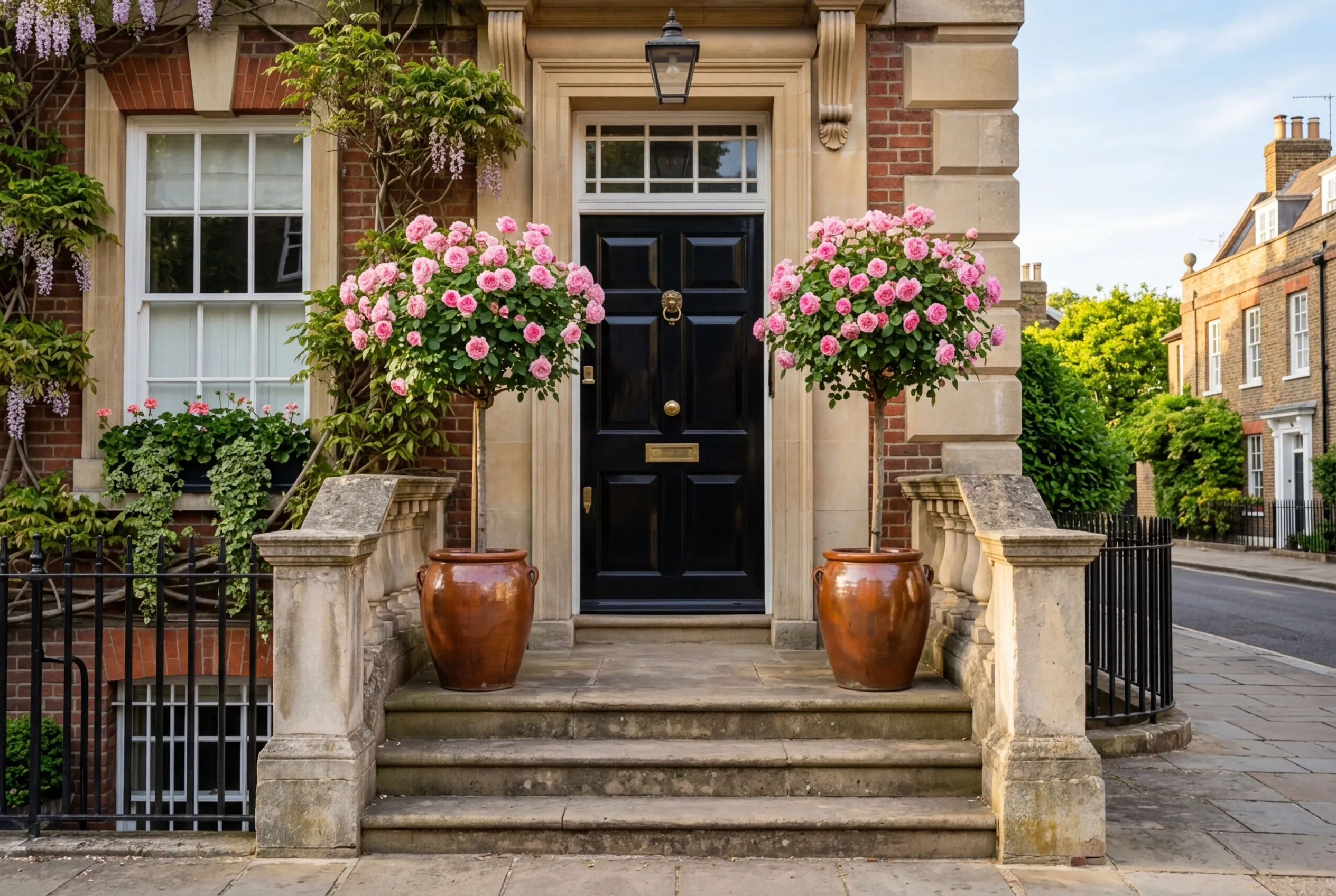
Standard roses in matching pots flanking a front door. This formal look works best with repeat-flowering varieties.
Best roses for containers: comparison table
| Variety | Type | Height | Pot Size | Scent | Flowering | Disease Resistance |
|---|---|---|---|---|---|---|
| Sweet Dream | Patio | 45cm | 35cm+ | Light | Jun-Oct | Excellent |
| Top Marks | Patio | 40cm | 35cm+ | Light | Jun-Oct | Excellent |
| Queen Mother | Patio | 50cm | 40cm+ | Moderate | Jun-Sep | Very good |
| Little Flirt | Miniature | 25cm | 25cm+ | None | Jun-Sep | Good |
| Harlow Carr | Shrub (DA) | 100cm | 50cm+ | Strong | Jun-Oct | Excellent |
| Desdemona | Shrub (DA) | 100cm | 50cm+ | Strong | Jun-Oct | Very good |
| Warm Welcome | Climber | 180cm | 50cm+ | Light | Jun-Oct | Good |
| Phyllis Bide | Climber | 250cm | 55cm+ | Light | Jun-Sep | Very good |
How to choose a container for roses
The container matters as much as the variety. Roses need depth for tap roots, width for lateral spread, and weight for stability in wind.
Minimum size: 40cm diameter and 40cm deep for standard patio and shrub roses. This gives roughly 45 litres of compost. Climbing roses on obelisks need 50-60cm pots. Miniature roses cope in 30cm pots but dry out faster.
Material matters. Terracotta is the best all-round choice. It breathes, preventing waterlogging. It has weight, keeping tall roses stable. It looks right in every setting. Buy frost-proof rated terracotta for UK use. Standard terracotta absorbs water, freezes, and cracks.
Glazed ceramic is attractive and frost-resistant but heavier to move. Plastic is lightweight and retains moisture longer, making it useful for balconies with weight restrictions. Avoid metal containers in full sun as they overheat roots in summer.
Drainage is critical. Every pot needs at least one drainage hole. Cover it with a crock or mesh to prevent compost washing out. Raise pots on feet or bricks so water runs freely. Standing water kills rose roots within days.
What compost to use for roses in pots
The compost mix determines whether a container rose thrives or struggles. Multi-purpose compost alone is too light, dries too fast, and runs out of nutrients by midsummer.
The ideal mix is 80% John Innes No. 3 and 20% multi-purpose compost. John Innes No. 3 is loam-based, heavy, and packed with slow-release nutrients. The multi-purpose adds organic matter and improves texture. Add a handful of perlite per pot if you need extra drainage on a wet balcony.
Never use garden soil in containers. It compacts, drains poorly, and carries soil-borne diseases including rose replant sickness. If you are replacing a rose in a pot, always use fresh compost. For more on container growing mediums, see our container gardening guide.
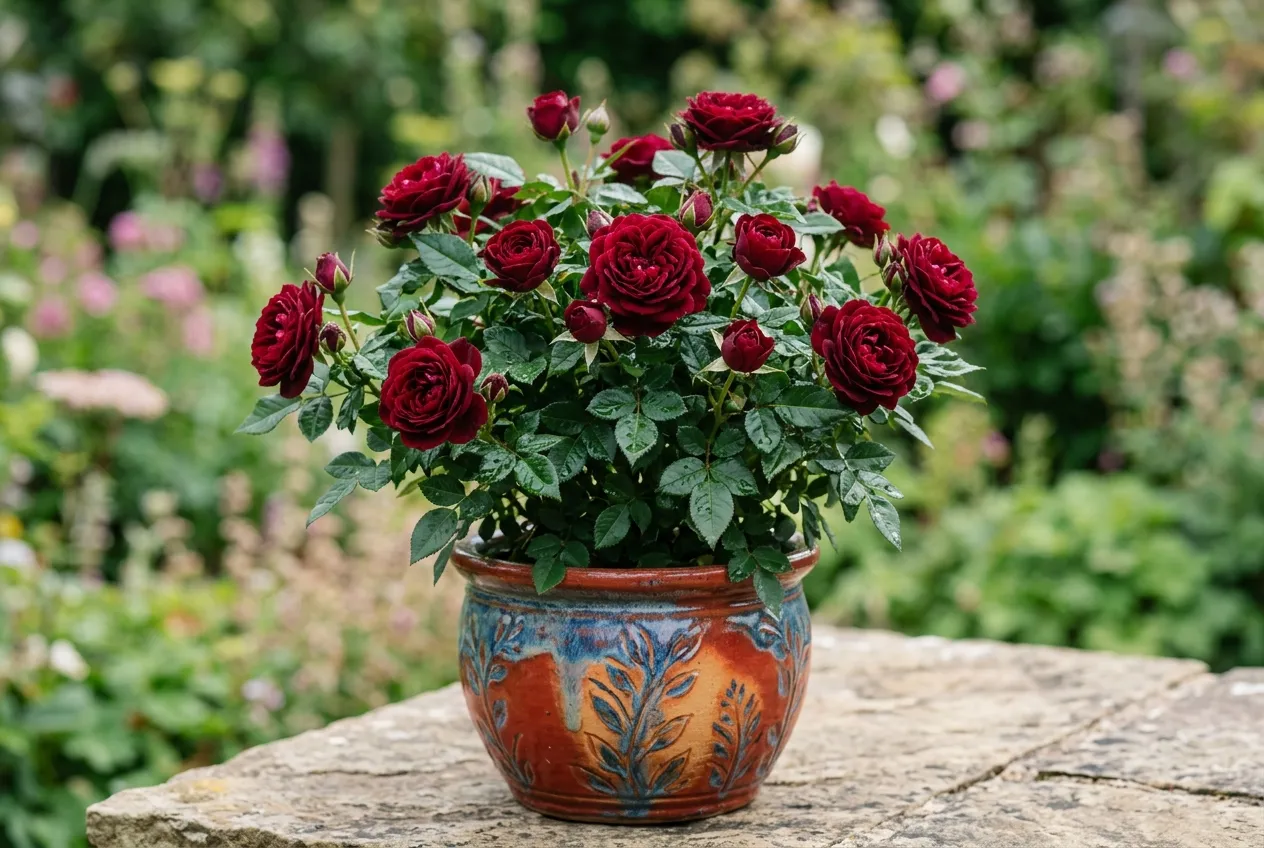
A compact patio rose in a glazed ceramic pot. These varieties stay under 50cm and flower continuously from June.
How to plant a rose in a container
Bare-root roses planted between November and March establish 30-40% faster than container-bought plants and cost significantly less. The RHS growing guide for roses covers bare-root planting principles that apply equally to containers.
Step-by-step method:
- Soak bare-root roses in a bucket of water for 2 hours before planting.
- Place 5cm of crocks or gravel in the bottom of the pot for drainage.
- Half-fill the pot with the John Innes No. 3 mix.
- Position the rose so the graft union (the bulge where the stems meet the rootstock) sits 2-3cm below the pot rim.
- Spread the roots outwards over the compost mound.
- Fill around the roots, firming gently with your fingers every few centimetres.
- Water thoroughly until liquid runs from the drainage holes.
- Mulch the surface with 3cm of bark chips to retain moisture.
Container-grown roses from garden centres can be planted year-round. Tease out circling roots before planting. The graft union should sit at the same depth it was in the original pot.
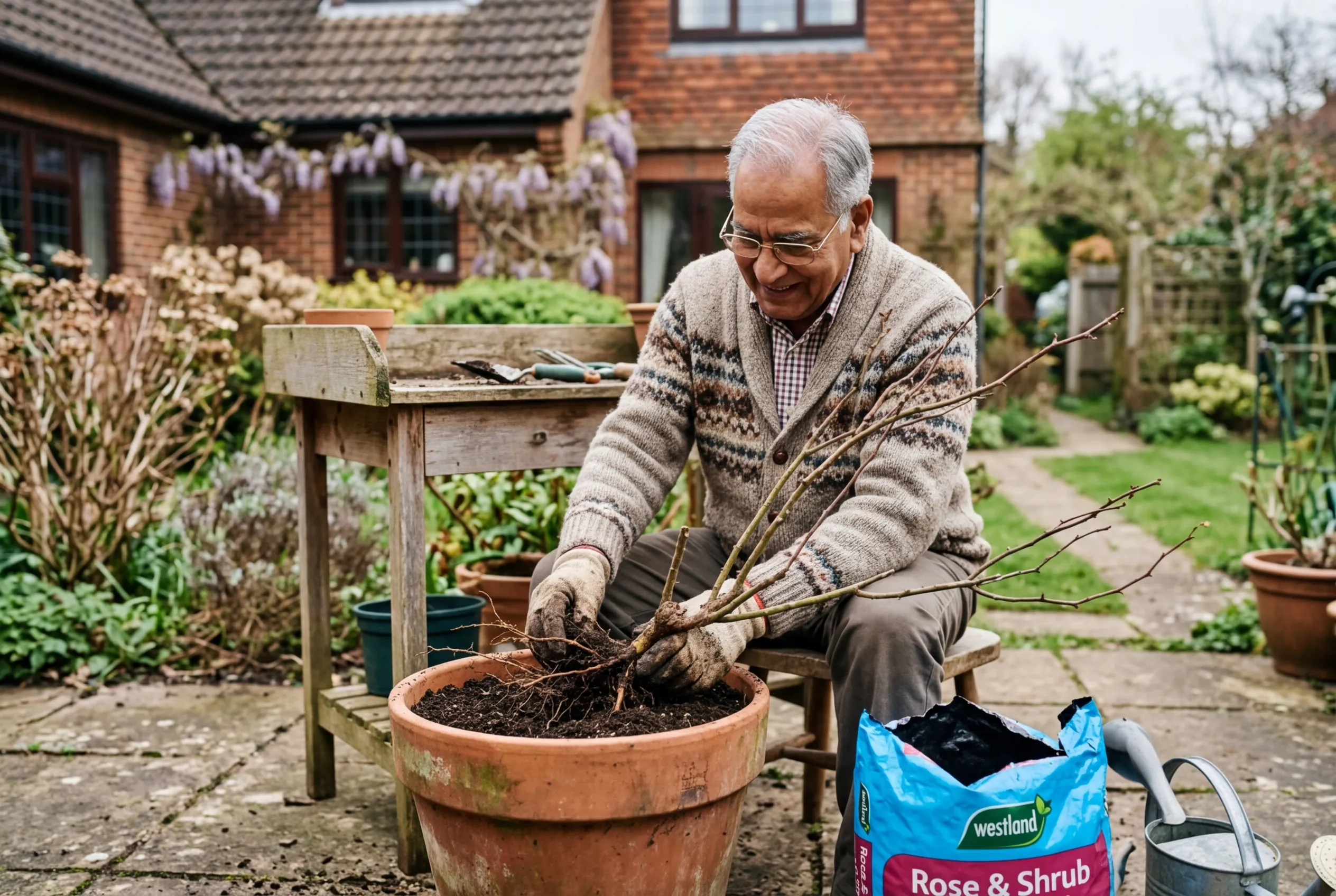
Planting a bare-root rose in late winter. Position the graft union 2-3cm below the compost surface for frost protection.
Feeding roses in containers
Container roses exhaust available nutrients far faster than border roses. A reliable feeding schedule is the difference between a plant that flowers for five months and one that stops by July.
March: Apply a slow-release granular rose fertiliser (such as Vitax Rose Food) to the compost surface. This provides background nutrition for the first 8-10 weeks.
April to August: Feed fortnightly with a liquid rose fertiliser high in potash. Potash drives flower production. Dilute to the manufacturer’s recommended rate. Overfeeding produces soft, disease-prone growth.
September onwards: Stop all feeding. New growth triggered by late feeding will not harden before frost and will be damaged or killed.
Top-dressing: Each March, scrape away the top 5cm of old compost and replace with fresh John Innes No. 3 mixed with a scattering of slow-release granules. This refreshes nutrients between full repots.
How to prune roses in containers
Container roses need lighter pruning than border roses. The root system is restricted, so heavy pruning combined with limited root mass weakens the plant.
Patio and miniature roses: In late February or early March, remove dead, damaged, and crossing stems. Shorten remaining stems by one-third. Cut to an outward-facing bud. Remove any thin, wispy growth thinner than a pencil. For detailed pruning techniques, see our guide to pruning roses.
Compact shrub roses: Follow the same one-third rule but also remove one or two of the oldest stems at the base each year to encourage fresh growth from below.
Climbing roses on obelisks: Remove dead wood and shorten side-shoots to 2-3 buds from the main stem. Do not cut the main structural canes unless they are diseased or overcrowded. Tie in new growth through summer.
Dead-heading is more important than pruning for continuous flowering. Remove spent flowers back to the first leaf with five leaflets. This triggers the next flowering flush within 4-6 weeks. Stop dead-heading in September to allow hips to form, which signals the plant to prepare for dormancy.
Monthly care calendar for container roses
| Month | Task | Detail |
|---|---|---|
| January | Check supports | Tighten obelisk ties loosened by winter wind |
| February | Prune | Remove dead wood, reduce by one-third |
| March | Top-dress and feed | Fresh compost layer + granular rose food |
| April | Start liquid feed | Fortnightly potash-rich liquid fertiliser |
| May | Pest check | Watch for greenfly. Pinch off or use soft soap spray |
| June | Dead-head | Remove spent blooms to trigger second flush |
| July | Water daily | Check moisture every morning in hot spells |
| August | Final feed | Last liquid feed by late August |
| September | Stop feeding | Allow stems to harden for winter |
| October | Tidy | Remove fallen leaves to prevent black spot |
| November | Winter protection | Move pots to sheltered wall or wrap in fleece |
| December | Monitor drainage | Clear blocked drainage holes in wet weather |
Winter protection for container roses
Roots in containers freeze faster than roots in open ground. A border rose tolerates -15C because the surrounding soil insulates the root ball. A container rose in a 40cm pot starts suffering root damage at -5C because the compost volume is too small to buffer the cold.
Move pots against a south or west-facing house wall from November. The wall radiates stored heat overnight and shields from the worst wind. This single step prevents most winter losses in the UK.
Wrap exposed pots in horticultural fleece or bubble wrap if you cannot move them. Focus on the pot itself, not the stems. The roots are more vulnerable than the top growth. Stuff straw or newspaper between grouped pots for extra insulation.
Raise pots off the ground in winter using pot feet or bricks. This prevents the drainage hole sitting in a puddle of frozen water, which kills roots faster than cold air alone.
Avoid heated spaces. Do not bring container roses into a greenhouse or conservatory over winter. Roses need a dormant cold period to flower properly the following year. Protecting from extreme frost is correct. Preventing dormancy entirely disrupts the flowering cycle.
When to repot container roses
Repot every three years in late winter (November to February). After three seasons, the compost structure breaks down, nutrients are exhausted, and roots fill the pot.
Lift the rose from the pot, shake off old compost, and trim any dead or circling roots with clean secateurs. Replant in fresh John Innes No. 3 mix at the same depth. You can reuse the same pot if roots are not excessively crowded. If the root ball fills every centimetre, move up one pot size.
Signs that a container rose needs repotting: flowers becoming smaller despite feeding, water running straight through without soaking in, roots emerging from drainage holes, and the plant drying out within hours of watering.
For rose varieties that also work well in scented garden borders, consider growing duplicates in pots to place near seating areas where you can enjoy the fragrance up close. David Austin Roses offers many compact scented varieties ideal for this dual approach. For a full breakdown of rose types and their habits, our types of roses guide covers every classification.
Frequently asked questions
What size pot do I need for a rose?
A minimum of 40cm diameter and 40cm depth is needed for container roses. This gives roughly 45 litres of compost, enough for healthy root development and moisture retention through a UK summer. Climbing roses on obelisks need 50-60cm pots. Miniature and patio roses cope in 30cm pots, but they dry out faster and need daily watering from June onwards.
Can you grow roses in pots all year round in the UK?
Yes, roses grow in pots year-round in all UK regions. The main risk is winter root freeze, because container soil drops below ground temperature faster than garden borders. Move pots against a south-facing house wall from November, or wrap in horticultural fleece and bubble wrap. Terracotta pots must be frost-proof rated or they crack in hard frosts.
What is the best compost for roses in containers?
John Innes No. 3 mixed with 20% multi-purpose compost is the best mix. The loam-based JI No. 3 provides weight, slow-release nutrients, and moisture retention. The multi-purpose adds organic matter and improves texture. Avoid peat-free multi-purpose alone as it dries out too fast and becomes hydrophobic, shedding water rather than absorbing it.
How often should I water roses in pots?
Water daily in summer and every 2-3 days in spring and autumn. Check by pushing a finger 3cm into the compost. If it feels dry, water thoroughly until liquid runs from the drainage holes. Overwatering in winter is the most common killer of container roses. From November to February, water only when the top 5cm of compost has dried out completely.
When should I repot a container rose?
Repot every three years in late winter, between November and February. Lift the rose, shake off old compost, trim any circling or dead roots, and replant in fresh John Innes No. 3 mix. You can reuse the same pot if root growth is not excessive. If roots fill every centimetre, move up one pot size.
What are the best roses for pots in the UK?
Patio roses are the best type for containers. ‘Sweet Dream’ (apricot, 45cm), ‘Top Marks’ (red, 40cm), and ‘Queen Mother’ (pink, 50cm) are all bred specifically for pot growing. Compact David Austin roses such as ‘Desdemona’ (100cm) and ‘Harlow Carr’ (100cm) also thrive in large 50cm pots.
Do roses in containers need feeding?
Yes, container roses exhaust available nutrients far faster than border roses. Feed fortnightly from March to late August with a liquid rose fertiliser high in potash. Apply a slow-release granular rose feed at the start of March for background nutrition. Stop all feeding by early September so new growth can harden before the first frosts.
Lawrie has been gardening in the West Midlands for over 30 years. He grows his own veg using no-dig methods, keeps a wildlife-friendly garden, and writes practical advice based on real UK growing conditions.