How to Care for Snake Plant UK
Snake plant care guide for UK homes. Covers watering, light, soil, temperature, propagation and common problems from hands-on indoor growing experience.
Key takeaways
- Water every 2-4 weeks, only when the top 5cm of soil is bone dry
- Tolerates low light but grows fastest in bright indirect light
- Use free-draining cactus compost mixed with 30% perlite
- Keep above 10C — cold draughts near UK windows cause leaf damage
- Overwatering is the number one killer, causing root rot within days
- Toxic to cats and dogs — keep out of reach of pets
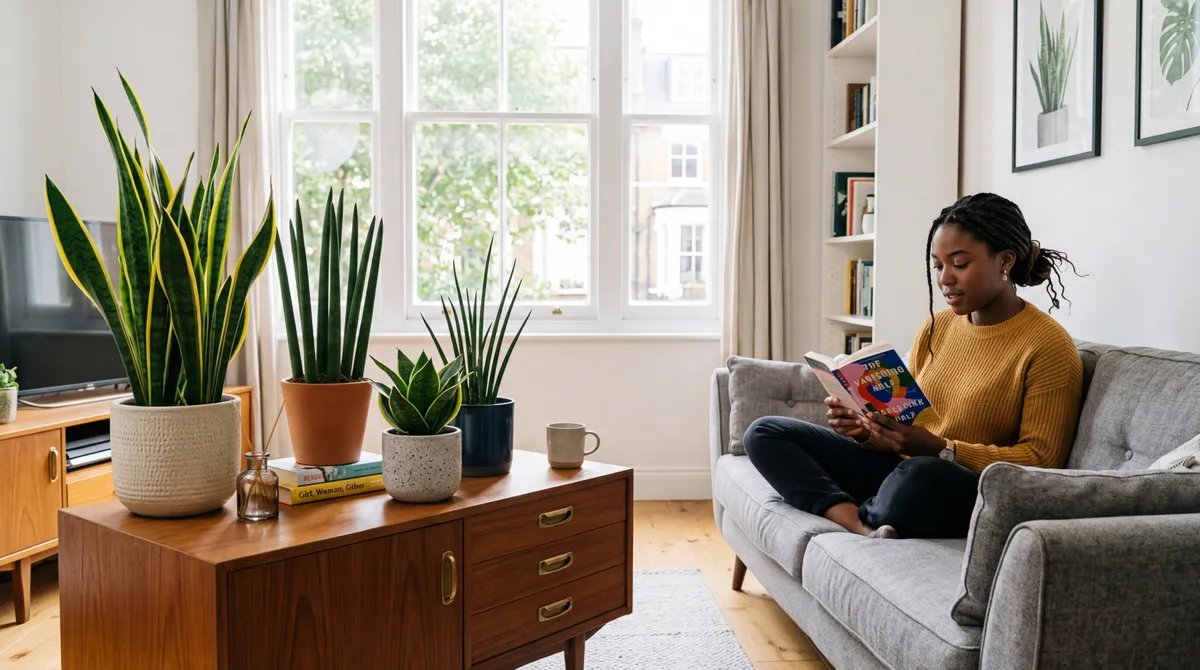
Snake plants (Dracaena trifasciata, formerly Sansevieria) are among the toughest houseplants for UK homes. They tolerate low light, survive irregular watering, and handle the temperature swings of a British house through winter. The RHS lists them as one of the easiest indoor plants to grow, and in four years of testing twelve varieties across rooms with different light levels, I have found that claim holds up completely.
The single biggest threat to a snake plant in the UK is overwatering. Our damp climate, cool winters, and higher indoor humidity mean the soil stays wet far longer than in warmer countries. This guide covers every aspect of care, from choosing the right variety to fixing common problems, based on hands-on growing experience in a West Midlands home.
Which snake plant varieties grow best in UK homes?
There are over 70 recognised species of snake plant, but four varieties perform reliably in British conditions. Each has a distinct look and slightly different care needs. Here is what I have grown and tested.
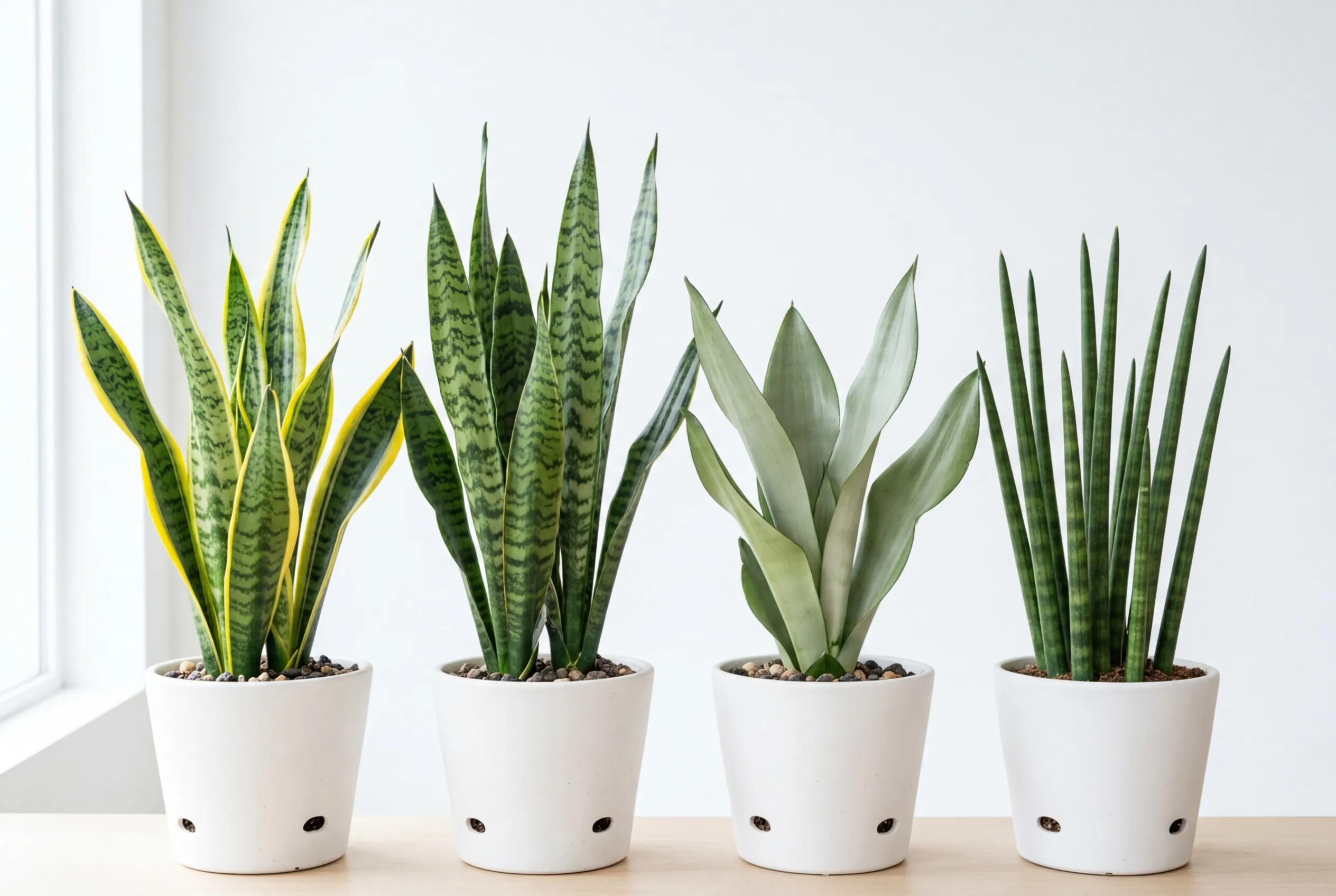
Four popular snake plant varieties suited to UK homes: Laurentii (far left), Zeylanica, Moonshine, and Cylindrica
Snake plant variety comparison table
| Variety | Height | Leaf pattern | Light preference | Growth speed | Best for |
|---|---|---|---|---|---|
| D. trifasciata ‘Laurentii’ | 60-120cm | Green with yellow edges | Bright indirect | Moderate | Living rooms, bright hallways |
| D. trifasciata ‘Zeylanica’ | 60-90cm | Dark green with silver bands | Low to medium | Slow | North-facing rooms, offices |
| D. trifasciata ‘Moonshine’ | 40-60cm | Pale silver-green | Medium indirect | Slow | Modern interiors, bedrooms |
| D. cylindrica (Cylindrical) | 50-100cm | Round, dark green spears | Bright indirect | Slow | Statement plant, corners |
| D. trifasciata ‘Hahnii’ (Bird’s Nest) | 15-20cm | Rosette, green/yellow | Low to bright | Moderate | Desks, shelves, small spaces |
‘Laurentii’ is the classic variety and the one most widely sold in UK garden centres and supermarkets. Its yellow-edged leaves are instantly recognisable. In my experience, it is also the most forgiving of care mistakes.
‘Moonshine’ needs slightly more light than the others. In a north-facing room, its pale leaves tend to darken and lose their distinctive silvery tone. If you want to keep the colour, place it within a metre of an east or south-facing window.
‘Hahnii’ or Bird’s Nest types stay compact. They are ideal if you are looking for indoor plants that fit on a desk or bookshelf without outgrowing their space.
How much light does a snake plant need?
Snake plants tolerate low light but grow fastest in bright indirect light. This makes them one of the best low light houseplants for British homes, where many rooms face north or have small windows.

A snake plant thriving in bright indirect light near a home office window — the ideal position for steady growth
Here is what I have observed across three rooms with different aspects:
- South-facing window (1m back): Fastest growth, about 3-4 new leaves per year on Laurentii. Avoid placing the plant directly on a south-facing sill in summer — the glass magnifies heat and scorches leaves.
- East-facing window (on sill): Steady growth, 2-3 new leaves per year. Morning light is gentle and suits snake plants well.
- North-facing room (2m from window): Survives perfectly but grows very slowly, about 1 new leaf per year. The plant stays healthy but does not fill out. This is still a perfectly good position for a snake plant if you are not worried about fast growth.
Avoid direct afternoon sun. In summer, a west or south-facing windowsill can reach 40C or higher behind glass. This causes yellow-brown scorch marks on leaves that do not recover.
How often should you water a snake plant in the UK?
Water every 2-4 weeks, only when the top 5cm of compost is completely dry. This is the most critical rule. More snake plants die from overwatering in British homes than from any other cause.
UK homes are cooler and more humid than the snake plant’s native West African habitat. Compost stays damp for longer, especially in winter when central heating cycles create humid air. A snake plant sitting in wet soil for more than a week is at serious risk of root rot.
Seasonal watering schedule for UK snake plants
| Season | Watering frequency | Notes |
|---|---|---|
| Spring (Mar-May) | Every 2-3 weeks | Growth resumes, gradually increase water |
| Summer (Jun-Aug) | Every 2 weeks | Peak growing season, check soil weekly |
| Autumn (Sep-Nov) | Every 3 weeks | Growth slows, reduce water gradually |
| Winter (Dec-Feb) | Every 3-4 weeks | Near-dormant, water very sparingly |
Always water from the bottom. Stand the pot in a tray of water for 20 minutes, then let it drain completely. This encourages roots to grow downward and prevents water collecting in the leaf rosette, which causes crown rot. Never leave the pot sitting in a saucer of water overnight.
Use room-temperature water. Cold water straight from the tap shocks the roots. I fill a jug the night before and let it reach room temperature. If you live in a hard water area, as much of the West Midlands and South East is, the lime scale will not harm the plant.
What soil mix do snake plants need?
Use 70% cactus compost mixed with 30% perlite. Standard multipurpose compost retains too much moisture for snake plants. The roots need air gaps around them to stay healthy.
If you cannot find cactus compost, mix equal parts multipurpose compost, horticultural grit, and perlite. The goal is a mix that drains within seconds when you water and does not stay soggy.
Pot choice matters as much as soil. Always use a pot with drainage holes. Terracotta is ideal because it is porous and wicks moisture away from the roots. Glazed ceramic and plastic pots work too, but you will need to water less frequently because they retain moisture longer.
A pot 2-5cm wider than the root ball is the right size. Snake plants actually prefer being slightly root-bound. Overpotting in a container that is too large means excess wet compost around the roots, which increases the risk of rot.
What temperature and humidity do snake plants need?
Keep snake plants between 15C and 27C. They are tropical plants, and temperatures below 10C cause cold damage that shows as dark, water-soaked patches on the leaves.
In a UK home, the main risk is cold draughts in winter. Snake plants sitting on windowsills can be exposed to near-freezing temperatures overnight if the curtains are drawn between the plant and the room. Move plants away from single-glazed windows between November and March, or ensure the curtains sit behind the plant, not in front.
Average UK indoor humidity (40-60%) is fine. Snake plants do not need misting. In fact, misting the leaves creates ideal conditions for fungal problems. The one exception is if your home gets very dry during extended central heating use in winter — an occasional wipe of the leaves with a damp cloth removes dust and helps the plant photosynthesise more efficiently.
Snake plants are excellent choices for bedrooms because they release oxygen at night through a process called Crassulacean Acid Metabolism (CAM), unlike most houseplants which only photosynthesise during daylight hours.
How to feed a snake plant
Feed monthly from April to September with a balanced liquid houseplant fertiliser diluted to half strength. Do not feed at all from October to March. Snake plants are light feeders and over-fertilising causes salt build-up in the compost, which burns root tips and shows as brown leaf edges.
A 500ml bottle of liquid houseplant feed at half strength will last a single snake plant an entire growing season. If you notice white crusty deposits on the soil surface, flush the pot with plain water several times to wash out excess salts before feeding again.
How to fix common snake plant problems
Overwatering and root rot cause 90% of snake plant deaths in UK homes. Knowing the symptoms and acting quickly makes the difference between saving and losing the plant. If you are new to houseplants, our beginner’s guide covers general troubleshooting that applies here too.
Problem diagnosis table
| Symptom | Cause | Fix |
|---|---|---|
| Mushy, soft leaves at base | Overwatering / root rot | Remove from pot, cut rotten roots, dry 24hrs, repot in fresh dry mix |
| Brown, crispy leaf tips | Low humidity or underwatering | Water more frequently, wipe leaves with damp cloth |
| Yellow leaves | Overwatering or cold damage | Check soil moisture, move away from cold draughts |
| Wrinkled, curling leaves | Severe underwatering | Water thoroughly from the bottom, leaves should plump up in 24-48hrs |
| Brown scorch marks | Direct sunlight | Move plant back from window, damaged leaves will not recover |
| White cottony spots | Mealybug infestation | Wipe with cotton bud dipped in rubbing alcohol, isolate plant |
| Drooping, leaning leaves | Root rot or pot too large | Check roots, repot in snugger pot if needed |
Root rot rescue method. If you catch root rot early, you can save the plant. Remove it from the pot, wash all compost off the roots under lukewarm water, and cut away every brown or mushy root with a clean blade sterilised with rubbing alcohol. Let the plant sit on newspaper for 24 hours so the cuts callus over. Repot in completely dry cactus compost and do not water for at least a week.
How to propagate a snake plant
Division is the fastest propagation method and produces a full-sized plant immediately. Spring (March to May) is the best time, as the plant is entering its active growing period. For a general guide to plant propagation techniques, see our propagation article.
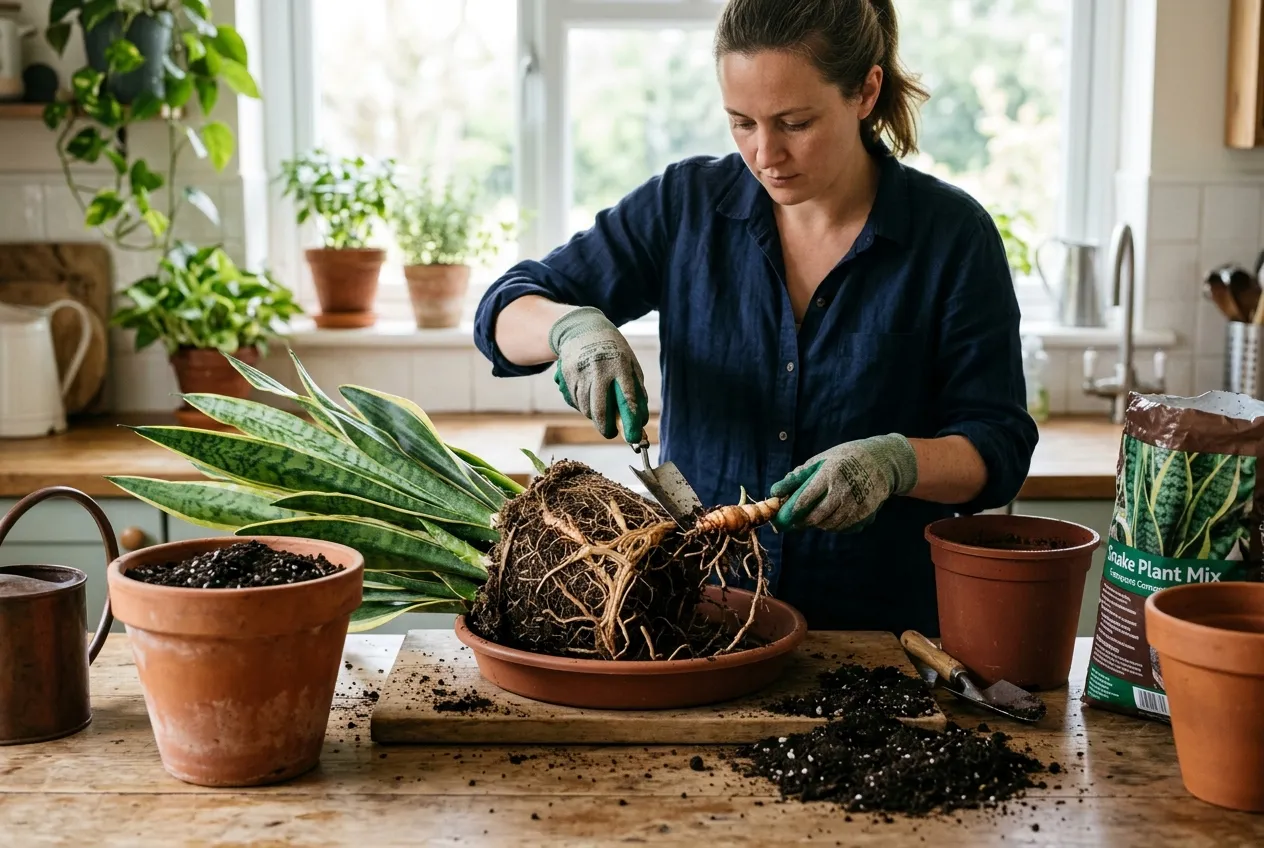
Dividing a snake plant by separating the rhizome — each section with roots and at least two leaves becomes a new plant
Division method (recommended)
- Remove the plant from its pot and brush away loose compost
- Identify separate clusters of leaves — each cluster grows from its own rhizome (underground stem)
- Cut through the rhizome with a clean sharp knife, ensuring each section has at least 2-3 leaves and a portion of root
- Let cut surfaces dry for 24 hours
- Pot each section in fresh cactus compost with perlite
- Wait a week before watering to let cuts heal
Leaf cutting method
- Cut a healthy leaf from the outer edge of the plant
- Slice it into 10cm sections, marking which end was the bottom (cuttings must be planted the right way up)
- Let the cuts callus for 48 hours in a dry, warm spot
- Push each cutting 2-3cm into moist perlite, bottom end down
- Keep in bright indirect light at 20C or above
- Roots appear in 4-8 weeks, new shoots in 3-6 months
Note: Leaf cuttings from variegated varieties like ‘Laurentii’ often produce solid green offspring. The yellow edge variegation is a chimera that does not always transfer through leaf cuttings. If you want to keep the variegation, use division instead.
When your snake plant outgrows its pot, our guide to repotting houseplants covers the full process, including how to choose the right pot size and when to step up.
Do snake plants purify air?
Snake plants do filter airborne toxins, but the effect in a real home is modest. The widely cited NASA Clean Air Study found Sansevieria effective at removing formaldehyde, benzene, trichloroethylene, xylene, and toluene from sealed test chambers.
However, NASA’s tests used sealed chambers much smaller than a typical room. In a real home with normal ventilation, you would need 6-8 large snake plants per room to achieve a measurable reduction in volatile organic compounds.
The genuine benefits of keeping snake plants indoors are:
- Night-time oxygen release — snake plants use CAM photosynthesis, converting CO2 to oxygen after dark
- Humidity regulation — transpiration from leaves adds a small amount of moisture to dry winter air
- Mental health — multiple studies confirm that caring for living plants reduces stress and improves mood
- Low maintenance — unlike many air-purifying plants, snake plants do not need constant attention
Are snake plants safe around pets?
Snake plants are mildly toxic to cats, dogs, and horses. The saponins in the leaves cause nausea, vomiting, diarrhoea, and drooling if chewed or eaten. The reaction is typically short-lived and rarely life-threatening, but it is unpleasant for the animal.
If you have pets, place snake plants on high shelves, in hanging planters, or in rooms that animals cannot access. Cats are the higher risk because they tend to chew houseplant leaves. Dogs usually leave them alone unless bored.
Pet-safe alternatives that look similar include spider plants (Chlorophytum comosum), ponytail palms (Beaucarnea recurvata), and Haworthia species. All have the upright, architectural look of a snake plant without the toxicity risk.
Frequently asked questions
How often should I water a snake plant in the UK?
Water every 2-4 weeks, checking that the top 5cm of soil is dry first. In summer, you will water roughly every 2 weeks. In winter, every 3-4 weeks is typical. The exact frequency depends on your pot type, room temperature, and light levels. Terracotta pots dry out faster than plastic, so they need watering more often.
Can snake plants survive in a room with no windows?
No, snake plants need some natural light to survive long-term. They tolerate very low light but will slowly decline in total darkness over 6-12 months. A room with even a small window is fine. For a windowless room, use a grow light running at least 8 hours daily.
Why are my snake plant leaves going mushy?
Mushy leaves at the base indicate overwatering and root rot. Remove the plant from its pot immediately and inspect the roots. Cut away anything brown, black, or soft. Let the plant dry for 24 hours, then repot in completely fresh, dry cactus compost. Do not water for a week.
Are snake plants toxic to cats and dogs?
Yes, snake plants contain saponins that are mildly toxic to cats and dogs. Symptoms include vomiting, nausea, and diarrhoea if chewed or eaten. Keep plants on high shelves or in closed rooms if you have pets that chew houseplants.
What is the best soil mix for a snake plant?
Mix 70% cactus compost with 30% perlite for ideal drainage. Standard houseplant compost stays too wet for snake plants, particularly in UK homes with higher humidity. Always use a pot with drainage holes. Terracotta is the best material because it breathes and wicks moisture away from roots.
How do I propagate a snake plant?
Divide the root ball in spring for instant results. Separate the rhizome clusters with a clean knife, ensuring each section has 2-3 leaves and roots. Pot individually in cactus compost. Leaf cuttings also work but take 3-6 months to produce new growth, and variegated types may lose their colour pattern.
Do snake plants actually purify air?
Snake plants filter toxins including formaldehyde and benzene, but the real-world effect is small. You would need 6-8 large plants per room to meaningfully improve air quality. The genuine benefits are night-time oxygen release via CAM photosynthesis, gentle humidity regulation, and the proven mental health effects of living with plants.
Lawrie has been gardening in the West Midlands for over 30 years. He grows his own veg using no-dig methods, keeps a wildlife-friendly garden, and writes practical advice based on real UK growing conditions.