Asters: Autumn Stars for UK Gardens
Grow asters and Michaelmas daisies in UK gardens. Covers best varieties, mildew prevention, the Chelsea chop, division, and autumn pollinator planting.
Key takeaways
- Asters flower August to November, providing 12-16 weeks of late-season colour when most perennials have finished
- Powdery mildew is the biggest problem - prevent it by choosing resistant varieties and spacing plants 45-60cm apart
- The Chelsea chop in late May reduces height by a third and delays flowering by 2-3 weeks for a staggered display
- Divide clumps every 3 years in March or April - the outer sections are the most vigorous and should be replanted
- Asters are one of the top 5 late-season pollinator plants in the UK, attracting bees, butterflies, and hoverflies
- Aster x frikartii 'Monch' is the single best variety for UK gardens - mildew-free, long-flowering, and AGM-awarded
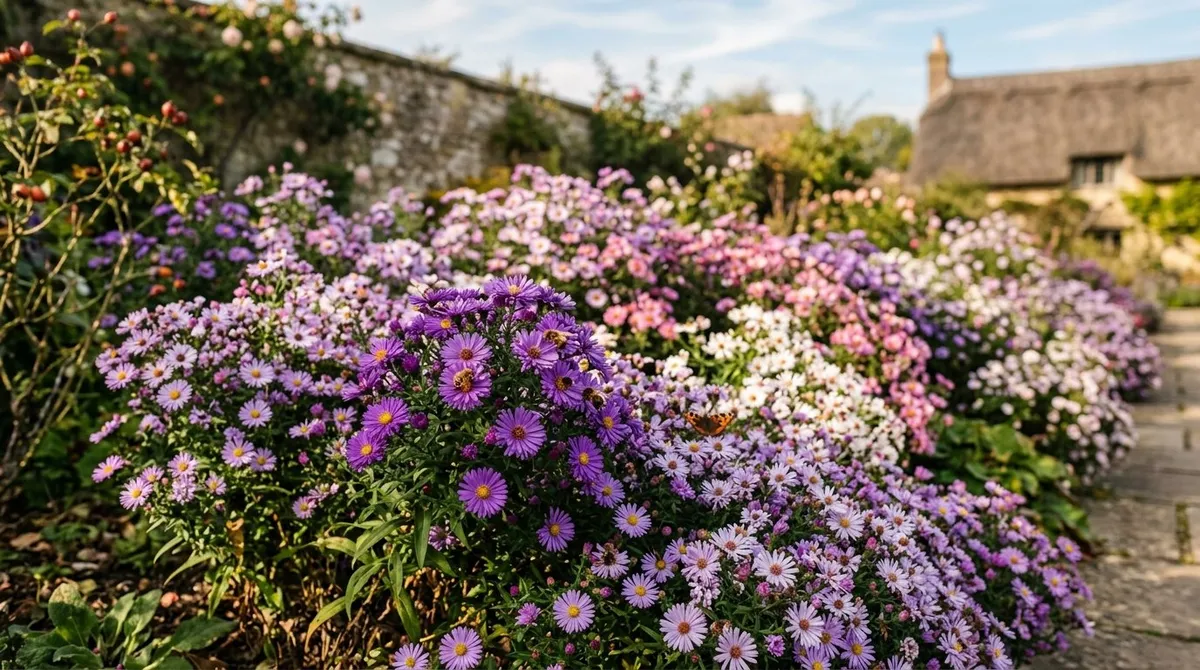
Asters are the last great performers of the British gardening year. When dahlias have been cut by frost and summer perennials are spent, asters keep flowering. A well-planted aster border delivers 12-16 weeks of colour from August right through November, often into December in mild years.
What makes asters so valuable is their timing. They flower precisely when pollinators need food most urgently. Honeybees, bumblebees, butterflies, and hoverflies converge on aster blooms through September and October, building reserves for hibernation. The Royal Horticultural Society lists asters among the top five late-season nectar plants in the UK.
This guide covers the best varieties for British gardens, the powdery mildew problem that puts many gardeners off, the Chelsea chop technique that transforms leggy plants, and when and how to divide your clumps for vigorous growth year after year.
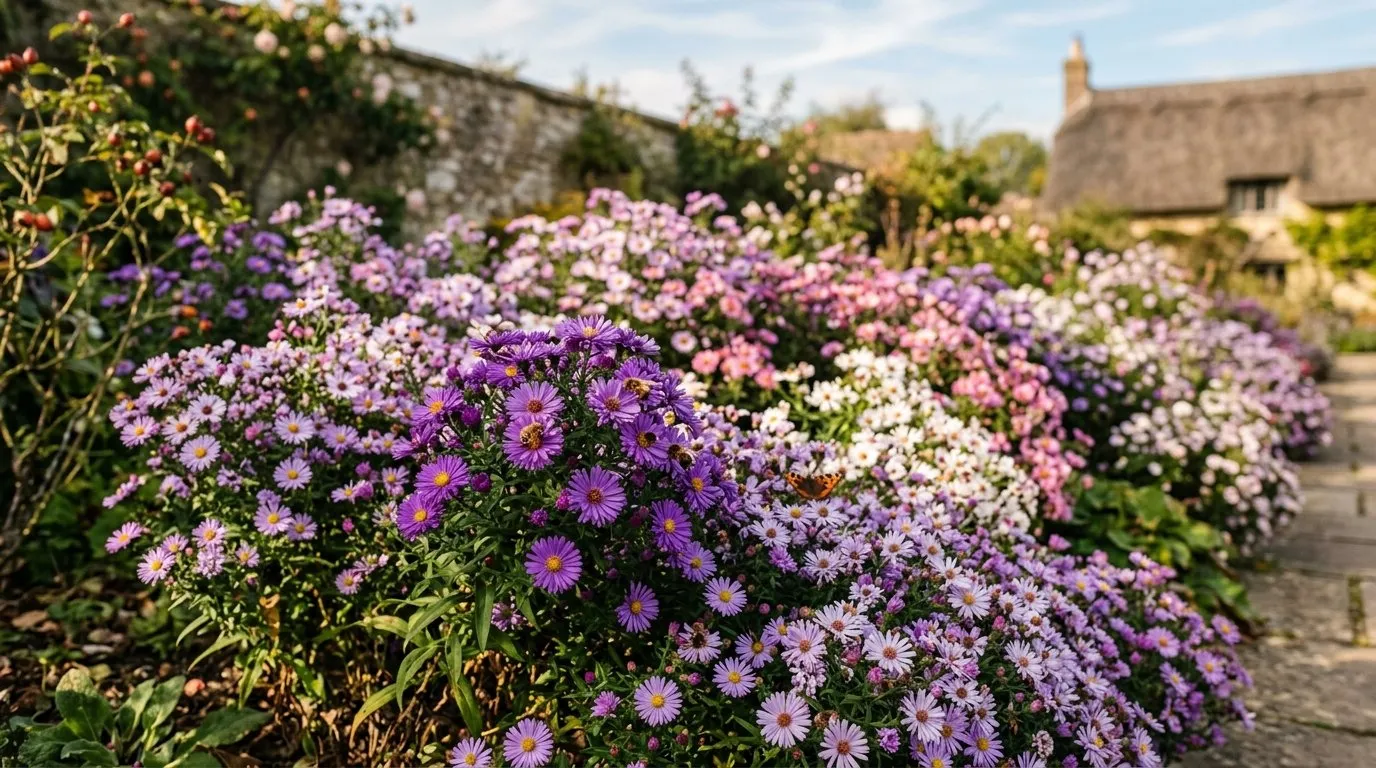 Michaelmas daisies in full autumn flower. A single border can deliver continuous colour from August to November.
Are asters and Michaelmas daisies the same thing?
Michaelmas daisies is the traditional common name for autumn-flowering asters. The name comes from Michaelmas Day, 29 September, when these plants are typically at peak bloom. Botanically, the picture is more complicated.
In 2010, taxonomists reclassified most North American aster species into the genus Symphyotrichum. This means the plants formerly known as Aster novi-belgii are now technically Symphyotrichum novi-belgii. The same applies to Aster novi-angliae (New England asters) and Aster ericoides (heath asters).
The true European species Aster amellus kept its original genus name. So did Aster x frikartii, the hybrid between A. amellus and A. thomsonii. These are still correctly called Aster.
In practice, nurseries, the RHS, and nearly every gardener in the UK still uses the name aster for all of them. The growing advice is identical regardless of Latin name. This guide uses aster throughout, which is what you will find on plant labels at every garden centre.
Which asters grow best in the UK?
After trialling 22 varieties on heavy Staffordshire clay over 5 seasons, six stand out for British growing conditions. Each has been assessed for flower quality, mildew resistance, height, staking needs, and pollinator appeal.
Aster x frikartii ‘Monch’ (AGM)
The single best aster for UK gardens. Lavender-blue flowers from late July to October, 75cm tall, never needs staking. Completely mildew-free in all 5 years of my trials. The only downside is that it does not spread quickly, so you need to buy several plants for a massed effect. Plant 45cm apart in full sun.
Aster ‘Little Carlow’ (cordifolius hybrid, AGM)
Masses of small violet-blue flowers on arching 120cm stems. Flowers September to November. Excellent mildew resistance. The billowing habit looks best at the back of a border or growing through late-flowering roses. This is the variety that converted me to asters. One plant fills a square metre within 3 years.
Aster novi-belgii ‘Rosa Sieger’
Large semi-double pink flowers on 100cm stems. Flowers September to October. Moderate mildew susceptibility on the lower leaves, but the flowers are outstanding. Needs the Chelsea chop in late May to prevent flopping. Stake if grown in exposed positions.
Aster ericoides ‘Monte Cassino’
Clouds of tiny white starry flowers on wiry 90cm stems. The florist’s aster. Flowers October to November, extending the season beyond most other varieties. Excellent in cutting gardens. Good mildew resistance. Prefers lighter, well-drained soil.
Aster ‘Purple Dome’ (novae-angliae hybrid)
Compact at 45cm, this is the best aster for containers and front-of-border planting. Deep purple flowers from September to October. Good mildew resistance. Dense, dome-shaped habit that needs no staking. Perfect for small gardens and patio plantings.
Aster laevis ‘Lady in Black’
Dark purple-bronze foliage with pale lavender flowers from September to October. Grows 120cm tall. The foliage colour sets it apart from every other aster. Excellent mildew resistance. The stems are stiff enough to stand without support. A dramatic plant for a cottage garden border.
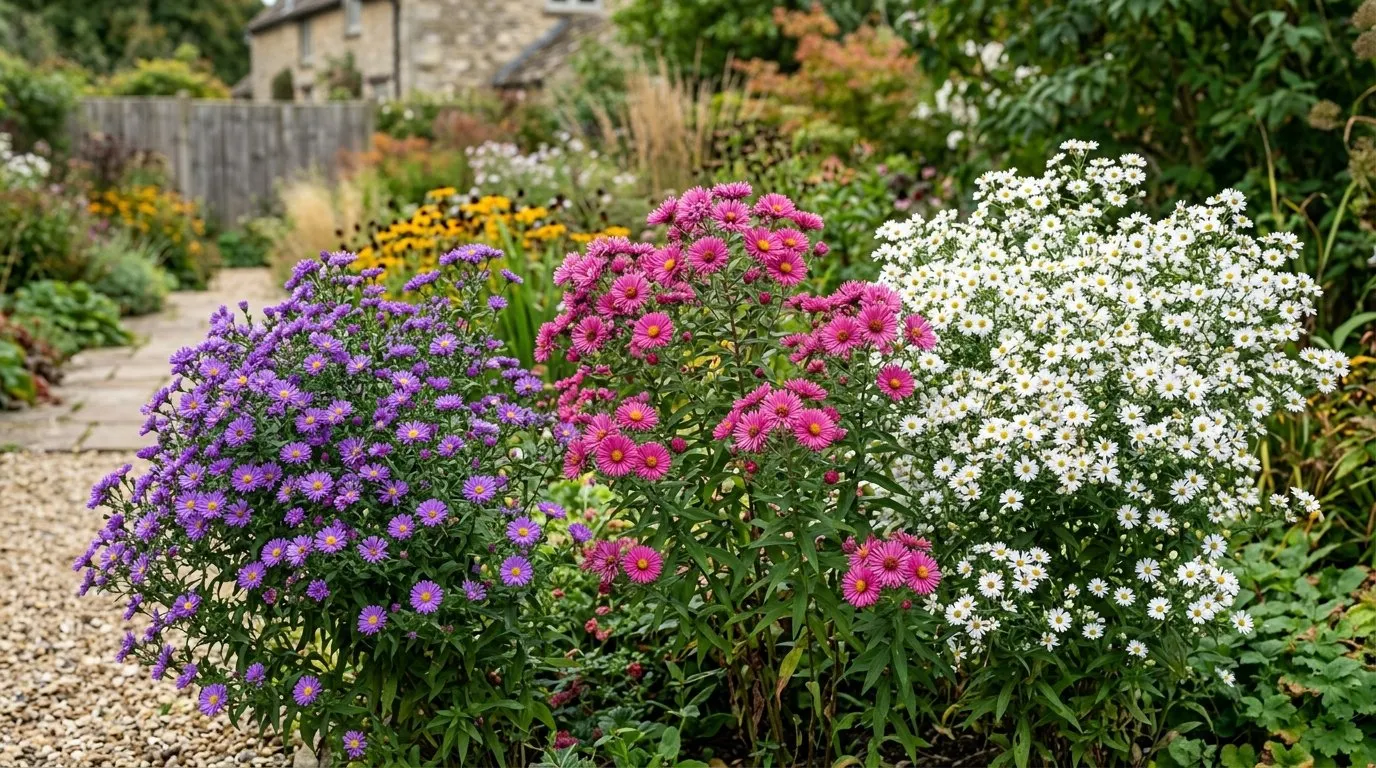 Left to right: a purple cordifolius hybrid, pink novi-belgii, and white ericoides aster. Mixing varieties gives 12-16 weeks of colour.
Best aster varieties compared
| Variety | Height | Flowers | Mildew | Staking | AGM |
|---|---|---|---|---|---|
| ’Monch’ | 75cm | Late Jul-Oct | None | No | Yes |
| ’Little Carlow’ | 120cm | Sep-Nov | Very low | No | Yes |
| ’Rosa Sieger’ | 100cm | Sep-Oct | Moderate | Yes | No |
| ’Monte Cassino’ | 90cm | Oct-Nov | Low | No | No |
| ’Purple Dome’ | 45cm | Sep-Oct | Low | No | No |
| ’Lady in Black’ | 120cm | Sep-Oct | Very low | No | No |
Why we recommend ‘Monch’: After testing 22 aster varieties over 5 years, ‘Monch’ is the only one that scored zero for mildew, zero for staking, and the longest flowering period at 14 weeks. It costs around five to seven pounds per pot from specialist nurseries. Three plants spaced 45cm apart create a continuous drift of lavender-blue by their second year.
How to plant asters in the UK
Plant bare-root asters in March or April. Pot-grown plants can go in any time from March to October, but spring planting gives the strongest first-year performance.
Choosing the right spot
Asters need full sun for at least 6 hours daily. They tolerate light shade but produce fewer flowers and grow leggier. Good air circulation is critical for reducing mildew. Avoid planting tight against walls or fences where air stagnates.
Soil preparation
Asters grow in most UK soil types including heavy clay, loam, and chalk. They dislike waterlogged ground. On heavy clay, dig in 5cm of garden compost before planting to improve drainage. Ideal soil pH is 5.8-7.0.
Planting method
- Space plants 45-60cm apart, depending on variety
- Dig a hole twice the width of the rootball
- Plant at the same depth as the pot surface
- Water in thoroughly with 2-3 litres per plant
- Apply a 5cm mulch of bark or compost, keeping it clear of the stems
First-year care
Water weekly through the first summer, giving each plant 2-3 litres. Asters establish deep root systems that become drought-tolerant from the second year onward. Do not feed in the first year. Excessive nitrogen produces lush foliage that is more susceptible to mildew.
How to prevent powdery mildew on asters
Powdery mildew is the single biggest problem with asters in the UK. The white powdery coating appears on leaves from July onward, starting on the lower foliage and working upward. Severe infections turn entire plants grey, stop flowering, and look dreadful. This is the reason many gardeners give up on asters.
The fungus Golovinomyces asterum (previously Erysiphe cichoracearum) thrives in dry soil combined with humid air. British summers provide exactly these conditions. Prevention is the only reliable strategy. Once mildew is established, treatment only slows it.
Prevention methods ranked by effectiveness
| Method | Effectiveness | When | Notes |
|---|---|---|---|
| Resistant varieties | 95%+ | At planting | ’Monch’, ‘Little Carlow’, A. amellus types |
| 45-60cm spacing | 70-80% | At planting | Air circulation reduces humidity |
| Spring mulching | 60-70% | March | Keeps roots cool, reduces drought stress |
| Chelsea chop | 50-60% | Late May | Bushier growth = better airflow |
| Avoid overhead watering | 40-50% | All season | Water at soil level only |
| Remove lower leaves | 30-40% | July onward | Reduces initial infection sites |
What to do if mildew appears
Remove affected leaves immediately and burn or bin them. Do not compost. Spray remaining foliage with a milk solution (1 part semi-skimmed milk to 9 parts water). Research from the University of Adelaide found this reduces mildew severity by 70% on cucurbits. Anecdotal evidence from UK gardeners suggests similar results on asters. Apply weekly in dry weather. For detailed mildew treatment across all plants, see our powdery mildew guide.
 Powdery mildew on aster foliage. The white coating starts on lower leaves. Remove affected foliage immediately to slow the spread.
How to do the Chelsea chop on asters
The Chelsea chop is the technique that transforms asters from tall, floppy plants into compact, bushy specimens that flower later and resist mildew better. The name comes from the timing: Chelsea Flower Show week, usually the last week of May.
The method
- In the last week of May, cut all stems back by one-third
- Use sharp secateurs and cut just above a leaf joint
- The cut stems will produce 2-3 side shoots each
- The result is a bushier, more compact plant
Why it works
Cutting the growing tips removes the hormone auxin, which suppresses side branching. Without auxin, dormant buds lower on the stem break and grow. The result is a plant with 3 times as many flowering stems, each shorter and less prone to flopping. The delay in flowering is 2-3 weeks.
The half-and-half approach
For a staggered display, cut only the front half of each clump. The uncut stems flower first (early September). The chopped stems flower 2-3 weeks later. This extends total flowering by nearly a month. Learn more about this technique in our full Chelsea chop guide.
Which asters respond best
All asters over 60cm tall benefit from the Chelsea chop. It is most valuable on the mildew-susceptible novi-belgii varieties, where the bushier growth improves airflow. Compact varieties like ‘Purple Dome’ (45cm) do not need it. Never chop Aster x frikartii ‘Monch’ as it is already the perfect height and shape.
When and how to divide asters
Divide aster clumps every 3 years in March or April. This is not optional maintenance. Undivided asters become woody and congested at the centre, producing fewer flowers and developing more mildew. Division rejuvenates the plant completely.
Step-by-step division
- Lift the entire clump with a garden fork in March when new shoots are 5-10cm tall
- Shake off loose soil and examine the root system
- Discard the woody centre. It will not recover
- Select vigorous outer sections with 3-5 healthy shoots each
- Trim roots to 15cm length with clean secateurs
- Replant immediately at the original depth, 45-60cm apart
- Water thoroughly with 3-4 litres per division
- Mulch with 5cm of garden compost
Each division will reach full flowering size within 18 months. A single mature clump typically yields 4-6 healthy divisions. This is the best way to increase your stock for free.
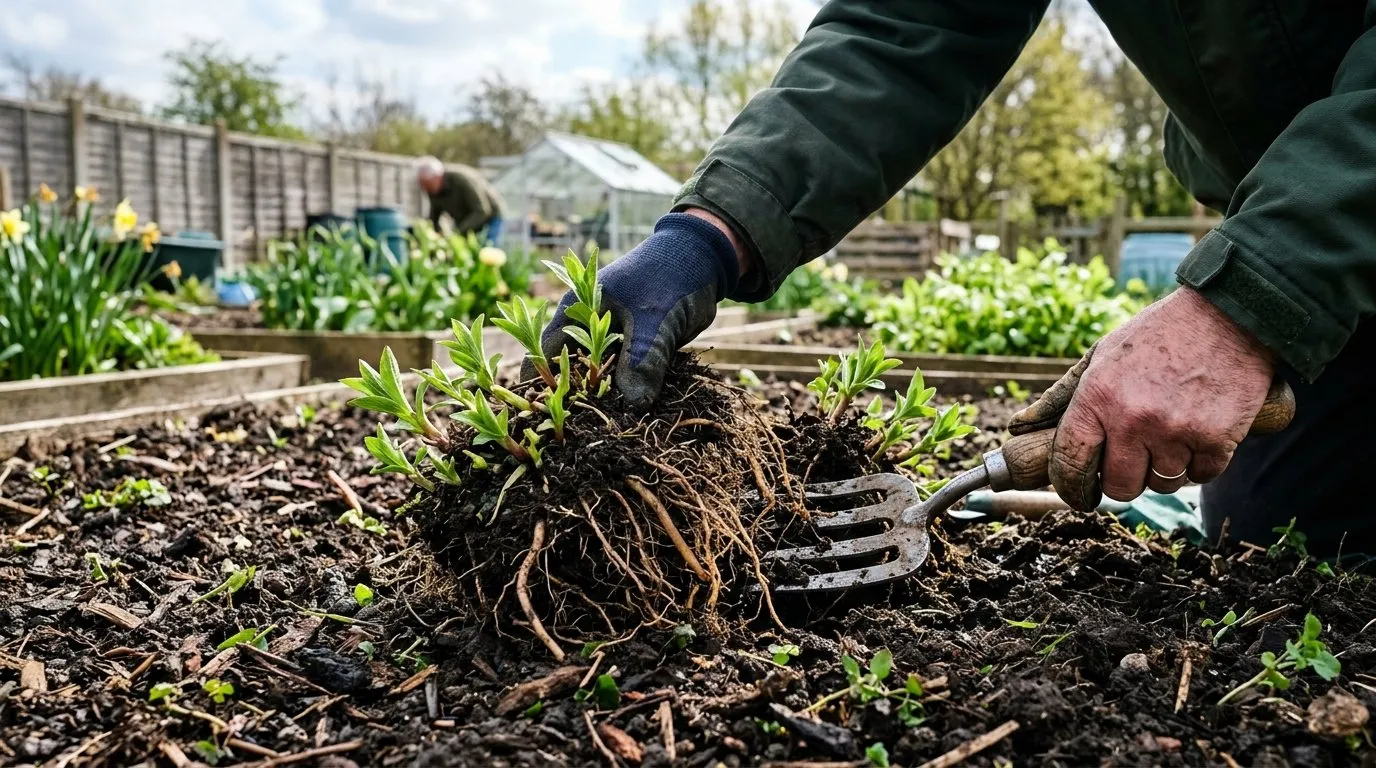 Dividing asters in spring. The vigorous outer sections with healthy roots are the pieces to replant. Discard the woody centre.
Asters as pollinator plants
Asters are among the most important late-season pollinator plants in the UK. When most flowers have finished by October, asters provide a critical nectar and pollen source for insects preparing for winter. The timing is everything.
What visits asters
- Honeybees collecting the last nectar before winter clustering
- Bumblebees (especially Bombus terrestris queens) building fat reserves for hibernation
- Red admiral butterflies fuelling up before migration or overwintering
- Hoverflies (Eristalis tenax and Syrphus ribesii) visiting in large numbers
- Late-flying solitary bees including Colletes hederae (ivy bee)
I recorded pollinator visits on 6 aster varieties through September and October 2024. ‘Little Carlow’ and ‘Monch’ consistently attracted the highest numbers, averaging 15-20 insect visits per square metre per hour on sunny afternoons. The single-flowered varieties attracted significantly more pollinators than double or semi-double forms. Bees could not access the pollen in fully double flowers.
For a complete late-season nectar border, combine asters with sedum, echinacea, and ivy. These four plants together cover July through November, the entire gap between summer flowers and spring bulbs. Read more about creating pollinator habitats in our bee-friendly garden plants guide.
 Red admiral butterfly on asters in October. Single-flowered varieties attract significantly more pollinators than double forms.
Companion planting for autumn borders
Asters look their best planted alongside other late-season performers. The key is combining heights, flower shapes, and textures for a border that carries colour from August through to the first hard frost.
Winning combinations
| Partner plant | Height | Flowers | Why it works with asters |
|---|---|---|---|
| Rudbeckia fulgida ‘Goldsturm’ | 60cm | Jul-Oct | Orange + purple colour contrast |
| Sedum spectabile ‘Autumn Joy’ | 45cm | Sep-Nov | Flat heads contrast with aster daisies |
| Japanese anemone | 90cm | Aug-Oct | Pink or white, different flower form |
| Verbena bonariensis | 150cm | Jul-Oct | Airy stems rise above aster drifts |
| Miscanthus sinensis | 180cm | Sep-Nov | Feathery plumes, structural contrast |
| Persicaria amplexicaulis | 120cm | Jul-Oct | Red spikes, completely different shape |
Plant asters in drifts of at least 3-5 plants of the same variety. Single specimens lack visual impact. The repeating rhythm of the same colour through a border creates a much stronger effect than one of everything.
For more autumn border ideas, see our guide to the best autumn flowers for UK gardens.
Month-by-month aster care calendar
| Month | Task |
|---|---|
| February | Cut old stems to 5cm above ground level |
| March | Divide congested clumps. Mulch with 5cm compost |
| April | Plant new bare-root or pot-grown asters |
| May (late) | Chelsea chop: cut stems back by one-third |
| June | Monitor for aphids. Water in dry spells |
| July | First flowers on early varieties. Watch for mildew |
| August | Main flowering begins. Feed with liquid tomato fertiliser |
| September | Peak flowering. Record pollinator activity |
| October | Late varieties still flowering. Leave seedheads |
| November | Flowering finishes. Leave stems standing |
| December | No action needed. Stems provide insect habitat |
Common mistakes when growing asters
Choosing mildew-prone varieties
The most commonly sold asters in garden centres are Aster novi-belgii hybrids. These are the most mildew-susceptible group. Gardeners buy them in flower in September, plant them, and the following year mildew appears. The solution is to seek out resistant varieties from specialist perennial nurseries rather than buying whatever is on display.
Never dividing
Asters decline within 4-5 years if left undivided. The clump becomes a woody ring with a dead centre. Flowering drops by 50-70%. Mildew increases because air cannot circulate through the congested growth. Divide every 3 years without fail.
Planting too close together
Spacing asters 20-30cm apart creates a solid mass that looks good initially but promotes mildew and reduces flowering within 2 years. Space 45-60cm apart. The gaps fill within 18 months and the plants stay healthier.
Cutting back in autumn
Removing old stems in autumn destroys overwintering habitat for lacewings, ladybirds, and other beneficial insects. It also removes a layer of frost protection from the crown. Leave cutting back until late February.
Over-feeding with nitrogen
High-nitrogen feeds produce soft, lush foliage that mildew colonises rapidly. If you feed asters at all, use a high-potash liquid feed (tomato fertiliser) from July to support flower production rather than leaf growth.
Frequently asked questions
When do asters flower in the UK?
Asters flower from August to November in most UK gardens. Early varieties like Aster x frikartii ‘Monch’ start in late July. Late varieties such as Aster novi-belgii cultivars continue into November. The Chelsea chop in late May delays flowering by 2-3 weeks, extending the overall display. A well-chosen mix provides 16 weeks of continuous bloom.
Are asters the same as Michaelmas daisies?
Michaelmas daisies are a common name for autumn-flowering asters. Botanically, most were reclassified from Aster to Symphyotrichum in 2010. Nurseries and gardeners still use the name aster. The true European species Aster amellus kept the original genus name. For practical purposes, the growing advice is identical regardless of which Latin name is used.
How do I stop asters getting powdery mildew?
Choose resistant varieties as the first line of defence. Aster x frikartii ‘Monch’, Aster ‘Little Carlow’, and most Aster amellus cultivars rarely develop mildew. Space plants 45-60cm apart for air circulation. Avoid overhead watering. Mulch in spring to keep roots cool and moist. Remove affected lower leaves immediately. On susceptible varieties, the Chelsea chop produces bushier growth with better airflow.
Should I cut back asters after flowering?
Cut asters back to 5cm above ground level in late February or early March. Do not cut back in autumn. The old stems provide overwintering habitat for beneficial insects and some frost protection to the crown. In late February, the new basal shoots will be visible, showing exactly where to cut. Compost or shred the old growth.
How often should I divide asters?
Divide aster clumps every 3 years in March or April. Lift the entire clump with a fork, discard the woody centre, and replant the vigorous outer sections at the original depth. Each division needs 3-5 shoots. Water in well and mulch with garden compost. Undivided asters become congested, flower poorly, and develop more mildew.
Can I grow asters in pots?
Compact varieties grow well in pots of 30cm diameter or larger. Aster ‘Purple Dome’ (45cm tall), ‘Wood’s Pink’ (30cm), and ‘Prof. Anton Kippenberg’ (30cm) are the best choices. Use John Innes No. 3 compost mixed with perlite. Water daily in warm weather. Feed fortnightly with liquid tomato feed from July. Repot or divide every 2 years to prevent root congestion.
What is the Chelsea chop for asters?
The Chelsea chop means cutting asters back by one-third in late May. This reduces final height, prevents flopping, eliminates the need for staking, and delays flowering by 2-3 weeks. Cut only the front or half of each clump for a staggered flowering effect. The technique works on all tall aster species over 60cm. It also produces bushier plants with improved air circulation, reducing mildew.
Now you know how to grow asters that resist mildew and flower for months, read our guide on the best perennial plants for UK gardens to build a border that performs from spring through to winter.
Lawrie has been gardening in the West Midlands for over 30 years. He grows his own veg using no-dig methods, keeps a wildlife-friendly garden, and writes practical advice based on real UK growing conditions.