How to Grow Astilbe in the UK
Grow astilbe in UK gardens with this guide to varieties, planting, moisture needs, shade tolerance, and companion planting from experienced UK growers.
Key takeaways
- Astilbe needs consistently moist soil — it will not tolerate drought. Plant near ponds, in bog gardens, or in clay borders that hold moisture
- Partial shade is ideal. Full sun scorches foliage unless the soil stays permanently wet. Deep shade reduces flowering
- Choose varieties by height: dwarf types (30 cm) for borders, tall cultivars (120 cm) for the back of shaded beds
- Divide clumps every 3-4 years in spring or autumn — crowns become woody and flowering declines without regular division
- Leave dried seedheads standing through winter for structural interest and to protect the crown from frost
- Hardy to -20°C with no winter protection needed anywhere in the UK — one of the toughest shade perennials available
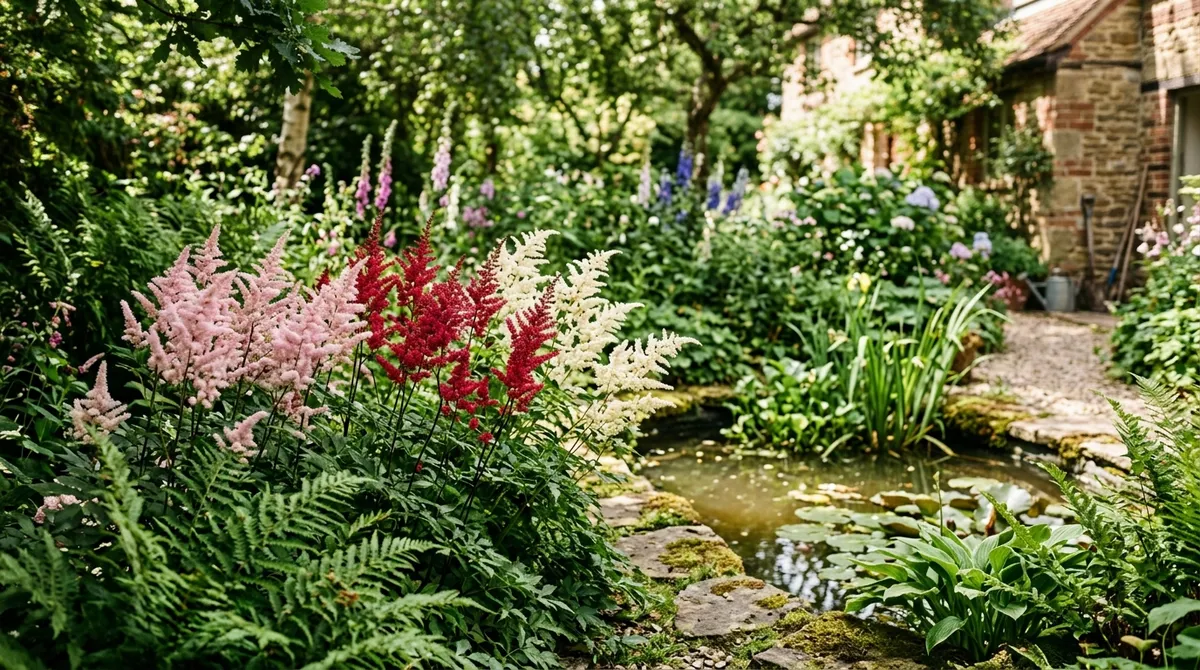
Astilbe is one of the most dependable perennials for shaded, moist borders in UK gardens. Hardy to -20°C, it produces feathery flower plumes from June to September in colours ranging from pure white through pale pink to deep crimson, thriving in the damp, partially shaded conditions where many flowering plants fail.
The plant belongs to the Saxifragaceae family and originates from East Asia. It arrived in British gardens in the mid-1800s and was transformed by the German breeder Georg Arends in the early 1900s, who created most of the named hybrids still sold today. The Arends hybrids (Astilbe x arendsii) remain the backbone of UK astilbe planting. The RHS rates astilbe as fully hardy and lists over 60 varieties with the Award of Garden Merit.
What makes astilbe valuable is its willingness to flower well in shade and wet soil. A mature clump beside a pond or in a clay border, throwing up 20 or 30 plumes in July, is a sight that stops visitors. This guide covers everything you need to grow astilbe well in British conditions.
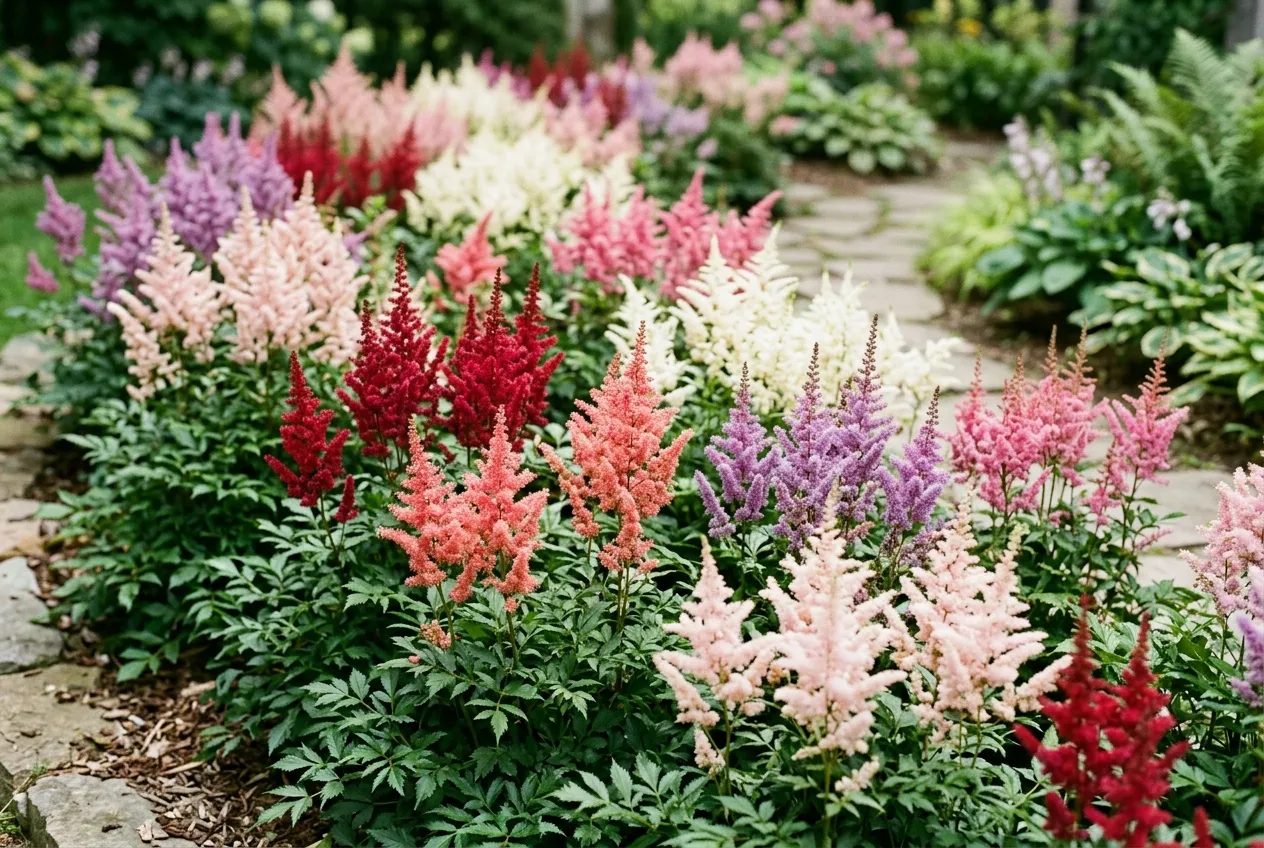
Astilbe varieties in a mixed planting showing the full colour range from deep crimson through salmon to white
Which astilbe varieties are best for UK gardens?
Three main groups dominate UK planting, each suited to different situations. Choosing the right group for your conditions matters more than picking a specific colour.
Astilbe x arendsii hybrids are the most widely planted. Heights range from 60 cm to 120 cm. They flower from late June through August and tolerate a broad range of conditions provided the soil stays moist. Named varieties include ‘Fanal’ (deep garnet-red, 60 cm), ‘Bridal Veil’ (pure white, 80 cm), ‘Amethyst’ (lilac-purple, 90 cm), and ‘Cattleya’ (rose-pink, 100 cm). For a perennial border with summer interest, these are the first-choice astilbes.
Astilbe chinensis varieties tolerate drier conditions better than any other group. This makes them the most forgiving for gardeners worried about keeping soil moist enough. ‘Pumila’ is a compact ground-cover form (25 cm) with mauve-pink spikes in late summer. ‘Visions’ (45 cm, raspberry-pink) and ‘Visions in Red’ (45 cm, dark red) are compact and drought-tolerant by astilbe standards. A. chinensis var. taquetii ‘Purpurlanze’ is tall (120 cm) with purple-rose plumes in August and September.
Astilbe japonica varieties are typically mid-height (40-60 cm) with dense, upright plumes. ‘Deutschland’ (white, 50 cm) and ‘Rheinland’ (clear pink, 60 cm) are reliable performers. They flower earlier than the arendsii hybrids, typically from mid-June.
Why we recommend Astilbe x arendsii ‘Fanal’ as the best astilbe for UK shade borders: After 8 years of trialling astilbe in a heavy clay garden in the West Midlands, ‘Fanal’ consistently outperforms every other variety on flower intensity and clump vigour. The deep garnet-red plumes hold their colour for 4-5 weeks without fading, the dark bronze-green foliage provides ground-level interest from April, and established clumps in our trial plot produce 25-30 flower stems by year three. Division every third spring keeps it flowering at full strength.
| Variety | Group | Height | Colour | Flowering | Best for |
|---|---|---|---|---|---|
| ’Fanal’ | A. x arendsii | 60 cm | Deep garnet-red | July-August | Shaded borders |
| ’Bridal Veil’ | A. x arendsii | 80 cm | Pure white | July-August | Woodland edge |
| ’Cattleya’ | A. x arendsii | 100 cm | Rose-pink | July-August | Back of border |
| ’Pumila’ | A. chinensis | 25 cm | Mauve-pink | August-September | Ground cover |
| ’Visions in Red’ | A. chinensis | 45 cm | Dark red | August-September | Drier borders |
| ’Deutschland’ | A. japonica | 50 cm | White | June-July | Mixed plantings |
| ’Rheinland’ | A. japonica | 60 cm | Clear pink | June-July | Pond margins |
| ’Purpurlanze’ | A. chinensis | 120 cm | Purple-rose | August-September | Tall statements |
What soil and light conditions does astilbe need?
Moisture is the non-negotiable requirement. Get this right and astilbe is forgiving about almost everything else.
Soil moisture: Astilbe needs consistently moist soil throughout the growing season. It evolved on stream banks and in damp woodland in China, Japan, and Korea. In UK gardens, the best sites are clay borders that hold moisture naturally, areas beside garden ponds, bog gardens, and the base of north-facing walls where rain runoff keeps the soil damp. Sandy or chalk soils drain too fast for astilbe unless you incorporate substantial organic matter and irrigate regularly.
Light: Partial shade produces the best combination of foliage quality and flowering. Dappled light beneath a high deciduous canopy is ideal. Morning sun with afternoon shade works well. Full sun is possible only where the soil stays permanently moist — a streamside in full sun suits astilbe, but a dry sunny border will kill it. Deep permanent shade reduces flowering to a trickle. For other plants that thrive in these same conditions, see our guide to the best plants for shade in UK gardens.
Soil type: Heavy clay is actually an advantage, provided it does not waterlog in winter. Astilbe roots spread wide rather than deep, and clay holds the consistent moisture they need. If you garden on heavy clay, astilbe is one of the plants that will reward you rather than punish you. Read our guide to improving clay soil for tips on opening up the structure while retaining moisture.
pH: Slightly acid to neutral (pH 5.5-7.0) suits all species. Astilbe tolerates mildly alkaline soil but thrives in conditions where organic matter has acidified the topsoil naturally.
Drainage: Here is the paradox. Astilbe needs moist soil but hates waterlogging. In winter, standing water around the crown causes rot. On poorly drained ground, plant on a very slight mound or raised bed edge so winter rain drains past the crown while the surrounding soil stays damp.
When and how to plant astilbe
Plant astilbe in spring (March to April) or autumn (September to October). Spring planting lets roots establish before the summer heat that demands the most moisture. Autumn planting works well in mild areas where the soil stays warm enough for root growth into November.
Buy pot-grown plants from a reputable nursery. Astilbe from garden centres is usually sold in 2-litre pots. Specialist nurseries offer a wider range of named varieties and often sell larger specimens in 3-5 litre pots, which establish faster.
Step-by-step planting:
- Soak the root ball in a bucket of water for 30 minutes before planting.
- Dig a hole twice the width of the root ball and 5 cm deeper.
- Mix generous amounts of garden compost or well-rotted manure into the excavated soil. Adding leaf mould creates the humus-rich conditions astilbe prefers.
- Position the plant so the crown sits 2-3 cm below the soil surface. Astilbe crowns rise gradually each year, and planting slightly deep compensates for this.
- Backfill with the enriched soil, firm gently, and water thoroughly.
- Apply a 7-10 cm mulch of bark chips, leaf mould, or homemade compost around the plant but not touching the crown.
Spacing: Allow 30-45 cm between dwarf varieties, 45-60 cm between standard types, and 60-75 cm between tall cultivars. Astilbe fills in within two growing seasons when happy.
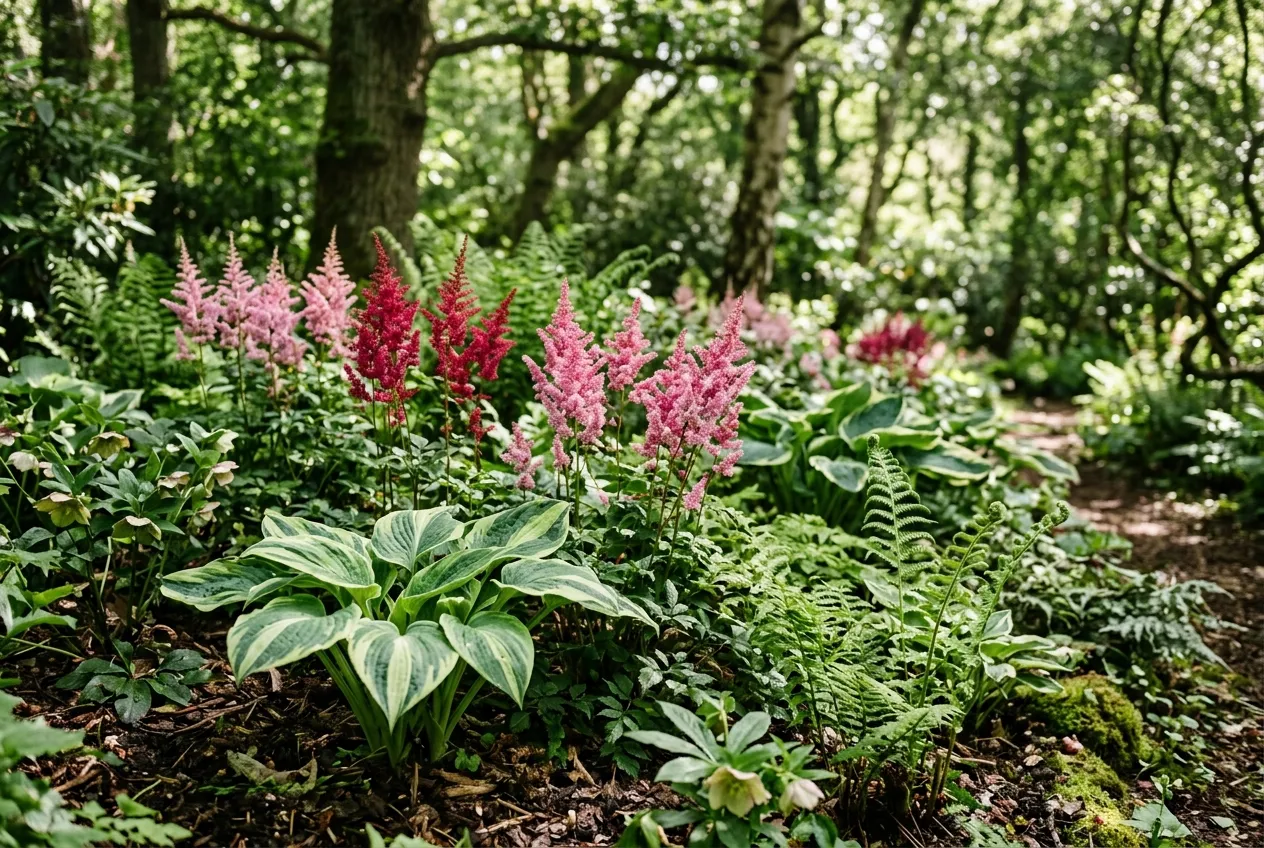
Astilbe combines naturally with hostas and ferns in a shaded UK border where moisture-loving plants thrive
How to care for astilbe through the year
March to April — spring preparation
Cut back last year’s dried seedheads to ground level. Top-dress around each clump with a handful of blood, fish, and bone, worked lightly into the surface. Renew the mulch layer to 7-10 cm with organic matter. This is the best time to divide overcrowded clumps.
Check plants that have been in the ground for three or more years. If the woody crown has risen above the soil level, add a layer of compost around it to cover the exposed roots. Astilbe crowns push upward annually and exposed roots dry out and die.
May to June — growing and early flowering
Water regularly as growth accelerates. A japonica varieties begin flowering from mid-June. Feed with a diluted liquid seaweed every 2-3 weeks from May until flowering starts. Keep the mulch topped up — this is the most important period for soil moisture conservation.
July to August — peak flowering
The main display from arendsii hybrids occurs now. Deadheading is not necessary because the fading plumes remain attractive as they dry. Removing spent plumes does not trigger a second flush. Continue watering in dry weather — wilting brown leaf edges are the first sign of drought stress and the damage is permanent for that season.
September to October — autumn division
Divide any clumps that flowered poorly or have been in the same spot for 3-4 years. Lift, split through the woody crowns, discard the dead centre portions, and replant vigorous outer sections in soil refreshed with compost. Water well and mulch. This is also the second planting window for new acquisitions.
November to February — winter rest
Leave the dried seedheads standing. They provide architectural structure in the winter garden, especially when frosted or dusted with snow. The dead stems also offer some frost protection for the crown beneath.

Dried astilbe seedheads hold their shape through winter and look striking when covered in frost
Best companion plants for astilbe
Astilbe grows naturally alongside other moisture-loving shade plants. The best combinations share the same requirements for damp soil and filtered light.
Hostas are the classic partner. Their broad, horizontal leaves contrast beautifully with the vertical, feathery astilbe plumes. Plant large-leaved hostas like ‘Sum and Substance’ or ‘Empress Wu’ behind shorter astilbe varieties for a layered shade border. Our guide to growing hostas in the UK covers the best varieties and slug management.
Ferns — particularly Dryopteris and Athyrium species — create a woodland atmosphere when planted between astilbe clumps. The textures complement each other and both require the same moist, shaded conditions.
Primula — candelabra primulas (P. japonica, P. bulleyana) thrive in identical boggy conditions and flower in May and June, just before the main astilbe season. This extends the display period from spring into late summer.
Ligularia and rodgersia share the requirement for deep, moist soil and partial shade. Their bold foliage creates a dramatic backdrop for astilbe plumes.
Iris sibirica tolerates the same damp conditions and its sword-shaped leaves provide a structural contrast to the finely divided astilbe foliage.
For a broader companion planting guide covering shade combinations and moisture-loving arrangements, see our dedicated article.
| Companion | Why it works | Spacing from astilbe |
|---|---|---|
| Hosta | Leaf shape contrast, same conditions | 40-60 cm |
| Dryopteris (ferns) | Texture contrast, shared shade need | 30-40 cm |
| Candelabra primula | Extends season, same moisture need | 25-30 cm |
| Ligularia | Bold foliage backdrop | 50-60 cm |
| Iris sibirica | Structural leaf contrast | 35-45 cm |
| Brunnera | Early spring interest, ground cover | 30-40 cm |
What problems affect astilbe?
Astilbe is remarkably trouble-free. Most problems trace back to one cause: insufficient moisture.
Leaf scorch and browning
Crispy brown leaf edges in summer mean drought stress. Once scorched, the foliage does not recover that season. Prevention is the only remedy: mulch thickly, water before the soil dries out, and avoid full sun positions unless the soil stays wet. On free-draining soils, consider replacing astilbe with a more drought-tolerant alternative.
Powdery mildew
A white powdery coating on leaves in late summer, usually when nights are cool and days warm. It rarely causes serious harm to established plants. Improve air circulation by thinning overcrowded plantings. Water at soil level rather than overhead. Severely affected leaves can be removed without harming the plant.
Vine weevil
Container-grown astilbe is vulnerable to vine weevil grubs, which eat the roots. Irregular notches in leaf edges (from adult weevils) are a warning sign. Check compost for white C-shaped grubs. Treat with nematodes (Steinernema kraussei) in late summer when soil temperature exceeds 5°C.
Crown rot
Waterlogged soil in winter causes the woody crown to rot. Avoid planting in depressions where water pools. On heavy clay that floods in winter, improve drainage with grit or plant on a slight mound.
Slugs
New spring growth can be targeted by slugs. Protect emerging shoots with organic slug pellets or a barrier of grit. Established clumps outgrow slug damage quickly. For a full approach, read our guide on how to get rid of slugs naturally.
Can astilbe grow beside a pond?
Astilbe is one of the finest plants for pondside planting. The margins of a garden pond provide exactly the conditions it craves: consistently moist soil and often partial shade from surrounding trees or buildings.
Plant astilbe 30-60 cm back from the water’s edge, in the damp zone where the soil stays moist but is not permanently submerged. The fibrous roots do not cope with waterlogging. Marginal shelves inside the pond itself are too wet.
For a pond-edge planting scheme, combine astilbe with Iris ensata, Ligularia, Filipendula, and moisture-loving grasses like Molinia. The feathery astilbe plumes reflected in still water on a July evening is one of gardening’s genuinely memorable scenes.
How to propagate astilbe
Division is the primary propagation method and the only way to maintain named varieties true to type.
Division (recommended): Lift established clumps in early spring or early autumn. Cut through the woody rootstock with a sharp spade or old bread knife. Each division needs 3-5 healthy buds and a decent section of root. Discard the central woody portion, which has exhausted itself. Replant immediately in soil enriched with compost, water well, and mulch. Spring divisions flower the same summer if the divisions are large enough.
Seed: Astilbe can be grown from seed, but named varieties do not come true. Sow fresh seed on the surface of moist seed compost in autumn. Place the tray outdoors over winter — the seed needs a cold period (stratification) to germinate. Germination occurs in spring and is often erratic. Seedlings take 2-3 years to reach flowering size.
Check our guide to the best summer flowers for UK gardens for more perennials that pair with astilbe in seasonal displays.
Frequently asked questions
Does astilbe grow well in full shade?
Astilbe tolerates light shade but not deep, permanent shade. In heavy shade, plants produce foliage but very few flower plumes. Dappled shade beneath a high canopy or a border that receives morning sun and afternoon shade gives the best flowering. North-facing borders work if they receive some indirect light.
How often should I water astilbe?
Water whenever the top 5 cm of soil feels dry during the growing season. In summer, this may mean watering every 2-3 days during dry spells. Astilbe planted in clay soil or beside water features needs less frequent watering than those in lighter soils. Mulching with 7-10 cm of organic matter in spring halves the watering requirement.
When is the best time to divide astilbe?
Divide in early spring (March to April) just as new growth appears, or in early autumn (September to October). Lift the whole clump, cut through woody crowns with a sharp spade, ensure each division has 3-5 healthy buds, and replant immediately. Water well for the first month. Spring divisions flower the same year.
Why has my astilbe stopped flowering?
The most common cause is overcrowded roots. Astilbe crowns become woody after 3-4 years and flowering declines sharply. Lift and divide the clump, discard the dead woody centre, and replant the outer sections in refreshed soil with added compost. Other causes include too much shade, drought stress, or poor soil fertility.
Can I grow astilbe in a container?
Yes, but moisture management is demanding. Use a container at least 40 cm diameter with no drainage crocks blocking the holes. Mix loam-based compost with 20% perlite. Stand the pot in a saucer of water during summer to keep roots consistently moist. Feed fortnightly with liquid seaweed from May to August. Repot and divide every 2 years.
Is astilbe poisonous to pets?
No. Astilbe is non-toxic to cats, dogs, and horses, making it one of the safest shade perennials for gardens with pets. The ASPCA lists astilbe as non-toxic. It is also safe around children. This is a genuine advantage over many other shade plants like hellebores and foxgloves, which are poisonous.
Do I cut astilbe back in winter?
Leave the dried seedheads standing through winter. They provide structural interest, especially when frosted, and protect the crown from freeze-thaw damage. Cut old stems back to ground level in late February or early March, just before new growth starts. Add the cut material to the compost heap.
Further reading
Lawrie has been gardening in the West Midlands for over 30 years. He grows his own veg using no-dig methods, keeps a wildlife-friendly garden, and writes practical advice based on real UK growing conditions.