How to Grow Bay Trees in the UK
Expert guide to growing bay trees in UK gardens. Covers container growing, topiary training, winter protection, and common problems.
Key takeaways
- Bay trees tolerate minus 5 degrees C freely and survive minus 10 degrees C with fleece protection
- Container growing is the most popular method in the UK, using 40-45cm pots with loam-based compost
- Standard, ball, and pyramid are the three main topiary forms, shaped by pruning in June and September
- Bay sucker and scale insects are the two most common pests, both treatable without chemicals
- Fresh bay leaves have 3-4 times more flavour than dried, picked any time of year
- Repot container bays every 2-3 years in spring using John Innes No. 3 with added grit

Bay trees are among the most versatile evergreen plants for UK gardens, equally at home flanking a front door in pots or growing into a handsome specimen in a sheltered border. Laurus nobilis, the true culinary bay, has been grown in Britain since the Romans brought it here. It provides aromatic leaves for cooking year-round, responds to topiary training, and keeps its glossy dark green foliage through winter. This guide covers everything from choosing the right container to managing the pests that target bay in British conditions. For a broader look at growing culinary plants at home, see our guide to growing herbs in the UK.
Is bay tree hardy enough for UK gardens?
Bay trees (Laurus nobilis) tolerate temperatures down to minus 5 degrees C without any protection and survive brief dips to minus 10 degrees C when wrapped in fleece. The Royal Horticultural Society rates bay as H4 (hardy to minus 10 degrees C) in sheltered positions. In practice, the real risk in Britain is not cold air but cold wet soil combined with wind.
Bay grows outdoors year-round across most of England, Wales, and southern Scotland. In exposed northern gardens, highland areas, and frost pockets, container growing gives you the option to move the tree under cover during prolonged freezing spells. The key is shelter from cold east and north winds, which scorch foliage and desiccate the plant faster than frost alone.
Young bay trees under 60cm tall are more vulnerable than established plants. A bay that has been in the ground for 3-4 years with a well-developed root system handles cold far better than a newly planted tree. Maturity brings hardiness.
How to grow bay trees in containers
Container growing is the most popular method for bay trees in the UK. It suits small gardens, patios, doorstep displays, and gardeners in colder regions who need to move trees under cover in winter.
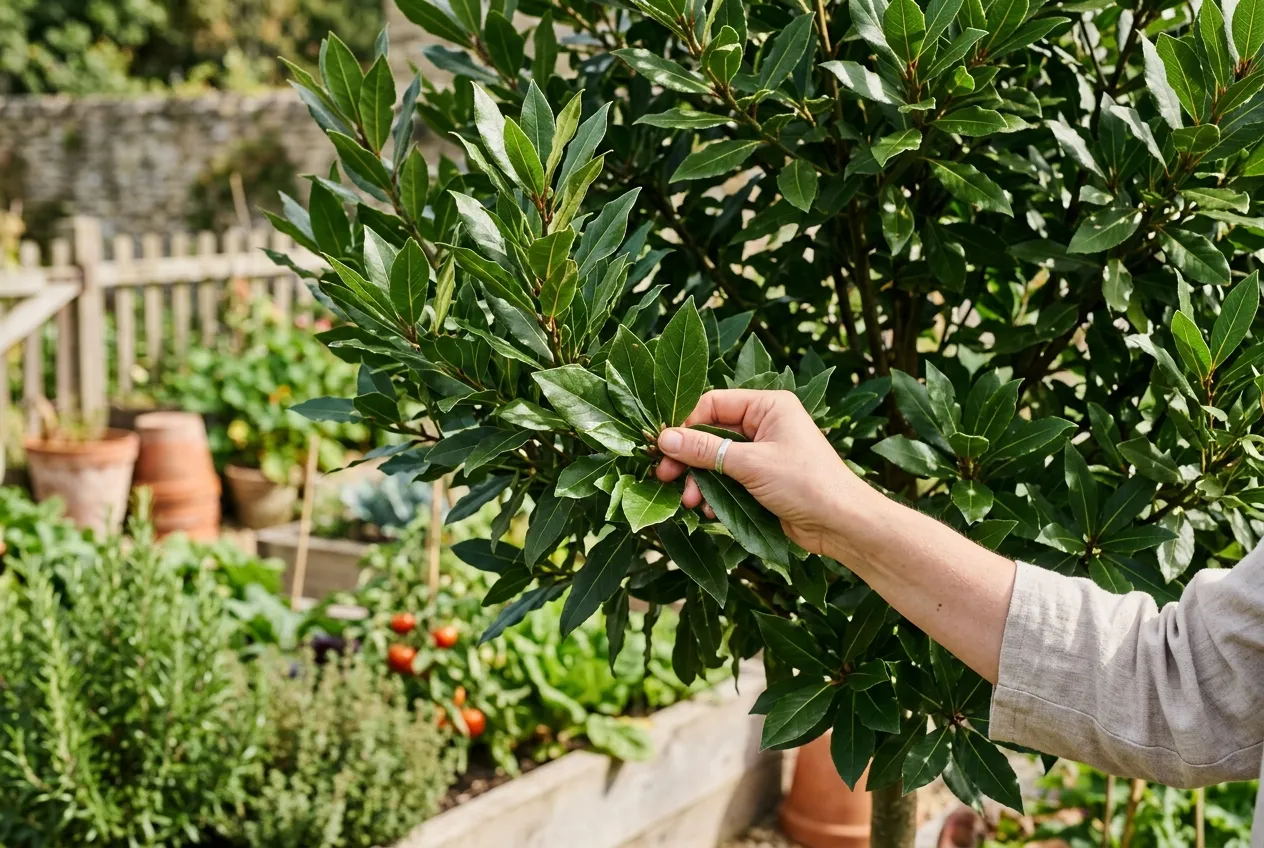 Fresh bay leaves picked straight from the tree have 3-4 times more flavour than dried shop-bought leaves.
Choosing the right pot
Use a pot of 40-45cm diameter as a minimum for a standard bay tree. Terracotta and glazed ceramic pots are heavier than plastic, which helps prevent top-heavy standards from blowing over. Ensure the pot has at least one large drainage hole. Bay roots sitting in standing water rot quickly, especially in winter.
The best compost for bay in pots
John Innes No. 3 is the best compost for container bay trees. Its loam base holds nutrients and moisture steadily without becoming waterlogged. Mix in 20% perlite or horticultural grit by volume for extra drainage. Avoid peat-free multipurpose composts for long-term plantings. They break down within 12-18 months, compacting around the roots and holding too much water. If you prefer growing in rosemary and sage alongside your bay, the same loam-based mix works for all Mediterranean herbs.
Watering and feeding
Water container bays when the top 3-5cm of compost is dry. In summer, this may mean every 2-3 days during hot spells. In winter, reduce watering to once a week or less. The compost should never be sodden. Feed once in April with a slow-release balanced fertiliser (such as Osmocote or Vitax Q4). A single application lasts the full growing season. Do not feed after August, as soft new growth is vulnerable to frost.
Repotting
Repot bay trees every 2-3 years in March or April. Move up one pot size (5cm wider). If the tree has reached its final pot size, top-dress instead: scrape away the top 5cm of compost and replace with fresh John Innes No. 3 mixed with slow-release fertiliser. This refreshes nutrients without disturbing the roots.
How to plant bay trees in the ground
In sheltered positions, bay trees grow into handsome evergreen specimens reaching 7-12m tall over many decades. Ground planting suits mild, urban, and coastal areas where winter temperatures rarely drop below minus 5 degrees C.
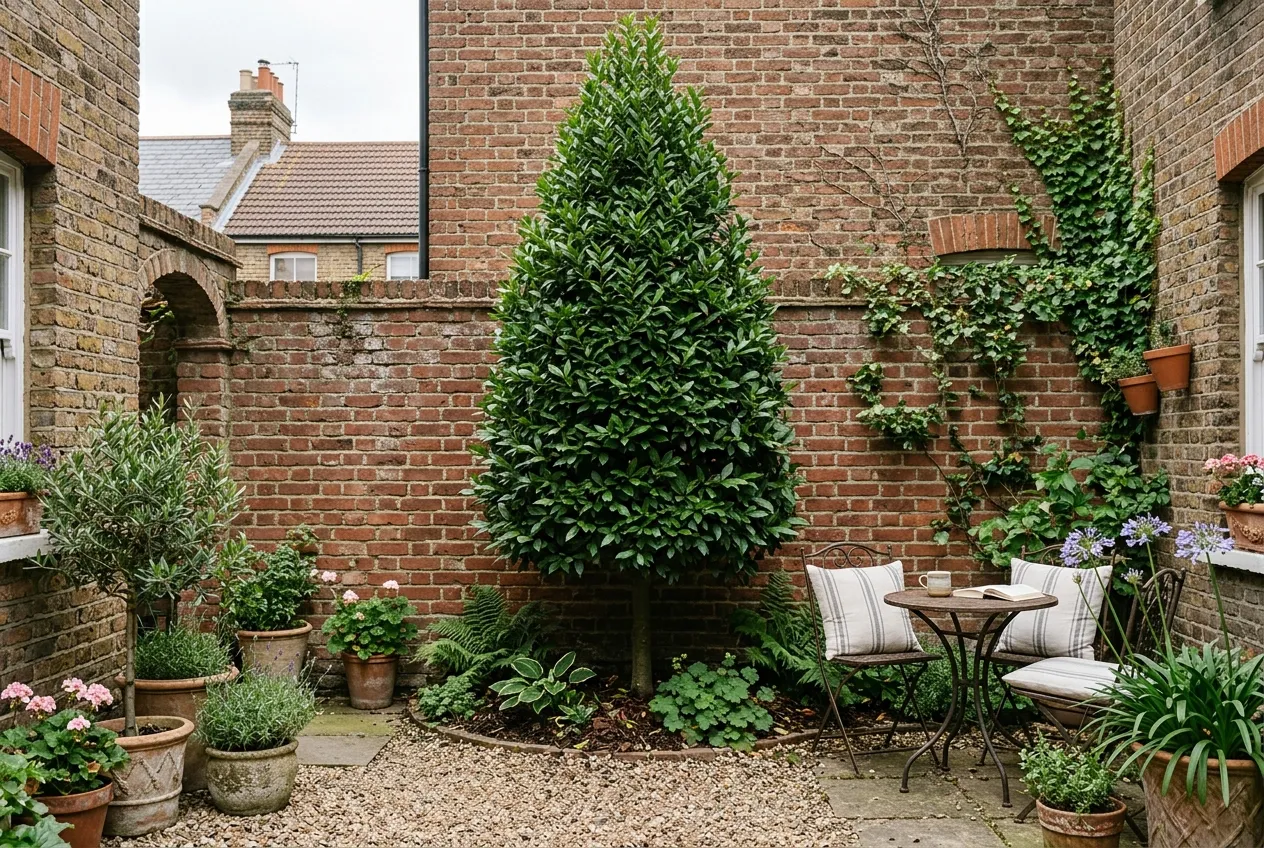 A mature bay tree in a sheltered courtyard. Brick walls provide warmth and wind protection that bay trees need in UK gardens.
Choosing the right spot
Bay needs a sheltered position protected from cold north and east winds. South or west-facing walls are ideal. The soil must drain freely. Bay tolerates most soil types including chalk, sand, and loam, but struggles on heavy clay unless drainage is improved. Dig in 30% grit by volume on clay soils and plant slightly proud of the surrounding ground level.
Planting method
Dig a hole twice the width of the root ball and the same depth. Set the tree so the top of the root ball sits level with the soil surface. Backfill with the excavated soil mixed with a handful of grit. Water well once after planting. Mulch with gravel or bark in a 5cm ring around the base, keeping mulch 10cm away from the trunk to prevent stem rot. Water weekly during the first summer, then let rainfall do the work.
Bay trees planted in the ground need minimal ongoing care. They rarely need feeding once established. Their deep root system finds its own nutrients. The main tasks are pruning for shape and monitoring for pests. Bay is one of the best evergreen trees for UK gardens when you want year-round structure.
Bay tree forms: standard, ball, and pyramid
Bay trees respond well to topiary training, and three shaped forms dominate British gardens. Each has different space requirements and maintenance levels.
| Form | Typical height | Pot size needed | Trims per year | Best for |
|---|---|---|---|---|
| Standard (lollipop) | 1.2-1.8m | 40-45cm | 2 | Doorstep pairs, formal displays |
| Ball | 0.6-1.0m | 35-40cm | 2-3 | Low planters, courtyard features |
| Pyramid (cone) | 1.0-1.5m | 40-45cm | 2 | Borders, focal points |
| Free-form (unpruned) | 3-12m | Ground only | 1 (optional) | Large gardens, screening |
How to train a standard
A standard bay tree has a clear single stem topped with a ball-shaped canopy. To train one from a young plant, select the strongest upright stem and remove all side shoots below the desired head height (typically 60-90cm). Allow the top growth to bush out, then clip to a ball shape twice a year. This takes 2-3 years from a young whip.
Shaping tips
Always use sharp secateurs rather than hedging shears. Shears cut through leaves, which turn brown at the edges and look unsightly for weeks. Secateurs allow you to cut each shoot cleanly just above a leaf node. This takes longer but gives a far better result. The best months for shaping are June (main cut) and September (tidy-up). For general principles on shaping woody plants, our pruning guide covers the fundamentals.
Common bay tree problems in the UK
Bay trees are generally trouble-free, but two pests and one environmental problem account for most issues British growers encounter.
Bay sucker (Trioza alacris)
Bay sucker is the most common pest of bay trees in the UK. The tiny sap-sucking insects cause leaves to curl, thicken, and turn yellow at the margins. Look underneath curled leaves for the small, flattened nymphs covered in white waxy fluff. Damage appears from late spring through summer.
Pick off and destroy affected leaves by hand. This is the most effective control for light infestations. For heavier attacks, spray with a fatty acid-based contact insecticide in May when nymphs are young and exposed. Bay sucker rarely kills a tree but makes it look untidy. Regular removal of affected foliage keeps it under control.
Scale insects
Soft scale insects appear as brown, oval bumps on the undersides of leaves and along stems. They feed on sap and excrete sticky honeydew, which attracts black sooty mould. The combination of scale and sooty mould disfigures the tree and reduces vigour over time.
Wipe off individual scale insects with a damp cloth. For larger infestations, spray with a plant oil-based winter wash in December or January when the tree is dormant. Encourage natural predators: ladybirds and parasitic wasps both feed on scale insects.
Wind scorch and yellow leaves
Yellow or brown leaf edges on bay trees almost always indicate wind scorch or waterlogging, not disease. Cold east winds in late winter and early spring desiccate the foliage faster than roots can replace moisture. Move container bays to a sheltered position from November onwards. In the ground, plant behind a wall, fence, or evergreen hedge for wind protection.
If leaves turn uniformly yellow rather than scorching at the edges, suspect waterlogging or nutrient deficiency. Improve drainage first. If drainage is already good, apply a balanced feed in April.
Field Report: In our Staffordshire trial garden (heavy clay, west-facing), a standard bay in a 45cm terracotta pot survived minus 8 degrees C in January 2024 with fleece protection. The same variety planted in open ground without wind shelter lost 40% of its foliage to wind scorch that same winter, despite the air temperature being the same. Shelter from wind matters more than the thermometer reading.
Pruning and maintaining bay trees
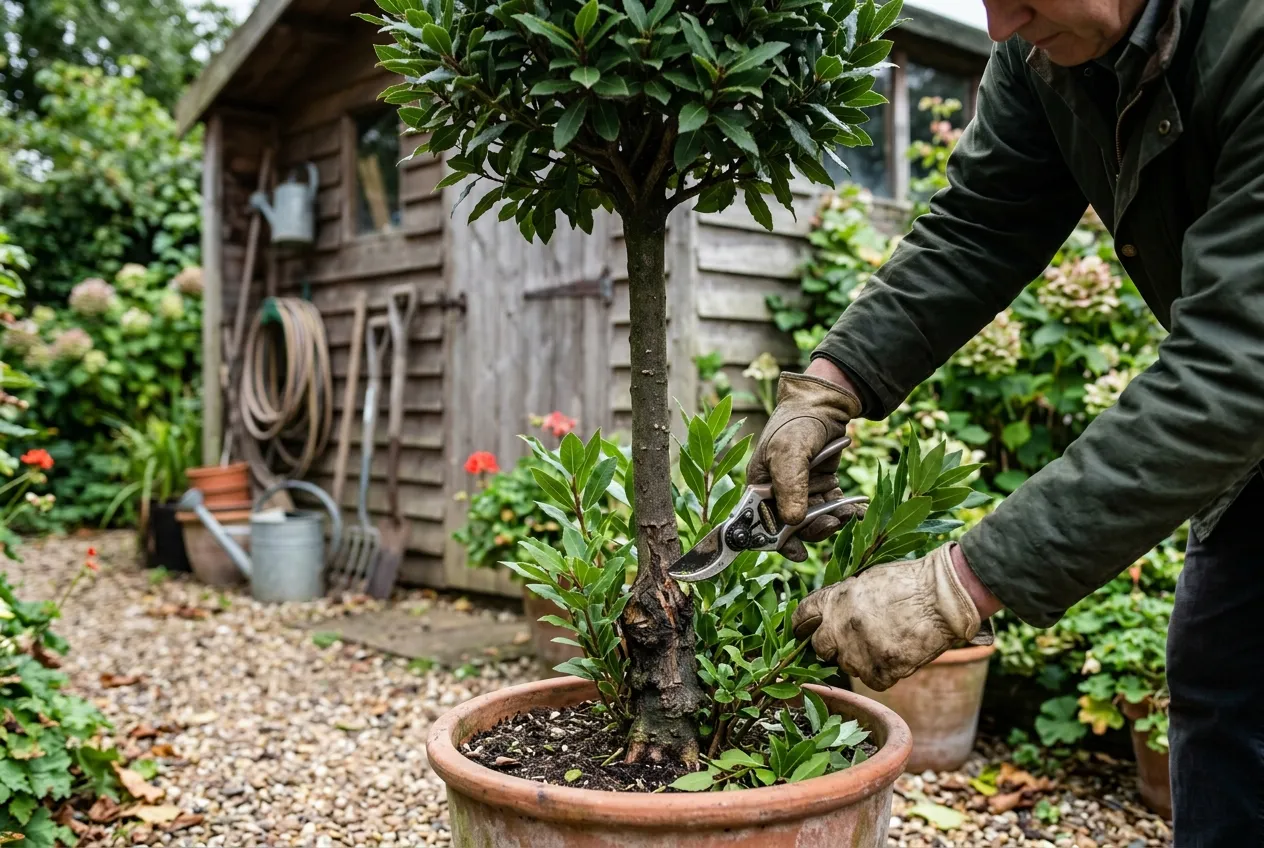 Sucker shoots growing from the base and trunk of a standard bay tree should be removed as they appear throughout the growing season.
When to prune
Prune bay trees twice a year. The main shaping cut is in June, after the spring growth flush has hardened. A light tidy-up in September removes any straggly late growth before winter. Avoid pruning after October. New growth stimulated by late pruning is soft and vulnerable to frost.
Removing suckers
Bay trees produce sucker shoots from the base, trunk, and root system. On standard trees, these spoil the clean stem and divert energy from the canopy. Remove suckers as they appear by tearing them off at the base rather than cutting. Tearing removes the dormant buds at the shoot base, which slows regrowth. Cutting leaves a stub with buds that reshoot quickly.
Renovation pruning
Neglected bay trees that have grown too large can be hard pruned in late spring (May). Cut back to within 15cm of the main framework. Bay regenerates well from old wood, unlike many evergreens. New shoots appear within 4-8 weeks. It takes 2-3 growing seasons to rebuild a full canopy after hard pruning. Feed with a balanced fertiliser after hard pruning to support regrowth.
Using bay leaves in cooking
Fresh bay leaves from your own tree have 3-4 times the flavour of dried supermarket leaves. The aromatic oils in fresh Laurus nobilis leaves are at their peak within minutes of picking. You can harvest leaves at any time of year, which is one of the great advantages of this evergreen herb.
Harvesting tips
Pick individual leaves rather than stripping whole branches. Choose mature, dark green leaves from the current or previous season’s growth. Young, light green leaves at the shoot tips have less flavour. One fresh leaf replaces two dried leaves in any recipe.
Drying and storing
To dry your own bay leaves, spread single layers on a wire rack in a warm, dry room for 2-3 weeks. Properly dried leaves should snap rather than bend. Store in an airtight glass jar away from light. Home-dried leaves keep their flavour for 12 months, far longer than shop-bought dried bay, which is often 2-3 years old by the time it reaches your kitchen.
Safety note
Only Laurus nobilis (true bay laurel) is safe for cooking. Do not confuse it with cherry laurel (Prunus laurocerasus), which has toxic leaves containing cyanide compounds. Cherry laurel has broader, shinier leaves without the distinctive aromatic scent when crushed. If in doubt, crush a leaf between your fingers. True bay smells warm and herbal. Cherry laurel smells faintly of almonds.
How to propagate bay trees from cuttings
Bay trees root from semi-ripe cuttings taken in July to September. The process is slower than most herbs, taking 4-6 months rather than 4-6 weeks, but success rates of 60-70% are typical with bottom heat.
Method
- Cut 10-15cm shoots from the current season’s growth
- Strip the lower two-thirds of leaves, leaving 3-4 leaves at the tip
- Wound the base by scraping a thin sliver of bark away on one side
- Dip in hormone rooting powder (strength 2 or 3)
- Insert into pots filled with 50/50 perlite and multipurpose compost
- Water lightly and cover with a clear plastic bag or propagator lid
- Place on a heated propagator mat at 18-20 degrees C
- Check for rooting after 3-4 months by gently tugging the cutting
- Pot on rooted cuttings individually and grow on under cover for the first winter
Bottom heat makes a significant difference. Without it, cuttings taken in September may not root until the following spring. A heated propagator mat (available from around 15-25 pounds) speeds the process considerably.
Bay trees offer year-round structure, fresh culinary leaves, and a classic British garden presence that few other plants match. For more aromatic herbs to grow alongside your bay, explore our guides to rosemary and sage.
Frequently asked questions
Are bay trees hardy in the UK?
Bay trees tolerate temperatures down to minus 5 degrees C. They survive brief dips to minus 10 degrees C when wrapped in horticultural fleece. Across most of England, Wales, and sheltered Scottish gardens, bay grows outdoors year-round without protection. In exposed northern and highland areas, grow bay in containers and move under cover during prolonged cold spells. Shelter from wind matters more than the absolute temperature.
Can I grow a bay tree in a pot?
Container growing is the most popular method in the UK. Use a 40-45cm pot with drainage holes and fill with John Innes No. 3 mixed with 20% perlite or grit. Bay trees thrive in pots for decades when repotted every 2-3 years in March and fed with slow-release fertiliser each April. Water when the top 3-5cm of compost dries out.
How fast do bay trees grow?
Bay grows 15-25cm per year in typical UK conditions. A young 60cm tree takes 5-7 years to reach 1.5m as a trained standard. Growth is slower in containers than in open ground. Feed annually and repot every 2-3 years to maintain a steady rate. Trees planted in sheltered ground eventually reach 7-12m tall over several decades.
Why are the leaves on my bay tree turning yellow?
Yellow leaves usually indicate waterlogging or nutrient deficiency. Check drainage first. Soggy compost needs more grit and less frequent watering. If drainage is fine, apply a balanced slow-release fertiliser in April. Cold wind scorch causes brown, dry edges rather than uniform yellowing. Move container trees to a sheltered spot from November through March.
When should I prune a bay tree?
Prune in June for the main shape and September for a light tidy-up. Use sharp secateurs, not shears. Shears cut through leaves, which brown at the edges. Remove sucker shoots from the base and trunk as they appear throughout the growing season by tearing rather than cutting. Avoid pruning after October to prevent soft growth that frost damages.
How do I protect a bay tree in winter?
Wrap the canopy in horticultural fleece when temperatures drop below minus 5 degrees C. Move container bays against a south-facing house wall for reflected warmth. Raise pots on feet to prevent waterlogging. An unheated porch, cold greenhouse, or garage with a window provides ideal emergency shelter. Avoid heated conservatories, which are too warm and cause leaf drop.
Can I grow bay from cuttings?
Bay propagates reliably from semi-ripe cuttings taken in July to September. Cut 10-15cm shoots, strip lower leaves, dip in rooting powder, and insert into 50/50 perlite and compost. Bottom heat at 18-20 degrees C speeds rooting from 6 months to 3-4 months. Expect a 60-70% success rate. Pot on individually and grow under cover for the first winter.
Lawrie has been gardening in the West Midlands for over 30 years. He grows his own veg using no-dig methods, keeps a wildlife-friendly garden, and writes practical advice based on real UK growing conditions.