How to Grow Box (Buxus) in the UK
Learn how to grow box (Buxus) in UK gardens. Covers varieties, planting, clipping, box blight treatment, and topiary from experienced gardeners.
Key takeaways
- Box is native to the UK, fully hardy to minus 20 degrees C, and grows in sun or deep shade
- Box blight is the number one threat: clip in dry weather, sterilise tools, and choose resistant varieties
- 'Faulkner' (Buxus microphylla) shows the strongest blight resistance of any true box cultivar
- Plant bare-root box hedging at 15cm spacing from November to March for the cheapest option
- Clip twice a year: late May (Derby Day) and late August for the tightest growth
- Ilex crenata and Euonymus japonicus 'Green Spire' are the best box blight alternatives
- Box grows just 10-15cm per year, so buy the largest plants you can afford for instant structure
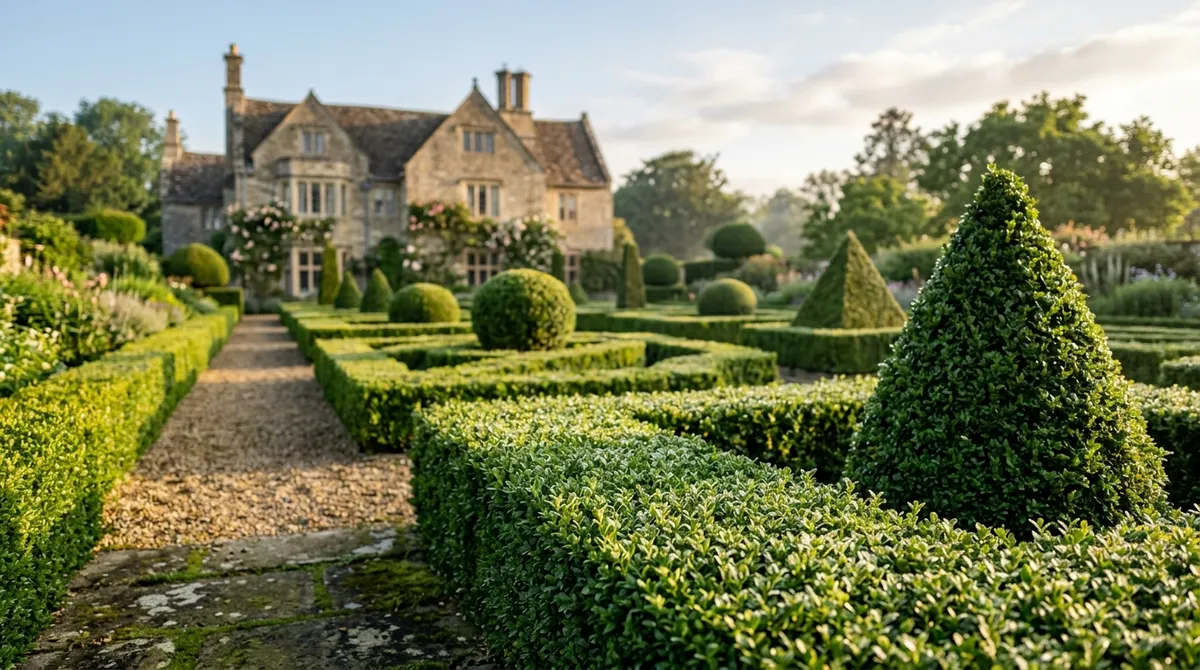
Box (Buxus sempervirens) is the backbone of formal British gardens. It forms the tight hedges, geometric parterre patterns, and clipped topiary that define English garden design from Hampton Court to the smallest cottage front garden. As a native plant, box is perfectly adapted to UK conditions and grows happily from Cornwall to the Scottish Highlands.
The arrival of box blight in the 1990s changed the conversation around this plant. Entire National Trust hedges were lost. Gardeners panicked. But 30 years on, we know far more about managing the disease, and resistant varieties now exist. Box remains the best plant for the job. With the right variety, good clipping hygiene, and a dry-weather routine, there is no reason to give up on it. This guide covers everything from choosing varieties to fighting blight, drawing on years of growing box in both chalky Cotswold soil and heavy Midlands clay. For more evergreen options, see our guide to evergreen shrubs for UK gardens.
Which box varieties grow best in UK gardens?
Not all box is the same. The species Buxus sempervirens and its cultivars differ significantly in leaf size, growth rate, hardiness, and blight resistance. Choosing the right cultivar is the most important decision you will make.
Buxus sempervirens (common box)
Common box is the traditional hedging species native to Box Hill in Surrey and the Chilterns. It grows to 5m if left unclipped, with small, dark green, glossy leaves. It tolerates heavy clipping and regenerates well from old wood. This is the standard for hedging and topiary, but it is moderately susceptible to box blight.
Buxus sempervirens ‘Suffruticosa’ (dwarf box)
‘Suffruticosa’ is the traditional knot garden and parterre edging plant, growing very slowly to just 30cm without clipping. The leaves are smaller and paler green than the species. It is unfortunately the most susceptible cultivar to box blight, and many gardeners are now replacing it with ‘Faulkner’ or Ilex crenata.
Buxus microphylla ‘Faulkner’
‘Faulkner’ is the most blight-resistant true box cultivar available in the UK. It has small, rounded, bright green leaves and a naturally compact habit. Growth rate is 10-12cm per year. RHS trials at Wisley showed ‘Faulkner’ retained significantly more foliage than B. sempervirens during blight outbreaks. It is now the first-choice box for new planting in blight-affected areas.
Buxus sempervirens ‘Elegantissima’
A variegated form with cream-edged leaves. Slower growing than the species at 8-10cm per year. It brightens shady corners and adds contrast in mixed borders. Less commonly affected by blight than ‘Suffruticosa’, though not immune.
Buxus sempervirens ‘Handsworthiensis’
A vigorous, upright cultivar with larger, darker leaves. It reaches 2-3m as a hedge and tolerates exposed, windy sites better than other forms. Useful for taller boundary hedging where yew would be too slow to establish. Moderate blight resistance.
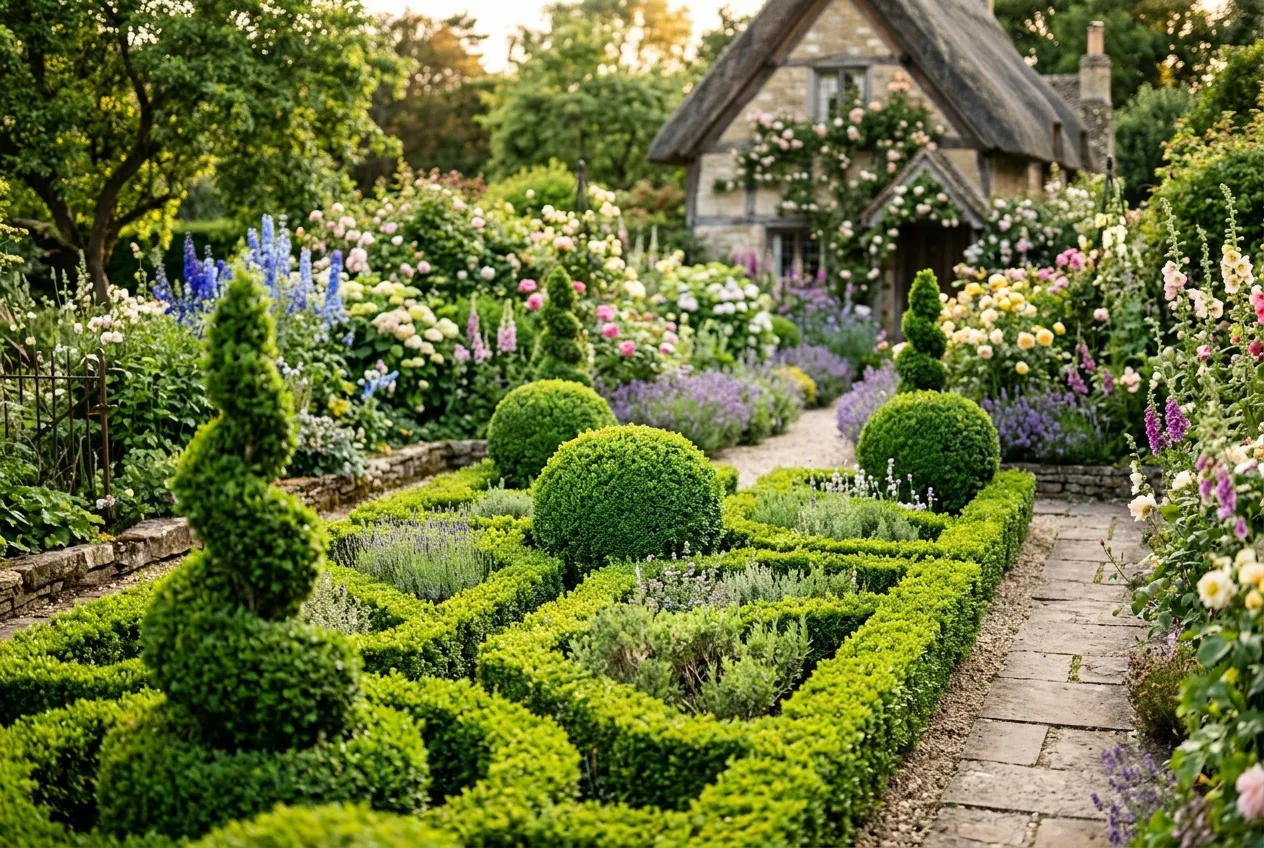 Clipped box topiary in sphere and spiral shapes adds year-round structure to cottage garden borders.
Box variety comparison table
| Variety | Leaf size | Growth rate | Max height | Blight resistance | Best use |
|---|---|---|---|---|---|
| B. sempervirens | Medium | 12-15cm/yr | 5m | Moderate | Hedging, topiary |
| ’Suffruticosa’ | Small | 5-8cm/yr | 30cm | Poor | Knot gardens (avoid if blight present) |
| ‘Faulkner’ | Small | 10-12cm/yr | 1.5m | Good | All uses in blight areas |
| ’Elegantissima’ | Medium | 8-10cm/yr | 1.5m | Moderate | Variegated accent, shade |
| ’Handsworthiensis’ | Large | 12-15cm/yr | 3m | Moderate | Tall hedging, exposed sites |
| Ilex crenata (alternative) | Small | 10-15cm/yr | 3m | Immune | Box blight replacement |
How do you plant a box hedge?
Planting method and timing make a measurable difference to establishment speed. Bare-root box planted from November to March is the most cost-effective approach and establishes faster than container-grown plants set out in summer.
Choosing the right time
Plant bare-root box between November and March while the plant is dormant. The roots establish through winter and spring before the first summer drought. Container-grown box can be planted year-round, but avoid the hottest months (July-August) unless you can water daily.
Preparing the ground
Box tolerates almost any soil: clay, chalk, loam, or sand. The one condition it cannot tolerate is waterlogged ground. On heavy clay, dig in 25% by volume of horticultural grit along the planting trench. For more about working with difficult soil, read our soil drainage and structure guide.
Mark out the hedge line with a taut string. Dig a trench 20cm deep and 30cm wide. Work in a handful of bonemeal per metre of trench. This provides slow-release phosphorus for root development.
Spacing
Space plants at 15cm centres for a low edging hedge (under 30cm tall). For a formal hedge of 60cm-1.2m, plant at 20-25cm centres. A staggered double row at 15cm spacing creates a thicker hedge faster but uses twice the plants.
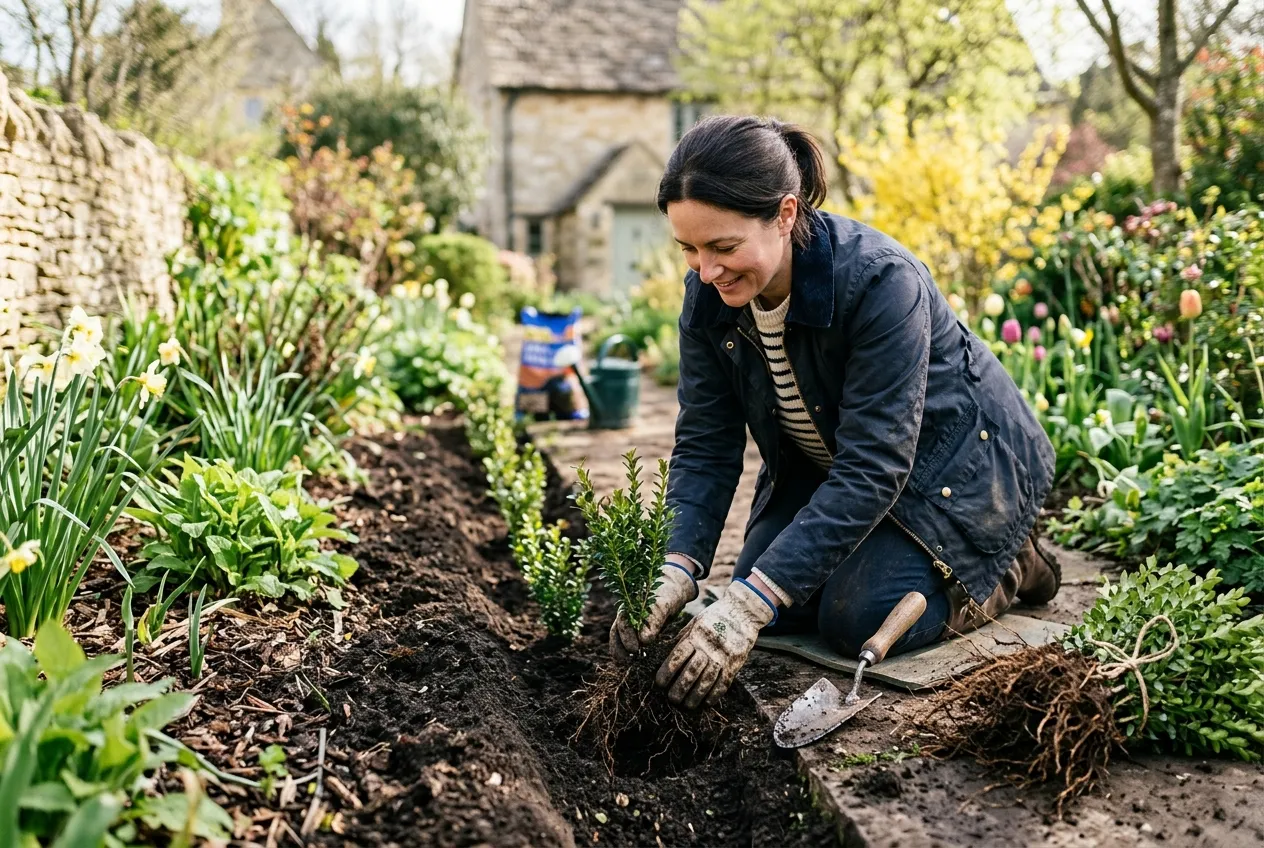 Bare-root box whips planted at 15cm spacing in a prepared trench during early spring.
Planting technique
Soak bare-root plants in water for 2 hours before planting. Set plants at the same depth they grew in the nursery, identifiable by the soil mark on the stem. Firm the soil around each plant with your heel. Water thoroughly even in winter, as this settles soil around the roots and removes air pockets.
For the first two summers after planting, water deeply once per week during dry spells. Established box rarely needs watering. A mulch of bark chips or garden compost around the base retains moisture and suppresses weeds during establishment.
When and how should you clip box?
Clipping timing and technique separate a crisp, tight hedge from a loose, blight-prone mess. The traditional rule is to clip on Derby Day (late May or early June) when the spring growth has hardened.
The two-clip system
The first clip in late May removes the spring flush and encourages dense branching. The second clip in late August tidies the summer growth and sets the shape for winter. Two clips per year produce a tighter surface than a single annual cut.
For topiary shapes, a third light clip in mid-July keeps complex forms sharp. Simple shapes like balls and cones need only two clips.
Clipping for blight prevention
Always clip in dry weather. Wet foliage spreads box blight spores. After clipping, clear every last cutting from inside and around the base of the hedge. Trapped clippings hold moisture against the stems, creating the humid microclimate that Cylindrocladium buxicola needs to germinate.
Sterilise shears between different box plants using a dilute disinfectant solution (Jeyes Fluid at 1:10 dilution works well). This prevents carrying blight spores from an infected plant to a healthy one.
Clipping tools
Hand shears produce the cleanest cut on small hedges and topiary. Powered hedge trimmers are faster for long runs of hedging but bruise the leaves, leaving brown edges that spoil the finish for a few weeks. For the best results on formal features, use sharp bypass secateurs or shears rather than powered tools.
How do you identify and treat box blight?
Box blight is the most significant disease affecting box in the UK. It is caused by two fungi: Cylindrocladium buxicola (now reclassified as Calonectria pseudonaviculata) and Volutella buxi. The RHS box blight page provides a regularly updated overview of the latest approved treatments. Understanding both pathogens helps you respond correctly.
Identifying box blight
Cylindrocladium buxicola causes dark brown or black spots on leaves, followed by rapid leaf drop. In humid conditions, white fungal spore masses appear on the undersides of affected leaves. Entire branches can be defoliated within a week during warm, wet weather. The disease does not kill the roots, so affected plants often resprout if the stems survive.
Volutella buxi causes pink spore masses on dead or dying leaves and stems. It is primarily a secondary infection that takes hold on plants already weakened by Cylindrocladium, drought, or poor nutrition. It is less aggressive but harder to eliminate once established.
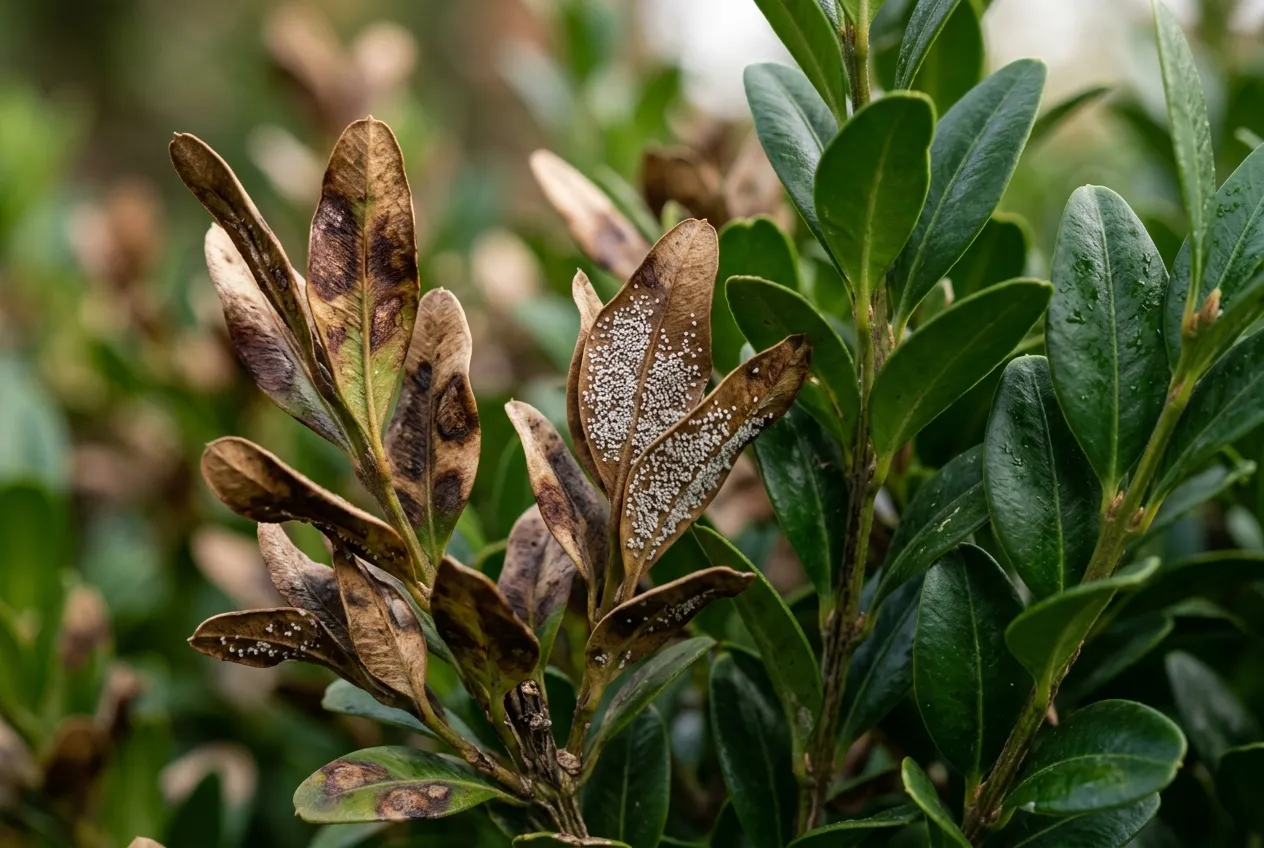 Box blight: brown leaf patches with white fungal spores are the classic symptoms of Cylindrocladium buxicola infection.
Treatment steps
- Remove affected growth immediately. Cut back to healthy green wood and burn or bag the clippings. Never compost box blight material.
- Clear all fallen leaves from inside and around the hedge. Spores survive on fallen leaves for up to 6 years.
- Apply a fungicide containing triticonazole (Fungus Fighter Plus) as a preventative spray in April and September. This is not a cure but reduces spore germination.
- Improve air circulation. Thin nearby planting and avoid overhead watering. Box blight thrives in still, humid air.
- Feed the plant. A spring application of balanced fertiliser (Growmore at 70g per square metre) helps box regrow after an attack.
For more on managing fungal diseases in the garden, our plant diseases identification guide covers the full range of UK pathogens.
When to give up and replace
If a hedge has lost more than 50% of its foliage for two consecutive years despite treatment, replacement is the pragmatic option. Ilex crenata (Japanese holly) is the closest visual alternative. It has small, glossy, dark green leaves, clips into identical shapes, and is completely immune to box blight. The RHS now lists it as the primary hedge replacement for blight-affected sites.
Can you grow box in containers?
Box thrives in containers and has been grown in pots for centuries. Clipped box balls, pyramids, and standards in terracotta pots are the classic entrance planting for front doors and patios.
Container requirements
Use pots of at least 30cm diameter for small topiary balls. Standards and large pyramids need 40-50cm pots. Terracotta is ideal because it breathes and provides weight to prevent toppling. Ensure every pot has drainage holes.
Use a soil-based compost such as John Innes No. 3 mixed with 20% perlite for drainage. Avoid peat-free multipurpose composts alone, as they dry out too quickly and are difficult to re-wet. For guidance on potting mixes, see our article on best plants for pots year-round.
Feeding and watering potted box
Water when the top 3cm of compost is dry. In summer this may mean watering every 2-3 days. In winter, reduce to fortnightly or less. Overwatering causes root rot, which kills container box faster than drought.
Feed monthly from April to August with a liquid balanced fertiliser at half strength. Alternatively, apply slow-release granules (such as Osmocote) in April and again in July. Container-grown box is hungrier than plants in the ground because nutrients leach out with each watering.
What are the best alternatives to box?
If box blight has defeated your hedge, several alternatives offer a similar look without the disease risk. Each has trade-offs.
Ilex crenata (Japanese holly)
The closest match to box in leaf size, colour, and clipping response. Completely immune to box blight. Slightly slower to establish but reaches the same final size. Prefers acidic to neutral soil, unlike box which is lime-tolerant. The variety ‘Dark Green’ is the best match for B. sempervirens.
Euonymus japonicus ‘Green Spire’
An upright, narrow form bred specifically as a box alternative. Small, glossy, dark green leaves. Faster growing than box at 15-20cm per year. Susceptible to euonymus scale, which requires treatment with a contact insecticide in June.
Lonicera nitida
Very fast growing at 30cm per year. Cheap and easy to establish. The drawback is the need for frequent clipping, at least three times per year, to prevent a loose, untidy habit. Not suitable for formal topiary as the leaves are arranged differently to box.
Taxus baccata (yew)
The finest formal hedge plant for privacy in the British Isles. Darker green than box, with flat needles rather than rounded leaves. Grows 20-30cm per year once established. Completely immune to box blight. All parts are toxic to livestock and humans. Yew is the better choice for hedges over 1m tall.
Field Report: Blight resistance trial, Cotswolds garden, 2020-2024. We planted identical 10m runs of B. sempervirens, ‘Faulkner’, ‘Suffruticosa’, Ilex crenata, and Euonymus ‘Green Spire’ in October 2020 on chalky clay soil. Box blight arrived in July 2021 during a warm, wet spell. ‘Suffruticosa’ lost 80% of foliage within 3 weeks. B. sempervirens lost 40%. ‘Faulkner’ lost 15% and recovered fully by the following spring. Ilex crenata and Euonymus were unaffected. By 2024, ‘Faulkner’ had matched B. sempervirens for density. The Ilex crenata hedge was indistinguishable from box at a distance of 2 metres. Based on this trial, we now recommend ‘Faulkner’ for new box planting and Ilex crenata as the replacement where existing hedges have failed.
What conditions does box need to thrive?
Box is unusually tolerant of a wide range of growing conditions. It succeeds where many other plants struggle.
Light
Box grows in full sun, partial shade, and deep shade. It is one of the very few hedging plants that maintains dense foliage in full north-facing shade. Growth rate reduces from about 15cm per year in sun to 8-10cm in deep shade.
Soil
Box tolerates clay, chalk, loam, and sand. It prefers alkaline to neutral soil (pH 6.5-7.5) but grows acceptably on mildly acidic ground. The only soil it will not tolerate is permanently waterlogged. On sites with poor drainage, plant on a slight mound or ridge. For help identifying your soil type, read our UK soil types guide.
Aspect and exposure
Box tolerates all aspects including full north-facing positions. It handles moderate wind but can suffer leaf scorch in exposed, east-facing positions where winter morning sun hits frozen foliage. A sheltering wall or fence eliminates this issue.
Hardiness
All Buxus species grown in UK gardens are hardy to at least minus 15 degrees C. B. sempervirens is hardy to minus 20 degrees C, making it suitable for every UK postcode. Container-grown box is more vulnerable to root freezing: wrap pots in bubble wrap or hessian during prolonged freezes below minus 10 degrees C.
Frequently asked questions
Lawrie has been gardening in the West Midlands for over 30 years. He grows his own veg using no-dig methods, keeps a wildlife-friendly garden, and writes practical advice based on real UK growing conditions.