Campanula: Bellflowers for Every UK Border
Grow campanula in UK gardens with this practical guide. Covers 8 species from alpine to border, planting, slug control, division, and shade tolerance.
Key takeaways
- Over 300 species ranging from 5cm rock garden alpines to 150cm tall border perennials
- C. persicifolia is the classic cottage garden bellflower, flowering June to August in blue or white
- Most campanulas tolerate partial shade, making them ideal for north-facing and woodland borders
- C. poscharskyana and C. portenschlagiana are vigorous ground cover plants for walls and paving
- All species are fully hardy in UK winters down to minus 15C or below
- Slugs are the main problem, targeting emerging spring shoots of taller species
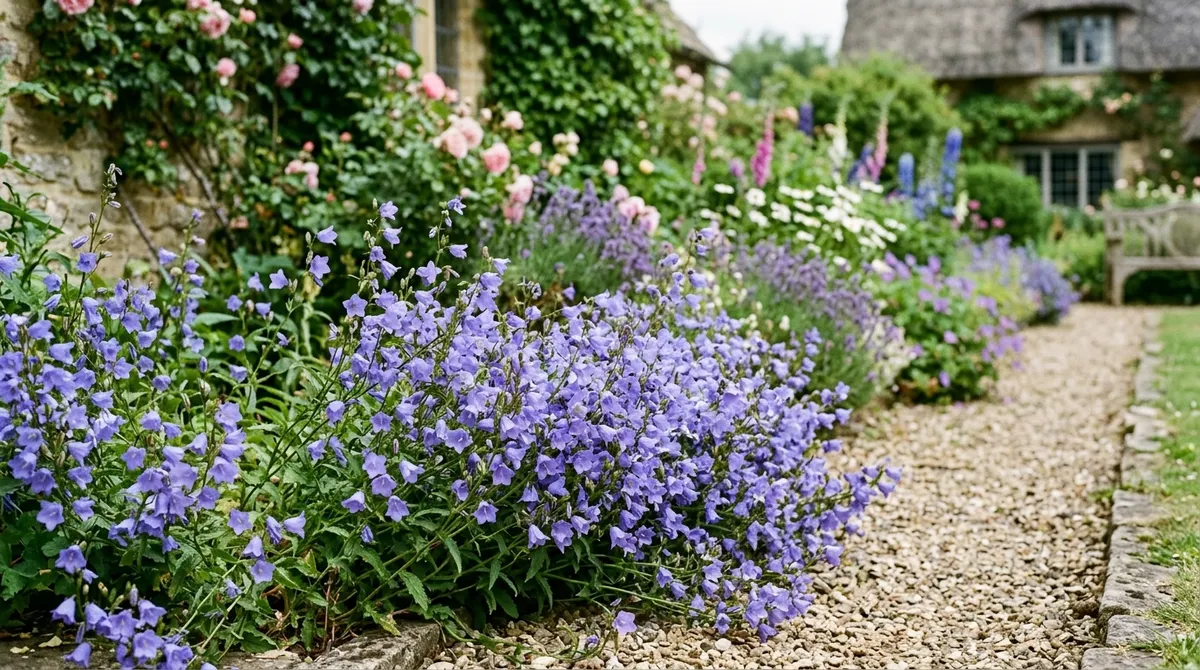
Campanulas have been flowering in British gardens for centuries, and for good reason. No other genus offers such range. From tiny alpine cushions tucked into crevices to tall, stately spires swaying at the back of a herbaceous border, there is a campanula for every spot in the garden. The bell-shaped flowers come in every shade of blue, violet, and white. Most tolerate shade. All survive British winters without fuss.
The genus Campanula contains over 300 species, but only a dozen or so are widely grown in UK gardens. This guide covers the eight most useful species, from the classic cottage garden favourite C. persicifolia to the vigorous wall-hugger C. portenschlagiana. Whether you are filling a sunny border or planting under trees in dappled shade, at least one campanula will thrive there.
Which campanula species should I grow?
Eight species cover every garden situation in the UK. Each has a distinct character, size, and habit. Knowing the differences saves you from planting a vigorous ground-cover species where you wanted a well-behaved border perennial, or vice versa.
Campanula persicifolia (peach-leaved bellflower)
The classic cottage garden campanula and the one most gardeners picture when they hear the word bellflower. Slender stems rise to 90cm carrying open, cup-shaped flowers in clear blue or white from June to August. The basal rosette of narrow, evergreen leaves sits neatly at ground level. Spreads gently by self-seeding into gravel, path edges, and gaps between paving. Not invasive. Easy to pull out where unwanted.
Best in mixed borders in sun or partial shade. Pairs beautifully with roses and hardy geraniums. Deadhead spent stems to encourage a second flush. Divide clumps every 3-4 years. Holds an RHS Award of Garden Merit.
Campanula lactiflora (milky bellflower)
The tallest commonly grown campanula at 120-150cm. Large, domed heads of lilac-blue, pink, or white flowers in July and August. Staking is essential in exposed or windy gardens. The stems are heavy when in full flower. Plant at the back of a border against a wall or hedge for natural shelter.
Grows in sun or partial shade. Prefers fertile, moisture-retentive soil. Cut back hard after flowering for a smaller second flush in September. The variety Prichard’s Variety is the most widely grown, with rich violet-blue flowers at 90cm. Loddon Anna has soft pink flowers.
Campanula poscharskyana (trailing bellflower)
A vigorous, spreading ground cover plant producing masses of starry, blue-purple flowers from June to October. Grows just 15-20cm tall but spreads up to 60cm per year by runners. Excellent for covering bare ground, trailing over walls, colonising paving cracks, and softening the edges of raised beds.
Grows in sun or shade, including full shade. Tolerates dry soil once established. Almost impossible to kill once happy. Can be invasive in small gardens if not controlled. Pull up unwanted runners in spring or autumn. The variety Stella is the most commonly sold form.
Campanula portenschlagiana (wall bellflower)
Similar to C. poscharskyana but more compact and restrained. Forms dense mats of kidney-shaped leaves covered in deep violet-blue bell flowers from June to August. Grows 10-15cm tall and spreads 30-40cm per year. Less aggressive than C. poscharskyana but still vigorous.
Ideal for walls, rockeries, container edges, and the front of borders. Thrives in sun or partial shade. Tolerates poor, dry soil. Fully evergreen through winter. One of the best plants for dry stone walls and vertical surfaces.
Campanula glomerata (clustered bellflower)
Distinctive clusters of deep violet-purple flowers packed tightly at the top of 40-60cm stems in June and July. A native UK wildflower found on chalk downland and limestone grassland. Superb in wildlife gardens and naturalised areas. The variety Superba has the richest colour.
Spreads by underground runners and can be vigorous in fertile soil. Best in alkaline or chalky soil in full sun. Cut back after flowering to prevent self-seeding.
Campanula latifolia (giant bellflower)
A native British species growing to 120cm with large, tubular flowers in violet-blue or white. Naturally found in woodland edges, hedgerows, and damp, shady places. The best campanula for deep shade and north-facing gardens.
Spreads by self-seeding and can colonise large areas in ideal conditions. Best in moist, humus-rich soil. The white form (var. alba) lights up shady corners brilliantly.
Campanula medium (Canterbury bells)
A biennial, not a perennial. Sow seed in May or June to flower the following May and June. Large, showy bell flowers in blue, pink, white, or rose on 60-75cm stems. The cup-and-saucer forms (var. calycanthema) are the most dramatic, with a flared petal ruff around each bell.
Treat as a bedding plant and replace each year. Excellent in cottage garden borders and cutting gardens. Flowers last well in a vase.
Campanula carpatica (Carpathian bellflower)
A compact alpine species forming neat mounds 15-20cm tall and 30cm across. Open, upward-facing flowers in blue or white from June to August. Ideal for the front of borders, rockeries, containers, and edging paths.
Needs full sun and sharp drainage. Dislikes wet winter soil. Grows well in gravel and raised alpine beds. The variety Clips Blue is the most widely available.
Comparing campanula species for UK gardens
| Species | Height | Spread | Flower Colour | Flowering | Sun/Shade | Best Position |
|---|---|---|---|---|---|---|
| C. persicifolia | 90cm | 30cm | Blue, white | Jun-Aug | Sun to part shade | Mid-border |
| C. lactiflora | 120-150cm | 60cm | Blue, pink, white | Jul-Aug | Sun to part shade | Back of border |
| C. poscharskyana | 15-20cm | 60cm/year | Blue-purple | Jun-Oct | Sun to full shade | Ground cover, walls |
| C. portenschlagiana | 10-15cm | 30cm/year | Violet-blue | Jun-Aug | Sun to part shade | Walls, rockery |
| C. glomerata | 40-60cm | 40cm | Deep violet | Jun-Jul | Full sun | Wildflower meadow |
| C. latifolia | 120cm | 45cm | Violet, white | Jun-Jul | Part to full shade | Woodland, north-facing |
| C. medium | 60-75cm | 30cm | Blue, pink, white | May-Jun | Full sun | Cottage border |
| C. carpatica | 15-20cm | 30cm | Blue, white | Jun-Aug | Full sun | Rockery, edging |
How to plant campanulas
Most campanulas are sold as pot-grown plants from garden centres in spring. Plant at the same depth as the pot, in soil improved with a handful of garden compost. Water well after planting and through the first summer until roots establish.
Soil requirements vary by species but most campanulas are unfussy. C. persicifolia, C. lactiflora, and C. latifolia prefer moisture-retentive soil enriched with organic matter. C. poscharskyana and C. portenschlagiana tolerate poor, dry, stony soil. C. glomerata thrives on chalk and limestone. C. carpatica demands sharp drainage and hates wet feet in winter.
Spacing depends on the species. Allow 30-40cm between C. persicifolia plants, 60cm for C. lactiflora, and 30cm for mat-formers. Ground cover species fill gaps quickly, so plant further apart and let them spread.
Position is the most important decision. Match the species to the light conditions. The shade-tolerant species (C. persicifolia, C. lactiflora, C. latifolia, C. poscharskyana) are among the best blue-flowered plants for difficult spots under trees and against north-facing walls. Sun-loving species (C. glomerata, C. carpatica, C. medium) need 4-6 hours of direct sun for the best flowering.
How to care for campanulas through the year
Campanulas are low-maintenance plants once established. A few seasonal tasks keep them looking their best.
Spring: Watch for slug damage on emerging shoots. Taller species like C. persicifolia and C. lactiflora produce soft, succulent new growth that slugs devour overnight. Protect with your preferred method from March onwards. Apply a light mulch of garden compost around perennial clumps.
Summer: Deadhead spent flower stems as blooms fade. Cut C. persicifolia stems to the base after the first flush for a second crop of flowers in August. Stake C. lactiflora before stems reach full height. Water newly planted campanulas during dry spells.
Autumn: Cut back all herbaceous growth to ground level once foliage dies back. Divide overcrowded clumps and replant sections. Collect seed from C. medium (Canterbury bells) for sowing the following spring.
Winter: No action needed. All commonly grown campanulas are fully hardy below minus 15C. Evergreen mat-formers like C. poscharskyana keep their foliage through winter and provide valuable ground cover for overwintering insects.
How to propagate campanulas
Three methods give you more campanula plants for free.
Division is the easiest method for all perennial species. Lift established clumps in early spring or October. Pull or cut apart into sections, each with roots and shoots. Replant immediately at the same depth and water well. Most campanulas benefit from division every 3-4 years to keep them vigorous.
Seed works well for C. persicifolia, C. medium, and C. carpatica. Sow on the surface of moist seed compost in spring. Do not cover. Most campanula seeds need light to germinate. Place trays in a cold frame or unheated greenhouse. Germination takes 2-4 weeks. Prick out seedlings when large enough to handle. Grow on in pots and plant out the following autumn or spring. The RHS provides a detailed growing guide for all common campanula species.
Basal cuttings in spring work for C. lactiflora and C. glomerata. Take 8cm cuttings from new shoots at the base of the plant in April. Insert in pots of gritty compost and keep moist. Roots form in 3-4 weeks. Pot on and plant out in autumn.
Dealing with slugs on campanulas
Slugs are the only serious pest of campanulas in UK gardens. They target the soft new shoots that emerge in March and April, sometimes eating plants to ground level before they have a chance to grow.
C. persicifolia and C. lactiflora are the most vulnerable because their spring shoots are thick, succulent, and full of water. C. poscharskyana and C. portenschlagiana suffer less because their tight, woody mat of growth offers slugs fewer soft targets.
Use your preferred slug control method from late February onwards, before growth begins. Nematode biological controls (Nemaslug) applied to the soil in March are effective against the small slugs that do the most damage. Beer traps sunk level with the soil catch larger slugs. Copper tape around containers deters slugs from reaching potted campanulas. Evening patrols with a torch and bucket remain the most reliable method for keen gardeners.
Once stems reach 20cm tall, slug damage is rarely fatal. The plants grow through it. Focus your protection efforts on the critical 4-6 weeks of spring emergence.
Campanulas for cutting
Several campanula species make outstanding cut flowers. C. persicifolia is the best, producing long, slender stems ideal for tall vases and natural-looking arrangements. Cut when the lowest flower on the stem is open and the upper buds are still closed. They open over 5-7 days in a vase. The white form is particularly striking in wedding and table arrangements.
C. lactiflora provides large, full heads that work as a focal flower in bigger displays. C. medium (Canterbury bells) has the most showy individual flowers and lasts 7-10 days in water. All campanulas benefit from conditioning: cut stems at an angle, strip lower leaves, and place in deep water for 2-3 hours before arranging.
If you enjoy cutting flowers from the garden, plant a row of C. persicifolia specifically for cutting. It produces enough stems per plant to fill vases weekly through June and July without stripping the border display. Our guide to conditioning cut flowers covers post-harvest care for all garden flowers.
Frequently asked questions
When do campanulas flower in the UK?
Most campanulas flower from June to August. C. persicifolia starts in early June and continues for 6-8 weeks with deadheading. C. lactiflora peaks in July. C. poscharskyana flowers from June right through to October. Canterbury bells (C. medium) bloom in May and June. Deadheading spent stems encourages a second flush in late summer.
Do campanulas grow in shade?
Yes, most campanulas tolerate partial shade. C. persicifolia, C. lactiflora, and C. latifolia all perform well in dappled shade and north-facing borders. Flowering is slightly reduced compared to full sun but the plants remain healthy and attractive. Only the alpine species prefer full sun and sharp drainage.
Are campanulas hardy in the UK?
Yes, all commonly grown campanulas are fully hardy in the UK. They survive winters down to minus 15C and below without protection. Herbaceous types die back to ground level in autumn and emerge strongly in spring. Evergreen mat-formers like C. poscharskyana keep their foliage through winter.
How do I stop slugs eating my campanulas?
Protect emerging spring shoots with slug pellets, beer traps, or nematode biological controls. Slugs target new growth in March and April when shoots are soft and succulent. Once stems reach 20cm tall, slug damage is rarely severe. C. poscharskyana and C. portenschlagiana are less affected because their tight, mat-forming growth gives slugs fewer access points.
Can I grow campanula from seed?
Yes, campanula seed is easy to germinate. Sow on the surface of moist compost in spring. Do not cover, as most species need light to germinate. Seedlings are slow in the first year but flower from the second year onwards. C. persicifolia and C. medium (Canterbury bells) self-seed freely in gardens with gravel paths and open soil.
How do I divide campanulas?
Divide established clumps in early spring or autumn. Lift the entire plant with a fork, split into sections each with roots and shoots, and replant at the same depth. Water well after replanting. Most campanulas benefit from division every 3-4 years to maintain vigour and prevent the centre of the clump dying out.
Which campanula is best for ground cover?
C. poscharskyana (trailing bellflower) is the best campanula for ground cover. It spreads rapidly by runners, forming dense mats of starry blue-purple flowers from June to October. It grows in sun or shade, tolerates dry soil, and covers bare ground, walls, and paving cracks. C. portenschlagiana is similar but more compact and slightly less vigorous.
Lawrie has been gardening in the West Midlands for over 30 years. He grows his own veg using no-dig methods, keeps a wildlife-friendly garden, and writes practical advice based on real UK growing conditions.